


 Close
Close
 24th October 2023
Classical Conditioning
Classical Conditioning, a theory of learning popularised by Russian physiologist and psychologist Ivan Pavlov in the 1920s, refers to the acquisition of a new behaviour through association between two stimuli.
A specific set of terminology is used to refer to the various stimuli and responses involved in classical conditioning. These are as follows:
- Stimulus – Anything present in the environment that has the potential to evoke a specific reaction.
- Unconditioned stimulus (US) – An environmental stimulus that, without learning, evokes an automatic behavioural response (unconditioned response).
- Neutral stimulus (NS) – Any stimulus that does not automatically evoke a response.
- Conditioned stimulus (CS) – This is what the neutral stimulus becomes when paired with the unconditioned stimulus to evoke a conditioned response.
- Unconditioned response (UR) – The natural response evoked by an unconditioned stimulus.
- Conditioned response (CR) – The learned response evoked by the conditioned stimulus.
Pavlov’s dogs
To demonstrate how classical conditioning works, we will discuss Pavlov’s famous experiments with dogs. Whilst studying the digestive process of dogs, Pavlov noticed that when presented with food, the animals would salivate. He observed that over time, the dogs would begin to salivate not only when visibly presented with food but prior to this, as the food was arriving. Pavlov hypothesised that the dogs had begun to pick up on the various cues indicating that a meal was arriving and that these cues in themselves generated a physical response.
Pavlov tested his theory using a bell as a neutral stimulus. Prior to conditioning, he first presented the dogs with food (US), which resulted in salivation (UR). The next stage of the experiment again involved presenting food to the dogs, but this time paired with the ringing of a bell just beforehand. The bell (NS) at first evoked no response in the dogs. However, after repeated exposures to the pairing of food and bell (conditioning), Pavlov noticed that the dogs salivated as soon as they heard the bell ringing, even before the food was presented.
Eventually, the dogs were observed to salivate in response to the sound of the bell in isolation, even when not paired with food presentation. The neutral stimulus (ringing bell) has become a conditioned stimulus, producing a conditioned response (salivation).
Timing of stimulus presentation
- Forward / Delayed conditioning – When the neutral stimulus is presented first, with a short delay before the unconditioned stimulus is presented. This is the most effective method of classical conditioning, with an optimum delay of 0.5 seconds between stimuli presentation.
- Trace conditioning – The neutral stimulus is presented first but removed before the unconditioned stimulus is presented.
- Backward conditioning – Where the neutral stimulus is presented after the unconditioned stimulus. This is widely regarded as a less effective method of conditioning.
- Simultaneous conditioning – Both neutral and unconditioned stimuli are presented at the same time.
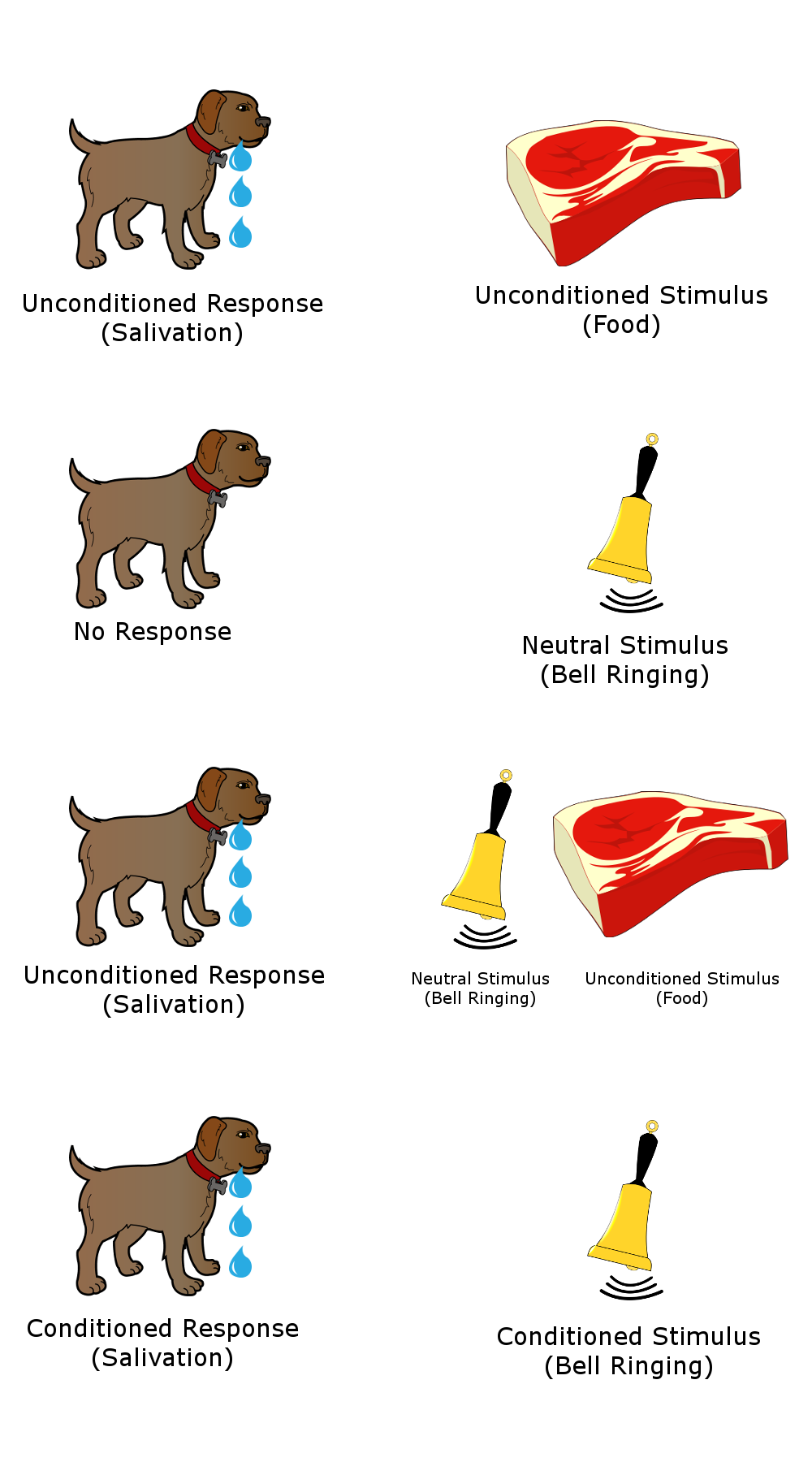
Image Source: Wikimedia Commons (2016). Classical Conditioning Diagram, Licensed under a creative commons licence. Available for free at: https://commons.wikimedia.org/wiki/File:Classical_Conditioning_Diagram.png (Accessed on: 17 October 2023).
Additional points
- Extinction occurs in classical conditioning when the conditioned stimulus is repeatedly presented without the unconditioned stimulus, leading to a weakening and eventual disappearance of the conditioned response over time. In the example of Pavlov’s dogs, if the bell were repeatedly presented without food, the dogs would eventually stop salivating in response.
- Spontaneous recovery can occur after extinction if the unconditioned stimulus and conditioned stimulus are again paired together, leading to a rapid reinstatement of the conditioned response.
- Incubation occurs when the conditioned stimulus is presented again after a prolonged absence, resulting in a heightened response. For example, the incubation of fear can result in a delayed presentation of symptoms in PTSD.
- Counterconditioning is where the conditioned stimulus is paired with an alternative stimulus that induces an opposite effect. This technique can be used in the treatment of phobias. For example, a child who is afraid of spiders is presented with a pleasing stimulus, such as a chocolate bar alongside the spider.
- Higher order conditioning describes the process whereby a second (and third, fourth, etc.) neutral stimulus is paired with the conditioned stimulus, leading to each new stimulus also being conditioned. For example, Pavlov tested this by shining a light before ringing the bell and found that eventually, the dogs would salivate in response to the light alone.
- Stimulus preparedness refers to the way in which certain stimuli are naturally more easily conditioned than others. For example, this is why we are more likely to develop phobias to snakes and spiders than to flowers.
Little Albert
‘Little Albert’ was a 9 month old boy involved in a series of experiments conducted by Watson & Raynor in 1919-1920. These experiments demonstrate the role that classical conditioning plays in the development of fear in humans.
At the beginning of the study, Albert’s response to various neutral stimuli (including a rat, a rabbit and a monkey) was tested, with Albert seen to show no significant response to any of the stimuli. It was, however, noted that Albert was startled by loud noises (an unconditioned stimuli), which led him to burst into tears (an unconditioned response).
In the next stage of the experiment, a rat was presented to Albert, and seconds later, a hammer was struck on steel to create a loud noise. With repeated exposures (conditioning) over several weeks, Albert was soon observed to demonstrate a fear response to the rat alone, in isolation from the loud noise.
Through repeated pairings with an unconditioned stimulus (a loud noise), the rat, once a neutral stimulus, has become a conditioned stimulus, evoking a conditioned fear response. This demonstrates how phobias can be generated through classical conditioning.
Stimulus generalisation occurs when a stimulus that is similar to (but not the same as) the conditioned stimulus evokes a response. This was seen in the Little Albert experiment, where Albert later demonstrated a fear response to stimuli such as the family dog and a fur coat due to being unable to discriminate them from the rat. The opposite of this phenomena is called stimulus discrimination.
Cue exposure therapy
Cue exposure therapy is a cognitive-behavioural technique based in classical conditioning used in the psychological treatment of substance misuse disorders. Individuals who misuse substances will associate various cues with substance misuse. In alcohol misuse, for example, cues may include being in a pub, being in the company of certain people, or the smell of alcohol.
When encountered, these cues can perpetuate and heighten the craving experienced by an individual. The idea behind CET is that repeated exposure to cues, coupled with resistance to undesirable behaviour, will reduce the intensity of craving and reduce the risk of relapse. During CET, the individual is repeatedly exposed to the identified cues until the intensity of craving reduces.
References
- Mcleod, S. (2023). Classical Conditioning: How It Works With Examples. Simply Psychology. Available online at: https://simplypsychology.org/classical-conditioning.html [Accessed Feb 2023]
- Mcleod, S. (2023). Little Albert Experiment (Watson & Rayner). Simply Psychology. Available online at: https://simplypsychology.org/little-albert.html [Accessed March 2023]
- Nickerson, C. (2023). Learned Helplessness Theory In Psychology (Seligman): Examples & Coping. Simply Psychology. Available online at: https://www.simplypsychology.org/learned-helplessness.html [Accessed March 2023]
- Pavlov, I. P. (1927). Conditioned Reflexes: an Investigation of the Physiological Activity of the Cerebral Cortex. Oxford Univ. Press.
- Rehman I., Mahabadi N., Sanvictores T. et al. Classical Conditioning. (2022). StatPearls. Treasure Island.
- Rosenber, H. (2002). Controlled Drinking. Encyclopaedia of Psychotherapy. 533-544.
- Seligman, M.E.P., Maier, S. (1967) Failure to Escape Traumatic Shock. Journal of Experimental Psychology, 74(1): 1–9.
- Watson JB, Rayner R (1920) Conditioned Emotional Reactions. Journal of Experimental Psychology, 3(1): 1–14.
Complete Guide to Clinical Genetics ST3 Application and Recruitment (2027)
Written by Medibuddy. Last updated: October 2026. Clinical Genetics is

Complete Guide to Clinical Radiology ST3 Application and Recruitment (2027)
Recruitment paused: NHS England is not running Clinical Radiology ST3+ recru

Complete Guide to Paediatric Surgery ST3 Application and Recruitment in United Kingdom (2026)
Written by Medibuddy. Last updated: October 2026. If you’re planning


Take your subscriptions with you
Our mobile app allows you to access your interview and exam question banks wherever you are.

