


 Close
Close
 24th October 2023
Operant Conditioning
Operant conditioning is a theory of learning associated with B.F. Skinner. Skinner felt that the complexities of human behaviour could not be adequately explained by classical conditioning. He theorised that the consequences of a behaviour influence its repetition, resulting in either the reinforcement or reduction of a particular behaviour.
Skinner’s work was influenced by Thorndike’s Law of Effect, which states that a behaviour associated with positive consequences will be repeated, whereas a behaviour associated with negative consequences is less likely to be repeated. Thorndike demonstrated this by placing cats in enclosures and rewarding them with food when they pressed a lever, allowing them to escape the box. After receiving food as a reward, the cat would be placed back in the box. Thorndike noticed that the cats became quicker at pressing the lever with each trial due to the reward of food reinforcing their behaviour of pressing the lever.
Reinforcement
Reinforcement is when a behaviour is associated with a consequence that makes the subject more likely to repeat the behaviour. Reinforcement can be positive or negative.
Positive reinforcement is when a behaviour is reinforced through association with a pleasant stimulus. For example, when a child is rewarded with an ice cream for doing homework.
Negative reinforcement is where a behaviour is reinforced through association with the withdrawal of an unpleasant stimulus. For example, when a person with a headache takes paracetamol, it leads to relief from the headache. This is also known as escape conditioning; the behaviour is completed in order to end an unpleasant stimulus.
Avoidance conditioning is a type of negative reinforcement where a behaviour is performed in order to avoid an unpleasant stimulus occurring in the first place; the expectation of a particular stimulus results in avoidance behaviour. For example, if an electric shock is given to a rat each time they hear a bell ring, they will learn to move to a different part of the cage when they hear the bell.
Reinforcers can be primary or secondary:
- Primary reinforcers, for example, food and water, satisfy an innate need.
- Secondary reinforcers are not directly associated with an innate need. However, they are rewarded through their association with a primary reinforcer. A common example is money; not rewarding on its own but rewarding through the things that are gained with it.
Punishment
Punishment is when a behaviour is associated with a consequence that makes the subject less likely to repeat the behaviour – the behaviour is said to be weakened. Punishment can be positive or negative:
- Positive punishment is when a behaviour results in an unpleasant stimulus, leading to a reduction in the frequency of that behaviour. For example, when a person receives a fine for speeding. This principle is used in aversion therapy, where the aim is to reduce the frequency of a harmful behaviour – for example, the use of disulfiram for alcohol misuse. Disulfiram causes an unpleasant physical reaction when alcohol is consumed, thus reducing the frequency of a person’s alcohol consumption.
- Negative punishment is when a behaviour results in the withdrawal of a pleasant stimulus, also leading to a reduction in the frequency of the behaviour. For example, when a child has their video games taken off them for bad behaviour.
Skinner box
As part of his research into operant conditioning, Skinner conducted an experiment whereby animals (rats or pigeons) were placed in a chamber (‘Skinner box’), within which he would study the effect of reinforcement and punishment on certain behaviours.
Typically, within a Skinner box, there would be a lever, which, when pressed or pecked by the animal, would release a food pellet as a reward. The release of a food pellet produces positive reinforcement, with the animal being more likely to repeat the behaviour of pressing the lever. Alternatively, the floor of the box would be electrified, and only by pressing a lever would the animal be able to turn off the electric current. This is an example of negative reinforcement.
Another feature of the Skinner box tested the concept of punishment. In this experiment, on pressing a lever, the rat would receive an electric shock, making them less likely to press the lever again. This demonstrates the effects of positive punishment. Negative punishment was administered whereby food pellets would be given at regular intervals, then withheld when the rat pressed a lever. Both positive and negative punishment led to a reduction in the frequency of behaviour (pressing the lever).
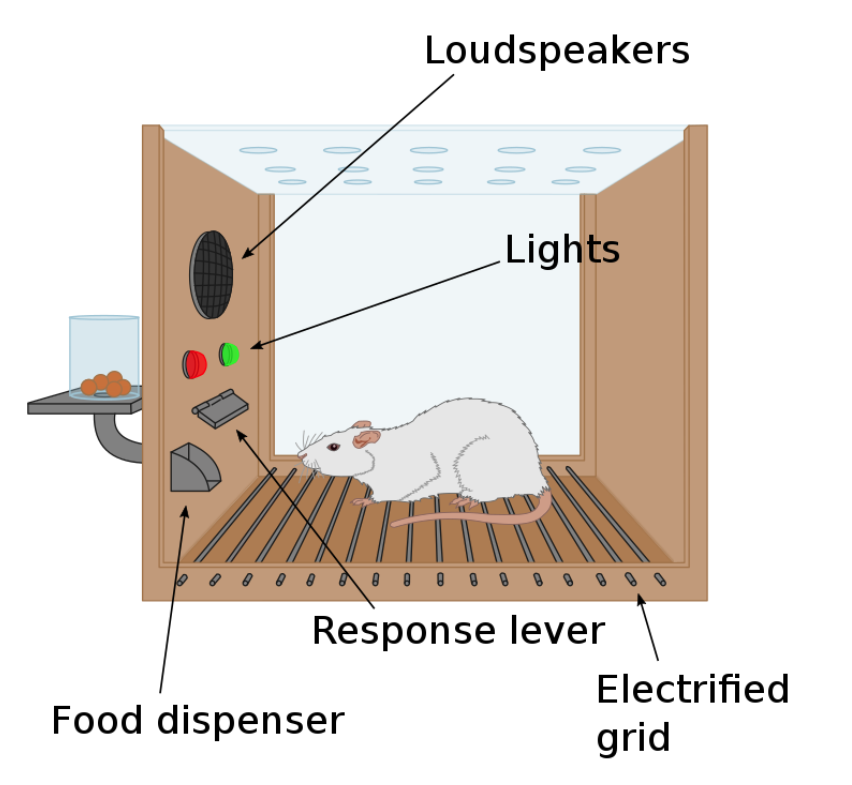
Image Source: Wikimedia Commons (2021). Skinner box scheme 01, Licensed under a creative commons licence. Available for free at: https://commons.wikimedia.org/wiki/File:Skinner_box_scheme_01.svg (Accessed on: 17 October 2023).
Reinforcement Schedules
As part of his behavioural experiments, Skinner also explored whether the way in which reinforcement is delivered would affect the strength of the resulting behaviour. Reinforcement schedules define which behaviours will be reinforced and when; these can be broadly divided into continuous and partial schedules.
Continuous schedules involve a reward produced in response to every instance of a desired behaviour (e.g., every time the rat presses the lever, it receives a food pellet). This type of schedule is learned quickly. However, it is also unlearned quickly and has the fastest extinction rate of all reinforcement schedules.
Partial schedules do not produce rewards for every instance of a desired behaviour. They are learned more slowly. However, they are more resistant to extinction. Partial schedules are subdivided as follows:
- Fixed interval schedule – Reinforcement is given after a fixed time period, regardless of the number of instances of the desired behaviour (so long as the behaviour has been performed at least once). E.g., the rat receives a food pellet every 5 minutes. Another example is being paid x amount of money per hour spent at work.
- Variable interval schedule – Reinforcement is given after at random, unpredictable time intervals; for example, in the Skinner box, a rat may receive a food pellet after 5 minutes initially, then after 3 minutes, then 15 minutes.
- Fixed ratio schedule – Reinforcement coincides with every nth incidence of desired behaviour, e.g., a food pellet is produced after every 5th press of the lever. Another example would be an individual being paid at work in a factory for every x number of items produced.
- Variable ratio schedule – Reinforcement is produced in response to a variable and unpredictable number of repetitions of the desired behaviour. This schedule is seen in gambling, e.g., a slot machine produces money after playing a random number of times. Variable ratio reinforcement produces behaviour that is very resistant to extinction, hence why gambling can be so addictive.
Shaping and chaining
Shaping refers to the way in which a more complex behaviour is reinforced by rewarding progressively closer approximations to the desired behaviour. For example, when a child learns to walk, praise is given to them first for crawling, then trying to stand, then finally walking.
Chaining is where complex tasks are broken down into steps, and each step in a sequence is rewarded until the desired behaviour is performed in full. For example, when teaching a child to make a cake, they are rewarded for adding the ingredients together, then for putting the batter in the oven, for taking the cake out of the oven, and finally for icing the cake.
Shaping and chaining are techniques that, as in the above examples, can be utilised in helping children to learn new skills and complex behaviours.
Covert conditioning
Covert conditioning refers to behavioural techniques in which behaviours are paired with mental images in order to either reinforce or reduce them.
In covert sensitisation, undesirable behaviour is imagined and paired with unpleasant mental imagery to try and reduce the frequency of said behaviour. For example, a smoker trying to quit may be asked to imagine themselves having a cigarette and then imagine receiving an electric shock.
In covert reinforcement, a desired behaviour is reinforced by asking the subject to imagine performing said behaviour, along with imagining a pleasant consequence.
Premack’s principle
Premack’s principle states that a desired low frequency behaviour can be reinforced by association with a high frequency behaviour. For example, a child can be encouraged to eat their vegetables (a desired but less probable behaviour) if their parent tells them that they can eat some chocolate afterwards (a more probable behaviour).
Learned helplessness
Learned helplessness is a theory suggested as an underlying mechanism for the development of depression, investigated by Seligman in the 1960s / 70s. Whilst looking into classical conditioning, Seligman observed that dogs subjected to unavoidable electrical shocks made no attempts to avoid or escape the unpleasant stimulus, even when there was the potential for avoidance/escape with subsequent shocks. He described this phenomenon as ‘learned helplessness’.
Seligman applied this theory to depression in humans, hypothesising that people who are repeatedly exposed to stressful life events over which they perceive they have no control become resigned to their situation and make no attempts to engage in purposeful behaviour as a result. Overall, however, it is widely agreed that the aetiology of depression is much more complex than this theory would suggest.
Phobias
The development of phobias can be explained through a combination of classical and operant conditioning. As demonstrated in Watson and Raynor’s experiment with Little Albert, a previously neutral stimulus, when associated with an unpleasant stimulus, can itself induce a fear response through classical conditioning.
If a young child is bitten by a dog, through the association of the dog (a previously neutral stimulus) with an aversive stimulus (being bitten), they may be conditioned to fear the dog itself.
This fear can then be maintained via operant conditioning: due to the association of dogs with being bitten, the child may continue to make efforts to avoid contact with dogs in order to avoid being bitten again. The anxiety and fear response that comes with being in the presence of a dog is removed through avoidance time and time again, thus negatively reinforcing the avoidance behaviour. This can lead to the maintenance of phobias in later life.
Cognitive behavioural methods are used in the treatment of phobias. Often, an anxiety hierarchy will be constructed, creating a hierarchy of anxiety-inducing situations relating to the focus of the phobia. In the above example, this might range from looking at a photograph of a dog (least anxiety) to being in a room with a dog (some anxiety) to petting a dog (most anxiety).
Systematic desensitisation involves working up the anxiety hierarchy whilst employing reciprocal inhibition at each stage (combining the phobic stimulus with a stimulus of the opposite effect, resulting in relaxation) until the most fear-inducing situation is reached.
Flooding is a technique that has been used in the treatment of phobias, in which the feared stimulus is presented directly and endured for an extended amount of time until the associated anxiety disappears. This, however, can be a very distressing experience for the subject. Implosion is a similar technique. However, it uses mental imagery in replacement of the feared stimulus itself.
Current CBT methods typically use a technique called graded exposure, based on the concept of habituation – whereby repeated exposure to a stimulus (working up the anxiety hierarchy) results in a reduction in the behavioural response. This method is similar to systematic desensitisation but does not involve the concurrent use of relaxation techniques.
References
- Mcleod, S. (2023). Operant Conditioning: What It Is, How It Works, And Examples. Simply Psychology. Available online at: https://simplypsychology.org/operant-conditioning.html [Accessed Feb 2023]
- Nickerson, C. (2023). Skinner Box: What Is An Operant Conditioning Chamber? Simply Psychology. Available online at: https://simplypsychology.org/what-is-a-skinner-box.html [Accessed March 2023]
- Skinner, B. F. (1938). The Behavior of Organisms: an Experimental Analysis. Appleton-Century.
- Thorndike, E. L. (1911). Animal Intelligence: Experimental Studies. Macmillan Press.
Complete Guide to Clinical Genetics ST3 Application and Recruitment (2027)
Written by Medibuddy. Last updated: October 2026. Clinical Genetics is

Complete Guide to Clinical Radiology ST3 Application and Recruitment (2027)
Recruitment paused: NHS England is not running Clinical Radiology ST3+ recru

Complete Guide to Paediatric Surgery ST3 Application and Recruitment in United Kingdom (2026)
Written by Medibuddy. Last updated: October 2026. If you’re planning


Take your subscriptions with you
Our mobile app allows you to access your interview and exam question banks wherever you are.

