


 Close
Close
 24th October 2023
Social Learning Theory
Social learning theory, hypothesised by Albert Bandura, is influenced by both Behaviourism and Cognitive Learning Theory. Whilst Bandura acknowledged the role of environmental factors in influencing behaviour, he also believed that cognitive factors played an important role.
Bobo Doll experiment
Bandura demonstrated observational learning through his Bobo Doll experiments in the 1960s. Bandura selected a group of 72 children aged between 3-6 years for the study.
In the first stage of the experiment, the children were split into three groups. The first group were asked to observe an adult model interacting with a bobo doll (a person sized inflatable toy doll). The model demonstrated aggressive behaviour towards the doll, attacking it both verbally and physically. The second group also observed an adult model in the room with the bobo doll; however, this time, the model mostly ignored the doll, behaving in a calm manner with no aggressive outbursts. A control group was also included, who were not exposed to a model at all.
In the second stage of the experiment, the children were subjected to ‘aggression arousal’. They were taken into a room full of toys, which they were told that they couldn’t play with, as they had been reserved for other children.
In the final stage, the children were taken into a second room containing toys, which they were informed they were allowed to play with. The toys ranged from neutral to aggressive in nature (for example, crayons and plastic animals vs. a toy gun and a bobo doll). The child was then observed in the room for a 20 minute period.
The main finding of the bobo doll experiment was that the children who had observed aggressive behaviour from the models initially were more likely to engage in aggressive behaviour themselves when left in the room with the bobo doll, compared to the non-aggressive and control groups.
In later experiments, Bandura found that children were more likely to imitate aggressive behaviour if they observed this to be associated with a reward, and they were less likely to do so when they observed that the behaviour resulted in punishment. This is known as vicarious reinforcement.
The results of Bandura’s experiment gave weight to his theory that human behaviour (in this case, aggression) can be learned through observation and imitation. This can be extrapolated to explain how children are influenced by the actions of individuals they are exposed to in society, for example, their family and peer groups.
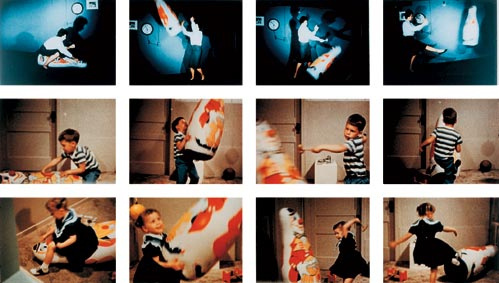
Image Source: Wikimedia Commons (2016). Bobo Doll Deneyi, Licensed under a creative commons licence. Available for free at: https://commons.wikimedia.org/wiki/File:Bobo_Doll_Deneyi.jpg (Accessed on: 17 October 2023).
Mediational processes
Social learning theory states that observational learning is mediated by cognitive processes, making it more complex than the behaviouralist approach. These processes reflect the individual weighing up the consequences of performing a behaviour and deciding whether the behaviour should be imitated or not.
Bandura identified four mediational processes that must occur for a behaviour to be imitated:
- Attention – An observed behaviour has to hold the individual’s attention.
- Retention – A behaviour can only be imitated if it is retained in memory.
- Reproduction – Refers to a person’s assessment of whether they would be physically able to imitate an observed behaviour.
- Motivation – The overall assessment of the risks versus benefits of performing a behaviour.
References
- Bandura, A., & Walters, R.H. (1963). Social Learning and Personality Development. Holt Rinehart and Winston: New York.
- Mcleod, S. (2023). Albert Bandura’s Social Learning Theory. Simply Psychology. Available online at: https://simplypsychology.org/bandura.html [Accessed March 2023]
- Mcleod, S. (2023). Bandura’s Bobo Doll Experiment On Social Learning. Simply Psychology. Available online at: https://simplypsychology.org/bobo-doll.html [Accessed March 2023]
Complete Guide to Clinical Genetics ST3 Application and Recruitment (2027)
Written by Medibuddy. Last updated: October 2026. Clinical Genetics is

Complete Guide to Clinical Radiology ST3 Application and Recruitment (2027)
Recruitment paused: NHS England is not running Clinical Radiology ST3+ recru

Complete Guide to Paediatric Surgery ST3 Application and Recruitment in United Kingdom (2026)
Written by Medibuddy. Last updated: October 2026. If you’re planning


Take your subscriptions with you
Our mobile app allows you to access your interview and exam question banks wherever you are.

