


 Close
Close
 30th October 2023
Life Events and Family
Expressed Emotion
What is expressed emotion?
Expressed emotion means the level of spontaneous comment about and reaction to a patient from their family in relation to their mental or physical health condition. First developed by George Brown and his colleagues in the second half of the 20th century, the concept is based on five principles (Myung and Furrow, 2019):
| Emotional overinvolvement | One or multiple family members behaving in a way that demonstrates increased care behaviours beyond what would be usual for the needs and developmental stage of that patient. For example, interfering where unnecessary, overprotectiveness and self-sacrifice. |
| Critical comments | Negatively toned remarks about a patient. They are deemed critical even if the family member believes they are being helpful, such as pointing out something they do not believe a patient has noticed. Factual statements become critical comments if they are intended as a complaint or negative judgment. |
| Hostility | Attitudes and behaviours towards a patient that demonstrate that a family member may have beliefs that a patient is lazy or selfish or choosing to act in the way that they do. There is a lack of understanding of how a patient’s condition may be affecting them in a way that is beyond their control. This can evolve into blame placed on the patient for problems in the wider family. |
| Positive remarks | Comments that are supportive of the patient and demonstrate an understanding of their condition and how it may affect them. Also, comments that give the patient an offer of help in a non-pressured way. |
| Warmth | A demonstration of care and compassion towards the patient. Family members show empathy and understanding through their behaviour. |
Levels of expressed emotion are culturally dependent. As an example, what is seen as emotional overinvolvement in one culture may be seen as completely normal in another culture. To have less involvement in that culture may actually be seen as a lack of care and concern. Therefore, cultural norms must be taken into account when assessing the level of expressed emotion (Bhugra and McKenzie, 2003).
Measures of expressed emotion
There are many different ways of determining the level of expressed emotion within a family. We have discussed a few of them below. An important thing to remember is that most of the methods require deep knowledge and understanding of how to interpret interviews and are complex in how they come to their conclusions. These summaries give a flavour of the methods used, but they are not in-depth representations of them.
Camberwell family interview (CFI)
This is the most commonly used tool for measuring expressed emotion. It was first developed as a way of assessing ‘emotional involvement’ when Brown and colleagues were studying the effect of a patient’s family environment on the likelihood of relapse in schizophrenia patients. The interview schedule focuses on the circumstances of the family home in the three months before admission for a relapse. Information is gathered on how the current relapse has affected family life, including arguments, contributions around the house and interactions between family members and the patient. It also looks at the patient’s feelings towards their family by assessing the emotional quality of speech and the content of the comments made.
When the CFI was developed in 1972, interviews were undertaken with 80 psychiatric patients and their spouses. Each patient and spouse were given separate interviews, followed by a short interview together. 30 additional families were then interviewed to assess the reliability and validity of the interviews. Emotions were given ratings on two scales. These were observed emotions, and several remarks, positive or negative, were made about a family member by the interviewee. The development of this tool allowed an index of expressed emotion to be created.
This was felt to be a reliable measure of expressed emotion. However, interviews could last up to five hours and would need to be recorded for coding later. This could be challenging for patients and their families, as well as requiring many researcher hours. As a result, in 1976, Vaughn and Leff set about to reduce the time needed to conduct the interview by around half without compromising on reliability or validity. They found that by prioritising certain topics, all areas of criticism and emotion that the interviewee had were covered without needing the full interview.
In practice, the CFI is still a lengthy process and requires significant interviewer training. Therefore, alternative tools for assessing expressed emotion have been developed (Vaughn and Leff, 1976).
Five minute speech sample (FMSS)
As the name suggests, this method of assessing expressed emotion is much quicker. It was developed in 1969 by Gottschalk and Gleser. An important family member is asked to talk about the patient for five minutes. The only direction they are given is to talk about what they think about the patient and how they get along with them. The interviewer does not interrupt in this time.
The interpreter of the interview then uses the following scales to assess the level of expressed emotion:
- Quality of the initial statement.
- Quality of the relationship.
- Criticism.
- Emotional overinvolvement.
Definitions of high expressed emotion statements are then split into critical or emotional overinvolvement. The definition of critical high expressed emotion is making one or more critical comments in the statement or if the first sentence of the statement is negative. Emotionally overinvolved high expressed emotion is noted if there is self-sacrificing behaviour or emotions are obviously displayed during the interview. Emotional overinvolvement can also be detected if there are two of the following characteristics: excessive past details, positive remarks totalling more than five, or a statement of feelings about the patient.
The FMSS gives similar results to the CFI when it detects highly expressed emotion. Families with high expressed emotion in the FMSS are also highly likely to have high expressed emotion on the CFI. However, more borderline cases of expressed emotion are under-detected on FMSS when compared with CFI (van Humbeeck et al., 2002).
Level of expressed emotion scale (LEE)
In 1988, Cole and Kazarian set out to create a questionnaire for the measurement of expressed emotion. This would serve the purpose of eliminating the need for an interviewer and someone to code the interview transcript. Using the CFI as a basis, they established four domains for the questionnaire items. These were:
- Intrusiveness.
- Emotional response.
- Attitude towards illness.
- Tolerance and expectations.
The questionnaire is given to the patient only. The final version of the scale contains 60 items, 15 in each domain, each with a true or false response. As this is a self-report questionnaire for the patient, family member perspective is not recorded. This may mean that factors such as the patient’s own expressed emotion levels and previous feelings towards family members before illness onset may skew the results. In addition, thoughts and feelings of the family members that patients may not have been consciously aware of may not come to light. These feelings are still important in assessing the level of expressed emotion (Cole and Kazarian, 1988).
Impact of highly expressed emotion
The concept of expressed emotion in families was first conceived in the context of schizophrenia after Brown and colleagues noticed that inpatients who were discharged back to the same family environment as before were more likely to relapse than if they went to a new home, such as to different family members. From there, research showed that highly expressed emotion was an important predictor for relapse in schizophrenia.
Since this pioneering research, a similar link has been proposed for other psychological conditions such as depression, eating disorders and post-traumatic stress disorder, although the link has not been quite so well established yet.
Work has been done to reduce the levels of expressed emotion within families to try and reduce rates of relapse. A bonus effect of this would be to help with mental health of caregivers, reducing carer burnout. Many studies have shown that self-help interventions, group therapy and educational strategies can all help to improve outcomes for patients and their families, reducing expressed emotion and reducing relapse (Amaresha and Venkatasubramanian, 2012).
Many of these studies are from the 80s and 90s and often use traditional family models in Western cultures to establish the possibility and impact of reducing expressed emotion. Further studies are needed to assess the impact on other types of families, as well as other cultures, although these are starting to happen.
Studies have also evaluated the impact of healthcare staff expressed emotion on patients. Whilst staff tend to have less expressed emotion than families, there is still some present. This tends to mostly take the form of critical comments, with hostility and emotional overinvolvement being seen less often. Two theories for a difference in expressed emotion between staff and families is that staff have less emotional connection to patients and often have professional coping strategies and training to reduce expressed emotion. Perhaps unsurprisingly, research seems to show that staff expressed emotion has less of an effect on patients than family expressed emotion. The presence or absence of a positive relationship between staff and patient seems to be more important than the level of expressed emotion (Berry, Barrowclough and Haddock, 2011).
References
- Amaresha, A.C. and Venkatasubramanian, G. (2012) ‘Expressed emotion in schizophrenia: an overview’, Indian journal of psychological medicine, 34(1), pp. 12–20.
- Berry, K., Barrowclough, C. and Haddock, G. (2011) ‘The role of expressed emotion in relationships between psychiatric staff and people with a diagnosis of psychosis: a review of the literature’, Schizophrenia bulletin. 37(5), pp. 958–972.
- Bhugra, D. and McKenzie, K. (2003) ‘Expressed emotion across cultures’, Advances in Psychiatric Treatment. 9(5), pp. 342–348.
- Cole, J.D. and Kazarian, S.S. (1988) ‘The level of expressed emotion scale: A new measure of expressed emotion’, Journal of Clinical Psychology, 44(3), pp. 392–397.
- van Humbeeck, G. et al. (2002) ‘Expressed emotion: A review of assessment instruments’, Clinical Psychology Review, 22(3), pp. 321–341.
- Myung, H.S. and Furrow, J.L. (2019) ‘Expressed Emotion in Families’, in J.L. Lebow, A.L. Chambers, and D.C. Breunlin (eds) Encyclopedia of Couple and Family Therapy. Cham: Springer International Publishing, pp. 980–985.
- Vaughn, C. and Leff, J. (1976) ‘The Measurement of Expressed Emotion in the Families of Psychiatric Patients’, British Journal of Social and Clinical Psychology, 15(2), pp. 157–165.
Bereavement
Bereavement and grief are experienced by almost everyone at some point in their lives. It is a complicated life experience that can lead to a variety of emotions and psychological processes. Everyone experiences grief in a different way, and therefore, normal and complicated grief reactions can be difficult to differentiate.
Definitions
Bereavement usually means when someone loses a loved one or other important person through death. However, bereavement could also be used to describe the loss of something else. For example, loss of independence after illness or injury or loss of material items, such as when a house is destroyed through fire or flood. Bereavement is inherently a negative experience, but positives can be found in it, such as when a loved one is no longer suffering.
Grief is the emotional reaction to bereavement. There are many different types and intensities of grief. They will vary according to culture, nature of the relationship, age of the bereaved person, the type of death itself and the personality and coping mechanisms of the bereaved person. For this reason, one person’s grief reaction may seem abnormal to someone else. It is also difficult to predict how one person will react to a bereavement or even to know how you yourself will react until it happens.
Mourning is sometimes used for the same meaning as grief. However, Stroebe et al. define it as the societal norms that are followed following a death. This obviously varies by culture and religion and changes over time. Mourning practices can help a person process their grief and find comfort, but they can also cause additional stress and interference if the person is not able to grieve in the way they naturally would (Stroebe et al., 2008).
Theories of grief
Mourning and melancholia
In 1917, Sigmund Freud described his theory of grief, contributing to the psychoanalytic model. He proposed that there were two responses to bereavement. These were mourning and melancholia.
Mourning was described as an external feeling of pain related to loss. The change to a person’s life caused by loss creates a hopelessness and disorientation that is felt through the reaction to the world around them. In time, a person adjusts to the new world that is now their life, and they become able to move on with acceptance that although their world is different now, they can still be part of it in a positive way.
Melancholia is felt as an internal pain. The pain becomes so intense that the mind must push it to an unconscious level. This unconsciousness is what Freud believed was the emotions and thoughts that are repressed due to their difficult nature but still cause pain to the sufferer, even if they are not actively aware of it. In the melancholia reaction to grief, the pain cannot be processed by the conscious mind due to it being buried in the unconsciousness, and so the sufferer’s grief is prolonged. Melancholia can lead to a depression in time that does not seem to be directly related to bereavement but has been triggered by escalating internalised feelings (Freud, 1917).
Critics of Freud’s theory point out that there is little allowance for cultural, societal and spiritual variations in how people mourn. There is also criticism that Freud views the lost person as an object rather than a fellow person that has their own impact on how grief will be experienced by the sufferer (Hagman, 1995).
Five stages of grief
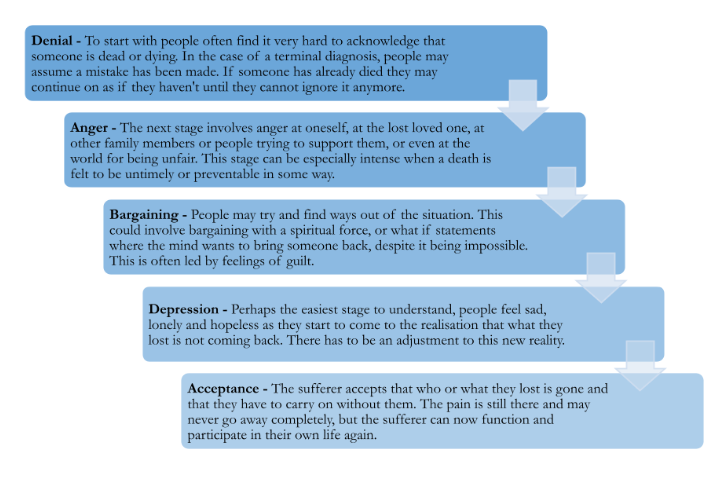
In her 1969 study Death and Dying, Elisabeth Kübler-Ross came up with the five stages of grief. These are well known, and you’ve probably heard of them before. They are denial, anger, bargaining, depression and acceptance. The stages are explained in more detail below. Although they are depicted as a linear sequence, Kübler-Ross says that they should not be viewed as a linear path. They can be experienced in a different order, or people can move back and forth between stages before eventually, hopefully, reaching acceptance (Kübler-Ross, 1970).
Kubler-Ross’s theory was based on interviews conducted with terminally ill patients. She sought to help dying patients process their fears of dying to help them pass with more dignity and peace.
Criticism of this theory is mainly rooted in the fact that there is a misconception that these stages should be followed in order and for limited time periods each. However, the process is, in fact, nowhere near as organised, and there can be overlap between stages, stages followed in a different order, or, indeed, stages missed altogether. This makes it difficult to use this model to identify people at risk of abnormal grief. It can also make bereaved people believe they are somehow ‘doing grief wrong’ if they do not follow the stages due to how well known the theory is amongst lay people (Stroebe, Schut and Boerner, 2017).
Anticipatory grief
Anticipatory grief is adapting to a loss before it has occurred, for example, in the case of terminal illness, where it is known that death will occur at some point in the near future. It was described by C. Knight Aldrich in 1974 as being potentially helpful in post-death grief reactions, as some adaptation can occur before the death does. Other authors have since agreed with this. For example, Stroebe and Stroebe in 1993 found that there is increased post-death severity of grief if there is no anticipatory period. However, some studies have found that an anticipatory period does not improve the experience of grief after death.
There are many different factors involved that can influence the positive or negative effects of anticipatory grief. For example, the nature and duration of the final illness, the coping styles of both the dying and the bereaved and the degree to which the dying and bereaved prepare for the death together. This preparation can be to allay the dying person’s fears of death and to help the bereaved get ready for a future without their loved one (Fan, 2020).
There are many different theories of grief and bereavement that cannot all be covered here. There is also much debate as to the correct theories and how they can be used therapeutically to help people who are experiencing a loss.
Complicated grief
The ICD-11 defines prolonged grief disorder as ‘a persistent and pervasive grief response characterised by longing for the deceased or persistent preoccupation with the deceased accompanied by intense emotional pain’ for at least six months. The grief reaction must be extreme when compared to social and cultural norms for that person. There must be a significant impairment in functioning for that person (World Health Organisation, 2019).
The ICD-11 specified that children and adolescents may experience grief differently, and therefore, caution should be taken when diagnosing prolonged grief disorder. For example, children are less likely to vocalise a specific longing for their lost loved one and may show it through play instead. They may also develop separation anxiety, fear of the death of someone else or general misunderstanding that the dead person is not coming back. In children, pain from a loss may also only be shown periodically, and therefore, it may seem that they are coping better than they actually are. In addition, the loss of a primary caregiver may lead to increased severity of grief and also manifest itself later in life. For example, when there is a need that could be fulfilled by a parent who is no longer there (World Health Organisation, 2019).
Other types of complicated grief include absent or delayed grief. There can appear to be no symptoms of grief or difficulty in functioning. In extreme cases, someone may present with a delusion that their loved one has not died at all and is in hiding or absent for another reason. Again, absent or delayed grief should be interpreted with caution as there may be other reasons for someone not to appear to be displaying a significant grief reaction, such as a very stoic personality or the relationship between the deceased and the bereaved not being what it seemed to people on the outside.
Risk factors for developing complicated grief can include the death of someone very close, such as a child or spouse, a violent or very sudden death, and existing maladaptive coping strategies to trauma. Diagnosing complicated grief is difficult. There is a risk of stigmatising people for experiencing grief in a highly emotional way when there may not actually be a pathological nature to their grief. On the other hand, there is evidence that some people find comfort in giving their intense grief a name and realising that what they are suffering, whilst pathological, is not unique to them, and others experience it too.
Antidepressants have been studied as a treatment for complicated grief. However, evidence is very limited for their use. There are studies that show that some types of antidepressants can help with the depressive symptoms of complicated grief but that they are not useful for the feelings of longing and loneliness caused by grief. On the other hand, cognitive behavioural therapies specifically for complicated grief have been shown to be effective (Nakajima, 2018).
References
- Fan, G. (2020) ‘Anticipatory Grief’, in D. Gu and M.E. Dupre (eds) Encyclopedia of Gerontology and Population Aging. Cham: Springer International Publishing, pp. 1–4.
- Freud, S. (1917) ‘Mourning and Melancholia’, in The standard Edition of the Complete Psychological Works of Sigmund Freud, Volume XIV (1914-1916): On the History of the Psycho-Analytic Movement, Papers on Metapsychology and Other Works, pp. 237–258
- Hagman, G (1995) ‘Mourning: a review and reconsideration’, The International Journal of Psycho-analysis, 76(5), pp. 909-925.
- Kübler-Ross, E. (1970) On death and dying. New York, Collier
- Nakajima, S. (2018) ‘Complicated grief: recent developments in diagnostic criteria and treatment’, Philosophical Transactions of the Royal Society B: Biological Sciences, 373(1754)
- Stroebe, M., Schut, H. and Boerner, K. (2017) ‘Cautioning Health-Care Professionals: Bereaved Persons Are Misguided Through the Stages of Grief’, OMEGA – Journal of Death and Dying, 74(4), pp. 455–473.
- Stroebe, M.S. et al. (2008) ‘Bereavement research: Contemporary perspectives.’, in Handbook of bereavement research and practice: Advances in theory and intervention. Washington, DC, American Psychological Association, pp. 3–25.
- World Health Organisation (2019) ‘6B42 Prolonged grief disorder’, in International statistical classification of diseases and related health problems. 11th edn.
Family
Family structure
One of the most important factors to consider for any patient is their family and the positive and negative impact of that family unit. The traditional ‘nuclear family’ is less common than it used to be, with many more families consisting of stepparents, unmarried cohabitating parents and single parents, as well as stepsiblings, half-siblings and foster siblings. While this in itself is not a bad thing, it may lead to additional considerations when assessing family dynamics.
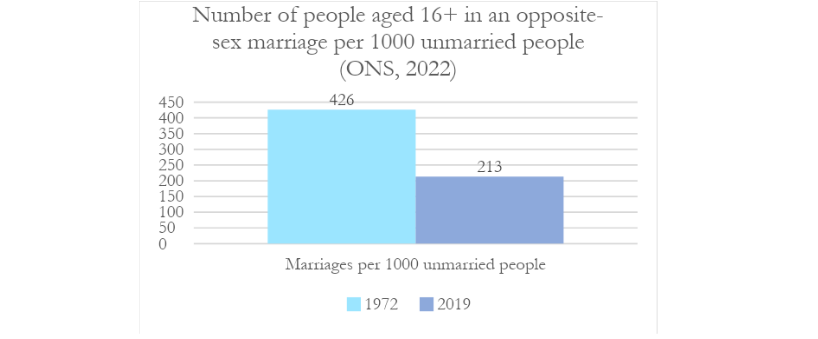
There has been a lot of research about the benefits of a childhood spent in a family where the biological parents are married. There has been evidence that these families tend to be less at risk of poverty and have increased well-being. However, there is also evidence that those from higher income backgrounds are more likely to be married before having children, and so the causal relationship must be questioned. Much of the research comes from a time when marriage was seen as the right path, and having children outside of marriage was stigmatised. The debate on the importance of marriage is ongoing, but it seems that this will be seen as less crucial as time passes (Brown, 2010).
In the case of divorce, there is, again, a lot of research. As one in four or five marriages end in divorce in Western countries, this is an important area of study. When parents separate, a child’s entire life can become uprooted. They will see one or both parents less than they used to, may have to move house or school, or may have to get used to living in two different houses. Their basic identity of being part of a particular family can shift as the dynamics of that family changes. Children can also be traumatised by arguments in the home, develop feelings of guilt if they blame themselves for the split, and can be affected by financial pressures of the divorce (Oren and Hadomi, 2020).
Most children will eventually adapt to their new family situation, and wellbeing consequences resolve after around two years. However, there can still be long term consequences. From a logistical point of view, changes in living arrangements might lead to changes to educational provision. This could lead to changes in academic achievement and even career prospects. There has even been research that suggests that children of divorced parents that do not communicate well with each other are more at risk of poor health, even into adulthood. Another long term consideration is that parents may seek to blame each other for the failure of the relationship. Older children and adults may cut off ties to a parent for a fault that the other parent has led them to believe, which may or may not be justified (Oren and Hadomi, 2020).
On the other hand, sometimes a family split is, in fact, beneficial if it reduces conflict and increases a child’s feeling of safety in the family. Some children in therapy after a divorce describe the divorce as creating a sense of relief that day to day animosity is reduced.
The consequences of divorce on parents must also be recognised. In heterosexual couples, divorce has long been recognised to have worse economic consequences for women than men. This was seen as a reason for an increase in divorce in the 70s and 80s, as women were more likely to be able to leave their spouse and be financially independent due to increased employment rates. From the 90s onwards, this seems to be a less important predictor of divorce as women being employed is now the norm (Raley and Sweeney, 2020). Therefore, the inequality between men and women during divorce is improving, but there are still differences. For example, women are more likely to win custody battles than men, but men are still less likely to experience financial hardship after divorce (Leopold, 2018).
The literature also recognises that the emotional strain of divorce will be different if you are the person who has made the decision to get divorced or if your partner is the one who has made that declaration. Similarly, a divorce that ends with an argument and attempts to ‘win’ the divorce is going to be more painful than a divorce that has ended with a mutual agreement that the relationship has come to its natural end. In these divorces, decisions are made more likely to be made with consideration for both parties (Oren and Hadomi, 2020).
Parenting styles
In Diana Baumrind’s 1991 article, she set out four parenting styles. These in themselves were based on the two categories of parental behaviour developed by Maccoby and Martin in 1983: demandingness and responsiveness.
Demandingness is defined as the amount of control a parent exerts over a child and the expectation to behave a certain way. Responsiveness is how much a parent can empathise and react compassionately to their child.
Baumrind’s parenting styles were as follows (Baumrind, 1991):
| Authoritarian | These parents set rules that they expect their children to follow and will punish their children if they feel that the expected standards are not met. They have high levels of demandingness but do not show very much responsiveness. |
| Authoritative | These parents support their children to grow into the adults that they would like them to be by setting clear expectations but also being receptive to the needs and emotions of the child. Boundaries are set, but these boundaries are explained to the child in an appropriate way. As a result, they show high levels of responsiveness and demandingness. |
| Permissive | Permissive parents believe that their children thrive when they do not have expectations placed on them. They are instead free to do as they please and create their own boundaries. These parents put the emotions of their child above all else. As such, they show high levels of responsiveness but low demandingness. |
| Uninvolved | These parents do not appear interested in what their children are doing or how they are feeling. This style can border on neglect, especially emotionally. There is little demandingness or responsiveness involved in this style. |
These different styles tend to contribute to how children grow into adults. Children with authoritative parents are likely to be more well balanced, have healthy coping styles and have clear aims for the future. On the other hand, children of authoritarian and uninvolved parents can struggle with self-esteem later in life, either due to feeling unimportant or feeling that they are never good enough. Children with permissive parents tend to have lower educational achievement and cognitive skills than children from authoritative homes (Panetta et al., 2014).
References
- Baumrind, D. (1991) ‘The Influence of Parenting Style on Adolescent Competence and Substance Use’, The Journal of Early Adolescence, 11(1), pp. 56–95.
- Brown, S.L. (2010) ‘Marriage and Child Well-Being: Research and Policy Perspectives’, Journal of marriage and the family, 72(5), pp. 1059–1077.
- Leopold, T. (2018) ‘Gender Differences in the Consequences of Divorce: A Study of Multiple Outcomes’, Demography, 55(3), pp. 769–797.
- Office of National Statistics (2022) ‘Marriages in England and Wales: 2019’, Available at: https://www.ons.gov.uk/peoplepopulationandcommunity/birthsdeathsandmarriages/marriagecohabitationandcivilpartnerships/bulletins/marriagesinenglandandwalesprovisional/2019 [Accessed: 12 Jan 2023]
- Oren, D. and Hadomi, E. (2020) ‘Let’s Talk Divorce – An Innovative Way of Dealing with the Long-Term Effects of Divorce through Parent-Child Relationships’, Journal of Divorce & Remarriage, 61(2), pp. 148–167.
- Panetta, S.M. et al. (2014) ‘Maternal and Paternal Parenting Style Patterns and Adolescent Emotional and Behavioral Outcomes’, Marriage & Family Review, 50(4), pp. 342–359.
- Raley, R. and Sweeney, M. (2020) ‘Divorce, Repartnering and Stepfamilies: A Decade in Review’, Journal of Marriage and Family, 82(1), pp. 81-99.
Complete Guide to Clinical Genetics ST3 Application and Recruitment (2027)
Written by Medibuddy. Last updated: October 2026. Clinical Genetics is

Complete Guide to Clinical Radiology ST3 Application and Recruitment (2027)
Recruitment paused: NHS England is not running Clinical Radiology ST3+ recru

Complete Guide to Paediatric Surgery ST3 Application and Recruitment in United Kingdom (2026)
Written by Medibuddy. Last updated: October 2026. If you’re planning


Take your subscriptions with you
Our mobile app allows you to access your interview and exam question banks wherever you are.

