


 Close
Close
 30th October 2023
Bereavement
Bereavement and grief are experienced by almost everyone at some point in their lives. It is a complicated life experience that can lead to a variety of emotions and psychological processes. Everyone experiences grief in a different way, and therefore, normal and complicated grief reactions can be difficult to differentiate.
Definitions
Bereavement usually means when someone loses a loved one or other important person through death. However, bereavement could also be used to describe the loss of something else. For example, loss of independence after illness or injury or loss of material items, such as when a house is destroyed through fire or flood. Bereavement is inherently a negative experience, but positives can be found in it, such as when a loved one is no longer suffering.
Grief is the emotional reaction to bereavement. There are many different types and intensities of grief. They will vary according to culture, nature of the relationship, age of the bereaved person, the type of death itself and the personality and coping mechanisms of the bereaved person. For this reason, one person’s grief reaction may seem abnormal to someone else. It is also difficult to predict how one person will react to a bereavement or even to know how you yourself will react until it happens.
Mourning is sometimes used for the same meaning as grief. However, Stroebe et al. define it as the societal norms that are followed following a death. This obviously varies by culture and religion and changes over time. Mourning practices can help a person process their grief and find comfort, but they can also cause additional stress and interference if the person is not able to grieve in the way they naturally would (Stroebe et al., 2008).
Theories of grief
Mourning and melancholia
In 1917, Sigmund Freud described his theory of grief, contributing to the psychoanalytic model. He proposed that there were two responses to bereavement. These were mourning and melancholia.
Mourning was described as an external feeling of pain related to loss. The change to a person’s life caused by loss creates a hopelessness and disorientation that is felt through the reaction to the world around them. In time, a person adjusts to the new world that is now their life, and they become able to move on with acceptance that although their world is different now, they can still be part of it in a positive way.
Melancholia is felt as an internal pain. The pain becomes so intense that the mind must push it to an unconscious level. This unconsciousness is what Freud believed was the emotions and thoughts that are repressed due to their difficult nature but still cause pain to the sufferer, even if they are not actively aware of it. In the melancholia reaction to grief, the pain cannot be processed by the conscious mind due to it being buried in the unconsciousness, and so the sufferer’s grief is prolonged. Melancholia can lead to a depression in time that does not seem to be directly related to bereavement but has been triggered by escalating internalised feelings (Freud, 1917).
Critics of Freud’s theory point out that there is little allowance for cultural, societal and spiritual variations in how people mourn. There is also criticism that Freud views the lost person as an object rather than a fellow person that has their own impact on how grief will be experienced by the sufferer (Hagman, 1995).
Five stages of grief
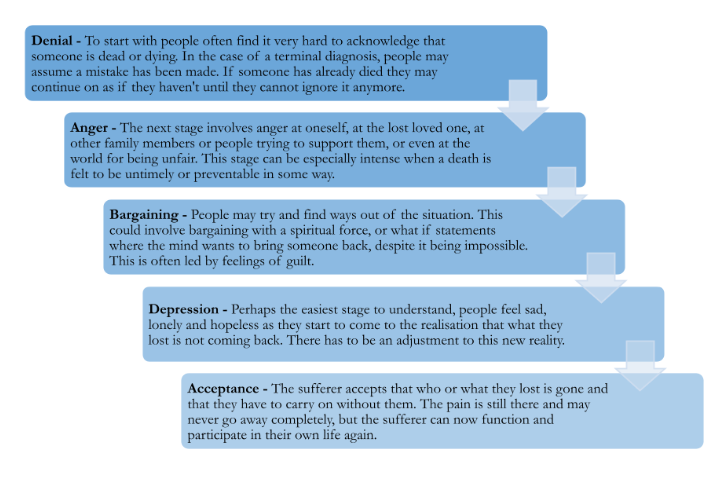
In her 1969 study Death and Dying, Elisabeth Kübler-Ross came up with the five stages of grief. These are well known, and you’ve probably heard of them before. They are denial, anger, bargaining, depression and acceptance. The stages are explained in more detail below. Although they are depicted as a linear sequence, Kübler-Ross says that they should not be viewed as a linear path. They can be experienced in a different order, or people can move back and forth between stages before eventually, hopefully, reaching acceptance (Kübler-Ross, 1970).
Kubler-Ross’s theory was based on interviews conducted with terminally ill patients. She sought to help dying patients process their fears of dying to help them pass with more dignity and peace.
Criticism of this theory is mainly rooted in the fact that there is a misconception that these stages should be followed in order and for limited time periods each. However, the process is, in fact, nowhere near as organised, and there can be overlap between stages, stages followed in a different order, or, indeed, stages missed altogether. This makes it difficult to use this model to identify people at risk of abnormal grief. It can also make bereaved people believe they are somehow ‘doing grief wrong’ if they do not follow the stages due to how well known the theory is amongst lay people (Stroebe, Schut and Boerner, 2017).
Anticipatory grief
Anticipatory grief is adapting to a loss before it has occurred, for example, in the case of terminal illness, where it is known that death will occur at some point in the near future. It was described by C. Knight Aldrich in 1974 as being potentially helpful in post-death grief reactions, as some adaptation can occur before the death does. Other authors have since agreed with this. For example, Stroebe and Stroebe in 1993 found that there is increased post-death severity of grief if there is no anticipatory period. However, some studies have found that an anticipatory period does not improve the experience of grief after death.
There are many different factors involved that can influence the positive or negative effects of anticipatory grief. For example, the nature and duration of the final illness, the coping styles of both the dying and the bereaved and the degree to which the dying and bereaved prepare for the death together. This preparation can be to allay the dying person’s fears of death and to help the bereaved get ready for a future without their loved one (Fan, 2020).
There are many different theories of grief and bereavement that cannot all be covered here. There is also much debate as to the correct theories and how they can be used therapeutically to help people who are experiencing a loss.
Complicated grief
The ICD-11 defines prolonged grief disorder as ‘a persistent and pervasive grief response characterised by longing for the deceased or persistent preoccupation with the deceased accompanied by intense emotional pain’ for at least six months. The grief reaction must be extreme when compared to social and cultural norms for that person. There must be a significant impairment in functioning for that person (World Health Organisation, 2019).
The ICD-11 specified that children and adolescents may experience grief differently, and therefore, caution should be taken when diagnosing prolonged grief disorder. For example, children are less likely to vocalise a specific longing for their lost loved one and may show it through play instead. They may also develop separation anxiety, fear of the death of someone else or general misunderstanding that the dead person is not coming back. In children, pain from a loss may also only be shown periodically, and therefore, it may seem that they are coping better than they actually are. In addition, the loss of a primary caregiver may lead to increased severity of grief and also manifest itself later in life. For example, when there is a need that could be fulfilled by a parent who is no longer there (World Health Organisation, 2019).
Other types of complicated grief include absent or delayed grief. There can appear to be no symptoms of grief or difficulty in functioning. In extreme cases, someone may present with a delusion that their loved one has not died at all and is in hiding or absent for another reason. Again, absent or delayed grief should be interpreted with caution as there may be other reasons for someone not to appear to be displaying a significant grief reaction, such as a very stoic personality or the relationship between the deceased and the bereaved not being what it seemed to people on the outside.
Risk factors for developing complicated grief can include the death of someone very close, such as a child or spouse, a violent or very sudden death, and existing maladaptive coping strategies to trauma. Diagnosing complicated grief is difficult. There is a risk of stigmatising people for experiencing grief in a highly emotional way when there may not actually be a pathological nature to their grief. On the other hand, there is evidence that some people find comfort in giving their intense grief a name and realising that what they are suffering, whilst pathological, is not unique to them, and others experience it too.
Antidepressants have been studied as a treatment for complicated grief. However, evidence is very limited for their use. There are studies that show that some types of antidepressants can help with the depressive symptoms of complicated grief but that they are not useful for the feelings of longing and loneliness caused by grief. On the other hand, cognitive behavioural therapies specifically for complicated grief have been shown to be effective (Nakajima, 2018).
References
- Fan, G. (2020) ‘Anticipatory Grief’, in D. Gu and M.E. Dupre (eds) Encyclopedia of Gerontology and Population Aging. Cham: Springer International Publishing, pp. 1–4.
- Freud, S. (1917) ‘Mourning and Melancholia’, in The standard Edition of the Complete Psychological Works of Sigmund Freud, Volume XIV (1914-1916): On the History of the Psycho-Analytic Movement, Papers on Metapsychology and Other Works, pp. 237–258
- Hagman, G (1995) ‘Mourning: a review and reconsideration’, The International Journal of Psycho-analysis, 76(5), pp. 909-925.
- Kübler-Ross, E. (1970) On death and dying. New York, Collier
- Nakajima, S. (2018) ‘Complicated grief: recent developments in diagnostic criteria and treatment’, Philosophical Transactions of the Royal Society B: Biological Sciences, 373(1754)
- Stroebe, M., Schut, H. and Boerner, K. (2017) ‘Cautioning Health-Care Professionals: Bereaved Persons Are Misguided Through the Stages of Grief’, OMEGA – Journal of Death and Dying, 74(4), pp. 455–473.
- Stroebe, M.S. et al. (2008) ‘Bereavement research: Contemporary perspectives.’, in Handbook of bereavement research and practice: Advances in theory and intervention. Washington, DC, American Psychological Association, pp. 3–25.
- World Health Organisation (2019) ‘6B42 Prolonged grief disorder’, in International statistical classification of diseases and related health problems. 11th edn.
Complete Guide to Clinical Genetics ST3 Application and Recruitment (2027)
Written by Medibuddy. Last updated: October 2026. Clinical Genetics is

Complete Guide to Clinical Radiology ST3 Application and Recruitment (2027)
Recruitment paused: NHS England is not running Clinical Radiology ST3+ recru

Complete Guide to Paediatric Surgery ST3 Application and Recruitment in United Kingdom (2026)
Written by Medibuddy. Last updated: October 2026. If you’re planning


Take your subscriptions with you
Our mobile app allows you to access your interview and exam question banks wherever you are.

