


 Close
Close
 31st October 2023
Philosophy of Psychiatry
The philosophy of psychiatry is mainly concerned with the way that we conceptualise mental disorders. Some people experience sadness, fear, erratic behaviour, unusual perceptions or elation and these experiences may be considered as symptoms of mental illness. By viewing them as symptoms, we apply a medical concept to the facts. The experiences may also be viewed as a moral failing, religious phenomena, normal response to a life situation or a criminal issue. Philosophy, in this sense, is about examining how we make sense of the world around us.
The mind and the body
The relationship between the non-material mind and the material body is key to a branch of philosophy known as the philosophy of mind. The main schools of thought are dualism and monism. Philosophy of mind exists as a form of phenomenology, which is about exploring and understanding our consciousness and how we perceive the world in the first person. Whereas phenomenology is about our experience itself, empiricism is concerned with what can be learned from these experiences.
Within phenomenology, there are two ideas that are important to know. Intentionality is the way an experience is directed towards the self. Qualia is the subjective way that we individually feel something. An example is seeing the colour green – as much as you can describe it, you cannot know that another person is seeing the same colour as you.
Dualism
Dualism is the understanding of the mind as something categorically separate from the physical brain and body. The functions and experiences of the mind are non-physical in being. Rene Descartes is credited with being the first philosopher to clearly identify that the mind is distinct from the brain in that it is associated with consciousness. Intuitively, many of us non-philosophers would have a dualist way of seeing the world.
Substance dualism (also known as Cartesian dualism) – Argues that the mind and body are qualitatively different and separate. The mind has no physical projection in space, and the body does not think. Descartes argued that immortal souls live in a separate existence from the physical world.
Property dualism – The mind arises from the brain. Therefore, the properties of the mind are independent of the brain, but they are both the same substance. If you have the right substance (the neural cells that make up the brain, then mental properties emerge.
Predicate dualism – Claims that mental predicates cannot be reduced to physical predicates. A predicate here means the way in which we describe or talk about the mental and physical processes.
Monism
This is the position that the mind and the brain are not two distinct entities. Monism is generally split into two schools of thought: Materialistic and Idealism.
Materialistic – The mind is entirely arising from the physical brain, and eventually, it will be understood and explained by physical science. It is also known as physicalism.
Idealism – All that exists is the mental (or ‘ideas’ – hence the name). The brain, body and physical world are all constructs or illusions of the mind.
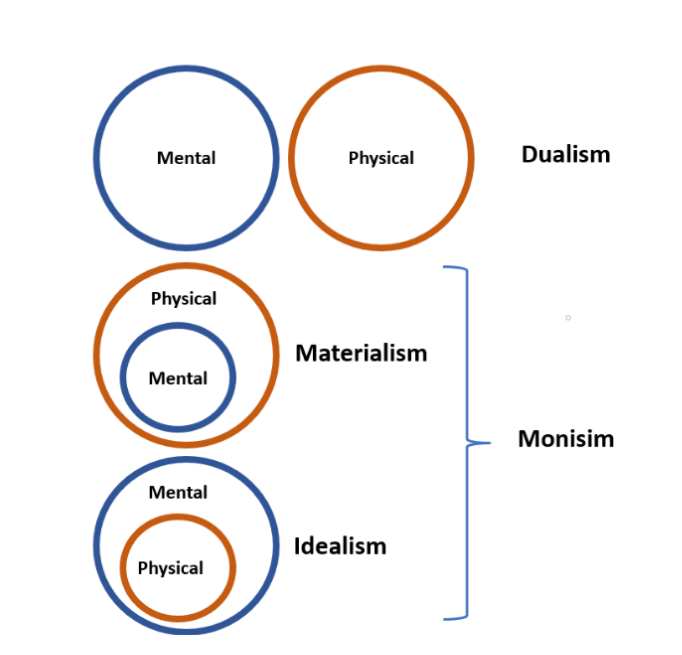
What is a mental illness?
The medical model (such as viewing the above experiences as symptoms of mental illness) implies that there is a value-free science of psychiatry that relies only on cold, hard facts. Many philosophers of the 20th century have argued that psychiatry is inherently value-laden.
Thomas Szasz
Szasz believed that medicine was over-reaching by applying the models of illness used in physical disease to mental distress. What we call mental illness, Szasz referred to as ‘problems of living’. In his 1960 essay ‘The Myth Of Mental Illness’, he argues several points as to why mental illness does not exist.
He examines the assumption that underlying mental illness, there is always a (perhaps yet undiscovered) neurological lesion and suggests that social factors (and the daily struggle of life) are more important. This is contrasted with diseases of the brain, which fall under the remit of neurology. He also argues that psychiatric diagnosis is based on a subjective understanding of a patient. For example, a patient may believe he is Napoleon but will only receive a diagnosis of delusional disorder if the clinician believes he is not Napoleon.
Robert Kendell
Kendell is a psychiatrist who critiqued Szasz’ opposition to the validity of mental illness in his 1974 essay ‘The Concept of Disease and its Implications for Psychiatry’. Instead of constructing the idea of disease around the need for an identifiable ‘lesion’, he drew on previous work that proposed diseases were:
Deviations from normal – This means that an illness is a state in which the individual is – by some perimeter – statistically different from the rest of the population. An intuitive example of this is hypertension. Of course, Kendell points out; some deviations can be neutral (foot size) or advantageous (intelligence – to a point).
Biologically disadvantageous – Meaning that the disease state leads to either reduced fertility or increased mortality. Kendell identifies that this criterion eliminates conditions that are abnormal but not harmful (such as syndactyly or stage 1 hypertension) but excludes conditions such as psoriasis or post-herpetic neuralgia, which do not shorten life or reduce fertility.
Kendell goes on to examine contemporary data about fertility rates in people with severe mental illness (reduced, especially among those with schizophrenia) and the mortality rates (raised). This argument is further complicated by discussion around whether these disadvantages are innate to the mental illness or rather exist as a result of the stigma and social exclusion faced by people with mental illness.
Christopher Boorse
Boorse’s conceptualisation of disease is that the human body has innate ways in which it can function, and deviations away from these reference ranges can be harmful to the organism. Therefore, Boorse is most often associated with the ‘harmful dysfunction’ model of disease. Of course, there is a subjective element to making a judgement about what is harmful.
When this dysfunctional state is deemed to be harmful, then the condition can be considered to be an illness, which comes along with special treatment, the sick role and (sometimes) excuses for bad behaviour.
In order to be able to identify deviations from natural functioning, there has to be a well defined reference group. Critics of Boorse’s theory claim that there is no value-free way to choose these reference groups. The natural functioning of the pancreas in a reference group of diabetics would be entirely different to a sample of people without diabetes. Kingma’s 2007 article uses the example of homosexuality. This is a difference that leads to reduced fertility, but it would only be a deviation from natural functioning if the chosen reference group consisted of heterosexual people. The choosing of a heterosexual reference group is itself a value laden judgement.
Jerome Wakefield
Wakefield follows Boorse by continuing the idea that there is a species-typical design. He argues that this is a product of natural selection. Wakefield expands the concept of harmful dysfunction to mental illness; they are the result of malfunctioning psychological processes, causing harm (distress) to the individual. Looking at the natural function of a thing (in this case, its purpose, evolutionarily) falls under the philosophical branch of teleology.
Naturalism and Constructivism
The above examples point to illness, specifically mental illness, arising as a result of a deviation from an inherent ‘healthy’ way of functioning. The disease would continue to exist even if it were not classified as such. This is known as a naturalist conception of disease. Schizophrenia, in this understanding, would exist even if it were not grouped within the category of ‘mental illness’.
Constructivists would argue that schizophrenia would not exist if it were not within human interest to define it. Diseases of any sort, in a constructivist understanding, cannot be identified independently of human values. Disease labels might be considered as a way of exerting social control.
A disease that exists in isolation from human values and is not changed by labelling it such would be known as a natural kind. Mental illnesses tend to change with time and in response to human understanding, perception and diagnosis of them, a process referred to as ‘looping’. This instability means many argue they cannot be natural kinds.
Michel Foucault and antipsychiatry
A criticism of the validity of psychiatry diagnosis would not be complete without a nod to the work of Michel Foucault. Foucault is associated with post-modernism and post-structuralism. These movements argue that truth and meaning are inconsistent; subjective truth results from individual experience, oppression and roles. Foucault’s take on psychiatry can be understood as a way for those in power to exert control over the freedom and behaviour of those labelled mentally ill.
Changes in the way mental illness is treated, including de-institutionalisation, occurred in the 1960s and 1970s alongside a movement known as antipsychiatry. Antipsychiatry is a movement that believes a medical model of mental illness (and associated medications and compulsory treatment) does more harm than good. Scottish psychiatrist RD Laing, like Szasz, rejected the notion that so-called mental illnesses could be understood and treated in a comparable way to physical illness. He took issue with the fact that mental disorders are diagnosed through observable behaviours and yet treated biologically.
References
- Bracken, P. and Thomas, P. (2010) “From Szasz to Foucault: On the Role of Critical Psychiatry,” Philosophy, Psychiatry, & Psychology, 17(3).
- Fulford, B., Thornton, T. and Graham, G. (2006) “Chapter 2,” in Oxford Textbook of Philosophy of Psychiatry. Oxford: Oxford University Press, pp. 2–20.
- Kendell, R.E. (1975) “The concept of disease and its implications for psychiatry,” British Journal of Psychiatry, 127(4), pp. 305–315. Available online at: https://doi.org/10.1192/bjp.127.4.305. [Accessed Feb 2023]
- Kingma, E. (2007) “What is it to be healthy?” Analysis, 67(2), pp. 128–133. Available Online at: https://doi.org/10.1093/analys/67.2.128. [Accessed Feb 2023]
- Murphy, D. (2020) Concepts of disease and health, Stanford Encyclopedia of Philosophy. Stanford University. Available online at: https://plato.stanford.edu/entries/health-disease/ [Accessed April 2023]
- Philosophy of mind (no date) Philosophy of Mind – By Branch / Doctrine – The Basics of Philosophy. Available online at: https://www.philosophybasics.com/branch_philosophy_of_mind.html [Accessed April 2023]
- Szasz, T.S. (1974) “The myth of mental illness,” Perspectives in Abnormal Behavior, pp. 4–11. Available Online at: https://doi.org/10.1016/b978-0-08-017738-0.50007-7. [Accessed March 2023]
- Wakefield, J.C. (1992) “The concept of mental disorder: On the boundary between biological facts and social values.” American Psychologist, 47(3), pp. 373–388. Available online at: https://doi.org/10.1037/0003-066x.47.3.373. [Accessed March 2023]
Complete Guide to Clinical Genetics ST3 Application and Recruitment (2027)
Written by Medibuddy. Last updated: October 2026. Clinical Genetics is

Complete Guide to Clinical Radiology ST3 Application and Recruitment (2027)
Recruitment paused: NHS England is not running Clinical Radiology ST3+ recru

Complete Guide to Paediatric Surgery ST3 Application and Recruitment in United Kingdom (2026)
Written by Medibuddy. Last updated: October 2026. If you’re planning


Take your subscriptions with you
Our mobile app allows you to access your interview and exam question banks wherever you are.

