


 Close
Close
 20th November 2023
Psychopathology of Emotion
‘Your emotions are the slaves to your thoughts, and you are the slave to your emotions.’
– Elizabeth Gilbert
Mood and Affect
Emotions are feelings which we all experience. For example, you might be feeling low about having to stay in and revise for this exam when you should be out enjoying a nice meal. In clinical psychiatry, we often refer to the emotions that our patients are experiencing in terms of mood and affect. Mood-related symptoms are present in many psychiatric disorders. They are particularly prominent (as the name would suggest) in mood disorders.
But what is mood? And what is affect?
Affect is often described as ‘The patient’s immediate expression of emotion’, and mood is a ‘more sustained emotional make up of the patient’s personality.’ These definitions did not help me much, and I benefited from a useful metaphor to help me understand: the weather.
If you were to ask the question, ‘How is the weather in England?’ You could give two responses. You might say ‘the weather in England is generally dull and rainy’, this is giving information on what the weather is like over a sustained period, like a mood. You could also look outside and say, ‘It’s currently very sunny,’ giving the answer of what the weather is like at the time you’re observing it, like an affect.
So, a patient’s mood will be their emotions over a larger period of time and affect is the observed emotion in the assessment room with them.
References
- Martin DC. The Mental Status Examination. In: Walker HK, Hall WD, Hurst JW, editors. Clinical Methods: The History, Physical, and Laboratory Examinations. 3rd edition. Boston: Butterworths; 1990. Chapter 207.
Bipolar and Related Disorders
Bipolar and their related disorders are characterised by the patient experiencing a manic or hypomanic episode.
A manic episode
A manic episode must last at least one week (unless shortened by treatment) and is defined as an ‘extreme mood state’. This mood will be primarily euphoria, irritability or expansiveness. For a diagnosis of mania, the patient should be presenting with at least three of the signs below (with four required if the mood is irritable):
- Increased activity or physical restlessness.
- Increased talkativeness – This can often be referred to as pressure of speech.
- ‘Flight of ideas’ or a subjective experience of thoughts racing. Flight of ideas is a sign in which the patient rapidly switches from topic to topic continuously with minimal links between the topics.
- Loss of normal social inhibitions – This can result in behaviour that is inappropriate to the circumstances.
- Decreased need for sleep.
- Inflated self-esteem or grandiosity.
- Distractibility or constant changes in plan.
- Behaviour that is foolhardy or reckless and which the patient is unable to recognise the risk of.
- Marked sexual energy or sexual indiscretions.
If that is mania, what is hypomania?
Hypomania is very similar to the above, but as the name would suggest, it is less severe. They would still require at least three of the signs listed for a diagnosis of mania. However, the criteria do not include flight of ideas or loss of normal social inhibitions, as these are more indicative of a manic episode. A hypomanic episode should last for at least four days and must not meet the above criteria for a manic episode. A hypomanic episode should not cause a severe impairment in functioning or require hospital admission.
Bipolar type I (Manic episode +/- further episodes)
A diagnosis of bipolar type I disorder is made when the patient has had one or more manic episodes. As bipolar is an episodic disorder, patients may experience relapses. These relapses can be a manic episode (as discussed above), a depressive episode (which will be discussed below) or a mixed episode (where the patient has both prominent manic and depressive symptoms). The signs should be present for most of the time, nearly every day for two weeks.
Bipolar type II (Hypomanic episode + depressive episode +/- further episodes)
A diagnosis of bipolar II type disorder is made when a patient has had one or more hypomanic episodes but also, crucially, at least one depressive episode. Like type I disorder, it is also an episodic mood disorder where the patient may experience hypomanic or depressive episodes. Like bipolar type I, signs should also be present for most of the time, nearly every day for two weeks.
Differences between ICD 10, ICD 11 and DSM V
Broadly speaking, the symptomology described in these classification symptoms for bipolar are the same, but there are slight differences.
ICD-10
Classifies bipolar not by type I and type II. Instead, it uses:
- Hypomania.
- Mania +/- psychotic symptoms.
- Bipolar affective disorder – Current episode (manic / depression / mixed) +/- psychotic symptoms.
- Bipolar affective disorder – Currently in remission.
ICD-11
Does not have hypomania, and mania as separate diagnoses in and of themselves. Instead, coding these experiences under Bipolar type I or Type II.
DSM V
There is a slight alteration in the symptoms as listed above for a manic episode.
- Reckless behaviour is changed into ‘excessive involvement in pleasurable activities that have a high potential for painful consequences.’
- Increased activity is changed to ‘Increase in goal directed activity’ and includes sexual activity as opposed to being classed as a separate sign.
- Does not include loss of normal social inhibitions as a separate sign.
References
- World Health Organization. (2004). ICD-10 : international statistical classification of Diseases and related health problems : tenth revision, 2nd ed. World Health Organization. https://apps.who.int/iris/handle/10665/42980
- International Classification of Diseases, Eleventh Revision (ICD-11), World Health Organization (WHO) 2019/2021 https://icd.who.int/browse11. Licensed under Creative Commons Attribution-NoDerivatives 3.0 IGO licence (CC BY-ND 3.0 IGO)
- American Psychiatric Association. (2013). Diagnostic and statistical manual of mental disorders (5th ed.). https://doi.org/10.1176/appi.books.9780890425596
Depressive Disorders
Depression is defined as a disorder of depressed mood, but as highlighted below, a patient need not have this typical symptom to be suffering from this condition. It is, unfortunately, very common, affecting roughly 1 in 6 adults experiencing it in the United Kingdom. To meet the criteria for a clinical depressive episode (ICD-11), the patient must experience at least two of the following. (These are sometimes referred to as the core symptoms.)
- Depressed mood for most of the time, almost every day for two weeks.
- Loss of interest or pleasure in activities (also known as anhedonia).
- Decreased energy or increased fatigue (anergia).
The patient must then also have additional symptoms from the list below. It is the total number of symptoms the patient is experiencing (including either the two or three above) that determine the severity of the disorder.
- Loss of confidence or self esteem.
- Unreasonable feelings of self-reproach (blaming yourself) or excessive and inappropriate guilt.
- Recurrent thoughts of death or suicide or any suicidal behaviour.
- Difficulty in concentrating or thinking.
- Changes in psychomotor activity (agitated or slowing down): these can be observed or self reported.
- Trouble with sleep.
- Increased or decreased appetite with associated weight change.
Types of depressive episode
- Mild depressive episode – Total of 4 symptoms (including at least 2 core symptoms).
- Moderate depressive episode – Total of 6 symptoms (including at least 2 core symptoms).
- Severe depressive episode – Total of 8 symptoms (including all 3 core symptoms).
As above, depression can be classified into a mild, moderate or severe episode. It can then also be further classified as to whether it is a recurrent disorder or a single episode and whether there is the presence of psychotic symptoms.
Differences in the DSM V
The DSM V criteria for major depressive disorder are broadly similar. They use two core symptoms of depressed mood or anhedonia, of which the patient must have one of. The patient must also have 5 symptoms in total. The DSM-V does not recognise loss of confidence and self esteem as a separate criteria. It also states that the agitation or slowing down of activity must be ‘observable by others’ and not just described subjectively by the patient.
Persistent mood disorders
There are two persistent mood disorders referred to as cyclothymia and dysthymia. These disorders should only be considered if you are confident the patient is not experiencing the disorders above. The symptoms must have been present for at least two years:
Cyclothymia – Unstable mood with episodes of both depressed mood and hypomania. However, none of these episodes should be severe enough to meet the criteria for mania or depression.
Dysthymia – A depressed mood that is present nearly all of the time. There may be intermittent periods of normal mood, but these should not last more than a couple of weeks. The individual episodes of depressed mood should not be severe enough to meet the criteria for depression.
Psychotic symptoms in mood disorders
Patients with depression and bipolar disorder can experience psychotic symptoms in relation to their mood disorder. These are delusions and hallucinations that are not listed under the criteria for a schizophrenic diagnosis. In episodes of depression, examples could be persecutory or nihilistic hallucinations or delusions. The patient could also be suffering from a ‘depressive stupor’ and appear catatonic. In episodes of mania, the patient may be experiencing grandiose delusions or hallucinations.
References
- World Health Organization. (2004). ICD-10 : international statistical classification of diseases and related health problems : tenth revision, 2nd ed. World Health Organization. https://apps.who.int/iris/handle/10665/42980
- International Classification of Diseases, Eleventh Revision (ICD-11), World Health Organization (WHO) 2019/2021 https://icd.who.int/browse11. Licensed under Creative Commons Attribution-NoDerivatives 3.0 IGO licence (CC BY-ND 3.0 IGO)
- American Psychiatric Association. (2013). Diagnostic and statistical manual of mental disorders (5th ed.). https://doi.org/10.1176/appi.books.9780890425596
- Cullum Attwell, R.M. (2022) Cost of living and depression in adults, Great Britain: 29 September to 23 October 2022, Cost of living and depression in adults, Great Britain – Office for National Statistics. Office for National Statistics. Available online at: https://www.ons.gov.uk/peoplepopulationandcommunity/healthandsocialcare/mentalhealth/articles/costoflivinganddepressioninadultsgreatbritain/29septemberto23october2022 [Accessed: March 26 2023]
Mood and the Mental State
As covered before in this textbook, the mental state is an essential part of clinical psychiatry and is important in mood disorders. It was developed in 1918 by Adolf Meyer and could be seen as the equivalent of your essential ‘A to E’ assessment in your physical assessments. Using the mental state systematic pattern can help you identify (and help remember) the key symptoms and signs of important mood disorders.
I have split these into two tables: a depressive episode and a manic episode. These are the general signs of how a patient may present, and of course, as everyone is individual, they will not present the same. For example, someone may be struggling with a low mood, but it may not initially appear, so they try to hide it with smiles and deny feeling low.
Depressive episode
| Appearance and behaviour | Due to the symptoms of depression, the patient may have less interest or care in how they look. They may appear unkempt or, in severe cases, show signs of self neglect. In their behaviour, you may see physical signs of slowing of their activities known as ‘psychomotor retardation’, which can even develop into catatonia. Conversely, you may see agitation associated with depression and see a restless patient in front of you. |
| Speech | Their speech can be slower, lower in volume, monotonal and can suffer from articulation errors. |
| Mood and affect | As highlighted above in detail, low mood is a core symptom of depression. You may observe a tearful, visibly low patient, but you also may see a ‘flat affect’. This is where the patient appears almost unreactive emotionally to the consultation. |
| Thought | They may be negative thoughts regarding the past with excessive guilt and self blame. There may be current negative thoughts surrounding themselves with low self esteem and self critical thoughts. There may also be negative thoughts surrounding the future whereby the patient can see only failure in it.
It is important here to always ask about suicidal thoughts, which are common in depression, and to risk assess the patient appropriately. There may be delusions present. These could be delusions of guilt, poverty, hypochondriasis or persecutory or nihilistic delusions. |
| Perception | Hallucinations can be present and would typically be second person auditory hallucinations confirming the patient’s negative beliefs. |
| Cognition | Poor concentration and attention may be present. There may be subjective poor memory, which is not demonstrated when formally tested. |
| Insight | There can be a variation of levels. Some patients will understand the effect depression is having on them. However, some patients will insist that their negative thoughts and feelings are accurate and not recognise the contribution of their depressive illness to them. |
Manic episode
| Appearance and behaviour | Patients who are manic could be dressed inappropriately for the environment and wear striking clothing and make up. They may also start to appear unkempt as their symptoms worsen. |
| Speech | They may have pressured loud speech. You may find it difficult to interrupt them as they speak at length. |
| Mood and affect | As described above, the patients will be displaying either an elated mood or an irritable one. |
| Thought | They may be experiencing racing thoughts, loosening of associations and flight of ideas. They may have grandiose or expansive ideas, such as believing they have an idea or a company they are developing which can make millions of pounds. They may also be experiencing grandiose, paranoid or religious delusions. |
| Perception | There may be hallucinations. These would usually be mood-congruent auditory hallucinations that would confirm the beliefs of the patient. |
| Cognition | They may be very distractible with poor concentration. |
| Insight | Patients will often show impaired insight into their manic episodes. |
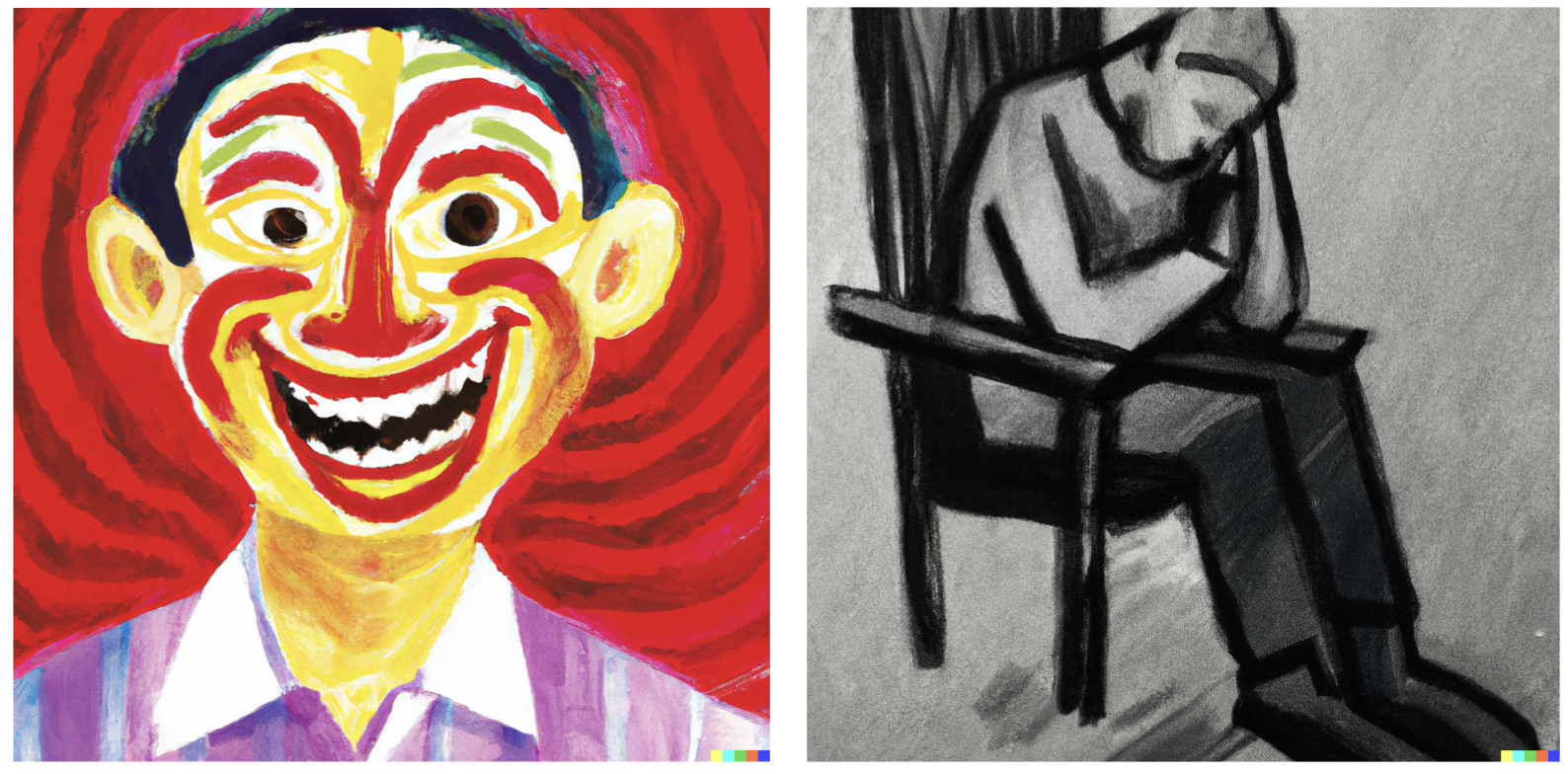
AI-generated images from Open AI. Mania (Left), Depression (Right)
References
- Voss RM, M Das J. Mental Status Examination. [Updated 2022 Sep 12]. In: StatPearls [Internet]. Treasure Island (FL): StatPearls Publishing; 2023 Jan-. Available from: https://www.ncbi.nlm.nih.gov/books/NBK546682/
- McKnight, Rebecca, et al. Psychiatry, Oxford University Press, Incorporated, 2019. ProQuest Ebook Central.
- Albuquerque L, Valente ARS, Teixeira A, Figueiredo D, Sa-Couto P, Oliveira C. Association between acoustic speech features and non-severe levels of anxiety and depression symptoms across lifespan. PLoS One. 2021 Apr 8;16(4):e0248842. doi: 10.1371/journal.pone.0248842. PMID: 33831018; PMCID: PMC8031302.
Complete Guide to Clinical Genetics ST3 Application and Recruitment (2027)
Written by Medibuddy. Last updated: October 2026. Clinical Genetics is

Complete Guide to Clinical Radiology ST3 Application and Recruitment (2027)
Recruitment paused: NHS England is not running Clinical Radiology ST3+ recru

Complete Guide to Paediatric Surgery ST3 Application and Recruitment in United Kingdom (2026)
Written by Medibuddy. Last updated: October 2026. If you’re planning


Take your subscriptions with you
Our mobile app allows you to access your interview and exam question banks wherever you are.

