


 Close
Close
 20th November 2023
Mood and the Mental State
As covered before in this textbook, the mental state is an essential part of clinical psychiatry and is important in mood disorders. It was developed in 1918 by Adolf Meyer and could be seen as the equivalent of your essential ‘A to E’ assessment in your physical assessments. Using the mental state systematic pattern can help you identify (and help remember) the key symptoms and signs of important mood disorders.
I have split these into two tables: a depressive episode and a manic episode. These are the general signs of how a patient may present, and of course, as everyone is individual, they will not present the same. For example, someone may be struggling with a low mood, but it may not initially appear, so they try to hide it with smiles and deny feeling low.
Depressive episode
| Appearance and behaviour | Due to the symptoms of depression, the patient may have less interest or care in how they look. They may appear unkempt or, in severe cases, show signs of self neglect. In their behaviour, you may see physical signs of slowing of their activities known as ‘psychomotor retardation’, which can even develop into catatonia. Conversely, you may see agitation associated with depression and see a restless patient in front of you. |
| Speech | Their speech can be slower, lower in volume, monotonal and can suffer from articulation errors. |
| Mood and affect | As highlighted above in detail, low mood is a core symptom of depression. You may observe a tearful, visibly low patient, but you also may see a ‘flat affect’. This is where the patient appears almost unreactive emotionally to the consultation. |
| Thought | They may be negative thoughts regarding the past with excessive guilt and self blame. There may be current negative thoughts surrounding themselves with low self esteem and self critical thoughts. There may also be negative thoughts surrounding the future whereby the patient can see only failure in it.
It is important here to always ask about suicidal thoughts, which are common in depression, and to risk assess the patient appropriately. There may be delusions present. These could be delusions of guilt, poverty, hypochondriasis or persecutory or nihilistic delusions. |
| Perception | Hallucinations can be present and would typically be second person auditory hallucinations confirming the patient’s negative beliefs. |
| Cognition | Poor concentration and attention may be present. There may be subjective poor memory, which is not demonstrated when formally tested. |
| Insight | There can be a variation of levels. Some patients will understand the effect depression is having on them. However, some patients will insist that their negative thoughts and feelings are accurate and not recognise the contribution of their depressive illness to them. |
Manic episode
| Appearance and behaviour | Patients who are manic could be dressed inappropriately for the environment and wear striking clothing and make up. They may also start to appear unkempt as their symptoms worsen. |
| Speech | They may have pressured loud speech. You may find it difficult to interrupt them as they speak at length. |
| Mood and affect | As described above, the patients will be displaying either an elated mood or an irritable one. |
| Thought | They may be experiencing racing thoughts, loosening of associations and flight of ideas. They may have grandiose or expansive ideas, such as believing they have an idea or a company they are developing which can make millions of pounds. They may also be experiencing grandiose, paranoid or religious delusions. |
| Perception | There may be hallucinations. These would usually be mood-congruent auditory hallucinations that would confirm the beliefs of the patient. |
| Cognition | They may be very distractible with poor concentration. |
| Insight | Patients will often show impaired insight into their manic episodes. |
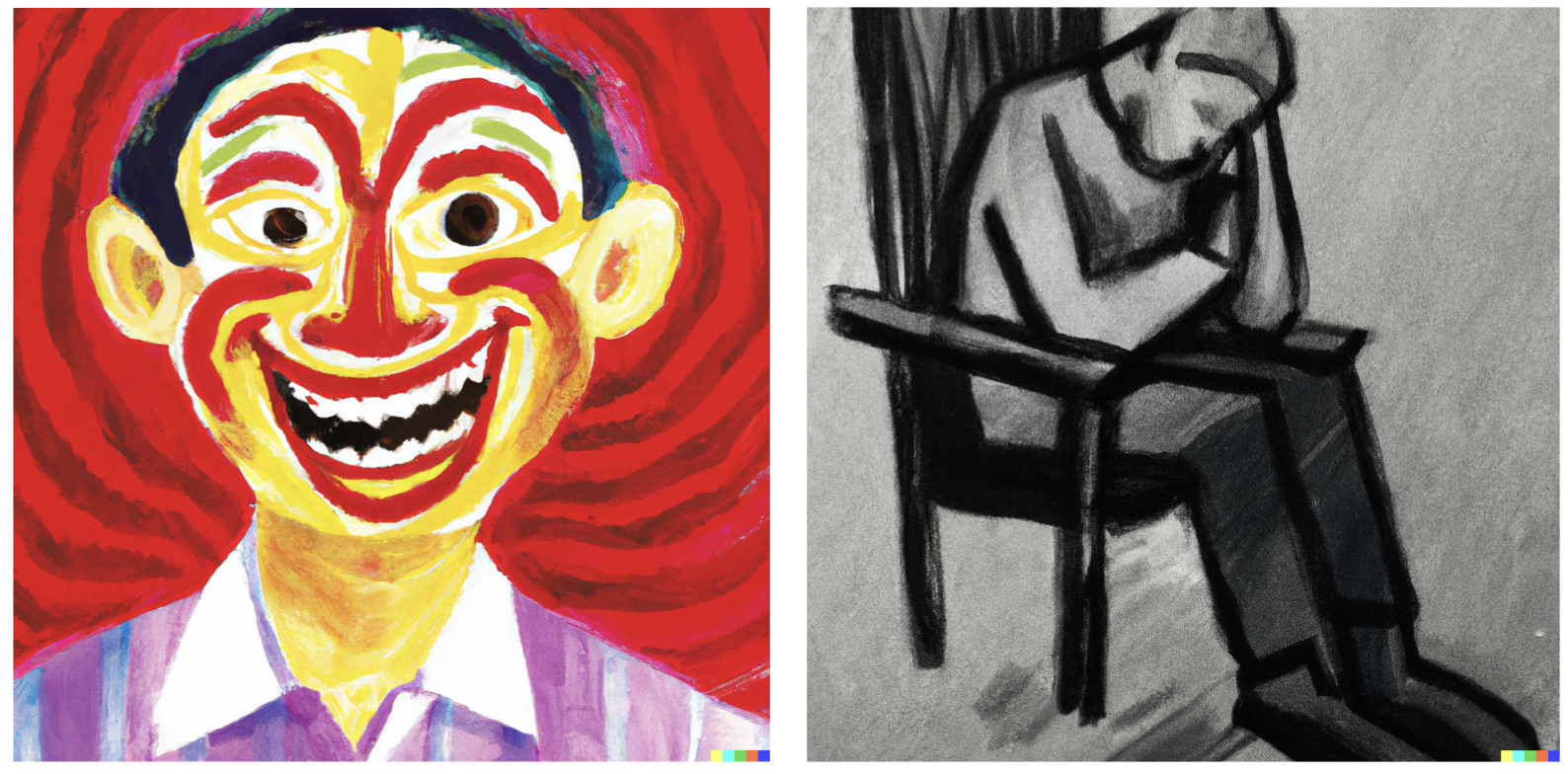
AI-generated images from Open AI. Mania (Left), Depression (Right)
References
- Voss RM, M Das J. Mental Status Examination. [Updated 2022 Sep 12]. In: StatPearls [Internet]. Treasure Island (FL): StatPearls Publishing; 2023 Jan-. Available from: https://www.ncbi.nlm.nih.gov/books/NBK546682/
- McKnight, Rebecca, et al. Psychiatry, Oxford University Press, Incorporated, 2019. ProQuest Ebook Central.
- Albuquerque L, Valente ARS, Teixeira A, Figueiredo D, Sa-Couto P, Oliveira C. Association between acoustic speech features and non-severe levels of anxiety and depression symptoms across lifespan. PLoS One. 2021 Apr 8;16(4):e0248842. doi: 10.1371/journal.pone.0248842. PMID: 33831018; PMCID: PMC8031302.
Complete Guide to Clinical Genetics ST3 Application and Recruitment (2027)
Written by Medibuddy. Last updated: October 2026. Clinical Genetics is

Complete Guide to Clinical Radiology ST3 Application and Recruitment (2027)
Recruitment paused: NHS England is not running Clinical Radiology ST3+ recru

Complete Guide to Paediatric Surgery ST3 Application and Recruitment in United Kingdom (2026)
Written by Medibuddy. Last updated: October 2026. If you’re planning


Take your subscriptions with you
Our mobile app allows you to access your interview and exam question banks wherever you are.

