


 Close
Close
 31st October 2023
Sociocultural Psychiatry
Social Class and Inequality
Social class is a way of classifying people into groups based on their income, education, occupation and influence. Historically, class in the UK has been divided into ‘upper class’, ‘middle class’ and ‘working class’. It is recognised, however, that traditional ways of dividing social class may be less relevant in current society.
In 2013, the results of the Great British class survey were published. This survey, conducted in 2011, found that social class could be understood in seven distinct groups. These were: elite, established middle class, technical middle class, new affluent workers, traditional working class, emergent service sector, and precariat. As well as looking at income and educational attainment, these classes take into account political beliefs and cultural engagement.
Overview of the Great British Class Survey 2011:
| Class | Features |
|---|---|
| Elite | Represent 6% of British society. High economic capital and high-brow cultural capital. Primarily located within London and the Home Counties. High proportion of graduates from Oxbridge. |
| Established Middle Class | Represent 25% of British society. High economic capital and high-brow and emerging cultural capital. High proportion of graduates into managerial and professional jobs. Even geographically spread throughout the UK. Typical careers: occupational therapists, police constables, town planners. |
| Technical Middle Class | Represent 6% of British society. High economic capital with moderate cultural capital and low social contacts. Typical careers: medical radiographers, senior administrative and research positions. Higher proportion living in the South East of England. |
| New Affluent Workers | Represents 15% of British society. Moderate economic capital, moderate high-brow capital, good emerging capital. Typical careers: electricians, postal workers and plumbers. Fewer attended university. Family background tends to be non-middle class. |
| Traditional Working Class | Represents 14% of British society. Relatively poor economic capital but some housing assets. Low cultural capital. Typical careers: care workers, cleaners and electricians (again). Many live in previous industrial areas of Britain. University graduates are more likely to attend as mature students or part time. |
| Emergent Service Sector | Represents 19% of British society. Relatively poor economic capital but reasonable household income. Good emerging social capital but poor high-brow social capital. Generally younger age group, with work in bars, chefs, and care assistants. Located in central London and university towns. |
| Precariat | Represents 15% of British society. Low economic and social capital. Low and unstable income due to ‘gig-economy’ and short term contracts. Often living in old industrial parts of Britain. |
Socioeconomic status
Social class and socioeconomic status are often used interchangeably; however, this is not technically correct. Socio-economic status is a person’s access to financial or social resources in relation to others. Rather than being neatly divided into discrete groups, socioeconomic status can be viewed as a spectrum of ‘high’, ‘middle’ and ‘low’. It is more changeable than social class throughout a person’s lifetime and can be impacted by sudden variations in income or health.
Social causation theory
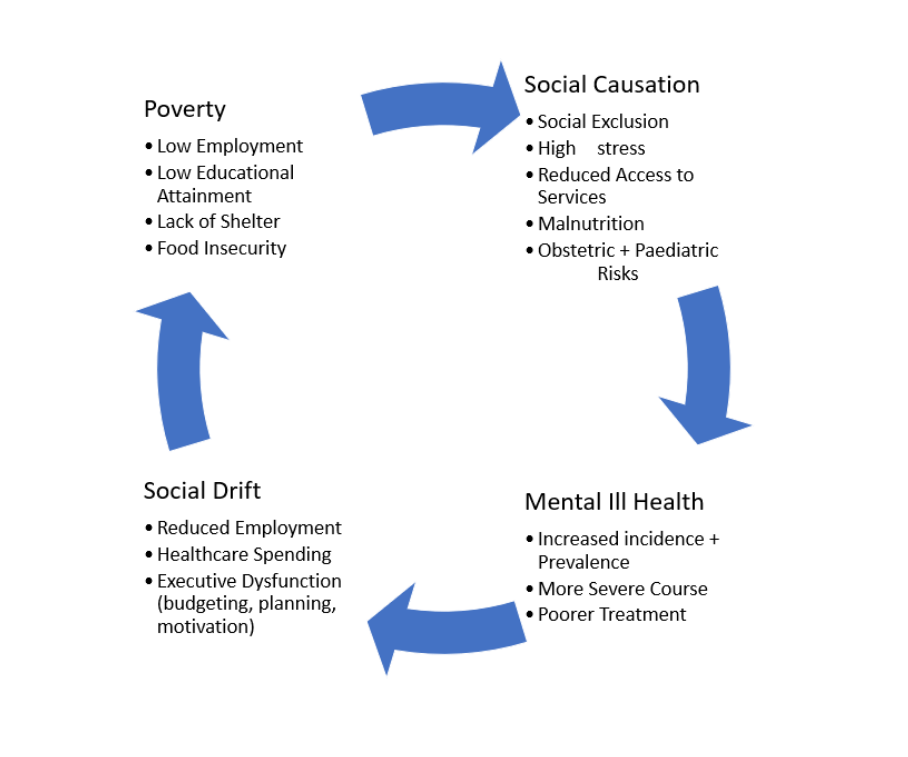
The social causation theory posits that poverty and inequality within society increases the risk of mental illness in people already vulnerable. For example, difficulties faced by people of minority ethnic groups, gender inequality and classism can cause stress that can ‘tip’ people into mental illness (see also the stress vulnerability model). Other relevant factors to the social causation theory of mental illness is the increased rates of social exclusion, isolation, malnutrition and obstetric complications seen in people of lower socioeconomic status.
Consider also the traditional barriers to accessing healthcare that affect people in poverty: unable to afford time off work to see a general practitioner or unable to afford transport to them. The inverse care law was proposed by Julian Tudor Hart in 1971 and explains that good healthcare availability varies inversely with a population’s needs. All the above factors can impact mental health as well as physical health.
It’s also important to consider that people experiencing poverty are less able to access protective factors, such as a supportive social network and enriching activities like exercise.
The above can be understood through Myers’ ‘life-course’ model (1975), which explains the higher levels of mental illness among people with the lowest socioeconomic status. He suggests poorer people consistently encounter greater social problems during their lives, but they do not have access to the educational, social and economic resources that would help them to overcome these problems. This accumulation of stress can tip a person into mental illnesses such as depression.
Social drift theory
As well as the propensity for poverty to negatively impact mental health, people with mental illness can drift into or remain in poverty. Known as the social drift theory, this can be due to increased spending on healthcare, reduced productivity, loss of employment, isolation and stigma.
In their 1963 study ‘Schizophrenia and Social Class’, Goldberg and Morrison looked at the social class of men aged 25-34 admitted to hospital with a first episode of schizophrenia. They found that the study subjects over-represented the lowest social classes. When they compared this to the occupation of the men’s father (which was in line with the general population), they found that there was a significant drop in social class between father and son. They hypothesised that the decline in social class was due to the impact of the men’s developing mental illness.
Urbanicity
People living in cities are at greater risk of developing mental illness than their rural counterparts. Results from a Swedish population study show that the risk of developing a psychotic illness is 66-77% in the most urban areas compared to the most rural areas (Sundquist et al. 2004). The increase in risk for depression is 12-20%. It also seems that the longer a person spends growing up in urban areas, the more their risk is increased. This shows that there is a ‘dose-response’ relationship.
The reasons for this finding are similar to those mentioned above. There is a higher level of inequality and discrimination in cities. Specific factors such as air pollution and lack of access to green space can also be a factor. Growing up in more deprived urban areas can also mean being exposed to gang violence, other physical threats, and easier access to street drugs.
References
- Devine, F. and Snee, H. (2015) ‘Doing the great british class survey’, The Sociological Review, 63(2), pp. 240–258. doi:10.1111/1467-954x.12282.
- Goldberg, E.M. and Morrison, S.L. (1963) ‘Schizophrenia and social class’, British Journal of Psychiatry, 109(463), pp. 785–802. doi:10.1192/bjp.109.463.785.
- Lund, C. et al. (2011) ‘Poverty and mental disorders: Breaking the cycle in low-income and middle-income countries’, The Lancet, 378(9801), pp. 1502–1514. doi:10.1016/s0140-6736(11)60754-x.
- Myers, Jerome K., et al. “Life Events, Social Integration and Psychiatric Symptomatology.” Journal of Health and Social Behavior, vol. 16, no. 4, 1975, pp. 421–27. JSTOR, https://doi.org/10.2307/2136613. Accessed 21 May 2023.
- Sundquist, K., Frank, G. and Sundquist, J. (2004) ‘Urbanisation and incidence of psychosis and depression’, British Journal of Psychiatry, 184(4), pp. 293–298. doi:10.1192/bjp.184.4.293.
Gender and Mental Health Basic Principles
There are many established and stable differences in the epidemiology of mental illness between men and women. For example, it is well known that women have a higher lifetime prevalence of mood and anxiety disorders. Some of these differences can be explained biologically – such as through the neuroprotective effects of oestrogen leading to a later onset of psychosis in women – but overall, the mechanisms for the discrepancy are complex and poorly understood.
Common mental illness
In the 2014 adult psychiatric morbidity survey, anxiety and depression (referred to as common mental disorders) had a lifetime prevalence of 1 in 5 for women, compared to 1 in 8 for men. In the 16-24 age group, women were almost three times more likely to experience a common mental disorder than men of the same age (24% vs 9%).
Proposed reasons for this difference include the differences in sex hormones on mood, women’s blunted response to the hypothalamic-pituitary-adrenal axis, sexual discrimination and increased rates of sexual assault against women. Women also have higher rates of body dissatisfaction, may be more prone to ruminating, and may take on a higher proportion of unpaid work as well as the burden of household labour.
Another theory is that the ways that women express distress are typically labelled as ‘mental illness’, whereas men’s distress is exhibited as antisocial or criminal behaviour. The prison population is majority male, with up to 70% of those requiring mental health support. In keeping with this, antisocial personality disorder is almost three times more prevalent in men than it is in women (4.9% vs 1.8%).
Suicide
The gender discrepancy in the diagnosis of anxiety and depression may also be due to the concept of masculinity and how men and women access mental healthcare. Expressing anxiety and vulnerability has traditionally been seen as ‘more feminine’. This is reflected in the lower rates of men accessing NHS talking therapies (only 36% of referrals are for men).
Men are also at a significantly higher risk of dying by suicide. 75% of deaths by suicide are male, and these rates have been stable over time for the last 30 years. The causes for this statistic are unknown but may be due to the difficulties faced by men accessing mental health care, the increased rates of substance misuse in men, and the ways in which men traditionally gain esteem. Loss of status and perceived loss of status is a known risk factor for suicide – therefore, loss of job or spouse in middle age or old age could be factors in the peaks in male suicide. The highest risk age for suicide is 45-59 years.
Schizophrenia
As with depression and anxiety, there are several established differences between schizophrenia in men and in women. The onset of schizophrenia in men is, on average, 3-4 years earlier than women, with peak incidence at 20-29 years. Women have a bimodal distribution of symptom onset, with a later incidence peak post-menopause.
There are also key differences in how schizophrenia presents and progresses. Men are more likely to experience more negative symptoms, whereas women tend to have more affective symptoms. It is possible, however, that a symptom such as poverty of speech could be described as a negative symptom of schizophrenia in a man but as a symptom of a depressive episode in a woman.
Outcomes such as homelessness, suicide, remission rates and global scores of functioning are all generally worse in men with schizophrenia compared with women. Gross abnormalities in neuroanatomy (such as reduced volume of the frontal and temporal lobe and increase in right hemisphere gyrification) are more prominent in men.
References
- Li, X., Zhou, W. and Yi, Z. (2022) ‘A glimpse of gender differences in schizophrenia’, General Psychiatry, 35(4). doi:10.1136/gpsych-2022-100823.
- Riecher-Rössler, A. (2017) ‘Sex and gender differences in mental disorders’, The Lancet Psychiatry, 4(1), pp. 8–9. doi:10.1016/s2215-0366(16)30348-0.
Sociology of Institutions
Erving Goffman
Sociologist Erving Goffman is well known for his 1950s and 1960s work on the sociology of total institutions. Total institutions are places where the residents are cut off from the outside world, and the organisation of their lives occurs from within the confines of the institution itself. Common examples of total institutions are care-homes, prisons, cruise ships, monasteries, orphanages, boarding schools and, of course, asylums.
Though there has been a shift towards care in the community for both old age care and mental illness, it is worth considering how this work still impacts our care settings. In institutions like care homes, time is structured for residents and decisions are made through the organisation’s policy. This is known as bureaucratic control.
This type of control arises through a process of institutionalisation that Goffman calls ‘mortification of the self’. This self-mortification is a dismantling of a person’s autonomy. There are 7 aspects of it:
- Role dispossession – A person loses their role (their job, motherhood, being a spouse) and takes on the sick role.
- Identity trimming – The person is reduced to data: for example, ‘the lady in room 3’ or their NHS number.
- Dispossession of property, name, and one’s ‘identity kit’, i.e. those artefacts that identify who we are.
- Imposition of degrading postures, stances, and deference patterns often justified by the power imbalance between those receiving care and caregivers.
- Contaminative exposure – This occurs when the organisation offers little or no private space so that our private activities are hard to conceal. This could be seen in single sex wards
- The disruption of the usual relationship between the individual and their actions/behaviours. For example, a person can no longer choose when to make a sandwich because they need a member of staff to monitor them while they are using a knife.
- Restrictions on self-determination, autonomy, and freedom of action. It becomes difficult or impossible to develop and pursue interests, make choices or associate with others of one’s own choosing.
Basic Principles of Criminology and Penology
Crime is defined as ‘an action or omission which constitutes an offence and is punishable by law’. In order for a crime to be committed, there must be a voluntary act or omission, known as ‘actus rea’ (‘guilty act’) – this is the physical act of committing a crime. For an act to be considered a crime, there must also be ‘mens rea’ (‘guilty mind’) – This refers to the intent and state of mind behind the act. Both mens rea and actus rea must be proven for an act to be considered a crime.
Criminology refers to the scientific study of crime, criminals, and delinquent behaviour. This encompasses legal principles as well as psychology, sociology, and moral philosophy. ‘Crime’ simply refers to behaviour that is against societal laws. In contrast, criminology takes a broader view. This includes making efforts to understand why people commit crimes and to explain why crime rates vary in different geographical areas and over time.
Penology is a subsection of criminology involving the study of the societal policies in place for inflicting punishment on those who commit crimes (such as prison sentences), as well as covering related policies such as probation and rehabilitation. In the context of forensic psychiatry, this may also involve the medical treatment of offenders.
Crime rates and figures are collected on a quarterly basis by the Office of National Statistics through the Crime Survey for England and Wales (CSEW) – This gives recorded crime rates based on cases reported to the police. However, not all crimes are reported to the police, and therefore, these ‘hidden crimes’ are not accounted for in the statistics, leading to an underestimation of actual rates of crime. Crime surveys can be used, in which people are asked to self-report incidents of crime, whether reported to the police or not, in order to calculate rates of hidden crime.
Crime and mental illness
There is a pervasive negative perception of certain mental illnesses as being associated with dangerousness and violence. This stereotype is particularly prominent regarding individuals with paranoid schizophrenia and substance misuse disorders. Reporting sensationalised stories by the media and the portrayal of mental illness in popular culture only strengthens this stereotype and increases the stigma surrounding mental illness.
Although mental illness can be associated with violent behaviour, this amounts to only a very small population attributable risk. For example, violent behaviour is seen in around 10% of patients with schizophrenia compared with 2% of the general population; whilst this does confer an increased risk, it still amounts to only 4% of violent crimes being attributable to individuals with schizophrenia.
People suffering from mental illness are, in fact, much more likely to be victims of crime than perpetrators and more likely to become victims of crime than the general population overall.
References
- ‘Criminology’. Oxford Reference. Accessed May 2023. [Website: https://www.oxfordreference.com/display/10.1093/oi/authority.20110803095648697]
- Mannheim, H. and Bernard, T.J. ‘Criminology’. Encyclopedia Britannica. Accessed May 2023. [Website: https://www.britannica.com/science/criminology]
- Office for National Statistics (ONS). [2022]. ONS website, Quality and Methodology Information (QMI) report, Crime in England and Wales QMI. [Website: https://www.ons.gov.uk/peoplepopulationandcommunity/crimeandjustice/methodologies/crimeinenglandandwalesqmi#:~:text=Police%20recorded%20crime,-Recorded%20crime%20figures&text=Unlike%20crime%20survey%20data%2C%20recorded,police%20decide%20not%20to%20record]
- Office for National Statistics (ONS). [2023]. ONS website, statistical bulletin, Crime in England and Wales: year ending September 2022. [Website: https://www.ons.gov.uk/peoplepopulationandcommunity/crimeandjustice/bulletins/crimeinenglandandwales/yearendingseptember2022]
- The Editors of Encyclopaedia Brittanica. ‘Penology’. Encyclopedia Britannica. Accessed May 2023. [Website: https://www.britannica.com/topic/penology]
- Varshney, M., Mahapatra, A., Krishnan, V. et al. [2016]. Violence and mental illness: What is the true story?Journal of Epidemiology and Community Health. 70:223-225.
Stigma and Prejudice
Stigma is defined as ‘a mark of disgrace associated with a person, a personal quality, or a personal circumstance’. In social psychology, any person who is perceived as not fitting with societal norms may experience stigma. Stigma sets an individual apart from others, leading to alienation, poor self-esteem, and overall reduced wellbeing in the individual. On a larger scale, stigma contributes to social inequality.
In Stigma: Notes on the Management of Spoiled Identity, Erving Goffman looked at the way in which people who are considered ‘abnormal’ by society are treated. He refers to stigma as an ‘attribute that is deeply discrediting’ – this can be something visible, such as having a certain ethnicity or physical appearance, or it can be hidden – for example, a mental illness. Goffman thought that most people would experience stigma to some degree at some point in their lives. He identified three categories of stigma:
- Stigma associated with mental illness
- Stigma associated with physical disfiguration
- Stigma attached to identification with a particular ethnicity, religion, ideology, etc.
In more recent research, several different subtypes of stigma have been identified in regard to mental health:
- Self-stigma (also referred to as internalised stigma) – Refers to the negative attitude held by an individual towards themselves. For example, Janet has a diagnosis of severe depression, and as a result, she has needed to take time off work for the past few months. She views herself as being worthless and pathetic for not being able to carry on.
- Enacted stigma – The experience of negative and unfair treatment from others. For example, Jamie has a diagnosis of paranoid schizophrenia. He has applied for a job in a café. However, the owner of the café rejects his application as they have been told that people with schizophrenia are dangerous and unpredictable.
- Felt stigma – The experience of feelings of shame or embarrassment in an individual when they anticipate others’ reaction to them. For example, Mark has been feeling depressed and has experienced suicidal thoughts. However, he refrains from sharing this with his wife, as he worries that she will perceive him as being weak.
- Public stigma – Negative attitudes held by the general public towards a certain characteristic, often based on prejudice.
- Professional stigma – Seen when healthcare professionals hold stigmatising beliefs about their patients, which can impact on patient care.
- Institutional stigma – An organisation’s beliefs or policies towards a stigmatised group.
- Courtesy stigma – The stigma felt by family and friends of a stigmatised person by way of association with them.
In Conceptualizing Stigma (2001), Phelan and Link identify four steps in the development of stigma:
- Differentiation and labelling – Whereby a deviation from perceived societal norms is identified and labelled as such.
- Stereotyping – Linking the label to prejudices; associating the label with negative attributes.
- Separation – Development of an ‘us vs them’ ethic, resulting in isolation.
- Status loss and discrimination – The societal disadvantage conferred to people in the ‘them’ category.
Prejudice is defined as a ‘preconceived opinion that is not based on reason or actual experience’. In social psychology, this refers to the attitude of one group towards members of another group.
Stereotyping refers to a similar concept. However, a stereotype is typically seen as a specific belief held about a group – for example, a blanket statement that all members of that group share a particular physical or behavioural characteristic. Stereotyping is defined as ‘a widely held but fixed and oversimplified image or idea of a particular type of person or thing’. Stereotyping reinforces the differences between groups and leads to discrimination.
Discrimination refers to ‘the unjust or prejudicial treatment of different categories of people, especially on the grounds of ethnicity, age, sex, or disability’. Discrimination can result in whole groups of people being placed at a disadvantage purely due to their membership in a particular group.
Pettigrew identified ultimate attribution error as a phenomenon whereby ingroup members view negative behaviours in the outgroup as being disproportionately due to internal factors rather than as a result of any external factor beyond their control. Conversely, any positive outgroup behaviour is seen as being by chance rather than as a result of internal factors. This means that outgroup members struggle to escape prejudice since any positive behaviours they demonstrate are shrugged off, whilst negative behaviours are just seen to confirm the ingroup’s negative perception of them.
Stigma and mental illness
In 1998, the Royal College of Psychiatrists launched a 5-year ‘Changing Minds’ campaign, aiming to target stigma and to address the prejudice against people with mental illness. However, a recent YouGov poll in 2013 revealed that the UK public still regards people with mental illness as being the most discriminated-against group.
Results showed that schizophrenia, alcoholism and drug addiction were associated with the highest proportion of negative opinions. 70% of people surveyed felt that individuals suffering from these issues were dangerous, whilst 80% saw them as being unpredictable. Furthermore, alcoholism and drug use were associated with the perception that people with these disorders were to blame for their illness (60-65%). Over 60% of respondents saw people with depression as being hard to talk to, 19% thought that they should pull themselves together, and 23% thought that they were dangerous to others.
Tackling stigma
Legal aspects
There are laws in place designed to protect individuals from experiencing discrimination. Key examples are the Universal Declaration of Human Rights 1948 and the Equality Act 2010.
The Universal Declaration of Human Rights 1948 details the basic rights that all humans should be entitled to. This includes the following:
- Article 1 – The right to be free and to be equal in dignity and rights.
- Article 2 – The right to freedom from discrimination.
- Article 23 – The right to work and to equal pay without discrimination.
The Equality Act 2010 lists 8 protected characteristics, conveying protection from discrimination on the basis of any of these:
- Age.
- Disability.
- Gender reassignment.
- Marriage and civil partnership.
- Pregnancy and maternity.
- Race.
- Religion or belief.
- Sex.
- Sexual orientation.
Public campaigns
Public campaigns can be beneficial in terms of raising awareness of mental health issues and tackling the stigma associated with them.
One example is the Royal College of Psychiatrists Changing Minds campaign (1998-2003), which involved public education on mental health issues. More recently, the RCPsych have run a further campaign, Fair Deal, advocating for parity of esteem between mental health and physical health services in the UK.
Governmental policy can also contribute to reducing mental health-related stigma, for example, the UK government’s No Health Without Mental Health strategy and, more recently, the Time to Change campaign – run by the charities Mind and Rethink Mental Illness and funded by the Department of Health.
References
- Andersen, M.M., Varga, S., Folker, A.P. [2022]. On the definition of stigma. J Eval Clin Pract. 28: 847- 853.
- Crisp, A., Gelder, M., Rix, S., Meltzer, H., & Rowlands, O. [2000]. The stigmatisation of people with mental illnesses. The British Journal of Psychiatry, 177(1), 4-7.
- LibreTexts [2021]. Deviance and Social Stigma. [Website: https://socialsci.libretexts.org/@go/page/8123]
- Pettigrew, T. F. [1979]. The Ultimate Attribution Error: Extending Allport’s Cognitive Analysis of Prejudice. Personality and Social Psychology Bulletin. 5(4), 461–476
- Subu, M.A., Wati, D.F., Netrida, N. et al. [2021]. Types of stigma experienced by patients with mental illness and mental health nurses in Indonesia: a qualitative content analysis. Int J Ment Health Syst 15, 77 (2021).
Ethnic Minorities, Acculturation, and Mental health
Culture is defined as ‘people’s way of life, including their attitudes, values, beliefs, arts, sciences, modes of perception, and habits of thought and activity’. Culture is acquired through the process of enculturation, which involves the learning of cultural rules, values and beliefs.
Transcultural psychiatry explores the ways in which cultural factors impact human behaviour and mental health presentations and outcomes. As part of this, transcultural psychiatry looks at the psychological impact of moving from the cultural background that one has been raised within and adapting to living within a new cultural context – for example, through immigration. This process of adaptation is referred to as acculturation.
Acculturation involves ‘a process of cultural and psychological change resulting from contact between cultural groups and their individual members’. Acculturation can occur via four different processes:
- Assimilation – In which people lose their background culture altogether, instead adopting the culture of their new environment entirely. When many individuals from different cultures choose to assimilate into a new culture, this can result in a melting pot – whereby each group loses their background culture and assimilates, eventually all melting together into the dominant culture. However, when individuals are forced to assimilate and abandon their background culture in this way, this results in a pressure cooker society.
- Integration – Where people manage to adopt some of the culture of their new society whilst also maintaining some of the integrity of their background culture. Successful integration is only possible where the dominant cultural group is inclusive and open to the notion of diversity. Thus, a mutual accommodation is required, with all groups showing respect and acceptance towards each other.
- Separation – Whereby people retain their background culture but resist interaction with the new culture and fail to participate in the new society. Note that when this separation from the dominant culture is not an individual choice but is forced upon individuals by the dominant society, this is referred to as segregation.
- Marginalisation – When people fail to adapt to the new culture and participate in society whilst also losing their background culture. Marginalisation can result from failed attempts at forced assimilation (pressure cooker) in combination with forced exclusion (segregation).
| High degree of adaptation to host culture | Low degree of adaptation to host culture | |
|---|---|---|
| High degree of maintenance of background culture | Integration | Separation |
| Low degree of maintenance of background culture | Assimilation | Marginalisation |
National policies can be designed in ways that encourage certain methods of acculturation. For example, some expect all immigrants to assimilate completely into the dominant culture, whilst others encourage integration with some retention of background cultures. Other policies may enforce the segregation of groups or encourage the marginalisation of groups considered unwanted.
The social and psychological implications of the acculturation process are variable. Some individuals adapt psychologically to acculturation simply through learning a new set of appropriate behaviours for the new cultural context whilst simultaneously unlearning some aspects of their background culture that are no longer appropriate in context. Culture conflict is experienced whereby there is a clash between different cultural values and beliefs, which can create discomfort. Culture shock occurs when there is significant conflict, resulting in psychological stress. Extreme difficulties in the acculturation process can result in psychopathology, for example, clinical depression.
Psychological adaptation is influenced by numerous factors. The characteristics of both the society of origin and the society of settlement are important. The discrepancy between the two is important in order to make an estimation of cultural distance (the degree to which the two cultures differ). The conditions experienced by individuals in the society of origin are also important if we aim to understand the motivation behind immigration, i.e. push and pull factors. In the society of settlement, the general attitude of the society towards immigration is an important factor in determining the success of psychological adaptation. Some societies support multiculturalism, whereas others view this in a negative light and aim to eradicate diversity through forced assimilation through segregation or marginalisation.
Plural societies are found where a variety of people from different cultural backgrounds all live together within a diverse society with a shared political structure. The presence of individuals from different cultures within the society is influenced by three factors:
- Voluntariness – For example, immigrants who have voluntarily moved into a new cultural context, compared to refugees, for example, who have to undergo acculturation by necessity.
- Mobility – Typically, groups who have moved to a new location (immigrants, refugees).
- Permanence – Whether the individual will remain on a permanent basis (e.g. immigrants) or temporarily (e.g. international students, temporary workers).
Mental healthcare and ethnic minorities
According to 2021 UK Census data, around 18% of the UK population are from Black and minority ethnic backgrounds. Ethnic minority groups face a distinct set of challenges and barriers to accessing healthcare, and as such, it may be necessary for accommodations and adjustments to be made to the healthcare model (which is typically designed with the dominant cultural group in mind) in order to improve access to and the delivery of healthcare for these groups. It is important for mental healthcare professionals to have an understanding of the challenges faced by ethnic minority groups and to be sensitive and adaptive in their clinical interactions with these groups.
The specific rates of illness and challenges faced by ethnic minority groups vary in relation to each other and in relation to the dominant population. Ethnic minority groups generally fall into a lower socioeconomic status level, and they may experience a degree of social isolation. The psychological toll of migration and the acculturation process can also impact on mental health. Refugees and asylum seekers are a particularly vulnerable group who face significant barriers to accessing healthcare and who have been shown to experience higher rates of mental illness compared to the general population.
Research has identified inequalities in psychiatric healthcare outcomes for ethnic minority groups in the UK. Compared with the experience of White British people, ethnic minority groups have been found to experience reduced access to mental healthcare services, with poorer engagement, higher rates of conflict with staff, and variations in the use of drug treatments.
Rates of compulsory admission to psychiatric inpatient wards are higher amongst individuals of Afro-Caribbean ethnicity, as are rates of admission for schizophrenia and affective psychoses. Rates of readmission are also higher amongst Afro-Caribbean patients, and Afro-Caribbean men are over-represented in forensic units and in prison populations.
Immigration and schizophrenia
Research has shown that migrant and ethnic minority groups in the UK have higher rates of schizophrenia and psychosis compared to the general population. This disparity is most noticeable in Afro-Caribbean groups, with studies showing increased rates in this group ranging from 2-18 times that of the general population. The AESOP study aimed to explore the high rates of psychosis in Afro-Caribbean populations in the UK, with results showing that the incidence of schizophrenia is 9 times higher in the Afro-Caribbean population compared to the white British population.
There is no single clear explanation for the higher rates of schizophrenia in Afro-Caribbean populations. However, an environmental explanation, rather than a genetic one, is thought to be more likely.
Rates of schizophrenia are similar in Caribbean countries compared to the indigenous UK population, whilst rates are considerably higher amongst second generation Afro-Caribbean immigrants to the UK compared to first generation immigrants. This suggests that environmental factors are likely to be responsible for the disparity rather than genetic factors. The excess risk is not exclusively found in Afro-Caribbean immigrants but has also been noted to some degree in other immigrant populations, indicating that risk is not specific to any one race, and therefore, a genetic explanation is less likely. Furthermore, Afro-Caribbean patients who develop schizophrenia are more likely to be at a social disadvantage compared to their white counterparts. Immigrants have been found to experience long delays in seeking mental health support, they are less likely to be referred, and they have higher rates of police or emergency services involvement as well as compulsory admissions.
Culture-bound syndromes
Culture-bound syndromes describe sets of behavioural, cognitive, and affective presentations that are specifically seen within defined cultures. These syndromes are regarded as deviations from normal behaviour for individuals in that particular culture, and they can cause distress in the way that other psychiatric illnesses do. Given that culture-bound syndromes, by definition, affect members of a particular cultural group, these syndromes are typically limited to specific geographical regions. Several of these syndromes are acknowledged in the ICD-10 classification; see the table below.
| Syndrome | Geographical location | Symptoms |
|---|---|---|
| Amok | Indonesia, Malaysia | An unprovoked episode of homicidal or highly destructive behaviour, followed by a period of amnesia. May culminate in suicide. |
| Dhat | India, China | Anxiety and somatic complaints related to a fear of semen loss. A white discharge in the urine may be reported, interpreted as semen loss. |
| Koro | South-east Asia, China, India | Acute anxiety around genital retraction. Sufferers become convinced that the penis will withdraw into the abdomen. |
| Latah | Malaysia, Indonesia | Exaggerated response to fright or trauma, followed by echolalia, echopraxia and trance-like states. |
| Nerfiza | Egypt, Greece, northern Europe, Mexico, Central and South America | Episodes of extreme sorrow or anxiety, including somatic complaints. More commonly seen in women. |
| Pa-leng | Taiwan, south-east Asia | Anxiety state with an obsessive fear of the cold and winds, believed to produce fatigue, impotence or death. |
| Pibloktoq | Inuit within the Arctic Circle | Prodromal fatigue, depression or confusion followed by a ‘seizure’ of disruptive behaviour, e.g., tearing off clothing, frenzied running, property destruction. Followed by loss of consciousness and amnesia. |
| Susto | Mexico, Central and South America | Chronic complaints attributed to loss of the soul resulting from a severe fright or trauma. |
| Tajin kyofusho | Japan | Anxiety or phobia is seen in men and young adults, characterised by a fear of social contact, extreme self-consciousness, and fear of contracting disease. |
| Ufufuyane | Kenya, Southern Africa | Anxiety state attributed to spirit possession or magical potions. Characterised by shouting, sobbing, paralysis, convulsions, and trance-like state. Typically seen in young unmarried women. |
| Uqamairineq | Inuit within the Arctic Circle | Sudden paralysis is associated with borderline sleep states, with anxiety, agitation, or hallucinations. |
| Windigo | Indigenous people of north-east America | Accounts of cannibalistic obsession are typically ascribed to possession. Symptoms of depression, homicidal or suicidal thoughts, and a delusional, compulsive wish to eat human flesh. |
References
- Berry, J. W. [2004]. Acculturation. Encyclopedia of Applied Psychology. 27-34.
- Berry, J. W. [1997]. Immigration, Acculturation, and Adaptation. Applied Psychology: An International Review. 46 (1). 5-68
- Cooper, B. (2005). Immigration and schizophrenia: The social causation hypothesis revisited. The British Journal of Psychiatry, 186(5), 361-363.
- ‘Criminology’. Oxford Reference. Accessed May 2023. [Website: https://www.oxfordreference.com/display/10.1093/oi/authority.20110901080526139]
- Bhui, K., Aslam, R., Palinski, A., McCabe, R., Johnson, M., Weich, S., Singh, S., Knapp, M., Ardino, V., Szczepura, A. [2015]. Interventions to improve therapeutic communications between Black and minority ethnic patients and professionals in psychiatric services: Systematic review. The British Journal of Psychiatry, 207(2), 95-103.
- Bhui, K., & Bhugra, D. [2002]. Mental illness in Black and Asian ethnic minorities: Pathways to care and outcomes. Advances in Psychiatric Treatment, 8(1), 26-33.
- McKenzie, K. (2008). Improving mental healthcare for ethnic minorities. Advances in Psychiatric Treatment, 14(4), 285-291.
- Morgan C, Dazzan P, Morgan K, Jones P, Harrison G, Leff J, Murray R, Fearon P. [2006]. AESOP study group. First episode psychosis and ethnicity: initial findings from the AESOP study. World Psychiatry. 2006 Feb;5(1):40-6
- Office for National Statistics (ONS). [29 November 2022]. ONS website, statistical bulletin, Ethnic group, England and Wales: Census 2021. [Website: https://www.ons.gov.uk/peoplepopulationandcommunity/culturalidentity/ethnicity/bulletins/ethnicgroupenglandandwales/census2021]
- World Health Organization. [1993]. Culture-specific disorders. International statistical classification of diseases and related health problems. 176-187.
Complete Guide to Clinical Genetics ST3 Application and Recruitment (2027)
Written by Medibuddy. Last updated: October 2026. Clinical Genetics is

Complete Guide to Clinical Radiology ST3 Application and Recruitment (2027)
Recruitment paused: NHS England is not running Clinical Radiology ST3+ recru

Complete Guide to Paediatric Surgery ST3 Application and Recruitment in United Kingdom (2026)
Written by Medibuddy. Last updated: October 2026. If you’re planning


Take your subscriptions with you
Our mobile app allows you to access your interview and exam question banks wherever you are.

