


 Close
Close
The 2027 IMT Interview Revision Platform: Question Bank, Live Practice and Mocks with Other Candidates
Medibuddy is the only IMT interview preparation platform that gives you both a Question Bank and live practice with other candidates in one place.
The Question Bank covers over 80 structured scenarios (the full range of stations you'll face) each with a model answer written and edited by high-scoring candidates who sat the interview in 2026.
But knowing a strong answer and delivering one under interview pressure are different skills. So we've also built live practice into the platform:
- Study Groups
- Unlimited Live Mocks with real people
- Peer Feedback on your mocks from a wide range of candidates
£89.99
Expires: 12 October, 2027

IMT Revision Platform includes:
- Over 80 scenarios with model answers
- Study Groups with candidates nationwide
- Live Mocks with other candidates
- Peer Feedback on your recorded mocks
Updated for 2027 Interviews
- 8 new clinical and handover scenarios
- 8 new ethics and governance scenarios
- 2 new communication scenarios
£147.99
£179.98 total if both bought separately

Expires: 12 October, 2027
Everything in the Revision Platform, plus the IMT Knowledge Course to:
- Access 14 video lectures, over 8 hours of teaching
- Learn the acute presentations for the clinical station
- Be prepared for all follow-up questions
- Differentiate yourself as a top candidate
What to expect from the IMT interview
Internal Medicine Training is one of the most competitive stages in a physician's career, and it's getting more so. In 2024 there were 6,273 applicants for 1,698 posts. By 2025 that had risen to 8,841 applicants for 1,677 posts, more than five candidates for every place.
This is the interview that decides where you train and how the next stage of your career takes shape, and with that many strong applicants it often comes down to a few marks between them. How well you prepare for the interview itself is one of the few things still in your control.
The interview is two stations, each around 11 minutes, marked by two interviewers. Communication is scored across both.
Station 1: Application, Suitability and Ethics
Opens with a two-minute presentation on the achievements most relevant to your application: no slides, and you're stopped at two minutes. Then questions on your suitability for IMT, followed by an ethics, professionalism and governance question you don't see in advance. It's underpinned by GMC Good Medical Practice, covering issues like capacity, DNACPR, confidentiality, patient safety and colleague conflicts.
Station 2: Clinical Scenario and Handover
A short clinical scenario, a few sentences, is read to you at the start of the station, and you can take notes. Up to ten minutes of questions follow on investigations, diagnosis and management, plus how you'd communicate with the patient, their family and colleagues. It closes with a one-minute handover of the patient, delivered as if to a colleague. Scenarios are deliberately brief, so the panel is testing how you think and escalate safely.
What the panel is looking for
Interviewers score seven areas across the two stations: your application and achievements, suitability for IMT, ethics and governance, clinical assessment and management, patient handover, and communication, which is scored separately in each station. Both interviewers mark each area from 1 to 5, giving 14 marks in total, with some areas weighted more heavily. A 3 is satisfactory. To be considered for an offer, none of those marks can be a 1, no more than two can be 2s, and your raw score must reach at least 42 of 70, whatever your weighted total.
Scored well, ranked high, got their first choice
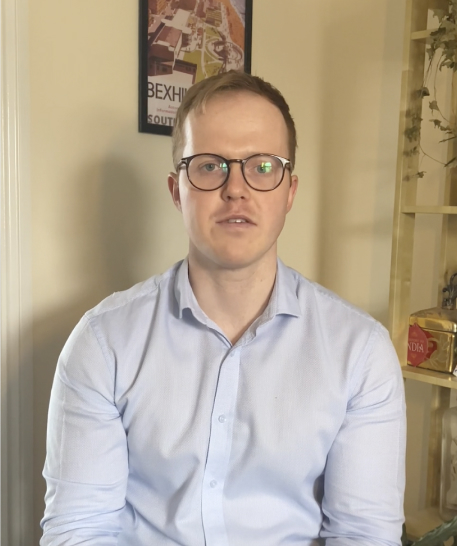
Will Bierrum ranked in the top 2%. Hear how he prepared with Medibuddy.

“Medibuddy was very useful in preparing for interview. It helped to give me a systematic approach for questions within the different stations.”
 Watch video
A few more of the candidates who prepared with us for the 2026 interview.

The Medibuddy 2027 IMT Interview Question Bank
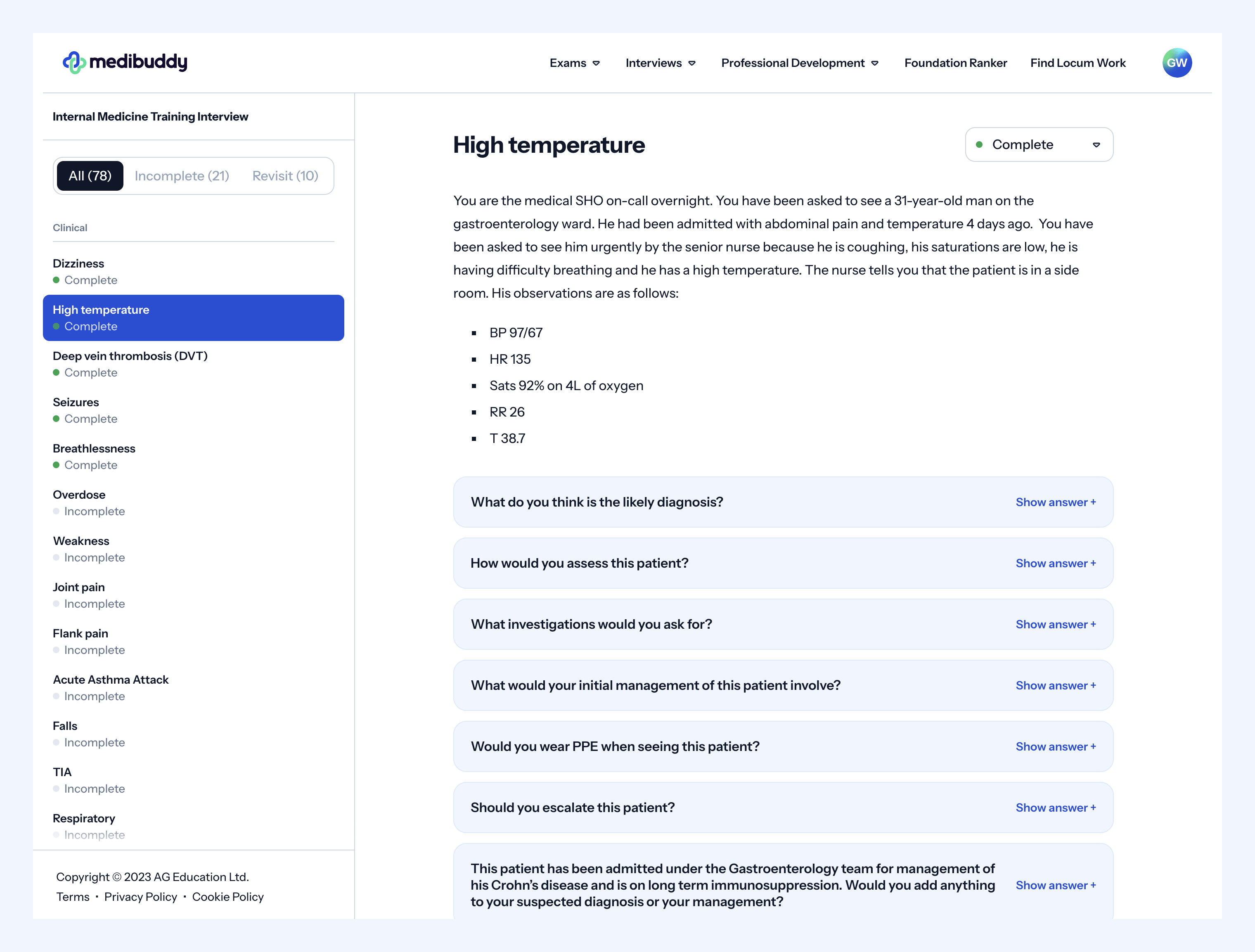
The Question Bank is where you'll find the scenarios most likely to come up in your interview, built around the two stations and the seven scored areas. It's part of a wider platform that gives you both the scenarios and model answers and a community of other candidates to practise them with.
Each of the 80-plus scenarios comes with a model answer showing how to structure your clinical reasoning and your delivery, written by candidates who sat the IMT interview in 2026 and scored well.
The scenarios and model answers are only part of what you get. Find out more about how you can practise with other candidates on the platform below.
What's insideWhat's included in the IMT Interview Question Bank
Application & Suitability
It's easy to ramble or undersell yourself in the two-minute presentation when you haven't practised it. These drill the presentation and the follow-up questions, with worked answers that show you how to present your achievements clearly and link them to what the panel is looking for.
Ethics, Professionalism & Governance
The unseen ethics question is where prepared candidates freeze without a framework. Realistic questions on capacity, DNACPR, confidentiality, patient safety and colleague conflicts, with structured model answers so you can reason through them on the day instead of going blank.
Clinical Scenarios & Handover
The scenarios are deliberately short on detail, so it's easy to miss what the panel is really testing. Short acute-medicine scenarios that train assessment, prioritisation and safe escalation, each with a worked answer, plus dedicated practice for the one-minute SBAR handover candidates so often rush.
Communication
Scored in both stations, so these scenarios target the marks candidates most often lose without realising, then let you rehearse them live in Live Mocks and submit them for Peer Feedback.
Added for 2027: 8 clinical & handover, 8 ethics & governance, and 2 communication scenarios.
Try an example IMT interview question
Respiratory. You are the IMT 2 in a general respiratory clinic. You have been asked to assess Mrs Bruth, a 65-year-old woman who has been referred by her GP with a productive cough, wheeze and shortness of breath on exertion. She has been smoking for the last 30 years, at least 10-20 cigarettes each day. Her past medical history includes hypertension which she takes amlodipine for. She has noticed 2-3 kg of weight loss over the last 12 months.
You have been asked to take a history from her and consider what investigations would help with regards to her diagnosis.
What questions would be helpful for you to ask when considering her presenting complaint of cough, wheeze and shortness of breath?
When you are given your scenario you often have a few minutes to think about it. If it helps you, write some small things down. Look at the question and work out what information you have. Then listen to the question and answer what you have been asked. In this case, be specific about the presenting complaint. Start with more general questions and then focus on the three specific complaints.
Example answer
I would start by asking general questions. For example:
- How long has she had these symptoms?
- Have they changed over time? For example, are they getting worse?
- Have they been associated with infection or any episodes where these symptoms have deteriorated significantly?
I would then specifically ask questions about each presenting complaint.
Cough
- Is the cough productive or dry? What colour is the sputum?
- Is the cough persistent or intermittent? Any time of day?
- Any history of haemoptysis?
- Any chest pain when coughing?
Wheeze
- Does the wheeze occur spontaneously or with triggers (exercise, dust, smoke)?
- What does the wheeze sound like?
- How long does the wheeze last?
- Has it ever been managed with medications?
Dyspnoea
- Does the shortness of breath occur at rest or with exertion?
- Is there any positional dyspnoea?
- How long do the episodes last and how does the patient manage it?
Is there anything else from her history you would want to know?
Example answer
I would want to know specifically about her history of weight loss as it is mentioned in her referral. Has this been intentional or not? Has this been associated with any other symptoms?
I would want a detailed past medical history and list of medications.
Her social history will also be extremely important in this consultation. I would want a detailed smoking history. Does she smoke cigarettes and what type? Does she smoke anything else? I would want to know about her living situation and where she lives, for example inner city vs out of the city, thinking specifically about pollution. Does she have any pets at home? I would want to know her occupation and any exposure history to specific agents such as asbestos. Finally, I would want to know about her history when growing up. Has she always lived in the UK? Is there any history of TB exposure?
I would also want to know a detailed family history. Specifically, is there any history of respiratory or cardiac disorders? For example, is there any history of alpha-1 antitrypsin disorder?
Finally, as part of my consultation, I would ask for a detailed systems review which may pick up anything that I may have missed. I would also finish by asking the patient about their ideas, concerns and expectations.
What investigations would be helpful in making a diagnosis?
Example answer
In clinic I would arrange some straightforward investigations that could be done on the day. I would ask for pulse oximetry and a sputum sample (if the patient can provide this). I would also ask for an ECG (given the presentation could still be cardiac). I would also ask for blood tests including a full blood count (raised Hb in response to chronic hypoxia), renal function and a CRP.
A chest x-ray would be important (although seldom diagnostic) in the diagnosis of COPD as well as assessing for the presence of significant comorbidities. Signs suggestive of COPD on x-ray would include hyperinflated lungs and flattened diaphragm.
Other investigations that may be useful would include pulmonary function tests and serial peak flow measurement. An echocardiogram would also be useful. Given this is likely a respiratory issue a CT chest would also give more information on any underlying pathology. However, given these are more specialised tests I would be keen to discuss these requests with my clinical supervisor in the clinic.
What is your differential diagnosis?
Example answer
I suspect that this is a respiratory issue. My top differential would be COPD given her age and smoking history. However, my investigations would be useful to help determine the remaining differentials that would include:
- Asthma
- Bronchiectasis
- Lung cancer
- Tuberculosis
Other non-respiratory causes of persistent cough and dyspnoea would be:
- Congestive heart failure
- Medication induced
- Gastro-oesophageal reflux disease
Your investigations come back and confirm a diagnosis of chronic obstructive pulmonary disorder. Please communicate this diagnosis to the patient and explain what it means in language that can be understood.
(One of your interviewers will play the part of the patient)
You can start your answer by explaining that you would set the scene in your clinic. Ask if she needs anyone else with her. Remember to use straightforward language and avoid medical jargon. Keep the answer simple, remember you are not being asked to list the treatment steps of COPD.
Example answer
Hi Mrs Bruth. I wanted to talk to you about the results of the investigations that we have ordered. These have come back and shown the reason for your cough, wheeze and shortness of breath.
The scans have confirmed a diagnosis of Chronic Obstructive Pulmonary Disorder. Have you ever heard of this before? Some people will also refer to this as emphysema or chronic bronchitis. (It is worth giving the patient time. They may want to respond or will indicate time for you to keep going. Pausing and giving the patient time to take in your words is an important part of communication.)
Would you like me to explain a little bit about what this diagnosis means?
Chronic Obstructive Pulmonary Disorder (or COPD for short) is a disease of the lungs which results in damage and inflammation to the airways that makes it harder for you to get air in and out which results in feeling short of breath. It is a progressive disorder and the inflammation of the airways is not reversible (such as in asthma).
COPD is common in the UK. The majority of cases are caused by long term smoking, although air pollution is also a common causative factor.
Symptoms can be managed with a combination of inhalers which we will start today and I will ask the respiratory CNS to talk to you in more detail about inhaler technique. The main thing that you can do which will help with slowing the progression of disease is to stop smoking. Exercise and losing weight will also help the condition.
COPD is a chronic condition, but you can experience exacerbations of your symptoms which may be prompted by viral infections for example. Exacerbations may require management with antibiotics and in extreme cases oxygen.
Does what I have told you make sense? Do you have any questions?
Depending on what you have said, you may be asked various follow up questions. These could range from treatment advice to asking about cancer to long term prognosis. Remember, you are not expected to know everything. All you are being judged on is your ability to communicate, so stay calm and answer in a polite way. Anything you don't know you can say, and demonstrate how you would go about finding the answer.
Finally:
I will provide you with written information on COPD. I will be referring you to the community respiratory team who will be responsible for your ongoing management of COPD and they along with your GP will be good points of contact moving forward.
You will now be given one minute to present this patient to your consultant as if it were the end of the clinic (prior to confirmation of the diagnosis). Give an overview of your findings and tell us what the next steps of your management would be.
Example answer
S: I have just assessed Mrs Bruth, a 65-year-old woman who presents with a chronic cough, wheeze and shortness of breath.
B: She has a 30 pack-year history and her past medical history is significant for hypertension. Of note, she has also lost about 2-3 kg over the last year.
A: Based on my assessment, I think this is a presentation of chronic obstructive pulmonary disorder. I have arranged several straightforward tests to support this diagnosis, including blood tests and an X-ray.
R: Because of the wide differential here, however, I would want to arrange suitable follow up for her again in this clinic to review these tests. If there is any diagnostic uncertainty following my initial investigations, I would arrange a CT chest given the symptoms and history of weight loss. She would benefit from being seen by the Respiratory CNS to discuss treatment options and review inhalers and I will refer her to this service today. I have provided her with written information about COPD and explained to her about the importance of managing exacerbations by seeing her GP.
Note: how this scenario can vary, and what you are assessed on
The majority of scenarios will ask you to give a medical handover. However, if you are in a clinic scenario you may be asked to discuss a result with a patient as in this scenario. We have included both options here to ensure you are prepared.
You will be assessed on your communication skills.
- Speak clearly and without using medical jargon.
- Look at the patient when talking to them.
- Ask them questions to check that they are listening and understand what you are saying.
- Give them time to speak and only talk when they have finished.
- Make sure you answer any questions at the end.
£89.99
Expires: 12 October, 2027
IMT Revision Platform includes:
- Every scenario in the Question Bank, worked through
- Study Groups with candidates nationwide
- Live Mocks with other candidates
- Peer Feedback on your recorded mocks
£147.99
£179.98 total if both bought separately
Expires: 12 October, 2027
Everything above, plus the IMT Knowledge Course:
- 14 modules on recognition and management
- Over 8 hours of acute medicine teaching
- Be ready for the station 2 follow-up questions
- Get the ultimate Question Bank companion
How we keep our Question Banks up to date
The IMT interview changes from year to year, and keeping a resource up to date is hard work, so a lot of providers don't, which means candidates can end up wasting time on topics that won't come up. We don't let that happen.
We review and update every Question Bank twice a year. In April, once that year's interviews are done, we go back through the scenarios and model answers in light of what candidates actually met on the day, and add new material where the questions have moved on. In October and November, once the official recruitment guidance is published, we run a full update against the new format and scoring, so the bank matches the interview you're about to sit rather than the one before it.
For 2027 that process has added 18 new scenarios to the IMT Question Bank: 8 clinical and handover, 8 ethics and governance, and 2 communication. We also reworked the model answers after the guidance changed to assess communication in Station 1 as well as Station 2.
The only interview resource where you can practise live with other candidates from across the country
Our IMT Question Bank gives you the questions and the model answers. But it's how you practise with them that decides the day. Reading a strong answer is nothing like delivering one out loud, under pressure, to another person.
Most candidates get as far as a friend or two who happen to be applying: same couple of people, same feedback every time. Medibuddy opens that up to every candidate on the platform, across the country, so you're rehearsing with far more people, and receiving a wider range of feedback than your own circle could ever give you.
👥Study Groups BETA
Study Groups connect you with other doctors across the country preparing for the same IMT interview: ask a question and get an answer from people who've read the same guidance, share what's coming up, and compare how you'd each approach a scenario.
Everyone brings different experience, from different hospitals and regions, so you learn things no single friendship group could tell you.
Study Groups: connect and prepare with IMT candidates from across the country.
🎤Live Mocks BETA
Reading and learning the Question Bank builds what you know, but the panel scores how you deliver it out loud, under pressure. That takes practising with other people, and the candidates who practise with the widest range of them tend to do best. Arrange a mock or join the waiting room and we match you with another IMT candidate on the platform at random, then take turns as interviewer and candidate on real Question Bank scenarios.
Live Mocks: practise with a wide variety of different candidates.
💬Peer Feedback BETA
You can rehearse an answer until it feels solid and still have no idea how it lands with someone else. With friends you get feedback from the same small group every time; Peer Feedback opens that up to a wide range of candidates across the platform.
Receive feedback. You can choose to record your live mocks, and then either submit the whole mock, or a single answer you trim it down to. Candidates from right across the platform can then give you the type of wide ranging and varied feedback you'd never get from one person alone.
Give feedback. You can review other candidates' recorded mocks too. Watching how other people approach the same scenarios is one of the fastest ways to improve your own performance, and your comments help them improve in return.
Peer Feedback: reviews from candidates across the platform, not the same few friends every time.
Practising out loud, hearing how other candidates answer, and getting your performance reviewed before the day are all included in the £89.99. There's nothing extra to buy.
Pick your planChoose the IMT Revision Platform, the Knowledge Course, or both
The IMT Revision Platform gives you the Question Bank, the model answers and all the live practice. It covers all the common questions that come up and explains how to score highly on them.
However, if you're doing well, the interviewers will often throw in curve ball questions to test the depth of your clinical knowledge. It's usually their way of working out whether to give you the top mark or not. These are the type of question you can only do well on if you have a thorough understanding of the clinical topic.
Station 2 works differently. The scenario is read to you on the day, and what follows is up to ten minutes of questions nobody can give you in advance. It's scored on your clinical management, your handover, and how you communicate through all of it. A model answer shows you how to structure your reasoning, but structure only takes you as far as your clinical knowledge goes.
That's what the IMT Knowledge Course is for: 14 video lectures and over 8 hours on the acute presentations station 2 is built around, taught by registrars who've been through IMT selection.
The Knowledge Course is £89.99 on its own. The Bundle is both products together, £147.99 instead of £179.98, for over eight hours of teaching on the station that's hardest to prepare for on your own.
What the IMT Knowledge Course covers
14 video lectures, over 8 hours, taught by six specialty registrars who've been through IMT selection.
- Adrenal insufficiency
- Anaphylaxis
- Chest pain
- Delirium
- Dizziness
- Deep vein thrombosis
- Epilepsy
- Flank pain
- Headache
- Overdose
- Pulmonary oedema
- Sepsis
- Supraventricular tachycardias
- Unconsciousness
Every lecture covers:
- Core clinical understanding
- Presentation and recognition
- Investigation and management principles
- Safety considerations and complications
Watch a lecture before you buy. This is Linda's headache lecture: how to assess a headache, the red flags that change your management, and how to work through primary and secondary causes. Linda Lei, Neurology/GIM SpR. Free to watch, no sign-up.


Instant access on web and the Medibuddy app. The Revision Platform and the Bundle both include Study Groups, Live Mocks and Peer Feedback.
£89.99
Expires: 12 October, 2027
IMT Revision Platform includes:
- The Question Bank and the model answers
- Study Groups with candidates nationwide
- Live Mocks with other candidates
- Peer Feedback on your recorded mocks
£147.99
£179.98 total if both bought separately
Expires: 12 October, 2027
Both products together for £147.99 instead of £179.98:
- The Revision Platform in full
- The IMT Knowledge Course in full
- 14 video lectures, over 8 hours of teaching
- The ultimate IMT interview preparation
How to prepare for the IMT interview
The platform is built to take you through it in order: work through the IMT interview questions, then use each live feature to turn what you know into how you perform on the day.
1. Start with the IMT Question Bank
Work through 80+ scenario types across both stations, each with a worked answer from a candidate who sat this interview and scored well. You see the types of questions that come up and how a strong answer is structured, so every hour goes on the real shape of the interview rather than generic content.
2. Talk the hard ones through in Study Groups
You're preparing alongside other IMT candidates, not on your own. Take the scenarios you find toughest into the forums, see how other people would approach the same question, and pick up the ethics and clinical angles you hadn't considered. Often another candidate has already worked out the bit you're stuck on, or catches a gap in an answer you thought was fine.
3. Rehearse out loud in Live Mocks
Reading an answer silently is nothing like delivering it out loud to a real person. Join the waiting room, get matched with another candidate, and take turns as interviewer and candidate working through real scenarios. This is where your two-minute presentation and your clinical answers actually become fluent.
4. Get reviewed with Peer Feedback before the day
The gap between how you think you came across and how you actually came across is where marks are lost. Record a mock and other members review it, telling you whether your handover was clear, whether your ethics answer had a structure, and what to sharpen, while there's still time to fix it.
5. Build the clinical depth behind your answers
When a panel pushes past your first answer, real acute-medicine knowledge is what carries you. The IMT Knowledge Course teaches the presentations tested in the clinical station in depth, so add it if you want to be ready for the follow-up questions as well as the scenarios themselves.
Frequently asked questions
What does the IMT interview involve?
Two stations of around 11 minutes, marked by two interviewers. Station 1 covers your application and suitability (starting with a two-minute presentation) plus an ethics, professionalism and governance question. Station 2 opens with a short clinical scenario read aloud to you, followed by up to ten minutes of questions and a one-minute patient handover. Communication is scored in both.
How competitive is the IMT interview?
Very. Applications rose from 6,273 for 1,698 posts in 2024 to 8,841 for 1,677 posts in 2025, more than five candidates for every place. At that level the difference between your preferred post and missing out often comes down to how well you prepare for the interview.
Who writes the model answers?
High-scoring candidates who sat the IMT interview in 2026. That's the whole idea of Medibuddy, the buddy in the year above: the answers reflect what actually came up and what actually scored, this year.
Can I practise with other candidates?
Yes. Every purchase (on its own or in the Bundle) includes all three live-practice features: Study Groups with candidates across the country preparing for the same interview, Live Mocks that match you with another candidate on demand, and Peer Feedback on your recorded mocks.
How do the Live Mocks work?
Join the waiting room and we match you with another IMT candidate. You take turns as interviewer and candidate, working through real Question Bank scenarios, so you get used to answering out loud to a real person before you face the panel.
What are Study Groups and how do they help?
Study Groups are community forums for doctors across the country preparing for the same IMT interview. Ask questions and get answers from other candidates, share what's coming up, and compare how you'd each tackle a scenario, so you're learning from the whole cohort rather than preparing alone.
Can I get feedback on my interview performance?
Yes, through Peer Feedback. Record a mock answer and other members of the community review it and tell you what landed and what to sharpen, whether that's the structure of your ethics answer or the clarity of your handover. It's the honest review most candidates never get before the day.
How do you keep the IMT Question Bank up to date?
We review and update it twice a year. In April, once that year's interviews are done, we go back through the scenarios and model answers in light of what candidates met on the day. In October and November, once the new recruitment guidance is published, we run a full update against the new format and scoring. For 2027 that process has added 18 new scenarios: 8 clinical and handover, 8 ethics and governance, and 2 communication.
What's the difference between the Question Bank and the IMT Knowledge Course?
The Question Bank is over 80 practice scenarios with worked answers and all the live-practice features. The IMT Knowledge Course provides the clinical depth behind your answers, with over 8 hours of content across 14 video lectures on the acute presentations tested in the clinical station. Most candidates use both, and the Bundle saves £30.
Why use Medibuddy over other interview question banks?
We've been preparing doctors for specialty interviews for 10 years, and the Question Bank is updated every year by editors who've recently sat this interview and scored well. That means the scenarios and model answers reflect this year's interview, not the one from when the resource was first written.
It doesn't stop at model answers either. Every purchase includes the live practice: Study Groups and community forums, Live Mocks against other candidates, and Peer Feedback on your recorded mocks. Most resources hand you a list of questions and leave you to it. We give you the questions, this year's answers, and a community to practise with, in one platform. And we don't stop at the interview: when you start IMT, our MRCP Part 1 resources are there for the next stage too.
Another candidate on how they used it
Ready to startStart preparing for the IMT interview
Everything you need for the IMT interview in one place. The Revision Platform gives you over 80 scenarios, this year's model answers, and live practice with other candidates. The Knowledge Course teaches the acute presentations station 2 is built around.
Together that's the Bundle, £147.99 instead of £179.98.
Ten years preparing doctors for interviews, and the questions, model answers, live practice and clinical teaching in one place. Instant access on web and the Medibuddy app • Study Groups, Live Mocks and Peer Feedback with every purchase • 2027 updates at no extra cost.
£89.99
Expires: 12 October, 2027
IMT Revision Platform includes:
- Over 80 scenarios with model answers
- Study Groups with candidates nationwide
- Live Mocks with other candidates
- Peer Feedback on your recorded mocks
£147.99
£179.98 total if both bought separately
Expires: 12 October, 2027
Everything in the Revision Platform, plus the IMT Knowledge Course to:
- Differentiate yourself as a top candidate
- Access comprehensive video lectures
- Be prepared for all follow-up questions
- Get the ultimate IMT question bank companion
£89.99
Expires: 12 October, 2027
IMT Revision Platform includes:
- Over 80 scenarios with model answers
- Study Groups with candidates nationwide
- Live Mocks with other candidates
- Peer Feedback on your recorded mocks
Updated for 2027 Interviews
- 8 new clinical and handover scenarios
- 8 new ethics and governance scenarios
- 2 new communication scenarios
£147.99
£179.98 total if both bought separately
Expires: 12 October, 2027
Everything in the Revision Platform, plus the IMT Knowledge Course to:
- Differentiate yourself as a top candidate
- Access comprehensive video lectures
- Be prepared for all follow-up questions
- Get the ultimate IMT question bank companion