The 2027 Cardiothoracic Surgery ST1 Interview Revision Platform: Question Bank, Live Practice and Mocks with Other Candidates
The Medibuddy Cardiothoracic Surgery ST1 Question Bank includes scenarios designed to closely reflect the real interview, each with a detailed model answer tailored to the Cardiothoracic Surgery ST1 interview format and expectations.
However, knowing a strong answer isn't the same as delivering it well under pressure, which is why we provide:
Study Groups
Unlimited Live Mocks with real people
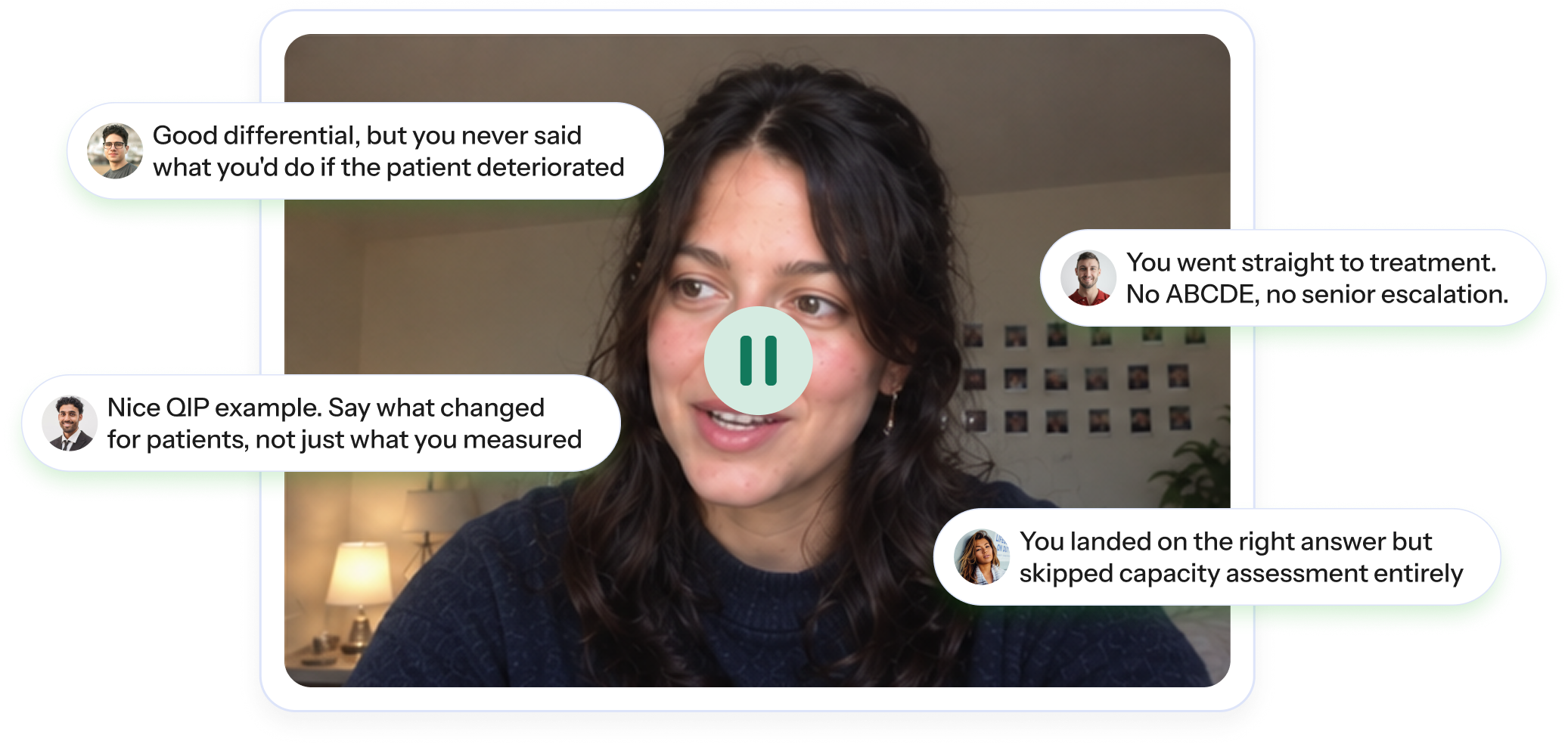
Peer Feedback on your mocks from a wide range of candidates
10 years’ experience preparing doctors for interviews
Users of the Medibuddy Cardiothoracic Surgery ST1 Revision Platform have secured some of the most competitive training jobs in recent rounds. Ask around, there's a good chance the trainees in the year above you used us too.
Always up to date
Did you know the interviews change every year? That's why we review and update every Question Bank on the platform twice a year, so you know you're always practising with scenarios based on the latest interview structure.
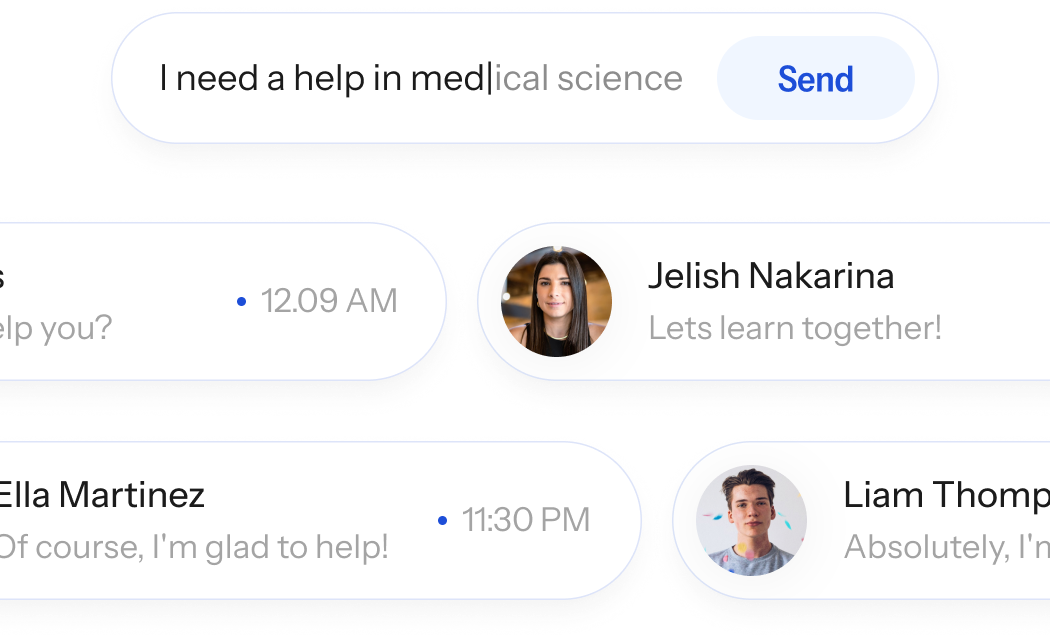
Network and practise real interview scenarios with other candidates
Question Bank
See every scenario, and how to answer it well
Scenarios across both the Structured Questions and Communication Skills stations, which tell you exactly how to respond to each question.
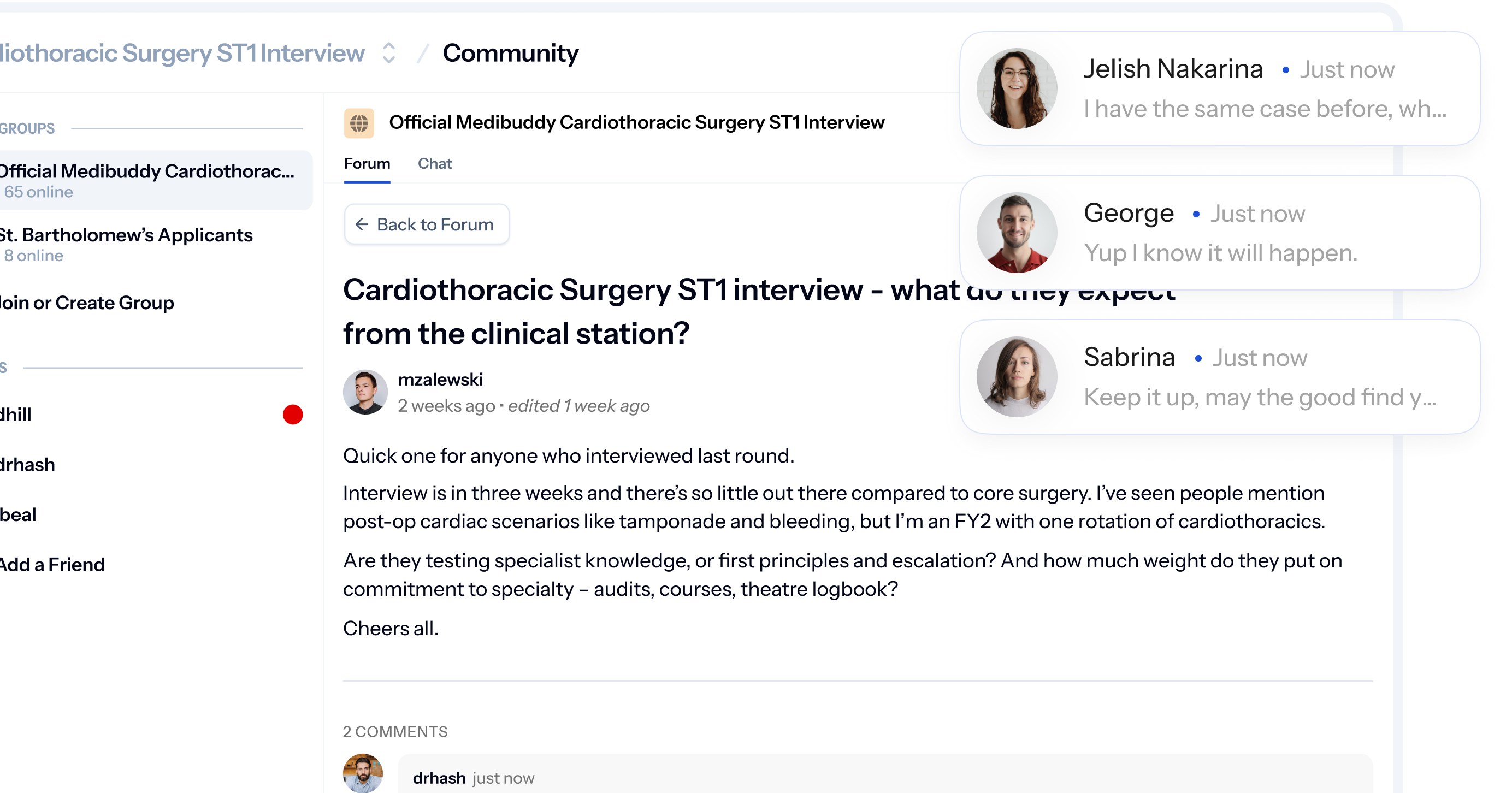
Study Groups
Connect with candidates across the country
Most people only ever practise with one or two friends. Study Groups connect you with candidates right across the country sitting the same interview.
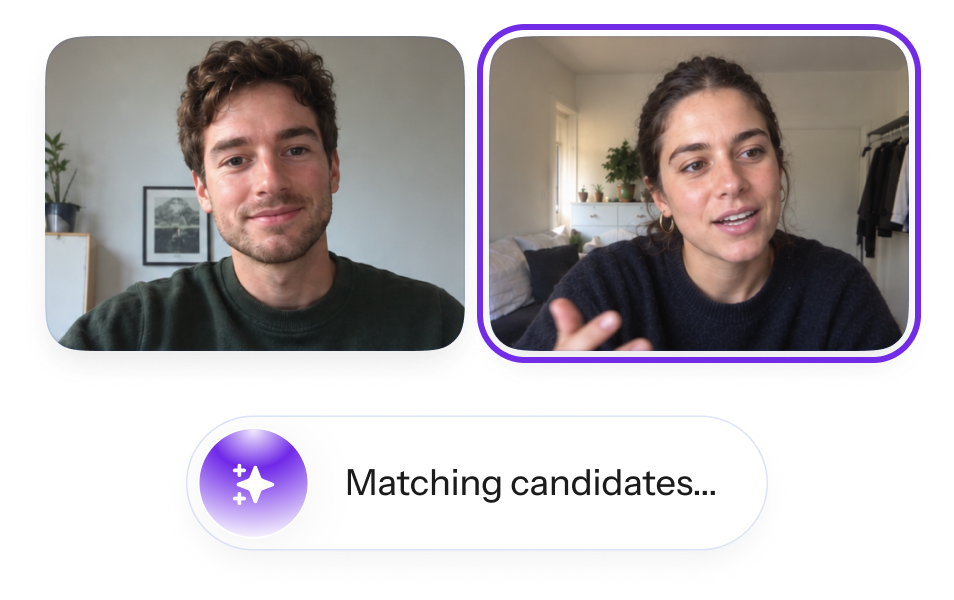
Live MocksBeta
Practise interview technique with different candidates
Arrange or get matched on demand with other candidates and run real scenarios out loud under interview conditions. Those who practise with the widest range of people tend to score the highest.
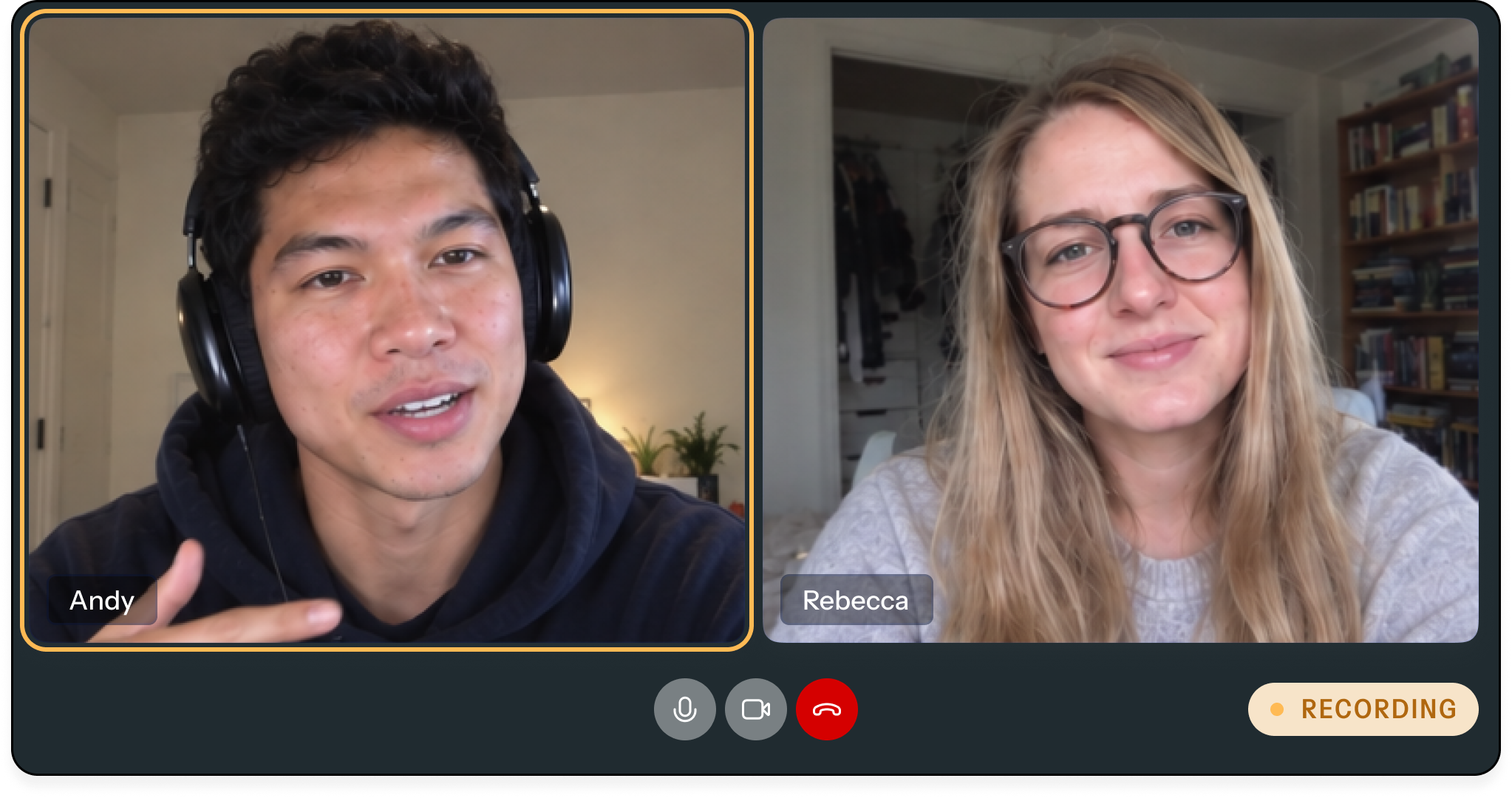
Peer FeedbackBeta
Reviewed by candidates across the platform
Submit your recorded mocks to candidates across the platform and get honest, varied feedback. Reviewing other people's mocks teaches you just as much.
The question bank, and other candidates to practise with, all in one platform.
Cardiothoracic Surgery ST1 Revision Platform • £89.99
Gain access to scenarios across both stations, and collaborate with other candidates through Study Groups, Live Mocks and Peer Feedback.
A few of the candidates who prepared with us for the Cardiothoracic Surgery ST1 interview.
Verified candidateInterviewed 2026
"I was successful at interview and the scenarios were very similar to those on the Medibuddy website. The information on Medibuddy was really useful for interview preparation."
Successful at interview
Verified candidateInterviewed 2026
"I wanted to say thank you for your wonderful site. I got my top ranked post and I scored highly in all stations."
Top-ranked post
Part 1 • See the questions
The Medibuddy 2027 Cardiothoracic Surgery ST1 Question Bank
The interview includes five structured questions and three communication skill questions, and only takes around 50 minutes, so you have a limited window to deliver the high-scoring answers you need to do well in the interview. That means every point has to land, and knowing how to structure each answer is essential. That's why each of our scenarios comes with a detailed model answer, giving you a clear framework for how to structure your response and approach the types of questions you may face in the Cardiothoracic Surgery ST1 interview.
What's inside
What's included in the Cardiothoracic Surgery ST1 Question Bank
There's nothing worse than getting to the interview and being handed a scenario you've never seen before. The panel has a huge range of topics to draw on, so the safest approach is to revise across all of them. We provide scenarios for both stations, including the common ones and the more unusual cases that have come up before, so you don't get caught out.
Clinical and Surgical Scenarios
Practice questions covering acute cardiothoracic presentations candidates have reported at interview, such as cardiac tamponade, low cardiac output syndrome and aortic stenosis, alongside managing the deteriorating cardiothoracic patient, testing clinical knowledge, prioritisation and judgement.
Portfolio and Commitment to Specialty
Structured practice for talking through your self-assessment evidence, from publications, presentations and audit cycles to teaching, taster weeks, SCTS engagement and logbook activity, in the way panels expect when verifying claims against the Wessex descriptors.
Ethics and Professionalism
Scenario questions applying GMC Good Medical Practice to consent, confidentiality, probity, candour and team conflict, alongside significant-event reflection using an SEA-style structure the panel recognises.
Motivation and Insight into Training
Questions on why cardiothoracic surgery, awareness of the pathway including the 2027 consolidation of entry at ST1, and the realities of the specialty, all recurring themes in candidate accounts.
Updated for 2027
Reviewed against the latest published guidance and recent candidate feedback.
Try it
Try an example Cardiothoracic Surgery ST1 question
You are a Cardiothoracic Surgery ST1 in a thoracic surgery outpatient clinic. Mrs Karen Okafor, a 61-year-old retired nurse, has a solitary 2.5cm right lower lobe non-small cell lung cancer, staged T1cN0M0. Her lung function is adequate and the MDT has recommended surgery. She's listed for a right lower lobe lobectomy via video-assisted thoracoscopic surgery (VATS), or an open thoracotomy if conversion is needed, and has come to sign her consent form. She has no prior surgical history and says she is very nervous.
How would you approach this consent consultation?
Question
How would you open the consultation and check her understanding?
Example answer
I'd introduce myself by name and role, confirm her identity with her full name and date of birth, and check she has capacity and isn't under any pressure to consent. I'd explain the purpose of today's appointment: to go through the operation together so she can make an informed decision and ask questions. Before explaining anything, I'd ask what she already knows or has been told, so I can build on that rather than start from scratch. I'd acknowledge that she's nervous and normalise it, invite her to stop me at any point, and check she's happy to go ahead.
Question
How would you explain the procedure in terms she can understand?
Example answer
I'd explain that the aim is to remove the lobe of lung containing the cancer completely, which gives the best chance of cure at her stage. I'd describe VATS in plain language: a few small keyhole cuts in the side of the chest through which a camera and instruments are passed to remove the lobe without opening the chest fully, which usually means less pain, a shorter stay and a quicker recovery. I'd be clear that occasionally the surgeon needs to convert to an open thoracotomy, a larger cut along the side of the chest, for safety or technical reasons, and that this is always made in her best interest. I'd explain she'll be under general anaesthetic with a breathing tube, and will have a chest drain afterwards to drain fluid and air while the lung re-expands.
Question
How would you explain the risks and complications?
Example answer
I'd structure the risks, separating common from serious but rare, use approximate frequencies, and invite questions after each part rather than delivering them all at once. Common: a prolonged air leak, the most common complication at around 5 to 10%, usually managed by leaving the chest drain in longer and mostly resolving within a week; chest infection or pneumonia, higher in smokers, managed with physiotherapy and antibiotics; and atrial fibrillation, common afterwards and usually transient. Serious but rarer: significant bleeding that may need a return to theatre or a transfusion; respiratory failure if the remaining lung struggles; recurrent laryngeal or phrenic nerve injury causing a hoarse voice or a weak diaphragm; a bronchopleural fistula; and, honestly and compassionately, a 30-day mortality of around 1 to 2% for lobectomy in appropriately selected patients.
That's one scenario. There are many more.
Cardiothoracic Surgery ST1 Revision Platform • £89.99
Includes every scenario in the Question Bank, and access to Study Groups, Live Mocks with other candidates and Peer Feedback.
The Cardiothoracic Surgery ST1 interview changes from year to year, and the biggest fear for any candidate is getting to interview day and realising you've revised with a question bank that's totally outdated.
That's why we review and update every Question Bank twice a year, so you know you're revising with scenarios that are likely to come up. We do this in April after the previous year's interviews, and again in October when the new recruitment guidance is published.
This question bank reflects the current 2027 CT Surgery ST1 interview format, with content reviewed against the latest published guidance and recent candidate feedback.
Updated for 2027 Interviews
Part 2 • Practise them live
The only interview resource where you can practise live with other candidates from across the country
Our Cardiothoracic Surgery ST1 Question Bank tells you exactly how to answer real interview scenarios. But how you practise with them will determine how many marks you score. Simply reading answers off a screen won't prepare you for the intense scrutiny you'll face in the interview. And only practising with the same few colleagues or friends limits the amount of feedback you'll get. Medibuddy gives you unique access to Cardiothoracic Surgery ST1 candidates across the country, so you can learn from a variety of perspectives and hear a far wider range of feedback than your own circle could ever give you.
Study Groups
When you prepare in isolation, you're relying on your own interpretation of the interview process, which is one of the quickest ways to get found out on the day. Study Groups connect you with other doctors across the country who are also applying to Cardiothoracic Surgery ST1, so you can engage and network with people preparing for the same interview as you. Everyone brings different experience from different hospitals and deaneries, meaning you won't ever miss out on the key bits of information that could swing the interview in your favour.
Live MocksBeta
Candidates who don't take part in mocks often struggle to adapt to the pressure of the interview. Your knowledge might be correct, but without convincing delivery the interviewers will score you poorly. The best way to improve your delivery is to take part in as many live mocks as possible, which is why we haven't put a cap on how many you can do. We also know how difficult it can be to organise mocks with other people, so all you have to do is join the waiting room and we'll match you with a different Cardiothoracic Surgery ST1 candidate each time. Take turns as both the interviewer and candidate on real Question Bank scenarios, so you can see exactly how other candidates perform in real time, while refining your own interview technique.
Peer FeedbackBeta
Preparing alone means you won't know how you're coming across during the interview. And preparing with the same few candidates means you'll miss opportunities to improve, which is why it's so important to get as many opinions as possible on your performance. With Medibuddy, you can record a mock and submit it for feedback from other candidates on the platform, so you receive a wider range of feedback and refine your answers with each person you practise with. Reviewing other people's mocks is just as valuable, as it shows you how strong candidates handle the same scenarios, which is one of the fastest ways to improve.
The interview
What to expect from the Cardiothoracic Surgery ST1 interview
Cardiothoracic Surgery ST1 is one of the most competitive entry points in UK specialty training. In the most recent round there were 737 applications for just 10 posts, a ratio of 73.7 to 1, up sharply from around 45 to 1 the year before, with only a handful of ST1 posts available each year. With ST4 Thoracic recruitment now closed, ST1 is the sole entry route into the specialty, so pressure on this interview is unlikely to ease.
Station 1
Structured Questions
This station has five questions and lasts for 25 minutes, testing clinical judgement and structured reasoning at ST1 level. This includes recognising and managing the acutely unwell patient, ABCDE assessment, prioritisation, escalation and safe decision-making, alongside portfolio content and your commitment to cardiothoracic surgery.
Station 2
Communication Skills
This station covers three questions, lasts for around 25 minutes and assesses how you handle communication challenges. This includes how you interact with patients and families, work within multidisciplinary teams, and manage difficult professional situations.
What the panel is looking for
The panel are scoring you against the person specification and ISCP cardiothoracic curriculum domains. These are clinical judgement and patient safety, prioritisation under pressure, professionalism, teamwork and leadership, and clear, patient-centred communication, with commitment to the specialty running throughout. Your final ranking combines your carried-over self-assessment score with your interview score.
Get ready
How to prepare for the Cardiothoracic Surgery ST1 interview
Start with the Question Bank
Work through scenarios across both stations, each with a worked answer from a candidate who recently sat the interview. With five questions in around 25 minutes, each structured answer sits at roughly four to five minutes, so treat every question as a timed spoken rehearsal rather than a written exercise.
Talk the hard ones through in Study Groups
Study groups are your biggest opportunity to network and connect with other candidates sitting the same interview as you. Everyone on the platform is in the same boat as you, so don't be scared to get involved and ask questions. After all, someone in your study group might just help you work through a scenario you've been struggling with.
Rehearse out loud in Live Mocks
Because both stations move at pace, untimed practice will mislead you. Run mocks with another candidate under timed, Qpercom-style conditions, camera on, no notes and no second attempt, taking turns as interviewer and candidate on real scenarios until answering out loud under pressure feels normal.
Get reviewed with Peer Feedback before the day
Once you've recorded a mock, you can have other community members review it. Most candidates find the gap between how they think they sound and how they actually sound is where the marks are lost, so this gives you time to refine your delivery as you revise. Reviewing other people's mocks is just as crucial, as you can see how other candidates navigate the same scenarios.
Questions
Frequently asked questions
What does the Cardiothoracic Surgery ST1 interview involve?
The interview is delivered online via Qpercom Recruit over two days in early February 2027. You'll sit two stations of roughly 25 minutes each, including a Structured Questions station of five questions covering clinical and portfolio content, and a Communication Skills station of three questions. A panel of around three assessors, typically Training Programme Directors and SAC members, scores each station.
How competitive is Cardiothoracic Surgery ST1?
Extremely. The most recent figures show 737 applications for just 10 posts, a ratio of 73.7 to 1, up sharply from around 45 to 1 the year before, and all posts filled. With the ST4 Thoracic route now closed, all entry into cardiothoracic training funnels through ST1, so competition is expected to intensify further.
What topics come up in the Cardiothoracic Surgery ST1 interview?
The Structured Questions station draws on the person specification, covering clinical scenarios relevant to cardiothoracic practice, ethics and professionalism, judgement under pressure, and portfolio-linked content including reflection on complications and adverse outcomes. The Communication Skills station tests how you handle challenging conversations.
Does the Question Bank cover both interview stations?
Yes. The question bank is built around the two-station Wessex format, with material for the Structured Questions station (clinical scenarios, ethics, professionalism, portfolio-linked reflection) and the Communication Skills station. Content is updated each year to reflect recent candidate feedback and the current person specification, so you're practising against the format you'll actually sit.
Can I practise with other candidates?
Yes. Every Revision Platform purchase gives you the opportunity to connect with other candidates through Study Groups, Live Mocks and Peer Feedback.
How do the Live Mocks work?
All you have to do is join the waiting room, and we match you with another Cardiothoracic Surgery ST1 candidate. You can then take turns as interviewer and candidate on real Question Bank scenarios, allowing you to gain experience answering out loud to a real person before you ever sit in front of the panel.
When should I start preparing for the Cardiothoracic Surgery ST1 interview?
We recommend starting focused interview practice at least eight to twelve weeks before the February interview window. Given the 73.7 to 1 ratio, most shortlisted candidates arrive well-prepared, so the margin sits in delivery under time pressure. Begin with the format, layer in station-specific practice, and build to full timed runs under Qpercom-style conditions in the final weeks.
What does the Cardiothoracic Surgery ST1 panel actually score you on?
Your final ranking combines your self-assessment score, carried over from the shortlisting stage, with your interview score across both stations. Portfolio evidence still contributes to the total once you reach interview, it doesn't reset. Your Oriel post preferences then determine how offers are allocated in rank order across the posts available.
How long do I get access for?
Access runs for 12 months from the purchase date.
Start preparing for the Cardiothoracic Surgery ST1 interview
The Revision Platform gives you scenarios across both stations to practise and refine with other candidates through Study Groups, Live Mocks and Peer Feedback.
Instant access on web and the Medibuddy app • Study Groups, Live Mocks and Peer Feedback with every purchase • 12 months' access
Cardiothoracic Surgery ST1 Revision Platform • £89.99



 Close
Close