The 2027 Urology ST3 Interview Revision Platform: Question Bank, Live Practice and Mocks with Other Candidates
The Medibuddy Urology ST3 Question Bank includes over 40 scenarios that closely mirror the real interview structure, each with a model answer written/edited by high-scoring candidates who sat the Urology ST3 interview in 2026.
However, knowing a strong answer isn't the same as delivering one under pressure, which is why we provide:
Study Groups
Unlimited Live Mocks with other candidates
Peer Feedback on your mocks from a wide range of candidates
10 years' experience preparing doctors for interviews
Users of the Medibuddy Urology ST3 Revision Platform have historically secured some of the most competitive training jobs in recent rounds. Ask around, there's a good chance the trainees in the year above you used us too.
Always up to date
Did you know the interviews change every year? That's why we review and update every Question Bank on the platform twice a year, so you know you're always practising with scenarios based on the latest interview structure.
Network and practise real interview scenarios with other candidates
Question Bank
Find out how to structure each response
40+ scenarios across all four stations, which tell you exactly how to respond to each question.
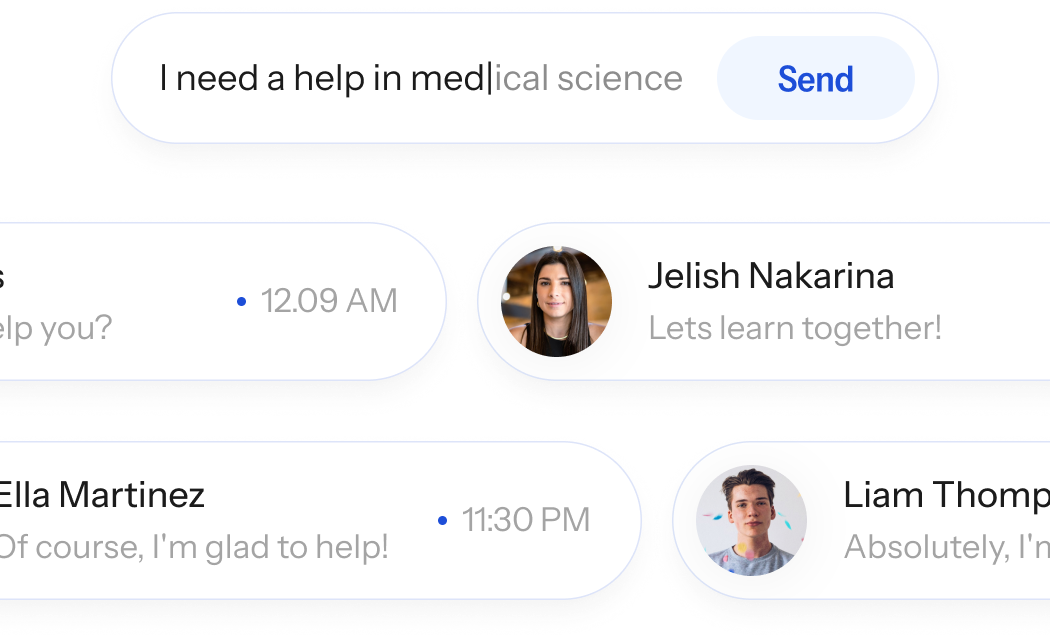
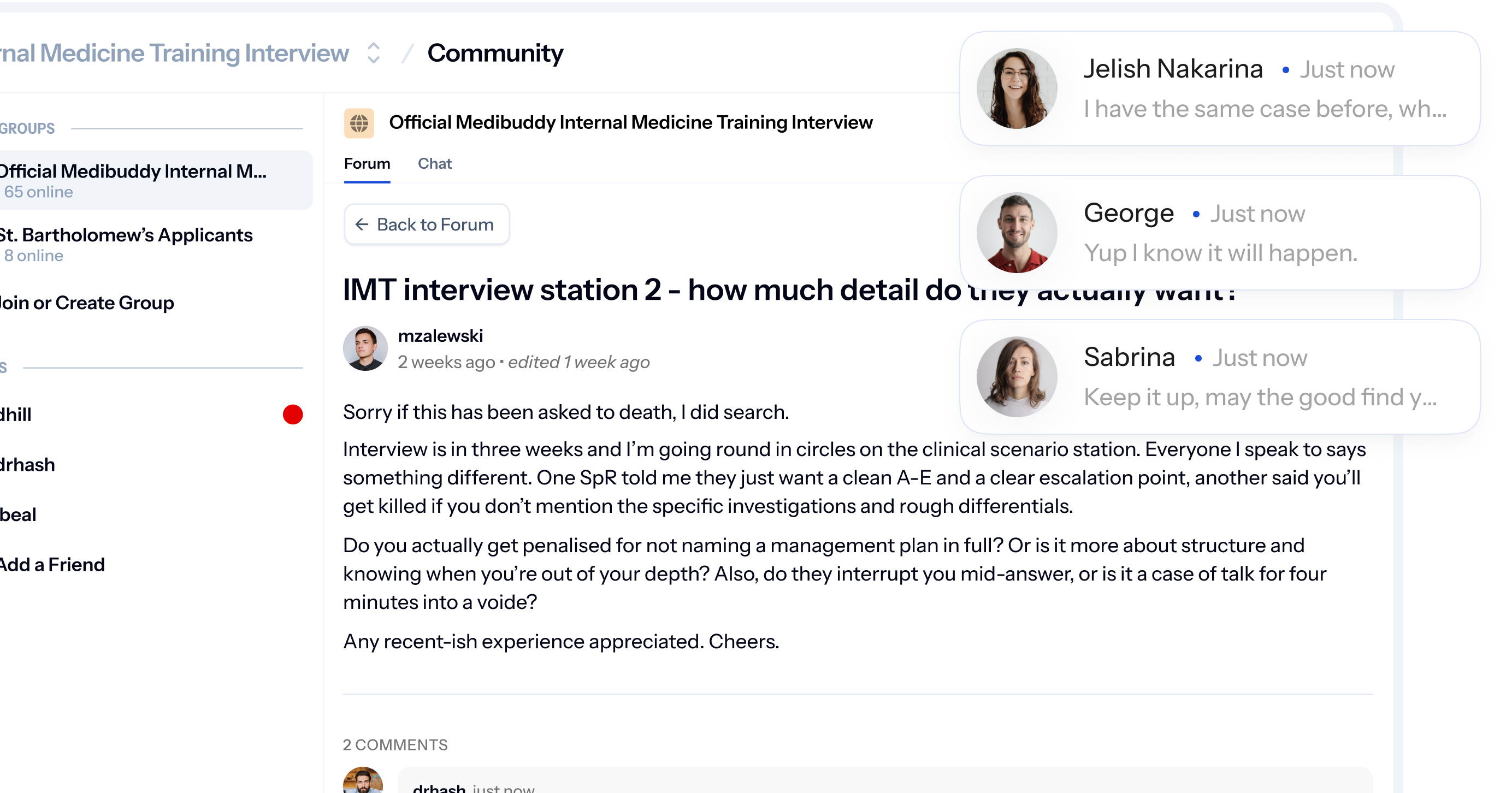
Study Groups
Connect with candidates across the country
Most people only ever practise with one or two friends. Study Groups connect you with candidates right across the country sitting the same interview.
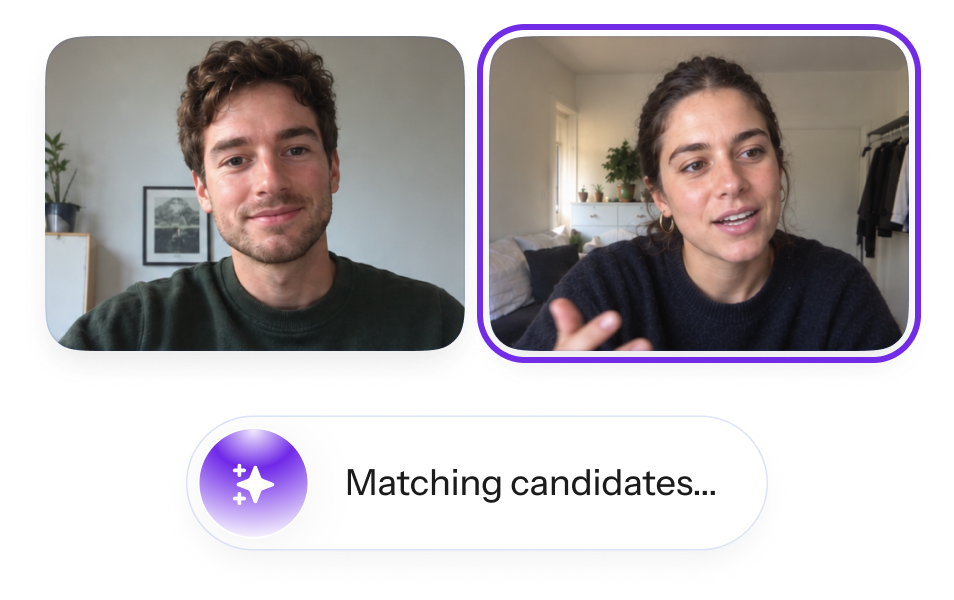
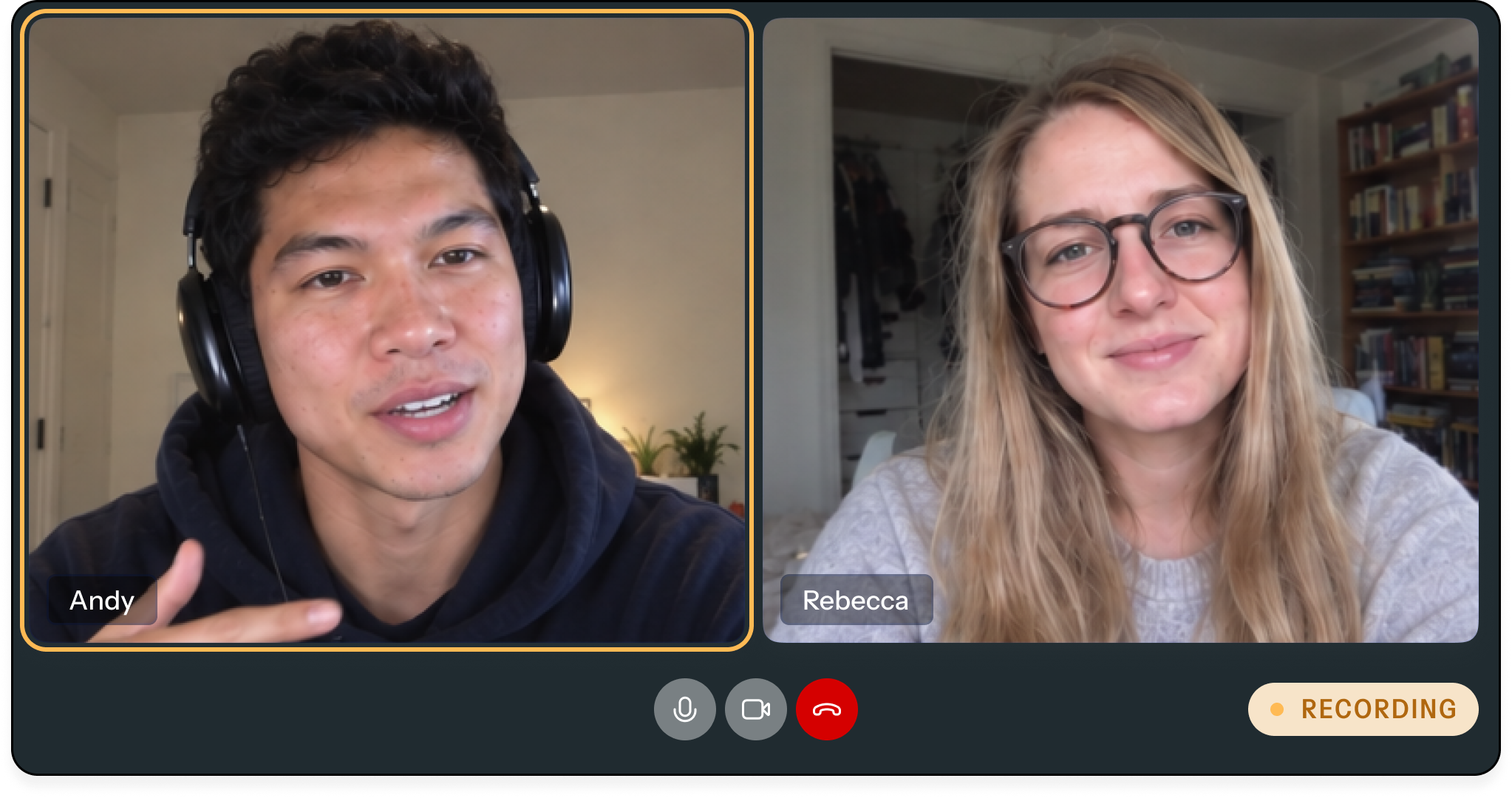
Live MocksBeta
Practise interview techniques with different candidates
Arrange or get matched on demand with other candidates and work through real scenarios out loud under interview conditions. Those who practise with a wide range of people tend to score the highest.
Peer FeedbackBeta
Reviewed by candidates across the platform
Submit your recorded mocks to candidates across the platform and get honest, varied feedback. Reviewing other people's mocks teaches you just as much.
The question bank, and other candidates to practise with, all in one platform.
Urology ST3 Revision Platform • £144.99
Gain access to over 40 scenarios, learn how to structure model answers, and collaborate with other candidates through Study Groups, Live Mocks and Peer Feedback.
The Revision Platform, plus the Urology ST3 Knowledge Course. A model answer shows you how to structure your response, while each Knowledge Course module teaches one key presentation in depth, so you can keep going when the panel asks challenging follow-up questions.
The Medibuddy 2027 Urology ST3 Interview Question Bank
Running out of time in the interview won't do you any favours, and with each station lasting just 13 minutes, you have a limited window to deliver answers that score the marks you need to progress. That means every bit of information you deliver has to have impact, and knowing how to structure each of your answers goes a long way towards that. That's why each of our 40-plus scenarios comes with model answers, so you know exactly how to approach and answer every question the interviewers throw your way.
What's inside
What's included in the Urology ST3 Interview Question Bank
There's nothing worse than getting to the interview and being presented with a scenario you've never seen before. The problem is that the interviewers have a huge catalogue of scenarios to choose from, so your best course of action is to revise all the potential topics that could come up. We provide a huge range of questions across all four stations, including all the common scenarios and even the more unusual ones that have come up in the past, so you don't get caught out.
Outpatients
Patient-centred scenarios that put symptom presentation ahead of disease, with answers that show how to score maximum points.
Emergency
Emergency urological situations that test teamwork, delegation and prioritisation, with focused questions on the topics that come up every year.
Communication
Situations that require you to break bad news and handle a missed diagnosis, with comprehensive model answers plus tips on picking up the marks candidates most often lose.
Clinical Skills
Detailed explanations and model answers for every clinical scenario, updated for the latest interview.
Updated for 2027
4 clinical skills scenarios updated and 2 new scenarios added.
Try it
Try an example Urology ST3 interview question
You are the ST3 running the haematuria clinic in a busy district general hospital. Your next patient is a 46-year-old woman with visible haematuria. Her CT KUB shows a small mass at the base of the bladder.
Question
How do you proceed?
Example answer
Haematuria is bladder or renal cancer until proven otherwise. I'd introduce myself and check the patient understands the reason for the referral, review the existing investigations, take a focused history, examine the patient, then perform a flexible cystoscopy. During the history I'd expect the nursing staff to process a urinalysis.
Focused urological history
Visible or non-visible haematuria: duration, initial or terminal, association with exertion
Duration and recurrence
Other symptoms: pain or fever, storage symptoms, recurrent UTIs
Red flags
Lower-limb swelling from lymphatic or venous obstruction, bone pain, weight loss, anorexia, confusion, and anuria from bilateral ureteric obstruction
Kidney disease, previous urological surgery, diabetes and other comorbidities; family history of urological cancer; allergies and anticoagulants
Examination
Full abdominal examination, as a large bladder tumour may present as a suprapubic mass. Women: external genitalia and PV. Men: external genitalia and DRE, which may reveal a pelvic mass
Investigations
Urinalysis. Non-visible haematuria: USS renal tract. Visible haematuria: CT urogram
Question
What are the indications for flexible cystoscopy?
Example answer
Haematuria, visible and non-visible
Sterile pyuria
Suprapubic pain
Recurrent UTIs
Other, for example botox instillation or difficult catheterisation
Question
How would you consent for a flexible cystoscopy?
Example answer
Confirm the patient's identity and explain the procedure using the BAUS information sheet.
Indication: to find the cause of the haematuria
Risks, usually self-limiting (always advise plenty of water afterwards): dysuria around 50%, frequency around 37%, haematuria around 19%, and UTI in around 3%
Alternative: rigid cystoscopy under GA, noting the anaesthetic risks
Give the patient the chance to ask questions, then complete and sign the consent form together
Question
Perform a flexible cystoscopy on the mannequin, explaining the steps as you go.
Example answer
Position the patient with the top half covered: men supine, women in lithotomy.
Clean the glans or labia with antiseptic and drape appropriately
Inject Instillagel into the urethral meatus
Ask the ODP to prepare the scope, flush it through with saline, and help hold it straight as the tip is inserted
Turn on the irrigation and, watching the screen, slowly advance the scope under direct vision, keeping the lumen in the centre of the screen
On entry to the bladder, fill it with saline and take in a global view as it fills
Deflect down to identify the ureteric orifices along the interureteric bar and inspect the trigone
Starting at the right UO, inspect the posterior wall, retract to the bladder neck, and repeat until the lateral and anterior walls are fully inspected
Complete the J-manoeuvre to view the urethral opening, then slowly retract, inspecting the bladder neck and prostate or external sphincter
Comment on: the urethra (narrowing, strictures, erythema), prostatic urethra, bladder neck, ureteric orifices, any abnormalities (diverticula, trabeculations, stones), and the bladder mucosa.
Question
What would you include in your operation note?
Example answer
Date and time
Indication
Findings
Plan
Follow-up or discharge
Sign and date
Question
Should prophylactic antibiotics be used for flexible cystoscopy?
Example answer
This is controversial. In the UK there's no national guideline and each hospital follows its own protocol. There isn't enough evidence to support routine prophylaxis, but it should be considered in immunocompromised patients or those with a suspected UTI.
Question
You identify a small 2cm papillary lesion in the trigone. How do you proceed?
Example answer
If possible, capture an image of the lesion with the scope's camera
Document the findings and explain them to the patient
Explain the next steps: rigid cystoscopy and TURBT to remove the lesion
Consent the patient in clinic using the BAUS leaflet
Introduce the patient to the bladder cancer nurse specialist
Question
Example answer
Flexible cystoscope
Distal end / light
Controls
Working channel
Lubricant (Instillagel / Optilube)
Integrated video and light cable
Question
Example answer
Monitor
Irrigation fluid
Scope connector
Not an exhaustive list: candidates should also recognise a flexible stent grasper for a stent-removal station, or a cystoscopy needle if the station involves bladder botox.
That's one scenario. There are over 40 more.
Urology ST3 Revision Platform • £144.99
Includes every scenario in the Question Bank, and access to Study Groups, Live Mocks with other candidates and Peer Feedback.
Scoring the highest marks in the Emergency and Clinical Skills stations requires a deep understanding of each presentation, and our video lectures give you the knowledge to handle those challenging follow-up questions.
The interviews change every year, and the biggest fear for any candidate is getting to interview day and realising you've revised with a question bank that's totally outdated.
That's why we review and update every Question Bank twice a year, so you can rest assured you're revising with scenarios that are likely to come up. We do this in April after the previous year's interviews, and again in October when the new recruitment guidance is published.
There were no structural changes to the Urology ST3 interview for 2027. However, after reviewing candidate feedback, we revised four clinical skills scenarios and added two further scenarios.
Updated for 2027 Interviews
Part 2 • Practise them live
The only interview resource where you can practise with other candidates from across the country
Our Urology ST3 Question Bank tells you exactly how to answer real interview scenarios. But how you practise with them will determine how many marks you score. Simply reading answers off a screen won't prepare you for the intense scrutiny you'll face in the interview. And only practising with the same few colleagues or friends limits the amount of feedback you'll get. Medibuddy gives you unique access to Urology ST3 candidates across the country, so you can learn from a variety of perspectives and hear a far wider range of feedback than your own circle could ever give you.
Study Groups
When you prepare in isolation, you're relying on your own interpretation of the interview process, which is one of the quickest ways to get found out on the day. Study Groups connect you with other doctors across the country who are also applying to Urology ST3, so you can engage and network with people preparing for the same interview as you. Everyone brings different experience from different hospitals and deaneries, meaning you won't ever miss out on the key bits of information that could swing the interview in your favour.
Live MocksBeta
Candidates who don't take part in mocks often struggle to adapt to the pressure of the interview. Your knowledge might be correct, but without convincing delivery the interviewers will score you poorly. The best way to improve your delivery is to take part in as many live mocks as possible, which is why we haven't put a cap on how many you can do. We also know how difficult it can be to organise mocks with other people, so all you have to do is join the waiting room and we'll match you with a different Urology ST3 candidate each time. Take turns as both the interviewer and candidate on real Question Bank scenarios, so you can see exactly how other candidates perform in real time, while refining your own interview technique.
Peer FeedbackBeta
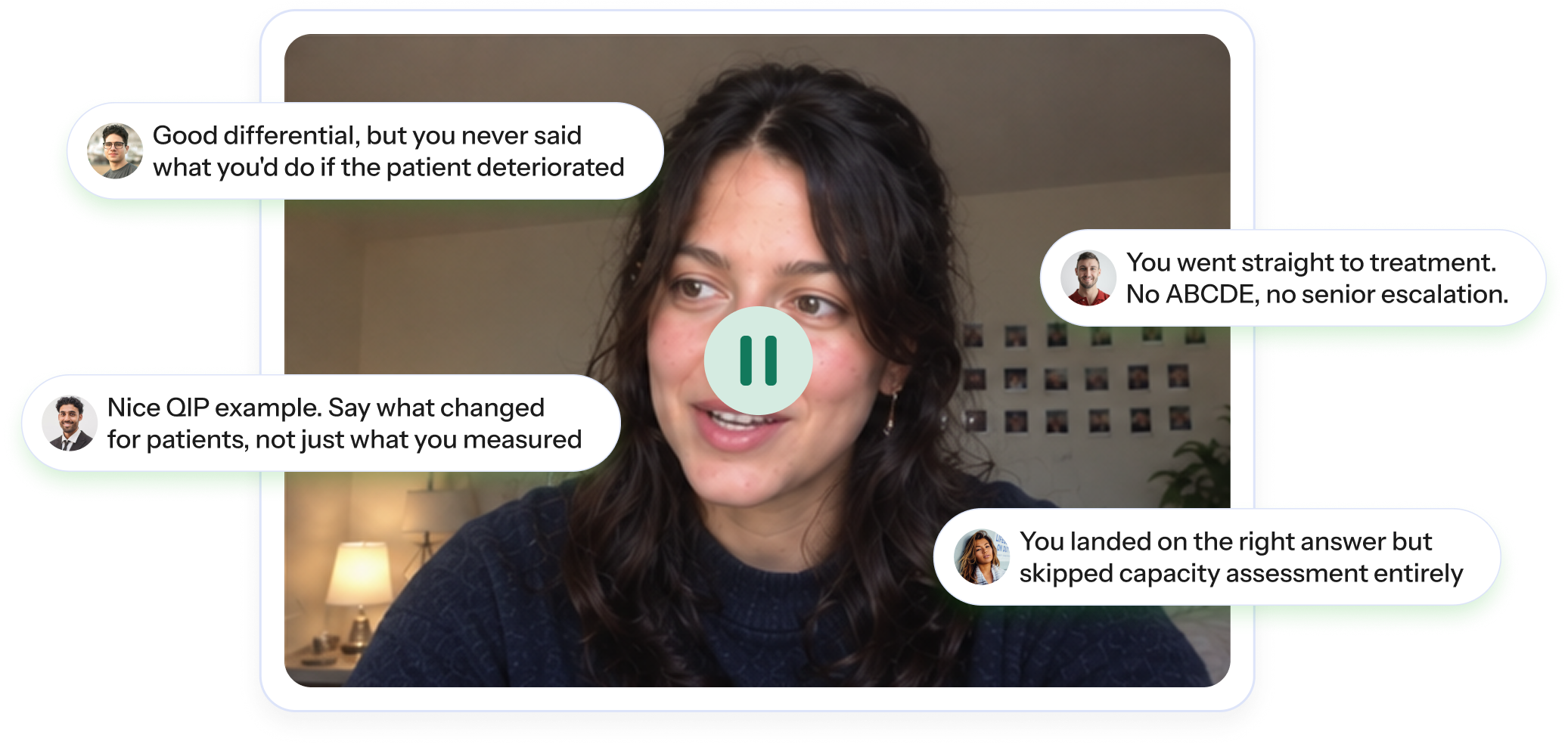
Preparing alone means you won't know how you're coming across during the interview. And preparing with the same few candidates means you'll miss opportunities to improve, which is why it's so important to get as many opinions as possible on your performance. With Medibuddy, you can record a mock and submit it for feedback from other candidates on the platform, so you receive a wider range of feedback and refine your answers with each person you practise with. Reviewing other people's mocks is just as valuable, as it shows you how strong candidates handle the same scenarios, which is one of the fastest ways to improve.
Pick your plan
Choose the Urology ST3 Revision Platform, the Knowledge Course, or both
The Revision Platform gives you access to the Question Bank and the chance to practise alongside other candidates, providing a foundation for your interview preparation. However, when you're doing well, interviewers will often throw in curve-ball questions to test the depth of your clinical knowledge. If you can't answer these questions, you won't get the top marks and your final ranking will suffer. The thing is, you can only answer them well if you really understand the topics, which is why we recommend adding our Urology ST3 Knowledge Course to your subscription (£44.99 saved if you buy both together).
What the Urology ST3 Knowledge Course covers
9 video lectures, around 6 hours, taught by specialty registrars who've been through Urology ST3 selection.
Acute Urinary RetentionPhimosis, Paraphimosis and PriapismBladder PathologiesFunctional and Female UrologyProstate PathologiesRenal PathologiesScrotal Pathologies
Every lecture covers:
Core clinical understanding
Presentation and recognition
Investigation and management principles
Safety considerations and complications
Watch a lecture before you buy
This is the Acute Urinary Retention lecture: how to assess and manage a patient in acute retention, the complications to watch for, and how to talk it through with the patient.
Brontë Paice, Urology SpR. Free to watch, no sign-up.
"The presentations were excellent for the purpose of interview preparation. The sessions covered the clinical aspects of the conditions covered."
Instant access on web and the Medibuddy app. The Revision Platform and the Bundle both include Study Groups, Live Mocks and Peer Feedback.
The interview
What to expect from the Urology ST3 interview
Urology is getting more competitive every year. In 2025 there were more than four candidates for every available post, making the interview more important than ever.
The interview lasts up to 60 minutes and consists of four 13-minute stations, with two minutes of additional reading time per station. It's designed to assess the criteria on the person specification.
Station 1
Outpatients Station
At an outpatient clinic you must prioritise a patient-centred approach, emphasising symptom presentation over disease. We provide detailed scenarios with model answers to help you get maximum points here.
Station 2
Emergency Station
Your ability to manage emergency urological situations is tested and requires you to demonstrate skills such as teamwork, delegation and prioritisation. We provide focused questions on the clinical topics that come up every year, so you can revise effectively.
Station 3
Communication Station
You're assessed on communication in situations such as breaking bad news and a missed diagnosis. Our examples give comprehensive answers plus tips on how to pick up points.
Station 4
Clinical Skills
The Clinical Skills Station has been reintroduced in recent years. We provide detailed explanations and model answers for every clinical scenario.
What the panel is looking for
The four stations are marked against the criteria on the Urology ST3 person specification, with communication assessed throughout. Our model answers are structured against those criteria, so you know exactly what a strong, well-organised answer looks like at each station.
Get ready
How to prepare for the Urology ST3 interview
Start with the Urology ST3 Question Bank
Work through over 40 scenarios across all four stations. Each scenario includes model answers from candidates who scored well in the 2026 interview. Start by reading how a strong answer is formed, then think about how you might deliver it.
Talk the hard ones through in Study Groups
Study groups are your biggest opportunity to network and connect with other candidates sitting the same interview as you. Everyone on the platform is in the same boat as you, so don't be scared to get involved and ask questions. After all, someone in your study group might just help you work through a scenario you've been struggling with.
Rehearse out loud in Live Mocks
Live mocks are where you begin to put everything you've learned into practice, and we know from experience that those who practise with a wide range of candidates usually do better. So organise mocks with people from one of your study groups, or get matched with a random Urology ST3 candidate, then take turns as interviewer and candidate using real scenarios until answering out loud under pressure feels normal.
Get reviewed with Peer Feedback
Once you've recorded a mock, you can have other members of the community review it. This allows you to see how you come across to other people, and gives you time to refine your delivery as you revise, rather than being caught out on the day. Reviewing other people's mocks is just as crucial, as you can see how other candidates navigate the same scenarios as you.
Build the clinical depth behind your answers
Your initial delivery might be perfect. However, without a deep clinical understanding of the topics, you won't be able to answer those tricky follow-up questions, and the interviewers won't give you the top marks. By adding the Urology ST3 Knowledge Course to your subscription, you'll gain access to 7 lectures that provide the in-depth knowledge needed to answer the most challenging curve-ball questions within the Emergency and Clinical Skills stations.
Questions
Frequently asked questions
What does the Urology ST3 interview involve?
The Urology ST3 interview lasts 60 minutes and consists of Outpatients, Emergency, Communication and Clinical Skills stations. Each station lasts 13 minutes and has two minutes of reading time.
How competitive is the Urology ST3 interview?
There were more than four candidates for every Urology ST3 post in 2025, and the process usually gets more competitive each year.
Who writes the model answers?
High-scoring candidates who sat the Urology ST3 interview in 2026 review and update all of our scenarios.
Can I practise with other candidates?
Yes. Every Revision Platform purchase gives you the opportunity to connect with other candidates through Study Groups, Live Mocks and Peer Feedback.
How do the Live Mocks work?
All you have to do is join the waiting room, and we match you with another Urology ST3 candidate. You can then take turns as an interviewer and candidate on real Question Bank scenarios, allowing you to gain experience answering out loud to a real person before you ever sit in front of the panel.
What are Study Groups and how do they help?
Study groups are community forums for doctors across the country preparing for the same Urology ST3 interview. You can ask questions, share what you're struggling with, and compare how you'd approach a scenario.
Can I get feedback on my interview performance?
Yes. After you've recorded a mock, you can ask other members to review it, allowing you to see which part of your answer needs fine-tuning.
How do you keep the Urology ST3 Question Bank up to date?
We update the question bank twice a year. In April, after that year's interviews, we review the scenarios and model answers against what candidates actually encountered on the day. We then review the question bank later in the year when the new recruitment guidance is published. For 2027, that meant four clinical skills scenarios were revised and two new scenarios were added.
Why use Medibuddy over other interview question banks?
We've spent 10 years preparing doctors for interviews, and the question bank is updated every year by editors who recently scored well in this interview. That means the scenarios always reflect this year's interview. And it doesn't just stop at a question bank. Every purchase includes access to Study Groups, Live Mocks and Peer Feedback, so you can revise alongside candidates across the country.
How long do I get access for?
Access runs for 12 months from the purchase date.
What's the difference between the Question Bank and the Knowledge Course?
The Question Bank includes 40+ scenarios with worked answers and all the live practice features. The Urology ST3 Knowledge Course teaches the clinical depth behind your answers. We find the most successful candidates at interview use both, and you can do the same for just £45 extra.
Start preparing for the Urology ST3 interview
The Revision Platform allows you to practise and refine over 40 interview scenarios with other candidates through Study Groups, Live Mocks and Peer Feedback.
Most candidates add the Knowledge Course for £45, which contains 7 video lectures on the urology presentations the panel follows up on hardest. It's the natural add-on if you want to score the highest marks.



 Close
Close




 Acute Urinary Retention
 Core clinical understanding
 Presentation and recognition
 Investigation and management principles
 Safety considerations and complications

