-
Pre-clinical
 If you have purchased a pre-clinical question bank for the 2025/26 academic year, login to your account here: app.medibuddy.co.uk
- Exams
- Interviews
- Crash Courses
- Professional Development
- Exams


 Close
Close
Build the Clinical Depth to Perform Confidently in the CST Interview (2026)
£89.99
Expires: 20 September, 2027

Knowledge course includes:
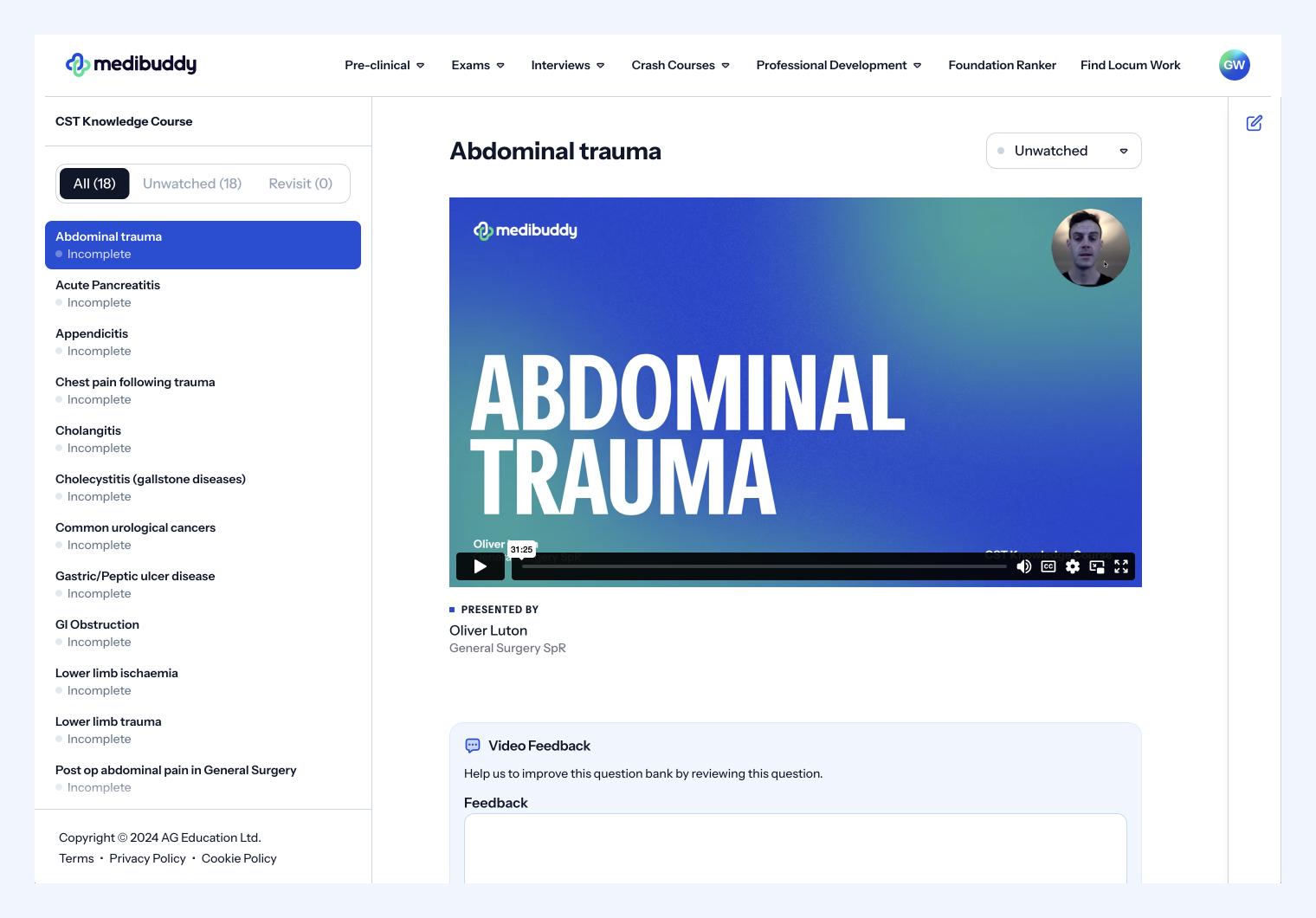
- 18 comprehensive video lectures
- Differentiate yourself as a top candidate
- Be prepared for all follow-up questions
£147.99
£179.98 total if both bought separately

Expires: 20 September, 2027
Buy our CST Question Bank in addition to our CST Clinical Knowledge Course to:
- Over 40 unique scenarios
- Clinical scenarios
- Management scenarios
- Portfolio
CST interviews test more than your ability to recall facts. They assess how well you reason through clinical scenarios and respond to follow-up questions under interview pressure.
Most candidates use question banks to rehearse common themes and familiar answer structures. This builds strong preparation for what to say first. But when an interviewer probes further, performance depends on genuine clinical depth, not just rehearsed content.
The Knowledge Course is designed to build that depth, so you can handle the unexpected questions that often determine where you finish on the ranking list.

Why a Question Bank Alone May Not Be Enough
Our CST Question Bank is designed to help you:
- Practise common surgical interview themes across clinical and management scenarios
- Structure and rehearse answers to familiar question types
- Build confidence with the CST interview format
This provides a strong foundation for what to say first.
However, interview performance often requires more. You may need to:
- Explain underlying pathophysiology and clinical reasoning in depth
- Handle curveball follow-up questions on complex or unexpected presentations
- Apply surgical knowledge confidently across multiple organ systems and specialties
These demands go beyond rehearsal. They require applied clinical understanding.
The Question Bank and Knowledge Course are designed to develop different parts of your interview preparation.


Many successful candidates use both resources together to combine structured practice with deeper clinical understanding.
Build the Clinical Foundation for Strong Interview Performance
The Knowledge Course is designed to complement your question practice by deepening the clinical understanding behind core CST topics.
Used together, the two resources help you:
- Structure answers with stronger clinical reasoning
- Handle follow-up questioning with greater confidence
- Move beyond scripted responses when presentations become more complex
- Apply knowledge across both clinical and management interview scenarios
This is what separates a prepared answer from a rounded one.

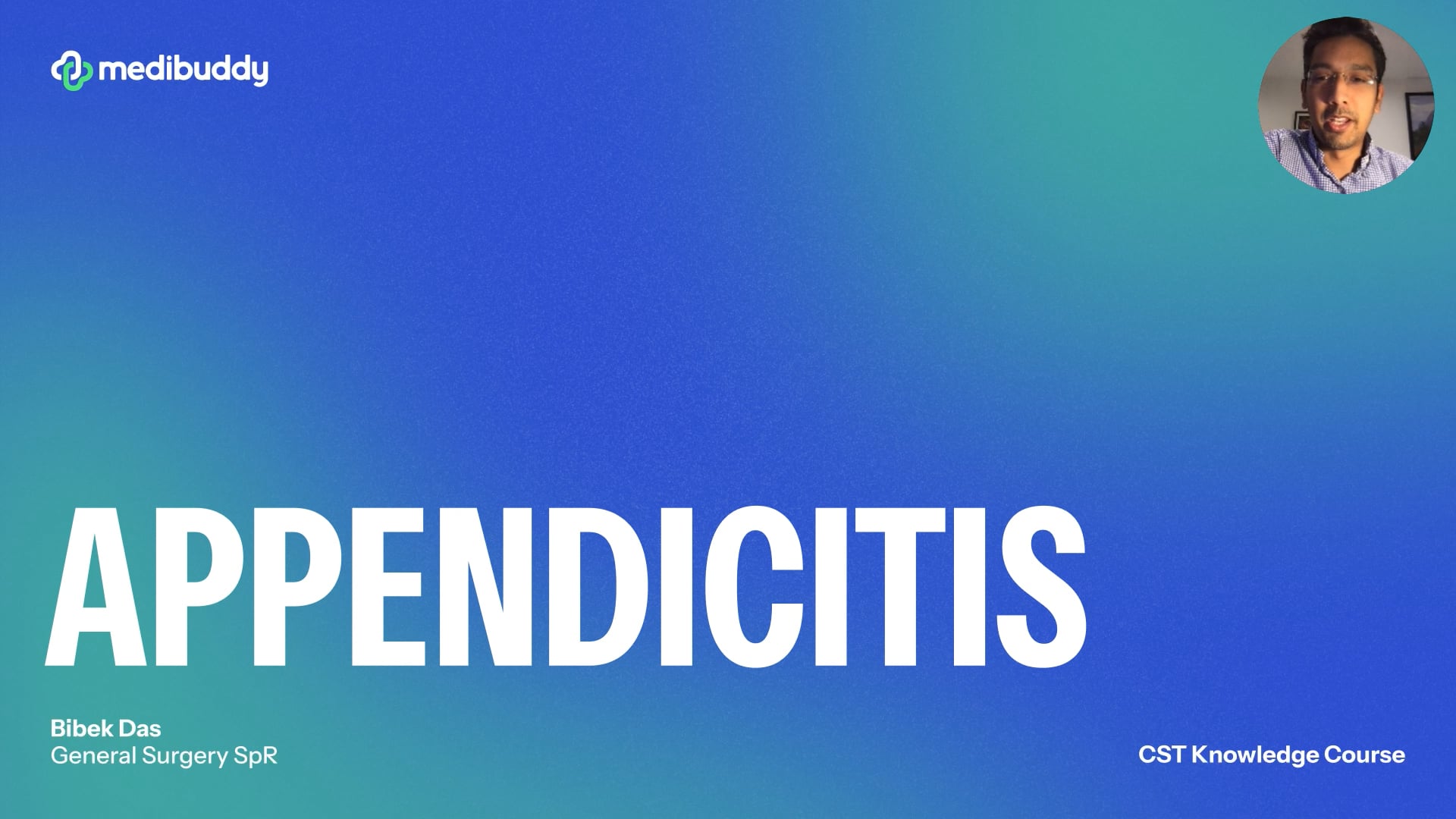
Watch Bibek's video on "Appendicitis" to experience the course format. The module covers an overview of appendicitis, including important examination findings, differential diagnoses, and the use of risk scoring and imaging to diagnose appendicitis.
What You'll Learn in the CST Knowledge Course
This course includes 18 comprehensive modules and nearly 10 hours of in-depth content, covering core CST interview topics across multiple surgical specialties.
Each module focuses on:
- Core clinical understanding
- Presentation and recognition
- Investigation and management principles
- Safety considerations and complications
Abdominal Trauma

Focus on assessing, diagnosing, and managing injuries to the abdomen, using surveys, imaging, and appropriate interventions to address shock and other complications
Acute Pancreatitis

Cover the symptoms, severity scoring, and management of pancreatitis, including understanding its pathophysiology and treatment for both uncomplicated and complicated cases
Appendicitis

Focus on the symptoms, diagnostic imaging, and management of appendicitis, including special considerations for children and pregnant women
Chest pain following Trauma

Address the assessment, imaging, and management of thoracic trauma, following ATLS guidelines for both surgical and non-surgical interventions
Cholangitis

Explore the causes, diagnostic investigations, and management of biliary infections, while differentiating them from other biliary pathologies
Gallstone diseases

Review the symptoms, diagnosis, and treatment options for cholecystitis, including management of both calculous and acalculous cases
GI Obstruction

Examine the symptoms, diagnostic approaches, and management strategies for gastrointestinal blockages, with both conservative and surgical options
Lower Limb Ischaemia

Focus on the causes, risk assessment, and management of acute and chronic limb ischaemia, covering a broad spectrum of presentations
Lower Limb Trauma

Address the assessment, diagnosis, and management of fractures, along with understanding potential complications and their immediate treatment
Peptic Ulcer Disease
Understand the pathophysiology, diagnostic investigations, and management strategies for ulcers, including both imaging and treatment options
Post op drowsiness

Cover the approach to managing drowsiness in post-operative patients, focusing on diagnosis, imaging, and treating common causes, with attention to vulnerable groups
Post op abdominal pain in General Surgery

Examine the differential diagnoses and management plans for patients presenting with post-operative abdominal pain
Pyelonephritis

Recognise the symptoms, perform investigations, and manage both uncomplicated and complicated kidney infections
Pyrexia in General Surgery
Focus on assessing, investigating, and managing fever in post-operative patients, including special scenarios and underlying causes
Renal Colic

Cover the symptoms, diagnosis, and treatment options for kidney and ureteric stones, particularly uncomplicated cases
Supracondylar Fracture of the Humerus
Review the anatomy, classification, and management of fractures, with a focus on emergency and definitive care
Upper GI Bleed

Examine the symptoms, diagnostic scoring systems, and management of variceal and ulcer-related bleeding, with strategies to prevent re-bleeding
Urological Cancers
Focus on the common types, diagnostic workup, and management strategies for suspected cancers in the urinary tract system
Learn From Doctors With Recent Experience of the Process
The course is taught by experienced registrars across surgical specialties who have recently completed the CST selection process.
Teaching is based on recent, practical experience of:
- The format and expectations of CST clinical and management interview stations
- Commonly tested surgical presentations and how they are explored in follow-up questions
- The level of clinical detail that distinguishes high-scoring answers
- How surgical knowledge is applied when candidates face unexpected or complex scenarios
The focus is on helping you translate clinical understanding into clear, structured responses under interview conditions.
Why This Course Matters More Than Ever
CST remains one of the most competitive training programmes in the UK. In 2025, there were 5,399 applicants competing for just 630 posts, with over 2,000 more candidates than the previous year competing for 15 fewer available positions.
In this context, success depends not just on preparation, but on:
- Clarity of thought
- Structured delivery
- Safe clinical reasoning under pressure
£89.99
Expires: 20 September, 2027
Knowledge course includes:
- 18 comprehensive video lectures
- Differentiate yourself as a top candidate
- Be prepared for all follow-up questions
£147.99
£179.98 total if both bought separately
Expires: 20 September, 2027
Buy our CST Question Bank in addition to our CST Knowledge Course to:
- Access over 40 unique scenarios
- Includes Clinical scenarios
- Includes Management/Presentation scenarios
Frequently Asked Questions
Who Is This Course For?
This course is designed for candidates applying to CST who want to:
- Strengthen clinical understanding beyond question practice
- Improve structure and clarity in answers
- Handle follow-up questioning more confidently
- Combine knowledge with interview technique
- Perform more consistently across clinical and management interview scenarios
It is designed to work alongside the CST Question Bank.
What Is a CST Knowledge Course?
The Knowledge Course is a structured video-based course covering core surgical topics that commonly arise in CST interview discussions, across both clinical and management station scenarios.
Rather than focusing on memorising model answers, it focuses on:
- Understanding the underlying clinical and pathophysiological principles behind each topic
- Applying knowledge to structured surgical interview scenarios
- Developing clear, logical reasoning for follow-up discussions on complex presentations
Who Delivers the Knowledge Course?
The course is delivered by registrars across surgical specialties who have recently completed the CST selection process, providing practical insight into how clinical knowledge is tested in the interview setting.
Do I Need the Question Bank as Well?
The Knowledge Course and Question Bank work best together. The CST Question Bank helps you practise structuring answers across clinical and management scenarios, while the Knowledge Course builds the clinical understanding behind those answers. Purchased as a bundle, you save £30 compared to buying both separately.
Prepare with Structure, Not Guesswork
Question practice prepares you for what to say first. Clinical understanding prepares you for where the interview goes next. The Knowledge Course is designed to bridge that gap, helping you develop the depth to handle curveball questions with clarity and structure. Used alongside the Question Bank, it gives you both the practice and the clinical foundation needed for stronger CST interview answers.
£89.99
Expires: 20 September, 2027
Knowledge course includes:
- 18 comprehensive video lectures
- Differentiate yourself as a top candidate
- Be prepared for all follow-up questions
£147.99
£179.98 total if both bought separately
Expires: 20 September, 2027
Buy our CST Question Bank in addition to our CST Knowledge Course to:
- Over 40 unique scenarios
- Clinical scenarios
- Management scenarios
- Portfolio
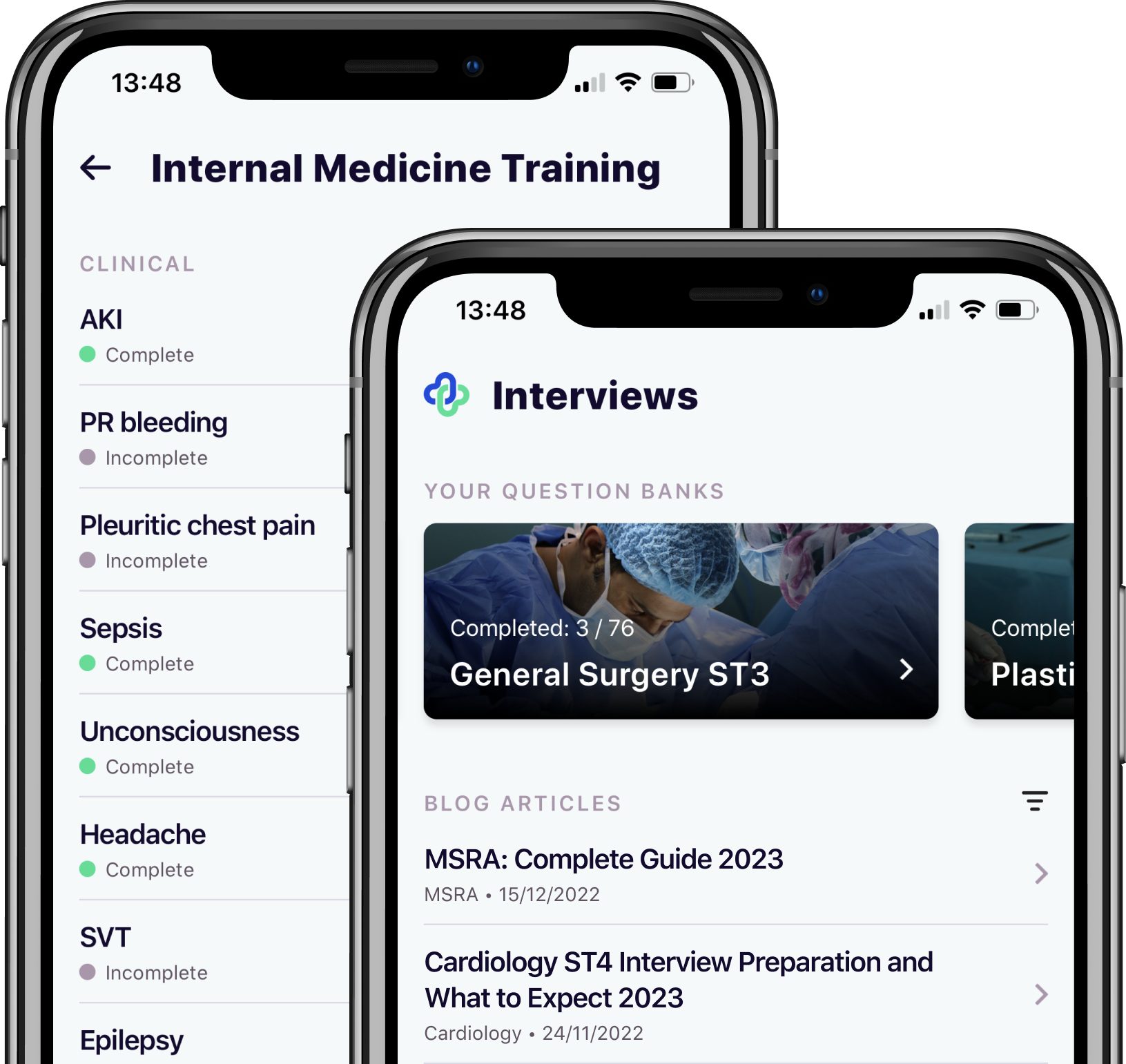
Take your subscriptions with you
Our mobile app allows you to access your interview and exam question banks wherever you are.