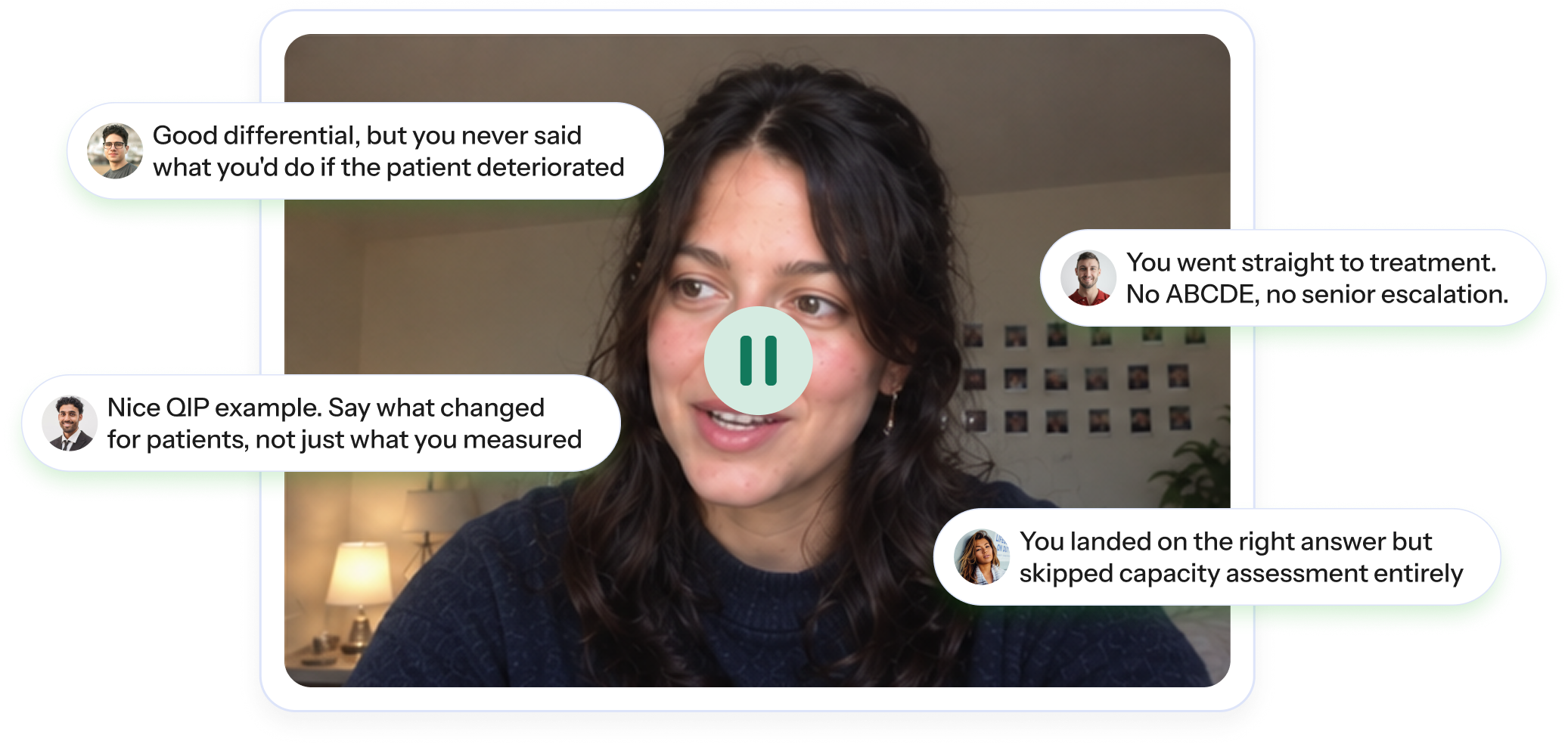
Emergency Medicine ST3 Interview Question Bank - Medibuddy
Emergency Medicine ST3 • 2027 Interview

The 2027 Emergency Medicine ST3 Interview Revision Platform: Question Bank, Live Practice and Mocks with Other Candidates

The Medibuddy Emergency Medicine ST3 Question Bank includes over 30 scenarios that closely mirror the real interview, each with a model answer written/edited by high-scoring candidates who sat the Emergency Medicine ST3 interview in 2026.

However, knowing a strong answer isn't the same as delivering it well under pressure, which is why we provide:

10 years’ experience preparing doctors for interviews

Users of the Medibuddy Emergency Medicine ST3 Revision Platform have secured some of the most competitive training jobs in recent rounds. Ask around, there's a good chance the trainees in the year above you used us too.

Always up to date

Did you know the interviews change every year? That's why we review and update every Question Bank on the platform twice a year, so you know you're always practising with scenarios based on the latest interview structure.

Network and practise real interview scenarios with other candidates

Question Bank

See every scenario, and how to answer it well

Over 30 scenarios across all three stations, which tell you exactly how to respond to each question.
Study Groups

Connect with candidates across the country
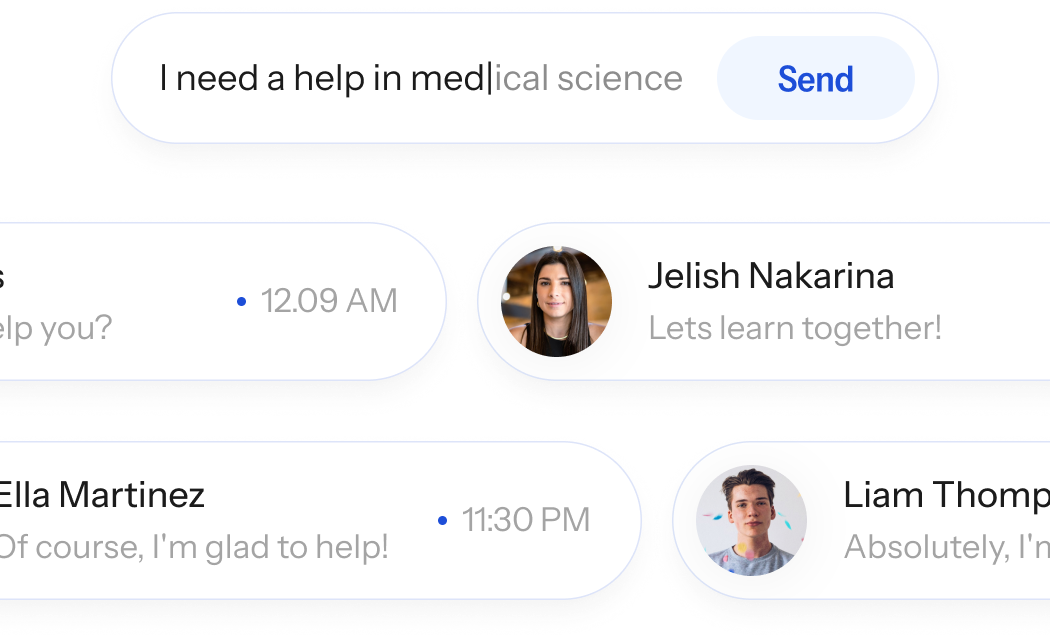
Most people only ever practise with one or two friends. Study Groups connect you with candidates right across the country sitting the same Emergency Medicine ST3 interview.
Live MocksBeta

Practise interview technique with different candidates
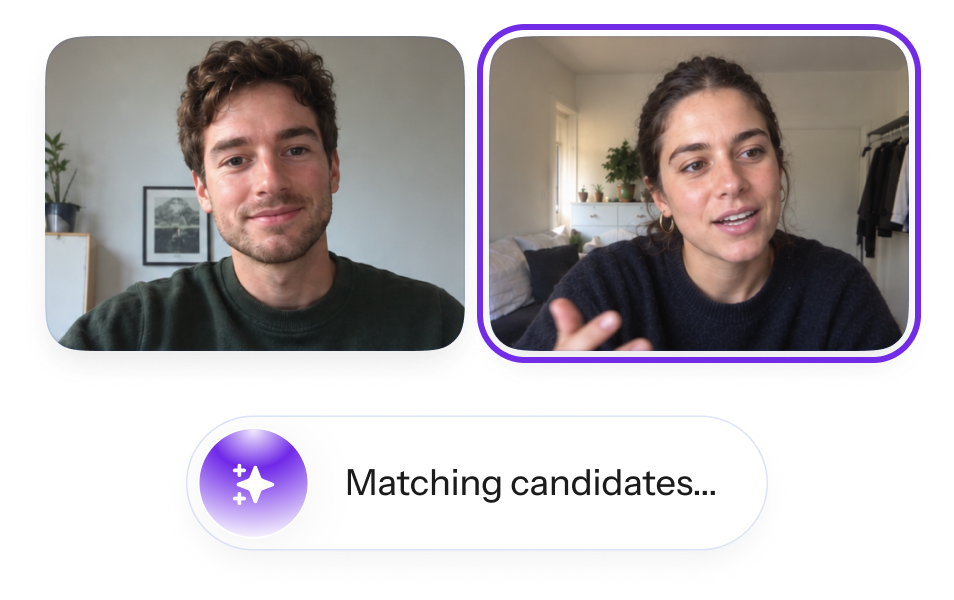
Arrange or get matched on demand with other candidates and run real scenarios out loud under interview conditions. Those who practise with the widest range of people tend to score the highest.
Peer FeedbackBeta

Reviewed by candidates across the platform
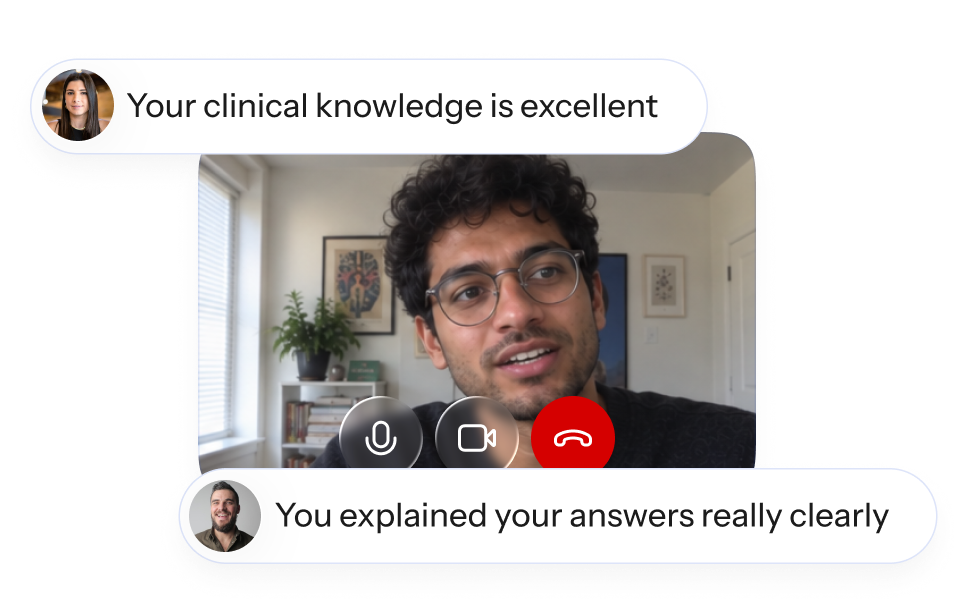
Submit your recorded mocks to candidates across the platform and get honest, varied feedback. Reviewing other people's mocks teaches you just as much.

The question bank, and other candidates to practise with, all in one platform.

Emergency Medicine ST3 Revision Platform • £144.99

Gain access to over 30 scenarios across all three stations, and collaborate with other candidates through Study Groups, Live Mocks and Peer Feedback.
Get instant access
What candidates say

Scored well, secured their post

A few of the candidates who prepared with us for the Emergency Medicine ST3 interview.

Verified candidateInterviewed 2026
"The clinical and ethical scenarios were pitched exactly right. Having a structure ready meant I could work through a tough resus scenario calmly under pressure."
Secured first-choice deanery
Verified candidateInterviewed 2026
"Practising the prioritisation and communication stations out loud with other candidates was the single most useful thing I did before the day."
Ranked highly
Part 1 • See the questions

The Medibuddy 2027 Emergency Medicine ST3 Question Bank

Each of the three interview stations lasts for 10 minutes, so you have a limited window to deliver the high-scoring answers you need to do well. That means every point has to land, and knowing how to structure each answer is essential. That's why each of our 30-plus scenarios comes with a model answer, written by candidates who scored highly in the 2026 Emergency Medicine ST3 interview, so you know exactly how to approach every question the interviewers throw your way.
What's inside

What's included in the Emergency Medicine ST3 Question Bank

There's nothing worse than getting to the interview and being handed a scenario you've never seen before. The panel will assess you on clinical, ethical, prioritisation and communication themes across the three stations, so the safest approach is to revise across all of them. We provide scenarios for every part of the interview, including the common ones and the more unusual cases that have come up before, so you don't get caught out.

Clinical Scenarios

Deteriorating patients and emergency presentations where you play the ST3: assess, reason and manage safely, each with a worked answer showing how to structure your response.

Ethical Scenarios

Real emergency department dilemmas, from risk and consent to confidentiality and capacity, with structured model answers so you can reason through them clearly on the day.

Prioritisation

High-pressure scenarios on ordering patient care, allocating limited resources and managing several emergencies at once, with model answers that show safe, logical decision-making.

Communication

Scenarios on communicating with patients, families and colleagues, with worked answers showing how to stay clear, calm and effective under pressure.
Reflecting how emergency medicine is really assessed
The clinical and ethical scenarios sit together in one station, and communication runs through everything you say. Our model answers are written with that in mind, alongside the prioritisation theme.
Try it

Try an example Emergency Medicine ST3 question

You are the ST3 working a backshift in the emergency department. Police and ambulance staff bring a man into the resuscitation room. His identity is unknown: he was found wandering into traffic at a nearby junction and refused to co-operate when police tried to move him from the road.

The ambulance crew has only limited information, as he is combative and refusing even basic observations.

How would you approach this?

Question
How would you initially approach this patient?
Example answer
I would split my response into organisational and clinical actions.
  • Organisational: this needs several team members to manage safely, so I would keep the police present to maintain control if needed, and make sure the nurse in charge and consultant in charge are aware, as it needs senior support.
  • De-escalation: attempt verbal de-escalation first, which also lets me assess his airway, breathing and conscious level.
  • Clinical: a full A to E assessment looking for obvious causes of agitation such as hypoxia, head injury, hypoglycaemia, a post-ictal state or intoxication, and an assessment of his capacity to refuse treatment.
Question
What information would you want from the ambulance crew and police?
Example answer
A history from the patient is often impossible, so a thorough collateral history matters.
  • When the agitation started or was first noticed.
  • What has been tried to de-escalate it, including any medications.
  • Any assessment of his capacity to refuse care.
  • Any restraint used, including its nature and duration.
  • Police involvement, specifically whether a controlled energy device such as a Taser was used, and any injuries before or during restraint.
Question
What are the possible causes, and how would you identify them?
Example answer
This is acute behavioural disturbance, the RCEM term, and there may be more than one cause. Treating it as an entity gives a framework.
  • Intoxication or withdrawal: one of the commonest causes, suggested by a smell of alcohol, abnormal pupils or stigmata of drug use.
  • Mental health crisis: also common, but considered only after organic causes are excluded.
  • Organic causes: hypoxia, hypoglycaemia, sepsis (more likely in older patients), head injury such as an extradural haemorrhage with a lucid interval, a post-seizure state, serotonin syndrome (pyrexia, clonus, altered consciousness), neuroleptic malignant syndrome, and electrolyte disturbance.
Question
How would you approach restraint or tranquillisation?
Example answer
The key step is establishing whether he has capacity to refuse assessment and treatment.
  • If he lacks capacity, is non-compliant with necessary care, and poses a risk to himself or others, he is more likely to need restraint or tranquillisation.
  • Use the least restrictive option for the shortest time. If prolonged physical restraint is needed, consider rapid tranquillisation for everyone's safety.
  • Rapid tranquillisation is usually given intramuscularly, as he is unlikely to allow cannulation. RCEM recommends IM ketamine or droperidol in severe cases, with continuous monitoring, ideally in a resus bay.
  • If he needs a general anaesthetic to be managed safely, I would avoid suxamethonium (hyperkalaemia risk after prolonged restraint) and fentanyl (serotonin syndrome risk).
Question
He is tranquillised with IM ketamine and is now safe to assess. What investigations would you do?
Example answer
I would tailor investigations to the likely cause, but broadly:
  • Vital signs, including end-tidal CO2 after sedation, and a blood gas.
  • FBC, U and E, calcium, magnesium, LFTs, troponin, CK and a coagulation screen, with blood cultures if he is pyrexial.
  • An ECG and a toxicology screen, a metabolic screen if indicated, and cross-sectional imaging if there is any suggestion of trauma.
  • Review his past medical history once his identity and records are available.
Question
What would you make sure to record in the notes?
Example answer
RCEM recommends documenting the key aspects of ABD care.
  • The collateral history and the features suggesting ABD.
  • Attempts to de-escalate, and the assessment of mental capacity.
  • Any restraint applied, with its duration and indication.
  • Police involvement, including the use of energy devices.
  • Sedatives given and any adverse reaction, and the involvement of other specialties such as critical care and the mental health team.

That's one scenario. There are over 30 more.

Emergency Medicine ST3 Revision Platform • £144.99

Includes every scenario in the Question Bank, and access to Study Groups, Live Mocks with other candidates and Peer Feedback.
Get instant access
Actively maintained

How we keep our Question Banks up to date

The Emergency Medicine ST3 interview changes from year to year, and the biggest fear for any candidate is getting to interview day and realising you've revised with a question bank that's totally outdated.

That's why we review and update every Question Bank twice a year, so you know you're revising with scenarios that are likely to come up. We do this in April after the previous year's interviews, and again in the autumn when the new recruitment guidance is published.

For 2027, this process kept the Question Bank aligned with the current three-station format, across the clinical and ethical, prioritisation and communication stations, so you always practise with the format the panel is using now.
Updated for 2027 Interviews
Part 2 • Practise them live

The only interview resource where you can practise live with other candidates from across the country

Our Emergency Medicine ST3 Question Bank tells you exactly how to answer real interview scenarios. But how you practise with them will determine how many marks you score. Simply reading answers off a screen won't prepare you for the intense scrutiny you'll face in the interview. And only practising with the same few colleagues or friends limits the amount of feedback you'll get. Medibuddy gives you unique access to Emergency Medicine ST3 candidates across the country, so you can learn from a variety of perspectives and hear a far wider range of feedback than your own circle could ever give you.
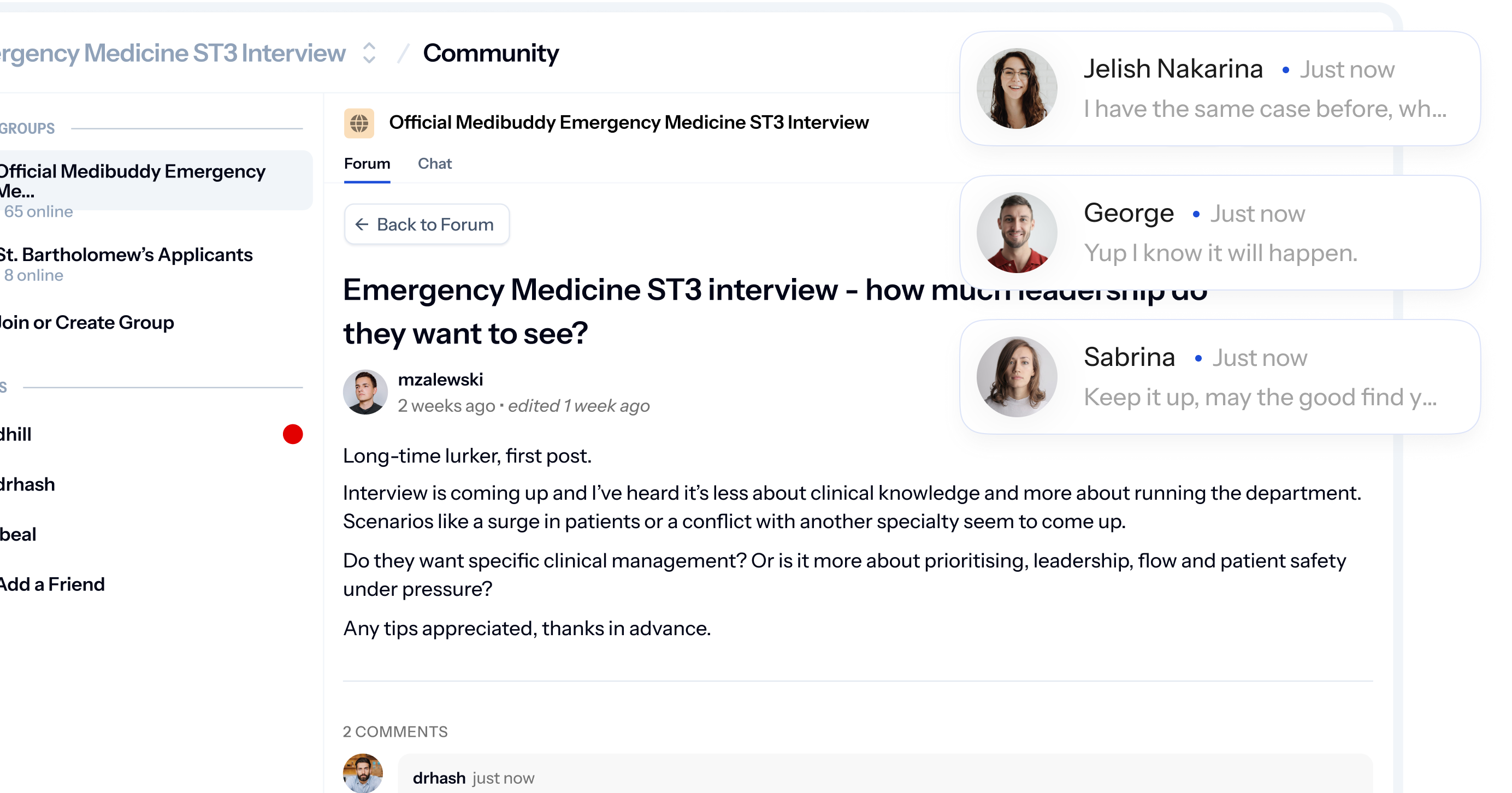
Study Groups
When you prepare in isolation, you're relying on your own interpretation of the interview process, which is one of the quickest ways to get found out on the day. Study Groups connect you with other doctors across the country who are also applying to Emergency Medicine ST3, so you can engage and network with people preparing for the same interview as you. Everyone brings different experience from different hospitals and deaneries, meaning you won't ever miss out on the key bits of information that could swing the interview in your favour.
Live MocksBeta
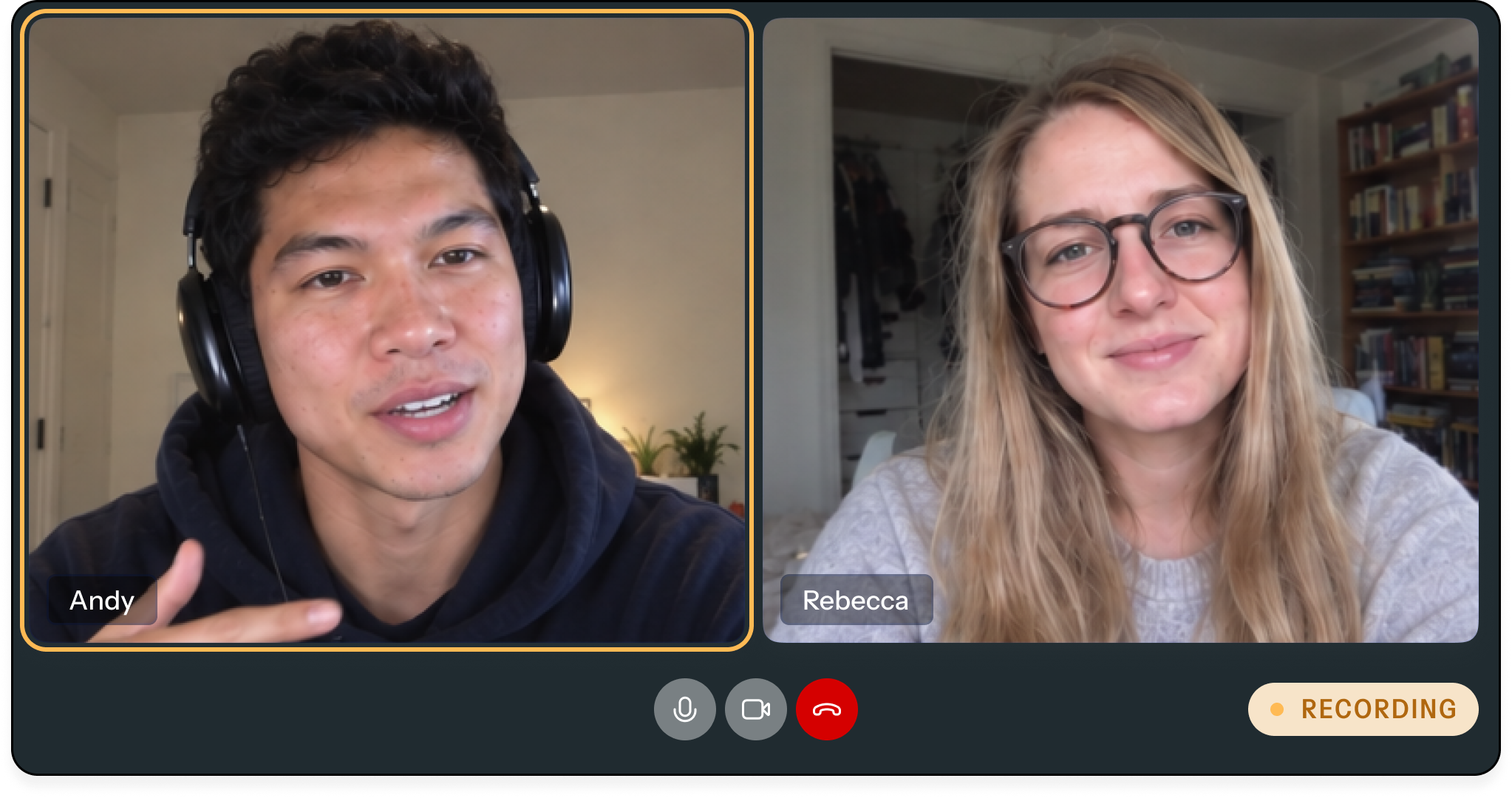
Candidates who don't take part in mocks often struggle to adapt to the pressure of the interview. Your knowledge might be correct, but without convincing delivery the interviewers will score you poorly. The best way to improve your delivery is to take part in as many live mocks as possible, which is why we haven't put a cap on how many you can do. We also know how difficult it can be to organise mocks with other people, so all you have to do is join the waiting room and we'll match you with a different Emergency Medicine ST3 candidate each time. Take turns as both the interviewer and candidate on real Question Bank scenarios, so you can see exactly how other candidates perform in real time, while refining your own interview technique.
Peer FeedbackBeta
Preparing alone means you won't know how you're coming across during the interview. And preparing with the same few candidates means you'll miss opportunities to improve, which is why it's so important to get as many opinions as possible on your performance. With Medibuddy, you can record a mock and submit it for feedback from other candidates on the platform, so you receive a wider range of feedback and refine your answers with each person you practise with. Reviewing other people's mocks is just as valuable, as it shows you how strong candidates handle the same scenarios, which is one of the fastest ways to improve.
The interview

What to expect from the Emergency Medicine ST3 interview

Emergency medicine is a competitive specialty, and strong applicants are often separated by narrow margins at interview.

Station 1

Clinical & Ethical Scenarios

A scenario testing how you manage clinical and ethical challenges, often real emergency department situations such as a deteriorating patient, managing risk, or a dilemma involving confidentiality or consent.
Station 2

Prioritisation

Assesses how you prioritise under pressure: deciding the order of patient care, allocating limited resources, and managing several emergencies at once.
Station 3

Communication

Tests your ability to communicate effectively, whether with patients, their families or colleagues, clearly and with empathy.

How the interview is scored

The stations are marked against the Emergency Medicine ST3 person specification. Our model answers are structured against those criteria, so you know exactly what a strong, well-organised answer looks like at each station.
Get ready

How to prepare for the Emergency Medicine ST3 interview

Start with the Question Bank

Work through over 30 scenarios across all three stations, each with a worked answer from a candidate who scored well in the 2026 interview. Start by reading how a strong answer is formed, then think about how you'd deliver it.

Talk the hard ones through in Study Groups

Study Groups are your biggest opportunity to network and connect with other candidates sitting the same interview as you. Everyone on the platform is in the same boat, so don't be scared to get involved and ask questions. Someone in your study group might just help you work through a scenario you've been struggling with.

Rehearse out loud in Live Mocks

Live mocks are where you begin to put everything you've learned into practice, and we know from experience that those who practise with a wide range of candidates usually do the best. Organise mocks with people from one of your study groups, or get matched with a random Emergency Medicine ST3 candidate, then take turns as interviewer and candidate using real scenarios until answering out loud under pressure feels normal.

Get reviewed with Peer Feedback before the day

Once you've recorded a mock, you can have other community members review it. This lets you see how you come across to other people, and gives you time to refine your delivery as you revise, rather than being caught out on the day. Reviewing other people's mocks is just as crucial, as you see how other candidates navigate the same scenarios.
Questions

Frequently asked questions

What does the Emergency Medicine ST3 interview involve?
Three 10-minute stations that take around 30 minutes, including Clinical and Ethical Scenarios, Prioritisation, and Communication. Each assesses a different mix of clinical reasoning, safe decision-making and communication.
How competitive is the Emergency Medicine ST3 interview?
Competitive. Strong candidates are frequently separated by small margins at interview, which is why a structured, well-rehearsed approach matters.
Who writes the model answers?
High-scoring candidates who sat the Emergency Medicine ST3 interview in 2026 and secured some of the most competitive jobs.
Can I practise with other candidates?
Yes. Every Revision Platform purchase gives you the opportunity to connect with other candidates through Study Groups, Live Mocks and Peer Feedback.
How do the Live Mocks work?
All you have to do is join the waiting room, and we match you with another Emergency Medicine ST3 candidate. You then take turns as interviewer and candidate on real Question Bank scenarios, so you gain experience answering out loud to a real person before you ever sit in front of the panel.
What are Study Groups and how do they help?
Study Groups are community forums for doctors across the country preparing for the same Emergency Medicine ST3 interview. You can ask questions, share what you're struggling with, and compare how you'd approach a scenario.
Can I get feedback on my interview performance?
Yes. After you've recorded a mock, you can ask other members to review it, so you can see which part of your answer needs fine-tuning.
How do you keep the Emergency Medicine ST3 Question Bank up to date?
We review and update it twice a year: in April after that year's interviews, and again in the autumn when the new recruitment guidance is published, so you always practise with the current three-station format.
How long do I get access for?
Access runs for 12 months from the purchase date.

Start preparing for the Emergency Medicine ST3 interview

The Revision Platform gives you over 30 scenarios to practise and refine with other candidates through Study Groups, Live Mocks and Peer Feedback.

Emergency Medicine ST3 Revision Platform • £144.99

Buy Now