Acute Internal Medicine ST4 Interview Question Bank | Medibuddy
Acute Internal Medicine ST4 • 2027 Interview

The 2027 Acute Internal Medicine ST4 Interview Revision Platform: Question Bank, Live Practice and Mocks with Other Candidates

The Medibuddy Acute Internal Medicine ST4 Question Bank includes over 50 scenarios that closely mirror the real interview, each with a model answer written/edited by high-scoring candidates who sat the Acute Internal Medicine ST4 interview in 2026.

However, knowing a strong answer isn't the same as delivering it well under pressure, which is why we provide:

10 years’ experience preparing doctors for interviews

Users of the Medibuddy Acute Internal Medicine ST4 Revision Platform have secured some of the most competitive training jobs in recent rounds. Ask around, there's a good chance the trainees in the year above you used us too.

Always up to date

Did you know the interviews change every year? That's why we review and update every Question Bank on the platform twice a year, so you know you're always practising with scenarios based on the latest interview structure.

Network and practise real interview scenarios with other candidates

Question Bank

See every scenario, and how to answer it well

Over 50 scenarios across both interview stations, which tell you exactly how to respond to each question.
Study Groups

Connect with candidates across the country
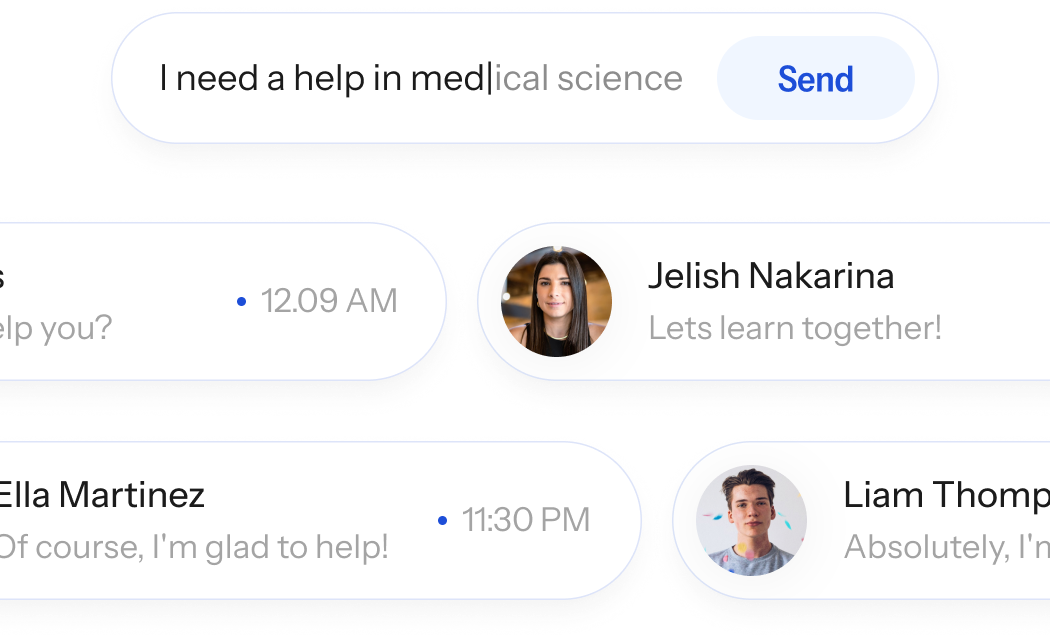
Most people only ever practise with one or two friends. Study Groups connect you with candidates right across the country sitting the same Acute Internal Medicine ST4 interview.
Live MocksBeta

Practise interview technique with different candidates

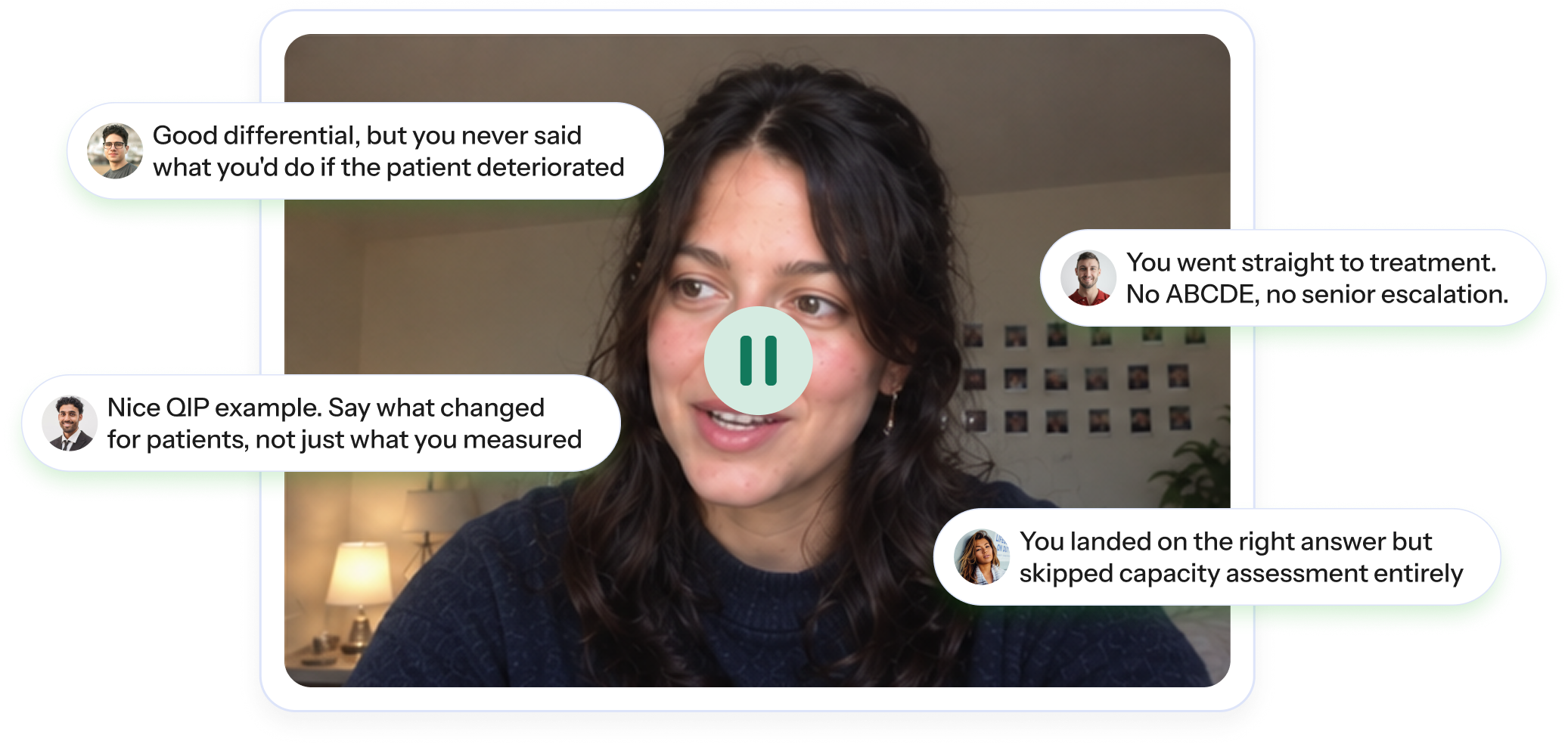
Arrange or get matched on demand with other candidates and run real scenarios out loud under interview conditions. Those who practise with the widest range of people tend to score the highest.
Peer FeedbackBeta

Reviewed by candidates across the platform

Submit your recorded mocks to candidates across the platform and get honest, varied feedback. Reviewing other people's mocks teaches you just as much.

The question bank, and other candidates to practise with, all in one platform.

Acute Internal Medicine ST4 Revision Platform • £144.99

Gain access to over 50 scenarios across both stations, and collaborate with other candidates through Study Groups, Live Mocks and Peer Feedback.
Get instant access
What candidates say

Scored well, secured their post

A few of the candidates who prepared with us for the Acute Internal Medicine ST4 interview.

Verified candidateInterviewed 2026
"The clinical scenarios were pitched exactly right. Having a clear structure ready meant I could work through a deteriorating patient calmly instead of freezing."
Secured first-choice deanery
Verified candidateInterviewed 2026
"Practising the registrar suitability questions out loud with other candidates was the single most useful thing I did before the day."
Ranked highly
Part 1 • See the questions

The Medibuddy 2027 Acute Internal Medicine ST4 Question Bank

The interview has two stations with four questions, each lasting around 7 to 8 minutes, so you only have a limited window to deliver the high-scoring answers you need to do well. That means every point has to land, and knowing how to structure each answer is essential. That's why each of our 50-plus scenarios comes with a model answer, written by candidates who scored highly in the 2026 Acute Internal Medicine ST4 interview, so you know exactly how to approach every question the interviewers throw your way.
What's inside

What's included in the Acute Internal Medicine ST4 Question Bank

There's nothing worse than getting to the interview and being handed a scenario you've never seen before. The panel can draw on clinical, registrar, suitability and governance themes across both stations, so the safest approach is to revise across all of them. We provide scenarios for every part of the interview, including the common ones and the more unusual cases that have come up before, so you don't get caught out.

Clinical Scenarios

Deteriorating and acutely unwell patients: assess with an A to E approach, interpret the investigations and act, each with a worked answer showing safe, structured management.

Medical Registrar Suitability

Questions on managing the acute unselected take, leading a team and knowing when to escalate, with model answers that show you're ready to step up as a medical registrar.

Suitability & Commitment

Your chance to show your motivation for acute internal medicine and why you're suited to ST4. We provide example questions and answers so you can present your experience and achievements clearly.

Ethics, Professionalism & Governance

Realistic questions on consent, capacity, patient safety and colleague concerns, with structured model answers so you can reason through them on the day instead of going blank.
Reflecting how AIM is really assessed
Communication is marked across the whole of station 1, meaning everything you say holds weight to it. Our model answers are written with that in mind, alongside the clinical, registrar, suitability and governance themes.
Try it

Try an example Acute Internal Medicine ST4 question

You are called to see a 68-year-old woman who has become unwell on the acute medical unit with rigors and a temperature of 39.1°C.

Observations: heart rate 122, respiratory rate 22, blood pressure 110/65, SpO2 94% on air.

She was brought to A&E earlier that day by her daughter with confusion. She has had multiple UTIs over the past six months, and a urine sample at her GP surgery three days ago grew E. coli. She was started on oral antibiotics and admitted under the medical team.

How would you approach this?

Question
How would you begin your assessment?
Example answer
I would treat her as acutely unwell and manage with a low threshold for sepsis given her presentation.
  • Move her to a monitored bed and establish IV access.
  • Perform a focused A to E assessment, treating problems as I find them.
  • Start empirical sepsis management: take blood cultures then give broad-spectrum antibiotics, an IV crystalloid bolus of 250 to 500 mL over 30 minutes, and oxygen targeting SpO2 of 94%.
  • Take a blood gas for the serum lactate, and insert a urinary catheter to guide fluid therapy.
Question
How would you focus your history, examination and investigations?
Example answer
With her confusion, recurrent UTIs and a positive urine culture, a urinary source is most likely, but I would keep an open mind.
  • History: ask about dysuria, haematuria, frequency and abdominal pain, and also cough, sputum and breathlessness. In any sepsis I would also ask about recent surgery, pregnancy, immunosuppression and indwelling lines or foreign bodies.
  • Reserve: clarify comorbidities, especially cardiorespiratory disease, previous critical illness admissions, functional status and frailty, as these shape escalation decisions.
  • Examination: focused cardiorespiratory, abdominal and neurological examination, inspecting the skin and hidden sites for a source.
  • Investigations: FBC, U and E, LFTs and clotting, a full infection screen (blood cultures, urine and sputum for MC and S, chest X-ray), and consider further imaging such as a CT abdomen.
Question
Which high-risk features would you be looking for?
Example answer
I would look for features that prompt an early critical care discussion.
  • A reduced conscious level, respiratory rate over 24, heart rate over 130, systolic blood pressure under 90, and reduced or absent urine output.
  • I would also treat established complications as high risk: shock, ARDS, acute kidney injury, DIC and arrhythmias.
The presence of any of these would lower my threshold for escalation.
Question
Thirty minutes later her BP is 88/56 with a lactate of 3.2. How does this change your management?
Example answer
She has deteriorated into septic shock despite initial resuscitation, which carries a much higher mortality than sepsis alone.
  • She warrants escalation to HDU for invasive monitoring and cardiovascular support with vasopressors or inotropes, so I would involve critical care.
  • While waiting, I would continue aggressive fluid resuscitation, aiming for 30 mL/kg of crystalloid over the first few hours, targeting a MAP of 65.
  • I would monitor her response clinically (heart rate, blood pressure, urine output) and biochemically (lactate, creatinine).
  • Given the severity, I would discuss her with my consultant.
Question
What scoring system helps predict outcomes in sepsis?
Example answer
The quick Sequential Organ Failure Assessment, or qSOFA.
  • It scores one point each for a respiratory rate of 22 or more, a systolic blood pressure of 100 or less, and altered mental state.
  • A score of 2 or more is associated with poorer outcomes and should prompt closer attention and escalation.

That's one scenario. There are over 50 more.

Acute Internal Medicine ST4 Revision Platform • £144.99

Includes every scenario in the Question Bank, and access to Study Groups, Live Mocks with other candidates and Peer Feedback.
Get instant access
Actively maintained

How we keep our Question Banks up to date

The Acute Internal Medicine ST4 interview changes from year to year, and the biggest fear for any candidate is getting to interview day and realising you've revised with a question bank that's totally outdated.

That's why we review and update every Question Bank twice a year, so you know you're revising with scenarios that are likely to come up. We do this in April after the previous year's interviews, and again in the autumn when the new recruitment guidance is published.

Updated for 2027 interviews

1 new clinical scenario and updates to 5 scenarios: 4 clinical and 1 Medical Registrar Suitability.

8 new questions and sections added: 5 in Medical Registrar Suitability, including a one-minute introductory presentation, and 3 in Suitability and Commitment.

Updated for 2027 Interviews
Part 2 • Practise them live

The only interview resource where you can practise live with other candidates from across the country

Our Acute Internal Medicine ST4 Question Bank tells you exactly how to answer real interview scenarios. But how you practise with them will determine how many marks you score. Simply reading answers off a screen won't prepare you for the intense scrutiny you'll face in the interview. And only practising with the same few colleagues or friends limits the amount of feedback you'll get. Medibuddy gives you unique access to Acute Internal Medicine ST4 candidates across the country, so you can learn from a variety of perspectives and hear a far wider range of feedback than your own circle could ever give you.

Study Groups
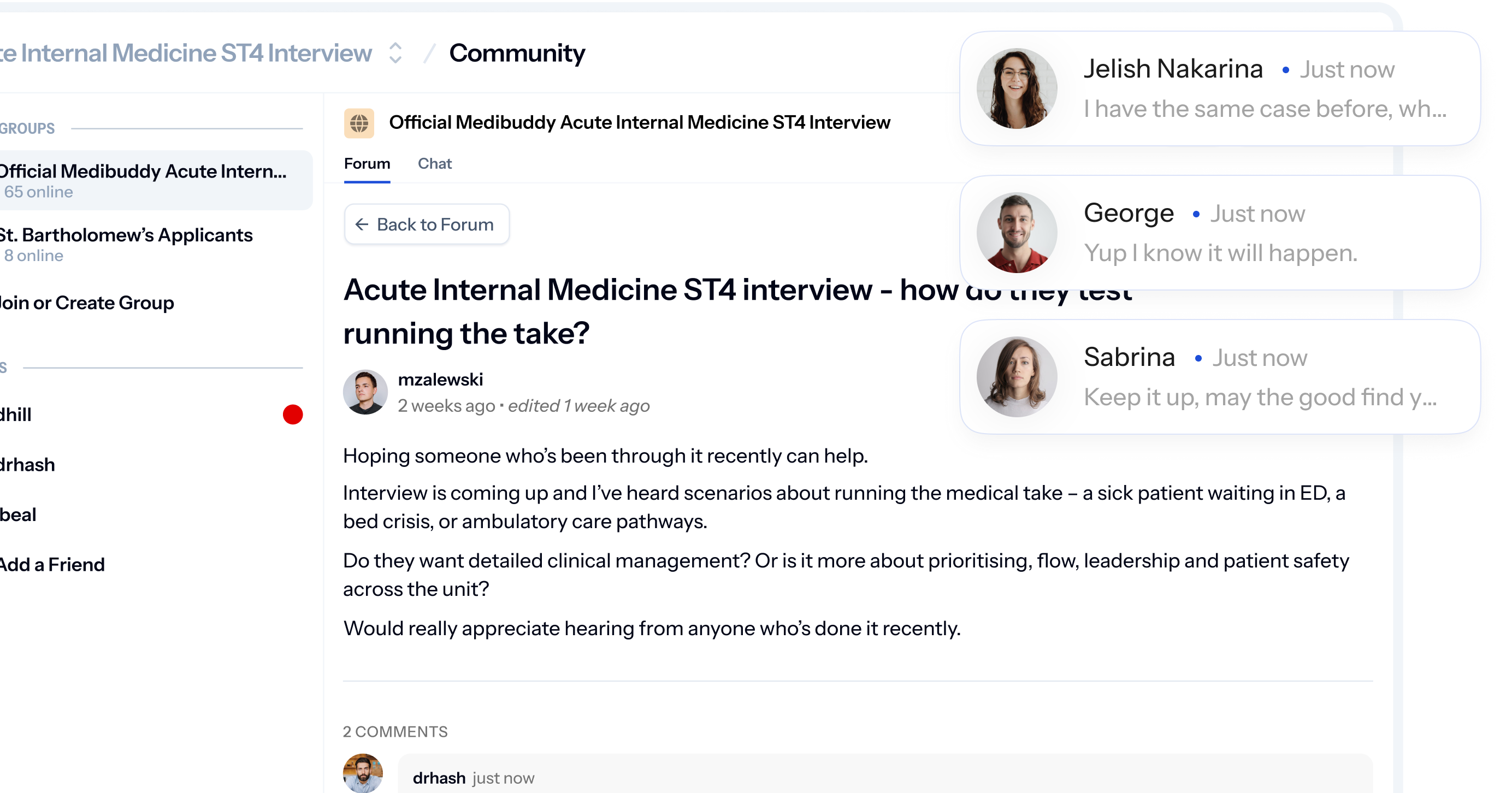
When you prepare in isolation, you're relying on your own interpretation of the interview process, which is one of the quickest ways to get found out on the day. Study Groups connect you with other doctors across the country who are also applying to Acute Internal Medicine ST4, so you can engage and network with people preparing for the same interview as you. Everyone brings different experience from different hospitals and deaneries, meaning you won't ever miss out on the key bits of information that could swing the interview in your favour.
Live MocksBeta
Candidates who don't take part in mocks often struggle to adapt to the pressure of the interview. Your knowledge might be correct, but without convincing delivery the interviewers will score you poorly. The best way to improve your delivery is to take part in as many live mocks as possible, which is why we haven't put a cap on how many you can do. We also know how difficult it can be to organise mocks with other people, so all you have to do is join the waiting room and we'll match you with a different Acute Internal Medicine ST4 candidate each time. Take turns as both the interviewer and candidate on real Question Bank scenarios, so you can see exactly how other candidates perform in real time, while refining your own interview technique.
Peer FeedbackBeta
Preparing alone means you won't know how you're coming across during the interview. And preparing with the same few candidates means you'll miss opportunities to improve, which is why it's so important to get as many opinions as possible on your performance. With Medibuddy, you can record a mock and submit it for feedback from other candidates on the platform, so you receive a wider range of feedback and refine your answers with each person you practise with. Reviewing other people's mocks is just as valuable, as it shows you how strong candidates handle the same scenarios, which is one of the fastest ways to improve.
The interview

What to expect from the Acute Internal Medicine ST4 interview

Acute internal medicine is a competitive specialty. In a recent round, 443 doctors applied for 100 posts, and the strong applicants are often separated by narrow margins at interview.

Station 1

Clinical Scenario

You’re given a clinical scenario and questioned on your assessment and management. Start with a safe, systematic approach before moving to more specialist investigations and management, and be ready to explain when you would escalate.
Station 1

Medical Registrar Suitability

Questions on your experience managing the acute unselected take and leading a team. Prepare concise examples that show your responsibilities, decision-making and readiness to work as a medical registrar. Communication is marked across this whole station.
Station 2

Suitability & Commitment

You’ll be asked about your motivation for acute internal medicine and why you’re suited to ST4. Be ready to go beyond listing achievements and explain how your experience demonstrates your suitability and commitment.
Station 2

Ethics, Professionalism & Governance

You’ll work through an ethical, professional or governance issue, which could involve consent, capacity, patient safety or concerns about a colleague. Explain your reasoning, refer to relevant guidance, and show how you would handle it safely and professionally.

How the interview is scored

The questions are marked against the Acute Internal Medicine ST4 person specification, with the clinical scenario and suitability sections weighted most heavily. Our model answers are structured against those criteria, so you know exactly what a strong, well-organised answer looks like at each station.
Get ready

How to prepare for the Acute Internal Medicine ST4 interview

Start with the Question Bank

Work through over 50 scenarios across both stations, each with a worked answer from a candidate who scored well in the 2026 interview. Start by reading how a strong answer is formed, then think about how you'd deliver it.

Talk the hard ones through in Study Groups

Study Groups are your biggest opportunity to network and connect with other candidates sitting the same interview as you. Everyone on the platform is in the same boat, so don't be scared to get involved and ask questions. Someone in your study group might just help you work through a scenario you've been struggling with.

Rehearse out loud in Live Mocks

Live mocks are where you begin to put everything you've learned into practice, and we know from experience that those who practise with a wide range of candidates usually do the best. Organise mocks with people from one of your study groups, or get matched with a random Acute Internal Medicine ST4 candidate, then take turns as interviewer and candidate using real scenarios until answering out loud under pressure feels normal.

Get reviewed with Peer Feedback before the day

Once you've recorded a mock, you can have other community members review it. This lets you see how you come across to other people, and gives you time to refine your delivery as you revise, rather than being caught out on the day. Reviewing other people's mocks is just as crucial, as you see how other candidates navigate the same scenarios.
Questions

Frequently asked questions

What does the Acute Internal Medicine ST4 interview involve?
Two stations with four questions, each around 7 to 8 minutes and roughly 40 minutes in total. Station 1 covers a Clinical Scenario and Medical Registrar Suitability, with communication marked across the whole station. Station 2 covers Suitability and Commitment, and Ethics, Professionalism and Governance.
How competitive is the Acute Internal Medicine ST4 interview?
Competitive. In a recent round, 443 doctors applied for 100 posts, over four applicants for every place, which is why a structured, well-rehearsed approach matters.
Who writes the model answers?
High-scoring candidates who sat the Acute Internal Medicine ST4 interview in 2026 and secured some of the most competitive jobs.
Can I practise with other candidates?
Yes. Every Revision Platform purchase gives you the opportunity to connect with other candidates through Study Groups, Live Mocks and Peer Feedback.
How do the Live Mocks work?
All you have to do is join the waiting room, and we match you with another Acute Internal Medicine ST4 candidate. You then take turns as interviewer and candidate on real Question Bank scenarios, so you gain experience answering out loud to a real person before you ever sit in front of the panel.
What are Study Groups and how do they help?
Study Groups are community forums for doctors across the country preparing for the same Acute Internal Medicine ST4 interview. You can ask questions, share what you're struggling with, and compare how you'd approach a scenario.
Can I get feedback on my interview performance?
Yes. After you've recorded a mock, you can ask other members to review it, so you can see which part of your answer needs fine-tuning.
How do you keep the Acute Internal Medicine ST4 Question Bank up to date?
We review and update it twice a year: in April after that year's interviews, and again in the autumn when the new recruitment guidance is published, so you always practise with the current two-station format.
How long do I get access for?
Access runs for 12 months from the purchase date.

Start preparing for the Acute Internal Medicine ST4 interview

The Revision Platform gives you over 50 scenarios to practise and refine with other candidates through Study Groups, Live Mocks and Peer Feedback.

Acute Internal Medicine ST4 Revision Platform • £144.99

Buy Now