The 2027 Emergency Medicine ST4 Interview Revision Platform: Question Bank, Live Practice and Mocks with Other Candidates
The Medibuddy Emergency Medicine ST4 Question Bank includes over 25 scenarios that closely mirror the real interview, each with a model answer written/edited by high-scoring candidates who sat the Emergency Medicine ST4 interview in 2026.
However, knowing a strong answer isn't the same as delivering it well under pressure, which is why we provide:
Study Groups with candidates across the country
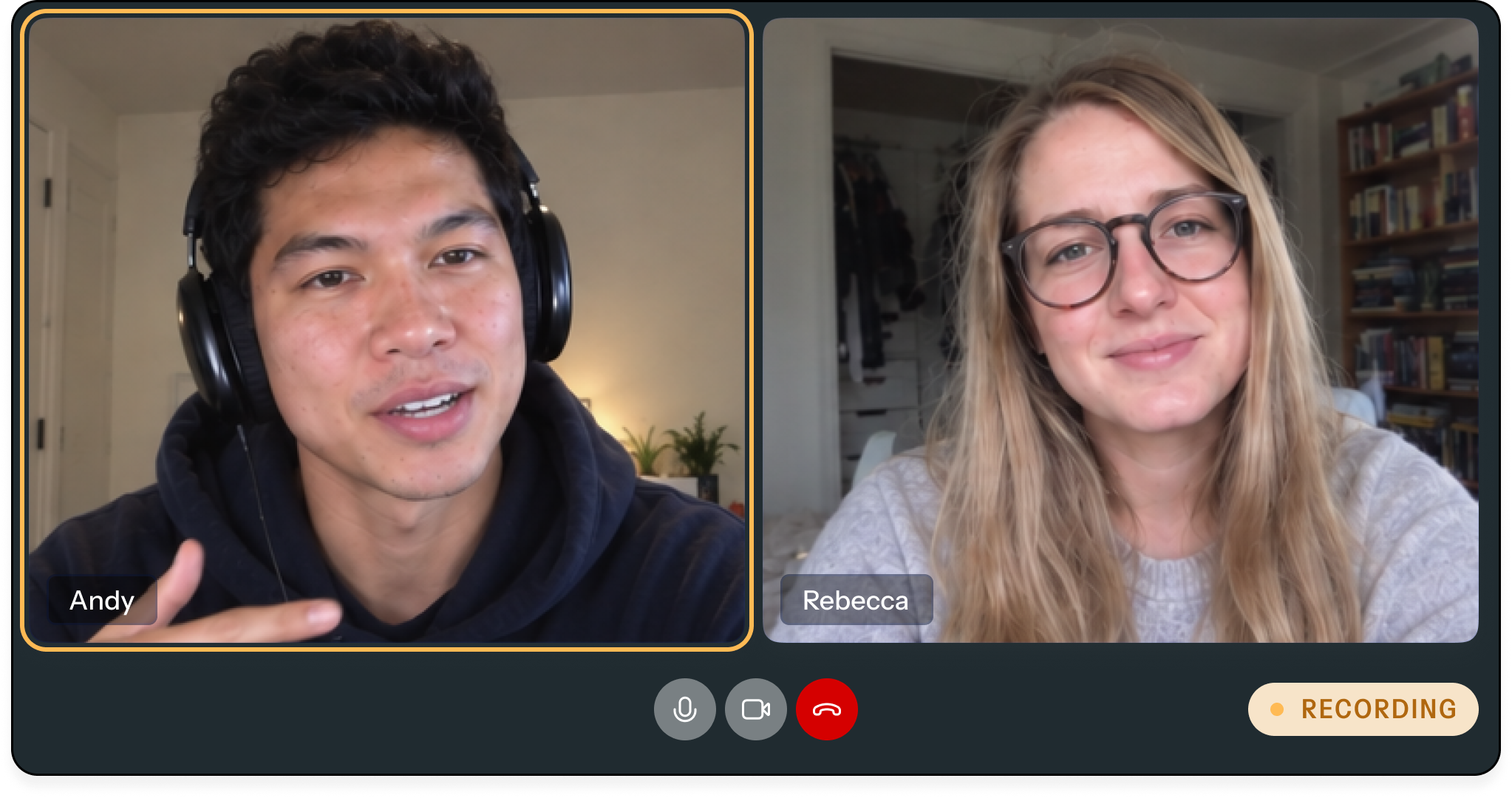
Unlimited Live Mocks with real people
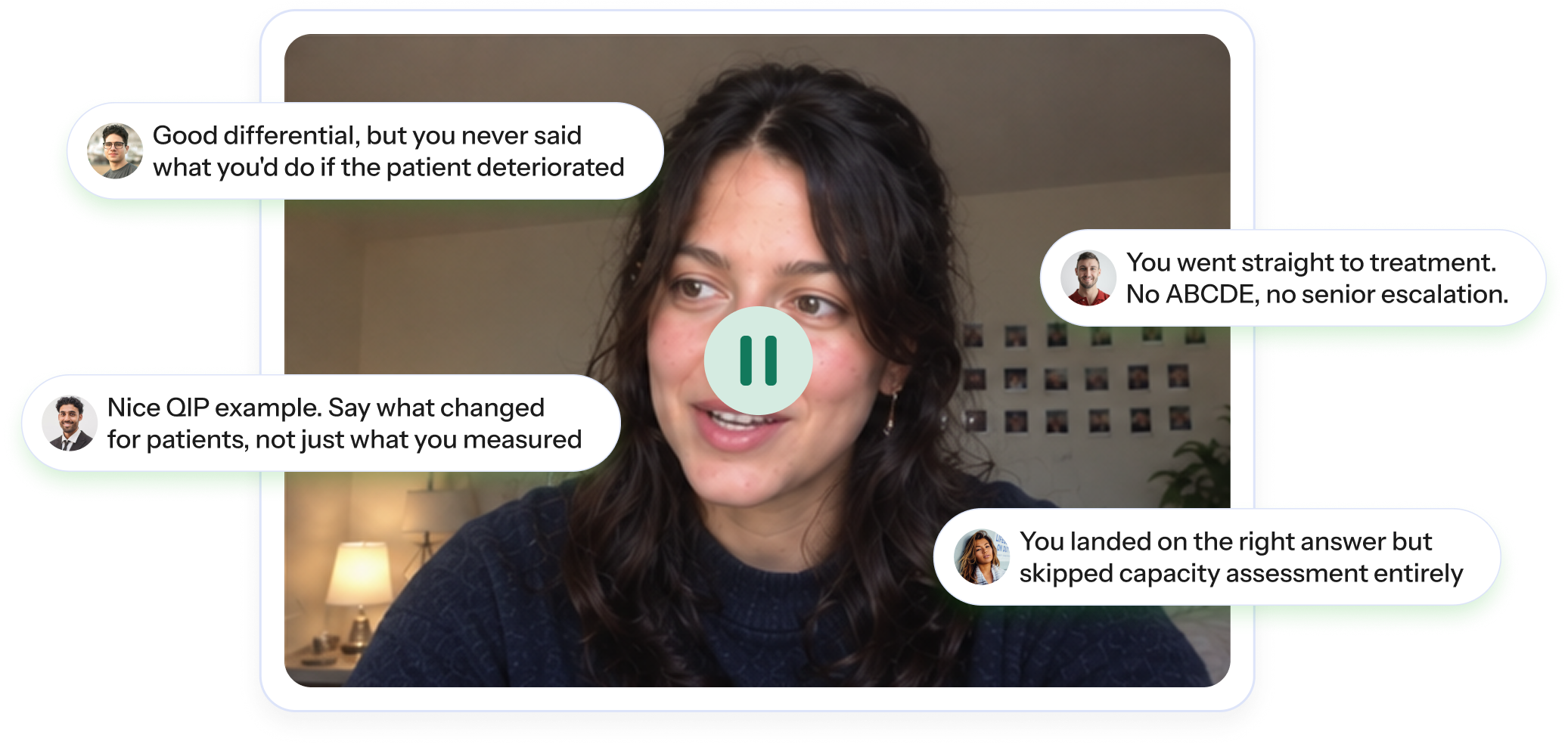
Peer Feedback on your mocks from a wide range of candidates
10 years’ experience preparing doctors for interviews
Users of the Medibuddy Emergency Medicine ST4 Revision Platform have secured some of the most competitive training jobs in recent rounds. Ask around, there's a good chance the trainees in the year above you used us too.
Always up to date
Did you know the interviews change every year? That's why we review and update every Question Bank on the platform twice a year, so you know you're always practising with scenarios based on the latest interview structure.
Network and practise real interview scenarios with other candidates
Question Bank
See every scenario, and how to answer it well
Over 25 scenarios across all three stations, which tell you exactly how to respond to each question.
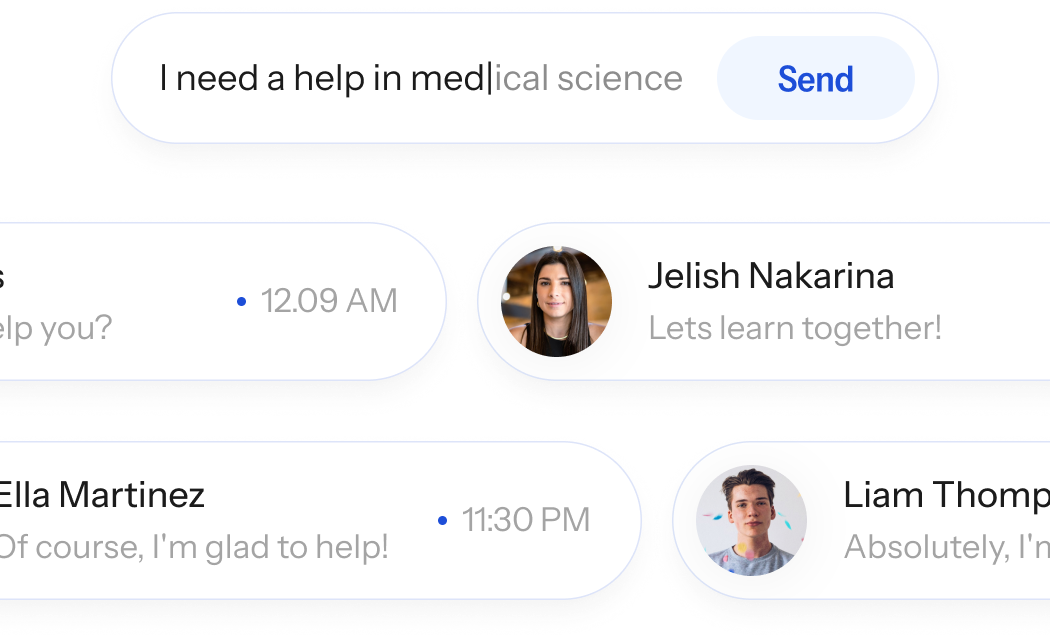
Study Groups
Connect with candidates across the country
Most people only ever practise with one or two friends. Study Groups connect you with candidates right across the country sitting the same Emergency Medicine ST4 interview.
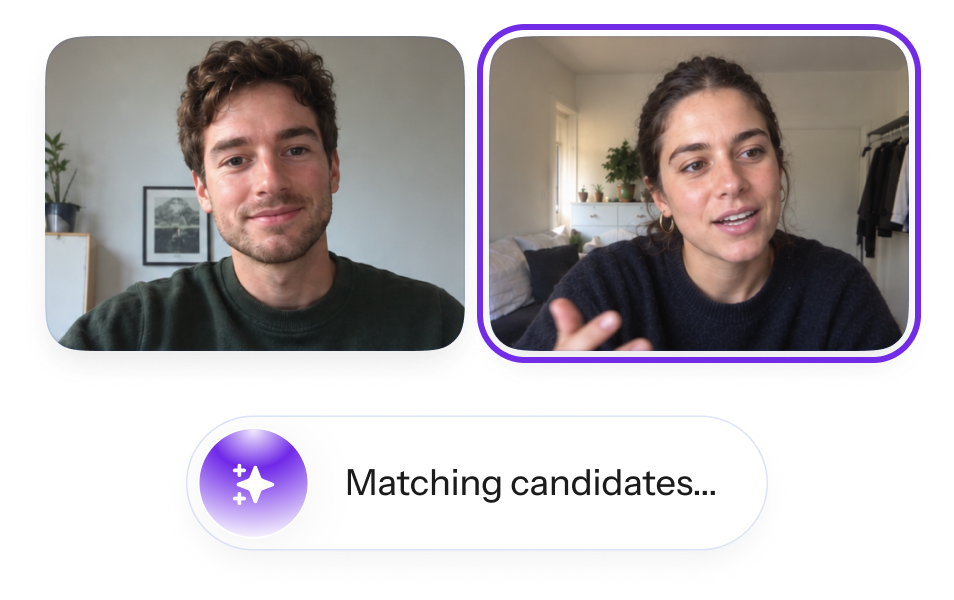
Live MocksBeta
Practise interview technique with different candidates
Arrange or get matched on demand with other candidates and run real scenarios out loud under interview conditions. Those who practise with the widest range of people tend to score the highest.
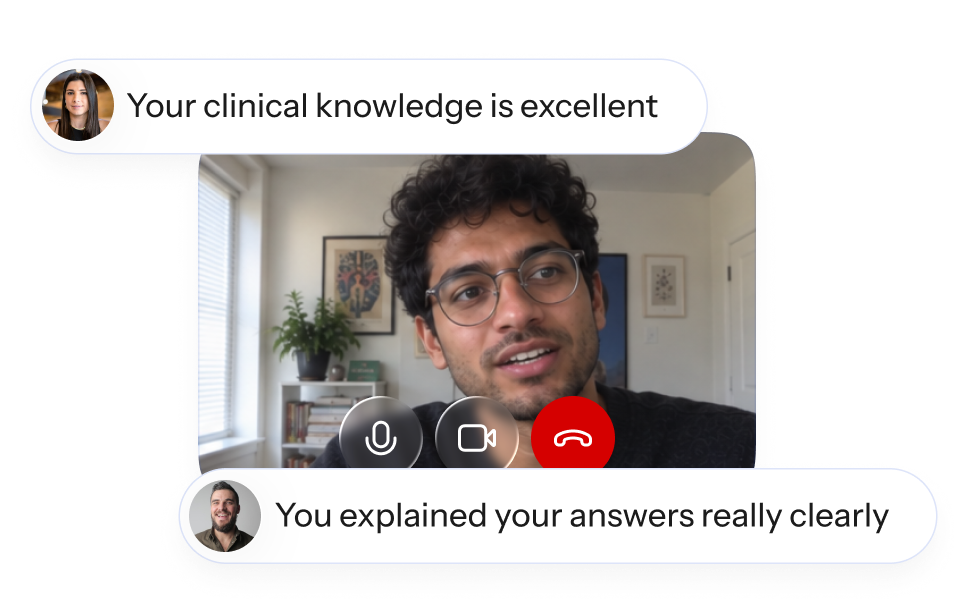
Peer FeedbackBeta
Reviewed by candidates across the platform
Submit your recorded mocks to candidates across the platform and get honest, varied feedback. Reviewing other people's mocks teaches you just as much.
The question bank, and other candidates to practise with, all in one platform.
Emergency Medicine ST4 Revision Platform • £144.99
Gain access to over 25 scenarios across all three stations, and collaborate with other candidates through Study Groups, Live Mocks and Peer Feedback.
A few of the candidates who prepared with us for the Emergency Medicine ST4 interview.
Verified candidateInterviewed 2026
"The communication scenarios were pitched exactly right. Having a structure ready meant I could handle breaking difficult news calmly and with compassion."
Secured first-choice deanery
Verified candidateInterviewed 2026
"Practising the clinical and prioritisation stations out loud with other candidates was the single most useful thing I did before the day."
Ranked highly
Part 1 • See the questions
The Medibuddy 2027 Emergency Medicine ST4 Question Bank
The interview has three stations and takes around 30 minutes in total, so you have a limited window to deliver the high-scoring answers you need to do well. That means every point has to land, and knowing how to structure each answer is essential. That's why each of our 25-plus scenarios comes with a model answer, written by candidates who scored highly in the 2026 Emergency Medicine ST4 interview, so you know exactly how to approach every question the interviewers throw your way.
What's inside
What's included in the Emergency Medicine ST4 Question Bank
There's nothing worse than getting to the interview and being handed a scenario you've never seen before. The panel can draw on clinical, ethical, prioritisation and communication themes across the three stations, so the safest approach is to revise across all of them. We provide scenarios for every part of the interview, including the common ones and the more unusual cases that have come up before, so you don't get caught out.
Clinical Scenarios
Complex, high-pressure emergency presentations where you play the ST4, each with a worked answer showing how to structure your response.
Ethical Scenarios
Real emergency department dilemmas, from consent and capacity to end-of-life decisions, with structured model answers built on clear principles.
Prioritisation
High-stakes scenarios on triage, resource allocation and managing several emergencies at once, with model answers that show safe, logical decision-making.
Communication
Scenarios such as breaking bad news and difficult conversations with families, with worked answers showing how to stay clear, honest and compassionate.
Reflecting how emergency medicine is really assessed
The clinical and ethical scenarios sit together in one station. Our model answers are written with that in mind, alongside the prioritisation and communication themes.
Try it
Try an example Emergency Medicine ST4 question
This is an example from the communication station.
A 79-year-old man, Alan Roberts, is brought to the emergency department after a sudden collapse. He was intubated by the ambulance crew and taken straight to resus. His CT head shows a massive intracerebral haemorrhage with midline shift and brainstem involvement, and the findings are not compatible with survival.
His wife and son are in the relatives' room, waiting to speak to a senior doctor.
How would you approach this conversation?
Question
How would you prepare before speaking to the family?
Example answer
I would set myself up to do this well.
Hand over the department briefly to a colleague so the ED stays covered while I am with the family.
Review all the clinical details, confirm the scan findings and prognosis and that the bleed is not operable, checking whether neurosurgery has been contacted.
Arrange a quiet, private room with seating, tissues and water.
Ask a senior nurse or bereavement officer to accompany me for support and documentation, and take a moment to compose myself.
Question
How would you open the conversation and break the news?
Example answer
I would use a clear, compassionate structure, along the lines of SPIKES.
Introduce myself and my role, confirm they are Mr Roberts' relatives, and explore what they already understand.
Give a warning shot: "I'm afraid I have some very difficult news."
Explain honestly and gently that the scan shows a very large bleed affecting the parts of the brain controlling breathing and consciousness, that it cannot be treated surgically, and that it is not survivable.
Then allow silence and space for their emotion, offering tissues and not rushing to fill the pause.
Question
How would you explain the plan, including ceiling of care and DNACPR?
Example answer
I would focus on comfort and dignity.
Explain that we are now focused on keeping Alan comfortable and pain-free, that he is not aware and will not feel distress, and that we will support his breathing while we prepare to make him comfortable.
Introduce DNACPR sensitively: because this injury cannot be reversed, CPR would not help and could cause harm, so it would be appropriate to record that we would not attempt resuscitation.
Reassure them this does not mean stopping care, and that our focus is his comfort and supporting them.
Offer that they can stay with him, that other relatives can come, and that chaplaincy and family support are available.
Question
How would you close the conversation?
Example answer
I would summarise and make sure they feel supported.
Summarise clearly: Alan has had a catastrophic, non-survivable brain bleed, and our focus is his comfort and dignity.
Explain the documentation, including the DNACPR, and that the consultant will also come to speak with them.
Offer ongoing support, tell them I will stay available for questions, and to let the nurse know if they need a break.
Close with genuine empathy, acknowledging how hard this is and that we will care for Alan with dignity and compassion.
That's one scenario. There are over 25 more.
Emergency Medicine ST4 Revision Platform • £144.99
Includes every scenario in the Question Bank, and access to Study Groups, Live Mocks with other candidates and Peer Feedback.
The Emergency Medicine ST4 interview changes from year to year, and the biggest fear for any candidate is getting to interview day and realising you've revised with a question bank that's totally outdated.
That's why we review and update every Question Bank twice a year, so you know you're revising with scenarios that are likely to come up. We do this in April after the previous year's interviews, and again in the autumn when the new recruitment guidance is published.
Updated for 2027 interviews
Reviewed against the latest published guidance and recent candidate feedback.
Updated for 2027 Interviews
Part 2 • Practise them live
The only interview resource where you can practise live with other candidates from across the country
Our Emergency Medicine ST4 Question Bank tells you exactly how to answer real interview scenarios. But how you practise with them will determine how many marks you score. Simply reading answers off a screen won't prepare you for the intense scrutiny you'll face in the interview. And only practising with the same few colleagues or friends limits the amount of feedback you'll get. Medibuddy gives you unique access to Emergency Medicine ST4 candidates across the country, so you can learn from a variety of perspectives and hear a far wider range of feedback than your own circle could ever give you.
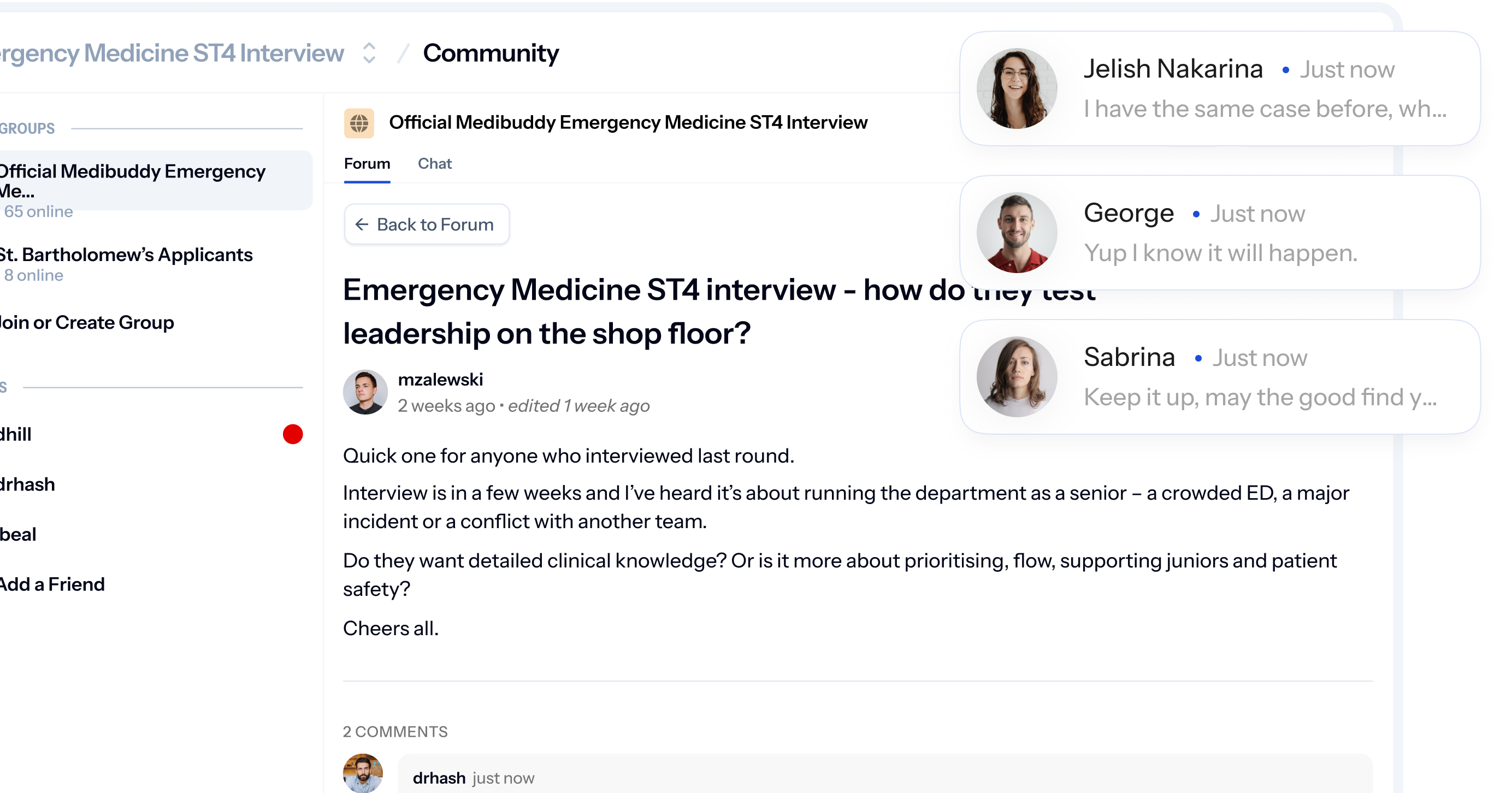
Study Groups
When you prepare in isolation, you're relying on your own interpretation of the interview process, which is one of the quickest ways to get found out on the day. Study Groups connect you with other doctors across the country who are also applying to Emergency Medicine ST4, so you can engage and network with people preparing for the same interview as you. Everyone brings different experience from different hospitals and deaneries, meaning you won't ever miss out on the key bits of information that could swing the interview in your favour.
Live MocksBeta
Candidates who don't take part in mocks often struggle to adapt to the pressure of the interview. Your knowledge might be correct, but without convincing delivery the interviewers will score you poorly. The best way to improve your delivery is to take part in as many live mocks as possible, which is why we haven't put a cap on how many you can do. We also know how difficult it can be to organise mocks with other people, so all you have to do is join the waiting room and we'll match you with a different Emergency Medicine ST4 candidate each time. Take turns as both the interviewer and candidate on real Question Bank scenarios, so you can see exactly how other candidates perform in real time, while refining your own interview technique.
Peer FeedbackBeta
Preparing alone means you won't know how you're coming across during the interview. And preparing with the same few candidates means you'll miss opportunities to improve, which is why it's so important to get as many opinions as possible on your performance. With Medibuddy, you can record a mock and submit it for feedback from other candidates on the platform, so you receive a wider range of feedback and refine your answers with each person you practise with. Reviewing other people's mocks is just as valuable, as it shows you how strong candidates handle the same scenarios, which is one of the fastest ways to improve.
The interview
What to expect from the Emergency Medicine ST4 interview
In 2025, 104 doctors applied for 71 Emergency Medicine ST4 posts. Even where the ratio is favourable, minimum score thresholds mean a strong, structured performance in every station is essential.
Station 1
Clinical & Ethical Scenario
Tests how you handle complex clinical and ethical situations under pressure, with a safe, structured approach and clear reasoning.
Station 2
Prioritisation
Assesses how you triage and allocate resources in a high-stakes environment, managing several competing demands safely.
Station 3
Communication
Evaluates how you navigate challenging conversations, from breaking bad news to supporting families, clearly and with empathy.
How the interview is scored
Each station is individually assessed against the Emergency Medicine ST4 person specification. Our model answers are structured against those criteria, so you know exactly what a strong, well-organised answer looks like at each station.
Get ready
How to prepare for the Emergency Medicine ST4 interview
Start with the Question Bank
Work through over 25 scenarios across all three stations, each with a worked answer from a candidate who scored well in the 2026 interview. Start by reading how a strong answer is formed, then think about how you'd deliver it.
Talk the hard ones through in Study Groups
Study Groups are your biggest opportunity to network and connect with other candidates sitting the same interview as you. Everyone on the platform is in the same boat, so don't be scared to get involved and ask questions. Someone in your study group might just help you work through a scenario you've been struggling with.
Rehearse out loud in Live Mocks
Live mocks are where you begin to put everything you've learned into practice, and we know from experience that those who practise with a wide range of candidates usually do the best. Organise mocks with people from one of your study groups, or get matched with a random Emergency Medicine ST4 candidate, then take turns as interviewer and candidate using real scenarios until answering out loud under pressure feels normal.
Get reviewed with Peer Feedback before the day
Once you've recorded a mock, you can have other community members review it. This lets you see how you come across to other people, and gives you time to refine your delivery as you revise, rather than being caught out on the day. Reviewing other people's mocks is just as crucial, as you see how other candidates navigate the same scenarios.
Questions
Frequently asked questions
What does the Emergency Medicine ST4 interview involve?
Three stations, each lasting 10 minutes, covering a Clinical and Ethical Scenario, a Prioritisation station, and a Communication station. Each is assessed against the person specification, with minimum score thresholds per domain.
How competitive is the Emergency Medicine ST4 interview?
In 2025, 104 doctors applied for 71 posts. Even where the ratio is favourable, the minimum score thresholds mean a strong, structured performance in every station is essential.
Who writes the model answers?
High-scoring candidates who sat the Emergency Medicine ST4 interview in 2026 and secured some of the most competitive jobs.
Can I practise with other candidates?
Yes. Every Revision Platform purchase gives you the opportunity to connect with other candidates through Study Groups, Live Mocks and Peer Feedback.
How do the Live Mocks work?
All you have to do is join the waiting room, and we match you with another Emergency Medicine ST4 candidate. You then take turns as interviewer and candidate on real Question Bank scenarios, so you gain experience answering out loud to a real person before you ever sit in front of the panel.
What are Study Groups and how do they help?
Study Groups are community forums for doctors across the country preparing for the same Emergency Medicine ST4 interview. You can ask questions, share what you're struggling with, and compare how you'd approach a scenario.
Can I get feedback on my interview performance?
Yes. After you've recorded a mock, you can ask other members to review it, so you can see which part of your answer needs fine-tuning.
How do you keep the Emergency Medicine ST4 Question Bank up to date?
We review and update it twice a year: in April after that year's interviews, and again in the autumn when the new recruitment guidance is published, so you always practise with the current three-station format.
How long do I get access for?
Access runs for 12 months from the purchase date.
Start preparing for the Emergency Medicine ST4 interview
The Revision Platform gives you over 25 scenarios to practise and refine with other candidates through Study Groups, Live Mocks and Peer Feedback.
Emergency Medicine ST4 Revision Platform • £144.99



 Close
Close