


 Close

 25th November 2026
Academic Clinical Fellowship (ACF) Interview Guide 2027
If you’re considering an Academic Clinical Fellowship (ACF), it’s worth knowing that these posts are among the most competitive in UK medical training. Each year, interest in combining clinical training with academic research continues to grow, and competition ratios can vary significantly depending on the specialty and deanery, in some cases reaching as high as 13 applicants per post.
In this guide, we’ll walk you through how ACF recruitment works, key dates for the 2027 cycle, and what to expect at interview, so you can prepare effectively and give yourself the best possible chance of success.
What is ACF?
An Academic Clinical Fellowship (ACF) is a specialty training post that combines clinical practice with protected academic time. Typically, this means spending around 75% of your time in clinical work and 25% in academic research.
ACFs are usually three years long (or four years for GP trainees) and are designed to give you the experience, skills, and track record needed to compete for a doctoral fellowship (PhD or MD) and eventually pursue a clinical academic career.
ACF Key dates
ACF recruitment runs on a national timetable each year, coordinated through Oriel. Posts are advertised by local deaneries/IAT partnerships from October, with a main recruitment round followed by a re-advert window for any unfilled posts.
Timelines can vary slightly between specialties and regions, so always check both the NIHR ACF recruitment guidance and your local deanery website for the most up-to-date information.
Below are the key dates for the 2027 ACF recruitment cycle:
| Stage | Date |
|---|---|
| Applications Open | 1 October 2026 |
| Applications Close | 29 October 2026 |
| Interview Window | 9 November 2026 — 15 January 2027 |
| Initial Offers | 19 January 2027 |
| Hold Deadline | 26 January 2027 |
| Return recruitment status updates to NIHR | From 2 February 2027 |
ACF Eligibility & Entry Requirements
Academic Clinical Fellowships (ACFs) are available across most GMC-recognised specialties and at a range of training levels, including ST1–ST3 and ST4 in specified specialties. To be eligible, applicants must meet both the clinical person specification for the chosen specialty and the academic person specification set for the ACF.
ST4 entry is available in Group 1 physician specialties, Anaesthetics, Emergency Medicine, Psychiatry and Paediatrics, depending on the advertised post. Applicants cannot repeat a training year to take up an ACF.
If you do not already hold a National Training Number (NTN) or Deanery Reference Number (DRN) for the specialty and level you are applying to, a successful ACF interview outcome will be subject to clinical benchmarking through the standard clinical recruitment process to ensure you meet the required clinical standards. Any offer will remain conditional until this requirement is met.
The ACF Application Process
Your first step is to find available posts on Oriel. Search for “Academic Clinical Fellowship” and filter by specialty or deanery. You’ll find some ACF posts are designated as competition posts, aligned with NIHR research themes, and may span up to three different specialties.
Next, you’ll need to submit your ACF application through Oriel. This form typically includes CV-style questions and requests evidence of your academic achievements, research experience, and relevant skills. Make sure all documentation is clear, concise, and accurately reflects your contributions. You can submit a maximum of three ACF applications per recruitment round.
If you do not already hold a National Training Number (NTN) or Deanery Reference Number (DRN) for the specialty and level you are applying to, you’ll also need to submit a clinical application to the standard recruitment round for benchmarking. Offers for ACF posts may be conditional on successfully passing this clinical benchmark, so it’s important to complete this step carefully. Submit the clinical application within its own recruitment window; do not wait for the ACF interview outcome.
Shortlisting & interview
Once applications are submitted, candidates are first longlisted against essential criteria. Those who meet the minimum standards are then assessed for shortlisting, with shortlisted candidates invited to interview.
ACF interviews are typically around 30 minutes and follow the NIHR evaluation framework, although the exact format may vary slightly between deaneries. NIHR recommends online interviews. You can expect the interview to assess both academic and clinical elements, reflecting the dual nature of the ACF post. Panels also have discretion over the exact wording of questions and may include a brief clinical scenario relevant to your specialty.
Common academic stations
Interviews usually cover several academic areas. These are assessment domains rather than a nationally prescribed station circuit. Candidates can expect to face questions such as:
- Critical appraisal – explaining a paper or dataset, and then summarising it for a lay audience.
- Academic achievements – summarising your research contributions and personal role in projects or publications.
- Research interests – discussing how your interests align with the ACF post or NIHR research themes.
- Practical research experience – outlining hands-on experience in study design, methodology, or analysis.
- Broader scientific knowledge – discussing research outside your immediate interests and its potential impact on patient care.
- Challenges of combining clinical and academic roles – reflecting on how you would manage dual responsibilities effectively.
The dataset/publication is supplied no more than 48 hours before interview and should be no longer than two sides of A4.
How ACF interviews are scored
Panels use the national NIHR interview scoresheet, which totals 54 points across seven scored areas:
- Scientific reasoning and data interpretation, including the ability to communicate complex findings clearly to both scientific and lay audiences – 8 points for the scientific explanation and 6 for the lay explanation, assessed separately.
- Academic achievements and personal contribution, appropriate for your career stage – 8 points.
- Research knowledge and fit with the unit or NIHR theme – 8 points.
- Practical research experience and methodological understanding – 8 points.
- Broader knowledge of science and academic medicine — 8 points.
- Balancing clinical and academic responsibilities — 8 points.
Professional skills, including communication, teamwork and leadership, may also be explored, but do not form an additional separately scored domain on the national scoresheet.
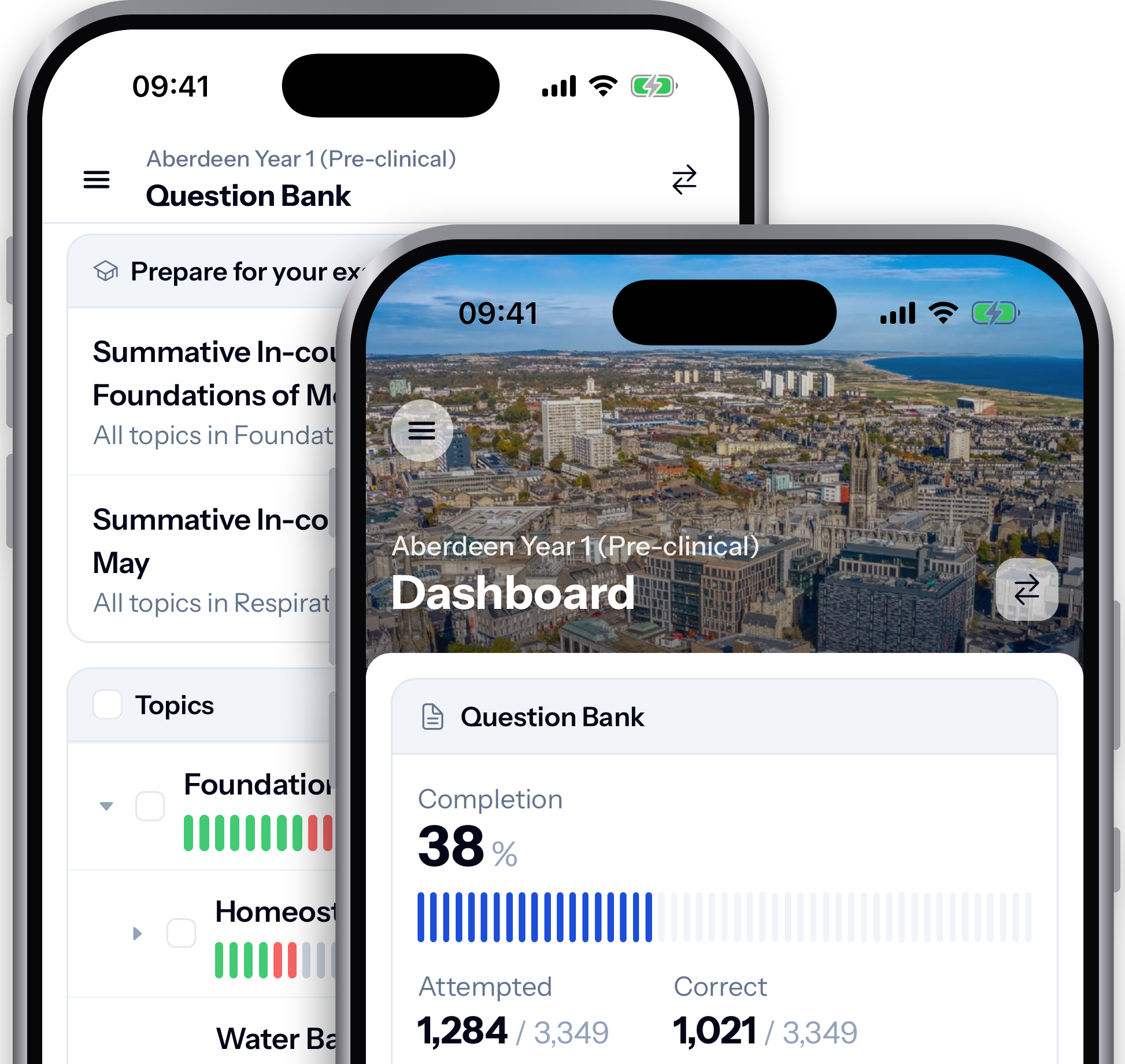
Ready to maximise your score in the 2027 ACF interview? The Medibuddy ACF Question Bank contains targeted practice across all common academic stations and scoring domains.
Take your subscriptions with you
Our mobile app allows you to access your interview and exam question banks wherever you are.

