


 Close

 13th November 2026
Anaesthetics CT1/ACCS Interview Guide 2027
If you’re interested in applying for Anaesthetics Core Training (CT1) but need some advice and guidance on how to navigate the process, our Anaesthetics CT1 interview guide for 2027 has been created to help you. We’ll cover the key 2027 recruitment dates, the interview format and how the assessors score each performance, giving you the best chance of making a good impression.
Anaesthetics ACCS is an alternative entry point to the world of anaesthetics. It’s a slightly longer course pathway than CT1, with additional time spent in emergency and general medicine. However, the two pathways have many similarities and share the same application and interview process.
Anaesthetics CT1 is a competitive specialty, and the 2026 competition ratio demonstrates this, with 5,766 applications for 547 posts. This gave a competition ratio of 10.54, meaning over 10 people applied for each post.
Maximise your performance at the Anaesthetics CT1/ACCS interview by preparing effectively and efficiently with our Interview Question Bank.
Anaesthetics CT1/ACCS Application
To be eligible for Anaesthetics CT1, you must have achieved one of the following foundation competencies in the 3.5 years running up to the start date:
- Current employment in a UKFPO-affiliated foundation programme
- Awarded an FPCC from a UK-affiliated foundation programme
- Current employment in a GMC-approved Specialty Training Programme
- 12 months of medical experience after full GMC registration (or equivalent post-licensing experience) and evidence to commence specialty training in the form of a Certificate of Readiness to Enter Specialty Training
This is one part of the eligibility criteria. You must also meet the other requirements, including having no more than 24 months’ whole-time-equivalent experience in anaesthetics by the advertised post start date, excluding Foundation modules. You can find the full eligibility criteria in the 2027 Anaesthetics CT1 Person specification.
If you’re eligible for Anaesthetics CT1, you’ll be invited to sit the MSRA, which will be used as a shortlisting tool to determine who’s invited to an interview should the applicant numbers exceed capacity. For 2027/28 recruitment, you must score at least 210 in each individual paper to meet the minimum shortlisting requirement. Meeting this minimum does not guarantee an interview: invitations depend on rank, prioritisation status and interview capacity.
Your MSRA results will also contribute 15% towards your total selection score. The other 85% comes from your online interview, which will be covered in more detail below.
Anaesthetics CT1/ACCS Key dates
The key dates for Anaesthetics CT1 and ACCS are as follows:
| Stage | Date |
|---|---|
| Applications open | 22 October 2026 at 10am |
| Applications close | 19 November 2026 at 4pm |
| Invitations to MSRA | No later than 14 December 2026 |
| MSRA window | 5—20 January 2027 |
| MSRA results | From 10 February 2027 |
| Invitations to interview | 16 February 2027 |
| Interview window | 23 February — 19 March 2027 |
| Offers Released | 6 April 2027 by 5pm |
Anaesthetics CT1/ACCS Interview format
Anaesthetics CT1 interviews continue to take place online, using Qpercom. There are two interview stations, each lasting 15 minutes. However, after allowing for ID checks, the five-minute wait before the general station and the five-minute reading time before the clinical scenario, you can expect the whole process to take around 50 minutes.
There will be two assessors for each station (so four in total), which can be daunting. But, like any interview or exam, preparation is key so you know you have the knowledge and confidence to deliver your answers. Practising the types of questions that are likely to come up in the interview is important here. You can do this by using question banks and verbalising your answers to yourself, a friend or a family member.
The two Anaesthetics interview stations are:
Clinical Judgement Station
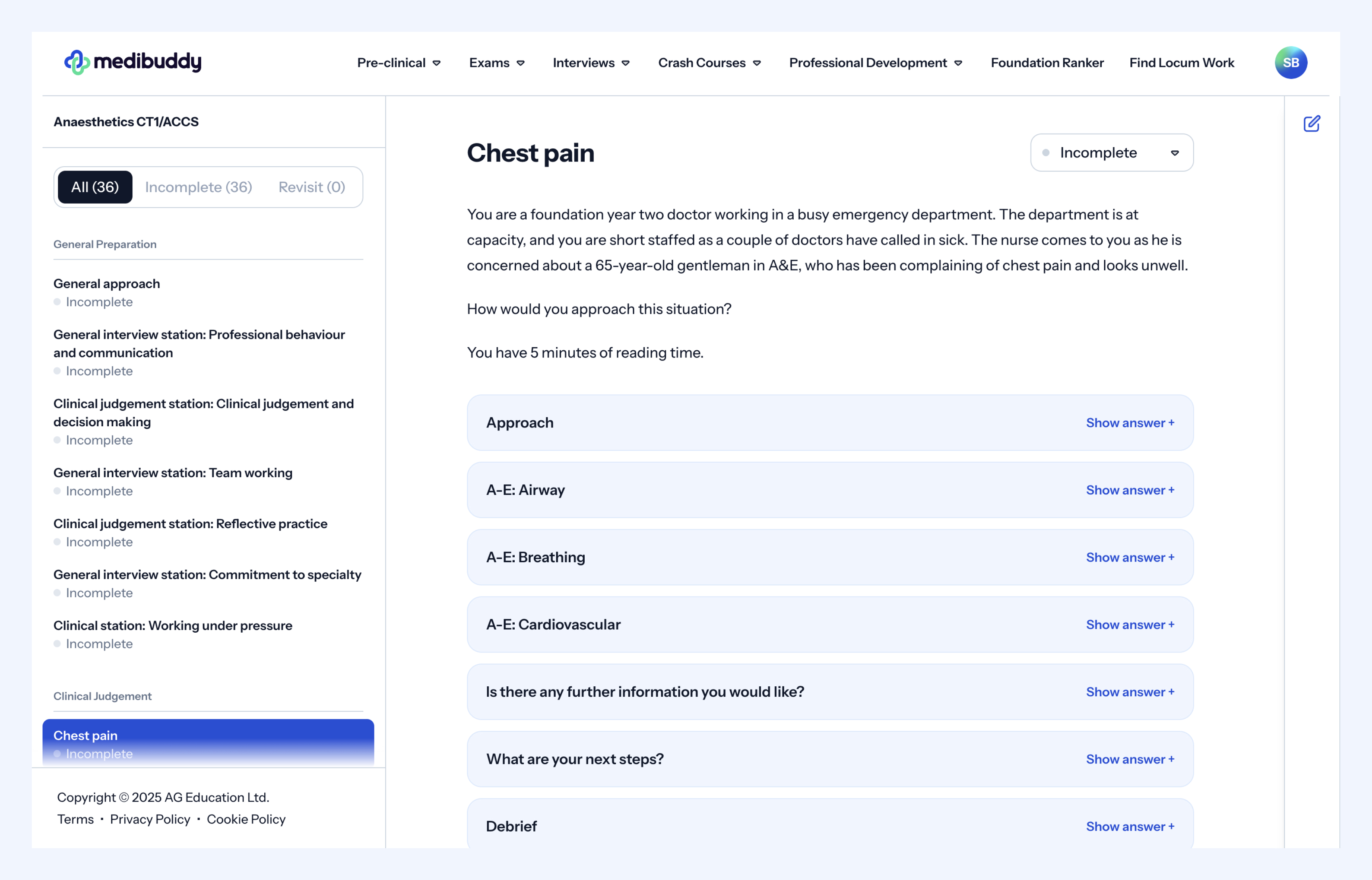
You’ll have five minutes to read the clinical scenario. This is an opportunity to really prepare yourself for the incoming questions. You can make notes here and think about how you might answer the questions.
You aren’t expected to have a lot of knowledge and experience with anaesthetics at this stage. Instead, the clinical scenario will be about a situation or emergency that’s familiar to FY2 doctors, assessing you in the following areas:
- Clinical judgement and decision-making
- Reflective practice
- Working under pressure
The assessor will introduce additional information as the scenario progresses.
Below is the type of scenario you can expect to find in our Anaesthetics CT1/ACCS Interview Question Bank:
General Interview Station
The general interview station is less specific, encompassing a wide range of topics. It’s your chance to show that you’re a well-rounded doctor, allowing you to highlight your strengths and achievements. You’re still limited to 15 minutes for this interview station. So, you should aim to be concise and direct with your answers. During this station, the interviewers will be assessing you in the following areas:
- Communication
- Commitment to Specialty
- Teamwork
Questions cover your training, commitment to anaesthetics, experience of working in and leading teams, and understanding of the NHS and its influence on the specialty.
Anaesthetics CT1/ACCS Interview Scoring
The current guidance confirms the scoring structure below, although the detailed interview domain and scoring guidance documents are still awaiting publication.
Each assessor awards up to 15 marks across the three station domains and a global rating out of 10. Overall, 100 marks are available, including 40 global-rating marks.
| Clinical Interview Station 1 |
General Interview Station 2 |
Totals | |||
|---|---|---|---|---|---|
| Assessor A | Assessor B | Assessor C | Assessor D | ||
| Communication | 5 | 5 | 10 | ||
| Clinical judgement & decision making | 5 | 5 | 10 | ||
| Teamwork | 5 | 5 | 10 | ||
| Reflective practice | 5 | 5 | 10 | ||
| Commitment to specialty | 5 | 5 | 10 | ||
| Working under pressure | 5 | 5 | 10 | ||
| Global Rating | 10 | 10 | 10 | 10 | 40 |
| Total Interview Score | 50 | 50 | 100 | ||
Receiving a global rating score of 1 from each of the assessors in one of the stations can lead to your application being vetoed, and you need to score at least 60 marks overall to be successful. So, how you present yourself and deliver your answers plays an important role in determining your success.
Good luck!
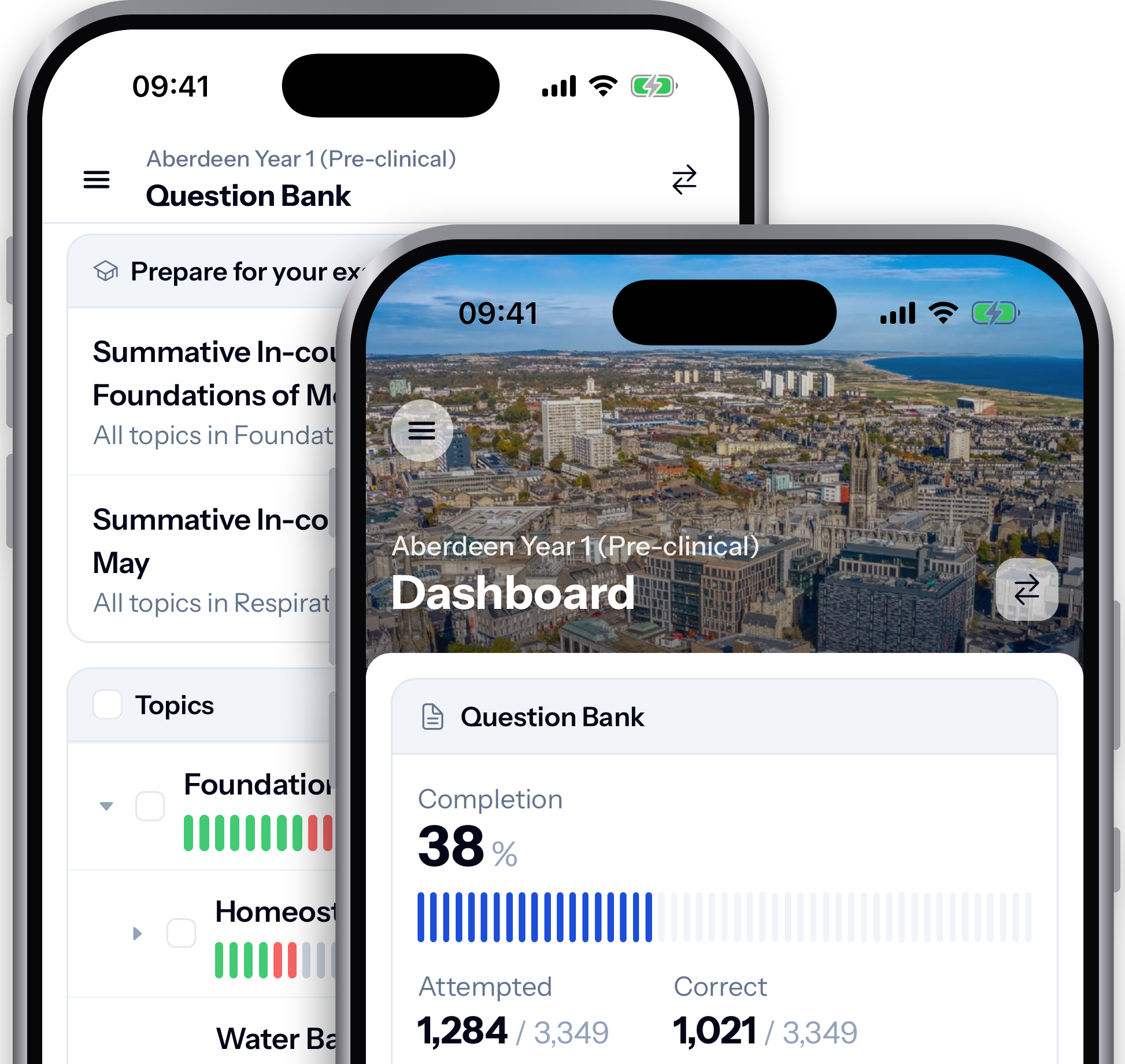
Take your subscriptions with you
Our mobile app allows you to access your interview and exam question banks wherever you are.

