


 Close
Close
Questions


Post ID: 63518 - Complete Guide to Clinical Genetics ST3 Application and Recruitment (2027)
Written by Medibuddy. Last updated: October 2026. Clinical Genetics is one of the few specialties you can enter from eight different backgrounds. The 2027 person specification sets them out in full: internal medicine, paediatrics, anaesthetics, psychiatry, surgery, obstetrics and gynaecology, ophthalmology and general practice. PHST notes that most trainees arrive from adult or paediatric medicine, holding MRCP(UK) or MRCPCH before entry at ST3. Selection happens at ST3 through Oriel under Physician Higher Specialty Training, and your application is scored twice before you reach the interview: once on your verified self-assessment and once on your commitment to the specialty. This 2027 Clinical Genetics ST3 guide covers the application process, eligibility, how shortlisting is scored, the self-assessment and portfolio evidence you’ll need, and the key recruitment steps. Where 2027 timings aren’t published yet, we use the 2026 round as a planning guide and we’ll update this page when 2027 dates are released. Key Facts at a Glance
Table of Contents
Clinical Genetics ST3 CurriculumClinical Genetics training is built around Capabilities in Practice (CiPs): high‑level outcomes you must evidence consistently in real clinical work. You’ll gather portfolio evidence from outpatient genetics clinics, multidisciplinary meetings, case discussions, quality improvement, teaching and leadership roles, alongside supervisor reports and multisource feedback, to demonstrate progression at ARCP against those CiPs. The curriculum is set by the Joint Royal Colleges of Physicians Training Board (JRCPTB) and approved by the GMC, with delivery through regional training programmes hosted in the UK’s Regional Genetics Centres. You’ll usually be based at a single centre and develop breadth through a mix of clinics (for example cancer, prenatal/reproductive, paediatric and cardiac genetics), joint clinics with partner specialties, and exposure to the Genomic Medicine Service. Many programmes also support academic or service‑development projects during training. How programmes vary regionallyThe entry standards and curriculum outcomes are national, but day‑to‑day delivery differs by region. Variations include:
It’s worth reading the specific programme descriptions and recent Oriel adverts for the centres you’re interested in to understand that local mix. Note: The GMC‑approved Clinical Genetics curriculum is the 2021 version, refreshed in 2024. If updated guidance is issued for 2027, we’ll update this page so your planning stays current. Clinical Genetics ST3 Eligibility Criteria and Entry RequirementsIf you’re applying for Clinical Genetics ST3 in 2027, here’s what you need to be eligible:
How to Apply for Clinical Genetics ST3 National RecruitmentIf you’re mapping out the 2027 cycle, here’s the practical, step‑by‑step process to get your application in smoothly. Note: Physician Higher Specialty Training (PHST) has not yet published the 2027 timetable. However, the 2026 framework can be used as a guide for your planning, and we’ll update this page when the 2027 dates are released.
Clinical Genetics ST3 Recruitment Timeline and Key Dates (2027)Until the 2027 dates are available, the following 2026 timeline is a useful reference point:
Note: These are Round 1 2026 dates from the NHS England national timetable and the PHST specialty page. They’re a useful planning guide for 2027, and we’ll update this page when the 2027 dates are released. Clinical Genetics did not run a round 2 in 2026, so plan for a single annual round. How Competitive Is Clinical Genetics ST3?NHS England publishes the annual competition ratios. Here are the last two completed rounds for Clinical Genetics ST3:
Competition has tightened year-on-year as applications increased while posts remained in the mid-teens. It’s a small specialty, so even modest changes in applicant numbers make a noticeable difference. What this means for you:
How Clinical Genetics ST3 Applications Are Scored (2027)Clinical Genetics recruitment uses a formal scoring framework through Physician Higher Specialty Training (PHST). Your Oriel supporting information is self-assessed against defined domains, then verified against uploaded evidence before shortlisting. The PHST application scoring page and the Clinical Genetics specialty page set out the weighting between shortlisting and interview for this specialty. Overall weightingThe scoring components and their weighting are:
The commitment-to-specialty score is used to decide who is interviewed and does not carry into final ranking; commitment is reassessed at interview. However, a commitment-to-specialty score of 0 from either assessor at shortlisting leads to no interview regardless of self-assessment. Self-assessment domainsPHST uses a single self-assessment matrix across its specialties. For Clinical Genetics, the domains and their maxima are:
As a cross-specialty rule within PHST, a live “train the trainer” style course of at least six hours scores 1 point in the Training in teaching domain; a PG Cert or Dip in medical education scores 3. If you need a qualifying course, our live Teach the Teacher course fits this requirement. How the self-assessment feeds the scoreHere’s how the pieces fit together. You complete the self-assessment in Oriel and upload evidence; PHST verifies your claims. That verified self-assessment forms 40 of the 60 shortlisting marks, alongside the 20-mark commitment score. Your verified application score (self-assessment part only) is then scaled to 20 and carried forward to final ranking, where it combines with the 80-mark interview. We cover what each domain expects, what evidence to upload, and where candidates lose easy points in the next section. Clinical Genetics ST3 Self-Assessment and Portfolio: How to Maximise Your ScoreClinical Genetics shortlisting leans heavily on your verified self‑assessment, so a well‑evidenced portfolio can be the difference between an interview and a rejection. In recent years, PHST has used a common nine‑domain self‑assessment matrix across its specialties, with the verified score worth 40 of the 60 shortlisting marks, and Clinical Genetics also scores a separate “commitment to specialty” review at shortlisting. See How Clinical Genetics ST3 Applications Are Scored (2027) for how this is used. How to score in each domain
Evidence and verificationYour self‑assessment is verified against documents you upload on Oriel. Assessors score only what’s evidenced, and discrepancies are amended down. Keep filenames clear, combine multi‑page PDFs, and ensure each claim has a single, decisive piece of proof. Note: For Round 1 2026, the evidence upload window fell in the week commencing 22 December 2025. We’ll update this page when the 2027 timetable is released. Common pitfalls: do and don’t
Actions to take before applications open
The Clinical Genetics ST3 Interview: A Brief OverviewShortlisted applicants attend a structured interview. For the full format and targeted practice, see the Clinical Genetics ST3 Interview Question Bank. Clinical Genetics ST3 Offers, Preferencing and What Happens NextOffers, preferencing and any upgrades are managed via Oriel in line with the national process. For current rules and timelines, see NHS England’s guidance on offers, feedback and upgrades. Frequently Asked Questions About Clinical Genetics ST3 ApplicationHow competitive is Clinical Genetics ST3 and how many posts are there?Competition has risen. NHS England’s competition ratios show 84 applications for 15 posts in 2025 (5.6:1) and 59 applications for 15 posts in 2024 (3.93:1). That makes Clinical Genetics a small specialty with a moderate-to-high level of competition. Post numbers are published on Oriel each round and can change during the offer process as programmes confirm final funding. What are the eligibility requirements for Clinical Genetics ST3 in 2027?Clinical Genetics is a PHST Group 2 specialty. You need capabilities equivalent to the first two years of Internal Medicine Training stage 1 by the post start date, or an accepted alternative route. Applicants from paediatrics (MRCPCH), general practice (MRCGP), and other specialties are eligible per the NHS England person specification. Full GMC registration with a licence to practise is required. Do I need MRCP(UK) to apply for Clinical Genetics ST3?For the internal medicine route, the 2027 person specification requires MRCP(UK) Part 1 at the time of application and the full MRCP(UK) diploma by the offer date. Alternative routes are accepted: MRCPCH for paediatrics, MRCGP for general practice, or relevant exams from surgery (including MRCS), anaesthetics, psychiatry, obstetrics and ophthalmology, as set out in the NHS England person specification. How does the Clinical Genetics ST3 application process work and when are the key dates?Applications run nationally via Oriel and are led by Physician Higher Specialty Training (PHST). You submit an application, complete self-assessment with evidence upload, and preference programmes before interview and offers. For planning, the 2026 round had evidence upload in the week commencing 22 December 2025 and interviews on 25 February 2026. We’ll update this page when the 2027 timetable is published. What scores well on the Clinical Genetics ST3 self-assessment?PHST uses a common nine-domain matrix for shortlisting. Maximums include MRCP/exam (8 points), Publications (8), Presentations/posters (6), Teaching experience (5), Postgraduate degrees (4), Quality improvement (4), Leadership/management (4), Additional achievements (3), and Training in teaching (3). A live Teach the Teacher–style course of at least six hours scores 1; a PG Cert/Dip in medical education scores 3. The verified self-assessment contributes 40 of the 60 shortlisting marks. Is commitment to Clinical Genetics scored at shortlisting?Yes. Clinical Genetics scores commitment at shortlisting in addition to the verified self-assessment. Two assessors independently award 10, 2 or 0, giving up to 20 commitment marks. A score of 0 from either assessor means you will not be shortlisted, regardless of self-assessment. This commitment score decides who is interviewed only; it does not carry into final ranking because commitment is assessed again at interview. Can I reapply to Clinical Genetics ST3 if I’m unsuccessful?Yes. You can reapply in future rounds. Most candidates improve their position by strengthening the PHST self-assessment domains (for example adding a completed quality improvement project, submitting a publication, undertaking leadership roles, or completing recognised training in teaching) and by evidencing clear commitment to Clinical Genetics through relevant clinical exposure, audits, and supervised teaching. How do offers and upgrades work for Clinical Genetics ST3?Offers are made nationally via Oriel based on your final rank and preferences. If you hold or accept an offer, you can opt in to upgrades. If a higher-preferenced post becomes available before the upgrade deadline, Oriel will automatically upgrade you and notify you. Allocations become final after the upgrade deadline. Clinical Genetics ST3 Useful ResourcesWhen you’re planning your 2027 application, these are the core links worth bookmarking:
Note: PHST does not publish a separate “applicant handbook” for Clinical Genetics; the specialty page and recruitment-process guidance above function as the official reference. ConclusionWe’ve covered how Clinical Genetics ST3 recruitment is scored, what evidence you’ll need for verification, and the key planning points for the 2027 round. Two big takeaways to bear in mind are that commitment to specialty is assessed at shortlisting alongside your verified self-assessment, and as a Group 2 pathway you can apply after the first two years of Internal Medicine Training or equivalent. When you’re ready to move from your application to your interview practice, work through the Clinical Genetics ST3 Interview Question Bank for a full breakdown and scenario-based practice with model answers. Focus now on maximising self-assessment points with clear, labelled evidence; then switch to structured interview prep using the question bank to bring your application together. |
||||||||||||||||||||||||||||||||||||||||||||||||||||||||||||||||||||||||||||||||||||||||||||||||||||||||||||||||||||||||||||||||||||||||||||||||||||||||||||||||||||||||||||||||||||||||||||||||||||||||
Post ID: 63130 - Complete Guide to Clinical Radiology ST3 Application and Recruitment (2027)
Recruitment paused: NHS England is not running Clinical Radiology ST3+ recruitment for the 2027 intake. A decision on 2028 programmes is expected in summer 2027. The guide below covers the 2026 round and is kept for reference only. Written by Medibuddy. Last updated: October 2026. Important: Clinical Radiology ST3 Recruitment Is Paused for 2027NHS England is not running any Clinical Radiology ST3+ recruitment for the 2027 intake. There is no 2027 application round, no 2027 timetable and no 2027 interview to prepare for. In NHS England’s own words, the decision follows "the low availability of ST3 level posts in recent years", and a decision on recruitment for programmes starting in 2028 will be taken in summer 2027. If you were planning a 2027 ST3 application, these are the routes still open to you:
Everything below this notice describes the 2026 ST3 round and is kept for reference only. It is the most recent round that actually ran, so it remains the best available picture of how ST3 selection worked: what the person specification asked for, how the self-assessment was scored, and where candidates gained or lost marks. Treat it as background, not as instructions for an application you can submit now. If and when ST3 recruitment returns, expect NHS England to publish a fresh person specification and timetable, and check those rather than relying on the detail here. About This Guide (2026 Round, for Reference)This guide to Clinical Radiology ST3 Application walks you through everything on the recruitment side as it worked for the 2026 round: eligibility, the application process via Oriel, self-assessment scoring, portfolio evidence and how the numbers actually shook out. Clinical Radiology in the UK is a five-year run-through programme (ST1–ST5) overseen by the Royal College of Radiologists and NHS England, with ST3 acting as a defined external entry point for doctors not already in a radiology training post. We’ll cover what the ST3 person specification asks for, how to build evidence ahead of time, and where candidates typically pick up, or drop, easy points. The interview itself is covered in depth on the Clinical Radiology ST3 Interview Question Bank page, so we’ll keep that brief here. Always verify with the current-year person specification. Eligibility wording, evidence requirements and timeline details are updated annually by NHS England on the Medical Hub. Treat this guide as orientation and the official documents as definitive. Key Facts at a GlanceThese figures describe the 2026 round, the last one that ran. There is no 2027 equivalent.
Table of Contents
What Is Clinical Radiology ST3 Higher Specialty Training?Clinical Radiology is a five-year, run-through specialty training programme in the UK, normally entered at ST1 and leading to a Certificate of Completion of Training (CCT) in Clinical Radiology. The curriculum is set by the Royal College of Radiologists (RCR) and approved by the GMC, while recruitment and programme delivery are overseen by NHS England (Workforce, Training and Education) in partnership with the devolved nations. Applications run centrally through Oriel. ST3 sits at a meaningful crossroads. The first three years (ST1–ST3) form "core" radiology, covering modality- and system-based rotations alongside the FRCR examinations. ST3 itself is the RCR-recognised progression point into special interest training, or, for those choosing interventional radiology, into IR subspecialty training (extending to ST6 for an IR CCT). Importantly for this guide, there’s also a separate national ST3 recruitment round for eligible doctors not already in a radiology programme. Successful candidates join at ST3 and complete the remaining three years to CCT. Completion confers entry onto the GMC Specialist Register in Clinical Radiology, the gateway to a substantive NHS consultant post. During training you’ll also work through the FRCR exams; note that reforms to FRCR Part 2B took effect from June 2025, so always check the latest RCR guidance. Day-to-day training varies by deanery (local Schools of Radiology shape your rotations, on-call patterns and sub-specialty exposure), but the curriculum endpoints are uniform UK-wide. Is Clinical Radiology ST3 Competitive?Clinical Radiology is consistently one of the most sought-after specialties in UK national recruitment, and the ST3 route is particularly tight: it exists as a recognised entry point (especially valuable for IMGs using the RCR Alternative Certificate or doctors switching from another specialty), but the number of advertised seats is small. NHS England reported approximately 88 applications for 9 ST3 posts in the 2025 round, a ratio of about 9.78:1, and figures vary year to year, with single-figure post counts in some deaneries. That makes self-assessment scoring and portfolio evidence unusually decisive. Clinical Radiology ST3 Eligibility Criteria and Entry RequirementsClinical Radiology in the UK is unusual in that it’s a run-through specialty whose principal entry point is ST1, but NHS England also runs a separate, smaller ST3 round each year for doctors who aren’t already in a Clinical Radiology training programme. That distinction matters: the ST3 person specification is its own document, published annually on the NHS England Medical Hub, and the rules are stricter on the radiology competences you must already hold. Always cross-check the year-specific wording before you submit. This is the single most important document for your application. For the 2026 round, you’ll need to meet the following at the point of application:
Note that the MSRA is used for ST1 entry, not ST3. ST3 selection is built around the self-assessment and interview instead, so you won’t sit a pre-application aptitude exam for this route. How to Apply for Clinical Radiology ST3 National RecruitmentClinical Radiology ST3 is a separate national recruitment route from the much larger ST1 round, run by the Royal College of Radiologists (RCR) with NHS England oversight. Posts are advertised through Oriel, the national applicant portal, and the exact dates, evidence rules and assessment format for your cycle are set out each year in the RCR’s ST3 applicant information and the NHS England Clinical Radiology ST3 person specification. Here’s the mechanical walkthrough for the 2026 round:
If your application isn’t successful, you can reapply in the next annual cycle. There’s no published cap on the number of attempts, provided you still meet the person specification. Feedback and a local appeals route are usually offered by the lead recruiter; check the timelines published with your decision email. Clinical Radiology ST3 Recruitment Timeline and Key Dates (2026)Clinical Radiology has both an ST1 entry route and a separate, formally advertised ST3 route for doctors who can demonstrate competencies equivalent to completed ST1/ST2 radiology training before posts begin. Both routes are coordinated nationally through Oriel under NHS England’s specialty recruitment process, with the Royal College of Radiologists (RCR) publishing supporting guidance. The 2026 ST3 cycle is Round 1 only (Clinical Radiology is not running in Round 3), and successful applicants start their 36-month training posts in August 2026. Here are the key dates to plan around for the 2026 ST3 cycle:
A couple of things worth flagging. ST3-specific dates can differ from the larger ST1 cycle, and the publicly accessible timeline pages are refreshed annually, so always confirm exact times against the NHS England Clinical Radiology ST3 recruitment timelines page. The 48-hour offer response clock is tight, so decide your preferences in advance so you’re not scrambling when the email lands. Clinical Radiology ST3 Competition Ratios and Application TrendsHere’s the honest picture: NHS England runs a formal annual national ST3 round for Clinical Radiology, and the most recent published figures show 88 applications for 9 posts in 2025, a competition ratio of approximately 9.78:1. That’s a small, highly competitive pool, and one of the smaller intakes in UK specialty recruitment. The catch is that NHS England’s competition ratios pages historically surface Clinical Radiology figures at ST1 entry rather than ST3, even though both rounds run. So if you go searching for the ST3 line in the published competition-ratio tables you may not find it prominently, which has led to a perception that ST3 entry is informal or vacancy-driven. It isn’t, but the public data trail is thinner than for the larger ST1 round. A few practical implications:
The headline: with small post numbers and high competition, every point of self-assessment evidence and every minute of interview prep counts. How Clinical Radiology ST3 Applications Are Scored (2026)Before we get into the detail of self-assessment and portfolio evidence, it helps to understand how the scoring framework hangs together. NHS England’s person specifications are the authoritative document for any given round, and we’d always recommend checking the current year’s version before you do anything else. The two scoring stagesFor Clinical Radiology ST3 specifically, the overall score is built from two stages:
Note that the MSRA is not used for ST3; that’s an ST1 entry mechanism. Shortlisting at ST3 is based on the self-assessment plus eligibility verification. How the self-assessment feeds the scoreThe self-assessment is a structured form completed in Oriel where you score yourself against defined portfolio domains: things like academic achievement (publications and presentations), quality improvement, teaching, and commitment to specialty. Community guidance on the 2025–26 cycle suggests a five-domain matrix, though the official scoring rubric should be confirmed against the current year’s self-assessment guidance on NHS England. Your self-scored answers don’t stand alone: each is verified against the evidence you upload, and unsupported claims are adjusted downward. We unpack each domain (what counts, what doesn’t, and where candidates lose easy points) in the next section. Preparing for the interview? Work through the Clinical Radiology ST3 Interview Question Bank for scenario questions with model answers from high-scoring trainees. Because the published rubric and weightings change year to year and ST3-specific documentation is sparse, anchor your preparation to the current year’s RCR and NHS England guidance rather than older write-ups you may find online. Clinical Radiology ST3 Self-Assessment and Portfolio: How to Maximise Your ScoreST3 entry into Clinical Radiology is a niche route, designed primarily for doctors who have completed or substantially progressed through radiology training overseas and want to join the final three years of UK training. That shapes everything about the self-assessment and portfolio: the bar is set around equivalence to a UK ST2 radiology trainee, not around generic clinical experience. What the self-assessment actually scoresThe NHS England Clinical Radiology ST3 Self-Assessment Guidance (published annually alongside the person specification) is the only document that tells you exactly which domains score and what evidence each band requires. In recent years it has centred on radiology-specific achievements: qualifications including FRCR Part 1, documented radiology training and teaching, audit and quality improvement in imaging, presentations and publications, and reflective practice. Don’t assume the ST1 self-assessment domains apply here; the ST3 form is its own thing. Evidence you’ll need to uploadEverything you claim is verified at longlisting and again before interview, so build the file now:
Upload as PDFs through Oriel before the round’s deadline. Claims without acceptable evidence get downgraded. Where candidates lose easy points
If you’re 6–12 months out, the highest-yield moves are sitting FRCR Part 1, lining up an imaging audit you can close, and arranging consultant supervision that can sign the Alternative Certificate when the round opens. The Clinical Radiology ST3 Interview: A Brief OverviewIf you make it through self-assessment shortlisting, you’ll be invited to a remote interview, with slots booked through Oriel. NHS England confirms the ST3 round runs online rather than in person, which is helpful if you’re juggling clinical commitments and don’t want to travel. NHS England’s official ST3 interview page sets out the format: two 15-minute stations, each with three sections. Station 1 is the specialty-specific part (radiology experience, a prioritisation exercise, and reviewing an image); Station 2 covers professional areas (coping with pressure and uncertainty, teamwork, and leadership). Panels are remote, usually up to two consultants, sometimes with a lay representative checking for fairness. For a full station-by-station breakdown, scoring focus and worked examples, see our dedicated Clinical Radiology ST3 Interview Question Bank, which we keep updated as each year’s applicant guidance is published. Preparing for the interview? Head to the Clinical Radiology ST3 Interview Question Bank for the full station-by-station breakdown, scenario questions with model answers, and practice material put together by high-scoring radiology trainees. Clinical Radiology ST3 Offers, Preferencing and What Happens NextOnce interviews are done, the offers phase runs centrally through Oriel. With only around 9 ST3 posts nationally in the 2025 round, the cascade moves quickly: declined offers drop straight to the next-ranked candidate on the reserve list, so it’s worth watching your inbox carefully. Here’s roughly how it works, from interview to start date:
One practical note: candidate accounts historically describe the centralised system as impersonal, and there has been at least one reported allocation error in radiology. Keep written records of every Oriel action in case you need to query something later. Frequently Asked Questions About Clinical Radiology ST3 ApplicationHow does ST3 entry into Clinical Radiology actually work in the UK?Clinical Radiology is a run-through specialty normally entered at ST1, but NHS England also runs a separate national ST3 round each year for eligible doctors with prior radiology experience. The 2025/26 round opened on 20 November 2025 and closed on 11 December 2025 via Oriel, with posts advertised across England, Scotland and Wales against a national person specification. Do I need FRCR Part 1 to apply for Clinical Radiology ST3?Yes. The 2026 Clinical Radiology ST3 person specification requires FRCR Part 1 at the point of application. You’ll also need to evidence ST1 and ST2 clinical radiology competences, typically gained in a recognised radiology training post. GMC registration with a licence to practise is also required. How is the Clinical Radiology ST3 application shortlisted?Shortlisting is based on a scored self-assessment rather than a separate exam such as the MSRA. You award yourself points against published domains (achievements, qualifications, training experience) and upload supporting evidence, which is then verified. Candidates with the highest verified self-assessment scores are invited to interview, and the final ranking combines self-assessment and interview marks. What is the Alternative Certificate and who needs it?The Alternative Certificate is an official RCR-issued form by which a supervising consultant signs off that you’ve achieved capabilities equivalent to a UK ST2 radiology trainee. It’s the key route for IMGs and doctors entering from outside the UK run-through ST1/ST2 pathway, and every listed professional capability must be confirmed by an authorised signatory. Incomplete sign-off makes a candidate ineligible, so identify your signatory and start the process early. What happens if I’m offered a post but want a higher preference?NHS England’s ST3 recruitment timeline includes a formal upgrade window. For the 2026 round, the NHS England ST3 timelines page lists the upgrade deadline as 4pm on Thursday 23 April 2026 (worth verifying against the live page, as published deadlines have varied between recruitment offices in some cycles). You keep your initial offer but stay in the queue for higher-ranked preferences via Oriel. If a higher preference becomes available before the deadline, you’re automatically upgraded and the lower-ranked offer is released. Can I reapply for Clinical Radiology ST3 if I’m unsuccessful?Yes. There’s no cap on the number of times you can apply, provided you still meet the person specification for the year you’re applying in. Many successful candidates apply more than once, using the extra time to strengthen audit, teaching, leadership and radiology-specific evidence. If you’re reapplying, request feedback on your previous self-assessment and interview scores to target the weakest areas. How long is Clinical Radiology training from ST3 to CCT?Entry at ST3 leaves three further years of run-through training before CCT, as confirmed by the Royal College of Radiologists and the NHS Oriel vacancy listings. Sub-specialisation in interventional radiology typically extends total training by around a further year. The RCR sets the curriculum and ARCP decision aid that govern progression at each stage. Where are the official Clinical Radiology ST3 requirements published?The Royal College of Radiologists publishes the curriculum and training standards at rcr.ac.uk, approved by the GMC. NHS England publishes the annual ST3 person specification, recruitment timeline, self-assessment guidance and interview information on the Medical Hub (medical.hee.nhs.uk). Applications themselves are submitted through Oriel, the national NHS recruitment portal. Clinical Radiology ST3 Useful ResourcesWhen you’re putting your application together, it pays to work from primary sources first, then layer community insight on top. Here’s what we’d bookmark. Official guidance (always your first stop)
Medibuddy resources
Putting together a strong Clinical Radiology ST3 application really does come down to the basics: meeting the person specification (including your 24 months’ WTE experience and FRCR Part 1), gathering verified evidence carefully, and treating the self-assessment and interview as scores that both count toward your final ranking. Get those foundations right and you give yourself a genuine shot at an NTN. When you’re ready to turn your attention to interview day, the Clinical Radiology ST3 Interview Question Bank walks you through scenario questions with model answers from high-scoring trainees. Good luck, you’ve got this. |
||||||||||||||||||||||||||||||||||||||||||||||||||||||||||||||||||||||||||||||||||||||||||||||||||||||||||||||||||||||||||||||||||||||||||||||||||||||||||||||||||||||||||||||||||||||||||||||||||||||||
Post ID: 63003 - Complete Guide to Paediatric Surgery ST3 Application and Recruitment in United Kingdom (2026)
Written by Medibuddy. Last updated: October 2026. If you’re planning your Paediatric Surgery ST3 Application for 2027, you’re in the right place. Paediatric Surgery is an uncoupled pathway: you apply at ST3 via a single national process on Oriel, with NHS England North East and Yorkshire leading recruitment. Higher specialty training then runs for six years (ST3 to ST8) to CCT under the JCST/ISCP curriculum. Preparing while working full-time can feel daunting, so we’ve made the route clear. This guide covers the whole application process, including the recruitment timeline, eligibility, how self-assessment is scored, what portfolio evidence to gather and how it’s verified, plus practical tips to avoid common pitfalls. Key Facts at a Glance
Table of Contents
Paediatric Surgery ST3 CurriculumFor Paediatric Surgery ST3, the ISCP Paediatric Surgery curriculum sets out what you must be able to do and how you show it. It’s built around Capabilities in Practice (CiPs) and the GMC’s Generic Professional Capabilities, with your progress evidenced in the ISCP e-portfolio through mapped portfolio evidence and reviewed at ARCP. The curriculum is overseen by the Joint Committee on Surgical Training (JCST) via the Specialty Advisory Committee in Paediatric Surgery and is GMC approved, with delivery through the Intercollegiate Surgical Curriculum Programme (ISCP). At the intermediate stage (ST3–ST4), the emphasis is on developing sound decision-making, safe operative assistance and supervised operating, peri‑operative care, and non-technical skills across the breadth of paediatric general surgery, neonatal surgery and urology. What you do day to day depends on where you train. The national framework is the same, but regional programmes configure rotations differently: some operate as region‑wide networks centred on a tertiary children’s hospital, others rotate between multiple paediatric units. That can mean different balances of neonatal exposure, emergency take, and subspecialty clinics. When you’re preferencing posts, look closely at local programme adverts and rotation maps to match the training mix you want. If you’re moving up from Core Surgical Training, expect to translate your core skills into paediatric contexts, with increasing responsibility under supervision as you progress. Note: NHS England’s recruitment pages and the ISCP curriculum are updated periodically; we’ll update this section if 2027 trainee guidance changes. Paediatric Surgery ST3 Eligibility Criteria and Entry RequirementsIf you’re applying for Paediatric Surgery ST3 in 2027, here’s what you need to be eligible:
In addition to this, the following is also listed as desirable paediatric exposure within the desirable selection criteria:
The requirements above reflect the published 2027 NHS England person specification for Paediatric Surgery ST3, which sets out the core surgical competence routes, the LAT experience cap and the MRCS timing. We’ll update this page if NHS England amends it during the round. Note: English language evidence (for example IELTS/OET) is handled through GMC registration rather than ST3 recruitment itself; follow GMC guidance when applying for registration. How to Apply for Paediatric Surgery ST3 National RecruitmentThe 2027 recruitment process for Paediatric Surgery ST3 is as follows:
Paediatric Surgery ST3 Recruitment Timeline and Key Dates (2027)NHS England North East and Yorkshire publishes the 2027 timetable below. Two stages are still to be confirmed, and we’ll update them here as soon as they are published.
All interviews will be held online for 2027, and a Round 2 is not expected, so plan for the single window. For context, the 2026 round held interviews on 30 and 31 March 2026. Note that the offers date matters for your exam planning as you need the full MRCS by the “initial offers released by” date, which is 13 April 2027. How Competitive Is Paediatric Surgery ST3?The most recent published competition ratios from NHS England are below:
What this means for you
How Paediatric Surgery ST3 Applications Are Scored (2027)Paediatric Surgery ST3 uses a two‑stage scoring framework: a verified self‑assessment on the application form, followed by a nationally run online interview for shortlisted candidates. The 2027 self‑assessment framework is published and totals 36 marks across 12 questions, while the 2027 interview scoring is pending final publication. The 2026 applicant handbook sets out the recent interview scoring model; we’ve summarised that below so you can see the overall weighting at a glance.
Self‑assessment (2027)The 2027 self‑assessment form carries 12 domains worth a total of 36 marks. It focuses on what you’ve actually done in core training and service posts: time in paediatric surgery and adult general surgery, stand‑alone neonatal and PICU posts, life‑support training for sick children, operative numbers (including appendicectomy and, new for 2027, scrotal exploration), publications, national presentations, audit/QI, teaching, and portfolio presentation. You’ll claim scores and then upload evidence after submission for verification. The 2026 handbook sets self‑assessment as the basis for interview shortlisting, and that process continues in 2027 with the updated grid; detailed scoring by domain sits in the Self‑Assessment & Portfolio section. Tip: Much of this evidence comes from Core Surgical Training and trust‑grade posts. If you’re still in CST, build it in as you go: teaching programmes, QI completions, and validated logbook outputs. Interview and final weightingIn 2026, the interview contributed 264 of the 295 available marks, with stations covering career progression, academic/CARE and clinical scenarios; the CARE communication station was piloted and unscored. The minimum appointable overall score was 178. When the 2027 handbook is published, you may see a change to the scoring. While it has been confirmed that the interview will continue with four stations, the Career Progression station now incorporates a Non‑Technical Skills element. Final offers are made using your overall selection score as defined in that year’s handbook (in 2026 this combined interview with a smaller self‑assessment component). The 2027 handbook will confirm whether any self‑assessment element contributes to the final ranking. Note: We’ll update this section when the 2027 handbook becomes available. Paediatric Surgery ST3 Self-Assessment and Portfolio: How to Maximise Your ScoreThe 2027 Paediatric Surgery ST3 Self-Assessment Form sets out 12 questions worth a total of 36 marks. The biggest gains come from the clinical exposure and operative domains, backed by watertight evidence and a clearly presented portfolio. How to score in each domain
Aim for 4 to 24 months in paediatric surgery rather than as much as possible, and note that “Training the Trainers” and anatomy demonstrating do not score under Q11. Where candidates lose easy points
Practical actions now
The Paediatric Surgery ST3 Interview: A Brief OverviewThe 2027 interviews will be held online. For more information about the format and how to prepare, including a full station‑by‑station breakdown, example scenarios and model answers, see our Paediatric Surgery ST3 Interview Question Bank. Paediatric Surgery ST3 Offers, Preferencing and What Happens NextFrom interview to a confirmed Paediatric Surgery ST3 postGetting from interview to a confirmed Paediatric Surgery ST3 post can feel like a whirlwind. Here’s how the national offer mechanism, preferencing and upgrades generally work, and what to expect next.
Note: Exact response windows, the hold-down period, and upgrade deadlines are set each round on Oriel by NHS England; follow the timings in your offer email. Frequently Asked Questions About Paediatric Surgery ST3 ApplicationIs Paediatric Surgery ST3 very competitive?It’s highly competitive with small national numbers. NHS England reports 109 applications for 16 posts in 2025 (6.8:1) and 84 applications for 9 posts in 2024 (9.3:1). Competition fell between 2024 and 2025 because more posts were available, but selection remains tight given the cohort size. Focus on maximising self-assessment points and clear evidence to stay competitive. What are the eligibility requirements for Paediatric Surgery ST3 in 2027?You need full GMC registration at application and a licence to practise by the post start date, completion of approved Core Surgical Training or equivalent (via the Alternative Certificate), and the full MRCS by the round’s initial offers date. You must not hold (or be eligible for) a CCT/CESR in paediatric surgery and must have no more than 24 months of LAT in the specialty by start date to be considered for LAT posts. Do I need MRCS to apply for Paediatric Surgery ST3 and by when?Yes, you must have successfully completed the full MRCS by the round’s initial offers release date (note, it isn’t required at application). Plan your sitting so the pass is confirmed before offers. If you haven’t completed Core Surgical Training in the UK, you’ll also need the Alternative Certificate to demonstrate equivalent competencies. For exam planning and support, see our MRCS resources. How do I apply for Paediatric Surgery ST3 and what are the 2027 dates?You submit a single national application on Oriel covering all UK vacancies. For 2027, applications open on 19 November 2026 at 10am and close on 10 December 2026 at 4pm. The lead recruiter is NHS England North East and Yorkshire, and interviews are held online. Plan for one main window; if a round 2 is announced, we’ll update this page. You’ll preference posts before offers are released. What scores well on the Paediatric Surgery ST3 self-assessment and what evidence is needed?The 2027 framework has 12 questions, totalling 36 marks. Strong scores come from 4–24 months in paediatric surgery (8 marks), adult general surgery exposure, operative numbers (appendicectomies and scrotal explorations), first/last author PubMed and Web of Science–indexed papers, national/international first‑author presentations, closed‑loop QI, and recognised teaching credentials (PGCert/MSc/Dip Ed). Upload signed, dated logbook pages with the clinician’s GMC or registration number, ISCP-validated UK evidence, current life support certificates, Oriel employment history (with a screenshot), and the contract front page for non‑training posts via Qpercom. How many Paediatric Surgery ST3 posts are there each year?Numbers are small and vary annually. NHS England recorded 16 national posts in 2025 and 9 in 2024. Expect low double‑digit vacancies across the UK in most cycles, coordinated through one national process. Can I reapply for Paediatric Surgery ST3 if I’m unsuccessful?Yes, you can reapply in a later round if you still meet eligibility, including full GMC registration at application, MRCS by that round’s offers date, CST completion or the Alternative Certificate. Use the time to build self‑assessment points and tighten your portfolio. How are offers and upgrades handled for Paediatric Surgery ST3?Offers are made via Oriel in rank order. If you accept or hold an offer, you can opt in to automatic upgrades: if a higher‑ranked preference becomes available, Oriel upgrades you in rank order until the published upgrade deadline. For 2027, recruitment is national through NHS England North East and Yorkshire. Paediatric Surgery ST3 Useful ResourcesUse these core links to plan, check eligibility, and get ready for selection:
ConclusionWe’ve covered what Paediatric Surgery ST3 recruiters look for, how the 2027 self‑assessment allocates marks, and the tightened evidence rules for verification. Remember the big eligibility pitfalls we discussed: you’ll need full GMC registration at application and MRCS by the initial offers date, not at submission. From here, focus on gap‑closing tasks under your control: complete any required life support, keep your logbook and employment history tidy and signed, and organise documents so uploading is smooth. When you’re ready to prepare for the interview itself, work through the Paediatric Surgery ST3 Interview Question Bank for a full breakdown and realistic practice scenarios. |
||||||||||||||||||||||||||||||||||||||||||||||||||||||||||||||||||||||||||||||||||||||||||||||||||||||||||||||||||||||||||||||||||||||||||||||||||||||||||||||||||||||||||||||||||||||||||||||||||||||||
Post ID: 63797 - Complete Guide to Sport and Exercise Medicine ST3 Application and Recruitment (2026)
Written by Medibuddy. Last updated: October 2026. Sport and Exercise Medicine ST3 is one of the few higher specialties you can enter from emergency medicine or general practice as readily as from internal medicine for the 2027 application round. It is a PHST Group 2 specialty entered at ST3, with four years of training (ST3 to ST6) to CCT across musculoskeletal medicine, exercise medicine and pitch-side care. Competition is sharp for a small intake: 107 applications for 12 posts in the last published round. This guide covers the 2027 application process, including eligibility, self-assessment scoring, portfolio evidence and verification, how national recruitment works, and the practical steps to submit a strong application. When you’re ready to prepare for the interview itself, the Sport and Exercise Medicine ST3 Interview Question Bank has the full structure and practice scenarios. Here are the key facts. Key Facts at a Glance
Table of Contents
Sport and Exercise Medicine ST3 CurriculumThe GMC-approved 2021 Sport and Exercise Medicine curriculum, set by the Faculty of Sport and Exercise Medicine (FSEM UK), is capabilities-based. You progress by demonstrating the required Capabilities in Practice across musculoskeletal medicine, exercise medicine and team/event care, and by evidencing them in your e-portfolio. Expect to collect high-quality portfolio evidence through workplace-based assessments, reflective case write-ups, documented clinics and field-of-play experience, multi-source feedback, quality improvement and teaching activity, mapped directly to the curriculum outcomes. The FSEM specialty examination is a defined requirement during training, usually achieved by ST5. Training is delivered by regional postgraduate deaneries (Schools of Medicine) under national oversight, with local Training Programme Directors coordinating placements and supervision. While the curriculum outcomes are the same everywhere, programmes differ in how they deliver them: rotations may include MSK clinics, rheumatology or orthopaedics attachments, exercise-testing services, and structured time with sports teams or national institutes. Scotland’s scheme, for example, includes a dedicated 12-month attachment to the Scottish Institute of Sport for elite-sport competencies, and national training days are shared across deaneries to support consistent teaching. Note: The precise mix of placements, teaching days and portfolio tools is set locally within the national curriculum. Always review individual programme adverts for how a region structures delivery; we’ll update this page if national curriculum guidance changes. Sport and Exercise Medicine ST3 Eligibility Criteria and Entry RequirementsIf you’re applying for Sport and Exercise Medicine ST3 in 2027, here’s what you need to be eligible:
Note: The 2027 NHS England person specification for Sport and Exercise Medicine ST3 is the definitive standard for this round; we’ll update this page if NHS England issues any revisions during the cycle. How to Apply for Sport and Exercise Medicine ST3 National RecruitmentThe steps below reflect the 2026 PHST guidance and NHS England timetable for SEM. They’re a solid guide while you plan your 2027 application. We’ll update this page when the 2027 dates are released.
Note: Plan for one annual round. SEM did not run a Round 2 in 2026 and has not taken part in one since 2017. Sport and Exercise Medicine ST3 Recruitment Timeline and Key Dates (2027)Although the 2027 timetable isn’t out yet, the 2026 Round 1 dates are a useful guide when planning your 2027 application. NHS England’s recruitment timelines and the PHST Sport and Exercise Medicine specialty page set out the key milestones below. We’ll update this page as soon as the 2027 dates are released.
Note: These dates reflect the 2026 Round 1 timetable for planning; the 2026 round did not include a Round 2. We’ll update this table when the 2027 timetable is published. How Competitive Is Sport and Exercise Medicine ST3?Sport and Exercise Medicine (SEM) is a small national intake with far more applicants than posts each year. NHS England publishes annual competition ratios, and the most recent figures show sustained high demand for a limited number of training numbers.
What this means for you
How Sport and Exercise Medicine ST3 Applications Are Scored (2027)Preparing your SEM application is much easier once you know the scoring framework. National Selection for SEM uses the Physician Higher Specialty Training (PHST) self-assessment matrix to shortlist, and then combines your verified application score with your interview score for final ranking. PHST’s application scoring page sets out the nine domains and their maxima, and the SEM specialty page confirms how the application and interview are weighted overall. Note: The 2027 scoring guidance has not yet been published. The 2026 PHST matrix below is a reliable planning guide and we’ll update this page as soon as the 2027 detail is released. Self-assessment domains and maximaThe PHST matrix lists the following domains and their maximum scores for SEM:
PHST states the verified self-assessment is worth 40 of the 60 shortlisting marks. Do not add the domain maxima to quote a "total"; PHST verifies and caps the shortlisting score. How the self-assessment feeds into the final score
When you’re ready to prepare for the interview itself, the Sport and Exercise Medicine ST3 Interview Question Bank has scenario questions with model answers, put together by high-scoring trainees. A couple of quick pointers
Sport and Exercise Medicine ST3 Self-Assessment and Portfolio: How to Maximise Your ScoreIf you’re aiming for SEM in 2027, your portfolio is your engine room. PHST uses a verified self-assessment to shortlist and it also contributes to your final ranking. The 2026 PHST matrix lists nine scored domains with published maxima; point bands and wording can shift slightly year to year, and we’ll update this page as soon as the 2027 scoring is published. How to score in each domain
Evidence and verificationYour self-assessment is checked against documents you upload during the PHST evidence window. Evidence must clearly show your name, the exact date, level (local/regional/national/international) and your role. Claims without robust proof are reduced to the verified level or scored zero. Publications need a DOI or acceptance email; presentations need a programme; QI needs the report and sign-off; degrees and exams need certificates. Common places candidates lose easy points
Actions to build before applications open
Note: There’s no published "sole-application" bonus for SEM; focus on scoring domains rather than restricting your application. The Sport and Exercise Medicine ST3 Interview: A Brief OverviewSEM uses a structured national interview as part of the PHST selection process. For the full format, scoring and realistic practice scenarios, use the Sport and Exercise Medicine ST3 Interview Question Bank. Sport and Exercise Medicine ST3 Offers, Preferencing and What Happens NextWhen you get to the post-offer stage, the mechanics are straightforward once you know what to expect. Here’s how it generally runs from interview to start date.
Note: Exact response windows and upgrade deadlines are set on Oriel each round. PHST has not yet published the 2027 timetable; we’ll update this page when it is released. Frequently Asked Questions About Sport and Exercise Medicine ST3 ApplicationHow many posts are available and do regions differ?SEM is a small national intake. Post numbers are limited and can change during a round; PHST notes that post numbers typically rise 20 to 40% during the process. There isn’t a published deanery-level competition breakdown for SEM; preferencing opens later in the process and distribution varies year to year. What are the eligibility requirements for Sport and Exercise Medicine ST3?SEM is a PHST Group 2 specialty entered at ST3 after prior core training. Physician-route applicants need the capabilities of year 2 of Internal Medicine Training Stage 1 (or an accepted equivalent) and the required examinations. The other two routes are Emergency Medicine via ACCS Emergency Medicine, and General Practice with full MRCGP. There is no Core Surgical Training or MRCS route into SEM ST3. The 2027 NHS England person specification sets the UK-wide requirements. Which exams do I need for SEM ST3?Your exam depends on the route. Internal Medicine applicants need MRCP(UK) Part 1 at application and the full MRCP(UK) diploma by the offer date. Emergency Medicine applicants need MRCEM (or the stated alternative) by the offer date, and GP-route applicants need full MRCGP by the post start date. Always check the 2027 person specification for accepted alternatives and exact timing on your route. How does the SEM ST3 application process work?Applications run through a single national round coordinated by Physician Higher Specialty Training (PHST) and submitted via Oriel. You’ll complete the application form, select self-assessment options, and upload evidence for verification. Preferencing of programmes is done in Oriel and used to allocate posts after interviews and ranking. Plan for one annual round; the 2026 cycle did not include a Round 2. How is shortlisting and scoring done for SEM ST3?Shortlisting is based on the PHST self-assessment you submit and the evidence that verifies it. PHST states the verified self-assessment contributes 40 of the 60 shortlisting marks. SEM does not score "commitment to specialty" at shortlisting; that’s assessed later at interview. Your verified self-assessment also carries forward into the final application score used for offers. What scores well on the SEM ST3 self-assessment?Nine domains are scored. Key maxima include MRCP(UK) or accepted alternative exam (up to 8), Publications (up to 8), Presentations and posters (up to 6), Teaching experience (up to 5), Quality improvement (up to 4), Leadership and management (up to 4), Postgraduate degrees (up to 4), Additional achievements (up to 3), and Training in teaching (up to 3). A live Teach the Teacher course of at least six hours scores 1 point in the training domain. Can I reapply to SEM ST3 if I’m unsuccessful?Yes. You can apply again in a future round. Prior attempts don’t disadvantage you, and previous scores don’t carry over. Use feedback to strengthen your self-assessment domains, add verifiable evidence (e.g. submit manuscripts, complete QI cycles), and ensure currency of competencies from Internal Medicine Training or your alternative route. How do offers, preferencing and upgrades work for SEM ST3?After interviews, offers are issued in rank order and matched to your Oriel preferencing. If you opt into upgrades when holding or accepting, Oriel will automatically move you to a higher-ranked preference if one becomes available later, without prior notification. If you don’t opt in, you’ll keep your original offer unless you actively change it. Sport and Exercise Medicine ST3 Useful ResourcesWhen you’re planning and evidencing your 2027 application, these are the core, official links worth bookmarking:
ConclusionSEM ST3 is competitive, but there’s a clear path if you focus on what moves the dial: nail the Group 2 entry requirements and maximise your PHST self-assessment with solid, verifiable evidence. We’ve covered how the nine-domain portfolio is scored and what to upload so you don’t leave easy points on the table. With only a few points between candidates, an extra self-assessment mark can make a real difference. When you’re ready to prepare for the interview itself, work through the Sport and Exercise Medicine ST3 Interview Question Bank for scenario questions with model answers, written by high-scoring trainees. |
||||||||||||||||||||||||||||||||||||||||||||||||||||||||||||||||||||||||||||||||||||||||||||||||||||||||||||||||||||||||||||||||||||||||||||||||||||||||||||||||||||||||||||||||||||||||||||||||||||||||
Post ID: 63936 - Complete Guide to Occupational Medicine ST3 Application and Recruitment (2026)
Written by Medibuddy. Last updated: September 2026. If you’re applying for Occupational Medicine ST3 in 2027, we’ve created this guide to support you through the application process. Occupational Medicine is an uncoupled higher specialty entered at ST3 and runs for four years full time (ST3–ST6), with national recruitment run by NHS England on Oriel. We’ll take you through the whole process, including eligibility, how national selection scores your self‑assessment, the scored prioritisation task on the application form, what portfolio evidence to upload and how it’s verified, plus how preferencing, ranking and offers work. Key Facts at a Glance
Table of Contents
Occupational Medicine ST3 CurriculumThe GMC‑approved OMST 2022 curriculum, set by the Faculty of Occupational Medicine (FOM), is built around high‑level Learning Outcomes underpinned by defined Professional Capabilities. You’ll evidence progression through an electronic portfolio, which includes workplace‑based assessments, reflective practice, case reviews, quality‑improvement activity and mapped portfolio entries against each capability. Annual Review of Competence Progression (ARCP) panels judge whether your evidence shows you’re meeting the capabilities for your stage. The MFOM examinations are aligned to the curriculum; MFOM Part 1 is often targeted early in training and Part 2 later, but exact timing is set locally and by FOM guidance. Delivery is coordinated nationally but organised locally by deanery specialty training committees, who set your rotation plan, supervisors and ARCP logistics. The core expectations don’t change between regions; what varies is the mix of placements. Some programmes are predominantly NHS occupational health services, while others include industry or public‑sector employers (for example utilities, transport, civil service) or academic time. That variation changes the day‑to‑day case mix and project opportunities, but you’re assessed against the same capabilities and portfolio standards everywhere. Note: This summary reflects the OMST 2022 curriculum and the April 2024 Assessment Strategy published by FOM; if updated guidance is released for 2027, we’ll update this page. Occupational Medicine ST3 Eligibility Criteria and Entry RequirementsIf you’re applying for Occupational Medicine ST3 in 2027, here’s what you need to be eligible:
Note: The 2027 person specification has not yet been published. The bullets above reflect the 2026 NHS England person specification for Occupational Medicine ST3, which is a reliable guide for planning, and we’ll update this page when the 2027 version is released. Practical clarifications
The 2026 NHS England person specification for Occupational Medicine ST3 lists the qualification, registration, experience and capability requirements above, and applicants submit any required competence sign‑off within the Oriel application. If you expect to need the CCCPC, start early so your supervising consultant has time to assess and sign off the required capabilities before you apply. How to Apply for Occupational Medicine ST3 National RecruitmentAlthough the 2027 application guidance has not yet been published, the 2026 application process is useful for understanding the different stages. We have included this below as a guide, and will update the information when the 2027 guidance becomes available.
Occupational Medicine ST3 Recruitment Timeline and Key Dates (2027)Planning around the key recruitment dates is half the battle. Once the 2027 recruitment timeline has been published, we’ll provide full details here. For 2026, Occupational Medicine ST3 ran two recruitment rounds, with the Round 2 interview planned for 9 October 2026. How Competitive Is Occupational Medicine ST3?NHS England publishes the official applicant and post numbers each year. The most recent confirmed figures are below.
Note: The 2025 figures come from NHS England’s competition ratios table; the 2024 table records 84 applications but no confirmed post count. We’ll update this section when NHS England publishes the next set of ratios. What this means for your 2027 application
With only a few marks often separating candidates in small rounds, every verified self‑assessment point and a well-executed prioritisation task can make a real difference to your final ranking. How Occupational Medicine ST3 Applications Are Scored (2027)How you’ll be scoredPutting your Occupational Medicine application together is easier when you know how you’ll be scored. NHS England sets a clear scoring framework with three scored components: your self-assessment (with uploaded evidence), a prioritisation task completed in Oriel, and a structured interview. A combination of your verified evidence score, prioritisation task score and interview score determines your final rank and appointability. Scoring components at a glance
Note: The 2027 scoring pages are not yet published. The outline above reflects the 2026 NHS England guidance and we’ll update this page when the 2027 detail is released. Full domain-by-domain advice sits in the Self-Assessment and Portfolio section. See “Evidence and verification” in the Self-Assessment and Portfolio section for upload rules and timing. Weighting and appointabilityNHS England does not publish percentage weighting between the self‑assessment, the prioritisation task and the interview. However, the appointability threshold is provided and outlines that you must achieve at least 70% of the total weighted score to be appointable. Applicants training in industry or the Armed Forces attend the same national interview for benchmarking, receive their benchmarking status in Oriel, and do not preference NHS posts. Occupational Medicine ST3 Self-Assessment and Portfolio: How to Maximise Your ScoreIf you’re applying for Occupational Medicine ST3 in 2027, your self-assessment and evidence upload will carry a lot of weight. The 2027 guidance hasn’t been published yet, but the 2026 NHS England self-assessment guidance is a reliable guide for planning. We’ll update this page when the 2027 guidance lands. How to score in each domainNHS England’s 2026 self-assessment guidance sets out nine scored domains, each with fixed statements and a maximum score:
Each domain includes a short text box (typically 100–300 words) where you must justify the score you claim. Evidence and verification
Easy points people miss (do/don’t)
Actions to take now
The Occupational Medicine ST3 Interview: A Brief OverviewOccupational Medicine ST3 uses a single online interview delivered via Qpercom, lasting about 35 minutes and split into two sections: Portfolio and Scenario. You book your slot in Oriel. For more information on the interview format, and for targeted preparation materials, use the Occupational Medicine ST3 Interview Question Bank. For context, interviews in 2026 were held on Friday 9 October 2026; we’ll update this page when the 2027 dates are released. Final ranking is calculated as described in the Scoring section. Occupational Medicine ST3 Offers, Preferencing and What Happens NextOnce interviews finish, Occupational Medicine ST3 uses Oriel’s national offer mechanism below:
Note: Applicants training in industry or the Armed Forces do not preference posts; they’re told their benchmarking status via Oriel and do not enter NHS post matching. Frequently Asked Questions About Occupational Medicine ST3 ApplicationHow competitive is Occupational Medicine ST3 in recent years?The short answer is very competitive. In 2025 there were 119 applications for 7 posts (17.00:1). Post numbers are tiny, so the ratio can swing year to year. Focus on maximising your self‑assessment score, completing the prioritisation task carefully, and preparing well for the interview to clear the 70% appointability threshold. What are the eligibility requirements for Occupational Medicine ST3?The 2026 person specification requires MBBS or equivalent, full GMC registration with licence to practise by start date, right to work, at least 24 months’ relevant post‑registration experience, and evidence of ST3‑level common professional capabilities. The 2027 specification isn’t published yet; we’ll update this information when it is. Do I need MRCP(UK) or another exam to apply for Occupational Medicine ST3?No specific postgraduate exam is required for entry, including MRCP(UK). Postgraduate qualifications are desirable and score on self‑assessment (for example, DOccMed attracts 1 point), but they aren’t mandatory. Concentrate on meeting the essential eligibility and evidencing core capabilities. How do I apply for Occupational Medicine ST3 through Oriel?You submit your application via Oriel, complete the specialty self‑assessment and the on‑form prioritisation task, then upload evidence via Qpercom after applications close. Shortlisting uses your claims (later verified). If invited, you book an online interview slot through Oriel. Final ranking combines components as outlined in the Scoring section. What scores well on the Occupational Medicine ST3 self-assessment?The self-assessment covers nine domains. High‑value items include PhD/MD with original research (4 points), multiple first‑author peer‑reviewed papers (4), international presentations (4), and strong teaching (a recognised PG teaching qualification scores 4; a Teaching‑the‑Teachers course scores 3). How many Occupational Medicine ST3 posts are there each year?Numbers are small. NHS England’s 2025 ratios show 7 national posts. Indicative vacancy numbers appear on the OM ST3 recruitment pages before preferencing. With such low numbers, building points across several domains is important. Can I reapply if I’m unsuccessful this year?Yes. You can reapply in a later round if eligible. Use the time to strengthen research, presentations, teaching and OH‑linked reflective practice, and ensure your evidence is watertight. Many succeed on a subsequent attempt after targeted improvements. How do offers, preferencing and upgrades work for Occupational Medicine ST3?Appointable applicants (≥70% total weighted score) are ranked and matched to their Oriel preferences. Offers allow 48 hours (excluding weekends) to accept, hold or decline. If opted in, upgrades automatically move you to a higher preference if it becomes available. References are requested after you accept. Occupational Medicine ST3 Useful ResourcesThe following links provide useful information and resources for completing your application and preparing for your interview:
Note: The 2027 guidance has not been published yet. The 2026 documents are a reliable guide while you plan your 2027 application, and we’ll update this page when the 2027 versions are released. ConclusionWe’ve covered how Occupational Medicine ST3 selection uses your self-assessment across defined domains, verified against the evidence you upload, and how the Oriel prioritisation task contributes to shortlisting and final ranking. The practical next steps are to finalise your domain statements, organise your evidence, and plan timelines so everything is ready at submission. When you’re ready to prepare for the interview itself, the Occupational Medicine ST3 Interview Question Bank has scenario questions with model answers, written by high-scoring trainees. Use it alongside targeted mock practice and feedback to convert a strong application into an offer. |
||||||||||||||||||||||||||||||||||||||||||||||||||||||||||||||||||||||||||||||||||||||||||||||||||||||||||||||||||||||||||||||||||||||||||||||||||||||||||||||||||||||||||||||||||||||||||||||||||||||||
Post ID: 63050 - Complete Guide to Palliative Medicine ST4 Application and Recruitment (2026)
Written by Medibuddy. Last updated: September 2026. If you’re applying for Palliative Medicine ST4, this 2027 application guide is for you. Palliative Medicine is a Group 1 specialty with national selection at ST4, delivered as a four‑year higher training programme that dual accredits with Internal Medicine. We’ve put everything you need in one place: how eligibility works, what national recruitment expects, how self‑assessment and portfolio scoring are verified, and practical ways to strengthen your evidence. Key Facts at a Glance
Table of Contents
Palliative Medicine ST4 CurriculumThe current Palliative Medicine curriculum is capability based. It’s set by the Joint Royal Colleges of Physicians Training Board (JRCPTB) and approved by the GMC, and your progress is judged against a set of Capabilities in Practice (CiPs) underpinned by the Generic Professional Capabilities. Day to day, that means gathering clinical evidence in an e-portfolio, mapped to the generic physician CiPs and the specialty CiPs, and reviewed at your Annual Review of Competence Progression (ARCP) using the Decision Aid. What does that look like in practice? You’ll collect workplace-based assessments and reflective evidence that demonstrate safe, independent practice across core areas of palliative care, alongside the broader physician capabilities. Educational supervisors use this evidence to make an entrustment judgement for each CiP, and panels look for a coherent, cross-referenced portfolio rather than isolated “ticks”. Regional delivery varies. All programmes cover hospice, hospital palliative care teams and community work, but the mix and sequence differ by deanery. Many programmes start ST4 in an inpatient unit to consolidate core skills, while others place you early with hospital teams. On-call arrangements and opportunities for exposure to acute general medicine also vary, so check rotation maps and programme handbooks when preferencing. Note: This summary reflects the 2022 GMC-approved curriculum and recent deanery handbooks; if JRCPTB issues updates for 2027, we’ll update this page. Palliative Medicine ST4 Eligibility Criteria and Entry RequirementsIf you’re applying for Palliative Medicine ST4 in 2027, here’s what you need to be eligible:
Note: wording and evidence points above reflect the 2026 person specification and PHST guidance for Palliative Medicine. They’re a reliable planning guide for 2027, and we’ll update this section when the 2027 documents are published. How to Apply for Palliative Medicine ST4 National RecruitmentIf you’re mapping out your 2027 application, the steps below follow the 2026 Physician Higher Specialty Training (PHST) guidance as a planning guide.
Note: Achievements gained between submitting the form and the evidence-upload deadline can usually be counted if you upload proof within the window. Palliative Medicine ST4 Recruitment Timeline and Key Dates (planning for 2027)Planning ahead will make the application process easier. Use the last published dates from the PHST 2026 Round 1 cycle as a guide while you plan your 2027 application.
Note: The 2027 timetable has not been published yet. The 2026 (Round 1) dates above are a useful planning guide, and we’ll update this page when the 2027 dates are released. Palliative Medicine also runs a Round 2. In 2026, Round 2 evidence upload ran 18–25 August 2026, and interviews took place 21–22 September 2026. How Competitive Is Palliative Medicine ST4?PHST publishes the competition ratios for each round. Here are the most recent figures for Palliative Medicine ST4:
What this means for you
How Palliative Medicine ST4 Applications Are Scored (2027)Palliative Medicine ST4 uses a clear, PHST-run scoring framework that splits into two parts: application shortlisting and final ranking. Your verified self-assessment and a scored commitment-to-specialty section determine whether you’re shortlisted; then your application score is combined with the interview using a defined weighting for offers. Note: This section reflects the 2026 PHST guidance and scoring matrix for Palliative Medicine; we’ll update this page when the 2027 details are released. Shortlisting and final weighting
Notes: Evidence is uploaded and verified before shortlisting; scores can go up or down at verification, and achievements gained up to the evidence deadline can be scored. For commitment to specialty, two independent assessors each award 10 (good), 2 (satisfactory) or 0 (not appointable). A single score of 0 means not being shortlisted, regardless of self-assessment. The commitment score does not carry forward into the final ranking because commitment is reassessed at interview. Self-assessment domainsYour self-assessment is scored across defined domains and then verified against uploaded evidence before shortlisting. PHST’s 2026 matrix sets the following maximums per domain:
Practical nuances to be aware of:
We explain what evidence unlocks points in each domain, and where applicants lose easy marks, in the Self-Assessment & Portfolio section. Palliative Medicine ST4 Self-Assessment and Portfolio: How to Maximise Your ScoreIn recent years, PHST’s verified self-assessment has carried 40 of the 60 shortlisting marks for Palliative Medicine, with a separate commitment-to-specialty review providing the other 20. PHST’s application scoring page describes nine domains with fixed maxima; scores are verified against uploaded evidence before shortlisting and can go up or down. How to score in each domain
Alongside this, commitment to specialty is scored separately at shortlisting. Two independent assessors each award either 10 points (good), 2 (satisfactory) or 0 (not appointable). A single score of 0 means not being shortlisted, regardless of self-assessment. The commitment score does not carry forward into the final ranking because commitment is reassessed at interview. Evidence and verification
Common pitfalls: do and don’t
Actions to take before applications open
The Palliative Medicine ST4 Interview: A Brief OverviewOnce you’re shortlisted, you’ll be invited to a structured national selection interview. It runs across two stations, which are about 15 minutes each, with the whole process taking approximately 40 minutes. Different assessor pairs score each station, exploring your overall suitability and commitment to Palliative Medicine alongside your communication and professionalism. Your interview performance is then combined with your application score to determine final ranking. Keep your preparation focused on demonstrating clear, reflective evidence of registrar-level capability and ethical, patient‑centred communication. The detailed timings, domains and scoring are set out on our Interview Question Bank page. Preparing for the interview? Work through the Palliative Medicine ST4 Interview Question Bank for the full station-by-station breakdown and realistic practice scenarios with model answers, written by high-scoring trainees. Palliative Medicine ST4 Offers, Preferencing and What Happens NextOffers and upgrades are issued and managed through Oriel under national rules. Here’s how the stage runs.
See the Timeline section for the 2026 Round 1 offer, hold and upgrade deadlines. Frequently Asked Questions About Palliative Medicine ST4 ApplicationIs Palliative Medicine ST4 getting more competitive?Competition has risen recently. PHST reports Round 1 2024 at 1.6:1 (101 applications, 65 posts) and Round 1 2025 at 2.3:1 (136 applications, 59 posts). Round 2 2024 was undersubscribed at 0.8:1 (32 applications, 41 posts). Post numbers can increase during a round, and applicants often cluster around a few regions, so preferencing widely helps. What are the eligibility requirements for Palliative Medicine ST4?You need Internal Medicine Training (IMT) Stage 1 capabilities, MRCP(UK) Part 1 at application with the full diploma by the offer date, plus full GMC registration with a licence to practise. The 2026 NHS England person specification sets ST4 as the entry point on a Group 1 pathway, with Palliative Medicine dual accrediting with Internal Medicine. Evidence of commitment to palliative care is essential, shown through clinical exposure and activities relevant to the specialty. Do I need MRCP(UK) to apply for Palliative Medicine ST4?You need MRCP(UK) Part 1 at the time of application and the full diploma by the offer date; holding the full diploma at application is desirable, not essential. Part 1 earns no self-assessment points, so passing Part 2 Written and PACES before the evidence deadline is worth up to 8 points and meaningfully lifts your shortlisting score. How do I apply for Palliative Medicine ST4?Applications run through a single national process on Oriel, coordinated by Physician Higher Specialty Training (PHST). You submit one specialty application, then preference regions/programmes within it. Although 2027 dates aren’t published yet, the 2026 Round 1 window opened on 20 November 2025 and closed on 11 December 2025. We’ll update this page when the 2027 timetable is released. How is the Palliative Medicine ST4 application scored?Shortlisting is out of 60. PHST confirms verified self-assessment contributes 40 marks and commitment to specialty 20 marks. Two assessors score commitment independently; a score of 0 from either means not being shortlisted. Commitment does not carry into final ranking. The self-assessment has nine domains with maxima: MRCP 8; Publications 8; Presentations 6; Teaching experience 5; Postgrad degrees 4; QI 4; Leadership 4; Additional achievements 3; Training in teaching 3. How many Palliative Medicine ST4 posts are there each year?PHST publishes posts and applications for each round. Round 1 2024 listed 65 posts; Round 1 2025 listed 59 posts, with applications rising year on year. PHST also shows indicative regional vacancies on its specialty page. Post numbers often increase by 20–40% during the round as funding is confirmed, so keep your preferencing up to date on Oriel. Can I reapply if I’m unsuccessful?Yes. You can reapply in Round 2 or the following year. Focus on high-yield gains: complete MRCP Part 2 Written and PACES, deliver and evidence a live teaching course of at least six hours (worth 1 point), lead a QI project to completion, and secure presentations or publications. How do offers and upgrades work for Palliative Medicine ST4?Offers are released via Oriel in merit order. When you accept, you can opt in to automatic upgrades: if a higher-ranked preference becomes available later, Oriel upgrades you to the highest available choice and releases your previous post to the pool. Keep your preference list accurate throughout the offer window to maximise upgrade chances. Palliative Medicine ST4 Useful ResourcesSome useful links for your 2027 application are below:
ConclusionHopefully, this guide has provided all the information you need so you feel confident tackling your Palliative Medicine ST4 application. Use the Recruitment Timeline to plan early, and check the Interview section above for how the selection process works. When you’re ready to prepare for the interview itself, the Palliative Medicine ST4 Interview Question Bank has scenario questions with model answers, put together by high-scoring trainees. |
||||||||||||||||||||||||||||||||||||||||||||||||||||||||||||||||||||||||||||||||||||||||||||||||||||||||||||||||||||||||||||||||||||||||||||||||||||||||||||||||||||||||||||||||||||||||||||||||||||||||
Post ID: 63692 - Complete Guide to Stroke Medicine/General (Internal) Medicine ST4 Application and Recruitment (2026)
Written by Medibuddy. Last updated: September 2026. If you’re planning your Stroke Medicine/General (Internal) Medicine ST4 Application for 2027, this guide will provide you with everything you need to know. Stroke Medicine/GIM ST4 is a Group 1 route with single accreditation in General (Internal) Medicine with a dedicated Stroke Medicine sub-specialty year, completed over three years after Internal Medicine Training Stage 1. Here we’ll cover how national selection works, eligibility, how the self-assessment and portfolio are scored, and the recruitment timeline, with practical steps to strengthen your application. Key Facts at a Glance
Table of Contents
Stroke Medicine/General (Internal) Medicine ST4 CurriculumTraining follows GMC‑approved curricula delivered through the JRCPTB. It’s capabilities‑based: you’ll collect portfolio evidence against Generic Professional Capabilities and specialty‑specific Capabilities in Practice for both GIM and Stroke Medicine, with progress judged through workplace‑based assessments, multi‑source feedback and ARCP outcomes in the JRCPTB e‑portfolio. Stroke content spans the whole pathway: hyperacute and acute stroke care, TIA and secondary prevention, rehabilitation, service leadership, teaching and quality improvement. Regional programmes deliver the same outcomes but differ in how they get you there. Rotations vary in the balance between hyperacute stroke units, thrombectomy‑referring centres, community stroke rehabilitation and general medicine. Some regions schedule the concentrated stroke year in the middle of the programme; others place it at the end. Exposure to thrombolysis decision‑making, tele‑stroke, thrombectomy pathways, and out‑of‑hours cover also varies with local service configuration. Many programmes embed academic time, simulation and regional teaching; check local adverts to see how these elements are incorporated. You’re expected to demonstrate increasing independence across GIM and stroke CiPs, contribute to teaching (ideally with feedback), lead QI that changes practice, and evidence leadership experience. The curricula build on what you covered in Internal Medicine Training, but expect you to lead the acute take while managing complex stroke pathways safely. Note: This summary reflects the current GMC‑approved Internal Medicine and 2022 Stroke Medicine sub-specialty curricula; if they change for 2027, we’ll update this page. Stroke Medicine/General (Internal) Medicine ST4 Eligibility Criteria and Entry RequirementsIf you’re applying for Stroke Medicine/General (Internal) Medicine ST4 in 2027, here’s what you need to be eligible:
Note: 2027 eligibility documents have not yet been published. The information above reflects the 2026 NHS England person specification and PHST specialty page and are a reliable guide for planning. We’ll update this page when the 2027 person specification is released. Most applicants will have progressed through the Foundation Programme into Internal Medicine Training. If you’re still in IMT, plan your MRCP(UK) timeline so you can complete Part 2 Written and PACES in time for offers. How to Apply for Stroke Medicine/General (Internal) Medicine ST4 National RecruitmentAlthough the 2027 timetable hasn’t been published yet, the 2026 PHST (Physician Higher Specialty Training) timeline is a good planning guide for your 2027 application. We’ll update this page when the 2027 dates are released.
Stroke Medicine/General (Internal) Medicine ST4 Recruitment Timeline and Key Dates (2027)The Stroke Medicine/GIM ST4 application process followed the timeline set out below for Round 1:
Note: Although the 2027 recruitment dates have not yet been published, the 2026 (Round 1) dates are a useful guide when planning your 2027 application. We’ll update this page when the 2027 dates are released. The specialty is also in Round 2 of 2026: evidence upload ran 21–28 August 2026, with interviews scheduled for 14 October 2026 and very few posts available. How Competitive Is Stroke Medicine/General (Internal) Medicine ST4?Here are the most recent official figures to help you gauge competitiveness and plan your preferences.
Figures are from the PHST Stroke Medicine/GIM specialty page. We’ll update this section when the next set of figures is released. What these figures mean for you
How Stroke Medicine/General (Internal) Medicine ST4 Applications Are Scored (2027)Scoring framework and weightingStroke Medicine/General (Internal) Medicine ST4 runs through Physician Higher Specialty Training (PHST) with a formal scoring framework. You self-assess your achievements on the application form; that score is then verified against uploaded evidence before shortlisting. There’s no separate “commitment to specialty” shortlisting screen for this pathway; shortlisting is based on the verified self-assessment alone, and that same application score also carries forward into the final ranking. Your final total is out of 100:
This 80/20 split is set out on the PHST Stroke Medicine/GIM specialty page. We summarise how the self-assessment feeds into this below; the detailed descriptors and evidence tips are in the Self-Assessment & Portfolio section. Self-assessment domains (overview)PHST scores nine domains for Stroke Medicine/GIM ST4. The domain maxima below reflect the 2026 PHST scoring matrix used across higher medical specialties; they’ll be updated here if PHST changes them for 2027.
Note: These are the 2026 PHST maxima; we’ll update this page if they change for 2027. For the evidence rules and upload process, see the Self-Assessment & Portfolio section. Stroke Medicine/General (Internal) Medicine ST4 Self-Assessment and Portfolio: How to Maximise Your ScoreYour verified self-assessment drives shortlisting and contributes to your final ranking (the application score is weighted to 20 of the 100-point total). As mentioned above, the PHST’s 2026 application-scoring guidance sets out nine portfolio domains with clear maxima for Stroke Medicine/GIM: MRCP(UK) up to 8; Publications 8; Presentations 6; Teaching experience 5; Postgraduate degrees 4; Quality improvement 4; Leadership and management 4; Additional achievements 3; Training in teaching 3. There is no scored procedural logbook for this specialty. Evidence and verificationAfter you submit the form, you upload evidence for every claim. PHST verifies it before shortlisting and your self-assessment can go up or down. For guidance on the verification window timescales, see the Stroke Medicine/General (Internal) Medicine ST4 Recruitment Timeline and Key Dates (2027) section. How to score in each domain
Common pitfalls: do and don’t
Actions to take now
The Stroke Medicine/General (Internal) Medicine ST4 Interview: A Brief OverviewOnce you’re shortlisted, you’ll complete a structured PHST interview. For the full breakdown, as well as preparation materials, head to our dedicated page: Stroke Medicine/General (Internal) Medicine ST4 Interview Question Bank. Stroke Medicine/General (Internal) Medicine ST4 Offers, Preferencing and What Happens NextHere’s how the offer mechanism works for Stroke Medicine/GIM ST4 and what to do at each stage.
Note: Timings for offers, upgrades and the hold-down period are set nationally each round; processes have been consistent in recent cycles and we’ll update this page with any 2027 changes. Frequently Asked Questions About Stroke Medicine/General (Internal) Medicine ST4 ApplicationIs Stroke Medicine/GIM ST4 hard to get into?Competition is moderate (4.5:1 in Round 1 2025). We’ll update this section when multi‑year figures are published. Round 2 sometimes runs; see the Timeline section. What are the eligibility requirements for Stroke Medicine/GIM ST4?You need MBBS or equivalent, full GMC registration, completion of Internal Medicine Training (IMT) Stage 1 (three years or equivalent) and MRCP(UK) Part 1 at application with the full MRCP(UK) diploma by the offer deadline. NHS England publishes the person specification annually for this route; PHST runs national recruitment via Oriel. What exams do I need for Stroke Medicine/GIM ST4?You must have MRCP(UK) Part 1 at the time you apply and the full MRCP(UK) diploma (both Written and PACES) by the offer deadline. PHST also recognises Irish Basic Specialty Training with the MRCPI, or eligibility for the GMC specialist register in GIM, in place of MRCP(UK); check the person specification if either applies to you. Most candidates progress via MRCP(UK). How is shortlisting done for Stroke Medicine/GIM ST4?Shortlisting uses your verified self-assessment score. You self-score across the PHST domains, then upload evidence; assessors review it before shortlisting and your score can go up or down. Achievements gained before the evidence-upload deadline can count. Supplying no evidence for a claimed domain risks not being shortlisted. Stroke Medicine/GIM does not use a separate “commitment to specialty” shortlisting step. What scores well on the Stroke Medicine/GIM ST4 self-assessment?High-yield areas include: MRCP(UK) (up to 8), publications (up to 8), national/international oral presentations (up to 6), teaching (up to 5), postgraduate degrees (up to 4), QI (up to 4), leadership (up to 4), additional achievements (up to 3), and training in teaching (up to 3). A live teaching course of at least six hours scores 1 point under Training in teaching. Your application score contributes 20% of the final /100 total. When are applications and evidence upload for Stroke Medicine/GIM ST4?Timings follow the PHST national timeline. In Round 1 2026, evidence upload ran 19–25 January and interviews were 10–11 March. Round 2 also ran in 2026; see the Timeline section for dates. We’ll update this page when the 2027 dates are released. How do offers, preferencing and upgrades work?On Oriel, you preference programmes. Offers are released in rank order using your total score. If you accept or hold an offer and opt in to upgrades, Oriel will automatically upgrade you to a higher-ranked preference if it becomes available, without prior contact. You can opt out of upgrades if you want to keep a specific post. Can I reapply if I’m unsuccessful for Stroke Medicine/GIM ST4?Yes. You can reapply in a future round provided you meet eligibility at the time. Use any Oriel feedback to target improvements, and build your self-assessment evidence (for example, presentations, QI, leadership, or training in teaching) before the next window. Stroke Medicine/GIM sometimes runs Round 2, which can offer another chance within the same year. Stroke Medicine/General (Internal) Medicine ST4 Useful Resources
ConclusionIn this guide, we’ve covered what scores in the PHST self-assessment, how your evidence is uploaded and verified before shortlisting, and how the application score then carries into your final ranking. From here, focus on mapping each achievement to the scoring domains, lining up the right evidence (including any required pro formas), and giving yourself enough time so nothing is a scramble. When you’re ready to prepare for the interview, work through the Stroke Medicine/General (Internal) Medicine ST4 Interview Question Bank for scenario questions with model answers, written by recent high-scoring trainees. |
||||||||||||||||||||||||||||||||||||||||||||||||||||||||||||||||||||||||||||||||||||||||||||||||||||||||||||||||||||||||||||||||||||||||||||||||||||||||||||||||||||||||||||||||||||||||||||||||||||||||
Post ID: 63462 - Complete Guide to Cardiothoracic Surgery ST1 Application and Recruitment (2026)
Written by Medibuddy. Last updated: September 2026. If you’re planning your Cardiothoracic Surgery ST1 Application for 2027, this guide will provide you with everything you need to know. We’ll walk you through the application process and timeline, eligibility, self‑assessment and portfolio scoring, and how offers and upgrades work. Key Facts at a Glance
Table of ContentsCardiothoracic Surgery ST1 CurriculumThe Cardiothoracic Surgery ST1 curriculum is a capability‑based framework that sets out what you must evidence and how training is delivered day to day. The Intercollegiate Surgical Curriculum Programme (ISCP) is overseen by the Joint Committee on Surgical Training (JCST) and implemented through the ISCP e‑portfolio. What you’ll evidence is built around Capabilities in Practice and Generic Professional Capabilities mapped to Good Medical Practice. You demonstrate these through portfolio evidence from workplace‑based assessments, reflective practice, logbook activity and supervisor reports, which together inform ARCP progression. The updated ISCP curriculum (version dated August 2026) also requires you to declare a special interest in cardiac or thoracic surgery by around the fourth year of specialty training. Regional programmes deliver the same national curriculum but differ in emphasis and rotation design. Review local programme adverts and deanery pages to understand the case mix and opportunities where you plan to train. Note: this section reflects the ISCP cardiothoracic curriculum update published in August 2026. We’ll update this page if ISCP issues material changes for 2027. Cardiothoracic Surgery ST1 Eligibility Criteria and Entry RequirementsIf you’re applying for Cardiothoracic Surgery ST1 in 2027, here’s what you need to be eligible:
What’s not required at application:
Note: The 2027 person specification has not yet been published. We’ll update this page when the 2027 document is released. How to Apply for Cardiothoracic Surgery ST1 National RecruitmentIf you’re applying for the 2027 recruitment round, the following guide will help you to begin planning your application:
Cardiothoracic Surgery ST1 Recruitment Timeline and Key Dates (2027)While the 2027 application timeline is not yet available, the 2026 (Round 1) dates are a reliable guide to plan your application:
Note: We’ll update the above timeline with the 2027 dates once they have been published. How Competitive Is Cardiothoracic Surgery ST1?NHS England publishes the official competition ratios each year. Here are the last two published rounds for Cardiothoracic Surgery ST1:
Figures are from NHS England’s 2025 and 2024 competition-ratios pages. We’ll update this section when the next set of figures is released. What the figures mean for you
The takeaway is simple: expect intense national competition and prepare accordingly. Every verifiable point on your application matters. How Cardiothoracic Surgery ST1 Applications Are Scored (2027)Cardiothoracic Surgery ST1 uses a formal scoring framework that combines a self-assessment portfolio with a selection centre. The 2026 national materials coordinated by NHS England Wessex contain the self-assessment rubric and scored domains, split into five sections, each with its own score range and required evidence. Your self-assessment is used to rank applicants for shortlisting. Top-scoring applicants then upload their evidence, and a panel verifies it before the final interview shortlist is confirmed. Your verified score also contributes to your final rank order. Note: Although the 2027 scoring paperwork is not yet published, the 2026 documents are a reliable guide for planning. We’ll update this page when the 2027 guidance is released. Self-assessment domains (2026 guide)The 2026 self-assessment outlines the following sections and scored lines:
For guidance on how to score in each domain, common pitfalls, and practical ways to gather evidence see our Self-Assessment & Portfolio section below. Weighting and final ranking
For the evidence upload and verification process, see step 7 of How to Apply for Cardiothoracic Surgery ST1 National Recruitment. Cardiothoracic Surgery ST1 Self-Assessment and Portfolio: How to Maximise Your ScoreGathering your self-assessment evidence while you’re working full-time can feel daunting, but a clear plan makes a big difference. Using the 2026 self-assessment document as a guide, we’ve outlined below the high‑value areas and where candidates commonly drop easy points, so you can prioritise areas that can make a real difference to your application score. How to score in each domain
Note: Again, this uses the 2026 Self‑Assessment document; we will update this page if there are any changes for the 2027 application round. Easy points people loseDo:
Don’t:
Steps you can take before applications open
The Cardiothoracic Surgery ST1 Interview: A Brief OverviewInterviews are run nationally. You can find more information about the interview format and preparation in our Cardiothoracic Surgery ST1 Interview Question Bank. This includes the full station-by-station breakdown, scoring detail and practice scenarios with model answers. Cardiothoracic Surgery ST1 Offers, Preferencing and What Happens NextHere’s how the offer stage usually runs for Cardiothoracic Surgery ST1, from interview to starting your NTN.
Frequently Asked Questions About Cardiothoracic Surgery ST1 ApplicationIs any region less competitive for Cardiothoracic Surgery ST1?Recruitment is national with a single applicant pool. Post numbers are very small and hosted in a limited number of centres, so competition is high everywhere. See the Competition section for context and recent ratios. Do I need Core Surgical Training or MRCS to apply for Cardiothoracic Surgery ST1?No. You don’t need Core Surgical Training or MRCS to apply at ST1. The 2026 person specification requires a primary medical qualification, full GMC registration by the start date, and evidence of Foundation Programme competencies. ST1 is run-through; the intercollegiate FRCS (C‑Th) comes later in training. How long does Cardiothoracic Surgery training take from ST1 to CCT?Under the GMC‑approved 2021 curriculum, run‑through training takes around seven years from ST1 to CCT. Early years consolidate core surgical competencies, then specialty training builds cardiothoracic skills with later sub‑specialisation. You must also pass the FRCS (C‑Th) before certification. How do I apply and when do applications open?It’s a single national process on Oriel, coordinated by NHS England (Wessex). For the 2026 round, applications opened 23 October 2025 and closed 20 November 2025, with interviews on 2–3 February 2026. We’ll update this page when 2027 dates are released. What scores well on the Cardiothoracic Surgery ST1 self-assessment?Score against the 2026 descriptors: undergraduate prizes and cardiothoracic attachments, higher degrees and exams, research, audit/QI, operative skills from your logbook, presentations, publications, teaching and leadership. Be precise, honest and evidence‑led (certificates, PubMed IDs, programmes, sign‑offs). Organise files to match domains and label clearly. How many Cardiothoracic Surgery ST1 posts are available each year?Numbers are small. NHS England recorded 10 posts in 2025. The lead recruiter indicated up to 12 ST1 posts for 2026 across the four nations. Final numbers are confirmed in each live round. Can I reapply for Cardiothoracic Surgery ST1 if I’m unsuccessful?Yes. National recruitment runs annually on Oriel. You can apply again if you still meet eligibility and immigration requirements. Use the interval to strengthen self‑assessment domains and gather robust evidence. How do offers and upgrades work for Cardiothoracic Surgery ST1?Offers arrive via Oriel with a 48‑hour window (excluding weekends) to Accept, Hold or Decline. If you opt in to upgrades, Oriel will automatically move you to a higher‑ranked preference if it becomes available before the upgrade deadline. Cardiothoracic Surgery ST1 Useful ResourcesConclusionWe’ve covered the essentials for a strong Cardiothoracic Surgery ST1 application, including eligibility, how the self‑assessment domains are scored and evidenced, the national timetable as a planning guide, and how preferencing and upgrades work. When you’re ready to prepare for the interview itself, the Cardiothoracic Surgery ST1 Interview Question Bank has scenario questions with model answers, put together by high-scoring trainees. |
||||||||||||||||||||||||||||||||||||||||||||||||||||||||||||||||||||||||||||||||||||||||||||||||||||||||||||||||||||||||||||||||||||||||||||||||||||||||||||||||||||||||||||||||||||||||||||||||||||||||
Post ID: 63409 - Complete Guide to Geriatric Medicine ST4 Application and Recruitment (2027)
Written by Medibuddy. Last updated: September 2026. If you’re planning your Geriatric Medicine ST4 Application, this guide is for you. Geriatric Medicine is an uncoupled pathway: you apply at ST4 to a four-year higher programme that’s dual-accredited with General Internal Medicine. You’ll need to complete Internal Medicine Training (IMT) and the full MRCP(UK) diploma prior to this. We cover national recruitment via Oriel, eligibility, self-assessment and portfolio scoring, and how offers are made, so you can plan with confidence. Key Facts at a Glance
Table of Contents
Geriatric Medicine ST4 CurriculumThe current Geriatric Medicine higher training is built around specialty Capabilities in Practice (CiPs) and the Generic Professional Capabilities (GPCs) in the GMC’s 2022 curriculum. You’ll evidence your progression in the JRCPTB ePortfolio, drawing on workplace-based assessments, supervisor reports and reflective portfolio entries that cover both Geriatric Medicine and General Internal Medicine. Training quality and delivery are overseen nationally by the Joint Royal Colleges of Physicians Training Board, and the curriculum is approved by the GMC, while regional statutory education bodies run the day-to-day programmes. Regional programmes deliver to the same national curriculum but differ in how they organise placements and teaching. Rotation footprints and block lengths vary, and the balance between acute frailty/front door, community geriatrics, rehabilitation, stroke and orthogeriatrics is shaped locally. For example, Scotland West sets out rotations spanning at least two units over the programme, with its own regional teaching schedule; other deaneries publish similarly distinct footprints and timetables. On-call and acute medicine commitments also differ by hospital network, so review local programme adverts when you’re ranking preferences. Note: This section reflects the 2022 GMC‑approved curriculum and JRCPTB guidance; if minor updates appear for 2027, programmes will brief trainees locally. Geriatric Medicine ST4 Eligibility Criteria and Entry RequirementsIf you’re applying for Geriatric Medicine ST4 in 2027, you’ll need to meet the entry requirements outlined in the person specification. The 2027 person specification has not yet been published; however, the 2026 document is a useful guide for understanding the eligibility criteria. In brief, you’ll need:
NHS England sets these requirements for ST4 Geriatric Medicine in the 2026 person specification, which is the governing reference for the current cycle. Although 2027 guidance is not yet published, the 2026 document is a reliable guide for planning your 2027 application. We’ll update this page when the 2027 person specification is released. Note: International medical graduates follow the same rules but will usually need to secure GMC registration, demonstrate English, and arrange sponsorship. How to Apply for Geriatric Medicine ST4 National RecruitmentThe 2027 recruitment timeline has not been published yet. However, the 2026 PHST timetable is a good guide for planning your 2027 application. We’ll update this page as soon as the 2027 dates are released.
Geriatric Medicine ST4 Recruitment Timeline and Key Dates (2027)Although the 2027 recruitment dates have not yet been published, the 2026 (Round 1) dates are a useful guide when planning your 2027 application. The 2026 dates were as follows: Note: We’ll update this section as soon as the 2027 timetable is published.
Note: Dates shown reflect the 2026 Round 1 schedule published by NHS England. Previously, Geriatric Medicine has also included a second round of recruitment. Round 2 dates are released later in the year once Round 1 concludes. How Competitive Is Geriatric Medicine ST4?Geriatric Medicine remains moderately competitive at national selection. The latest official competition figures come from NHS England’s annual competition ratios. For 2027 applicants, the most recent two published rounds are below.
Ratios have sat around two-to-one nationally. That said, it’s not a guaranteed post: a strong self-assessment and complete, well-evidenced portfolio still make a real difference at shortlisting and final ranking. NHS England’s 2025 England fill-rate data show not all posts were accepted (107 of 133), highlighting that vacancies persist in some regions even when the national ratio looks competitive. Regional variation matters: British Geriatrics Society commentary has flagged some deaneries with markedly lower fill rates in recent rounds. What this means for you:
Note: The table reflects NHS England’s published figures for 2025 and 2024. We’ll update this page when newer competition ratios are released. How Geriatric Medicine ST4 Applications Are Scored (2027)Geriatric Medicine ST4 uses a formal scoring framework through Physician Higher Specialty Training (PHST): you self-assess on Oriel, that score is verified, and you’re then ranked further at interview. The self-assessment is used to shortlist for interview and also contributes to the final application score. The following information is from the 2026 guidance: Components of the overall score
PHST confirms that a weighting is applied to the interview total to produce the final rank, but geriatrics-specific numerical weights are not publicly published. We’ll update this page when the 2027 scoring matrix is released. Interview scoring and appointabilityYour verified self‑assessment contributes to the overall score and final ranking is driven by interview performance. PHST sets appointability rules on its geriatrics page:
Self‑assessment domainsYou’ll self‑score across set domains with fixed descriptors and upload evidence for verification. The domains cover your academic output (publications, presentations), education activity (teaching and any formal training in teaching), improvement work (QI/audit), leadership/management, additional qualifications and explicit commitment to Geriatric Medicine. Your verified total forms the shortlisting score and is added to the final application total alongside interview performance. We’ll discuss what counts and common evidence pitfalls in the next section. Geriatric Medicine ST4 Self-Assessment and Portfolio: How to Maximise Your ScoreIn recent years, PHST has shortlisted and ranked Geriatric Medicine ST4 applications using a self-assessment across defined domains, with evidence checked against your claims. Exact weightings can shift year to year, so treat the 2026 PHST guidance below as your baseline and check for any minor updates when the 2027 guidance is published. How to score in each domain
Evidence and verificationFor your self-assessment score, you’ll be asked to upload documentary evidence for every claim in a separate PHST evidence-upload window after applications close. Acceptable documents usually include certificates, supervisor letters on headed paper, publication proofs (with DOI), conference acceptance emails/programmes, and structured teaching/QI feedback. If a claim can’t be verified, it’s usually scored down to the lowest applicable level, often zero. Easy points people miss
Evidence pitfalls: dos and don’ts
Practical next steps:
The Geriatric Medicine ST4 Interview: A Brief OverviewGeriatric Medicine ST4 uses a structured online interview delivered via the national PHST process; for format and targeted practice, see our dedicated resource: Geriatric Medicine ST4 Interview Question Bank. Geriatric Medicine ST4 Offers, Preferencing and What Happens NextThe offers stage can feel like a whirlwind. Here’s how it generally works, and what to do at each step.
Frequently Asked Questions About Geriatric Medicine ST4 ApplicationHow competitive is Geriatric Medicine ST4 training in the UK?NHS England’s 2025 competition ratio was 2.06:1 (323 applications for 157 posts). Recent rounds have sat around 1.5–2:1. Strong self‑assessment evidence helps secure interviews and improves final ranking. What are the eligibility requirements for Geriatric Medicine ST4?You’ll need MBBS (or equivalent), full GMC registration, completion of Internal Medicine Training (IMT) stage 1 (or equivalent capabilities), and MRCP(UK) Part 1 at application with the full MRCP(UK) diploma by the offer date (Scotland may require full MRCP at application). The person specification also recognises MRCPI via Irish BST or eligibility for the General Internal Medicine specialist register. How does the Geriatric Medicine ST4 application process work?There’s a single national application via Oriel. You submit one form under PHST, upload your self‑assessment and evidence, and preference regions/deaneries. Longlisting checks eligibility; verified self‑assessment ranks you for interview. Post allocation happens later via offers. How are candidates shortlisted for Geriatric Medicine ST4?Shortlisting is by verified self‑assessment score across domains such as QI, teaching/training in teaching, leadership, presentations/publications and additional qualifications. Where used, any separate commitment‑to‑specialty screen affects shortlisting only. What scores well on the Geriatric Medicine ST4 self‑assessment?High-yield areas include closed-loop audit or QI with demonstrated change, regular teaching with feedback and training in teaching, regional/national presentations, peer‑reviewed publications, leadership roles, and additional qualifications. PHST also awards 1 point for a live “train the trainer” course of at least 6 hours; a Teach the Teacher course is ideal. How many Geriatric Medicine ST4 posts are there each year?For 2025, there were 157 UK posts and 323 applications. Indicative regional numbers are usually shown on PHST’s recruitment pages; Scotland and Northern Ireland publish their own regional adverts. Final numbers can shift slightly before offers. How do offers, holds and upgrades work for Geriatric Medicine ST4?Offers are made via Oriel based on your final rank and preferences. You can accept, decline, or hold, and opt in for automatic upgrades to a higher preference if it becomes available before the upgrade deadline. Can I reapply if I’m unsuccessful in Geriatric Medicine ST4?Yes. You can reapply if you remain eligible. If you previously left UK specialty training or are reapplying from within training, you’ll need a Support for Reapplication form signed by your TPD/Head of School. You may also need to strengthen your self‑assessment evidence before reapplying. Geriatric Medicine ST4 Useful ResourcesOur recommended resources for your 2027 application:
Note: The links above reflect the latest published round: 2026 for the person specification. We’ll update this page when 2027 documents are released. ConclusionThat’s a lot to juggle while you’re working, but you’ve got this. We’ve covered eligibility, how the self-assessment and portfolio are scored, and where applicants often drop easy points so you can plan evidence early and avoid last‑minute scrambles. With only a few marks between candidates, a tidy, well‑verified portfolio and a realistic timeline can make a real difference. Preparing for the interview? Work through the Geriatric Medicine ST4 Interview Question Bank for scenario questions with model answers, put together by high-scoring trainees. |
||||||||||||||||||||||||||||||||||||||||||||||||||||||||||||||||||||||||||||||||||||||||||||||||||||||||||||||||||||||||||||||||||||||||||||||||||||||||||||||||||||||||||||||||||||||||||||||||||||||||
Post ID: 63334 - Complete Guide to Paediatric Cardiology ST4 Application and Recruitment (2026)This guide covers everything you need to know about the Paediatric Cardiology ST4 Application for 2026 entry, walking you through the recruitment side from eligibility and the five-application cap through to self-assessment scoring and portfolio evidence. Your Paediatric Cardiology ST4 Application sits within a UK higher specialty training programme entered at ST4, running an indicative five years (ST4–ST8) under the RCPCH and JRCPTB, with National Selection coordinated by the NHS England Wessex office via Oriel. Entry is open via both the paediatrics (MRCPCH) and Internal Medicine Stage 1 (MRCP(UK)) routes, which shapes much of what follows. We’ve kept the interview itself brief here and covered it in depth on the Paediatric Cardiology ST4 Interview Question Bank page. Here’s the quick overview first. Key Facts at a Glance
Table of Contents
What Is Paediatric Cardiology ST4 Higher Specialty Training?Paediatric Cardiology is a recognised UK higher specialty training programme entered at ST4, after you’ve completed core training and the relevant membership exam. It’s an uncoupled, run-through programme leading to a Certificate of Completion of Training (CCT) in Paediatric Cardiology, which entitles you to entry on the GMC Specialist Register and to take up a substantive NHS consultant post. Throughout the programme you train as a Specialty Registrar (StR) holding a National Training Number, with the CCT awarded at the end. The programme has a dual-entry feel that’s unusual among paediatric subspecialties. Most trainees come in from paediatrics with MRCPCH, but you can also enter from Internal Medicine Stage 1 with MRCP(UK), provided you complete additional core paediatric and neonatal capabilities arranged by your employing deanery after appointment. Oversight is shared between the Royal College of Paediatrics and Child Health (RCPCH) and the Joint Royal Colleges of Physicians Training Board (JRCPTB), with the curriculum hosted by the Federation. National Selection is run separately from the Physician Specialty Recruitment Office. It’s coordinated by the NHS England Wessex Recruitment Office via Oriel, on behalf of all four UK nations. Structurally, the programme runs an indicative five years (ST4–ST8), typically split into roughly three years of core paediatric cardiology followed by two years in a chosen area of subspecialty interest. Sub-specialty options include fetal cardiology, interventional catheterisation, electrophysiology, advanced imaging, ACHD and cardiac intensive care. The curriculum is the 2021 JRCPTB/Federation Paediatric Cardiology Curriculum, built around Generic Professional Capabilities and specialty-specific Capabilities in Practice. Programme structures evolve, so check the current applicant handbook for your recruitment year, particularly given the recent move to RCPCH Progress+ affecting feeder paediatric training.Is Paediatric Cardiology ST4 Competitive and What Is the Lifestyle Like?Paediatric Cardiology is one of the smaller, more specialised ST4 entry points, and competition reflects that. Only a handful of national posts are filled each year, and the field tends to attract candidates who’ve actively shaped their CV towards congenital cardiac work. If you’re drawn to long-term relationships with patients and families, a wide clinical canvas (fetal cardiology, paediatric inpatients, PICU and adult congenital heart disease), and technical work like echocardiography and catheter procedures, this specialty rewards that interest in a way few others can. Lifestyle and on-call: Training runs ST4–ST8 in tertiary congenital cardiac centres, and you’ll join a specialty-specific middle-grade rota. Intensity varies a lot by host unit: official NHS job adverts show rotas ranging from 1 in 5 or 1 in 6 (banded 2B) at busier centres to roughly 1 in 9 or 1 in 10 elsewhere. A 2024 BJCA training survey analysis (Jenner et al.) flagged meaningful burnout across UK cardiology trainees, so it’s worth asking current registrars about the specific centre you’re considering. Less-than-full-time training is available with a well-founded reason; programme length extends pro rata. Pay: ST4 sits at nodal point 4 on the national resident doctor scale (basic ~£65,048 in 2024/25), moving to nodal point 5 (~£73,992) from ST6. Take-home is higher once on-call, weekend and London weighting supplements are added. Career trajectory: CCT leads to consultant posts in tertiary congenital cardiac centres, with subspecialty interests in fetal cardiology, interventional cardiology, electrophysiology, imaging or ACHD. Many trainees build a research or fellowship year into the pathway.Paediatric Cardiology ST4 Eligibility Criteria and Entry RequirementsEligibility for Paediatric Cardiology ST4 is set out in the NHS England person specification, published annually and applying across England, Northern Ireland, Scotland and Wales. The 2026 specification is the document to work from. If you’re applying in this round, treat it as the single source of truth, since exact wording can shift year on year. What makes Paediatric Cardiology distinctive is its dual-route entry. You can come in via paediatrics or via adult medicine, and the requirements differ slightly depending on your background. Core requirements for every applicant:
How to Apply for Paediatric Cardiology ST4 National RecruitmentPaediatric Cardiology ST4 sits outside the Physician Specialty Recruitment Office (PSRO) process and is run as a single national annual cycle by the NHS England Wessex Recruitment Office. All steps below are drawn from the Wessex Applicant Guide and 2026 Person Specification. Always cross-check the live versions on the Wessex recruitment page before you submit. Here’s the mechanical walkthrough for the 2026 round:
Paediatric Cardiology ST4 Recruitment Timeline and Key Dates (2026)Paediatric Cardiology ST4 sits outside the Physician Specialty Recruitment Office (PSRO) process and is coordinated nationally by the NHS England Wessex Recruitment Office. That’s worth flagging early, because Wessex (not the RCPCH sub-specialty portal or PSRO) is the authoritative source for dates. The 2026 cycle runs to a tight three-week application window in late November, with remote interviews in March. Here’s how the 2026 round breaks down:
Paediatric Cardiology ST4 Competition Ratios and Application TrendsPaediatric Cardiology ST4 is a small, nationally coordinated round, so even modest swings in applicant numbers shift the ratio sharply. The most recent published cycle (2025) saw the competition ratio climb to 6.30:1, up from 4.42:1 in 2024 and around 4.0:1 back in 2019. Post numbers have stayed roughly stable at 10 nationally, so the rise reflects more applicants chasing the same handful of training places.
How Paediatric Cardiology ST4 Applications Are Scored (2026)Paediatric Cardiology ST4 sits outside the main Physician Specialty Recruitment Office (PSRO) process. It’s coordinated nationally by the NHS England Wessex Recruitment Office, which means the scoring framework is different from adult Cardiology and most physician specialties. There’s no PSRO-style points grid. Instead, you’re assessed in two scored stages anchored in the published Person Specification and Shortlisting Criteria. Always cross-check the current year’s Wessex Applicant Guide and Shortlisting Criteria before you finalise your form, as exact weightings are reviewed annually.The two scored stagesStage 1: Application form shortlisting. Each application is independently scored by three paediatric cardiology consultants against Wessex’s published scoring guide, then quality-assured by the recruitment team. Points are awarded across structured domains drawn from your self-assessment answers and supporting evidence (covered in detail in the next section). Stage 2: Remote interview. Shortlisted candidates are invited to a remote interview, which for 2026 entry is fully online. RCPCH sub-specialty guidance indicates that shortlisting scores are used to determine who’s invited to interview and don’t carry forward into the final ranking, meaning the interview itself effectively decides offers. This is an important quirk worth knowing: a strong portfolio gets you through the door, but it won’t compensate for a weaker interview performance.Indicative domain weightings at shortlistingImportant caveat. The figures below are based on the most recently available 2024–25 Wessex scoring guide; the 2026 document may differ. Confirm at the Wessex recruitment page before submitting.
Paediatric Cardiology ST4 Self-Assessment and Portfolio: How to Maximise Your ScoreThe Paediatric Cardiology ST4 self-assessment is structured around six domains on the Oriel form, with each application independently scored by three consultants against the Wessex Shortlisting Criteria.Where the points actually sitIn recent years, the scored domains have covered:
How evidence is verifiedEvery self-assessment claim needs documentary backing from the moment you submit: supervisor letters, certificates, conference programmes, acceptance emails, audit reports and ePortfolio entries. The recruitment team scrutinises evidence at shortlisting, and assessors can adjust your scores. The RCPCH also requires a separate Confirmation of Eligibility form via RISR before the Oriel deadline.Where candidates lose easy points
The Paediatric Cardiology ST4 Interview: A Brief OverviewPaediatric Cardiology ST4 recruitment is coordinated nationally by NHS England Wessex, and for the 2026 round interviews are being held virtually via the Qpercom Recruit platform on 12–13 March 2026. Unlike the multi-station OSCE circuit used for adult Cardiology ST4, the paediatric pathway uses a panel-style virtual interview, broken into themed sections, starting with a Suitability component and progressing through further clinical, academic, and leadership-focused domains, based on the Wessex Applicant Guide. The exact station count and total duration are not officially published in the retrieved guidance, so confirm in the live Wessex Applicant Guide once it’s released for the round. Because the format, themes and scoring deserve a proper walkthrough (with worked examples rather than a quick summary), we’ve kept the deep dive separate.Preparing for the interview? Head to the Paediatric Cardiology ST4 Interview Question Bank for a full station-by-station breakdown, scenario questions and model answers written by recently appointed trainees. Paediatric Cardiology ST4 Offers, Preferencing and What Happens NextOnce interviews close, the Wessex Recruitment Office ranks all candidates nationally and sends offers through Oriel. Because Paediatric Cardiology ST4 sits outside the Physician Specialty Recruitment Office process, everything, from preferencing to upgrades, runs through the Wessex national recruitment Oriel pipeline. Here’s roughly how it unfolds:
Frequently Asked Questions About Paediatric Cardiology ST4 ApplicationHow competitive is Paediatric Cardiology ST4?Competition has tightened over recent cycles. NHS England figures show the 2025 round had 63 applications for 10 posts (a ratio of 6.3:1), compared with around 4.0:1 in 2019. Post numbers have stayed roughly stable, so the rise reflects growing applicant interest rather than shrinking training capacity. Expect 2026 to remain competitive.Who is eligible to apply for Paediatric Cardiology ST4?You need MBBS or equivalent, GMC registration, and either the full MRCPCH diploma (paediatric route) or full MRCP(UK) diploma (physician route). Physician-route entrants must also evidence around 12 months of paediatric and neonatal capabilities before starting the ST4–8 programme. The official 2026 person specification is published by NHS England and applies across all four UK nations.How do I apply for Paediatric Cardiology ST4?Applications go through the Oriel national portal. Recruitment is coordinated by the NHS England Wessex Recruitment Office on behalf of all four UK nations. It sits outside the PSRO process used by most adult medical specialties. For the 2026 intake, applications opened on 20 November 2025 and closed on 11 December 2025, with interviews held remotely on 12–13 March 2026.How does shortlisting work for Paediatric Cardiology ST4?After applications close, Wessex carries out a longlisting eligibility check followed by shortlisting against published criteria. Your self-assessment and supporting evidence are scored against the Wessex shortlisting framework, and only candidates reaching the required standard are invited to interview. There’s a formal shortlisting appeals stage if you believe a domain has been mis-scored.How long is Paediatric Cardiology training in the UK?Higher specialty training is an indicative five-year programme running ST4 to ST8, leading to a Certificate of Completion of Training (CCT). It’s typically structured as around three years of core paediatric cardiology followed by two years in a chosen area of subspecialty interest. Trainees entering from an internal medicine background may need an additional nominal year of paediatric and neonatal experience first.How many Paediatric Cardiology ST4 posts are advertised each year?National post numbers have been small and fairly stable, usually around 10 posts per round across the UK. NHS England published 12 advertised posts in the 2024 round (53 applications, 4.42:1), with the fill-rate page showing 10 posts ultimately accepted. Indicative post numbers for each cycle appear on the Wessex Paediatric Cardiology ST4 page once recruitment opens.Can I reapply if I’m unsuccessful at Paediatric Cardiology ST4?Yes. There’s no cap on the number of times you can apply for Paediatric Cardiology ST4. Many successful candidates apply more than once, using the intervening year to strengthen weaker self-assessment domains, typically publications, formal teaching qualifications, quality improvement and paediatric cardiology-specific experience. Feedback on your shortlisting score is available after each round and is the best place to start.How do offers and upgrades work after the interview?Offers are released through Oriel. You can accept outright, decline, or accept and hold with upgrades. If you opt in for upgrades and a higher-preferenced post later becomes available, Oriel upgrades you automatically without contacting you first. Upgrades continue until the published deadline, after which all allocations are finalised. Make sure your preference order genuinely reflects where you want to train.Paediatric Cardiology ST4 Useful ResourcesWhen you’re pulling your application together, go straight to the official sources first. They tell you exactly what’s being scored. Official recruitment and person specification
|
||||||||||||||||||||||||||||||||||||||||||||||||||||||||||||||||||||||||||||||||||||||||||||||||||||||||||||||||||||||||||||||||||||||||||||||||||||||||||||||||||||||||||||||||||||||||||||||||||||||||
Post ID: 63952 - Complete Guide to Oral and Maxillofacial Surgery ST1 Application and Recruitment (2026)
If you’re putting together your Oral and Maxillofacial Surgery ST1 application for 2026 entry, you’re stepping into one of the UK’s most distinctive surgical pathways: the only specialty that requires dual qualification in both medicine and dentistry. This guide walks you through what you need to know about the application itself: eligibility, National Recruitment for OMFS ST1 on Oriel, self-assessment scoring, portfolio evidence, and how the run-through ST1 route sits alongside the traditional Core Surgical Training into ST3 pathway. We’ll also touch briefly on the interview, but for a full station-by-station breakdown and practice questions with model answers, head to the Oral and Maxillofacial Surgery ST1 Interview Question Bank. First, here’s what the process looks like at a glance. Key Facts at a Glance
Table of Contents
What Is Oral and Maxillofacial Surgery ST1 Higher Specialty Training?Oral and Maxillofacial Surgery (OMFS) is the UK surgical specialty dealing with disease, injury and reconstruction of the mouth, jaws, face and neck. It’s genuinely unique among surgical specialties because it requires dual qualification in both medicine and dentistry before you can enter training, a long road, but one that opens the door to a remarkable breadth of practice. ST1 is the run-through entry point into the OMFS programme. Following the GMC’s approval of run-through training from August 2017, ST1 posts are increasingly the main route in, with recent JCST and NHS England guidance signalling a shift away from the older ST3 direct-entry model. During ST1 and ST2 you complete the Core Surgical Training curriculum competencies (including the opportunity to sit the MRCS) before progressing seamlessly into higher specialty years. The programme is set by the Intercollegiate Surgical Curriculum Programme (ISCP) (curriculum updated in 2021), overseen by the Joint Committee on Surgical Training (JCST) via its OMFS Specialty Advisory Committee under the four UK Royal Colleges of Surgeons. Recruitment is coordinated nationally by NHS England through Oriel, with BAOMS providing professional guidance alongside. Rotations vary meaningfully by region (Kent, Surrey and Sussex, West Midlands and North West England each run their own placement structures) even though eligibility and curriculum are set nationally. Is Oral and Maxillofacial Surgery ST1 Competitive and What Is the Lifestyle Like?OMFS sits in a genuinely unusual position on the competitiveness map. BAOMS notes it has one of the more favourable application-to-appointment ratios of any UK surgical specialty at ST and consultant level, and direct ST3 entry has historically been undersubscribed. The real bottleneck is earlier: securing a "controlled" shortened second-degree place (in medicine if you’re a dentist, or vice versa) has been reported with ratios anywhere from around 5:1 to 29:1. ST1 run-through posts are also reported as oversubscribed compared with ST3, so competition depends heavily on which door you enter through. Lifestyle at ST1 is demanding. Trainees join a three-tier non-resident on-call rota covering facial trauma alongside clinics and theatre, with reported frequencies varying between roughly 1 in 5 and 1 in 9 depending on unit. A GMC-commissioned review characterised long hours and heavy on-call as typical of the specialty. Less than full-time training is available at 50% or above, with the programme extended pro rata. Career trajectory: ST1 is a shorter feeder stage (usually 12 months, up to 24) into the substantive 5-year higher training that traditionally begins at ST3. From ST1, total training is around 7 years; from a medicine-first background, the whole route can take around 11 years post-medical degree, leading to CCT and consultant practice across trauma, head and neck oncology, orthognathic, reconstructive and skin surgery. Salary (2025/26): ST1–2 basic pay sits at around £52,656, rising to roughly £65,048 at ST3–5 and £73,992 at ST6–8 on the NHS resident doctor scale, before on-call supplements and London weighting. Oral and Maxillofacial Surgery ST1 Eligibility Criteria and Entry RequirementsOne caveat worth flagging up front: the exact wording of each domain can shift between rounds, so always cross-check against the current year’s Person Specification on Oriel before you submit. That’s the single reference document that governs everything below. OMFS is unusual: it’s the only UK surgical specialty that requires you to be dual-qualified in both medicine and dentistry before you even apply at ST1. That single fact shapes almost everything about eligibility. The formal criteria are set out in the nationally agreed 2026 Person Specification published by NHS England (with matching versions from Scotland MDRS and HEIW in Wales), and you’ll be checked against it before your application is shortlisted. Here’s what you need in place to be eligible for ST1 in the 2026 round:
A quick note on what you don’t need at ST1: MRCS is not required at this stage (it’s an ST3 entry requirement in many surgical specialties), and there’s no separate national aptitude exam like the MSRA for OMFS. Membership exams such as MFDS, MJDF and MRCS can still earn you self-assessment points, but they’re not gatekeepers. How to Apply for Oral and Maxillofacial Surgery ST1 National RecruitmentNational Recruitment for OMFS ST1 runs as a single annual round through Oriel, coordinated by NHS England. A phased shift in OMFS recruitment has been flagged from October 2025 onwards, so it’s worth verifying the specifics in the current OMFS ST1 applicant handbook before you submit.
Reapplication: There’s no published cap on the number of times you can reapply in future cycles. Individual feedback is released via Oriel after the round. If you’ve previously held or resigned from a specialty training post, you must submit a signed Reapplication to Specialty Training form. Formal appeals go through the lead recruiting deanery’s published complaints policy. Once your form is in, attention shifts to the interview, covered in the next section. Oral and Maxillofacial Surgery ST1 Recruitment Timeline and Key Dates (2026)Because OMFS ST1 is a small national round with a dual-qualification applicant pool, the timeline moves quickly and there’s very little slack once applications close. NHS England runs recruitment through Oriel as part of Round 1, so the shape of the year follows the standard national schedule, with interviews sitting in early February and offers landing by the end of March. From October 2025 a phased change to the OMFS recruitment model is being introduced, so a couple of the intermediate dates below are indicative rather than confirmed. If in doubt, the live Oriel vacancy always trumps everything else. Set an alert for the OMFS ST1 vacancy the moment applications open and track your Oriel messages daily during offer and upgrade weeks. Here are the key dates for the 2026 cycle (August 2026 posts):
Dates are drawn from NHS England, ScotMT and Oriel-linked sources for the 2026 round. No official NHS England or BAOMS source has published an OMFS ST1-specific evidence-upload window; the 2–9 January dates above are drawn from third-party sources and should be confirmed via Oriel when applications close. For 2026 there’s no shortlisting (all eligible candidates are invited to interview) so once applications close, the next thing you’re waiting on is your Oriel invitation in January. Oral and Maxillofacial Surgery ST1 Competition Ratios and Application TrendsOMFS ST1 has long been one of the less competitive surgical entry points in the UK, largely because of the dual medicine-and-dentistry requirement rather than any lack of enthusiasm for the specialty. That said, the picture is shifting, and the most recent cycle shows a noticeable jump in applicant numbers. Here’s how the last few rounds have looked, drawn from NHS England’s published competition ratios and the 2024 BJOMS review by Dennis et al.:
The headline figure for 2025 (77 applications for 22 posts) is a marked step up from 2024’s 1.89:1. Across recent rounds, the BJOMS review reports ST1 ratios ranging between roughly 2.4:1 and 6.3:1, so year-to-year fluctuation is normal when national post numbers are small. For the August 2026 intake, around 17 OMFS ST1 vacancies have been indicated nationally. With such small numbers, a handful of extra applicants moves the ratio significantly, and competitiveness can vary sharply between deaneries even though NHS England only publishes national totals. In practical terms: don’t be lulled by the low headline ratio. Every self-assessment and portfolio point still matters. The Oral and Maxillofacial Surgery ST1 Interview Question Bank has scenario practice you can use to push each domain further. How Oral and Maxillofacial Surgery ST1 Applications Are Scored (2026)OMFS ST1 selection uses a national scored framework run through Oriel against the NHS England person specification. Two components drive your overall score: a self-assessment portfolio (verified by a consultant panel) and the interview. Notably, OMFS ST1 does not use the MSRA, which shifts a lot of weight onto your evidenced portfolio and interview performance. There’s also no shortlisting for 2026 (all eligible candidates are interviewed) so the self-assessment score doesn’t gatekeep the interview, but it does contribute to your final ranking. The scored domainsYou self-score each domain on Oriel and upload evidence during the January 2026 window. Within a domain you can generally only claim your single highest-scoring achievement (the exceptions being OMFS educational activity and commitment to specialty, where multiple entries are allowed).
How the domains are weightedThe exact percentage split between portfolio and interview isn’t published in the current OMFS ST1 person specification, and community sources map the domains but don’t confirm 2026 weightings. Third-party guidance suggests individual questions may be worth up to around 6 points each, but confirm this against the official scoring rubric when applications open. Because the primary medicine and dentistry degrees are entry requirements rather than scored items, and because run-through means this is your single competitive entry point up to ST7, the domains above are effectively where you differentiate yourself. We go through each in detail in the next section. Oral and Maxillofacial Surgery ST1 Self-Assessment and Portfolio: How to Maximise Your ScoreOMFS ST1 is unusual in UK surgical recruitment: you’ve already cleared a high bar just to be eligible (both MBBS and BDS, plus GMC registration and foundation-level competence), and unlike ST3 you don’t need MRCS or the MSRA at this stage. That means the self-assessment score does a lot of the heavy lifting. Exact weightings are confirmed in the applicant handbook released when applications open. Check that once, then get on with the evidence. If you want to pressure-test how your portfolio reads out loud, the Oral and Maxillofacial Surgery ST1 Interview Question Bank includes portfolio-verification style questions with model answers. The domains that actually score points
How evidence is verifiedAfter applications close, you upload evidence into Oriel within a defined window (usually around a week). Independent assessors then verify your self-assessed score against the documents. The format rule matters: one consolidated PDF per self-assessment question, containing all the evidence for that domain in order. If you upload too many separate items, assessors will typically only score the first. Nothing submitted late or in the wrong format gets scored, no exceptions. Where candidates lose easy pointsDo:
Don’t:
What to do before applications openMap your current evidence against each domain now. Two areas typically move the needle for OMFS applicants with time to prepare: enrolling on a PGCert in Medical Education (or equivalent accredited course), and getting a case report or audit into a PubMed-indexed OMFS journal. Both take months, not weeks. If you’re still building foundation-level evidence, our Foundation Programme guide has pointers on QIP and teaching that translate directly into scored domains here. The Oral and Maxillofacial Surgery ST1 Interview: A Brief OverviewOnce your self-assessment and portfolio evidence are in, selection moves to a virtual interview held on 2 February 2026 for the current round. There’s no shortlisting this year (every eligible applicant is invited to interview) so the interview itself does a lot of the work in ranking candidates. The format is a four-station virtual panel run over Oriel, covering:
Portfolio verification happens inside the interview process rather than as a separate stage, so the evidence you’ve uploaded needs to line up with what you say on the day. Total duration and per-station marks are not published in the 2026 national materials; confirm via your Oriel invitation.
Oral and Maxillofacial Surgery ST1 Offers, Preferencing and What Happens NextOnce interviews are done, OMFS ST1 offers are handled through Oriel, the national recruitment portal. With only around 17 ST1 posts nationally, the cohort is small, so understanding the mechanics matters. Here’s how it generally works from interview to start date:
Frequently Asked Questions About Oral and Maxillofacial Surgery ST1 ApplicationHow competitive is Oral and Maxillofacial Surgery ST1?OMFS ST1 is one of the least competitive UK surgical pathways on paper. NHS England’s 2025 figures show 77 applications for 22 posts, a ratio of 3.5:1. Historical ratios sit roughly between 2.4:1 and 6.3:1. The low numbers reflect the demanding dual medicine-and-dentistry entry requirement, not lack of interest. The earlier second-degree places that feed the pipeline are much more competitive (5:1 to 29:1). Who is eligible to apply for OMFS ST1 in 2026?You need both a primary medical degree (MBBS/BMBS or equivalent) and a registrable dental qualification (BDS or equivalent), plus full GMC registration with a licence to practise. You must also evidence achievement of Foundation Programme competences, meaning completed Foundation training or 12 months of equivalent post-registration medical experience. The dual-qualification requirement is what makes OMFS unique among UK surgical specialties. Do I need MRCS to apply for OMFS ST1?No. MRCS is not required at ST1 for OMFS. That’s a key difference from ST3 entry into higher surgical training, where the MRCS is expected. At ST1 the focus is on your dual medical and dental qualifications, Foundation-level competences, and evidence in your self-assessment. MRCS can still strengthen your portfolio, but it’s not an eligibility gate. How do I apply for OMFS ST1?Applications are handled centrally through the Oriel online portal, coordinated across the four UK nations. You submit a single national application against the NHS England person specification, rather than applying to individual hospitals or deaneries. For the 2026 round, applications opened in November 2025, with interviews scheduled around early February 2026 and first offers expected by 31 March 2026. Is OMFS ST1 shortlisted or does everyone interview?For the 2026 round, NHS England confirmed there is no shortlisting for OMFS ST1: all candidates who meet the eligibility criteria in the national person specification are invited to interview. You still complete a scored self-assessment with uploaded evidence, verified by a consultant panel, but it doesn’t filter you out before interview. OMFS ST1 does not use the MSRA. What counts in the OMFS ST1 self-assessment scoring?The self-assessment mirrors the wider surgical framework: additional degrees and postgraduate qualifications, teaching experience and formal teaching qualifications (a PGCert in Medical Education typically scores), quality improvement and audit with closed loops, presentations and publications, prizes, and leadership. Every claim needs uploaded evidence; unverified points are removed. Consult the specific scoring rubric issued when applications open, as point values can shift between rounds. Can I reapply if I’m unsuccessful?Yes. There’s no national cap on OMFS ST1 reapplications provided you continue to meet the person specification. Many successful candidates apply more than once. Use the intervening year to strengthen weaker self-assessment domains (often publications, formal teaching qualifications, or leadership roles) and request feedback via Oriel to see exactly where you lost marks. How does the OMFS ST1 offer and upgrade process work?Offers go through Oriel. If you accept an offer and opt into upgrades, Oriel automatically moves you to a higher-ranked preference if one becomes available. No action needed from you. For the 2026 round, the upgrade deadline is 4pm on Thursday 23 April 2026. After that, upgrades stop and you keep whatever post you hold. Oral and Maxillofacial Surgery ST1 Useful ResourcesWe’d recommend bookmarking these before you start pulling your application together. Official sources first, then trainee communities, then Medibuddy guides that go deeper. Official recruitment and curriculum
Professional body and trainee community
Medibuddy guides
Applying for OMFS is a real commitment, but the good news is that most of the hard work is front-loaded into evidence you can start building today. Keep the NHS England person specification open as you go, log your portfolio evidence against the self-assessment domains, and treat MRCS and dual-degree milestones as anchors in your timeline rather than last-minute worries. When you’re ready to turn a strong application into a strong interview performance, work through the Oral and Maxillofacial Surgery ST1 Interview Question Bank for scenario questions with model answers written by high-scoring OMFS trainees. You’ve got this. |
||||||||||||||||||||||||||||||||||||||||||||||||||||||||||||||||||||||||||||||||||||||||||||||||||||||||||||||||||||||||||||||||||||||||||||||||||||||||||||||||||||||||||||||||||||||||||||||||||||||||
Post ID: 63812 - Complete Guide to Medical Ophthalmology ST3 Application and Recruitment (2026)
If you’re putting together a Medical Ophthalmology ST3 Application for the 2026 UK recruitment round, you’re aiming at one of the smallest and most specialised higher physician training programmes in the country. Entry sits at ST3, following either Internal Medicine Stage 1 with MRCP(UK) or Ophthalmic Specialist Training with FRCOphth Part 1, and recruitment runs nationally through NHS England on Oriel under a GMC-approved curriculum overseen by the Federation of the Royal Colleges of Physicians. This guide walks you through eligibility, the application process on Oriel, the five-application Round 1 cap, self-assessment scoring and the portfolio evidence you’ll need. The interview itself is summarised briefly here and covered in depth on the Medical Ophthalmology ST3 Interview Question Bank page. Here’s the shape of it at a glance. Key Facts at a Glance
Table of Contents
What Is Medical Ophthalmology ST3 Higher Specialty Training?Medical Ophthalmology is a small, recognised higher specialty training programme in the UK, entered at ST3 after either physician training (Internal Medicine Stage 1 with MRCP(UK)) or ophthalmology training (with FRCOphth Part 1). It sits within the Federation of the Royal Colleges of Physicians of the UK, with the curriculum delivered jointly by the JRCPTB and the Royal College of Ophthalmologists, and approved by the GMC. Recruitment runs nationally through NHS England on Oriel using a single UK-wide person specification covering England, Northern Ireland, Scotland and Wales. Training is built around the 2021 GMC-approved curriculum, which has three integrated components: core medical ophthalmic skills, internal medicine, and higher medical ophthalmology training. Progression is assessed via Capabilities in Practice (CiPs) and Generic Professional Capabilities at each ARCP. The higher training component normally runs for five years full-time, giving an indicative total of around seven years from foundation completion to CCT (two years IMT plus five years HST). On successful completion, you’re awarded a Certificate of Completion of Training (CCT) in Medical Ophthalmology and enter the GMC Specialist Register, the requirement for a substantive NHS consultant post as an ophthalmic physician. Consultants typically practise across ocular inflammation and uveitis, medical retina, neuro-ophthalmology, and public visual health (including diabetic retinopathy screening), often alongside related medical work in neurology, immunology or diabetes.
Is Medical Ophthalmology ST3 Competitive and What Is the Lifestyle Like?Medical Ophthalmology is one of the smallest physician specialties in the UK, with only a handful of national training numbers each year. NHS England publishes official annual competition ratios for the specialty (see the competition section below), but because post numbers are so small, year-to-year figures are volatile and a single change in advertised posts can swing the ratio significantly. Applicants should be prepared to be flexible about location. Lifestyle and day-to-day work. This is a predominantly outpatient specialty. Most of your week is spent in clinic managing uveitis, neuro-ophthalmology, diabetic and vascular eye disease, thyroid eye disease and joint clinics with rheumatology, neurology or endocrinology. You’ll do on-calls (the 2021 curriculum confirms this, pro-rata for LTFT trainees), but ophthalmology nights are generally described by deaneries as quieter than acute medicine, and the GMC’s 2024 National Training Survey showed ophthalmology trainee "very high burnout" fell from around 14% to 8% year-on-year. Many trainees cite the predictable weekday clinic pattern as a genuine draw. Pay. You’re on the standard NHS resident doctor scale, not a specialty rate. ST3–ST5 basic pay in England for 2025/26 sits around £65,048 (Nodal Point 4), rising to roughly £73,992 at ST6+, plus on-call and London supplements where they apply. Career trajectory. Training is five years, leading to CCT and a Consultant Medical Ophthalmologist post, typically hospital-based, often with a subspecialty interest (uveitis, neuro-ophthalmology or medical retina) and links to diabetic retinopathy screening services. LTFT is available and extends the programme pro-rata without changing CCT requirements. Medical Ophthalmology ST3 Eligibility Criteria and Entry RequirementsMedical Ophthalmology is unusual because it has two distinct entry routes into ST3, so the first thing to check is which stream you’re applying through. The essential criteria are set out in the NHS England 2026 person specification, which applies across England, Northern Ireland, Scotland and Wales. Exact wording can shift year to year, so cross-check the current PHST applicant handbook before you submit. Here’s what you need to be eligible:
Note that MSRA is not required for this specialty. How to Apply for Medical Ophthalmology ST3 National RecruitmentMedical Ophthalmology ST3 recruitment runs through the national Oriel portal, coordinated by the Physician Higher Specialty Training (PHST) office alongside NHS England. It’s a small, dual-entry specialty (only 3 posts nationally in 2025), so the mechanics matter: a missed document or a rushed self-assessment can genuinely cost you a place. The 2026 Medical Ophthalmology ST3 person specification is the definitive rulebook, so check it before you start. Here’s the process, step by step:
If you’re reapplying: you’ll need a signed support for reapplication to a specialty training programme form, endorsed by both your Training Programme Director and your current educational supervisor. There’s no lifetime cap on attempts, but the reapplication form is non-negotiable. Structured feedback is issued after longlisting and after interview, and procedural appeals go through the PHST complaints and appeals route. Scores themselves generally aren’t appealable. Medical Ophthalmology ST3 Recruitment Timeline and Key Dates (2026)Medical Ophthalmology ST3 sits within the Physician Higher Specialty Training (PHST) round, so the dates line up with the national physician recruitment schedule rather than a standalone ophthalmology timeline. Because this is a small specialty with only a handful of posts, missing a deadline effectively costs you the year, so it’s worth pinning these dates to your calendar as soon as you decide to apply. Here’s how the 2026 cycle is shaping up, drawing on the PHST recruitment portal and the NHS England specialty recruitment schedule:
The application window shown here reflects the NHS England and Scotland MT published Round 1 dates. The PHST specialty page has separately listed a 20 November 2025 – 11 December 2025 window for this specialty, so always cross-check against your Oriel account and the Medical Ophthalmology page on phstrecruitment.org.uk before relying on any date. A few practical points. The evidence upload on 26 January 2026 is a separate step from submitting your application form, and it’s easy to overlook because it sits weeks after applications close. Once offers are released, you’ll have 48 hours to accept, hold or reject via Oriel. Holding with upgrades is usually the sensible default if you’ve ranked multiple regions. Medical Ophthalmology ST3 Competition Ratios and Application TrendsMedical Ophthalmology is one of the smallest physician training rounds in the UK, and that shapes everything about the competition picture. With only a handful of national training numbers each year, small changes in post numbers swing the ratio dramatically. Here’s what the official NHS England competition ratio data shows for the most recent cycles:
The headline story for the 2025 round is the jump to 4.67:1, but it’s worth understanding what actually happened. Applicant numbers have stayed remarkably stable at 12–16 per year. The sharp rise came almost entirely from post numbers being cut from 7 to 3, not from a surge of new applicants. NHS England’s 2025 England fill-rate table also flags a discrepancy worth knowing about: it lists 2 posts with only 1 acceptance, suggesting not every advertised post was filled that year. Don’t confuse this pathway with surgical Ophthalmology ST1, which is a completely separate route and has climbed to over 21:1. Medical Ophthalmology sits in the physician training family, entered at ST3 after Internal Medicine Training, and its competition profile is genuinely different. Because recruitment is run as a single national process, regional breakdowns aren’t published for this specialty. How Medical Ophthalmology ST3 Applications Are Scored (2026)Medical Ophthalmology ST3 is recruited through the Physician Higher Specialty Training (PHST) process on Oriel, and the scoring framework has two clear parts: a self-assessment score at shortlisting and an interview score on the day. There’s no MSRA for this specialty. Differentiation rests entirely on your portfolio evidence and how you perform at interview. The two scoring components1. Self-assessment (shortlisting). You claim points against defined domains on the Oriel form and upload evidence. PHST’s general guidance indicates up to 38 points are available across self-assessment domains for physician higher training. Every claim you make must be backed by verifiable evidence. Unsupported claims are struck out at verification, which is one of the most common ways candidates lose easy points. 2. Interview. PHST confirms the Medical Ophthalmology ST3 interview runs across two stations with four scored questions in total. Each of the four areas is marked 1–5 by two interviewers, giving eight scores that sum to a Raw Interview Score (RIS) of 8–40. The interview then dominates the final ranking. How the components combinePHST does not publish an explicit percentage weighting between self-assessment and interview for Medical Ophthalmology ST3. Based on published Dermatology figures, where the raw interview score is scaled to 80/100 and the application score to 20/100, an analogous 80/20 split is a reasonable working assumption for planning, but confirm the exact Medical Ophthalmology ST3 split on the PHST specialty page before planning around it.
Appointability thresholdsTo be classed as appointable, PHST guidance for physician higher training indicates candidates must meet three criteria: no interview score of 1/5, no more than two scores of 2/5 across the eight, and an RIS of at least 24. These thresholds reflect published PHST guidance and should be confirmed on the current phstrecruitment.org.uk specialty page, as the exact numerical cut-off appears to be set per round by the panel. What this means in practiceWith only a handful of national posts (3 in 2025, 14 applicants), single-point margins decide outcomes. The self-assessment is where you bank points in advance (you can’t add evidence after submission), and the interview is where the majority of the final score is generated. The next section breaks down each scored domain (postgraduate degrees, publications, presentations, teaching, QIP) and where candidates typically lose marks. Medical Ophthalmology ST3 Self-Assessment and Portfolio: How to Maximise Your ScoreMedical Ophthalmology is a small, dual-entry specialty recruited through Physician Higher Specialty Training (PHST), so your self-assessment sits inside the standard PHST framework: around 38 points spread across defined domains, with each option typically scored on a 1–5 scale. Attribute those figures to the PHST recruitment portal; the specialty-specific rubric is refreshed annually, so cross-check the 2026 guidance when it lands. Because posts are tiny (just 3 in 2025), every domain point matters. The domains that actually scoreIn recent years the self-assessment has rewarded:
Notably, there’s no scored operative logbook at ST3 entry (surgical DOPS and eyelogbook belong to ARCP later), no separate score for breadth of rotations or MDT working, and no sole-application bonus of the kind IMT offers. How evidence is verifiedPHST verifies every claim against documentary proof. Evidence is uploaded outside Oriel, via a separate portal on the PHST timetable, not at initial application submission. You’ll need PDFs of certificates, formal feedback forms, acceptance emails, programme extracts and supervisor sign-off. Claims without acceptable evidence get downgraded at verification, which is where candidates lose easy points. Where points slip awayDo: get your PGCert enrolment paperwork in early if you’re aiming for the top teaching tier; keep first-author PubMed IDs to hand; save formal feedback for every teaching session you deliver; complete QI cycles fully with re-audit data. Don’t: claim a poster without the acceptance email; count a single-cycle audit as QI; assume ophthalmology ST1 (OST) advice applies here (it’s a completely different scheme); leave "commitment to specialty" evidence until the last month. For a medical-route candidate, this evidence is best built through Medical Ophthalmology Society events, JRCPTB-affiliated meetings, UK Neuro-Ophthalmology Society activities, or RCOphth meetings relevant to the medical ophthalmology subspecialty (uveitis, medical retina, neuro-ophthalmology). If you’re building your portfolio alongside physician training such as Internal Medicine Training or an ophthalmology ST1/ST2 pathway, treat evidence collection like an exam: log it as you go, not the week before Oriel opens. The Medical Ophthalmology ST3 Interview: A Brief OverviewMedical Ophthalmology ST3 recruitment, run through Physician Higher Specialty Training (PHST), uses a formal selection centre alongside your application form and pre-employment checks. The interview is structured as two stations lasting roughly 35–40 minutes in total, with four scored questions in total across the two stations. Each station is scored independently by its own panel, so both carry real weight on your final ranking. We’ve kept this section short on purpose. The full station-by-station breakdown, worked examples and preparation strategy live on our dedicated interview page.
Medical Ophthalmology ST3 Offers, Preferencing and What Happens NextBecause Medical Ophthalmology ST3 is such a small national programme (just 3 posts against 14 applications in 2025, per NHS England), the offers stage can feel unusually high-stakes. The good news is the mechanics themselves are the standard Oriel process shared with the rest of Physician Higher Specialty Training, so here’s how it generally runs from interview to start date:
Confirm the exact 2026 hold-down and upgrade cut-off dates in your Oriel offer email, as these shift slightly year to year. Frequently Asked Questions About Medical Ophthalmology ST3 ApplicationHow competitive is Medical Ophthalmology ST3?Medical Ophthalmology is a very small round. NHS England’s 2025 competition ratios show 14 applications for 3 posts (4.67:1), up from 2.29:1 in 2024 (16 applications, 7 posts) and 1.71:1 in 2019. The 2025 jump was driven by fewer posts rather than a surge in applicants, so year-to-year swings are large in absolute terms. Who is eligible to apply for Medical Ophthalmology ST3?Applicants need MBBS with GMC registration and a licence to practise, plus completed Foundation training. Beyond that, there are two entry routes: the physician route (Internal Medicine/Core Medical Training with MRCP(UK) Part 1 at application and the full diploma by offer date), or the ophthalmology route (completion of Ophthalmic Specialist Training to OST2 with FRCOphth Part 1 by offer date). Which exams do I need for Medical Ophthalmology ST3?It depends on your route. Physician applicants must hold MRCP(UK) Part 1 at the point of application and the full MRCP(UK) diploma by the offer date (equivalents such as MRCPI, or eligibility for the GIM specialist register, are also accepted). Ophthalmology-background applicants need FRCOphth Part 1 by the offer date. There’s no MSRA requirement for this specialty. How do I apply for Medical Ophthalmology ST3?Applications go through Oriel, the national NHS recruitment portal, coordinated by the Physician Higher Specialty Training (PHST) recruitment office on behalf of England, Northern Ireland, Scotland and Wales. You submit one application against the nationally agreed person specification, complete the self-assessment, and, if shortlisted, attend a national interview. For 2026, interviews are scheduled for 18 March 2026. What scores well on the Medical Ophthalmology ST3 self-assessment?The PHST scoring framework awards up to 38 points across domains including postgraduate qualifications, teaching, quality improvement, research and publications, and presentations. Higher-tier points typically require substantive evidence: a PGCert in Medical Education rather than a short course, first-author peer-reviewed publications rather than posters, and completed QI cycles with measurable outcomes. Every claim needs certificate-level documentary evidence held at application. How many Medical Ophthalmology ST3 posts are there each year?Post numbers are small and vary annually. Official NHS England data shows 7 posts in 2019 (12 applications), 7 posts in 2023 (15 applications), 7 posts in 2024 (16 applications), and just 3 posts in 2025 (14 applications). Because the round is so small, a single training location choosing not to recruit can noticeably change national numbers. Always check the current round’s advert on Oriel for confirmed post counts. Can I reapply if I’m not successful?Yes. There’s no cap on reapplication for Medical Ophthalmology ST3, and many candidates strengthen their portfolio over a year before reapplying. Common areas to build on include completing MRCP(UK) if still outstanding, adding a PGCert in Medical Education, publishing further peer-reviewed work, and gaining ophthalmology-relevant clinical exposure such as taster weeks or medical retina/neuro-ophthalmology clinics. How does the Oriel offer and upgrade process work?Once offers are released via Oriel, you can accept, hold or decline. If you accept or hold, you can opt in to the upgrade process, meaning that if a higher-ranked preference becomes available (through withdrawals or declines), Oriel automatically moves you to it. You must actively opt in; otherwise you won’t be upgraded even if a preferred post opens up. Medical Ophthalmology ST3 Useful ResourcesWe’ve grouped the most useful sources below so you can go straight to what you need. Official recruitment and eligibility
Curriculum and colleges
Community
Medibuddy resources When you’re ready for the interview, the Medical Ophthalmology ST3 Interview Question Bank has scenario questions with model answers. You may also find our Foundation Programme guide helpful earlier in the journey. Applying for Medical Ophthalmology ST3 is a real commitment, but it’s a manageable one when you break it down: get your MRCP(UK) or FRCOphth Part 1 route sorted, build portfolio evidence that reflects the curriculum’s subspecialty domains, and treat the self-assessment form with the care it deserves. Every point counts in a specialty this small. When you’re ready to turn your attention to interview day, the Medical Ophthalmology ST3 Interview Question Bank walks you through scenario questions with model answers from high-scoring trainees. Good luck. You’ve got this. |
||||||||||||||||||||||||||||||||||||||||||||||||||||||||||||||||||||||||||||||||||||||||||||||||||||||||||||||||||||||||||||||||||||||||||||||||||||||||||||||||||||||||||||||||||||||||||||||||||||||||
Post ID: 63805 - Complete Guide to Clinical Neurophysiology ST3 Application and Recruitment (2026)
If you’re applying for Clinical Neurophysiology ST3 in 2026, this Clinical Neurophysiology Application guide walks you through everything on the recruitment side: eligibility, the person specification, self-assessment, portfolio evidence, and how national selection through Oriel actually works. It’s an uncoupled Group 2 specialty entered after a recognised core programme (Internal Medicine Stage 1, ACCS-IM, Paediatrics or Neurology) plus MRCP(UK) or equivalent, with four years of higher training run under the JRCPTB curriculum. We’ll focus on getting your application competitive; the interview itself is covered in depth on the Clinical Neurophysiology ST3 Interview Question Bank page. Here’s the snapshot before we dig in. Key Facts at a Glance
Table of Contents
What Is Clinical Neurophysiology ST3 Higher Specialty Training?Clinical Neurophysiology is a small, GMC-approved higher specialty focused on diagnosing disorders of the brain, spinal cord, nerves and muscles using techniques like EEG, nerve conduction studies, EMG, evoked potentials and intraoperative monitoring. It’s a Group 2 (uncoupled) specialty, meaning you apply nationally at ST3 after completing a core programme rather than progressing run-through from day one. The programme lasts four years (ST3–ST6) and is delivered under the Joint Royal Colleges of Physicians Training Board (JRCPTB), part of the Federation of the Royal Colleges of Physicians, with the Specialist Advisory Committee providing specialty oversight. National recruitment runs through Oriel, currently hosted by the Yorkshire and Humber Deanery on behalf of NHS England, with a single person specification covering England, Northern Ireland, Scotland and Wales. To enter at ST3 you’ll need to have completed a recognised core route (Internal Medicine Stage 1, ACCS Internal Medicine, Paediatrics, or Neurology run-through) and hold MRCP(UK), MRCPCH or an accepted equivalent. Once in the programme, at least two years must be spent in neurophysiology-specific techniques. Training follows the 2021 Clinical Neurophysiology curriculum (updated November 2024), built around the Generic Professional Capabilities framework and specialty Capabilities in Practice, assessed through workplace-based assessments, a Multiple Consultant Report and annual ARCPs. Successful completion leads to a Certificate of Completion of Training (CCT) in Clinical Neurophysiology and eligibility for the GMC Specialist Register, the gateway to substantive consultant posts. Applicants should work from the 2024-updated curriculum and the 2026 person specification rather than older versions floating around online. Is Clinical Neurophysiology ST3 Competitive and What Is the Lifestyle Like?Clinical Neurophysiology is a small, largely diagnostic specialty, so post numbers each year are modest and the field is genuinely selective. Detailed year-on-year competition ratios specific to CN ST3 aren’t well documented in the public domain (this is a recurring gap in candidate accounts), but with only a handful of national training numbers advertised each round, you’re competing against a self-selected group who often already have neurology or neurosciences experience. Where the specialty really stands out is lifestyle. The PHST recruitment guidance and the RCPE describe it as predominantly outpatient-based with broadly 9-to-5 working, and there is no mandatory acute on-call rota for CN itself. Many trainees opt into the neurology on-call rota to keep their general neurology skills sharp, but this is voluntary. LTFT training is explicitly supported on a pro rata basis, with the four-year full-time-equivalent minimum simply extended proportionately. Day to day, you’ll be running EEG, EMG, nerve conduction studies and evoked potentials clinics, reporting studies, and liaising closely with neurology, neurosurgery, orthopaedics and rheumatology. More senior trainees pick up intra-operative monitoring and epilepsy telemetry work. On pay, ST3 sits at nodal point 4 of the resident doctor scale, around £61,825 basic (2024/25 gov.uk figure), with a further 3.5% DDRB uplift accepted from 1 April 2026. London weighting, additional hours and any opted-in on-call push earnings higher. After CCT, most trainees move into NHS consultant neurophysiologist posts, often integrated within neurosciences departments. A small number of centres offer dual accreditation with neurology, which broadens consultant job options considerably. Clinical Neurophysiology ST3 Eligibility Criteria and Entry RequirementsClinical Neurophysiology is one of the more unusual specialties to apply for, because it opens its doors to three different core backgrounds: physicians, paediatricians and surgeons. That widens the pool but also means the eligibility rules are slightly different depending on which route you’re coming from. Everything below is drawn from the NHS England 2026 ST3 person specification, which is the authoritative document you should cross-check before hitting submit. To be eligible for the 2026 round, you’ll need to evidence all of the following:
One quirk worth knowing: doctors who already hold a CCT in Neurology or Paediatric Neurology can still apply in open competition, which is unusual and reflects the diagnostic overlap between these specialties. If you’ve spent significant time in LAT posts, check the current handbook carefully. Sibling specialties like Neurology apply explicit LAT caps, and rules can shift year to year. How to Apply for Clinical Neurophysiology ST3 National RecruitmentClinical Neurophysiology ST3 is recruited nationally through Oriel, with the Yorkshire and Humber Deanery acting as lead recruiter on behalf of all four UK nations. The applicant handbook and person specification (published on the NHS England 2026 recruitment pages) are the definitive references. Check them once at the start of your prep and use them as your source of truth for anything below. Here’s the practical sequence for the 2026 Round 1 cycle:
Reapplication. If you’re unsuccessful, you can reapply in future cycles; there’s no numerical cap. If you’ve previously held, resigned from or been removed from any national training programme, you must submit a completed Support for Reapplication to Specialty Training form signed by your previous Postgraduate Dean, or your application will be rejected. The self-assessment score itself cannot be appealed, though procedural complaints routes exist. Clinical Neurophysiology ST3 Recruitment Timeline and Key Dates (2026)Clinical Neurophysiology ST3 recruitment runs to the national Physician Higher Specialty Training (PHST) calendar, with Yorkshire and Humber Deanery as the lead recruiter. Because the specialty is small (just 9 posts nationally in 2025), the timeline is tight and easy to miss if you’re juggling other applications. Here are the confirmed 2026 dates:
Dates are for the 2026 intake as published by PHST Recruitment and Yorkshire and Humber Deanery. Always check the lead recruiter page for the current round, as timings shift slightly year to year. Two easy things to trip on: the academic (NIHR) route runs several weeks earlier than the main window, and the evidence upload deadline sits separately from the application close. Miss it and your self-assessment scores won’t be verified. Clinical Neurophysiology ST3 Competition Ratios and Application TrendsClinical Neurophysiology is one of the smallest specialties in UK national recruitment, with post numbers in single digits and applicant pools of around 40 people. That makes the competition ratio genuinely useful, but also volatile: a swing of a few applicants either way can move the ratio noticeably. Here’s how the last few confirmed cycles have looked, based on NHS England’s official competition ratios pages:
The 2025 round is the most recent completed cycle. Applications for 2026 opened in November 2025, so ratios for the current round won’t be published until after recruitment closes. A few things worth pulling out. Application volumes and post numbers have both crept up modestly since 2019, but with such small absolute numbers we’d be cautious about calling this a firm upward trend. Fill rates are consistently high: NHS England’s 2025 fill-rate data shows all 7 England posts were accepted (100%), and Scotland’s small allocation also filled. Recruitment is coordinated as a single national process by the Yorkshire and Humber deanery, so you apply once rather than region-by-region, and there’s no meaningful public breakdown of competitiveness by programme. Rank position at interview is what ultimately determines which region you’re offered. How Clinical Neurophysiology ST3 Applications Are Scored (2026)Clinical Neurophysiology ST3 recruitment is run nationally by the Physician Specialty Recruitment Office (PSRO/PHST), with NHS England North East and Yorkshire as the lead deanery. Unlike some specialties, there’s no standalone written entry paper. Your score is built from a self-assessment on Oriel and an interview, both graded against a published framework. The two scored componentsThe self-assessment (also called supporting information) sits inside your Oriel form. You grade yourself against defined domains, upload evidence, and shortlisters can adjust your scores up or down after verification. This determines whether you make it through to interview. PHST guidance for the 2026 round references 38 points available across the self-assessment domains. Confirm this figure in the published 2026 applicant guide, as it may reflect a minor tweak versus prior years. The interview then produces a Raw Interview Score (RIS): eight domains, each scored 1–5. The interview shape is covered briefly further down the guide. For the full station-by-station breakdown and practice questions, head to the Clinical Neurophysiology ST3 Interview Question Bank. Weighting and how scores combinePHST applies a common scoring template across its physician specialties. Based on the current PHST guidance for Clinical Neurophysiology, the two components combine into a total out of 100:
So the interview carries roughly 80% of the final ranking and the self-assessment around 20%. That said, the self-assessment isn’t something to coast on. It’s the gate to interview in the first place, and a low score here can end your application before you get to show what you can do in person. The PHST Clinical Neurophysiology page describes the raw interview score being scaled to /80 and the raw application score (/40) halved to /20. Per-domain interview weightings within the eight stations are not explicitly published for Clinical Neurophysiology in the retrieved guidance, so treat any specific multipliers you see quoted for sibling specialties as indicative rather than confirmed for CN. Confirm the exact scoring model, including the 38-point self-assessment total and the per-domain interview weights, against the 2026 PHST applicant handbook for Clinical Neurophysiology once it’s published. To be classed as appointable, the PHST guidance is clear: none of the eight interview scores may be 1/5, no more than two may be 2/5, and the RIS must be at least 24. What the self-assessment actually coversThe self-assessment domains for Clinical Neurophysiology ST3 include postgraduate degrees and qualifications, publications, presentations and posters, quality improvement and audit, teaching experience, prizes and distinctions, and commitment to specialty. Each domain contributes to the raw self-assessment total before weighting is applied. We’ve broken down what each of these domains actually rewards, and where candidates lose easy points, in the next section. Clinical Neurophysiology ST3 Self-Assessment and Portfolio: How to Maximise Your ScoreClinical Neurophysiology ST3 is a small, competitive specialty (around 4.56:1 in 2025), so a well-evidenced self-assessment is often what separates candidates by a point or two. Shortlisting runs through the Physician Higher Specialty Training (PHST) portal, hosted by the Yorkshire and Humber Deanery on behalf of the Physician Specialty Recruitment Office. What the self-assessment actually scoresThe form covers the familiar PHST/physician domains: additional qualifications, publications, presentations, teaching experience and qualifications, quality improvement, prizes and distinctions, leadership/management, and commitment to specialty. Notable points for neurophysiology:
How evidence is verifiedEvery self-assessment claim must be backed by a document uploaded to Oriel by the evidence deadline. Anything late simply isn’t scored. Expect to upload: certificates for degrees, prizes and courses; PubMed IDs/DOIs plus the paper for publications; programme covers or acceptance emails for presentations; supervisor letters for QI and leadership; and attendance or feedback records for teaching. Eligibility items (MBBS, MRCP(UK) or the paediatric route, Foundation competence, English language) must be evidenced by the post start date. Where candidates lose easy points
The Clinical Neurophysiology ST3 Interview: A Brief OverviewOnce your application form is scored and you’re shortlisted, the next stage is a national selection interview coordinated through the Physician Higher Specialty Training (PHST) office. For 2026, interviews are held online and last around 40 minutes in total, split across two stations of roughly 15 minutes each, with a separate pair of interviewers scoring each station. Broadly, one station centres on a clinical and communication scenario, and the other combines a short ethical scenario with questions on your suitability and commitment to Clinical Neurophysiology. That’s the high-level shape. The detailed station structure, what interviewers are actually looking for, and worked practice questions sit on our dedicated interview page.
Clinical Neurophysiology ST3 Offers, Preferencing and What Happens NextOnce interviews are done, offers in Clinical Neurophysiology ST3 flow through Oriel in strict rank order. With only around 9 national posts on offer in recent rounds, the cohort is small and the process moves quickly. Here’s roughly how it unfolds:
One thing worth flagging: the Medical Training (Prioritisation) Bill is expected to change how offers are distributed from 2027, so check the Yorkshire and Humber lead recruiter page for the current-round rules before you preference. Frequently Asked Questions About Clinical Neurophysiology ST3 ApplicationHow competitive is Clinical Neurophysiology ST3?Clinical Neurophysiology ST3 is a small but consistently contested specialty. NHS England’s official figures show a competition ratio of 4.56:1 in 2025 (41 applications for 9 posts), following 5.50:1 in 2024 (44 applications, 8 posts) and 3.29:1 back in 2019. With single-digit post numbers nationally, ratios swing noticeably year to year on small changes. Who is eligible to apply for Clinical Neurophysiology ST3?You need MBBS (or equivalent), full GMC registration, and completion of the UK Foundation Programme (or equivalent competences). You must also hold a recognised core training route: MRCP(UK) via Internal Medicine Training, MRCPCH via core paediatric training, or MRCS via a surgical route. Full details are in the NHS England 2026 person specification. Do I need the full MRCP by the application deadline?No. For physician applicants, you need MRCP(UK) Part 1 at the point of application, with the full MRCP(UK) diploma achieved by the offer/post start date. Paediatric applicants apply via MRCPCH, and surgical applicants via MRCS. This gives you some flexibility to complete written and clinical components alongside submitting your application. How does the Clinical Neurophysiology ST3 application process work?Recruitment is run as a single national process, with Yorkshire and Humber acting as lead recruiter for all four UK nations. You apply through the Oriel portal against the NHS England person specification. For the 2026 round, applications opened on 20 November 2025 and closed on 11 December 2025, with interviews scheduled for 13 March 2026 (online). What scores well on the Clinical Neurophysiology ST3 self-assessment?Shortlisting is based on a validated self-assessment where you score yourself against defined domains and upload evidence to verify each claim. Strong scorers typically demonstrate additional degrees, published peer-reviewed research, quality improvement work with completed cycles, teaching qualifications (PGCert, PGDip or Masters in medical education), and specialty-specific experience in neurology or clinical neurophysiology. How many Clinical Neurophysiology ST3 posts are available?Post numbers are small and vary by year: 9 nationally in 2025, 8 in 2024, and 7 in 2019. Final regional allocations are confirmed by the lead recruiter (Yorkshire and Humber) and PHST Recruitment during the round. Because volumes are low, being flexible about geography significantly improves your chances of receiving an offer you’d accept. Can I reapply if I’m unsuccessful?Yes. There’s no cap on reapplication for Clinical Neurophysiology ST3. Between rounds, focus on the gaps that cost you points last time: publish outstanding research, complete a QI cycle, or gain neurophysiology exposure through taster weeks or an LAT/clinical fellow post. How does the offer and upgrade process work?Offers are made via Oriel in interview rank order after the 13 March 2026 interviews. If you accept or hold a post with upgrades enabled, you’re automatically moved to a higher-preferenced post if one becomes available. No action needed. Upgrades continue until the published deadline (22 April 2026 for the 2026 round), after which allocations are final. Clinical Neurophysiology ST3 Useful ResourcesWe’ve pulled together the sources worth bookmarking before you start your Clinical Neurophysiology ST3 application. Because this is such a small specialty, most of what you need sits on official pages rather than in commercial guides. Official recruitment and person specification
Curriculum and progression
Professional networks
Medibuddy guides
Putting together a strong Clinical Neurophysiology ST3 application is a long game: mapping your evidence against the NHS England person specification, getting your neurology and neurophysiology exposure logged, and making sure your self-assessment claims are properly verified before you hit submit on Oriel. Get those foundations right and you’ll go into selection in a much stronger position than most. When you’re ready to turn your attention to interview day, the Clinical Neurophysiology ST3 Interview Question Bank walks you through scenario questions with model answers from high-scoring trainees, so you can practise with the same rigour you’ve put into the rest of your application. |
||||||||||||||||||||||||||||||||||||||||||||||||||||||||||||||||||||||||||||||||||||||||||||||||||||||||||||||||||||||||||||||||||||||||||||||||||||||||||||||||||||||||||||||||||||||||||||||||||||||||
Post ID: 63526 - Complete Guide to Genitourinary Medicine ST4 Application and Recruitment (2026)
If you’re putting together your Genitourinary Medicine ST4 application for 2026, you’re aiming for one of the most rewarding higher specialty routes in UK medicine: a four-year dual-accreditation programme with Internal Medicine, entered after IMT1–3 and recruited nationally through Oriel and the Physician Higher Specialty Training (PHST) office. We’ve written this guide to walk you through the whole recruitment side of things: eligibility, the person specification, self-assessment scoring, portfolio evidence and the application mechanics (including a reported five-application cap being introduced across specialties for 2026). A note on caveats: recruitment rules and dates shift year to year, so always cross-check what follows against the current NHS England GUM ST4 person specification and PHST applicant handbook before submitting. We won’t repeat that reminder in every section. The interview itself is covered in depth on our Genitourinary Medicine ST4 Interview Question Bank page, so we’ll only summarise it here. Let’s start with the headline facts. Key Facts at a Glance
Table of Contents
What Is Genitourinary Medicine ST4 Higher Specialty Training?Genitourinary Medicine (GUM) is a higher specialty training programme entered at ST4, after you’ve completed Foundation training and Internal Medicine Training stage 1 (IMT1–3) with full MRCP(UK). Since August 2022, all new higher specialty trainees follow the updated 2022 curriculum and dual-accredit in Genitourinary Medicine and Internal Medicine, so you’ll build GUM, HIV and sexual health expertise while maintaining acute general medical competencies throughout. The programme runs ST4–ST7, typically four years, with roughly 12 months full-time equivalent in Internal Medicine spread across the four years (about three months per year). The curriculum is set by the Joint Royal Colleges of Physicians Training Board (JRCPTB) on behalf of the Federation of Royal Colleges of Physicians, and it’s structured around Capabilities in Practice (CiPs), split into generic and specialty-specific, assessed through workplace-based assessments and annual ARCPs against the JRCPTB decision aid. Recruitment is coordinated nationally through Oriel and the Physician Higher Specialty Training (PHST) recruitment office, and the same person specification applies across England, Northern Ireland, Scotland and Wales. What varies is local delivery: deaneries such as London, West Midlands, Severn and Yorkshire & Humber run their own rotation patterns and regional teaching days, and HIV volume and urban versus district general case mix can differ noticeably. At the end of ST7, you’ll be awarded a dual CCT in Genitourinary Medicine and Internal Medicine, giving you entry to the GMC Specialist Register in both. Most trainees also collect the Diploma in GUM, Diploma in HIV Medicine and often the DFSRH along the way, opening doors into HIV, SRH, genital dermatology, psychosexual medicine and academic pathways after CCT. Is Genitourinary Medicine ST4 Competitive and What Is the Lifestyle Like?If competition is your first worry, GUM ST4 is one of the least contested higher specialty routes in UK medicine. The 2025 round had 46 applicants for 45 posts, a ratio of roughly 1.02:1 (community-source figure from specialty-applications.co.uk, cross-referenced with NHS England data). For context, the related Community Sexual and Reproductive Health ST1 route sat at around 98.5:1 the same year, so if sexual health is your interest, the ST4 GUM pathway is by far the more accessible door. Lifestyle. GUM has long been known for a favourable work–life balance, and that’s still broadly true. Clinics are predominantly outpatient, and pure GUM/HIV on-call is light. The important caveat since August 2022 is that all higher trainees dual accredit with Internal Medicine, so you’ll spend around three months of each training year on GIM placements, contributing to the acute medical take. That’s where most of your antisocial hours will come from. Less-than-full-time training is well supported and extends the four-year programme pro rata. Salary. At ST4 you sit at nodal point 4 on the 2025/26 resident doctor scales: basic pay around £65,048, rising to about £73,992 at nodal point 5 (ST6+). Additional hours, on-call supplements and London weighting sit on top. Career trajectory. You’ll CCT as a dual consultant physician in GUM and GIM, with strong workforce demand driven by rising STI rates. Sub-specialty interests (HIV, complex STIs, adolescent sexual health, contraception) are actively encouraged, and many consultants combine clinical work with public health, teaching or research roles. Genitourinary Medicine ST4 Eligibility Criteria and Entry RequirementsEligibility for Genitourinary Medicine ST4 is set out in the nationally agreed person specification published by NHS England, and it applies across all four UK nations. Since August 2022 the programme has been dual-accredited with Internal Medicine, so the entry criteria are built around completing IMT and holding the full MRCP diploma, not just a Part 1 pass as at some other ST4 entry points. This is the document to anchor everything else to: if you take one action away from this guide, it’s downloading and working through the current version line by line. To be eligible for the 2026 round, you’ll need to meet the following:
There’s no formal cap on post-foundation experience at ST4 level, so more experienced applicants remain eligible. How to Apply for Genitourinary Medicine ST4 National RecruitmentApplications for Genitourinary Medicine ST4 run through a single national round coordinated by the Physician Higher Specialty Training (PHST) Recruitment Office, with the Midlands region long/shortlisting on behalf of the UK. Here’s the mechanical walkthrough for the 2026 round:
Interviews for GUM ST4 2026 run from 5 January to 10 April 2026, with Round 1 offers expected by 31 March 2026. Genitourinary Medicine ST4 Recruitment Timeline and Key Dates (2026)Genitourinary Medicine ST4 recruitment sits within the Physician Higher Specialty Training (PHST) national process, coordinated centrally and run through Oriel. There are two rounds each year: Round 1 in the spring for the main August intake, and a smaller Round 2 in the autumn for August–December start dates. Since August 2022, all GUM higher trainees dual accredit with Internal Medicine, so the timeline sits alongside the wider physician specialties. Here are the key Round 1 dates for the 2026 intake:
A few practical points worth flagging. All self-assessment evidence must be uploaded through Oriel within the main application window. There is no separate portfolio upload portal opening later, and late evidence uploads are not accepted, so give yourself several days of buffer before the close. If posts remain unfilled after Round 1, GUM participates in Round 2, with the PHST timeline showing a summer application window (28 July to 13 August 2026) for August start dates. Devolved nations (Scotland, Northern Ireland) publish their own hold and upgrade deadlines that can differ by a week or two, so if you’re applying regionally, check your deanery page. Genitourinary Medicine ST4 Competition Ratios and Application TrendsGenitourinary Medicine (GUM) sits at the less competitive end of higher specialty training, and the numbers have stayed that way for years. In the 2025 round, NHS England recorded 46 applications for 45 advertised posts, giving a competition ratio of 1.02:1, essentially one applicant per post. The fill rate tells the more striking story: only 17 of 41 posts were accepted, a fill rate of around 41%.
Two things are worth flagging. First, NHS England’s competition ratios table and fill-rate table give slightly different post counts for 2025 (45 vs 41), which reflects different snapshots during the cycle rather than a data error. Second, since August 2022, GUM training has moved to dual accreditation with Internal Medicine, which changes the shape of the training programme but hasn’t materially shifted applicant volumes. The practical takeaway: if you’re eligible and your portfolio and Internal Medicine Training evidence are in order, you have a genuinely realistic shot at a post. Regional variation isn’t published, so it’s worth thinking carefully about your deanery preferences. Undersubscribed specialties often mean some regions fill while others don’t. How Genitourinary Medicine ST4 Applications Are Scored (2026)Genitourinary Medicine ST4 recruitment is run through Physician Higher Specialty Training (PHST), and unlike some specialties where interview does most of the heavy lifting, GUM uses a structured self-assessment application score alongside the interview. Getting to grips with how those two pieces combine is worth doing early, because it changes where you invest your time in the months before applications open. The two components that make up your scoreSelection has two scored stages plus eligibility gateways:
Self-assessment domains and weightingPHST generic guidance indicates around 38 points are available across the self-assessment domains on the application form. Confirm the exact total in the current GUM ST4 scoring guidance for your recruitment year. The domains map to the GUM ST4 2026 person specification and cover the areas below. We’ve kept this at a summary level here; the next section unpacks what each domain actually wants and where candidates lose easy marks.
One honest caveat on weighting: PHST publishes the domain structure and the RIS range, but doesn’t publish an explicit percentage split between the application score and interview score in the final combined ranking for GUM ST4. A community source suggests a roughly 50/50 split for ST3/ST4 medical specialties broadly, but this is unconfirmed for GUM ST4 specifically. The PHST GUM applicant handbook is the definitive source. Either way, both halves matter: a strong self-assessment gets you shortlisted and starts you higher up the ranking, and the interview then decides where you land. Genitourinary Medicine ST4 Self-Assessment and Portfolio: How to Maximise Your ScoreGUM ST4 shortlisting is run through Physician Higher Specialty Training (PHST), and it works differently from many surgical or GP applications. There’s no operative logbook, no case numbers to count. Instead, you self-score against a set of defined domains, upload evidence for every claim through Oriel, and your verified score produces a Rank Index Score (reported as roughly 10–50) that decides whether you’re shortlisted for interview. The self-assessment has typically totalled around 38 points across the domains below in recent rounds. Check the current PHST GUM scoring guidance for the exact rubric in your recruitment year. The domains that carry the points
How evidence is verifiedEvery scored item needs documentary proof uploaded during the Oriel window (in 2025 this ran 15–29 May). PHST provides pro formas in its Document Library for publications, presentations, teaching and QI. You must use these where required. Certificates, acceptance emails and supervisor sign-off letters go in as PDFs. Anything unverifiable, or submitted without the correct pro forma, is not scored. This is where candidates most commonly lose easy points. Do and don’t
One final point worth holding in mind: with GUM ST4 running at roughly 1.02:1 in 2025, the self-assessment mostly functions as a gate to interview. Once you’re through, the interview does the heavy lifting, and that’s covered in depth in the Genitourinary Medicine ST4 Interview Question Bank. The Genitourinary Medicine ST4 Interview: A Brief OverviewIf you’re shortlisted, the Genitourinary Medicine ST4 selection process moves on to a structured online interview run through the Physician Higher Specialty Training (PHST) recruitment route. According to the official PHST recruitment page, it’s split across two stations of around 20 minutes each, giving roughly 50 minutes in total including the transition between them. Across the two stations you’ll face four questions of about 10 minutes each, covering areas like clinical scenarios, ethical scenarios and presentations, with communication skills assessed throughout. Each station is staffed by a separate pair of interviewers, and your weighted interview score is combined with your application score to produce the total ranking score. We’ve kept this deliberately brief because the full station-by-station breakdown, scoring detail and practice material sit on a dedicated page.
Genitourinary Medicine ST4 Offers, Preferencing and What Happens NextOnce interviews are done, offers for Genitourinary Medicine ST4 are made through Oriel and coordinated nationally by PHST Recruitment. Here’s how the sequence generally works from interview to start date:
There’s no fast-track for prior GUM experience. Everyone enters at ST4 into the four-year dual GUM/GIM programme set by the JRCPTB. Frequently Asked Questions About Genitourinary Medicine ST4 ApplicationHow competitive is Genitourinary Medicine ST4?Genitourinary Medicine ST4 has historically been one of the less competitive higher physician specialties. NHS England’s 2025 data recorded 46 applications for 45 posts, a ratio of just 1.02:1, with a fill rate around 41%. That said, undersubscription doesn’t guarantee an offer. You still need to meet every essential criterion on the person specification and score well at interview. What are the eligibility requirements for GUM ST4 in 2026?You need MBBS (or equivalent) with GMC registration, foundation competences signed off, and MRCP(UK) Part 1 at the time of application with the full MRCP(UK) diploma by the offer date. Alternative routes include specialist register eligibility in General Internal Medicine or Irish Basic Specialty Training plus MRCPI. The 2026 person specification is published by NHS England and applies across all four UK nations. How do you apply for Genitourinary Medicine ST4?Applications are made through the Oriel portal in a single centralised national process, coordinated by the JRCPTB Recruitment Office via PHST Recruitment. You apply once against the UK-wide person specification, complete a verified self-assessment, and, if shortlisted, attend interview. Northern Ireland runs its own parallel process through NIMDTA but uses the same person specification. When does the GUM ST4 interview window open in 2026?For 2026 Round 1, the NHS England interview schedule lists the national Genitourinary Medicine ST4 interview date as 18 March 2026. NIMDTA is running its Northern Ireland GUM ST4 interview earlier, on 5 February 2026. First offers across Round 1 specialties are expected by 31 March 2026. GUM also participates in Round 2 later in the year for any remaining posts. How does shortlisting work for GUM ST4?Shortlisting is driven by your verified self-assessment score entered on the Oriel application form, benchmarked against the ST4 person specification. The highest-scoring applicants are invited to interview, and self-assessment claims are cross-checked against your uploaded portfolio evidence. Any claim you can’t evidence gets removed, which can drop you below the shortlisting threshold, so be conservative and accurate. Do you need a PGCert in Medical Education to apply?No. The 2026 GUM ST4 person specification asks for evidence of teaching experience and/or training in teaching, but a formal postgraduate qualification isn’t mandatory. A short accredited "training the trainers" course meets the essential criterion. Where teaching is scored, more substantial qualifications (PGCert or PGDip in Medical Education) typically score above ad hoc teaching experience, though exact bands aren’t published. How long is Genitourinary Medicine training?Higher specialty training in GUM is a 4-year programme entered at ST4, leading to a CCT. Since August 2022 it’s delivered as a dual-accreditation programme with Internal Medicine, so you’ll spend roughly 12 months full-time equivalent in internal medicine spread across the four years (about 3 months per year), with the remainder in GUM. What happens if you’re offered a lower-preference post?You can accept and "hold with upgrades". If a post you ranked higher becomes available later in the offers cycle, it’s automatically allocated to you and replaces your accepted offer. Upgrades continue running until the process closes or you decline further upgrades. This is standard across physician higher specialty training coordinated by PHST Recruitment. Genitourinary Medicine ST4 Useful ResourcesWhen you’re pulling your application together, we recommend anchoring everything to the official sources first and using community material as a supplement. Here’s where to look. Official recruitment and person specification
Curriculum, clinical standards and specialty networks
Medibuddy guides
Applying for Genitourinary Medicine ST4 is a big step, but with dual GUM and Internal Medicine accreditation, full MRCP(UK), a well-organised self-assessment and a portfolio that maps cleanly to the PHST scoring domains, you’re giving yourself the best possible start. Get your evidence together early, cross-check everything against the current NHS England person specification, and treat the self-assessment as the scorable exercise it is. When you’re ready to prepare for interview day itself, the Genitourinary Medicine ST4 Interview Question Bank has scenario questions with model answers, put together by high-scoring trainees. Good luck. You’ve got this. |
||||||||||||||||||||||||||||||||||||||||||||||||||||||||||||||||||||||||||||||||||||||||||||||||||||||||||||||||||||||||||||||||||||||||||||||||||||||||||||||||||||||||||||||||||||||||||||||||||||||||
Post ID: 63398 - Complete Guide to Chemical Pathology ST3 Application and Recruitment (2026)
If you’re putting together a Chemical Pathology Application for the 2026 round, this guide is designed to walk you through it from start to finish. Chemical Pathology is a UK-wide, uncoupled higher specialty programme entered at ST3, with an indicative five years of training under the RCPath 2021 curriculum and recruitment coordinated nationally through Oriel. We’ll cover eligibility, the application timeline, how the self-assessment is scored, what to put in your portfolio, and how the five-application Round 1 cap affects your strategy. The interview itself is summarised briefly here and covered in full on the Chemical Pathology ST3 Interview Question Bank page. Let’s start with the headline facts. Key Facts at a Glance
Table of Contents
What Is Chemical Pathology ST3 Higher Specialty Training?Chemical Pathology is the laboratory medicine specialty that bridges the diagnostic lab and the clinic, covering everything from electrolyte interpretation and endocrine biochemistry to inherited metabolic disorders, lipid disorders and nutrition. Higher specialty training is entered at ST3, after foundation and a period of core medical training (typically Internal Medicine Training or core paediatrics, evidenced by MRCP(UK) or MRCPCH at the point of application). The programme is uncoupled, run-through from ST3 to CCT, with an indicative minimum length of five years. The curriculum is set by the Royal College of Pathologists (RCPath) and approved by the GMC. Recruitment is coordinated UK-wide via NHS England, with Scotland, Wales and Northern Ireland participating through their own deaneries. A few things worth knowing before you apply:
Is Chemical Pathology ST3 Competitive and What Is the Lifestyle Like?Chemical Pathology ST3 is a small-numbers specialty with a niche profile, and ST3-specific competition ratios aren’t routinely published in the headline national tables, so it sits outside the high-volume specialties like IMT or radiology. Posts are limited, recruitment is run nationally by the East Midlands office of NHS England on behalf of all four UK nations, and applicants typically come from a physician (MRCP) background, paediatrics, or via the chemical pathology ST1 run-through. That breadth makes ST3 a recognised re-entry point if you’re switching from another medical specialty. Lifestyle. This is widely regarded as one of the more lifestyle-friendly hospital specialties. Day-to-day work is predominantly lab- and clinic-based: assay validation, quality control, authorising biochemistry results, advising clinical teams on test interpretation, and running clinics in lipids, diabetes, metabolic bone disease and inherited metabolic disorders. On-call is typically phone-based biochemistry advice rather than resident night shifts, though community accounts suggest workload varies by deanery and the integrated Metabolic Medicine clinical commitments do add ward and clinic time. Career pathway. Since 2021 the curriculum integrates Chemical Pathology with Metabolic Medicine, so you finish with a dual identity: laboratory leadership plus direct patient care. Training runs around 5–5.5 years to CCT, with FRCPath Part 1 and Part 2 along the way. Total time from foundation to CCT is roughly eight years. Salary. You’ll be paid on the standard NHS resident doctor scale. ST3 entry in England (nodal point 4) sits at roughly £61,825–£65,048 basic (2024/25), rising to around £73,992 at ST6+, plus London weighting (~£4,678) and any on-call enhancements where applicable. Chemical Pathology ST3 Eligibility Criteria and Entry RequirementsEligibility for Chemical Pathology ST3 is set by the annual Person Specification published by NHS England and aligned to the Royal College of Pathologists (RCPath) curriculum. The same document applies across England, Scotland, Wales and Northern Ireland, so wherever you’re applying from in the UK, the criteria are the same. Always cross-check the current year’s handbook before you submit, as the wording does shift year on year. Here’s what you need to have in place by the relevant deadlines for the 2026 round:
There’s no upper cap on post-foundation experience, so more senior applicants aren’t disqualified, though holding a CCT in the same specialty would make you ineligible. IMGs without GMC registration can enter via PLAB or the RCPath Sponsorship Scheme, which is specifically designed to support overseas chemical pathology entrants. How to Apply for Chemical Pathology ST3 National RecruitmentChemical Pathology ST3 is recruited through a single annual national process, led by NHS England East Midlands on behalf of England, Scotland, Wales and Northern Ireland, with all applications submitted via the Oriel portal. The mechanics below reflect the 2026 cycle; always cross-check the live East Midlands timeline and the NHS England 2026 person specification before you submit, as exact wording can change year on year. Here’s how the process runs in practice:
If you’re unsuccessful, you’ll receive feedback at longlisting, self-assessment verification and interview stages. There’s no published cap on reapplications. You can apply again next cycle provided you still meet the person specification. Formal appeals exist but require evidence of a procedural failure, not disagreement with scoring judgement. Chemical Pathology ST3 Recruitment Timeline and Key Dates (2026)Chemical Pathology ST3 runs on the national Higher Specialty Training timetable, coordinated through Oriel with East Midlands as the lead deanery. Recruitment covers England, Scotland, Wales and Northern Ireland in a single round for posts starting in August 2026, so there’s only one window each year to plan around. Here are the key dates for the 2026 intake:
A few practical things to flag. There’s no separate evidence upload portal: self-assessment claims go into the Oriel application form itself, and verification evidence is requested electronically from shortlisted candidates before interview. Hold and upgrade deadlines are taken from the national HST timeline, so do cross-check yours against the NHS England recruitment timeline and your Oriel vacancy advert closer to the time, as exact times can shift slightly year to year. Chemical Pathology ST3 Competition Ratios and Application TrendsChemical Pathology is one of the smaller specialties at ST3 entry, which shapes how competition behaves year to year. Because it’s run as a single national recruitment process led by the East Midlands NHS England office, you’re ranked against one UK-wide list rather than competing regionally. NHS England publishes official applicant and post numbers on its Medical Hub each year. Here’s how the most recent cycles look:
The headline trend is that applications jumped noticeably between 2024 and 2025, while post numbers only nudged up by two. That pushed the ratio from 1.44:1 to 2.30:1, still modest compared with high-volume specialties, but a real shift in a small recruitment round where each extra applicant moves the needle. A couple of things worth knowing. First, fill rates have consistently sat at or near 100%, so every post tends to be taken up: places aren’t going begging. Second, NHS England doesn’t publish a deanery-level breakdown for Chemical Pathology, so you can’t easily identify "quieter" regions to target. What you can do is take the rising ratio seriously: with only around 20 posts UK-wide, even a strong applicant needs a polished self-assessment and portfolio to land an offer. The 2026 round figures haven’t been published yet at the time of writing. How Chemical Pathology ST3 Applications Are Scored (2026)Chemical Pathology ST3 is recruited nationally through NHS England, with the East Midlands office as the lead recruiter for posts across England, Scotland, Wales and Northern Ireland, and applications made through Oriel. Your overall ranking comes from two scored stages: the Oriel application form (including a self-assessment of your portfolio) and the national interview. References are reviewed for fitness to practise but don’t contribute to your score. The two scoring componentsEligibility is gated by the 2026 person specification, which requires evidence of progress toward FRCPath by examination and MRCP(UK) (or equivalent). Once you’ve cleared those essential criteria, your numerical score comes from:
Weighting between application and interviewThe lead recruiter doesn’t publish a Chemical Pathology-specific weighting document, but candidate-reported guidance describes a 2:1 interview-to-application split used across sibling pathology specialties (including Haematology): the raw interview mark (out of 40) is doubled to 80, and the self-assessment score (out of 40) is halved to 20, giving a combined total out of 100. On that model, your portfolio self-assessment contributes roughly 20% of your final ranked score and the interview the remaining 80%. Treat this as a working assumption rather than gospel, and confirm it against the lead recruiter’s applicant guidance for 2026. What this means in practice
Because the interview carries the heavier weight, every self-assessment point you can defend with solid evidence is valuable, but interview performance is where most candidates are differentiated. We unpack what to expect at interview further down, with the full station-by-station breakdown reserved for the Chemical Pathology ST3 Interview Question Bank. Chemical Pathology ST3 Self-Assessment and Portfolio: How to Maximise Your ScoreChemical Pathology ST3 is scored differently from the procedural specialties you may be used to. There’s no operative logbook, no case numbers: selection runs through a portfolio self-assessment matrix; candidate-reported guidance describes around 38 points distributed across six domains. Every claim you make on the form has to be backed by a PDF uploaded through Oriel’s evidence portal, and unsupported claims get downgraded at verification. With around 2.3 applicants per post in 2025 (46 applications, 20 posts per NHS England), a couple of well-evidenced points can move you up the rank list. The six domains you’re scoring againstBased on the 2026 person specification and third-party scoring guides, the Chemical Pathology ST3 self-assessment covers:
One important nuance for 2026: candidate-reported guidance suggests the Commitment to Specialty score may not feed into the final shortlisting rank for some specialties, with shortlisting based on the verified self-assessment score. Check the 2026 applicant guidance from the lead recruiter to see how this applies to Chemical Pathology before you decide where to put your effort. Evidence that actually verifiesThe fastest way to lose easy points is sloppy evidence. The self-assessment scoring rules require formal feedback evidence for all teaching scoring options, supervisor or activity-lead letters confirming your specific contribution for audit/QI, and proper documentation (conference programme page plus abstract) for presentations. Do:
Don’t:
If you’re still in Foundation or an IMT post, the highest-yield moves are getting one audit cycle closed with a supervisor sign-off, submitting an abstract to a Royal College of Pathologists or Association for Clinical Biochemistry meeting, and arranging a taster week in a chemical pathology lab with a written reflective record. These are the points most candidates leave on the table. The Chemical Pathology ST3 Interview: A Brief OverviewOnce your application clears longlisting and self-assessment scoring, you’ll be invited to the selection interview. For 2026 entry, Chemical Pathology ST3 interviews are scheduled for 20 March 2026 and will be delivered virtually via the Qpercom platform, with national recruitment led by NHS England (East Midlands). The interview is scored against the published ST3 person specification, so the same domains you evidenced in your portfolio (clinical knowledge, commitment to specialty, academic achievement, and professional skills) will come up again in conversation. We’re keeping the deep dive on stations, timings and content over on the dedicated interview page, so this guide stays focused on the application itself.
Chemical Pathology ST3 Offers, Preferencing and What Happens NextOnce you’ve interviewed, the rest of the process runs on Oriel, with NHS England East Midlands acting as lead recruiter for Chemical Pathology ST3 across England, Scotland and Wales. Here’s roughly how it unfolds:
Competition has historically been modest (2.3:1 in 2025), so most ranked candidates do receive an offer, though not always at their first-choice deanery. Frequently Asked Questions About Chemical Pathology ST3 ApplicationHow competitive is Chemical Pathology ST3?Chemical Pathology ST3 is a low-volume, modestly competitive round. NHS England’s 2025 figures show 46 applications for 20 posts, a ratio of around 2.3:1, up from 1.44:1 in 2024 (26 applications, 18 posts). Fill rates have consistently sat at or near 100%, so posts are reliably taken up even though the applicant-to-post ratio is far below high-competition specialties. Who is eligible to apply for Chemical Pathology ST3?You need an MBBS or equivalent, signed-off Foundation competences, and a recognised core training route. Physician applicants need MRCP(UK) Part 1 by application and the full MRCP(UK) diploma by the offer date (or GIM specialist register eligibility, or Irish BST plus full MRCPI by offer). Paediatric applicants enter via the MRCPCH route. Criteria are set in the NHS England 2026 Person Specification. What exam do I need before applying to Chemical Pathology ST3?For physician-route applicants, MRCP(UK) Part 1 must be passed at the time of application, with the full MRCP(UK) diploma (Part 2 written and PACES) completed by the published offer date. Paediatric-route applicants need MRCPCH. Alternative routes include GIM specialist register eligibility or Irish Basic Specialty Training with the full MRCPI diploma by offer. How do I apply for Chemical Pathology ST3?Recruitment is centralised and run as a single UK-wide process via the Oriel portal, with the East Midlands office leading on behalf of England, Scotland and Wales (Northern Ireland is handled by NIMDTA). For the 2026 round, applications opened on 20 November and closed on 11 December 2025, with virtual interviews on 20 March 2026 for posts starting 5 August 2026. What scores well on the Chemical Pathology ST3 self-assessment?The self-assessment within the Oriel form covers domains such as achievements outside medicine, presentations and publications, teaching, and audit/quality improvement. Each claim must be backed by uploaded verifiable evidence, and scores can be adjusted up or down at verification. Peer-reviewed publications, formally presented work at national meetings, and a completed audit cycle with a re-audit tend to score most reliably. How many Chemical Pathology ST3 posts are available each year?Numbers are small. NHS England’s competition ratios page recorded 20 posts UK-wide in 2025 and 18 in 2024, with earlier rounds sometimes as low as 5 posts. Exact figures shift year to year and are published annually on the NHS England Medical Hub competition ratios pages, alongside fill-rate data showing posts have been consistently filled. Can I reapply if I’m unsuccessful at Chemical Pathology ST3?Yes. There’s no national cap on reapplication for Chemical Pathology ST3, and many successful applicants strengthen their portfolio over a year in a clinical post before reapplying. Use the feedback from your Oriel application, particularly your self-assessment domain scores, to target weaker areas such as publications, formal teaching qualifications, or completed audit cycles. How does the Chemical Pathology ST3 offer process work?Offers are made via Oriel after interview ranking. If you opt in to the automatic upgrade process, your offer moves up if a higher-ranked preference becomes available (for example when another candidate declines). Upgrades continue until the published deadline, after which the offer you hold becomes final and must be accepted or declined. Chemical Pathology ST3 Useful ResourcesWe’ve pulled together the most useful official and supporting links for your application below. Bookmark the official documents first: they’re the source of truth for the 2026 round. Official governing body and recruitment sources
Exam and curriculum preparationMost ST3 entrants have little Foundation or Core exposure to Chemical Pathology, so the RCPath 2021 curriculum, the embedded Metabolic Medicine content, and MRCP(UK) materials are your best starting point. RCPath’s New Trainee Welcome Day recordings on YouTube are a friendly orientation to training, FRCPath Part 1/2 and the Stage A exam. Medibuddy guides
Chemical Pathology ST3 recruitment rewards applicants who plan early. Getting MRCP(UK) sorted, lining up your portfolio against the RCPath curriculum and Specialty Specific Guidance, and reading the NHS England person specification line by line will put you ahead of most candidates. With small national post numbers, every self-assessment point genuinely matters. When you’re ready to focus on the interview itself, work through the Chemical Pathology ST3 Interview Question Bank for scenario questions, clinical biochemistry vignettes and model answers written by trainees who’ve scored well in recent rounds. Good luck, you’ve got this. |
||||||||||||||||||||||||||||||||||||||||||||||||||||||||||||||||||||||||||||||||||||||||||||||||||||||||||||||||||||||||||||||||||||||||||||||||||||||||||||||||||||||||||||||||||||||||||||||||||||||||
Post ID: 63366 - Complete Guide to Allergy ST3 Application and Recruitment (2026)Your Allergy ST3 Application starts here, and if you’re aiming for a 2026 start, you’re applying to one of the smallest and most competitive Higher Specialty Training programmes in UK medicine. Allergy is entered at ST3 as an uncoupled programme after Internal Medicine Training (or an equivalent core route) with MRCP(UK), and is recruited nationally through NHS England’s Physician Higher Specialty Training process, leading to a CCT in either Allergy and Clinical Immunology (ACI) or Allergy, Clinical and Laboratory Immunology (ACLI). This guide walks you through eligibility, the recruitment timeline, self-assessment scoring, portfolio evidence and how to build a competitive application. The interview itself is summarised briefly and covered in depth on the Allergy ST3 Interview Question Bank. Let’s start with the headline facts. Key Facts at a Glance
Table of Contents
What Is Allergy ST3 Higher Specialty Training?Allergy higher specialty training in the UK is an uncoupled programme entered at ST3, after you’ve completed a core route such as Internal Medicine Training (IMT), ACCS-IM or paediatrics and hold MRCP(UK) or MRCPCH by the offer date. Since August 2021, training has followed the GMC-approved Allergy and Clinical Immunology (ACI) curriculum, with a sister Allergy, Clinical and Laboratory Immunology (ACLI) pathway for those wanting a stronger lab immunology focus. The programme is overseen by the Joint Royal Colleges of Physicians Training Board (JRCPTB) through its Specialty Advisory Committee, with national recruitment run by NHS England under the Physician Higher Specialty Training (PHST) process. Training is built around general allergy clinics covering the breadth of allergic disease (food allergy, drug allergy, anaphylaxis, venom immunotherapy, asthma and respiratory allergy, urticaria and angioedema), alongside paediatric exposure and, in many programmes, dual accreditation with General Internal Medicine.Key facts - Programme: Allergy and Clinical Immunology (ACI), 2021 curriculum - Entry point: ST3, uncoupled from core training - Indicative length: around 4–5 years (ST3 to CCT), subject to ARCP progression - End qualification: CCT in Allergy, leading to entry on the GMC Specialist Register - Oversight: GMC (curriculum), JRCPTB and the Federation of Royal Colleges of Physicians (delivery), NHS England (recruitment)Allergy is a small specialty, only a handful of national posts each year, hosted by a limited number of deaneries, so while entry criteria are uniform UK-wide, local rotations vary meaningfully between centres. Exact CCT length for the ACI pathway should be confirmed against the JRCPTB Allergy curriculum page, as durations are quoted as indicative. Is Allergy ST3 Competitive and What Is the Lifestyle Like?Allergy is one of the smallest specialties in UK higher specialty training, and that shapes everything about it. In 2025 there were just 3 national posts for 29 applicants (around 9.7:1 according to community-collated recruitment data), so while absolute applicant numbers are modest, the squeeze for places is real. You’ll also be choosing between two GMC-approved pathways introduced in August 2021, Allergy and Clinical Immunology (ACI) and Allergy, Clinical and Laboratory Immunology (ACLI), and entering from either the physician route (MRCP(UK)) or the paediatric route (MRCPCH). Lifestyle: Allergy is consistently described by deaneries and BSACI as one of the better specialties for work-life balance. Day-to-day work is predominantly outpatient (skin prick testing, IgE interpretation, food and drug challenges, immunotherapy) with standard weekday hours and minimal specialty-specific on-call. The caveat: trainees on the dual ACI + General Internal Medicine pathway will still do GIM on-calls, so the rota feels heavier than career-promotion material suggests. Less-than-full-time training is well supported and open to any trainee under current NHS England Category 3 arrangements. Pay: There’s no Allergy-specific scale; you’ll sit on the standard NHS resident doctor pay points. At ST3 entry in England (nodal point 4) that’s around £61,825 basic (2024/25), rising through ST grades to roughly £76,500, plus London weighting and any GIM banding. Career trajectory: CCT leads to consultant posts in a small, tertiary-centre-based specialty (Cambridge, a handful of London centres, and other regional hubs). Many trainees supplement training with BSACI courses, an MSc, or Allergy Academy overseas fellowships (3, 6 or 12 months) to strengthen their consultant CV.Allergy ST3 Eligibility Criteria and Entry RequirementsAllergy is one of the few higher specialty programmes you can enter from two different parent specialties (internal medicine or paediatrics), so the eligibility rules look slightly different depending on which route you’re coming from. The essential criteria are set out in the NHS England person specification for Allergy ST3 2026, which applies UK-wide across England, Scotland, Wales and Northern Ireland. Always verify against the current person specification before you submit, as wording can shift year to year. Here’s what you need to have in place by the relevant deadlines:
How to Apply for Allergy ST3 National RecruitmentAllergy ST3 is recruited annually as a Group 1 physician specialty through the Physician Higher Specialty Training (PHST) process, coordinated by the JRCPTB Recruitment Office (hosted by the Yorkshire and Humber Deanery) and submitted via the Oriel portal. For full procedural detail, always cross-check the current PHST applicant handbook and the NHS England Allergy ST3 person specification. These are the definitive sources for the cycle you’re applying in. Here’s the step-by-step shape of the process:
Allergy ST3 Recruitment Timeline and Key Dates (2026)Allergy ST3 is recruited through Physician Higher Specialty Training (PHST) via Oriel, with one national interview each February. The 2026 cycle is unusual in that allergy and immunology candidates sit a joint interview panel, so the dates below apply to both pathways (ACI and ACLI). Allergy sits in the PHST summer HST window rather than the October/November Round 1 timeline used by other specialties. Confirm dates against the PHST Allergy specialty page and your Oriel vacancy once published. Because posts are few (only 3 nationally in 2025), the timeline is tight and every deadline matters, particularly the separate evidence upload window, which catches people out.
Allergy ST3 Competition Ratios and Application TrendsAllergy is one of the smallest higher specialty programmes in the UK, with just three national posts in recent rounds, which makes the headline ratios feel sharper than they might in larger specialties. NHS England publishes the official figures on its Medical Hub Competition Ratios and Fill Rates pages, and PHST Recruitment corroborates them for Allergy specifically. Here’s how recent cycles have looked:
How Allergy ST3 Applications Are Scored (2026)Allergy ST3 recruitment runs through the Physician Higher Specialty Training (PHST) office, which sets the scoring framework that ranks candidates for offer. Based on published PHST data for comparable physician specialties (Respiratory Medicine is the documented example), the weighting is likely interview 80% / self-assessment 20%. Your raw interview score (out of 40) is doubled to give a weighted total out of 80, and your application score (out of 40) is multiplied by 0.5 to give a weighted total out of 20, combining to a final ranking score out of 100. The exact split for Allergy is not numerically confirmed on the PHST Allergy page, so confirm against the current applicant handbook before you apply. That weighting matters. Allergy is a tiny specialty (single-digit national posts each round), so margins between appointable candidates are thin, and the interview is where most of the differentiation happens. The self-assessment, though, is what gets you into the interview room in the first place. It’s the shortlisting gate.The scored domainsThe Allergy ST3 self-assessment is structured around eight domains, each capped at 1–5 points, verified against uploaded evidence and adjustable up or down by the panel at interview. Check the current PHST Allergy applicant handbook to confirm the exact domain list and point allocations for the 2026 round, as scoring details can shift between cycles.
How exams feed inUnlike some ST3 specialties, Allergy doesn’t use the MSRA. MRCP(UK) (or paediatric/Irish equivalents) is a threshold requirement at application or offer rather than a scored domain. You either have it or you can’t apply. Your exam result doesn’t give you points, but missing it ends the application entirely. We unpack each self-assessment domain (what counts, what doesn’t, and where candidates lose easy marks) in the next section.Allergy ST3 Self-Assessment and Portfolio: How to Maximise Your ScoreBecause Allergy is a small physicianly specialty without an operative logbook, your Allergy ST3 application stands or falls on the self-assessment portion of the Oriel form and the evidence you upload to back it up. Recruitment is run by PHST, and in recent years the shortlist score has sat on a 0–60 scale across domains set out in the applicant handbook. Treat the handbook as your scoring rulebook: every point you claim must map to a document you can produce.What the self-assessment actually scoresFor Allergy ST3, the scored domains cover postgraduate degrees and qualifications, presentations and posters, publications, teaching experience and teaching qualifications, quality improvement and audit, and leadership/management achievements. Commitment to specialty also sits within the self-assessment and, according to PHST guidance, is the one domain where a minimum threshold applies at shortlisting. Score poorly here and a strong total elsewhere may not save you. Evidence ranges from MRCP(UK) onwards: think postgraduate certificates, abstract acceptance emails, full publication citations with DOI/PubMed IDs, formal teaching feedback forms, and supervisor sign-off for QI projects.Where candidates lose easy points
Build evidence before applications openIf you’re 6–12 months out, prioritise: an allergy taster or clinic week, a completed audit cycle with allergy relevance, a teaching series with structured feedback, and a presentation (regional counts) you can cite. If you came in via paediatrics with MRCPCH rather than MRCP(UK), make sure your evidence demonstrates adult/paediatric breadth. Your parent specialty shapes how assessors read your portfolio. Upload everything as PDFs, named clearly, well before the deadline. When you’re moving on to interview prep, the Allergy ST3 Interview Question Bank walks through how the same portfolio evidence gets probed at interview.The Allergy ST3 Interview: A Brief OverviewIf you’re shortlisted, the Allergy ST3 interview is run nationally through the PHST recruitment process as an online, two-station panel, typically held jointly with Immunology ST3 given how closely the two specialties sit together. Each station runs for around 20 minutes with two scoring interviewers, splits into two questions, and the full interview takes roughly 45–50 minutes including transitions between stations. That’s the high-level shape. The station-by-station breakdown, the domains assessed, scoring approach and worked example answers all live on our dedicated interview resource.Preparing for the panel? The Allergy ST3 Interview Question Bank walks through each station with scenario questions and model answers written by recent high-scoring trainees, plus a structured plan to work through before your interview date. Allergy ST3 Offers, Preferencing and What Happens NextAllergy and Clinical Immunology (ACI) is one of the smallest physician higher specialties, historically just a handful of national posts each year, so the offers stage moves quickly and geographical choice can be tight. Here’s how the process generally runs from interview to start date:
Frequently Asked Questions About Allergy ST3 ApplicationHow competitive is Allergy ST3 in the UK?Allergy ST3 is one of the smallest higher specialty training programmes in the UK, which makes it consistently competitive. NHS England figures show 29 applications for 3 posts in 2025 (a ratio of 9.67:1) and 30 applications for 3 posts in 2024 (10.00:1). Demand has risen since 2021, when the ratio was 5.25:1, while post numbers have stayed in low single digits.Who is eligible to apply for Allergy ST3?You’ll need MBBS or equivalent, GMC registration with a licence to practise, and the right core training behind you. Physician-route applicants need MRCP(UK) Part 1 at application and the full MRCP(UK) diploma by the offer date, plus completion of Internal Medicine Training (IMT) or 36 months of equivalent experience. Paediatric-route applicants need full MRCPCH by the offer date. Alternative routes via the GIM specialist register or Irish BST plus MRCPI are also accepted.How does the Allergy ST3 application process work?Recruitment is fully centralised. You apply through the national Oriel portal, with the process coordinated by the JRCPTB’s Physician Higher Specialty Training (PHST) office on behalf of NHS England and the devolved nations. A single person specification covers England, Scotland, Wales and Northern Ireland, and allergy and immunology applicants attend a joint interview panel rather than applying hospital by hospital.What scores well on the Allergy ST3 self-assessment?The PHST self-assessment uses domains scored 1–5, giving a raw application score on the published scale. Higher-tier points typically go to candidates with completed postgraduate degrees (MD, PhD), peer-reviewed allergy or immunology publications, national-level presentations, completed quality improvement work with measurable outcomes, formal teaching qualifications, and leadership roles. Every claimed point must be backed by verifiable evidence at interview.Do I need a teaching qualification to score points?A formal qualification isn’t essential, but it helps. The person specification treats evidence of training in teaching as essential, and a short accredited "teach the teacher" course meets that bar. For the top tier of teaching-domain points, a higher qualification such as a PGCert, PGDip or Masters in Medical Education tends to score best in equivalent physician HST matrices.When are Allergy ST3 interviews and offers in 2026?For the 2026 cycle, NHS England has scheduled Allergy ST3 interviews for 12 February 2026, with allergy and immunology assessed via a single joint panel. Round 1 first offers for posts starting August 2026 are expected by 31 March 2026, with the indicative upgrade deadline shortly after (around 4pm on Thursday 23 April 2026 per the PHST HST timeline).How does the offer upgrade system work?If you accept an offer and opt into upgrades on Oriel, you’ll automatically be moved to a higher-preferenced post if one becomes available as other candidates decline. NHS England confirms no contact is made before the upgrade is applied. After the published upgrade deadline, no further movement between posts happens, so your ranking order on the application really matters.Can I reapply if I’m not successful first time?Yes. Allergy ST3 has no formal cap on reapplications, and many successful candidates apply more than once. Use the gap year to publish allergy-relevant work, complete a QIP with measurable outcomes, take on a leadership role, or finish a teaching qualification. Each of these directly lifts self-assessment scores in domains where small gains decide outcomes in a 9–10:1 field.Allergy ST3 Useful ResourcesWe’ve pulled together the key links you’ll want to bookmark for your Allergy ST3 application. Treat the official sources as your single source of truth and use everything else as supporting reading. Official recruitment and curriculum documents
|
||||||||||||||||||||||||||||||||||||||||||||||||||||||||||||||||||||||||||||||||||||||||||||||||||||||||||||||||||||||||||||||||||||||||||||||||||||||||||||||||||||||||||||||||||||||||||||||||||||||||
Post ID: 63314 - Complete Guide to Immunology ST3 Application and Recruitment (2026)This guide covers every stage of the Immunology ST3 Application process for the 2026 UK round, walking you through it step by step. Immunology ST3 Application sits within higher specialty training entered through the Allergy, Clinical and Laboratory Immunology (ACLI) pathway, a five-year programme overseen by the JRCPTB with national recruitment run by NHS England through Oriel. We cover eligibility, the application timeline, the new five-application cap for Round 1, self-assessment scoring and the portfolio evidence you’ll need to gather. The interview itself is summarised briefly here and broken down in full on the Immunology ST3 Interview Question Bank page. Let’s start with the headline facts. Key Facts at a Glance
Table of Contents
What Is Immunology ST3 Higher Specialty Training?Immunology ST3 is the UK higher specialty training programme that takes you from senior medical trainee to consultant Clinical Immunologist, with trainees holding the formal NHS grade of Specialty Registrar (StR). Since August 2021, the specialty has been delivered under a refreshed GMC-approved curriculum called Allergy, Clinical and Laboratory Immunology (ACLI), sitting alongside its sibling pathway Allergy and Clinical Immunology (ACI). For now, the specialty is still advertised as "Immunology" for recruitment, though a formal name change is pending Department of Health sign-off. Training is overseen by the Joint Royal Colleges of Physicians Training Board (JRCPTB) in partnership with the Royal College of Pathologists (RCPath), with national recruitment coordinated through NHS England via Oriel. You’ll enter at ST3 after completing Internal Medicine Stage 1 (or equivalent, such as legacy CMT or ACCS Acute Medicine) with full MRCP(UK), or via the paediatric route with MRCPCH. From there, the indicative programme runs five years (ST3–ST7), blending clinical immunology clinics (primary and secondary immunodeficiency, allergy, autoimmune disease) with diagnostic laboratory training. You’ll also sit FRCPath Part 1 and Part 2 in Immunology, including a case book submission, alongside workplace-based assessments and annual ARCPs. The curriculum is built around Capabilities in Practice (CiPs), grouped into generic, shared and specialty-specific outcomes. Successful completion leads to a Certificate of Completion of Training (CCT) and entry onto the GMC Specialist Register in Immunology, the gateway to a substantive NHS consultant post. Entry standards and end-point competencies are nationally consistent across England, Scotland, Wales and Northern Ireland, but rotation structures vary by deanery (North Western, Yorkshire & Humber, East Midlands and NIMDTA all run their own local programmes), so it’s worth looking closely at where you’d actually be working day-to-day.Is Immunology ST3 Competitive and What Is the Lifestyle Like?Immunology is a small, niche specialty, and that shapes both how competitive it feels and what life inside training looks like. National post numbers are tiny. Northern Ireland advertised just one ST3 immunology post in a recent round, and the East Midlands and Yorkshire/Humber schools hold only nine National Training Numbers between them. Formal competition ratios aren’t routinely published for this specialty, but with so few posts each year, geographical flexibility matters as much as raw competitiveness. The lifestyle is one of the strongest draws. Immunology ST3 is widely regarded as one of the more lifestyle-friendly physician specialties: predominantly outpatient and laboratory-based work, typical hours around 9–5 Monday to Friday, and little or no general medical on-call once you’re in a pure immunology rotation. The British Society for Immunology notes that consultants are rarely required in hospital out of hours. Less-than-full-time training is well established and routinely accommodated. One caveat from community sources: Specialty Registrars on the Allergy and Clinical Immunology (ACI) pathway may pick up some pro-rata on-call depending on local rotation design, so it’s worth asking deaneries directly. Pay follows the standard NHS resident doctor scale rather than anything specialty-specific. ST3 sits at nodal point 4 (around £61,825–£65,048 basic depending on pay year), rising to roughly £73,992 at ST6, with London weighting and any additional duties on top. After the 4–5 year programme, most CCT holders become consultants combining clinic-based care of immunodeficiency, allergy and autoimmune patients with running a diagnostic immunology laboratory: a genuinely dual clinical-scientific identity, with strong research and academic options through OOP-PhD routes.Immunology ST3 Eligibility Criteria and Entry RequirementsEligibility for Immunology ST3 is set out in an annual person specification published by NHS England (Workforce, Training and Education), which applies across England, Northern Ireland, Scotland and Wales. The framework is underpinned by the GMC-approved 2021 curricula (Allergy and Clinical Immunology, and Allergy, Clinical and Laboratory Immunology) hosted by the JRCPTB, with oversight from the Royal College of Pathologists’ Immunology SAC. Exact wording can change year to year, so always cross-check the current handbook on the NHS England person specifications page before you apply. Here’s what you’ll need to meet the 2026 essential criteria:
How to Apply for Immunology ST3 National RecruitmentImmunology ST3 is recruited nationally through the Physician Higher Specialty Training (PHST) office, with the London region coordinating longlisting, shortlisting and interviews on behalf of all four UK nations. As always, check the current applicant handbook and NHS England person specification for any updates before you apply. What follows is the typical shape of the process for the 2026 round.Step-by-step: applying for Immunology ST3
If you’re unsuccessfulYou can reapply in a future cycle. There’s no lifetime cap on attempts. Feedback is available, and PHST runs a formal complaints and appeals process, though appeals are restricted to procedural grounds rather than challenges to selectors’ scoring judgements. Coming back stronger usually means rebuilding the self-assessment evidence, which the next section breaks down.Immunology ST3 Recruitment Timeline and Key Dates (2026)Immunology higher specialty training is recruited centrally through the Physicianly Higher Specialty Training (PHST) office via Oriel, with Allergy and Immunology interviewing jointly in Round 1. Because the cohort is small (just a handful of national posts), every date matters. Missing the evidence upload window is one of the easiest ways to lose points before you’ve even started. Here are the headline dates for the 2026 round:
Immunology ST3 Competition Ratios and Application TrendsImmunology is one of the smallest pathology training programmes in the UK, which makes competition look volatile on paper. With only a handful of posts each year, even modest changes in applicant numbers swing the ratio sharply. Here’s how recent rounds have looked, using figures published on the NHS England Medical Hub competition ratios pages:
How Immunology ST3 Applications Are Scored (2026)Immunology ST3 recruitment is run nationally by Physician Higher Specialty Training (PHST) recruitment through Oriel, with the London region acting as the lead recruiter. It uses a formal, points-based framework: you’re longlisted against the 2026 person specification, shortlisted on a verified self-assessment score, and then interviewed across two stations made up of four scored questions. Because Immunology is a micro-specialty (only 5 posts in 2025), the margins between offer and no offer can be tiny. Every scoring decision matters.The headline weightingBased on the published PHST Immunology scoring breakdown, which should be confirmed in the current applicant handbook, the final score is out of 100 and combines two components:
Progression thresholdsPHST also applies pass/fail safety nets at interview. You can’t score 1/5 on any question, you can’t have more than two scores of 2/5, and you need a raw interview score of at least 24/40 to be appointable (confirm the current figure against the PHST Applicant Handbook). Strong performance on one question doesn’t rescue a very weak one.How the self-assessment feeds inThe self-assessment is a domain-scored form covering postgraduate qualifications, publications, presentations and posters, teaching, quality improvement and audit, and other achievements. You self-score against published descriptors, then upload evidence for every claimed point. Anything unverifiable is struck out at interview, and scores can’t be amended after submission. We unpack each domain, the evidence rules and where candidates typically lose marks in the next section. Notably, eligibility instead rests on full MRCP(UK) or MRCPCH by the offer date rather than any centralised written exam.Immunology ST3 Self-Assessment and Portfolio: How to Maximise Your ScoreWith only around five posts nationally and roughly 7.4 applications per post in the 2025 round (specialty-applications.co.uk), a single self-assessment point can be the difference between an offer and the reserve list. Immunology ST3 recruitment runs through the Physician Higher Specialty Training (PHST) office via Oriel, and the self-assessment is your main lever to control your score.What the form actually scoresThe Immunology ST3 (ACLI route) self-assessment uses the standard PHST eight-domain structure, producing a Ranked Index Score between 8 and 40, with each domain scored 1–5. The domains in recent years have included postgraduate degrees, additional qualifications, presentations and posters, publications, teaching experience and qualifications, quality improvement, leadership and management, and a commitment-to-specialty/supporting statement. Confirm the exact 2026 banding in the PHST Immunology scoring matrix, as descriptors can shift between rounds. There is no operative or procedural logbook, and no separate score for breadth of rotations. Clinical readiness is gated through MRCP(UK) (or MRCPCH for the paediatric route) plus IMT stage 1 completion or the alternative certificate of capabilities.Where the easy points sit
Where candidates lose easy pointsEvidence is everything. PHST is explicit that no evidence equals no shortlisting for that domain. The most common avoidable losses:
Concrete actions before applications openIf you’re applying in the next round, audit your evidence against each domain this month. Book the MRCP sittings you still need, pin down a QI project you can finish and present, and arrange an immunology taster or laboratory attachment to underpin your supporting statement. The PHST evidence-upload window for the 2026 cycle opened on 23 October 2025. Late or wrongly formatted documents aren’t accepted, so build your evidence folder long before that.The Immunology ST3 Interview: A Brief OverviewAllergy and Immunology recruit jointly, so if you’re applying for Immunology ST3 you’ll sit the same panel interview as Allergy candidates, run nationally through the Physician Higher Specialty Training (PHST) recruitment office via Oriel. For the 2026 round, interviews are held online as a two-station panel, with each station lasting around 20 minutes and splitting into two questions, and the full interview running roughly 45–50 minutes including transitions between stations. Your final score combines this interview performance with your scored self-assessment, so both halves of the process genuinely matter. We’ve kept this section deliberately short because the interview deserves its own deep dive: station content, what assessors are looking for, and worked examples.Preparing for the interview itself? The Immunology ST3 Interview Question Bank gives you the full station-by-station breakdown, scenario questions and model answers written by trainees who scored highly at national selection. Immunology ST3 Offers, Preferencing and What Happens NextOnce you’ve interviewed, the offers stage is where ranking, preferences and a bit of nerve all meet. Here’s how it generally works for Immunology ST3 in the UK:
Frequently Asked Questions About Immunology ST3 ApplicationHow competitive is Immunology ST3 in the UK?Immunology ST3 is a very small programme, so ratios swing on a tiny denominator. The 2025 round recorded 37 applications for 5 posts (7.4:1) according to NHS England’s competition data, up sharply from roughly 3.2:1 in 2019 (19 applications for 6 posts). Only 4 of the 5 posts were filled in 2025, so even popular programmes can leave seats vacant.Who is eligible to apply for Immunology ST3?You need MBBS or equivalent plus one of three routes: Internal Medicine Training stage 1 with MRCP(UK) Part 1 at application and full MRCP(UK) by the offer date; eligibility for the GIM specialist register; or paediatric training to RCPCH Progress+ ST3 equivalent with full MRCPCH by the offer date. Irish Basic Specialty Training plus MRCPI also counts. The full criteria sit in the NHS England 2026 person specification.Do I need to pass MRCP before applying?Not in full. For physician applicants, you need MRCP(UK) Part 1 at the point of application, with the complete MRCP(UK) diploma (Part 1, Written and PACES) achieved by the offer date. Paediatric applicants must hold full MRCPCH by the offer date. If you’re mid-MRCP, plan PACES sittings so the full diploma is banked before offers are issued.How does the Immunology ST3 application process work?Applications are centralised through the Oriel national portal, coordinated by the JRCPTB Physician Higher Specialty Training (PHST) recruitment office on behalf of all four UK nations. You complete a self-assessment on Oriel, upload evidence, and London region runs national longlisting and shortlisting. Eligible candidates above the self-assessment threshold are invited to interview, with offers made in rank order.What scores well on the Immunology ST3 self-assessment?Points are awarded across postgraduate qualifications (MD, PhD, relevant MSc), peer-reviewed publications with PubMed IDs, oral and poster presentations, prizes, audit and quality improvement, teaching delivery and teaching qualifications, and leadership or management roles. Immunology-relevant work (laboratory experience, allergy clinic exposure, immunodeficiency or autoimmunity research) strengthens the verification stage, where self-declared scores can be adjusted up or down against your evidence.How many Immunology ST3 posts are available each year?Post numbers are in single digits in most rounds. NHS England’s published figures show 5 posts in 2025 and 12 posts in 2024, with applicant numbers in the high thirties. Because Immunology is a small specialty distributed across a handful of deaneries, geographic flexibility matters when you rank preferences on Oriel.Can I reapply if I’m not successful?Yes. There’s no limit on reapplications to Immunology ST3, provided you continue to meet the person specification. Many candidates use a further year in Internal Medicine, a clinical fellow post or a research role to strengthen self-assessment scoring, particularly publications, presentations and teaching qualifications.How does the offer and upgrade process work?Offers are released through Oriel in rank order once interviews close (first offers by 31 March 2026 for the upcoming round). When you accept or hold an offer, you can opt in to upgrades. If a higher-preferenced post becomes available because someone declines, your offer moves automatically. The 2026 upgrade deadline is 4pm on 23 April 2026, after which the window closes.Immunology ST3 Useful ResourcesWhen you’re pulling your application together, going straight to the official sources saves you a lot of second-guessing. Here’s a categorised list of what we’d keep bookmarked. Official recruitment and person specification
|
||||||||||||||||||||||||||||||||||||||||||||||||||||||||||||||||||||||||||||||||||||||||||||||||||||||||||||||||||||||||||||||||||||||||||||||||||||||||||||||||||||||||||||||||||||||||||||||||||||||||
Post ID: 20082 - Medical Licensing Assessment (MLA) Exam: Complete Guide 2026The Medical Licensing Assessment (MLA) an exam introduced by the General Medical Council (GMC) to ensure that all doctors registered to practise in the UK have the knowledge, skills and behaviours needed for safe practice. All UK medical school graduates are required to take the MLA. International medical graduates applying to practise in the UK are required to take the PLAB. However, the PLAB is compliant with the requirements of the MLA. You can find out more about the MLA content map in the section below. This guide will tell you everything you need to know about the MLA, including when you need to take the exam, the format of the MLA and how to prepare. Do you need to take the MLA?Our MLA AKT question bank and MLA CPSA resource, designed specifically to match the exam syllabus, can help! The MLA syllabus differs from old-style medical finals. Ensure that any question bank provider you use has not just changed the name of their old question bank. Medicine is vast, and you may waste considerable time revising topics not in the MLA. All providers should be able to give you a breakdown of exactly how their question bank matches the MLA content map. Find ours here. What is the MLA?The GMC sets the standard for medical education and doctors working within the UK; all doctors working in the UK must be registered with the GMC and have a licence to practise. The MLA has been designed as a standardised assessment for all doctors applying for a licence to practise medicine. It will ensure that those graduating in the UK and abroad meet the same standard for safe practice before they are licensed to practise. Previously, medical schools chose their finals, and this inevitably meant there was variation across different universities, and those who qualified abroad were required to complete the PLAB. The MLA provides a UK-wide threshold for safe practice in the UK.What is the format of the MLA?The exam is made up of two parts:
MLA Content MapThe MLA content map sets out the knowledge, skills and behaviours required to practise medicine in the UK. Within this document, you will find the topics and areas that the AKT and CPSA assessments may cover. The content map is based on the following key documents:
MLA Exam Dates 2026All UK medicine graduates are required to take the MLA. All students graduating from UK medical schools will need to take the MLA as part of their medical degree, and you must pass before you can join the GMC medical register. The exam will be taken at your medical school and on dates chosen by them. Finals are normally taken in either the 4th or 5th year, but your medical school will inform you of this. The most up-to-date information provided by the GMC states that international applicants are required to take the PLAB and will not be required to sit the MLA. If you’re an international graduate applying to practise in the UK, you can find everything you need to know about the PLAB and MLA exam in our PLAB and MLA blog.Is MLA pass or fail, and what score do I need?Yes, the MLA is a pass or fail assessment. Students at UK medical schools will need to pass the exam in order to graduate and apply for a licence to practise medicine. Currently, we do not know what score you need to pass the MLA, however, we expect this to become clearer in the coming months as further information is released.When will I get my MLA results?Your results for both the AKT and CPSA sections of the MLA will be given to you by your medical school. The time in which you receive these after your exam will vary, and we recommend finding out the results policy for your specific medical school.What happens if I fail the MLA?The MLA exam is to be treated like any other part of your degree, and passing it is a requirement for graduating. We recommend setting a sufficient amount of time to prepare for your MLA exam to ensure you do not fall into this category. We will tell you a little bit more about our dedicated MLA question bank below, which you can use to help you prepare.Will I have to pay for the MLA?Students at UK medical schools will not be charged to take the MLA, as their university will cover the cost of the exam. However, you may have to pay for any resits that you need to take.Will the MLA be similar to PLAB?The PLAB is the current exam some international medical graduates take when applying for a licence to practise medicine in the UK. You can find more information, including who is required to complete the exam, in our PLAB Guide. Although there will undoubtedly be differences between the MLA and the PLAB – they’re different exams after all – there are similarities too, mainly:
MLA PreparationGetting to grips with the MLA content map is the best place to start. This contains the knowledge, skills and behaviours you need to pass the exam. The vast majority of people will prepare using this, their university notes, and online question banks. The MLA content map can seem quite daunting, with a breakdown of the six ‘domains’ and an ‘A-Z of presentations’, it’s not the easiest document to revise from. That’s why we’ve created an updated and comprehensive MLA question bank tailored specifically to the MLA content map. With over 10,000 questions covering every MLA presentation and condition, we have designed it to make revising for the MLA simple and effective, and you can see how many questions we have for each condition here. We haven't just rebranded our previous finals question bank; our question bank has been created solely for the MLA.How to choose your MLA Question BankAs mentioned above, the MLA content map details every area and presentation you could be assessed on. When you are choosing your question bank, look for one that has been mapped against this and that gives you the opportunity to practise answering questions covering all elements of the exam, to ensure that you’re as prepared as possible for any question you may encounter. Medicine is vast, and finals are tough, so you need to ensure you are revising exactly what you need to for the exam, and not spending hours revising topics that won't come up. [caption id="attachment_23997" align="alignnone" width="3040"]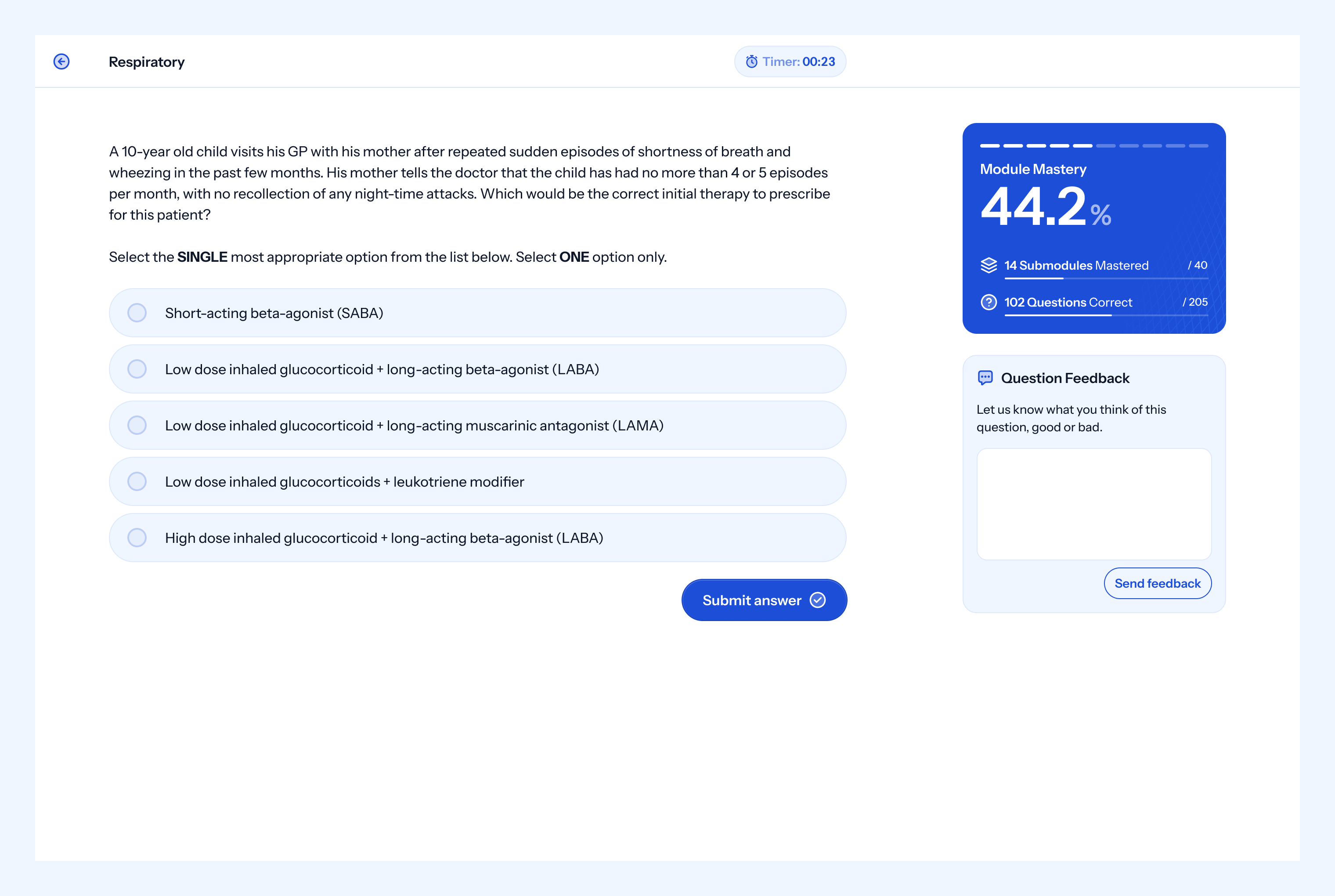 Example of an AKT question from the Medibuddy MLA Question Bank.[/caption]
A question bank which includes detailed explanations will also support your revision further, ensuring that you can learn from any mistakes you make and expand your knowledge across the MLA topics. Our MLA question bank provides a comprehensive overview of every topic, allowing you to learn about the relevant subject after each question, or to access it all in our ‘library’ to work through topics at your own pace.
[caption id="attachment_23998" align="alignnone" width="3040"] Example of an AKT question from the Medibuddy MLA Question Bank.[/caption]
A question bank which includes detailed explanations will also support your revision further, ensuring that you can learn from any mistakes you make and expand your knowledge across the MLA topics. Our MLA question bank provides a comprehensive overview of every topic, allowing you to learn about the relevant subject after each question, or to access it all in our ‘library’ to work through topics at your own pace.
[caption id="attachment_23998" align="alignnone" width="3040"]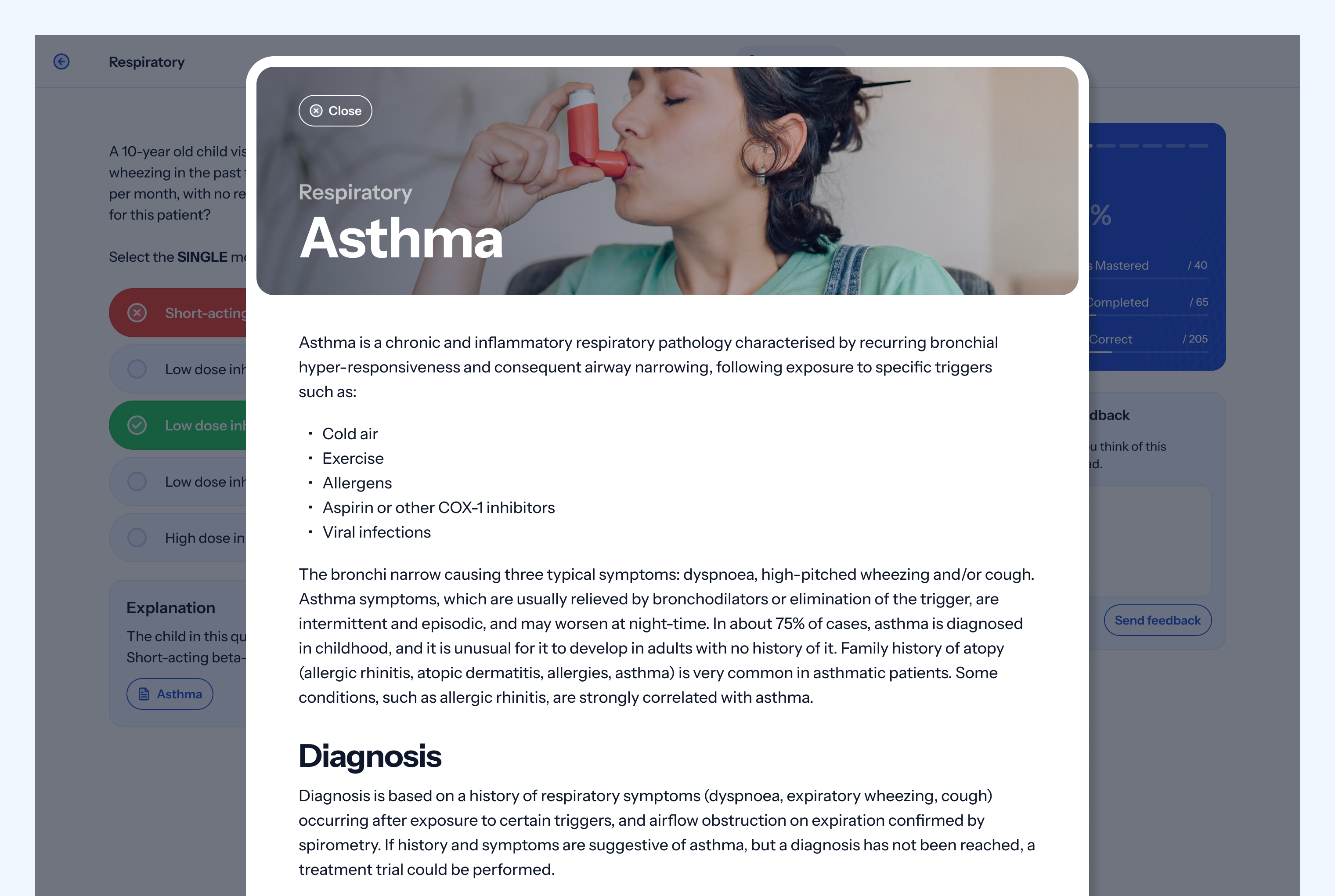 Example of a detailed AKT explanation from the Medibuddy MLA Question Bank.[/caption] Example of a detailed AKT explanation from the Medibuddy MLA Question Bank.[/caption]
How artificial intelligence technology can improve your MLA scoreOur MLA AKT question bank uses our state-of-the-art AI technology to personalise your learning experience. Using machine learning algorithms, it continually assesses your strengths and weaknesses as you’re answering questions, and adapts based on your needs, giving you topics and questions most suited to further your learning. But what does this mean? You won't spend time answering questions on topics you already know, and answering questions on topics you aren't familiar with yet - the question bank will build you up to these. This ensures that your exam revision is focused on areas which will have the biggest impact on your progress, makes the most effective use of your time and helps maximise your MLA score. |
||||||||||||||||||||||||||||||||||||||||||||||||||||||||||||||||||||||||||||||||||||||||||||||||||||||||||||||||||||||||||||||||||||||||||||||||||||||||||||||||||||||||||||||||||||||||||||||||||||||||
Post ID: 22935 - The PLAB and the Medical Licensing Assessment (MLA) ExamThe Professional and Linguistic Assessments Board (PLAB) exam is a requirement for the majority of international medical graduates applying to the General Medical Council (GMC) for a licence to practise medicine in the UK. The exam assesses whether you have the knowledge and skills required for UK practice. The Medical Licensing Assessment (MLA) is an exam introduced by the GMC. It is designed to assess the core knowledge, skills and behaviours needed for safe practice and ensure a common and consistent threshold for all doctors registered to practise in the UK.
What are the requirements for the PLAB and MLA?The PLAB forms part of your GMC application for a licence to practise medicine within the UK. Before you can book your PLAB exam, you need to set up a GMC online account, demonstrate that you meet the eligibility criteria and provide the necessary evidence. You can find out more about the eligibility criteria for registering with the GMC in our PLAB Pathway blog. The MLA is required for all UK medical school graduates. You do not need to apply to take the MLA; this will be included in your medical degree and will be a requirement for graduating and being able to apply for GMC registration.English language requirements for the MLA / PLABEnglish language requirements are included in the eligibility criteria for GMC registration. As part of your application, you must provide evidence that you meet the English language requirements for practising within the UK, before you can book your PLAB exam. For international medical graduates, this usually includes meeting the minimum score requirements for the IELTS test or OET (medicine version). You can find more details on the GMC’s website.How much will the MLA / PLAB cost?The current PLAB fees for booking from 1 April 2026 onwards are as follows:
What is the MLA / PLAB exam structure?The PLAB is made up of the following 2 exams:PLAB 1This is a 3-hour multiple choice written exam. It consists of 180 single-best-answer (SBA) questions. For each question, you’ll be given a scenario, followed by a question and five possible answers. You can see an example from our PLAB 1 question bank below to give you an idea of the question structure: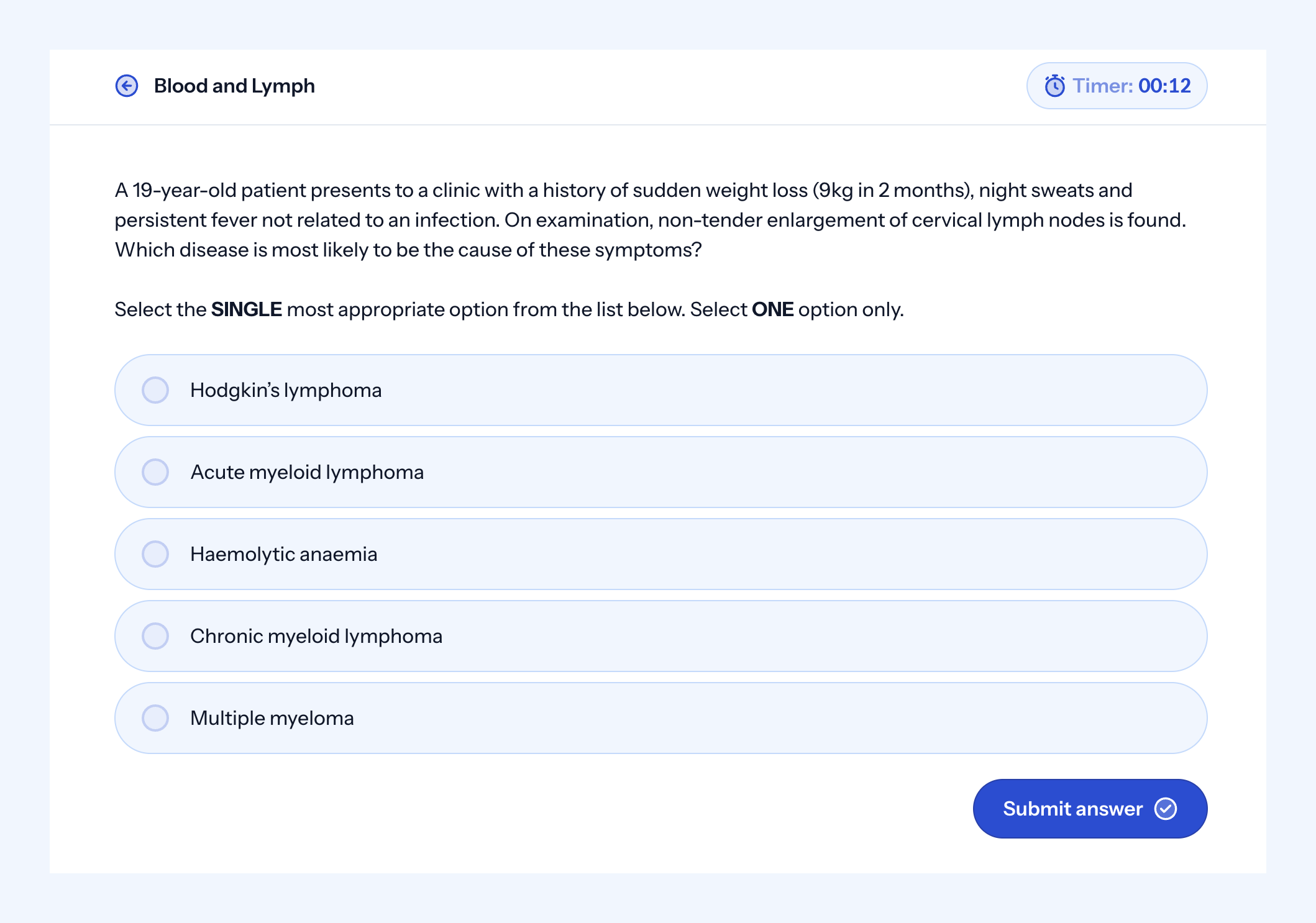 You can also find more information in our PLAB 1 Guide.
PLAB 2This is a practical ‘objective structured clinical exam’ (OSCE). It consists of 16 scenarios, each lasting 8 minutes, which aim to reflect real life situations and settings. You can find out more about the PLAB 2 exam in our PLAB Guide.The MLA similarly consists of 2 exams: The Applied Knowledge Test (AKT)The AKT is an on-screen, multiple-choice exam made up of 2 papers. Each paper consists of 100 single-best-answer (SBA) questions, each with 5 answer options. An example from our MLA AKT question bank is shown below:
You can find more information, including the areas of clinical practice that are assessed within the exam, in our Guide to the AKT.
Clinical and professional skills assessment (CPSA)The CPSA is a practical assessment of your clinical and professional skills, knowledge and behaviours. You may see this referred to as an ‘objective structured clinical examination’ (OSCE) or ‘objective structured long examination record’ (OSLER). An example question from our MLA CPSA resource can be seen below: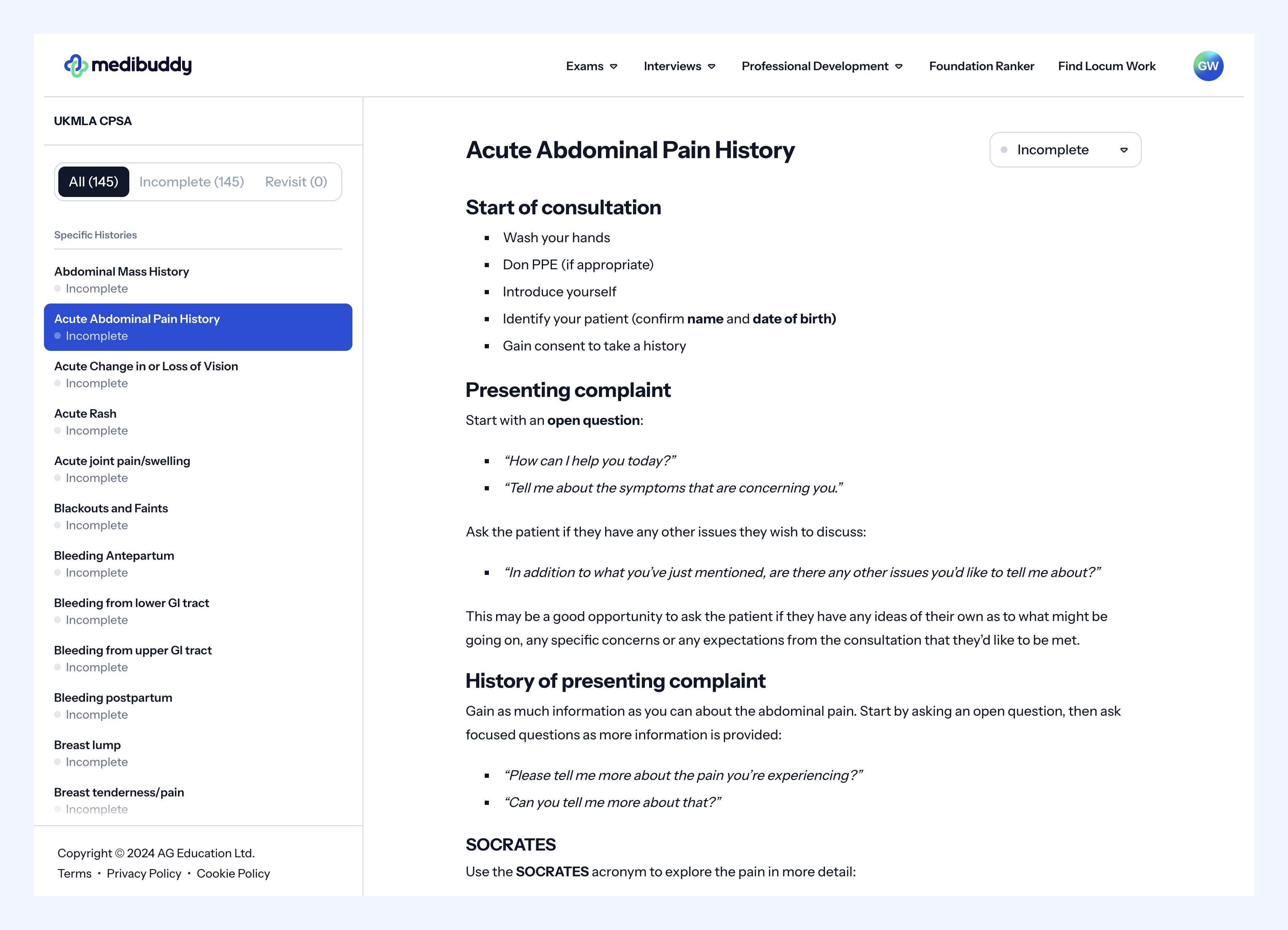 You can find out more about the CPSA, including what topics are covered, in our CPSA Guide.
Do IMG doctors need to do PLAB and the MLA?The majority of international medical graduates applying for a licence to practise medicine in the UK will be required to pass the PLAB only. As a general rule, if you qualified outside of the UK and don’t hold a ‘relevant European qualification’, you must complete the PLAB as part of your registration application. There are some exceptions to this, which you can learn more about on the GMC’s website. The current advice from the GMC is that the MLA will only be used to assess UK medical graduates.Will MLA be harder than the PLAB?As the MLA content map is used for PLAB exams you may be wondering what this means for the difficulty of the exam. Will the MLA be harder than the PLAB? And if so, will this in turn make the PLAB more difficult to pass? The MLA content map will set out the core knowledge, skills and behaviours needed for UK practice. As the PLAB exam already covers these areas, the standard of the test and the types of questions you’ll experience will not change. To give you an idea of the PLAB difficulty, you can find the most recent pass rates in our PLAB Guide.How do I prepare for the MLA / PLAB?To prepare for the PLAB exam, the GMC recommends that you refer to the following documentation: Although these resources provide comprehensive guidance for UK medical practice, revising for an exam from this type of document is difficult. Therefore, most people supplement this with the use of question banks. The GMC offers 30 sample questions for PLAB 1 and a sample OSCE station for PLAB 2. These are great starting points for your revision, but you’ll need to practise with a wider range of questions to prepare effectively. Our personalised PLAB 1 Question Bank covers all aspects of the PLAB blueprint to ensure your revision is comprehensive and effective. What’s more, our AI-powered algorithm automatically assesses your progress and adapts to your individual learning needs. By providing you with questions that are targeted to your areas of development, it ensures your learning is more focused, and therefore makes the best use of your revision time! The question bank dashboard (below) also makes it easy for you to see how you’re performing in all areas of the exam so you can take control and choose which topics you want to focus on.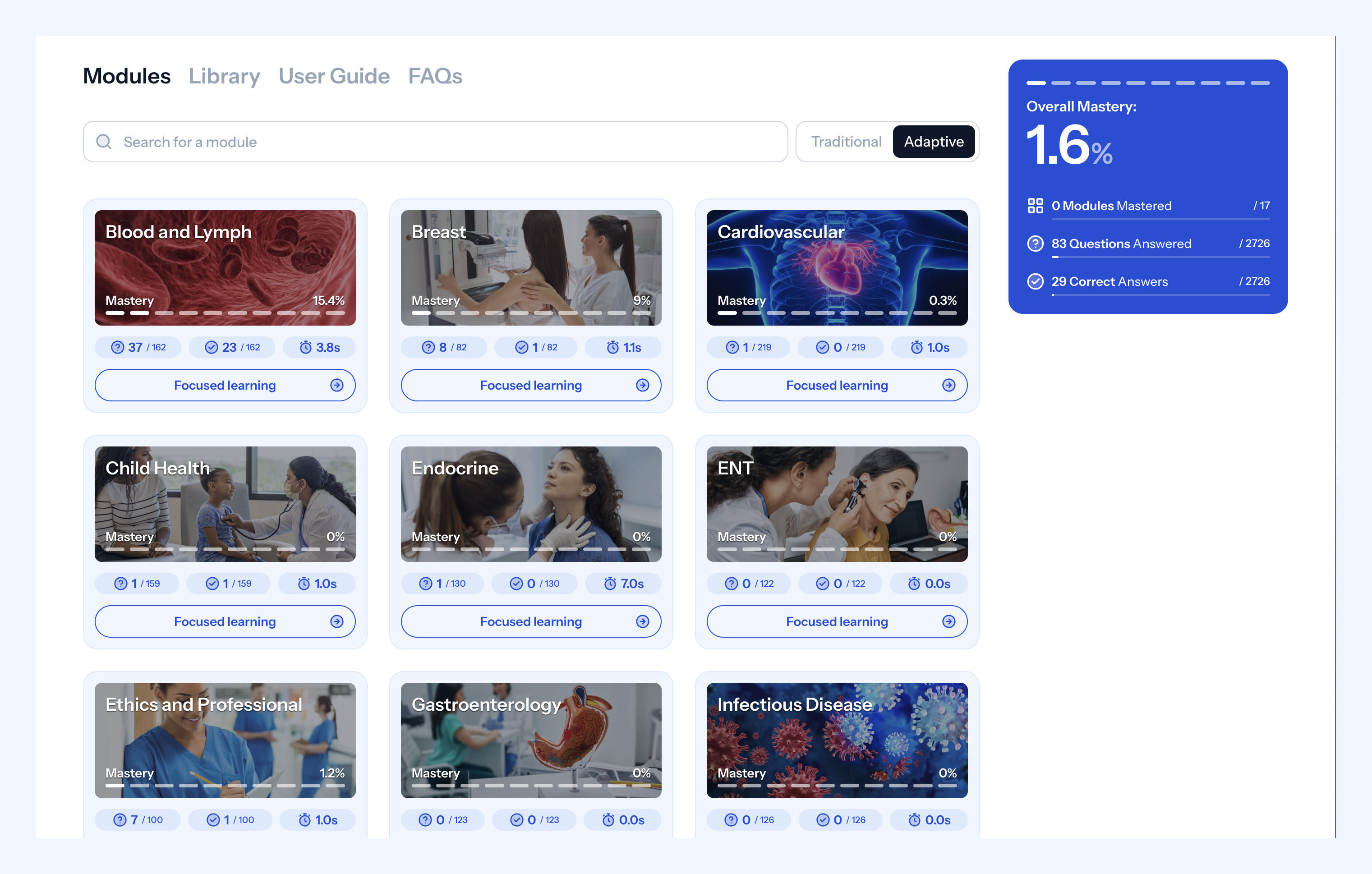 A high-quality question bank, with detailed explanations and learning personalised to you, such as our PLAB 1 question bank, is the perfect accompaniment to the GMC resources.
For the MLA, the GMC states that your UK medical degree is the best preparation for the exam, and you won’t need to learn anything beyond what is covered in the curriculum. The MLA content map outlines the topics that will be assessed and is a useful tool for identifying areas which you may need to revise or develop further to ensure you’re prepared for the AKT and CPSA.
Although the MLA content map is not easy to revise from, our comprehensive MLA AKT question bank and MLA CPSA resource has been specifically tailored to the MLA content map, to make revising for the exam simple and effective.
A high-quality question bank, with detailed explanations and learning personalised to you, such as our PLAB 1 question bank, is the perfect accompaniment to the GMC resources.
For the MLA, the GMC states that your UK medical degree is the best preparation for the exam, and you won’t need to learn anything beyond what is covered in the curriculum. The MLA content map outlines the topics that will be assessed and is a useful tool for identifying areas which you may need to revise or develop further to ensure you’re prepared for the AKT and CPSA.
Although the MLA content map is not easy to revise from, our comprehensive MLA AKT question bank and MLA CPSA resource has been specifically tailored to the MLA content map, to make revising for the exam simple and effective.
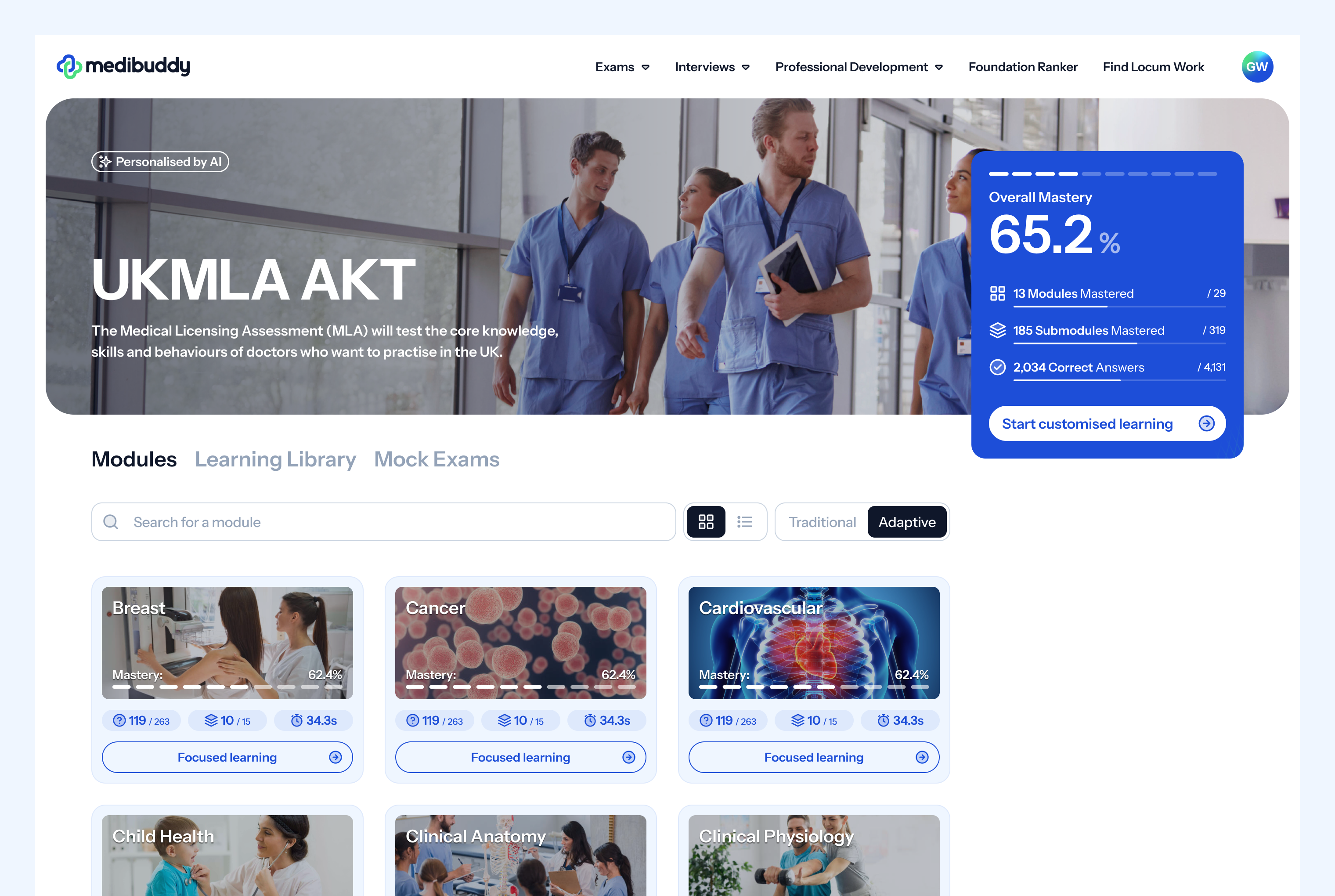 Mapped against the MLA content map, there are over 10,000 questions within our MLA AKT question bank covering every MLA presentation and condition, so you can practise answering questions across all elements of the exam. Designed to the same high standards as our PLAB question bank, it uses AI technology to personalise your learning experience, and provides detailed explanations and a learning library to further your knowledge.
We hope this guide has been useful in providing you with up-to-date and accurate information about the PLAB and MLA.
Mapped against the MLA content map, there are over 10,000 questions within our MLA AKT question bank covering every MLA presentation and condition, so you can practise answering questions across all elements of the exam. Designed to the same high standards as our PLAB question bank, it uses AI technology to personalise your learning experience, and provides detailed explanations and a learning library to further your knowledge.
We hope this guide has been useful in providing you with up-to-date and accurate information about the PLAB and MLA.
|
||||||||||||||||||||||||||||||||||||||||||||||||||||||||||||||||||||||||||||||||||||||||||||||||||||||||||||||||||||||||||||||||||||||||||||||||||||||||||||||||||||||||||||||||||||||||||||||||||||||||
Post ID: 21579 - MLA: A guide to the CPSAThe Clinical and Professional Skills Assessment (CPSA) makes up one component of the two-part Medical Licensing Assessment (MLA). The exam is being introduced by the General Medical Council (GMC) for all UK medical school graduates and international medical graduates who wish to register for a licence to practise medicine in the UK. The MLA will ensure a common and consistent threshold against which to assess the skills needed for safe practice in the UK. If you’re a UK medical student, you will need to pass the MLA as part of your medical degree before you can join the medical register. This guide will provide you with everything you need to know about the CPSA section of the MLA. We also have more information about the exam in our MLA Guide. If you’re an international graduate who is currently required to pass the PLAB (PLAB 1 & PLAB 2) before you can apply to join the UK medical register, we have all the information you need in our PLAB and MLA Guide. Do you need to take the MLA?Our MLA AKT question bank and MLA CPSA resource, designed specifically to match the exam syllabus, can help! The MLA syllabus differs from old-style medical finals. Ensure that any question bank provider you use hasn’t just changed the name of their old question bank. Medicine is vast, and you may waste considerable time revising topics not in the MLA. All providers should be able to give you a breakdown of exactly how their question bank matches the MLA content map. Find ours here. What is the CPSA part of the MLA?The MLA is a two-part exam made up of the following:Applied Knowledge Test (AKT)This will be an on-screen, multiple-choice exam, assessing your ability to apply medical knowledge to different scenarios. You can find more information about the AKT – including the clinical areas which are assessed, when you will take the AKT and how to prepare – in our Guide to the AKT.Clinical and Professional Skills Assessment (CPSA)This will be a practical, performance-based assessment of your clinical and professional skills, knowledge and behaviours. For UK medical students, your CPSA will be set and delivered by your medical school. You may see the CPSA referred to as something else, for example, an Objective Structured Clinical Examination (OSCE) or Objective Structured Long Examination Record (OSLER), as some medical schools use different names. Regardless of what it’s called, your CPSA will need to meet the same requirements as all other UK medical schools, as set by the GMC.What topics does the CPSA cover?As mentioned above, all CPSAs must meet specific requirements set by the GMC. These have been developed in collaboration with medical schools and with the support of independent assessment experts. The MLA content map outlines the core knowledge, skills and behaviours needed for practising in the UK, and those which you will be assessed against in the CPSA. From September 2026 onwards, the MLA will follow an updated MLA content map. The CPSA is mapped against the content map’s three overarching themes:
Is the CPSA similar to current OSCEs in medical school finals?Yes, the CPSA is a practical exam like the OSCEs (or similar) which are currently taken in medical school finals. What’s more, the MLA content map, which sets out the topics that could be assessed in the CPSA, is based on the GMC’s Outcomes for Graduates. This document outlines the requirements for newly qualified UK graduates, in terms of what they must know and be able to do, and every UK medical school needs to ensure that their graduates are meeting these outcomes. As your medical school is already preparing you to meet the GMC’s Outcomes for Graduates, the topics covered by your medical school and likely to be assessed in any current OSCEs, should be similar to those in the MLA content map, and subsequently the CPSA exam.Preparing for the Medical Licensing Assessment CPSAAdvice from the GMC states that your medical degree is the best preparation for the MLA and you don’t need to learn anything beyond what is covered in the curriculum. Remember, the MLA content map outlines the topics and areas which could be assessed in the CPSA. This can be used to guide your preparation, helping you to identify any areas which you may need to develop further and providing topics to practise from. Although it is a new exam, don’t forget what you would usually do for OSCEs or any other practical exam to help you to prepare. Practising with others – using the content map topics – will help you to gain practical experience and build confidence for the exam.MLA CPSA resourceOur MLA CPSA resource would be a really valuable addition to your CPSA preparations, providing you with station topics and detailed explanations to help you demonstrate your clinical and professional skills, knowledge and behaviours during the exam. While the MLA content map, with its ‘A-Z of presentations’, is useful for identifying topics to revise, a question bank can then help you prepare for each of these. For example, the MLA content map lists “Acute Abdominal Pain” as a presentation on which you may be assessed. Using a question bank can help you revise how you would approach CPSA stations relating to this, like in the example given below: [caption id="attachment_31160" align="alignnone" width="3048"] Example of a CPSA specific history from the Medibuddy MLA CPSA resource[/caption]
A high-quality MLA CPSA resource should cover all topics and areas listed in the MLA content map. Our comprehensive MLA CPSA resource has been mapped against the MLA content map and designed specifically to cover all elements of the exam, helping you to prepare effectively for the CPSA.
When will I take the MLA CPSA?If you’re a UK medical student graduate, you’ll take the exam in the penultimate or final year of your medical degree. Dates for the MLA CPSA will be determined by your medical school. It’s likely that this will be in line with when your medical school currently sets finals, as it’s planned that the CPSA will be integrated into the existing finals (following a process of quality assurance to ensure that GMC requirements are met). If you’re an international medical graduate, you will still be required to pass the PLAB at this stage and will not need to take the MLA. However, the PLAB follows the MLA content map to make it compliant with the requirements of the MLA. You can find more information in our MLA Guide.Where will the CPSA be held?UK medical schools will deliver their individual CPSAs; therefore, if you’re a UK student you will complete your CPSA at your medical school or a place of their choosing. As mentioned above, international medical graduates will continue to take the PLAB. PLAB 2 exams are held in one of two GMC assessment centres in Manchester, UK.How is the MLA CPSA scored?Both parts of the MLA – the AKT and CPSA – are pass/fail assessments. For UK medical students, your CPSA will be set, delivered and assessed by your medical school. This means the MLA CPSA scoring is determined locally, by individual medical schools, rather than nationally. However, all CPSAs need to meet the GMC requirements and will be quality assured by the GMC for quality, consistency and fairness. Additionally, your medical school will need to provide rationale for their approach to scoring.How many people fail the CPSA?There are no figures showing how many people fail the CPSA. However, a good marker is to compare it to the PLAB 2 pass rates, as this is to be the equivalent exam to the CPSA. For 2025, the percentage of candidates who passed the PLAB 2 was 59.8%. In the last 5 years the pass rate percentage has consistently been below 70%. Hopefully this guide has answered any questions you may have about the CPSA. We also have you covered with a MLA Guide and AKT Guide. |
||||||||||||||||||||||||||||||||||||||||||||||||||||||||||||||||||||||||||||||||||||||||||||||||||||||||||||||||||||||||||||||||||||||||||||||||||||||||||||||||||||||||||||||||||||||||||||||||||||||||
Post ID: 14834 - A complete guide to MRCP Part 2 for 2026If you’re preparing for the MRCP Part 2 exam, you’re in the right place. We’ve put together this comprehensive guide covering everything you need to know about the exam. MRCP Part 2 is the second of three essential exams required to gain the Membership of the Royal Colleges of Physicians Diploma. To be awarded the diploma and move forward onto specialty training, you must pass all three parts of the MRCP examination:
Which specialties require MRCP?If you're applying for any Physician Higher Specialty Training (PHST) programmes, you need to have successfully completed all elements of the MRCP(UK) – or an acknowledged equivalent – before the specified deadline. Usually, this will be by the offer date; however, you can check the individual specialty deadlines here. This applies for the following specialties:
What is the MRCP Part 2 Exam?When you sit MRCP Part 2 you will be expected to complete two papers over the course of a day. For each paper, you will have three hours to go through 100 multiple choice questions. MRCP Part 2 will test your knowledge, skills and behaviour as a doctor. In addition, your ability to understand and make clinical judgements will be assessed across a multitude of topics. The questions within Part 2 of the exam are based on the diagnosis, investigation, management and prognosis of a patient.What is the difference between MRCP Part 1 and 2?Although MRCP Part 2 requires you to build on the knowledge that is assessed in Part 1, there is one key difference between the two exams. While Part 1 is purely made up of text based multiple choice questions, MRCP Part 2 often uses images to display clinical scenarios. Among other medical related occurrences, these images usually include x-rays, pathology slides, CT and MRI scans. On top of having the relevant medical knowledge, you will need to be able to interpret the information that is given to solve the problems and answer the questions.MRCP Part 2 Exam DatesThere are three different periods throughout the year that you can sit the exam. For UK students, the application fee is £502, while international students have to pay £672. You can submit an application for the MRCP Part 2 exam through the MRCP UK website. The exam dates for 2026 are as follows:
MRCP Part 2 Pass MarkThe pass mark for MRCP Part 2 is 454. After sitting the exam, you will receive a result which has been curated by a process referred to as equating. This method of marking relies on a statistical approach, to ensure that candidates are awarded a comparable score for similar rates of performance across different parts of the MRCP exam.What is a good score in MRCP Part 2?To achieve the set pass mark of 454, you need around 121 correct answers from the 200 questions. However, due to the marking process, answering this many questions correctly won’t necessarily result in a pass mark. Therefore, you are better off aiming for an overall score of 475 to 575. The key to achieving a good score on the MRCP Part 2 exam is making sure that you prepare effectively. As well as gaining an insight into the type of questions that will be included in the exam, going through sample MRCP Part 2 questions will encourage you to understand the concepts behind the right answers.ResourcesThere are several excellent resources available to support your preparation for the MRCP Part 2 exam. As the exam is based on the UK Core Medical Training (CMT) curriculum and national clinical guidelines, your study plan should align closely with these specifications. It's also important to keep your clinical knowledge current by referring to up-to-date medical textbooks and relevant peer-reviewed journals. In addition to building your theoretical foundation, it's crucial to become familiar with the format and style of the exam. Practising a wide range of MRCP Part 2-style questions is one of the most effective ways to prepare. This helps you build confidence, sharpen your clinical reasoning, and manage your time effectively under exam conditions. To support you with this, we’ll soon be launching our own MRCP Part 2 question bank, designed to mirror the real exam with high-quality, clinically relevant sample questions. [coming_soon qb="mrcp_part_2"] As well as exam question banks, consider enrolling in a preparation course. A variety of courses are available, delivered both in-person and online, by the three Royal Colleges that comprise the Federation of Royal Colleges of Physicians of the United Kingdom. These can offer valuable insights, exam strategies, and structured revision support. Good luck with your MRCP Part 2 exam preparation! |
||||||||||||||||||||||||||||||||||||||||||||||||||||||||||||||||||||||||||||||||||||||||||||||||||||||||||||||||||||||||||||||||||||||||||||||||||||||||||||||||||||||||||||||||||||||||||||||||||||||||
Post ID: 14419 - Core Surgical Interview Tips 2026This year, the Core Surgery Training (CST) interviews take place between Monday 2 March to Wednesday 11 March 2026, using an online platform called Qpercom. Interview techniqueInterview technique and how you present yourself to interviewers is fundamental to success in the interview. While knowledge and content of answers will give you marks, if you present yourself professionally and confidently, you will come across as someone they see as a future surgical trainee and colleague.General interview tips/ techniquesThese should be practised before the interview. Candidates often find recording themselves on video useful to fine-tune their technique. You can also practise with colleagues and ask for feedback specifically on how you come across.Body language
Speech/ verbal communication
Online interview considerations
The day beforeIt is important to reduce any anxiety on the day of your interview by preparing yourself fully the day/ or a few days before. Here are some tips:
|
||||||||||||||||||||||||||||||||||||||||||||||||||||||||||||||||||||||||||||||||||||||||||||||||||||||||||||||||||||||||||||||||||||||||||||||||||||||||||||||||||||||||||||||||||||||||||||||||||||||||
Post ID: 34308 - Anaesthetics CT1/ACCS Interview Guide 2026If you’re interested in applying for Anaesthetics Core Training (CT1) but need some advice and guidance on how to navigate the process, our Anaesthetics CT1 interview guide for 2026 has been created to help you. We’ll cover the key 2026 recruitment dates, the interview format and how the assessors score each performance, giving you the best chance of making a good impression. Anaesthetics ACCS is an alternative entry point to the world of anaesthetics. It’s a slightly longer course pathway than CT1, with additional time spent in emergency and general medicine. However, the two pathways have many similarities and share the same application and interview process. Anaesthetics CT1 is a competitive specialty, and the 2025 competition ratio demonstrates this, with 6,770 applications for 539 posts. This gave a competition ratio of 12.56, meaning over 12 people applied for each post. [custom_sales_panel title="Anaesthetics CT1/ACCS" link="https://medibuddy.co.uk/ct1-accs-anaesthetics/interview-question-bank/"] Anaesthetics CT1/ACCS ApplicationTo be eligible for Anaesthetics CT1, you must have achieved one of the following foundation competencies in the 3.5 years running up to the start date:
Anaesthetics CT1/ACCS Key datesThe key dates for Anaesthetics CT1 and ACCS are as follows:
Anaesthetics CT1/ACCS Interview formatAnaesthetics CT1 interviews continue to take place online. There are two interview stations, each lasting 15 minutes. However, after allowing for the waiting time before the general station and the five-minute reading time you’re permitted before the clinical scenario, you can expect the interview to take around 50 minutes. There will be two assessors for each station (so four in total), which can be daunting. But, like any interview or exam, preparation is key so you know you have the knowledge and confidence to deliver your answers. Practising the types of questions that are likely to come up in the interview is important here. You can do this by using question banks and verbalising your answers to yourself, a friend or a family member. The two Anaesthetics interview stations are:Clinical Judgement StationYou’ll have five minutes to read the clinical scenario. This is an opportunity to really prepare yourself for the incoming questions. You can make notes here and think about how you might answer the questions. You aren’t expected to have a lot of knowledge and experience with anaesthetics at this stage. Instead, the clinical scenario will be about a situation or emergency that’s familiar to FY2 doctors, assessing you in the following areas:
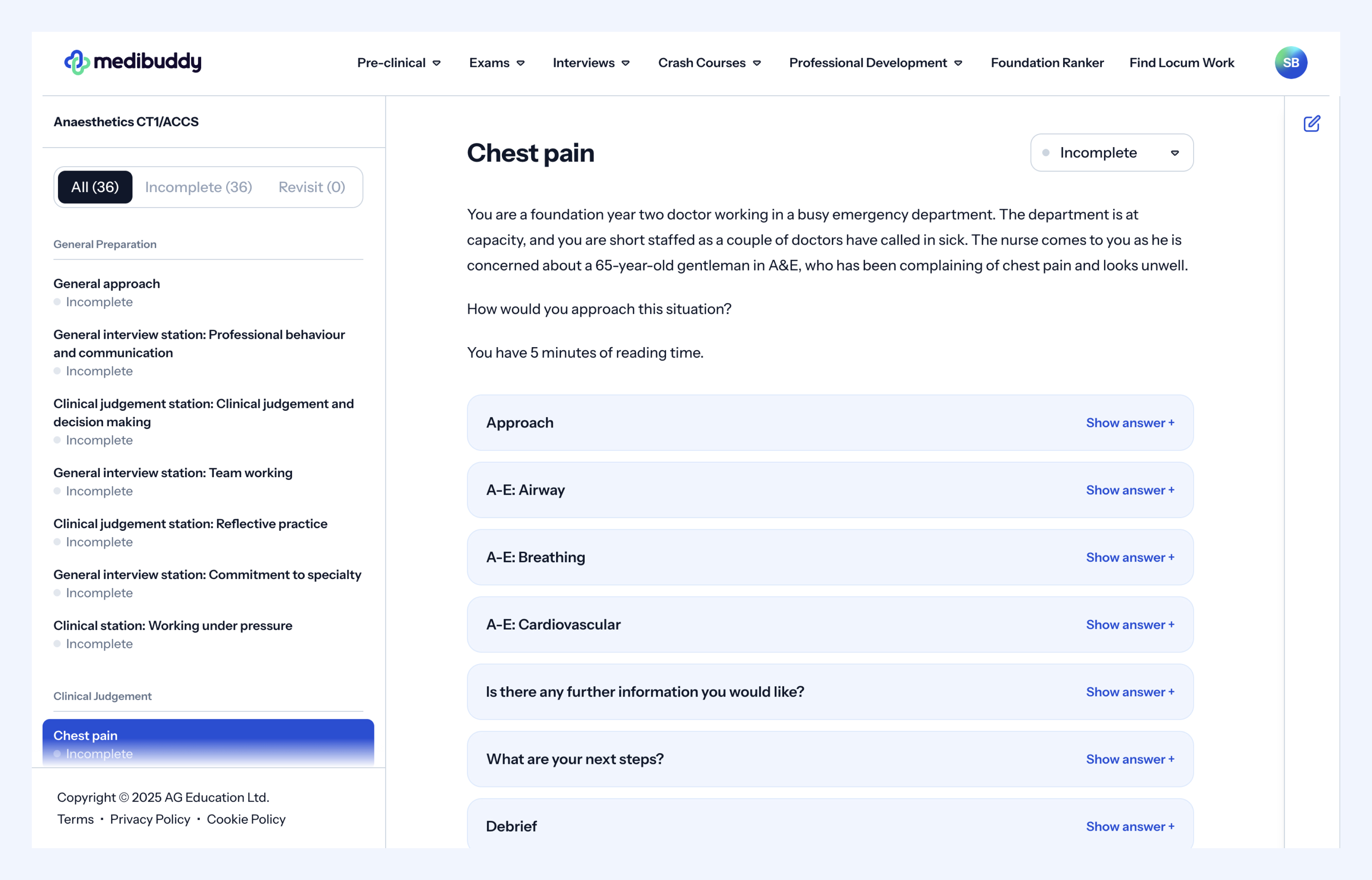
General Interview StationThe general interview station is less specific, encompassing a wide range of topics. It’s your chance to show that you’re a well-rounded doctor, allowing you to highlight your strengths and achievements. You’re still limited to 15 minutes for this interview station. So, you should aim to be concise and direct with your answers. During this station, the interviewers will be assessing you in the following areas:
Anaesthetics CT1/ACCS Interview ScoringThe 2026 scoring matrix has not yet been confirmed. In the meantime, the Anaesthetics CT1 scoring matrix used for the 2025 interview is included below to give you an indication of how candidates were assessed. As you can see, each assessor has a potential 15 marks to award. Overall, 100 marks are available, with the remaining 40 marks coming from your global rating. Each assessor will rate you out of 10, reflecting their overall impression of you.
|
||||||||||||||||||||||||||||||||||||||||||||||||||||||||||||||||||||||||||||||||||||||||||||||||||||||||||||||||||||||||||||||||||||||||||||||||||||||||||||||||||||||||||||||||||||||||||||||||||||||||
Post ID: 26836 - Public Health Medicine ST1: Application and Selection Centre Guide 2026If you’re considering applying for Public Health Medicine ST1 as part of the 2026 recruitment process, this guide will provide everything you need to know to submit your application and progress to the assessment and selection stages. Unlike other specialties, Public Health Medicine ST1 includes a medical and non-medical route, meaning you can apply with or without a medical degree, provided you meet the eligibility criteria (see the section below). There is no quota defining the proportion of places offered to each group. Applications to Public Health Medicine ST1 have increased significantly in recent years. For 2025 recruitment, there were 2,710 applicants for only 95 posts, giving a competition ratio of 28.53. This puts Public Health Medicine in the top five most competitive specialties for ST1 recruitment! However, as Public Health Medicine is open to medical and non-medical applicants, a direct comparison to other clinical specialties is limited. Regardless, with fierce competition for posts, it’s crucial that your application meets the required standards and you perform well at the assessment centre and selection centre stages. [custom_sales_panel title="Public Health ST1" link="https://medibuddy.co.uk/st1-public-health-medicine/interview-question-bank/"] Public Health Medicine ST1 ApplicationAs mentioned above, you can apply to Public Health Medicine ST1 via the medical or non-medical route, depending on your qualifications and experience. The 2026 person specification outlines the eligibility criteria that you must meet for each route. The eligibility criteria only is used for the purpose of longlisting applicants. If you meet the requirements, you will progress to the next stage of the application process, the Public Health Medicine ST1 Assessment Centre (see below). You’re not required to include information such as publications and presentations, etc. in your Public Health Medicine ST1 application, unlike with other specialties, as scored shortlisting is not included in the application process. The 2026 person specification provides full details of the eligibility requirements, and you can find an example application form here.Public Health Medicine ST1 Recruitment TimelineThe following are the key dates for Public Health Medicine ST1 2026 recruitment (for posts starting from August 2026):
Public Health Medicine ST1 Assessment CentreIf you meet the eligibility criteria, you’ll be invited to attend the assessment centre. Note, this takes place at Pearson Vue test centres at various locations throughout the UK and globally between 6 – 7 January 2026 for 2026 recruitment. This stage of the recruitment process includes the following three computer-based assessments:
Public Health Medicine ST1 Selection CentreTop-ranked applicants from the written tests will be invited to the next stage of the recruitment process, the selection centre. The Public Health Medicine ST1 selection centre is a virtual interview that will take place between 3 – 5 March 2026 for 2026 recruitment. The interview will consist of 6 questions, each lasting 6 minutes. However, including ID checks and candidate briefing, you can expect the interview time to be up to 60 minutes in total. The selection centre interview is formatted into 2 interview stations, each with 3 questions, and 3 assessors per station. The purpose of using a range of assessors is to ensure a balanced view of your abilities. Two of the questions will include an element of preparation time. The information for these will be sent to you the day before the interview. Below, you can see an example of the type of question you may receive and how to approach it, taken from our Public Health ST1 Interview Question Bank.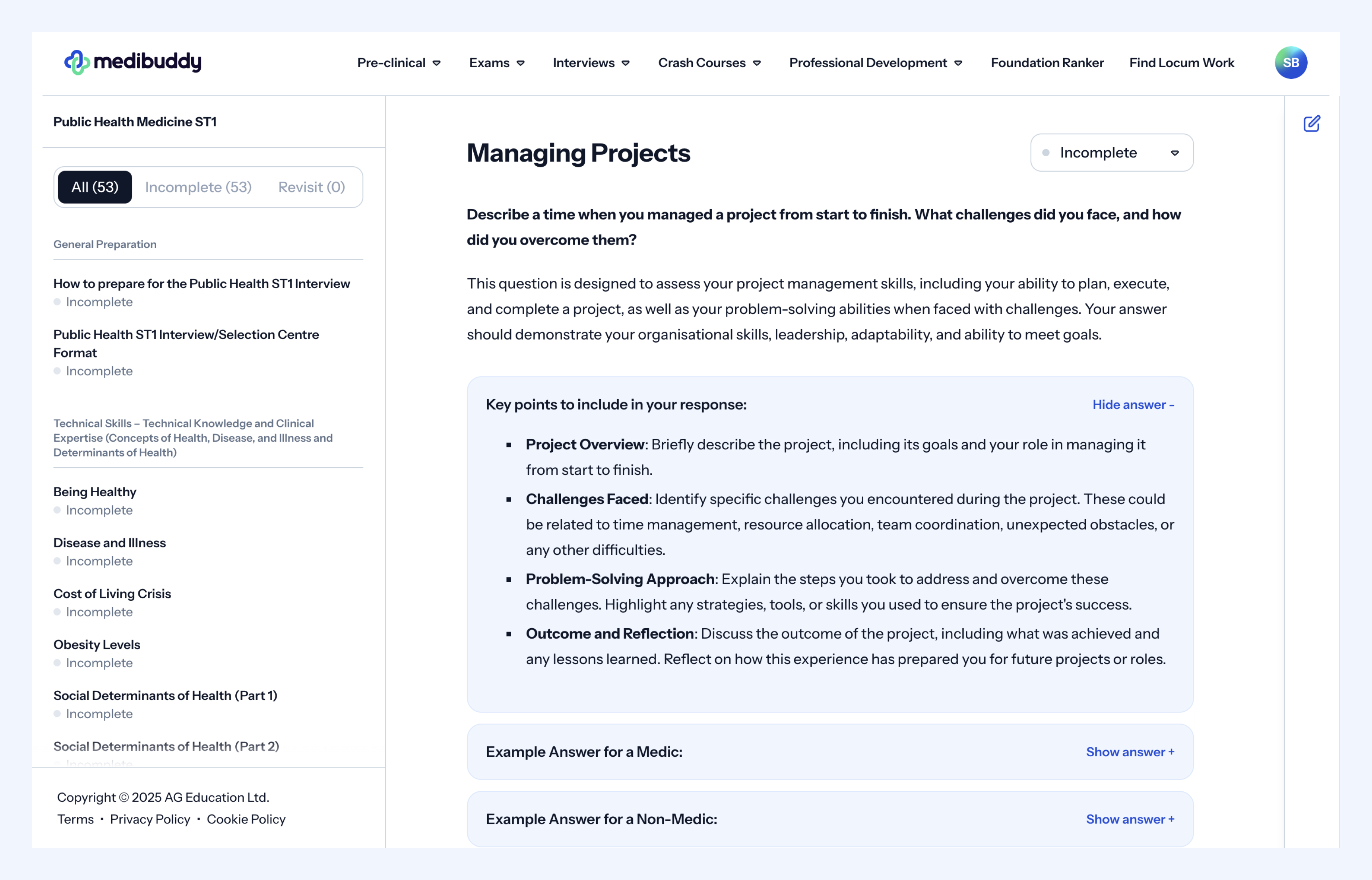 Each question will assess specific essential criteria from the 2026 person specification.
Public Health Medicine ST1 Application ScoringAs mentioned above, there will be 3 assessors per station scoring your performance. To be considered for appointment, you must meet a minimum total score for the selection centre. If you score below this, you’ll be notified that you have been unsuccessful. However, if you meet the required standard at the application centre, you’ll be considered for appointment. This involves being ranked based on your interview score – as with the assessment scores – with offers made in rank order. At both stages of the selection process – the assessment centre and selection centre – you’ll be assessed on the selection criteria outlined in the 2026 person specification, including:
|
||||||||||||||||||||||||||||||||||||||||||||||||||||||||||||||||||||||||||||||||||||||||||||||||||||||||||||||||||||||||||||||||||||||||||||||||||||||||||||||||||||||||||||||||||||||||||||||||||||||||
Post ID: 3814 - ACCS Emergency Medicine Interview Guide 2026If you’re thinking about applying to ACCS Emergency Medicine, the interview is a crucial element of the application process. Unfortunately, the Royal College of Emergency Medicine (RCEM) and Health Education England (HEE) resources regarding the interview process are vague, that’s why we have written this blog. When thinking about your Emergency Medicine interview, the first thing to remember is that the interview panel wants you to succeed, they are interested in your experiences and achievements. Secondly, the panel are not trying to catch you out with trick questions, it’s an opportunity to showcase your successes. The ACCS Emergency Medicine ApplicationApplications for ACCS Emergency Medicine are submitted through Oriel only, so you’ll need an active account before the window opens. Before starting the form, make sure you meet the eligibility criteria by checking the 2026 ACCS EM person specification. The deadline for applications is 4pm on Thursday 20 November 2025. Make sure to give yourself plenty of time to complete and review your form, as once submitted, it cannot be changed, and late applications will not be accepted. After submitting, you’ll enter the national selection process, which typically includes the MSRA followed by an interview if you’re shortlisted. Your final score is a combination of both, with the MSRA contributing 40% and the interview making up the remaining 60%.Multi-Specialty Recruitment Assessment (MSRA)The MSRA exam is used as a shortlisting tool for interviews, so it is really important that you prepare for this exam. The exam is made up of two parts, the Clinical Problem Solving paper and the Professional Dilemmas paper. You can prepare for your MSRA using the AI-powered, adaptive Medibuddy MSRA question bank. We have broken the syllabus down into the different topics you need to learn, as you can see from the image below.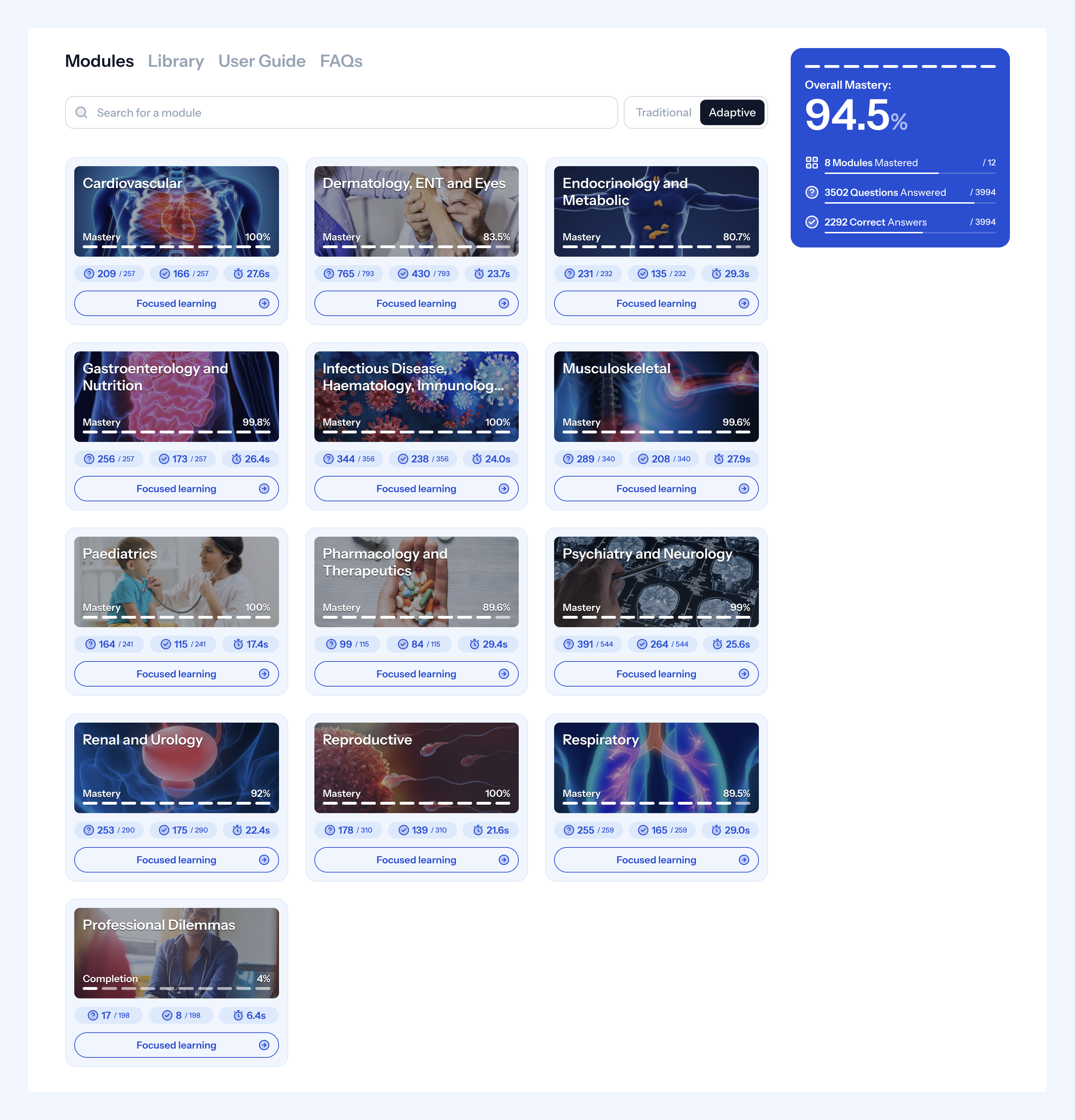 We won't just tell you how many questions you have answered incorrectly, our clever algorithms will show you your skill level for each topic, so you know which topics to focus on to enhance your score. When you are working through each topic, instead of giving you random questions, our algorithm is carefully selecting the next question for you, meaning you spend less time answering questions you already know and more time learning new information. You will take the MSRA exam in January, with most candidates beginning their preparation around October time. You can find out more about the MSRA, including how to prepare, here.
[msra_sales_panel]
We won't just tell you how many questions you have answered incorrectly, our clever algorithms will show you your skill level for each topic, so you know which topics to focus on to enhance your score. When you are working through each topic, instead of giving you random questions, our algorithm is carefully selecting the next question for you, meaning you spend less time answering questions you already know and more time learning new information. You will take the MSRA exam in January, with most candidates beginning their preparation around October time. You can find out more about the MSRA, including how to prepare, here.
[msra_sales_panel]
ACCS Emergency Medicine Key DatesThe dates for 2026 recruitment are below:
ACCS Emergency Medicine Interview Overview
ACCS Emergency Medicine Interview PreparationDue to the interview details being so vague, we recommend doing as much preparation as you can to ensure you are ready for whatever questions come up. To help you, we have been busy building our ACCS Emergency Medicine Interview question bank, written by previously high scoring trainees covering themes and questions that have come up in previous years. We have broken our ACCS Emergency Medicine Interview question bank into the different themes that could be included in the interview. We recommend preparing for your interview like you would an exam, and our easy to navigate dashboard will show you which questions you have completed, and which questions you need to go back to. For each section, we have provided tips and advice and comprehensive examples to help guide you when putting your answers together. We recommend working your way through each scenario, reading the tips and advice and the example, and then formulating your own personal answer using everything you have learned. Here is an example of an interview question from our question bank.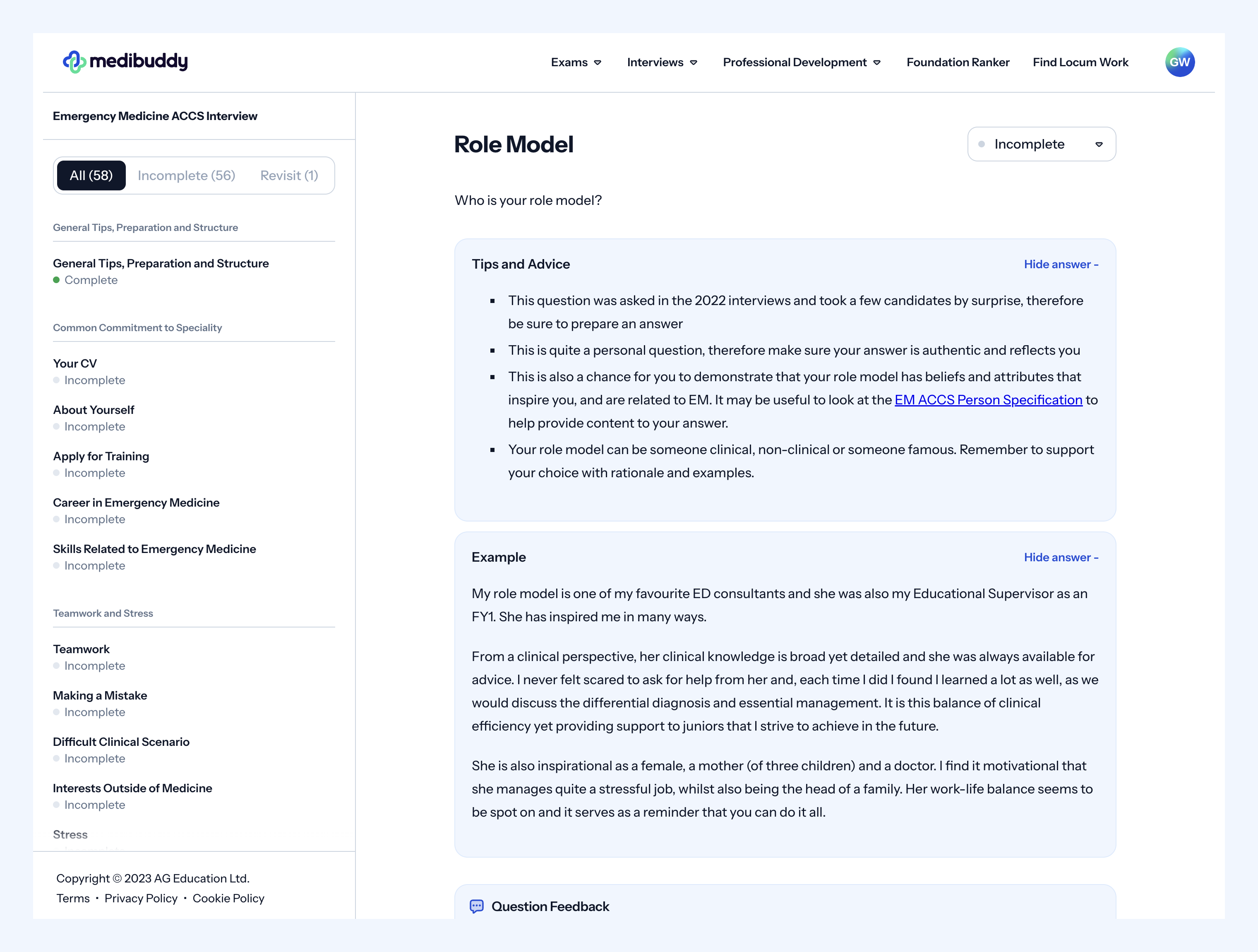 As well as this, we recommend the following:
Practice, practice, practice!
Write out your CV
Structure
Tips for your ACCS Emergency Medicine InterviewPre-Interview:
|
||||||||||||||||||||||||||||||||||||||||||||||||||||||||||||||||||||||||||||||||||||||||||||||||||||||||||||||||||||||||||||||||||||||||||||||||||||||||||||||||||||||||||||||||||||||||||||||||||||||||
Post ID: 21574 - A guide to the MLA AKT examThe Applied Knowledge Test (AKT) is the first section of the Medical Licensing Assessment (MLA), which was introduced by the General Medical Council (GMC) for all UK medical school graduates and international medical graduates. The exam will assess the skills needed for safe practice, and is intended to set a common and consistent threshold for all doctors applying for a licence to practise medicine in the UK, regardless of where they studied. All UK medical school graduates need to pass the MLA as part of their medical degree before they can join the medical register. This guide will provide you with everything you need to know about the AKT section of the MLA. You’ll also find more information in our MLA Guide, which we’re updating regularly as new information becomes available. For international medical graduates who currently need to pass the PLAB (PLAB 1 & PLAB 2) before they can register for a licence to practise medicine in the UK, we have more information about how the introduction of the MLA will affect you in our PLAB and MLA Guide. Do you need to take the MLA?Our MLA AKT question bank and MLA CPSA question bank, designed specifically to match the exam syllabus, can help! The MLA syllabus differs from old-style medical finals or the PLAB. Ensure that any question bank provider you use hasn’t just changed the name of their old question bank. Medicine is vast, and you may waste considerable time revising topics not in the MLA. All providers should be able to give you a breakdown of exactly how their question bank matches the MLA content map. Find ours here. What makes up the MLA exam?The MLA is a two-part assessment, made up of the following:Applied knowledge test (AKT)This is an on-screen, multiple-choice exam, which assesses your ability to apply medical knowledge to different scenarios.Clinical and professional skills assessment (CPSA)As the name suggests, this assesses your clinical and professional skills. Your medical school may refer to the CPSA as an Objective Structured Clinical Examination (OSCE) or Objective Structured Long Examination Record (OSLER). You can find out more about this section of the exam in our CPSA guide.How big is the MLA AKT?The AKT section of the MLA will consist of 200 single-best-answer (SBA) questions, each with 5 answer options. These will be spread across 2 papers (100 per paper) covering the following areas of clinical practice:
What is the MLA content map?The MLA content map is based on situations typically faced by doctors working in the UK Foundation Programme (FP). The AKT is designed to assess how you would respond and apply your medical knowledge to these types of situations. You’ll find practice questions for all of these topics in our MLA AKT question bank to help you prepare effectively for the exam. Below is an example of our dashboard, so you know what to expect when you subscribe. [caption id="attachment_23996" align="alignnone" width="3040"] Medibuddy MLA AKT question bank dashboard.[/caption]
What do I need to know about the MLA AKT?If you’re a UK medical student, your MLA AKT exam will be run by your medical school, while the GMC will administer the exam for international medical graduates. Regardless of where you complete your medical degree, and whether your AKT is set by your UK medical school or the GMC, the MLA aims to ensure that you will be assessed against the same standards for safe practice. UK medical schools will work together, through the Medical Schools Council (MSC), to set and administer the MLA AKT. The exam will be constructed centrally, with the collaboration of medical schools, and delivered locally. The exam will have a common format, test standard, process for delivery and policy framework. The central design and development will be overseen, regulated and quality assured by the GMC, to ensure quality, consistency and fairness. What does this mean for you? It should ensure that you’re assessed against the same standard of proficiency as all other UK medical graduates and are prepared to practise medicine as a Foundation Year doctor following graduation.Is the AKT similar to previous years' medical school final exams?The MLA content map sets out the core knowledge, skills and behaviours needed for UK practice. These are the topics which could be assessed within the AKT (and CPSA exams). The content map is based on the GMC’s Outcomes for Graduates, which outlines what newly qualified UK medical graduates must know and be able to do. This is already in place and every UK medical school needs to ensure that their graduates are meeting these outcomes; therefore, the topics covered at your medical school should be similar to those in the MLA content map. When you are revising, be sure to plan your preparation based on the MLA content map only, as medicine is so vast, you don't want to spend time revising topics that will not come up.MLA AKT Exam Dates 2026UK medical students who plan to graduate in the academic year 2025-26 and onwards will take the MLA in the penultimate or final year of their medical degree. The dates for the exams will be set by your individual medical school; this will likely be in line with when your medical school currently sets finals, although it doesn’t have to be.MLA AKT PreparationThe MLA content map outlines the possible topics and areas which may be assessed in the MLA. These are the required knowledge, skills and behaviours necessary to practise medicine in the UK. As mentioned previously, the MLA content map is based on the GMC’s Outcomes for Graduates, and as UK medical schools already work towards ensuring their graduates meet these outcomes, they should already be covering this and preparing you for the MLA. The GMC states that your degree is the best preparation for the MLA. What’s more, you don’t need to learn anything beyond what is covered in your medical school’s curriculum. You can find more information about the MLA content map, including the 3 overarching themes and 6 sections, in our guide to the MLA. We recommend starting your revision early, for example answering a select number of questions every evening, to start familiarising yourself with the types of questions that will come up, so you are not overwhelmed in the weeks and months before your exam.MLA AKT Question BankThe MLA content map – which includes an 'A-Z of presentations’ that may be assessed in the exam – is useful for identifying topics which you may need to revise. However, it’s then up to you to revise these topics and ensure that you’re prepared for any questions you may have to answer about them. This is where a MLA question bank can help! A high-quality MLA question bank will be mapped against the MLA content map and cover all possible topics to fully support your exam revision. Our comprehensive MLA question bank does just that, with over 4000 questions covering every MLA presentation and condition, it is specifically designed to make revising for the MLA simple and effective. [caption id="attachment_23997" align="alignnone" width="3040"] Example of an AKT question from the Medibuddy MLA Question Bank.[/caption]
With detailed explanations linked to each question and available in our library for every MLA AKT topic, our question bank is more than just questions and answers. It has been created to assess your understanding and develop your knowledge across all areas of the MLA AKT. Focused entirely on the content map, we don't include 'extra questions'; medicine is vast, and you must ensure your revision is as targeted as possible.
[caption id="attachment_23998" align="alignnone" width="3040"] Example of a detailed AKT explanation from the Medibuddy MLA Question Bank.[/caption]
What’s more, our MLA question bank uses artificial intelligence to personalise your learning and ensure that each question you’re given is tailored to your individual learning needs. How does this work? Our state-of-the-art algorithms continually assess you as you’re answering questions to identify your strengths and weaknesses and provide you with questions and topics aimed specifically at your areas for development. This means you’re given the right questions at the right time, making the most effective use of your revision time, and helping you to improve more!
Is there a MLA AKT Pass Mark?The MLA AKT is a pass/fail assessment. You will be given a score for the AKT exam but no pass mark has been provided at this stage. The standard will be set nationally – by a panel of experts from different UK medical schools – and must meet the GMC requirements. Additionally, your individual medical school will need to ensure that their approach to scoring enables fair and consistent pass/fail decisions on candidate performance. |
||||||||||||||||||||||||||||||||||||||||||||||||||||||||||||||||||||||||||||||||||||||||||||||||||||||||||||||||||||||||||||||||||||||||||||||||||||||||||||||||||||||||||||||||||||||||||||||||||||||||
Post ID: 9683 - PLAB Pathway / RouteIf you’re planning to undertake the Professional and Linguistic Assessments Board (PLAB) test in 2026, our PLAB pathway / route guide will provide you with key information about the process, from preparing and submitting your application through to receiving your exam results and what happens next. [plab_sales_panel] The PLAB is designed to assess whether doctors who qualified outside of the UK have the relevant knowledge and skills to practise medicine within the UK. As part of the registration process with the General Medical Council (GMC) – compulsory for all doctors wishing to practise medicine within the UK – overseas medical graduates who don’t hold a relevant European qualification are required to complete the PLAB test. The PLAB test consists of a written multiple-choice exam (Part 1 / PLAB 1) and a practical clinical exam (Part 2 / PLAB 2); you can find more information about both elements of the exam below. Before you can apply to the GMC for registration with a licence to practise medicine, you’re required to pass both parts of the PLAB test. Before you get started / preparationBefore you can book the PLAB exam, you need to set up a GMC online account and demonstrate that you meet the eligibility criteria required for licence registration; more information relating to the eligibility criteria can be found in the section below. Once you have completed this and provided the necessary evidence, you’ll be able to book Part 1 of the PLAB exam through your GMC online account. Note: you can only book Part 2 of the exam once you have passed Part 1.Eligibility CriteriaTo apply for GMC registration with a licence to practise medicine, you need to provide the following evidence to demonstrate that you meet the eligibility criteria:
Preparing for the PLAB exam
From September 2026 onwards, PLAB exams will be based on the updated MLA content map. Therefore, if you're preparing to take the PLAB exams, you should prepare with a question bank that’s based on the MLA content map. Question banks built around the PLAB blueprint will no longer include relevant revision material on or after this date. You can find out more in the section below and in our PLAB and MLA blog.
The GMC provides an MLA content map (and supporting user guide) which outlines the knowledge, skills and behaviours which will be assessed during the exam. It also provides an overview of the exam syllabus, including the topics assessed, their presentation and related conditions. Although a useful document, it’s pretty heavy reading and difficult to revise directly from. However, you can see a much clearer breakdown of the syllabus in our PLAB 1 question bank.
Not only does our question bank provide a clear breakdown of each topic / skill, but it also shows you a comprehensive breakdown of how you’re performing for each. This allows you to see how much of the syllabus you’ve actually mastered and which areas you should focus on to improve your PLAB score. To learn more about your mastery level and how our algorithm works to identify your areas of strength or weakness, visit our PLAB Guide.
The MLA content map is mapped against the following three documents, which the GMC also advises applicants to explore as part of their PLAB preparations:
Submitting the ApplicationWhen applying for the PLAB exam, it’s worth bearing in mind that there are only four Part 1 exam dates each year; therefore, it’s essential that you’re aware of the deadline for the exam date you require and submit your application prior to this. The Part 2 assessment does not have the same date restrictions as Part 1, with exam dates throughout the year; however, you must pass Part 1 before you can book Part 2 of the PLAB. You can find more information about the PLAB test dates, including deadlines for applying, locations and costs, in our PLAB Guide.Part 1 – written examPLAB 1 is a 3-hour written examination, consisting of 180 multiple-choice questions. For each question, you’ll be given a short scenario and five possible answers, from which to choose the ‘single best answer’. The following is an example of a PLAB 1 question from our question bank:
Unlike Part 2, Part 1 of the PLAB exam can be taken at various locations across the UK and a number of countries outside of the UK; you can view the available test locations and dates within your GMC online account. You can also find further information relating to Part 1 within our PLAB 1 guide.
[plab_sales_panel]
Part 2 – practical examPLAB 2 is a practical objective structured clinical exam (known as an OSCE), consisting of 16 scenarios, each lasting 8 minutes. The scenarios within the PLAB 2 exam aim to reflect real-life settings and situations you may encounter working as a doctor within the UK, including a ‘mock consultation or an acute ward.’ Part 2 of the PLAB exam can only be completed at the GMC’s clinical assessment centre in Manchester, UK. However, Part 2 tests run throughout the year, providing more flexibility in terms of test dates in comparison to Part 1. Further information relating to Part 2 of the PLAB is available within the GMC’s PLAB 2 guide.When you receive resultsThe time between completing the exam and receiving your results varies across the two PLAB tests:PLAB 1 resultsFor Part 1 of the PLAB test, your results will be published six weeks after you sit the exam. You’ll receive an email from the GMC allowing you access to your results in the ‘My Tests’ section of your GMC online account. You can find more information about your Part 1 test results, including ‘understanding your results’ and how the pass mark is set, within the GMC PLAB 1 guide. Once it’s confirmed that you’ve passed Part 1 of the PLAB test, you’ll be able to view and book a test date for Part 2 through your GMC online account. Note: you’re unable to do this until you’ve received your Part 1 result confirming that you’ve passed. You’ll then have three years from the date you passed Part 1 to pass Part 2 of the PLAB. If you fail Part 1 of the PLAB, you can resit the exam up to a maximum of four times, provided you still meet all eligibility requirements. Following four failed attempts, you are able to apply for one final attempt through an application to the GMC, which demonstrates evidence of additional learning over a 12-month period.PLAB 2 resultsFor Part 2 of the PLAB test, your results will be published within a month of taking the exam. As with Part 1 of the exam, you’ll receive an email from the GMC allowing you to access your results in the ‘My Test’ section of your GMC online account, once they are available. As with Part 1, if you fail Part 2 of the PLAB, you can resit it up to a maximum of four times, provided you still meet all elements of the eligibility criteria. Likewise, you can also submit an application to the GMC for one final attempt, following four failed attempts at PLAB 2, in which you’ll need to demonstrate evidence of additional learning over a 12 month period. You also have the option to appeal your PLAB result.What happens afterOnce you have confirmation that you’ve passed Part 2, and therefore both parts of the PLAB, you can submit your application to the GMC for registration with a licence to practise medicine. Once approved by the GMC, you can work as a doctor within the UK. It’s worth noting that your registration needs to be approved within two years of passing Part 2 of the PLAB. If more time has elapsed between you passing PLAB 2 and submitting your registration application and receiving approval, the GMC will request additional evidence of your knowledge and skills to support your application. You can find more information to support your PLAB preparations in our comprehensive PLAB Guide and information relating to registration in the GMC’s ‘before you apply’ and PLAB guides.Is the MLA replacing the PLAB?The MLA is an assessment used by the GMC to provide a common and consistent assessment framework for all doctors applying for registration to practise medicine in the UK. Doctors who are required to take the PLAB will not be required to pass a separate MLA. However, from September 2026, PLAB exams will be based on the updated MLA content map. Remember, it’s best to revise with a question bank that’s based on the MLA content map if your exam is affected. You can learn more about the MLA content map in our MLA Guide. We’ve also covered everything you need to know about how these changes will impact the PLAB in our PLAB and MLA Guide. |
||||||||||||||||||||||||||||||||||||||||||||||||||||||||||||||||||||||||||||||||||||||||||||||||||||||||||||||||||||||||||||||||||||||||||||||||||||||||||||||||||||||||||||||||||||||||||||||||||||||||
Post ID: 19489 - Prescribing Safety Assessment (PSA)All final-year medical students and overseas graduates coming to the UK to work as Foundation Year 1 (FY1) doctors are required to take the Prescribing Safety Assessment (PSA). The exam assesses your competencies in relation to the safe and effective use of medicines. It is designed as a tool for demonstrating that you have achieved the core prescribing competencies as outlined in the GMC’s Outcomes for Graduates. As an FY1 doctor, prescribing is a fundamental part of your role, as you’ll write and review prescriptions daily. Therefore, you must demonstrate that you are competent to do so by passing the PSA by the end of your first year of the Foundation Programme (FP). What is the Prescribing Safety Assessment (PSA)?Delivered jointly by the British Pharmacological Society and the MSC Assessment, the PSA is an online exam designed to assess your knowledge, skills and judgement of prescribing medicines within the context of the NHS. This includes writing, reviewing and amending prescriptions, calculating drug doses, and identifying adverse drug reactions and medication errors. The PSA exam is structured into the following 8 sections:
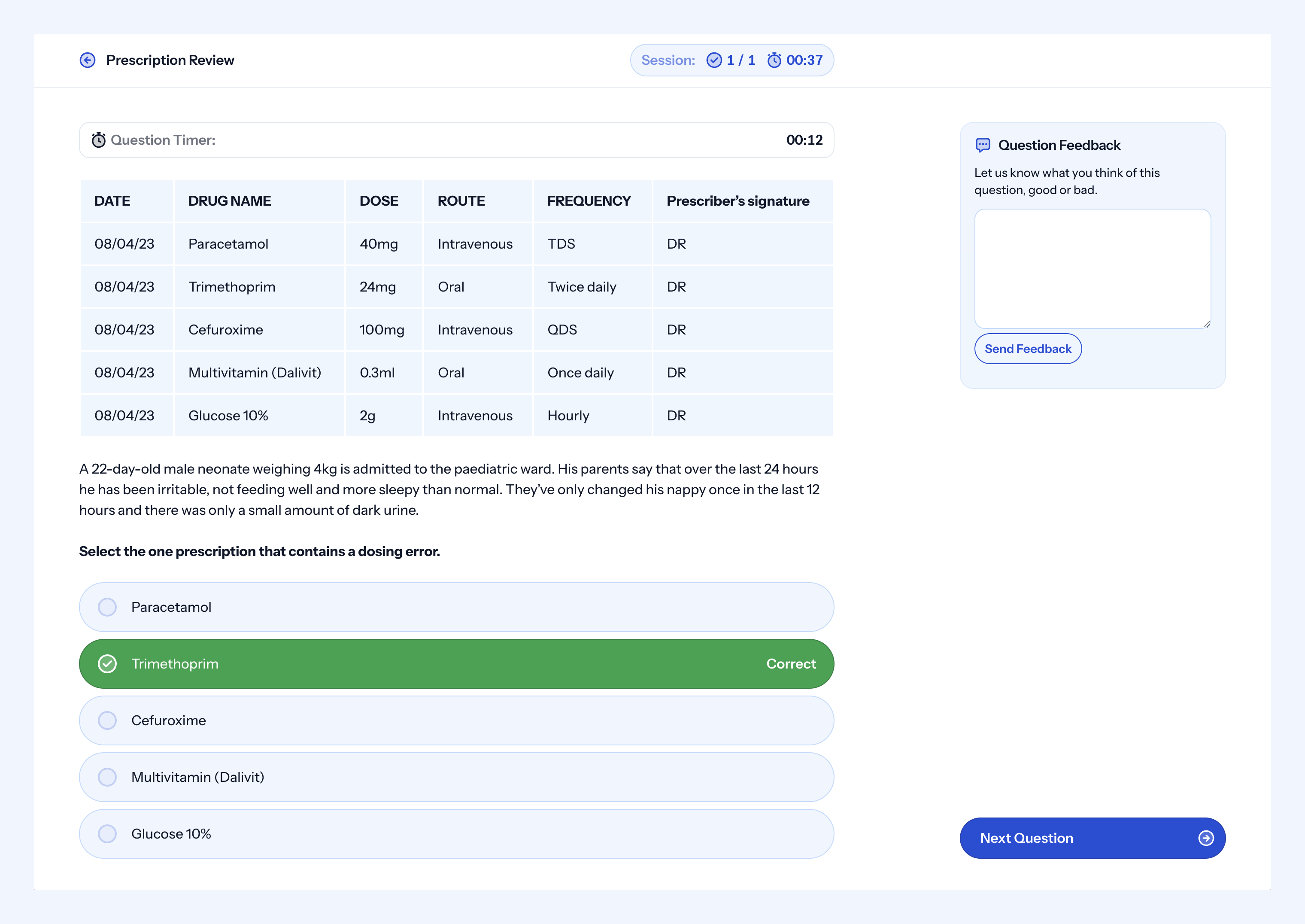
How many questions are on the prescribing safety assessment?The PSA exam is 2 hours long, with an extra 30 minutes available if you’re eligible for reasonable adjustments. You’ll be given 60 questions to answer across the 8 areas, with a total of 200 marks available. For each section, the number of questions and the available marks are given below:
|
||||||||||||||||||||||||||||||||||||||||||||||||||||||||||||||||||||||||||||||||||||||||||||||||||||||||||||||||||||||||||||||||||||||||||||||||||||||||||||||||||||||||||||||||||||||||||||||||||||||||
Post ID: 15599 - PLAB 1 Guide 2026If you’re considering taking the Professional and Linguistic Assessments Board (PLAB) 1 exam in 2026, this article is a great place to start! Our comprehensive PLAB 1 guide will provide you with all the information you need – including registration, fees and dates; what the exam entails; and how to prepare. If you plan to practise medicine in the UK, you might have found yourself thinking, “What is the PLAB 1 exam?”. The PLAB exam (PLAB 1 and PLAB 2) is an essential component of the registration process with the General Medical Council (GMC) for overseas medical graduates who don’t hold a relevant European qualification. Registration with the GMC is compulsory for all doctors wishing to practise medicine within the UK. This guide focuses on the PLAB 1 exam, but completing PLAB 2 is also essential. To learn more about the PLAB 2 exam, including exam cost, scoring and previous pass rates, visit our PLAB Guide for more information. PLAB 1 Syllabus
From September 2026 onward, PLAB exams will be based on the updated MLA content map, which outlines the core knowledge, skills and behaviours needed for practising in the UK. Therefore, it’s important that you prepare using a question bank that’s based on the MLA content map. Failure to do so might leave you unprepared on the day. To learn more about the MLA content map visit our MLA Guide. And for more information about how these changes have impacted the PLAB exam see the section below and our PLAB and MLA blog.
If you completed your medical qualification outside of the UK, the PLAB 1 exam is designed to assess that you have the relevant skills and knowledge to practise medicine within the UK. The questions relate to current best practices in the UK and will assess your ability to apply your knowledge to the care of patients.
For a full breakdown of the knowledge, skills and behaviours assessed as part of the PLAB exams, the GMC provides the MLA content map. This gives an overview of the syllabus for the topics assessed, their presentation and related conditions.
The MLA content map includes six domains which will be covered in the exam:
PLAB 1 ExamDetails of the PLAB 1 exam are as follows:
The GMC provides details on what to expect on the day of the PLAB 1 exam, including when you should arrive and what you should and shouldn’t take with you.
PLAB 1 DatesThe most recent and upcoming PLAB 1 exam dates are:
How much does PLAB 1 cost?The current test fees for PLAB 1 are £283. These apply to bookings from 1 April 2026 and are provided on the GMC website. As you can see, the exam is not cheap. We’ve therefore kept the cost of our adaptive PLAB 1 question bank low to ensure that everyone can access the materials they need to pass first time. [plab_subscriptions] It’s worth also bearing in mind, should you need to cancel your PLAB 1 exam, the GMC may charge you a cancellation fee. You can find a breakdown of the cancellation fees in our PLAB Guide. For exceptional circumstances, such as visa refusal, the introduction of travel restrictions, ill health or bereavement, the GMC may consider giving you a full refund if you’re unable to attend your exam. You can find more details on why and how a full refund is granted here. We take the same approach with our adaptive question bank, so if for any reason you can’t take the exam or need an extension, we’ll do this for you at no extra cost.How to register for PLAB 1To register for the PLAB 1 exam, you need to set up a GMC online account and provide the following details:
PLAB 1 PracticeYou’ll find a small selection of sample PLAB 1 questions on the GMC’s website with answers, explanations and links to the relevant GMC guidance. These are useful for providing examples of the types of questions you’ll face during your PLAB 1 exam. To prepare effectively for the exam, you’ll need to complete a wider range of practice questions than those provided by the GMC, so ensure you carefully think about what PLAB study materials you will use. When deciding which PLAB question bank to use, there are several things to consider:
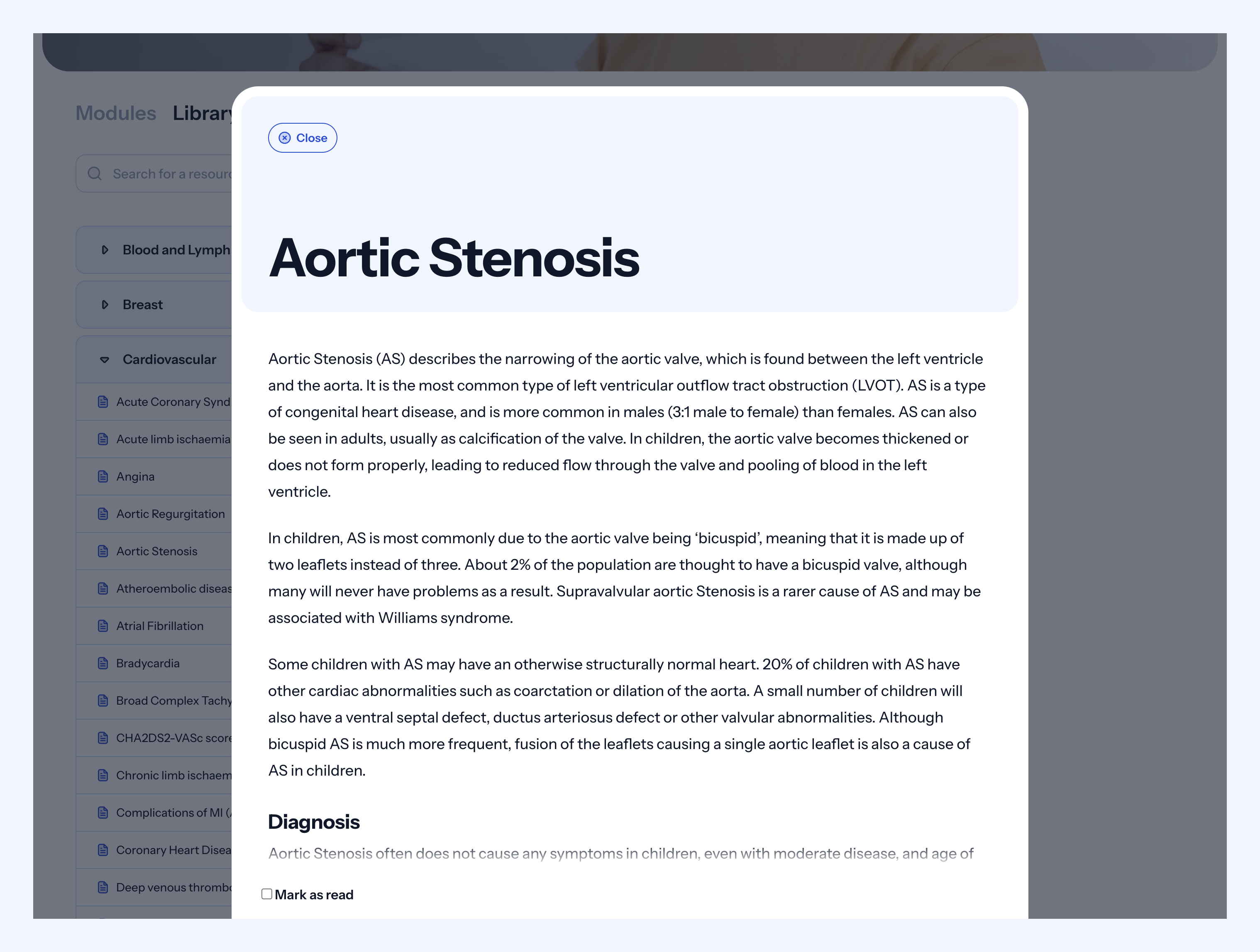
Is the MLA replacing the PLAB?The MLA has been designed to ensure that all doctors licensed to practise in the UK are assessed against the same standard for safe practice. Medical students training in the UK will need to pass the MLA before they can graduate and obtain a licence to practise medicine. However, international medical graduates are required to pass the PLAB as part of their registration and will not be required to take the MLA. From September 2026 onwards, PLAB exams will be based on the updated MLA content map. Remember, you should use a question bank that’s based on the MLA content map if your exam is affected. For more information about the MLA content map, visit our MLA Guide. And to learn more about how the introduction of the MLA will impact the PLAB, visit our PLAB and MLA Guide for everything you need to know.Further Reading |
||||||||||||||||||||||||||||||||||||||||||||||||||||||||||||||||||||||||||||||||||||||||||||||||||||||||||||||||||||||||||||||||||||||||||||||||||||||||||||||||||||||||||||||||||||||||||||||||||||||||
Post ID: 9049 - PLAB Guide 2026If you’re planning to register to practise medicine in the UK and are required to carry out the Professional and Linguistic Assessments Board (PLAB) test, our comprehensive PLAB guide will provide you with key information about the exam, including what to expect, key dates for 2026 and how to prepare. All doctors who practise medicine in the UK must be registered with the General Medical Council (GMC) and have a licence to practise; for the majority of international medical graduates, the application process will include a PLAB test. The exam is designed to ensure that doctors who qualified outside of the UK have the relevant knowledge and skills to practise medicine within the UK.
The PLAB exams are now based on the MLA content map rather than the PLAB blueprint, as it has been previously.
From September 2026 onwards, PLAB exams will be based on the updated MLA content map.
Therefore, you should prepare for your exam using a question bank that is built around the MLA content map. If you are using a PLAB question bank, this will mostly likely be based on the PLAB blueprint and therefore not tailored to the exam you will take. You can find out more in the section below.
Is the MLA replacing the PLAB?The Medical Licensing Assessment (MLA) is a new GMC assessment intended to provide a common and consistent assessment of safe practice for all doctors registered to practise in the UK. Medical students graduating from UK universities will need to pass the MLA as part of their degree before they can join the medical register. For international doctors required to take the PLAB as part of the registration process for joining the UK medical register, you will continue to do so, and you will not take the MLA. However, with the PLAB becoming compliant with the requirements of the MLA, both UK medical graduates and international medical graduates applying to practice in the UK will take assessments that draw on the same topics and meet the same requirements. The MLA content map outlines the core knowledge, skills and behaviours needed for UK practice. As mentioned above, this change ensured that the PLAB is compliant with the MLA requirements and that consistent standards for the assessment of UK-registered doctors are being met. Remember, it’s best to use a question bank that’s based on the MLA content map if your exam is affected. You can find out more about the MLA content map in our MLA Guide. To learn more about how the introduction of the MLA will affect the PLAB, visit our PLAB and MLA Guide.Which countries accept PLAB?The PLAB is the GMC’s method of assessing the knowledge and skills required for practising medicine within the UK. It is used as evidence for applicants who don’t hold a UK or ‘relevant European qualification’. There are some exceptions, which you can find here, but generally, if you qualified outside of the UK and don’t hold a ‘relevant European qualification’, you will be required to undertake the PLAB test as part of your GMC registration.PLAB exam patternThe PLAB test is divided into two parts – PLAB 1 and PLAB 2 – which you’ll undertake separately. The following section has more information on what is involved in each exam. You must pass both parts of the PLAB test to be able to apply for registration with a licence to practise medicine in the UK.PLAB exam steps and lengthThe following is an overview of the two parts of the PLAB test:PLAB 1
Example of a PLAB question[/caption]
You can learn more about what PLAB 1 entails and how to prepare effectively in our PLAB 1 guide.
PLAB 2
Exam requirementsBefore you can book your PLAB test, you must provide the GMC with the additional evidence required for your registration, including evidence of your medical qualification and knowledge of English. You can find more information about the evidence requirements for your registration here. Once you’ve provided these, you’ll be able to book your PLAB 1 test; you’re not able to book the second part of the exam, PLAB 2, until you’ve received your results for PLAB 1.PLAB datesPLAB 1The GMC offers PLAB 1 exams four times throughout the year, both within the UK and at a number of overseas locations. The most recent and upcoming PLAB 1 exam dates are:
PLAB 2The GMC offers PLAB 2 tests throughout the year at their two clinical assessment centres in Manchester. As with the PLAB 1 test, you can view available places and book your test through your GMC online account; remember, you’re not able to do this until you’ve received your PLAB 1 results. Demand for PLAB 2 places is high, so you may not be able to book an exam as soon as you’d like. However, if you have a UK job offer in the NHS which requires GMC registration or hold UK refugee status, you may be offered an exam sooner. You can find out more on the GMC website here.PLAB costThe following are the test fees for the PLAB exams, as provided by the GMC:
Exam syllabusTo help you understand the PLAB syllabus, the GMC provides an MLA content map that details the knowledge, skills and behaviours you’ll be expected to demonstrate during the exam. The blueprint provides a knowledge section outlining what will be tested, and a domains section, which links to the GMC’s core guidance, good medical practice. The GMC states that the MLA content map is mapped against the following documents, which you may find useful to explore further:
PLAB Question Bank[/caption]
Our question bank provides a clear breakdown of each topic; we have called each of these a “skill”, so you can then clearly see how much of each skill you have “mastered”. Your mastery level is a measure of your knowledge of a given category; it is based on how much of the syllabus you have shown the algorithm that you know. A topic is considered mastered once you have correctly answered enough questions on that component to show you have a good understanding of it, and you can clearly see on the dashboard which topics you need to spend more time working on.
Important SkillsThe advice relating to the required skills for the PLAB test is the same for both parts of the exam and is covered in the content map provided by the GMC. These skills ‘match those typically faced by doctors starting the second year of their UK Foundation Programme training’, to ensure that doctors passing the PLAB are at the same level as doctors who qualify in the UK. Therefore, the Foundation Programme curriculum is a useful document to explore, along with the content map, to determine the skills you’ll be expected to demonstrate in the PLAB exam.PLAB study materialsTo prepare for your PLAB test and ensure you get the mark required to bring you closer to your GMC registration, the GMC recommends that you use the following resources online: These resources all provide comprehensive guidance and should form part of your PLAB study materials. However, they are very difficult to revise from, and the vast majority of people use question banks. When picking the question bank to choose from there are a number of things to consider, such as price, the number of questions, the quality of questions, and how the questions are selected for you. Our PLAB 1 question bank offers over 2,500 questions at a competitive price, with questions chosen specifically for you using a sophisticated algorithm, so you will receive high-quality questions that will actually help improve your score. The GMC also provide the following additional resources in relation to the good medical practice guidance, to support you to develop and test your knowledge of the document:
PLAB 1 practice questionsThe GMC only offers 85 sample questions for PLAB 1 with answers, explanations and links to the relevant GMC guidance. PLAB 1 is a difficult exam, with approximately 1 in 4 failing, so you will need to use external resources to help you prepare. The best way to prepare for your exam is by using a personalised learning approach. Personalised learning is an educational approach that considers an individual’s knowledge, interests, strengths and weaknesses, and adapts their learning to meet these needs, providing a unique learning experience. When preparing for exams, it can feel like you spend hours answering questions and not really progressing. This is a common frustration when using standard, non-personalised question banks where all users are given the same questions in the same order without considering what skills or topics they actually need to focus on. We all learn at different rates, with some finding topics harder than others, which is why personalised learning is so beneficial. AI-powered question banks use sophisticated algorithms to personalise your learning experience and ensure every moment of your practice is laser-focused on ensuring you pass first time. Artificial intelligence is revolutionising online education, and the Medibuddy AI-powered question bank is the only question bank available using this technology for the PLAB 1 exam.PLAB 2For PLAB 2, the GMC provides a sample OSCE station, detailing the scenario, what the examiner will be looking for and what you need to demonstrate to be successful.PLAB difficultyThe PLAB test assesses you against the level of knowledge and skills expected of doctors beginning the second year of their Foundation Programme training in the UK. To gain a deeper understanding of the level of difficulty this involves, you can explore the Foundation Programme curriculum here. In 2025, only 62.2% of candidates passed their PLAB 1. For PLAB 2, this was even less, with only 59.8% passing. It’s therefore vital that when you are answering questions, you thoroughly read and take on board the explanations. Below is an image of a question and explanation taken from the Medibuddy PLAB 1 question bank. You can see that if you had just looked at the correct answer and moved to the next question without reading the explanation, you would have missed out on vital information, which could be the difference between a pass and a fail. [caption id="attachment_25399" align="alignnone" width="2134"]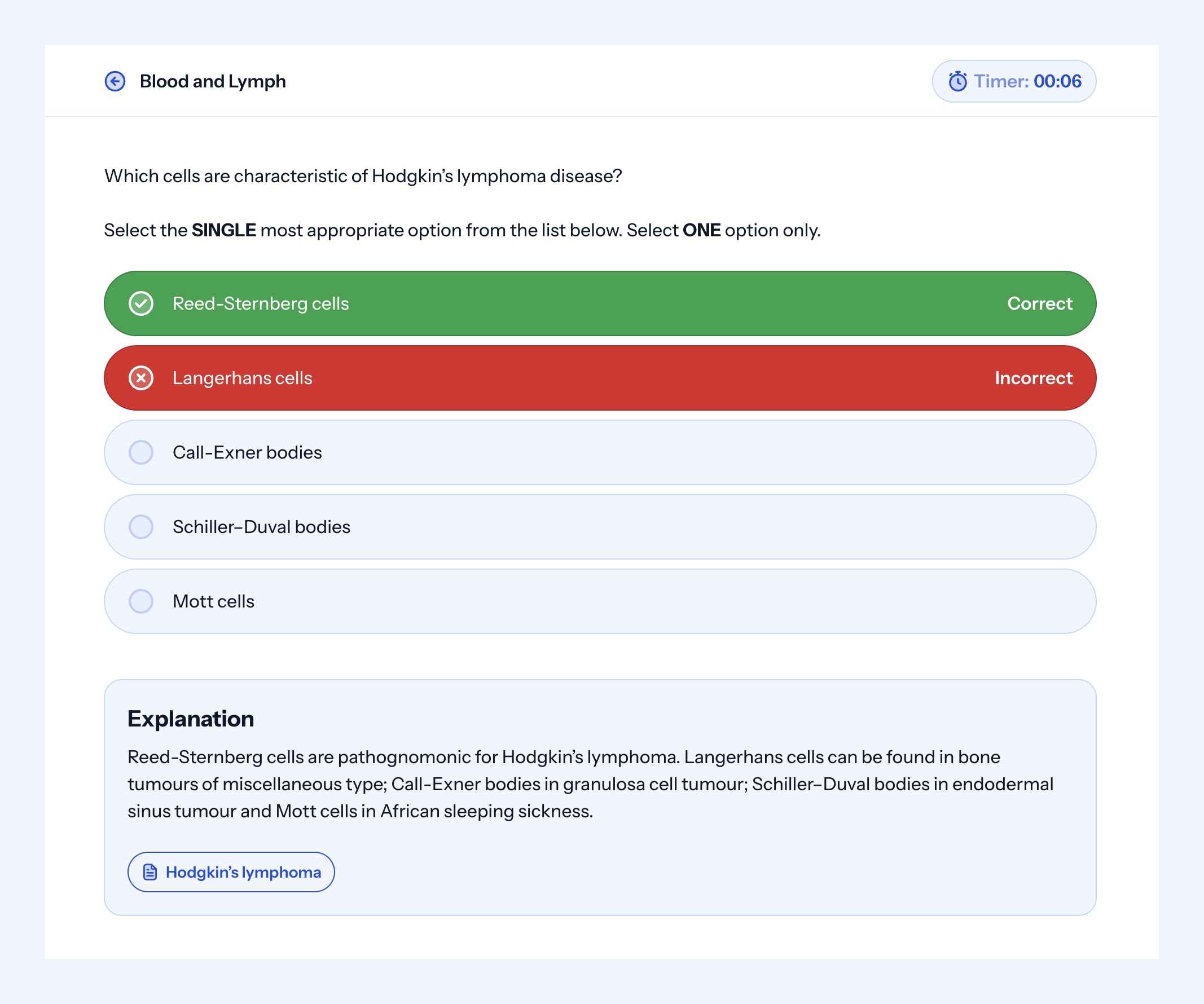 PLAB Question Bank[/caption]
[caption id="attachment_25400" align="alignnone" width="3036"] PLAB Question Bank[/caption]
An explanation is provided, followed by an overall explanation, which is more detailed and helps with your understanding of the subject.
Don’t fall into the trap of trying to get through as many questions as possible without spending enough time on each one. It’s about quality, not quantity! PLAB Question Bank[/caption]
[caption id="attachment_25400" align="alignnone" width="3036"] PLAB Question Bank[/caption]
An explanation is provided, followed by an overall explanation, which is more detailed and helps with your understanding of the subject.
Don’t fall into the trap of trying to get through as many questions as possible without spending enough time on each one. It’s about quality, not quantity!
Good PLAB passing scoreThe GMC does not provide a pass score for either of the PLAB exams, as this changes depending on the individual tests; therefore, it’s impossible to know for certain what mark you must achieve. However, they do provide a total number of scenarios (see below) that you need to pass in the PLAB 2 exam, which gives you some indication of the achievement required. Although an overall pass score isn’t provided, the GMC does set out how this is calculated, which varies across the two PLAB tests.PLAB 1Within PLAB 1, you’ll be awarded one mark for each correct answer within the 180 multiple-choice questions, with the total number of correct answers being your test score. To calculate the pass mark for each test, the GMC uses the ‘internationally recognised Angoff method and include[s] one standard error of measurement’. You can find more information about how your PLAB 1 test will be scored and how the GMC ensures consistent and fair pass scores here.PLAB 2During the PLAB 2, you’ll be assessed at each of the 16 scenario stations against the following ‘marking domains’, as outlined by the GMC:
PLAB pass rateThe GMC provides the following data in relation to the pass rates for the PLAB examinations:Recent PLAB 1 pass rates
Recent PLAB 2 pass rates
|
||||||||||||||||||||||||||||||||||||||||||||||||||||||||||||||||||||||||||||||||||||||||||||||||||||||||||||||||||||||||||||||||||||||||||||||||||||||||||||||||||||||||||||||||||||||||||||||||||||||||
Post ID: 18292 - UK Foundation Programme Office (UKFPO): Overview 2026If you’re approaching the end of medical school, you might be starting to think about the UK foundation programme for 2026. This guide provides a handy overview of the UKFPO, how to apply and the UKFPO timeline (so you don’t miss any key dates!). You’ll also find information on other key areas relating to the UKFPO, including the specialist foundation programme (SFP), the foundation priority programme, psychiatry foundation fellowships and less than full time training (LTFT). Please note: Recruitment to Specialised Foundation Programmes (SFP) is changing for 2026. You can find out more below. Do you need to take the MLA?Our new MLA question bank, designed specifically to match the exam syllabus, can help! The MLA syllabus differs from old-style medical finals or the PLAB. Ensure that any question bank provider you use hasn’t just changed the name of their old question bank. Medicine is vast, and you may waste considerable time revising topics not in the MLA. All providers should be able to give you a breakdown of exactly how their question bank matches the MLA content map. Find ours here. UK foundation programme office (UKFPO)Following medical school, you’ll undertake the UKFPO – a 2-year, work-based training programme – which aims to develop your clinical and professional skills in the workplace. The UKFPO is a continuation of your medical education and aims to ensure that newly qualified doctors deliver safe and effective patient care. The UKFPO bridges the gap between medical school and specialty or general practice training. You’ll be allocated your UKFPO role through a ranking process – you can find out more in the ‘how do I apply to foundation training?’ section below – but in short, you’ll first rank the foundation schools in order of your preference, before then ranking the jobs within your allocated foundation school. The ranking process can be time consuming and frustrating; you can find tips on how to make the whole process easier and quicker in our Foundation Job Ranking blog.How does the foundation programme work?Through the UKFPO, you’ll complete a number of rotations in different medical and surgical specialties. These are designed to provide a balanced programme which allows you to meet the competencies and outcomes of the Foundation Programme (FP) curriculum set by the GMC. The UKFPO is split into Foundation Year 1 (FY1) and Foundation Year 2 (FY2). Usually, you’ll undertake three rotations each year, but this does vary depending on your role. Regardless of rotations, FY1 and FY2 provide the following opportunities and outcomes:FY1Through undertaking supervised responsibility for patient care, you’ll consolidate your skills from medical school within the workplace. Following successful completion of FY1, you’ll be awarded a Foundation Year 1 Certificate of Completion (FY1CC) and recommended to the GMC for full registration. You can find out more about full registration here.FY2Although you’ll still be supervised, you’ll have greater responsibility for patient care, and begin to make management decisions as you progress towards independent practice. You’ll also contribute to the learning and development of the wider healthcare team, including nurses, medical students and less experienced doctors. On successful completion of FY2, you’ll be awarded a Foundation Programme Certificate of Completion (FPCC). This indicates that you are beginning to demonstrate clinical effectiveness, leadership and decision making skills, which are essential for core, specialty or general practice training, and therefore are ready to begin one of these training programmes.How do I apply to foundation training?To apply for the UKFPO, you must register on Oriel and apply through the national FP vacancy during the national application window (see timeline below). You need to complete the national application form, which includes your foundation school preferences. Once you have applied and submitted your foundation school preferences, you’ll be allocated a foundation school. You can find more information about foundation school preferences, including how to choose a foundation school and how these are allocated, in our Foundation Job Ranking blog. Within your foundation school, you’ll then need to rank the jobs in order of preference. Ranking your job preferences can be a difficult and lengthy task, and as it’ll determine which UKFPO role you’ll undertake and where you spend the next two years, it’s not one you want to undertake lightly. The simplest approach is to decide what is more important to you in terms of location and/or specialty and use this to order your jobs accordingly. For example, the applicant below prioritised the job specialties over the location and was interested in surgery.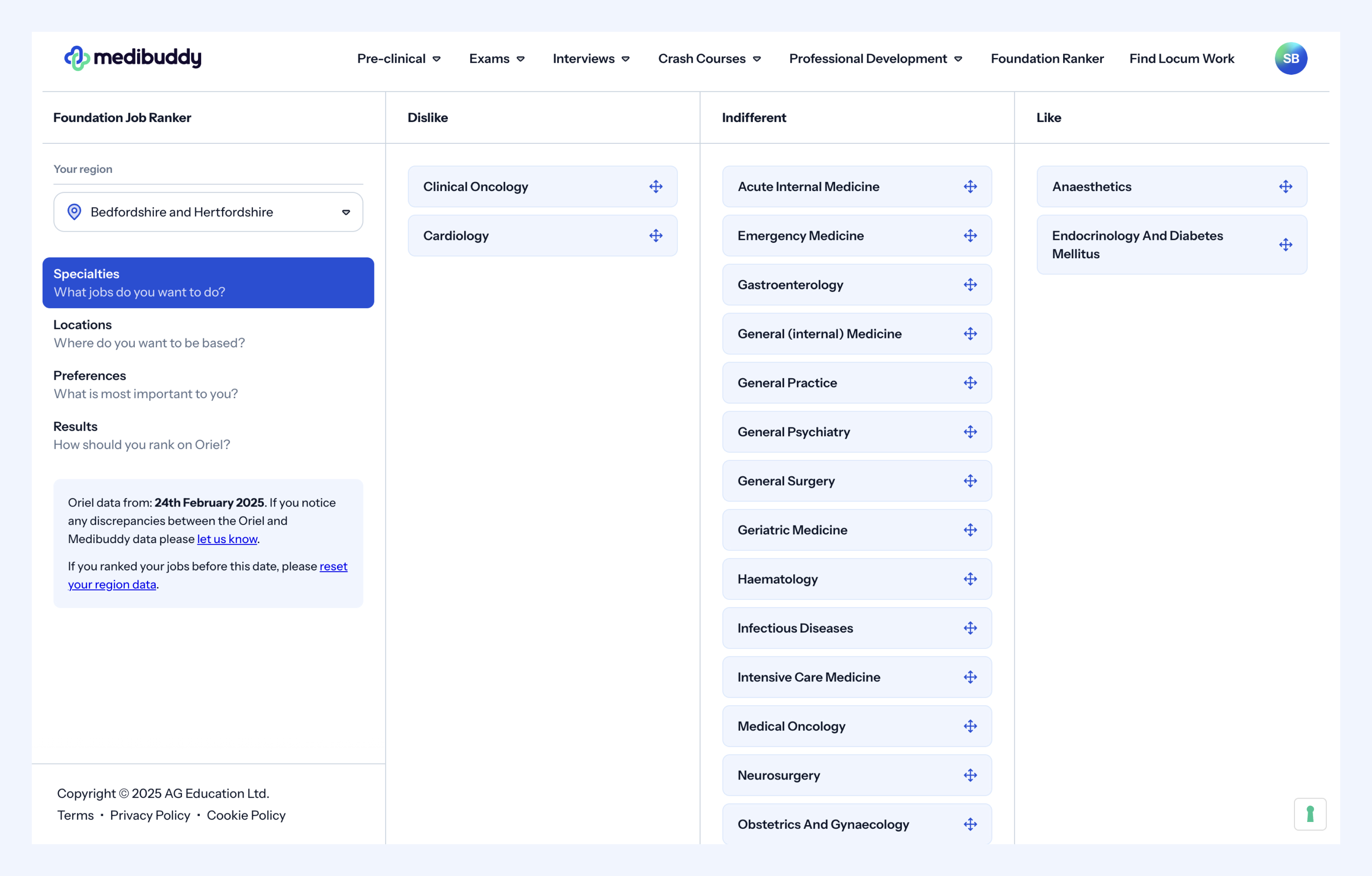 Using the Medibuddy foundation job ranker, they placed any surgery related specialties in the ‘like’ column. Any specialties they didn’t want or would rank low – such as General Practice and Psychiatry – they placed in the ‘dislike’ column, and any other specialties they put in the ‘indifferent’ column. Using this information, the available jobs in their foundation school were then automatically ordered to match their specialty preferences.
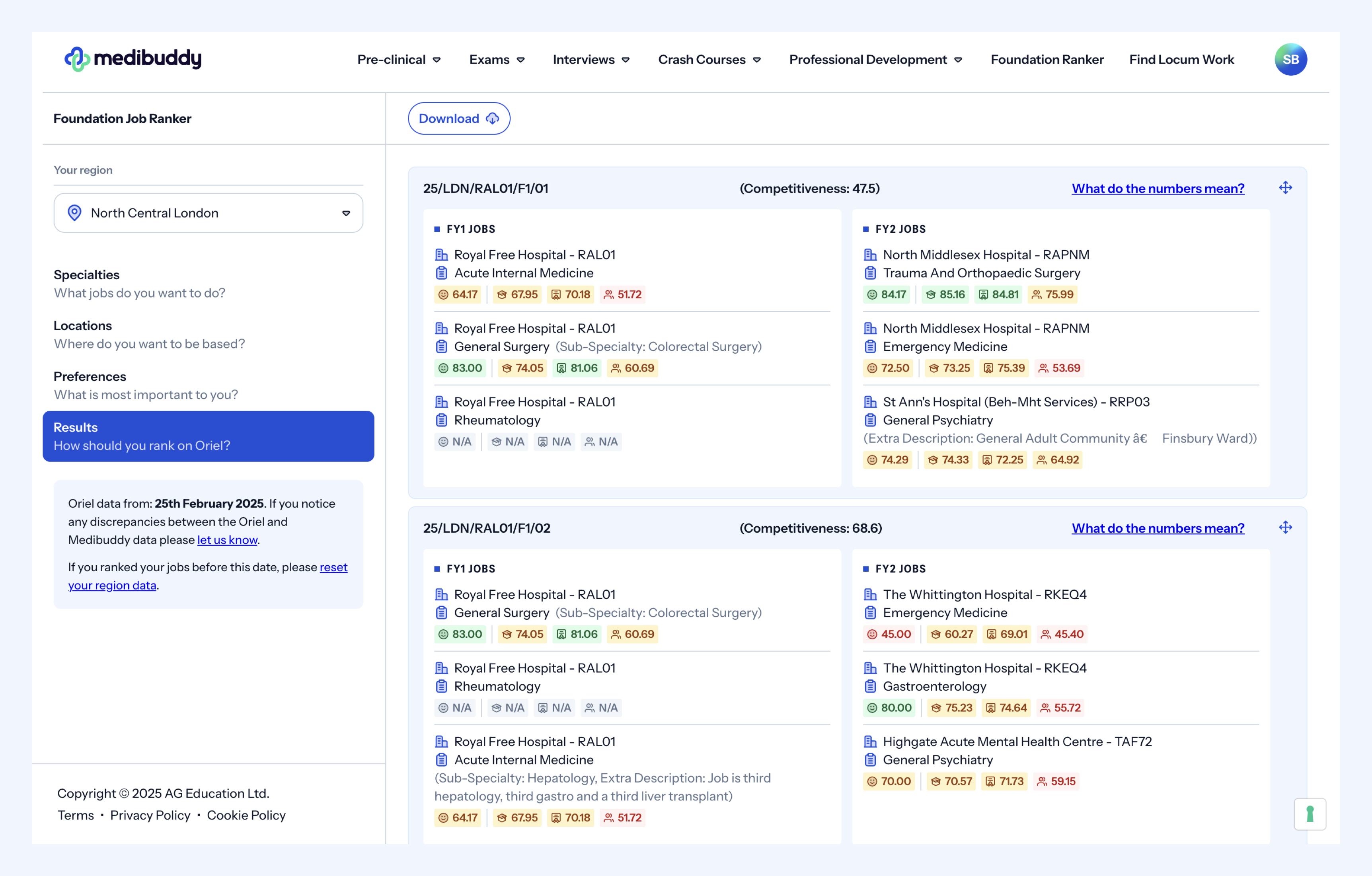 This would then be used to rank their jobs easily and effectively in Oriel.
Note: before you can register and apply on Oriel, you first need to be ‘nominated’, either by your medical school or the UKFPO’s Eligibility Office. You can find out more here.
This would then be used to rank their jobs easily and effectively in Oriel.
Note: before you can register and apply on Oriel, you first need to be ‘nominated’, either by your medical school or the UKFPO’s Eligibility Office. You can find out more here.
What is Oriel?Oriel is the national online application system for medical training in the UK. You complete all aspects of applying for the UKFPO in Oriel. The Medibuddy foundation job ranker downloads the foundation jobs for your allocated foundation school directly from Oriel. This ensures that the job list in the foundation job ranker is identical to Oriel, making it simple for you to rank your choices easily in our system, before transferring them to Oriel. For more information on how you rank your programme preferences in Oriel visit our Foundation Job Ranking blog.Changes to Recruitment for Specialised Foundation Programmes for 2026The recruitment process for SFP posts has been updated for 2026 in England. SFP posts now use a dual-pathway system: Pathway 1 – Local Medical School Selection: Some posts are selected by your own medical school, and successful applicants are automatically matched to the SFP programme on Oriel. Pathway 2 – Preference Informed Allocation (PIA): The remaining posts are allocated through the main Foundation Programme allocation process using PIA. Applicants preference the SFP group after allocation to a foundation school and are then matched to individual SFP programmes. All applicants must still complete the main Foundation Programme application on Oriel, even if applying via local selection. These changes aim to create a fair and consistent recruitment process across all SFP posts while ensuring applicants have clear access to both school-selected and centrally allocated posts. UKFPO allocation process – Preference Informed Allocation (PIA)Preference Informed Allocation (PIA) was introduced for the UK FP allocation process in 2024 and continues to be used for the 2026 UKFP allocation process. Under PIA, all applicants are assigned a computer-generated rank. The algorithm on Oriel then works through applicants in this rank order, allocating as many applicants as possible to their first-choice foundation school and then foundation programme. The same rank is used for both school and programme allocation. This process replaces the previous Foundation Programme Application System (FPAS) points, which combined the Educational Performance Measure (EPM) and Situational Judgement Test (SJT). Applicants are no longer required to take the SJT, and EPM scores no longer influence allocation. You can learn more about the PIA process here.Eligibility & Evidence Requirements for UKFPRemoval of Dean’s StatementChanges introduced in recent years, including the removal of the Dean’s Statement and updates to primary medical qualification (PMQ) evidence requirements, continue to apply. Eligibility route applicants must provide proof of their PMQ through one of the following methods:
English language proficiency requirementsApplicants whose primary medical qualification is from a country where English is not the first language must provide evidence of English proficiency via one of the following:
Primary Medical Qualification (PMQ)A PMQ is accepted as evidence of English language proficiency if obtained from a medical school in a country where English is the first language. Some important notes to be aware of:
IELTS CertificatesFor UKFP 2026, only the Academic and UKVI (Academic) versions of the IELTS test will be accepted. The minimum required standard remains a score of 7.5 in each skill (speaking, listening, reading, and writing) on the same Test Report Form (TRF). Tests must fall within the period 05 August 2024 to 01 July 2025. IELTS One Skill Retake: The UKFPO accepts the IELTS One Skill Retake option, provided the final result can be verified on the IELTS verification portal.OET CertificatesThe requirements for OET certificates remain unchanged. Applicants must score 400 in each skill in a single test sitting, and the tests must also be dated between 05 August 2024 and 01 July 2025.Eligibility condition for applicants whose medical school is listed on the GMC’s qualifications listIf your primary medical qualification (PMQ) appears on the GMC’s list of accepted overseas medical qualifications, you have an additional eligibility condition to meet. You must submit evidence as a letter or email, which the UKFPO will then review on a case-by-case basis. The deadline to submit this evidence is 04 September 2025. You must provide sufficient evidence by this deadline to ensure your application is accepted.UKFPO TimelineTo Secure your UKFPO role, the key things you must do are:
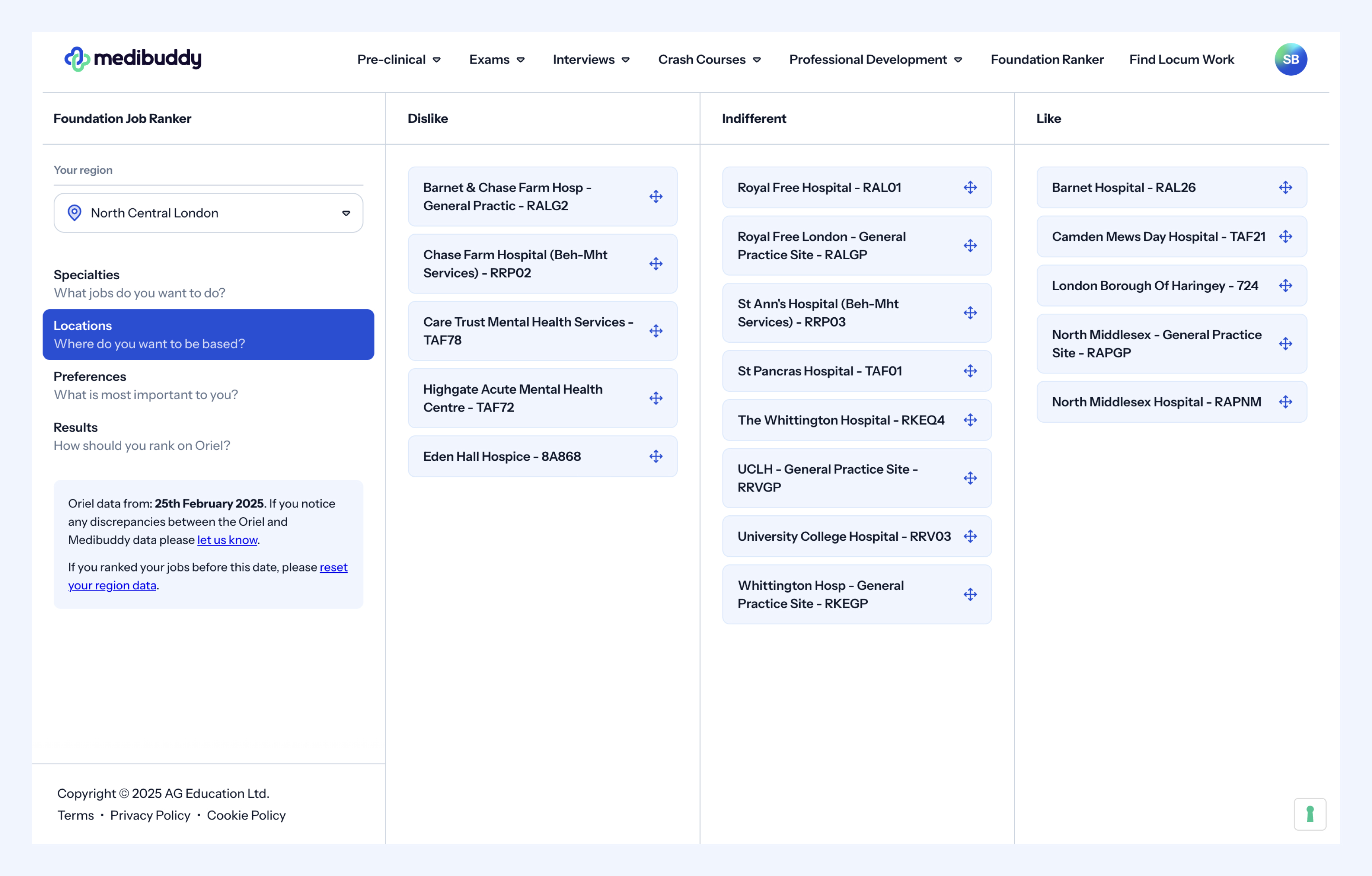 Using these preferences, the foundation job ranker simply arranged the available jobs to ensure that those close to the applicant’s home address were ranked first.
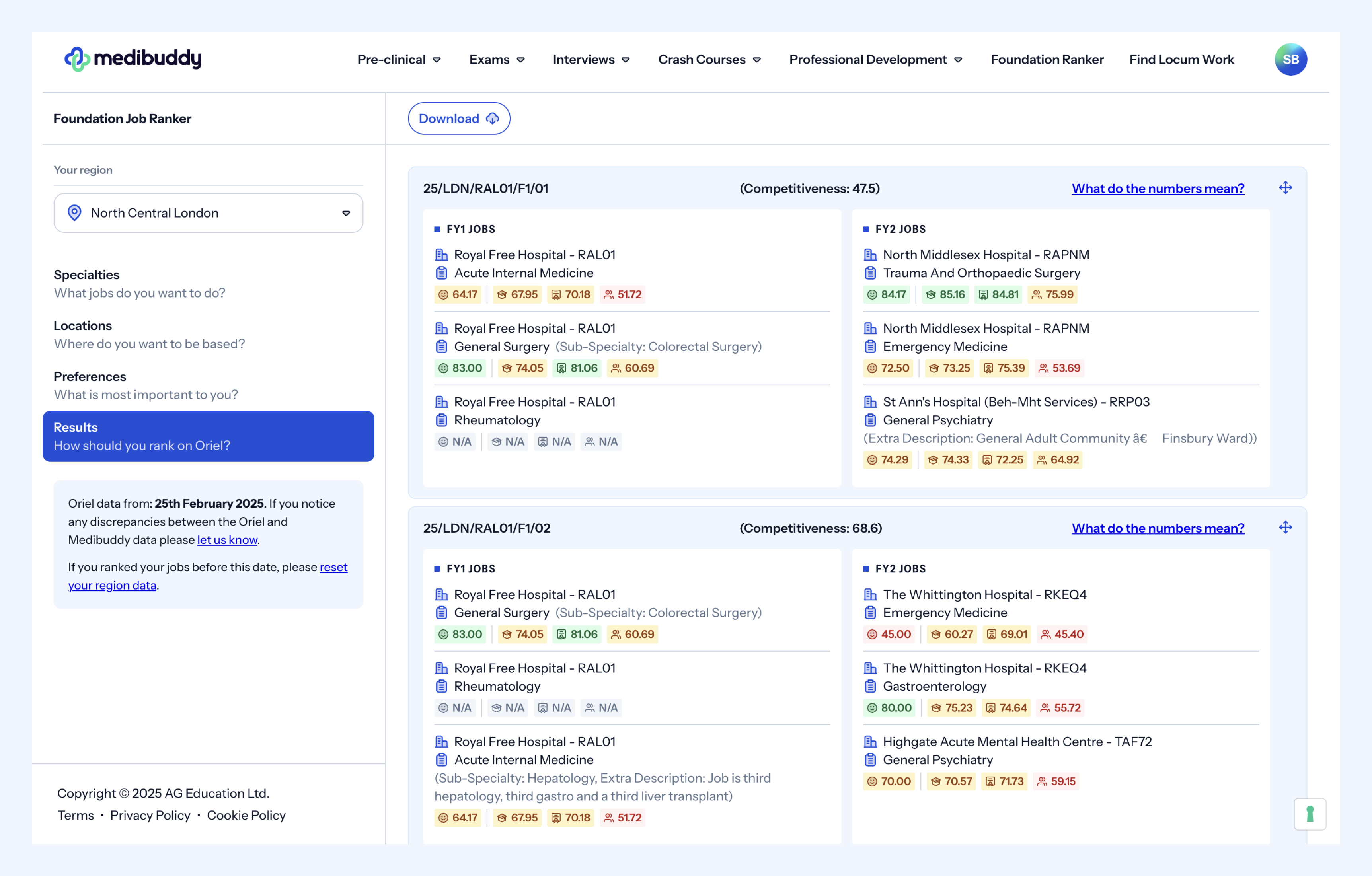 As you can see, jobs at the Royal Free Hospital, North Middlesex Hospital and St Ann's Hospital have been prioritised, meaning they can now use this to rank their jobs in Oriel easily and quickly.
The following is an overview of the key dates in relation to the UKFPO 2026:
As you can see, jobs at the Royal Free Hospital, North Middlesex Hospital and St Ann's Hospital have been prioritised, meaning they can now use this to rank their jobs in Oriel easily and quickly.
The following is an overview of the key dates in relation to the UKFPO 2026:
Less than full time training (LTFT)Whilst applying for the UKFPO, you’ll have the option to indicate on your application form if you would like to train on a less than full time basis. Once you have been allocated a foundation school, it is recommended that you discuss this with them. When it comes to ranking the jobs within your foundation school, you should only rank jobs you wish to be considered for – those offering less than full time working – and any you would not accept should be listed in the ‘not wanted’ column. For more information on how to effectively rank the foundation jobs – whether you’re applying for LTFT or not – visit our Foundation Job Ranking blog. Or, if you’ve already got a region in mind, you can take a look at the various jobs that were available in 2025 using our Foundation Job Ranker (we’ll be updating with the 2026 jobs when Oriel releases them). |
||||||||||||||||||||||||||||||||||||||||||||||||||||||||||||||||||||||||||||||||||||||||||||||||||||||||||||||||||||||||||||||||||||||||||||||||||||||||||||||||||||||||||||||||||||||||||||||||||||||||
Post ID: 18019 - Teach the Teacher CourseIn medicine, we have a fantastic culture of passing down our knowledge to junior colleagues and students, through bedside teaching, small group sessions, and large clinical lectures. We’re also frequently expected to deliver teaching to our peers in the form of grand round presentations and weekly meetings. But have you ever had training on how to teach others? How to take your knowledge and experience, and deliver it in a way that others can understand and learn from? This is where a Teach the Teacher course for doctors comes in. You may have picked up techniques unwittingly throughout your training or figured out a teaching method that works for you, but the theory behind how to deliver effective teaching is often neglected. What is a Teach the Teacher Course?Teach the teacher is a course in which you’ll learn about adult education theory and how to confidently lead a teaching session for your peers, colleagues, and students. You’ll study different educational techniques, how to find your teaching style, and how to give effective feedback. At Medibuddy, we offer a Live 1-Day and 2-Day Teach the Teacher Course, as well as a flexible On-Demand version, covering the same core educational theory and practical frameworks in different formats to suit your schedule. Having attended a teach the teacher course, you will be able to incorporate effective teaching into your daily working life. From impromptu bedside teaching for medical students to formal teaching roles within a university, a teach the teacher course gives you the framework to adapt your teaching style to your audience. As a bonus, formal training in teaching can contribute to portfolio scoring in several specialty applications. For example, Internal Medicine Training awards 1 point for evidence of at least 6 hours of formal teaching training. Teaching qualifications and courses may also contribute to applications such as:
What's covered in a Teach the Teacher course?Teach the teacher is a healthcare-focused training in teaching course which helps you to gain confidence in your presenting skills and teaches you a framework for delivering effective medical education. These courses cover a variety of teaching methods in general and include specific advice on teaching in a healthcare environment. On-the-job learning is a vital part of medical training, with bedside teaching unique to medical education, so teach the teacher courses are perfect for doctors and nurses. Both our On-Demand Teach the Teacher and Live Courses cover the following topics:
How long is a Teach the Teacher course?The length of a teach the teacher course depends on which type of course you choose. There are more options for on-demand learning courses and virtual online courses available. Face-to-face teach the teacher courses are normally delivered over 2 full days, and sometimes provide pre-course learning materials. Virtual teach the teacher courses generally follow the same structure as face-to-face courses – delivering the course over 1-2 days. Online teach the teacher courses provide a more convenient option for those who want to learn in their own time. The suggested duration of these courses is usually between 8 and 16 hours.How does an online Teach the Teacher course work?You may have wondered if you can do a teach the teacher course online. There are two types of online teach the teacher courses available:Virtual EventsVirtual teach the teacher courses are delivered using the same structure as face-to-face courses, but instead of delivering the course in person, the course is facilitated online using video-conferencing software such as Zoom and Microsoft Teams. These courses offer some element of interaction with the course facilitator but can be attended from home and save you the cost of travelling to the course location. You can read about the benefits of a live teach the teacher course here.On-Demand LearningThese e-learning courses are delivered over the web using learning management systems which allow you to learn at your own pace, from the comfort of your home. After purchasing an on-demand learning course you will have access to all the course modules usually included in event-based teach the teacher courses. Depending on the course provider, these can be delivered in several different formats. On-demand teach the teacher courses can be made up of video presentations, interactive elements, or a mix of the two. Video-based courses utilise pre-recorded videos in which a course facilitator will go through key concepts of educational theory. Interactive e-learning courses use learning management systems which feature interactive slides, end-of-module quizzes, and immersive videos. An example of the Medibuddy Teach the Teacher on-demand online course can be seen below:
How much does a Teach the Teacher course cost?The cost of teach the teacher courses vary depending on whether it is a face-to-face course, virtual event, or online learning course. 2-day face-to-face and virtual courses generally charge around £400. On-demand learning courses vary in price and can be as much as £250.Who is the course suitable for?Teach the teacher courses are aimed at healthcare professionals. This includes NHS consultants, junior doctors, nurses, and physician associates. There are also non-medical educational theory courses available – usually titled “train the trainer” – however, these courses do not give specific advice on delivering bedside teaching or scenario-based clinical teaching. While teach the teacher courses are a career boost to any healthcare professional, they might be especially useful if you are considering taking on a formal teaching role. Voluntary roles as OSCE examiners, communications tutors, and clinical lecturers are common in teaching hospitals and obtaining these career-boosting roles will be easier if you have evidence of formal training in teaching. If you have a passion for medical education, booking a teach the teacher course may be the first step in your journey to becoming a teaching fellow, an educational supervisor, or a member of the medical school teaching faculty.When should I do my Teach the Teacher course?Teach the teacher courses are very accessible and don’t require a significant amount of prior teaching experience. This means that you can purchase a teach the teacher course at any point of your training. If you’re a doctor, you may be able to utilise your study budget to cover the cost of a teach the teacher course, once you’re in Foundation Year 2 and beyond. While you can book a teach the teacher course at any time, booking a course earlier in your career may be wise. Not only can this give you additional speciality application points and make your CV more competitive, but it gives you more opportunities to obtain a formal teaching role earlier in your career.Are Teach the Teacher and Train the Trainer courses the same?“Teach the teacher” and “train the trainer” are often interchangeable and can both refer to medical training in teaching courses, depending on the company. “Teach the teacher” is generally more specific to medical-focused training in teaching courses, and while “train the trainer” courses can still be medical, many non-medical course companies also use this terminology. When booking a course, ensure that the course is healthcare-focused, or you’ll miss out on specific advice for teaching in a medical environment.Are Teach the Teacher courses accredited?Some teach the teacher courses are CPD/CME accredited, though this depends on the company you choose and does not always guarantee that the CPD points will be accepted by your employer. All of our teach the teacher courses are CPD Certified and will earn you the following CPD Points:
Where should I do my Teach the Teacher course?While you’re searching for teach the teacher courses, look out for symbols of CPD accreditation. Even if you’re not collecting CPD points, this accreditation signals that the course has reached the required standards of CPD certifying services. When searching for the right teach the teacher course for you, you’ll need to consider a few factors:Your physical locationMany courses take part in large population centres such as London, Manchester, and Edinburgh. If you don’t live in these cities, consider how long it will take you to travel to the course and whether you’ll need accommodation. If you’d prefer to attend the course from the comfort of your home, search for an online teach the teacher course.Your learning styleSome people love to attend teaching at a physical location and mingle with tutors and other students, while others would prefer to be in their home environment. Consider what you prefer when deciding between face to face and virtual courses. It’s also worth thinking about whether you would prefer to interact with the tutor at a face-to-face or virtual course. If you would prefer to take the course at your own pace, on-demand learning might be better suited to you.Your budgetIf you’re on a budget an on-demand learning course might be better suited to you, as these are significantly cheaper than face-to-face or virtual courses. An on-demand learning course, like the Medibuddy Teach the Teacher course, also has the added benefit of allowing you to work through the content at your pace and at a time that’s convenient for you. Written in collaboration with Medibuddy by Dr James Davidson. James was a medical trainee in the NHS for 5 years, before leaving to pursue his passion for technology and education. He founded the medical education platform MedCourse in 2022. |
||||||||||||||||||||||||||||||||||||||||||||||||||||||||||||||||||||||||||||||||||||||||||||||||||||||||||||||||||||||||||||||||||||||||||||||||||||||||||||||||||||||||||||||||||||||||||||||||||||||||
Post ID: 19362 - Consultant Interview CourseAn NHS consultant interview will be different to any other interview you have experienced during your training. They are usually competitive, with multiple candidates applying for one position. It’s therefore essential that you fully prepare for them. Many candidates go on several consultant interview courses before successfully getting appointed, as they are a great way of ensuring you know what to expect during the process and are as prepared as possible. [nhs_ci_sales] What is the NHS consultant interview?The medical consultant interview is a panel interview, typically consisting of between six to eight interviewers, although it can be more. Understandably, this can seem like a daunting prospect; however, with the right preparation, you will be able to answer all the questions they ask you comfortably. The interview panel will have already read your application and CV, so the interview is an opportunity to demonstrate your knowledge, skills, and experience, as well as what extras you can offer. This includes highlighting the desirable skills that you have, what you will offer the department and your ability to communicate well in stressful situations.How long is the consultant interview?Generally, the consultant interview will last approximately forty-five minutes. During this time, you’ll answer a range of questions to demonstrate your suitability for the role; you can find out more about the types of questions in the ‘NHS consultant interview questions’ section below.When do NHS consultant interviews take place?NHS consultant interviews take place throughout the year, as and when positions become available. There is no national selection process, as you will have experienced throughout your training. Don’t be afraid to make connections with consultants in your specialty and enquire about potential opportunities.NHS consultant interview questionsDuring the consultant interview, you’ll be asked questions relating to your suitability and motivation for the role, including how your training and previous experience have prepared you. An example from our NHS Consultant Interview Course can be seen below: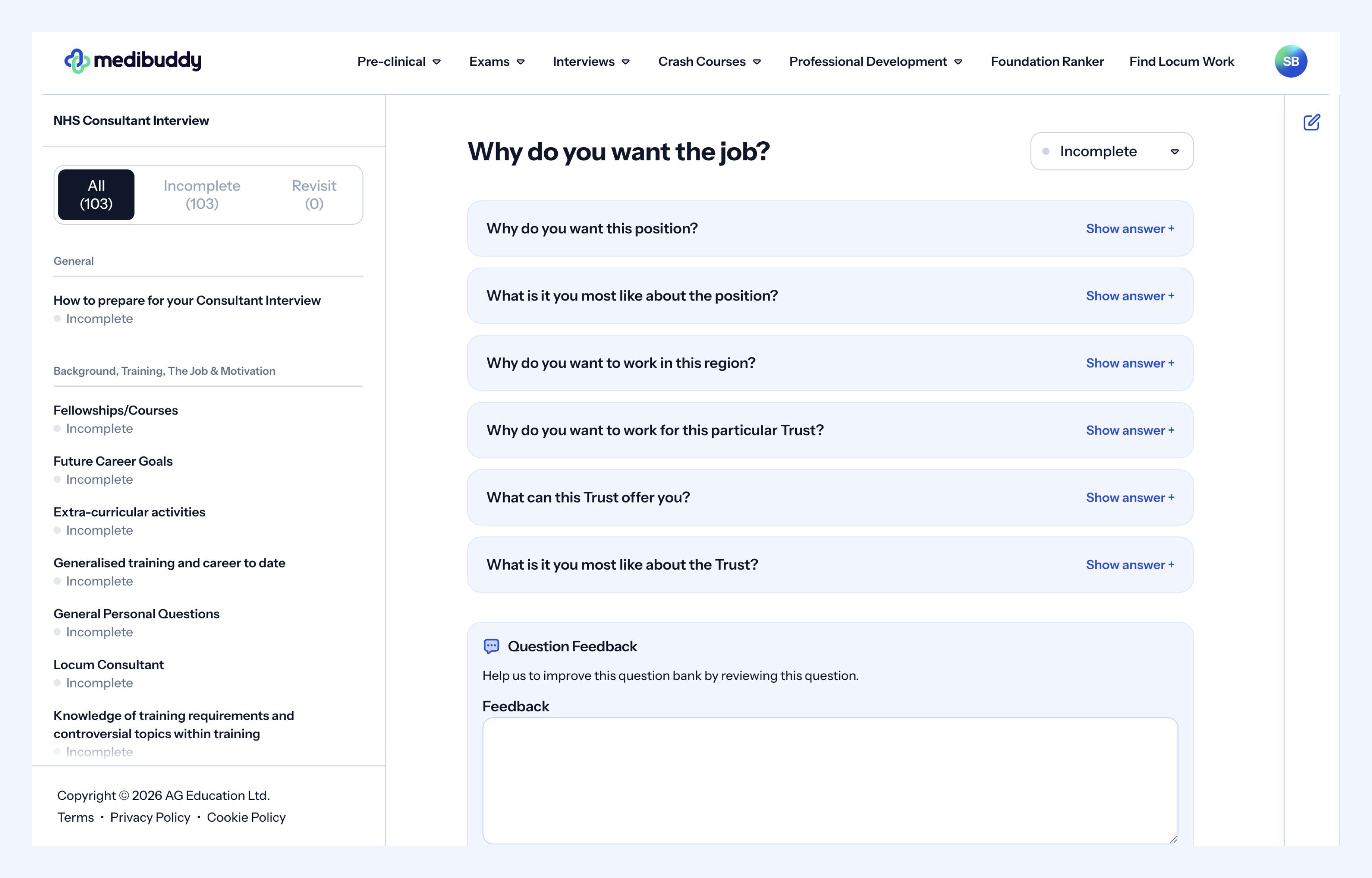 You’ll also be asked about your personal attributes, for example, your teamwork, leadership and management skills, and how you deal with things like stress, criticism and feedback, and conflict resolution.
Teaching, research, clinical governance, safe practice, and NHS issues are all key topics you should also prepare for.
Your communication skills will be assessed throughout and are a key aspect of the interview. It’s vital that you can demonstrate to the interview panel that you can communicate proficiently during challenging situations.
You’ll also be asked about your personal attributes, for example, your teamwork, leadership and management skills, and how you deal with things like stress, criticism and feedback, and conflict resolution.
Teaching, research, clinical governance, safe practice, and NHS issues are all key topics you should also prepare for.
Your communication skills will be assessed throughout and are a key aspect of the interview. It’s vital that you can demonstrate to the interview panel that you can communicate proficiently during challenging situations.
How do I prepare for an NHS consultant interview?Effective preparation is undoubtedly key to ensuring that you are successful at a consultant interview, and there are things that you can already be doing to prepare. Being informed about recent announcements/whitepapers relating to the NHS and your specialty will help you confidently discuss these topics. Understanding what the role entails outside of just the clinical aspect is also essential. Simple things like meeting with the medical directors, service directors, and the chief executive beforehand, if you can, are good ways of doing this. Make sure you make the most of these opportunities and ask as many questions about the trust as possible. Likewise, if you’re able to get involved in trust committee meetings or read what was discussed, you can become familiar with common topics covered, such as performance, finance and service development. This will provide you with valuable insight into the deeper workings of the trust, which will help you to answer questions more effectively in your consultant interview and highlight what you can offer. Additionally, understanding the types of questions you’ll be asked is essential to help you prepare well for the interview. Dedicating time to practice answering different questions you might encounter will help you feel more prepared, calm and confident when it comes to the interview, making the whole experience easier. This is where a high-quality interview question bank, like the Medibuddy NHS Consultant Interview Course, can help you. With example questions and model answers, it will help you effectively prepare for the types of questions you may encounter.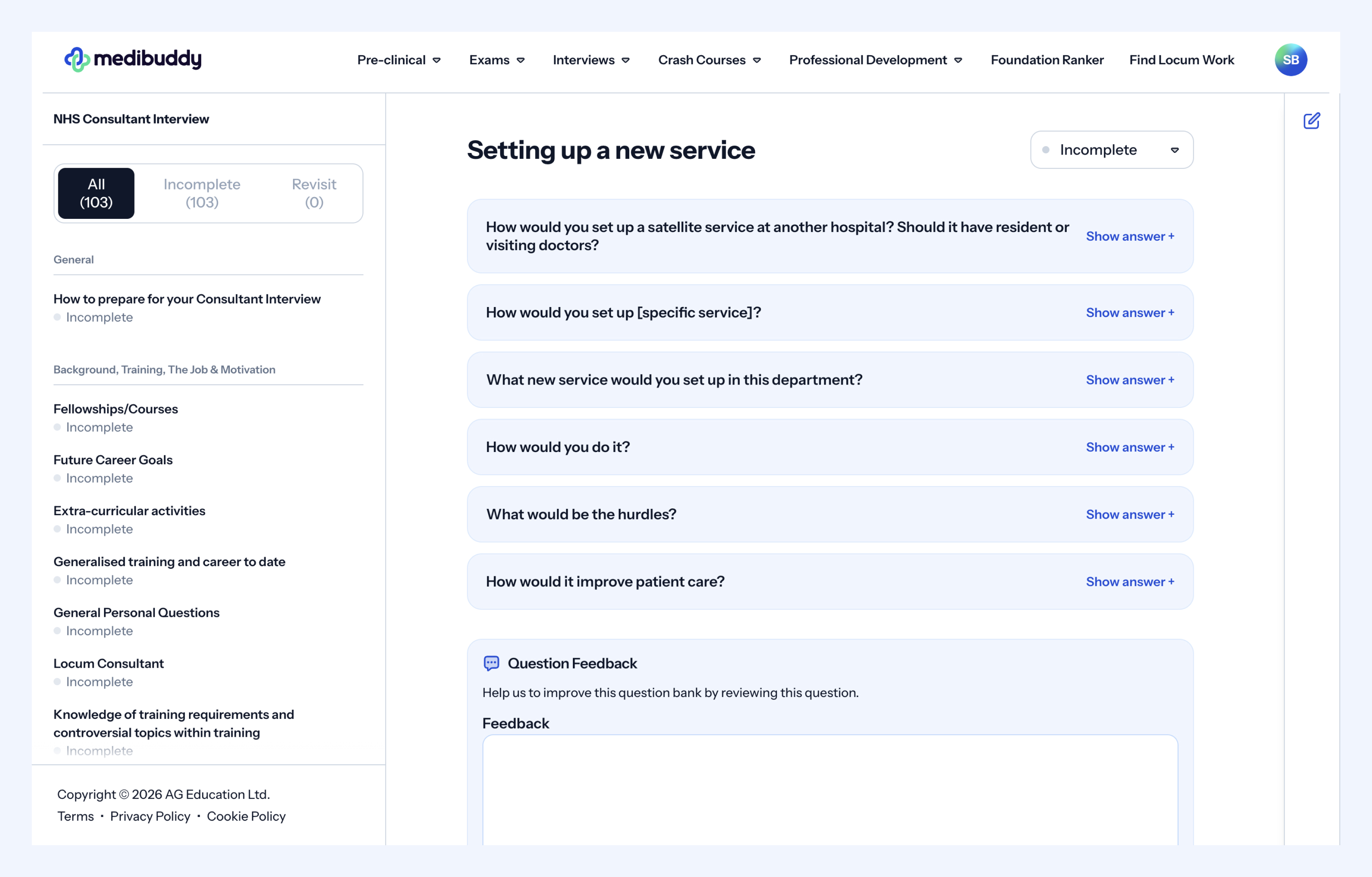
How does an online consultant interview course work?An online consultant interview course should provide you with common questions asked during the interview and give guidance on how to answer them. Example answers will usually be given, but as your answers will be personal to you and your experiences, you should use these to craft your own responses, rather than just recite them as a model answer. You can generally expect access to information in various formats, including text, videos and interactive activities, to help you prepare. These courses are available ‘on demand’ so you can work through them in your own time. Alternatively, virtual consultant interview courses are available, which provide a more interactive experience but must be taken at a set date and time, as you would with a face-to-face course. These tend to offer less information compared to an online course; however, there is the added benefit of being able to practice answering questions with others to build your experience and confidence in doing this.How much does an NHS consultant interview course cost?Prices vary depending on the provider you choose and whether it’s a standard on-demand online course or a virtual day course. You can expect to pay in the region of £150 – £200 for an online course and £350 for a virtual one. |
||||||||||||||||||||||||||||||||||||||||||||||||||||||||||||||||||||||||||||||||||||||||||||||||||||||||||||||||||||||||||||||||||||||||||||||||||||||||||||||||||||||||||||||||||||||||||||||||||||||||
Post ID: 32405 - Combined Infection Training Interview ST3/ST4: 2026 InterviewThe combined Infection training specialty recruits at both ST3 and ST4 levels. Combined Infection Training ST3 is a Group 2 training programme, whereas ST4 is categorised within Group 1. However, even though the application process is identical, the specialties require you to submit separate applications. We have put together a Combined Infection Training ST3/ST4 guide to support you through the application process. The guide covers everything you need to know about the Combined Infection Training interview. This includes the key training dates for 2026, the different interview stations and the level of competition you can expect to face. What do I need to know about Combined Infection Training?Due to its varied nature, Combined Infection Training consists of four infection specialties. You can find the unique contents of each specialty below:Infectious DiseasesA fascinating and fast-changing specialty, infectious diseases focus on laboratory and clinical skills, meaning doctors have the opportunity to see an extensive range of patients. As a specialty, infectious diseases include a mixture of in-patient and out-patient work. The in-patient work is based in regional specialist ID Units, requiring doctors to manage patients with a variety of complex conditions. This includes community-acquired infections, TB, HIV, and bone and joint infections. Whereas, out-patient work revolves around travel-related conditions and tropical medicine. The training programme has been revised recently, with infection trainees now spending two years on a combined infection training (CIT) programme. One year is ID-based, and one is spent attached to the microbiology laboratory and clinical consult rounds. After, trainees will take on another three years of higher specialist training in either ID, general medicine, microbiology or virology.Medical MicrobiologyMedical Microbiology involves all aspects of infection. Once, it was predominantly a laboratory-based role, overseeing diagnostic work, interpreting results and providing telephone advice to clinicians. However, due to its evolving nature, the specialty has become more diverse. There’s now the opportunity to provide advice on how to control the spread of infection in hospitals and the community, give ward consults about complex or serious infection cases and lead in developing new infection services like outpatient parenteral antibiotic treatment (OPAT). Medical Microbiology has similarities to Infectious Diseases, and there’s even the possibility of doing dual training across both specialties.Medical VirologyMedical virologists diagnose and manage patients with viral infections. As a result, the specialty provides an opportunity to work in a mix of laboratory liaison, research, development and teaching. During the programme, trainees will gain an idea of how to monitor resistance to antiviral drugs, manage respiratory outbreaks and make use of molecular-based tests to provide rapid diagnosis. As well as this, there’s the opportunity to manage patients with chronic viral infections. This includes HIV, hepatitis B and C, and respiratory virus infections. With the emergence of new viral infections in recent years, the role of a medical virologist is constantly expanding, and medical virology is becoming an increasingly exciting specialty to become involved in.Tropical MedicineThere are only a small number of posts available in tropical medicine. In ST4, these are linked to general internal medicine and medical microbiology or medical virology, in ST3. Most tropical medicine specialists end up in academic positions, work abroad, or manage the collaboration between UK-based and international tropical centres. Again, there are similarities to infectious diseases. But, there are the following differences that you should be aware of:
Combined Infection Training Key DatesDuring the assessment of your Combined Infection Training applications, you will be required to upload evidence. You only have to do this once, during the window of 19 December 2025 – 2 January 2026. Unlike other specialties, which allow you to book an interview slot, Combined Infection Training allocates a slot for you. This is to allow for the differing interview lengths while also considering the availability of the interviewers. The exact timings will become clearer closer to the time, but you can expect your Combined Infection Training interview to take place between 16 – 19 March 2026.Combined Infection Training ApplicationThe Combined Infection Training specialty recruits across two levels, ST3 and ST4. This means it contains both Group 1 and 2 programmes. As a result, there are key differences to most other specialties. Firstly, if you are applying to separate levels, you will need to fill out two application forms. Although, these are identical in appearance, and therefore, the content should be duplicated. Also, both levels recruit through the same interview, dictating the scores for both programmes. For more information about how the application process works, you can take a look at the ST3 and ST4 2026 Combined Infection Training person specifications. The difference in levels comes with different eligibility requirements. To be eligible for Group 1 programmes, you must complete three years of internal medicine training (IMT) stage 1 programme or equivalent. Whereas, with Group 2, only the first two years of the IMT are required to be eligible. The MRCP is an important consideration for Combined Infection Training. Both levels require you to have either successfully completed the MRCP(UK) Part 1 at the time of application and MRCP(UK) Part 2 by the offer date or completed the Irish Basic Specialty Training in Medicine and the MRCPI full diploma by the offer date to be eligible to apply. Being eligible for the specialist register in general internal medicine by the time of application is another alternative which will allow you to apply for Combined Infection Training.Boost your Combined Infection Training Interview ST3/ST4 application score by Training in TeachingPostgraduate teaching qualifications such as a PG Cert or PG Diploma can contribute up to 3 points to your Combined Infection Training application, but completing these courses can take a long time and may not be feasible before interviews. A quicker alternative is attending a Live Teach the Teacher Course, which includes at least six hours of live, synchronous teaching and awards 1 point toward your application. Our 1-day and 2-day course options make it easy to find a format that fits around your schedule.Combined Infection Training ST3/ST4 InterviewThe Combined Infection Training interview process varies slightly depending on whether you're eligible for Group 1 programmes in addition to Group 2. There are two stations for ST3 (Group 2), and four questions in total, with each taking around five minutes. When you consider the time between the stations, you can expect the interview for ST3 to last around 30 minutes. Those interviewing for ST4 (Group 1) programmes face an extra station, which focuses on the medical registrar suitability of applicants. This station takes around ten minutes, meaning the ST4 interview runs closer to 45 minutes.Station 1 Question 1 - PresentationThe interview’s first question requires you to prepare and deliver a presentation on the following topic: 'An interesting recent development / research finding, relevant to infection specialties (including infectious diseases, medical microbiology, medical virology or tropical medicine)' To prepare for the presentation, you should consider the following points:
Station 1 Question 2 - Suitability & CommitmentThis part of the interview focuses on your suitability and commitment towards Combined Infection Training as a specialty. This is your opportunity to build on the information you provided in the application form.Station 2 Question 1 - Clinical ScenarioAs you enter station 2, you’ll be given a clinical scenario to review. The brief will only be a couple of sentences in length. So, the rest of the window is a chance for you to mentally prepare to answer questions on the scenario. The scenario itself will describe a hypothetical clinical situation in which you have become involved. When you’re preparing to give your thoughts on the clinical scenario, you should think about the following points:
Station 2 Question 2 - Ethical, Professionalism & GovernanceHere, you will be asked a question that revolves around the moral, ethical and legal aspects of a medical situation. Unlike the clinical scenario, you won’t have access to this question beforehand, so you’ll have no time to prepare your answer in advance. Below is the type of scenario you can expect to find in the Ethical, Professionalism & Governance section of our Combined Infection Training ST3 Interview Question Bank:
Station 3 Question 1 - Medical Registrar Suitability (Group 1 / ST4 only)Those applying for a Group 1 programme will explore the non-clinical aspects of being a medical registrar, with a primary focus on two of the Capabilities in Practice (CiPs) from the Internal Medicine Stage 1 Curriculum. These are:
Combined Infection Training Interview ScoringFor each interview question, two assessors will independently score your performance. They’ll use a standard scoring metric, providing you with a set of marks based on how you perform against the expected level. You can find the scoring framework below:
Combined Infection Training AppointabilityLike with most specialties, the sum of your separate interview scores will be combined, providing you with a raw interview score (RIS). However, due to the Group 1 and 2 interviews being slightly different, the appointability requirements also differ. ST4 (Group 1) has five questions, giving you ten interview scores. Therefore, you can expect your RIS to be somewhere between 10 to 50. Before your application to a Group 1 programme can be considered appointable, your results must meet the following criteria:
Combined Infection Training Competition RatiosThe 2025 competition ratios will give you an insight into what you’re up against in the upcoming recruitment round. In round 2, there were 154 applications for 36 Combined Infection Training ST3 posts. This resulted in a competition ratio of 4.28, meaning almost four people applied for each post. Combined Infection Training ST4 was more competitive, with 112 applications for 10 posts, resulting in a competition ratio of 11.20. |
||||||||||||||||||||||||||||||||||||||||||||||||||||||||||||||||||||||||||||||||||||||||||||||||||||||||||||||||||||||||||||||||||||||||||||||||||||||||||||||||||||||||||||||||||||||||||||||||||||||||
Post ID: 3781 - Cardiology ST4 Interview Preparation and What to Expect 2026Core training was previously 2 years, however, it has since been changed to 3, so trainees enter cardiology training at ST4 level instead of ST3, as was the case previously. Cardiology ST4 ApplicationsIf you are applying to Cardiology ST4, you will first complete your application, which is made up of your self-assessment and submission of your evidence. The self-assessment offers 38 points across all domains and you must provide evidence for your achievements. Evidence can include certificates and letters of reference, and the key is that it is “sufficient for the reviewer to be confident that you have claimed correctly”. There are a further two marks available for if this evidence is well-presented. You can find out more about the scoring framework and evidence criteria here. The evidence uploading window for 2026 is 29 December 2025 until 7 January 2026, so make sure you have gathered all of your evidence prior to this, so you aren’t panicking or missing anything on the day.Boost your Cardiology ST4 application score by Training in TeachingCompleting a formal teaching qualification, such as a PG Cert or PG Diploma, can earn you up to 3 points on your Cardiology ST4 application. However, these qualifications take time and are often difficult to complete before interviews. A practical alternative is to attend a Live Teach the Teacher Course that includes a minimum of six hours of live, interactive teaching, which will give you 1 point towards your application. Our courses are available in both 1-day and 2-day formats, so you can choose the option that fits best around your schedule.Cardiology ST4 InterviewThe Cardiology ST4 interviews are a highly competitive process which understandably causes considerable anxiety for candidates. In 2025, more than 4 people applied for every post! However, there are several things that you can do to help you perform at your best. The aim of this article is to outline the interview process and to give some advice based on our personal experience and opinion. We’ve also produced our Cardiology ST4 Interview Question Bank and knowledge course to help you prepare. For Cardiology 2026, the interview dates are as follows: 16th, 17th, 18th, 19th, March 2026, and this applies to all regions. The interview comprises two stations. Each station will last 22 minutes and the total interview will last around 50 – 55 minutes. Each of the five questions provide the opportunity to earn five points from each assessor. You’ll also be assessed on your communication skills throughout the interview, meaning there are six score areas in total.Station 1 - Question 1: Suitability and CommitmentThis section gives you the opportunity to answer the question: “Why are you the ideal candidate for cardiology training?” and allows you to build on the information you provided in your application form. The section varies slightly each year and will last around 10 minutes. Despite the changes in wording, every year its essence is the same and it is an opportunity for you to sell yourself and outline why you are suitable for cardiology training. Most candidates will have very similar curriculum vitae: publications, presentations, audits/QIPS, research, clinical cardiology rotations during foundation or core medical training, cardiology specific courses (e.g. echocardiography courses), MRCP (or pending). Whilst it’s important to mention these, the point of this question is not to simply list your achievements or experiences as you did in your written application. You must qualify your achievements and relate them to cardiology, explaining how they will make you a better cardiology registrar. For example:
Station 1 - Question 2: Medical Registrar SuitabilityIn this section, there will be two short themes/questions provided to you by interviewers, and you will have approximately 7 minutes dedicated to discussing them. You will need to think about the non-clinical aspects of being a medical registrar. This question focuses on two of the Capabilities in Practice (CiPs) from the Internal Medicine Stage 1 Curriculum:
Station 1 - Question 3: Ethical, Professionalism and GovernanceThe third section is based on ethical, professionalism and governance issues. These questions can be difficult to pre-empt and are given to you during the interview, so you do not have time to prepare beforehand. Our advice here would be to ensure that you understand clinical governance and the various activities that comprise this umbrella term (eg. teaching and training, audit, information technology etc.). Have examples of activities that you have been engaged in that demonstrate your understanding and participation in clinical governance. Again, it is important to not just list what you have done, but to explain your learning and how you would apply it to cardiology training. We would also recommend reading GMC guidelines for doctors, including best practice, consent, confidentiality and mental capacity. Having some knowledge about the role of indemnity organisations like the MPS may also be helpful. Irrespective of the scenario, your goal should be to demonstrate that you are sensible and safe, aware of the guidance and can quote some references (for example GMC guidelines). Our interview question bank provides a number of example questions and answers for this section. As the questions can be quite difficult to pre-empt, we have produced over 50 questions to help you prepare and achieve maximum points in this section. If you want to take your preparation to the next level, we also offer a Cardiology ST4 Knowledge Course, consisting of 12 video modules designed to enhance your knowledge and improve your confidence going into the interview. You can even save £40 when you buy the question bank and knowledge course together.
Station 2 - Questions 1 & 2: Clinical Scenario 1 & 2For 2026, you will be given two clinical scenarios. For the first clinical scenario, you will be given a clinical scenario to review for a few minutes. You will then be asked questions on this scenario for around 13 minutes. Remember, this is not an opportunity to tell the interviewers everything that you think you know about cardiology. Make sure you listen carefully to the questions and answer them concisely, ensuring you don’t deviate too far away from what has been asked. The most important point for you to remember is to start with the basics and be safe. They want to know that you are competent and will work within the confines of your knowledge, without trying to do something that you are not yet trained to do. There is nothing wrong with suggesting investigations that you cannot perform, but we’d advise you to start with the basics. Try to put yourself in the scenario and say what you would do in real life. This question is designed to test your clinical acumen and judgement, so saying that you would do a coronary angiogram or insert a pericardial drain as your first response is unlikely to score you many points. Think about the steps you would take. For example, start by saying you would take a history and examine the patient, managing them in a systematic and organised fashion. Your first priority would be to stabilise the patient and ensure basic tests are done (blood tests, ECG, urine dip, chest x ray, ensuring there is vascular access and a cardiac monitor). You would then inform other members of the team to organise specialist tests and management, so think about how you would communicate this. The point here is to emphasise that you are able to manage acutely and chronically unwell patients presenting with cardiovascular illnesses. You will be expected to have some knowledge of managing cardiology specific scenarios, for example post-angiography or post coronary syndrome complications, however, you should aim to demonstrate this knowledge once you have first covered the basics. You should be aware of the NICE and ESC guidelines for common presentations such as stable angina, coronary syndromes, heart failure, hypertension, tachy- and brady-arrhythmia, syncope. You should also be aware of the cardiology specific investigations eg. echocardiograms, stress tests, CT coronary angiography, angiography and angioplasty, cardiac MRI etc. However, due to time limitations there are unlikely to ask you detailed questions about these so a general overview should suffice. Your goal should be to demonstrate you have knowledge of guidelines and are able to apply them to an unwell patient. Remember, in order to score highly you need to answer the questions concisely, start with a basic management plan and then move to more complex tests and investigations. You must then demonstrate that you know when to escalate for help and can think laterally about the patient’s problems, ideas, concerns, and expectations. For your second clinical scenario, you will be given a hypothetical scenario verbally, and asked questions on it for around 9 minutes. You should approach this in a similar way to the previous clinical scenario, thinking about steps you would take, potential treatments, further information you would gather, and how you would communicate with those involved in the scenario. Below is just a snippet of some of the clinical scenarios we include in our cardiology interview question bank. We hope that the above has been useful in outlining the interview process, and has given you an insight into what you may expect. Of course, interview formats and their content can change, and your own experiences may differ from those noted above, so each year we collect feedback from interviewees to ensure our resources, including our interview question bank and knowledge course are as up-to-date as possible. You can be confident that the same principles will apply to your interview and hopefully, you will find our advice informative and useful.
If you have read this blog, but aren't actually sure if Cardiology is the specialty for you, you can check out our Life as a Cardiology ST4 blog which will give you an insight as to what to expect from the specialty.
Good luck!
We hope that the above has been useful in outlining the interview process, and has given you an insight into what you may expect. Of course, interview formats and their content can change, and your own experiences may differ from those noted above, so each year we collect feedback from interviewees to ensure our resources, including our interview question bank and knowledge course are as up-to-date as possible. You can be confident that the same principles will apply to your interview and hopefully, you will find our advice informative and useful.
If you have read this blog, but aren't actually sure if Cardiology is the specialty for you, you can check out our Life as a Cardiology ST4 blog which will give you an insight as to what to expect from the specialty.
Good luck!
|
||||||||||||||||||||||||||||||||||||||||||||||||||||||||||||||||||||||||||||||||||||||||||||||||||||||||||||||||||||||||||||||||||||||||||||||||||||||||||||||||||||||||||||||||||||||||||||||||||||||||
Post ID: 2947 - ST3 General Surgery Interview Preparation and Essential ReadingThe key to success in the 2026 General Surgery ST3 interview is preparation. You will have a much greater chance of success if you start preparing early and wisely. This requires planning and a combination of solo reading and group practice. Below we have summarised the best methods of structuring your interview practice and provided a selection of texts that we found helpful when preparing.
To support your interview preparation further we’ve also developed a General Surgery ST3 Interview Question Bank. Here you’ll find example scenarios and recommended answer structures for the clinical scenario and management scenario sections of the interview. For example, for the management scenario you may be provided with a scenario such as the following:
General
Individual
Small groups
Essential readingThe latest application documents can be found on the Oriel website:
Recommended books and websites
|
||||||||||||||||||||||||||||||||||||||||||||||||||||||||||||||||||||||||||||||||||||||||||||||||||||||||||||||||||||||||||||||||||||||||||||||||||||||||||||||||||||||||||||||||||||||||||||||||||||||||
Post ID: 2941 - General Surgery ST3 Interview FormatWhat is the General Surgery ST3 interview actually like? There are many stories and myths about what goes on, but in this post, we hope to demystify the intricacies of the interview format. The take-home message is that time is tight, and you need to approach each station with a strategy. You’ll find a breakdown of the current interview format below, and to help you prepare for each individual station, we’ve developed our General Surgery ST3 Interview Question Bank and Knowledge Course. General Surgery ST3 Interview 2026For 2026, the interview dates are:Thursday 26 March and Friday 27 March 2026 For a full breakdown of the application timeline, see our guide to the General Surgery ST3 Application Process. The interview will last 40 minutes and will involve reading time, a clinical scenario, a management scenario and a career discussion (see below). All interviews will be conducted remotely via Qpercom Recruit. It is vital you test your audio-visual equipment and ensure you have a strong WIFI connection. Interviews will be terminated if the panel cannot see you. Previously Microsoft Teams was used for the General Surgery ST3 interviews, which you may be more familiar with. More information about Qpercom Recruit and what to expect from the virtual interview is provided on the Specialty Recruitment website. The initial process for the remote interview will be as follows:
The General Surgery ST3 Interview StationsFor 2026, the General Surgery ST3 interview will consist of 3 core stations, each lasting 10 minutes, with 5 minutes of reading time prior to the clinical scenario and management scenario stations. The interview format will be as follows:1. Clinical Scenario Reading Time (5 minutes)You will be given a clinical scenario relating to a patient and 5 minutes reading time in order to prepare. Time is very tight, so ensure you read the scenarios fully before writing any notes, as you must make sure you understand them. There is usually 1 side of A4 text for each scenario containing a lot of clinical information. Candidates have failed in the past for missing out on a vital point in the scenario: the last piece of text on the instructions. Completing practice questions during your interview preparation will help you to get used to identifying the relevant information quickly and preparing a management plan.2. Clinical Scenario (10 minutes)You’ll then have 10 minutes to answer questions related to the clinical scenario given. You will need to explain your management for the Clinical Scenario step by step. We have provided example scenarios and the recommended answer structures in our General Surgery ST3 Interview Question Bank. An example of this is below: The recommended answer structure provided in the example will help you to organise your answer and provide a clear step-by-step management plan.
Make sure you identify all the issues at the beginning. The interviewers will provide you with more information and ask you to suggest management plans. These can usually be anticipated (e.g. CT reports).
The recommended answer structure provided in the example will help you to organise your answer and provide a clear step-by-step management plan.
Make sure you identify all the issues at the beginning. The interviewers will provide you with more information and ask you to suggest management plans. These can usually be anticipated (e.g. CT reports).
3. Management Scenario Reading Time (5 minutes)This is similar to the clinical scenario reading time. You’ll be given a scenario related to a management problem in a clinical environment with 5 minutes reading and preparation time. Ensure you make a note of the key management issues in the clinical environment and how you would approach this.4. Management Scenario (10 minutes)You will then have 10 minutes to answer questions related to the management scenario. We have provided example scenarios and the recommended answer structures in the General Surgery ST3 Interview Question Bank to help you to prepare effectively. An example is below: The recommended answer structure supports you to think through how you would approach the scenario, and what you would need to consider initially, so you can explain how you would manage the situation effectively.
For both scenarios, you will be marked down if you are prompted to highlight a key issue or aspect of management, so it’s essential that you make the most of your reading time to identify all issues before you start.
The recommended answer structure supports you to think through how you would approach the scenario, and what you would need to consider initially, so you can explain how you would manage the situation effectively.
For both scenarios, you will be marked down if you are prompted to highlight a key issue or aspect of management, so it’s essential that you make the most of your reading time to identify all issues before you start.
5. Professional Development Station (10 minutes)This is an opportunity for the panel to ask questions about aspects of your career to date. There’s no need to bring a physical portfolio, and the interviewers won’t have access to any of your portfolio evidence during the interview. Instead, they’ll focus on your experiences, reflections, and examples, so be ready to talk confidently about the key moments that have shaped your training. Our General Surgery ST3 Knowledge Course consists of 14 video modules and is designed to enhance your surgical knowledge and interview preparation. You can even save £40 when you purchase the question bank and the knowledge course together.
Good luck for your interview!
Further ReadingGeneral Surgery ST3 Interview Questions General Surgery ST3 Knowledge Course General Surgery ST3 Application Process |
||||||||||||||||||||||||||||||||||||||||||||||||||||||||||||||||||||||||||||||||||||||||||||||||||||||||||||||||||||||||||||||||||||||||||||||||||||||||||||||||||||||||||||||||||||||||||||||||||||||||
Post ID: 3414 - Urology ST3 Interview Overview 2026The Urology ST3 interview is a national selection process that will last up to 60 minutes in total. You will be assessed and scored by two Consultants. The recruitment process for National Urology ST3 2026 will follow the timeline below as per HEE:
Urology ST3 Portfolio/Self AssessmentYour ST3 Urology portfolio will have already been assessed prior to your interview. Once you have completed your application via Oriel, you will be asked to upload evidence, so it is vital to have all your documentation ready before starting your application. ST3 Urology portfolio tips: Start early. Send emails, make phone calls, and gather every piece of evidence you need. Remember, the more, the merrier! Failing to prepare is preparing to fail. Your portfolio marks are guaranteed marks if you prepare thoroughly. Ensure you go through the ST3 Urology portfolio checklist and tick every possible box. You can find the checklist for 2026 here. Also, refer to the 2026 person specification here. One mark could be the difference between securing a position and reapplying next year. Complete your clinical audits, attend urology-related courses, participate in teaching, and ensure your PBA’s are signed off. These are essential components of an ST3 Urology application, and every strong candidate has them. Examiners are fair and aim to give you credit where evidence is clear. They want you to do well. Focus on high-impact elements of your portfolio, like leadership in audits, teaching experience, and excellent feedback in PBAs. Remember, a polished portfolio reflects your commitment to excelling in urology.Boost your Urology ST3 Application by Training in TeachingYou can score up to 4 points by being involved in medical teaching. To score maximum points in this area of teaching, you must have been the principal organiser of a relevant course. You can also score Urology ST3 Application points by ‘training in teaching’, with 3 points available for an MSc or equivalent in clinical education. All you have to do for 1 extra point is attend a course like our On-Demand or Live Teach the Teacher courses.
The Urology ST3 Interview FormatOutpatient ScenarioIn this scenario at an outpatient clinic, prioritise a patient-centred approach, emphasising symptom presentation over diseases. Clearly describe your patient assessment process, including common tests, while staying focused on answering specific questions. We recommend knowledge-specific revision, focusing on symptom presentations like raised PSA or lump in scrotum. Be prepared for closed questions in the station, so provide concise initial answers and wait for cues to elaborate. We have included an example from our Urology ST3 question bank below.
Emergency ScenarioThis question will test your ability to handle Urology emergency scenarios for the ST3 interview, assessing your approach to urgent and high-pressure clinical situations. You can draw on the knowledge you gained whilst revising for the MRCS exams. Anticipate encountering various emergency scenarios that will evaluate your teamwork, delegation, and prioritisation skills, and ensure you are demonstrating these within your answer.CommunicationIn this question, you’ll be assessed on your communication skills for the ST3 Urology interview, focusing on scenarios such as breaking bad news and addressing a missed diagnosis If you can, see if you can sit in with some of your consultants when they are having difficult conversations, or ask them for advice on how to approach these situations. We also provide a list of scenarios within our question bank including tips and examples of how to approach different situations you may be asked about.SkillsYou will be presented with a scenario and asked multiple questions in regards to your approach. Here is an example of a Urology interview skills scenario from our question bank, to give you an idea of what to expect. Two assessors will independently score during your interview, and there may also be a Lay Representative too.
Remember, some questions will not have a strict correct answer but as long as you can provide a thought process and sensible plan you can score maximum points. The outpatient scenarios are probably the easiest to prepare for. Learn each scenario, know exactly what you will ask in your history, how you will examine and how you will investigate. But don’t be caught out! I say this because it’s not uncommon to have to discuss stone treatment when given a scenario relating to recurrent UTI’s for example. Our detailed question bank will ensure you are adequately prepared and help you think outside the box.
In addition to our question bank, our Urology ST3 Knowledge Course is designed to further enhance your knowledge and interview preparation. You can even save £40 when you purchase the question bank and knowledge course together.
Two assessors will independently score during your interview, and there may also be a Lay Representative too.
Remember, some questions will not have a strict correct answer but as long as you can provide a thought process and sensible plan you can score maximum points. The outpatient scenarios are probably the easiest to prepare for. Learn each scenario, know exactly what you will ask in your history, how you will examine and how you will investigate. But don’t be caught out! I say this because it’s not uncommon to have to discuss stone treatment when given a scenario relating to recurrent UTI’s for example. Our detailed question bank will ensure you are adequately prepared and help you think outside the box.
In addition to our question bank, our Urology ST3 Knowledge Course is designed to further enhance your knowledge and interview preparation. You can even save £40 when you purchase the question bank and knowledge course together. Ultimately, the key to succeeding with your Urology ST3 interview preparation is to practice each station individually while maintaining a good understanding of what happens on the day. If you have any questions about the interview process, please get in touch. Good luck!
Resources:Medibuddy Urology ST3 Interview Question Bank Medibuddy Urology ST3 Knowledge Course Urology ST3 Person Specification MRCS Part A Question Bank |
||||||||||||||||||||||||||||||||||||||||||||||||||||||||||||||||||||||||||||||||||||||||||||||||||||||||||||||||||||||||||||||||||||||||||||||||||||||||||||||||||||||||||||||||||||||||||||||||||||||||
Post ID: 3092 - Radiology ST1 Application Process 2026If you're preparing your Radiology ST1 application for the 2026 recruitment window, this guide will provide everything you need to know about the process, including the application timelines, how to prepare for the MSRA, and how the ranking and offer process works. What is the Radiology ST1 application process for 2025–2026?
How do I prepare for the MSRA?Considering that the MSRA is such an important part of the Radiology application process, preparing for this efficiently is key. The exam is split into two key sections: Professional Dilemmas (PD) and Clinical Problem Solving (CPS). So you know what to expect, we have included below an example of each question type from our question bank. [caption id="attachment_25388" align="alignnone" width="2130"]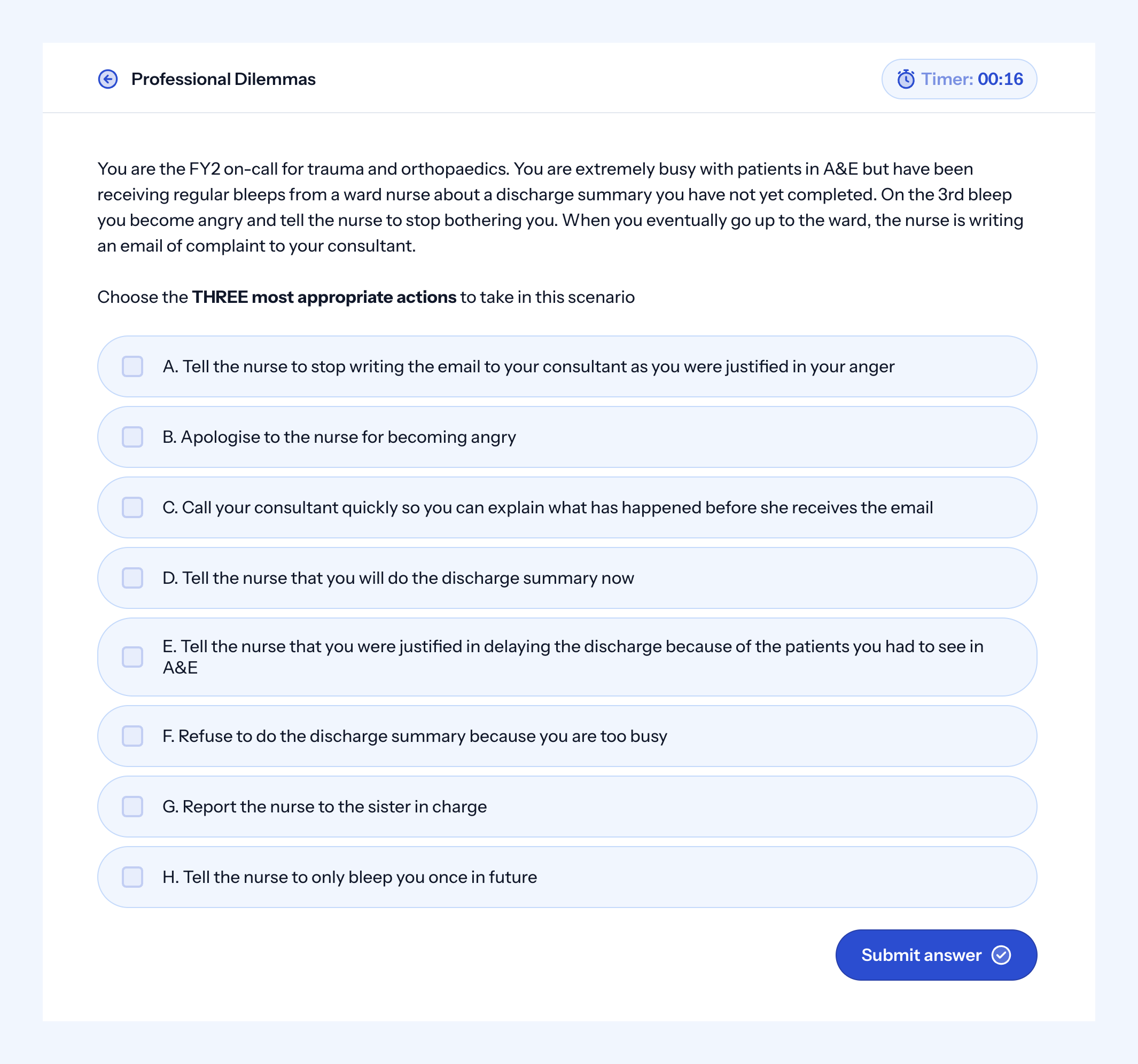 Professional Dilemmas Question[/caption]
[caption id="attachment_25389" align="alignnone" width="2130"] Professional Dilemmas Question[/caption]
[caption id="attachment_25389" align="alignnone" width="2130"]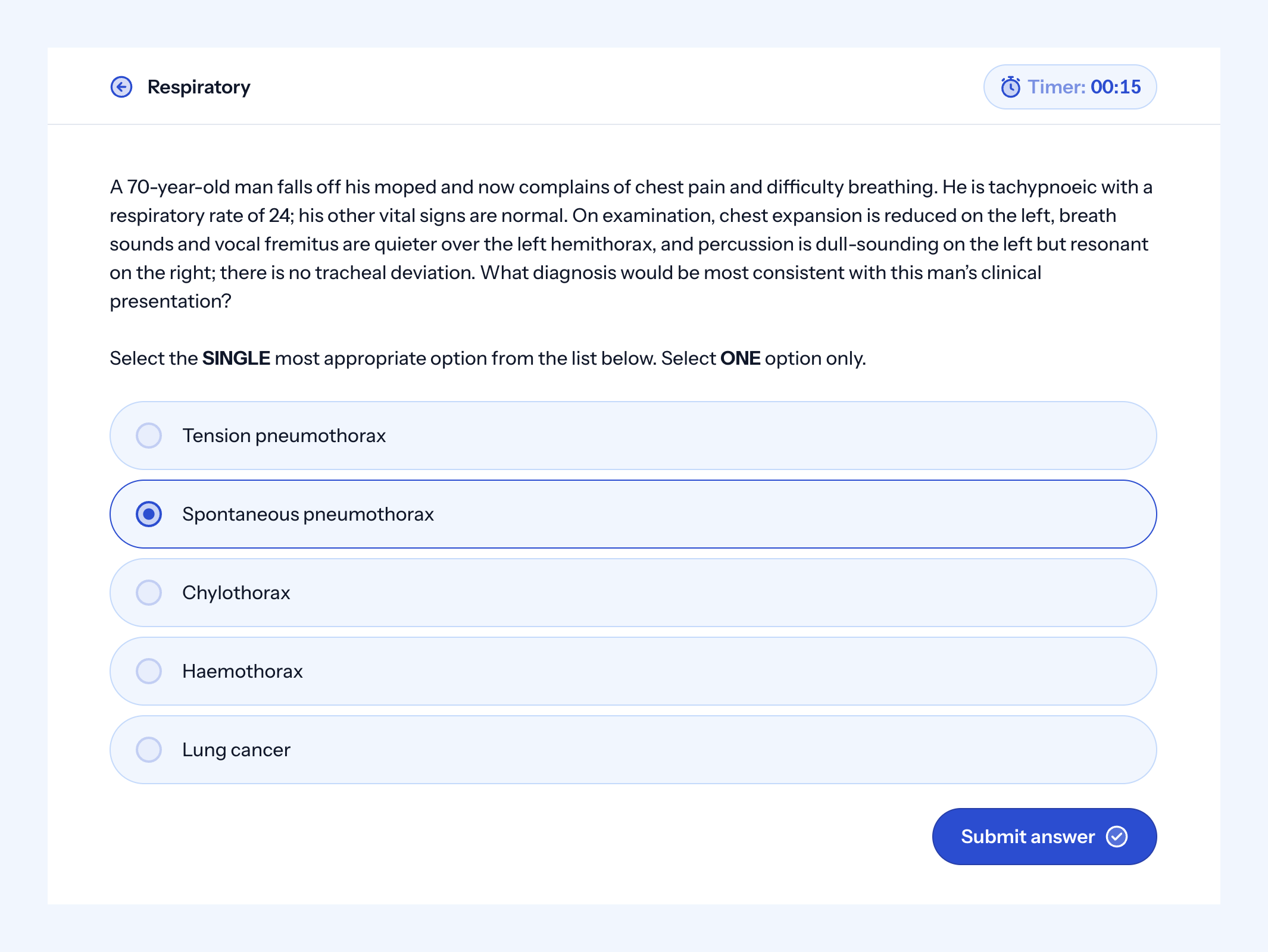 Clinical Problem Solving Question[/caption]
We recommend putting as much time aside as possible to prepare for your MSRA exam. This may be the first exam you are sitting whilst also working as a doctor. This means you will have less hours per day to dedicate towards revision compared to your medical school days. To overcome this, you will need to be structured and organised in your revision. Start your revision early, and create a revision timetable to ensure you cover all of the topics necessary, especially dedicating time to the areas you are weak in, as well as high yield areas. Be sure to allow some flexibility to allow for adjustments in cases of unforeseeable events.
Ensure you familiarise yourself with the exam curriculum, the test blueprint is a useful source of information, Our adaptive MSRA question bank will help you isolate weak areas by displaying your mastery level on the dashboard (pictured below) for each part of the curriculum, this is a measurement of your knowledge of that topic, so you can easily see what areas you should focus your time on.
We’ll also give you explanations for each answer to help you revise. With competition for training posts more competitive than ever, having a high score is key! You can find out more about the MSRA in our Complete Guide to the MSRA blog.
[msra_sales_panel] Clinical Problem Solving Question[/caption]
We recommend putting as much time aside as possible to prepare for your MSRA exam. This may be the first exam you are sitting whilst also working as a doctor. This means you will have less hours per day to dedicate towards revision compared to your medical school days. To overcome this, you will need to be structured and organised in your revision. Start your revision early, and create a revision timetable to ensure you cover all of the topics necessary, especially dedicating time to the areas you are weak in, as well as high yield areas. Be sure to allow some flexibility to allow for adjustments in cases of unforeseeable events.
Ensure you familiarise yourself with the exam curriculum, the test blueprint is a useful source of information, Our adaptive MSRA question bank will help you isolate weak areas by displaying your mastery level on the dashboard (pictured below) for each part of the curriculum, this is a measurement of your knowledge of that topic, so you can easily see what areas you should focus your time on.
We’ll also give you explanations for each answer to help you revise. With competition for training posts more competitive than ever, having a high score is key! You can find out more about the MSRA in our Complete Guide to the MSRA blog.
[msra_sales_panel]
What is the Radiology ST1 recruitment timeline for 2025–2026?The dates for Radiology ST1 recruitment for 2025–26 are below:
How are Radiology training programmes ranked?Candidates can view all the available deaneries on the ORIEL platform – the number of available places per deanery will be listed, although more specific details on each deanery are limited. Not all places will be listed from the day of opening, so be sure to recheck periodically to see if new posts have been uploaded. Candidates can then rank deaneries based on preference via the ORIEL platform – you do not need to rank every deanery and you can exclude yourself from specific deaneries if you wish. This ranking process takes place before the results of the Radiology interview are released. In recent years, there has been the additional option to apply for a six year interventional radiology post. From ST1-ST3 this will be largely the same as clinical radiology post, but from ST4 you will switch to the interventional side. Even if you start on the five year clinical radiology post, there is still the option to apply for IR after ST3.What is the Radiology ST1 offer process?Essentially, candidates are ranked according to their overall score (combined score from their self-assessment and interview score); based on this, the top ranked candidate is offered their highest preference job that is available. This process is repeated for each candidate sequentially down the rankings until all jobs have been offered. If there are spare vacancies, there will be a clearing process. There may be a slight delay between getting your overall ranking and receiving your specific offer.How to prepare your Radiology ST1 applicationThe overall radiology application can be divided into the Multi-Specialty Recruitment Assessment (MSRA), the portfolio and the interview itself. You can use our MSRA question bank to prepare for the exam.Basic eligibilityIn terms of the basic, general eligibility criteria, most of it is criteria that the vast majority of candidates will automatically fulfil, i.e. successful completion of foundation training. If you have any further specific, unusual personal circumstances, we recommend emailing HEE London and South East Recruitment directly to determine your eligibility. However, one specific point to make is that applicants must have 18 months or less of experience in Radiology (excluding Foundation Year modules) to be eligible to apply.Portfolio preparationFor 2026, your portfolio will play a significant role in the Radiology interview process in Station A. This will cover five domains (reduced from seven in last year’s self-assessment). To achieve this change, the prizes and awards section has been merged with the academic domain, and the teaching and training domains have also been merged. Full details are outlined in the guidance document. At the point of application, you will complete a supporting evidence section, where you must review the guidance, select the category your single piece of evidence is most appropriately associated with, and provide a title for that evidence. It’s worth keeping a few things in mind when doing this:
Further readingRadiology ST1 Interview Overview Self Assessment Marking Scheme MSRA Complete Guide Radiology Interview Question Bank - Updated with new scenarios for 2025 Teach the Teacher Course Live Teach the Teacher Course |
||||||||||||||||||||||||||||||||||||||||||||||||||||||||||||||||||||||||||||||||||||||||||||||||||||||||||||||||||||||||||||||||||||||||||||||||||||||||||||||||||||||||||||||||||||||||||||||||||||||||
Post ID: 3100 - Radiology ST1 Interview Preparation Guide for 2026Maximising your preparation for the Radiology ST1 interview is crucial if you want to be amongst the top-scoring candidates and secure your dream training post. The interview is the most significant aspect of the Radiology ST1 application process, holding 60% of your overall ranking, with the other 40% coming from the self-assessment stage. Radiology ST1 Interview FormatThe Radiology ST1 interview consists of 7 questions across two 15-minute stations, each assessing essential qualities for a successful radiology trainee. Here's what you can expect:Station AStation A includes:
Station BStation B includes:
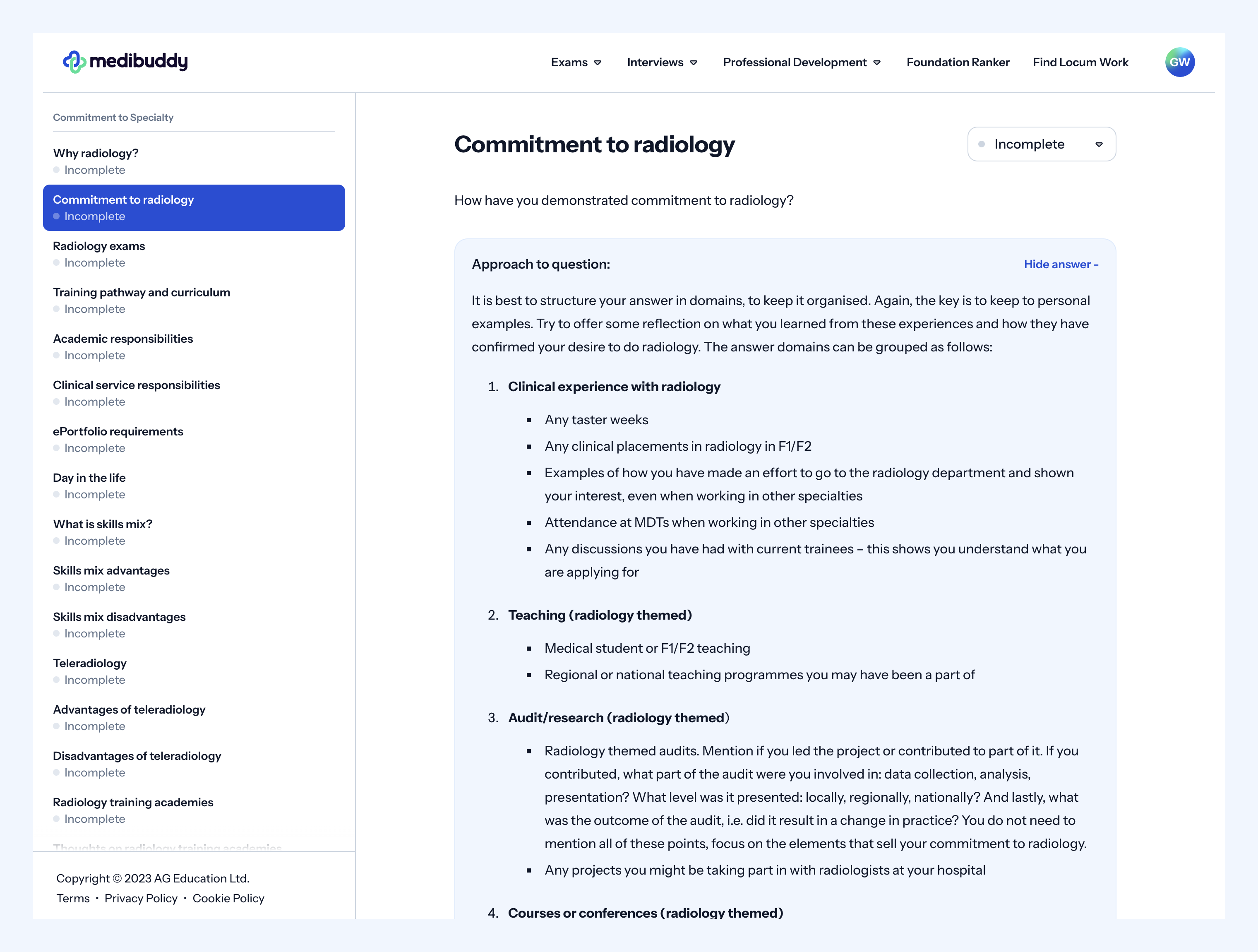 The Radiology ST1 interview has been known to change at the last minute in previous years. In 2024, the interview included a Clinical Prioritisation station, which was announced just before the interview and then dropped for the 2025 interview. For 2026, a question on clinical scenario prioritisation has been included in Station B. You can practice these question types in our Question Bank.
Staying updated on the latest radiology news and developments is crucial in the lead-up to your interview. By following this guide and keeping informed of any changes, you’ll position yourself for success in the Radiology ST1 interview. Remember, thorough preparation and a genuine passion for the specialty are essential to achieving a high score in the interview.
Good luck!
The Radiology ST1 interview has been known to change at the last minute in previous years. In 2024, the interview included a Clinical Prioritisation station, which was announced just before the interview and then dropped for the 2025 interview. For 2026, a question on clinical scenario prioritisation has been included in Station B. You can practice these question types in our Question Bank.
Staying updated on the latest radiology news and developments is crucial in the lead-up to your interview. By following this guide and keeping informed of any changes, you’ll position yourself for success in the Radiology ST1 interview. Remember, thorough preparation and a genuine passion for the specialty are essential to achieving a high score in the interview.
Good luck!
Useful ResourcesRadiology ST1 Person Specification 2026 Medibuddy Radiology Interview Question Bank |
||||||||||||||||||||||||||||||||||||||||||||||||||||||||||||||||||||||||||||||||||||||||||||||||||||||||||||||||||||||||||||||||||||||||||||||||||||||||||||||||||||||||||||||||||||||||||||||||||||||||
Post ID: 3450 - Radiology ST1 Interview Overview 2026The Radiology ST1 interview is a key hurdle in an increasingly competitive application process. In the 2025 Radiology application cycle, there were a total of 4011 applicants for 356 training posts across England, Scotland and Wales. With an 11.27 competition ratio, this means nearly twelve people are applying for each post! Evidently, making a good impression and standing out in the interview is vital in securing a radiology training number - don’t let your hard work revising for the MSRA go to waste! In addition to helping you prepare for the interview, as we've done in this blog, we’ve written guides to support you through the Radiology ST1 application process and self-assessment criteria. What is the Radiology ST1 interview format?The format of the radiology interview has changed again for 2026, and we are in the process of updating our question bank to reflect this. Previously, the interview consisted of two stations lasting 10 minutes, aimed at assessing a candidate’s “commitment to radiology and communication skills”. This could involve asking candidates about a range of topics within radiology, from their understanding of the training pathway to what they thought about teleradiology. Candidates would also be scrutinised on their portfolio. Having a detailed understanding of what is present was crucial to answering the relevant portfolio based questions. However, for 2026, the interview includes Stations A & B, each lasting up to 15 minutes, covering different criteria from the person specification. It will assess your commitment to radiology and your communication skills. We have split our question bank into two sections to cover Stations A & B, reflecting the renewed interview format. For 2026, your interview is worth 60% of your overall score, marking an increase again this year and placing further emphasis on your interview performance.Station AStation A will assess your portfolio, understanding of the radiology specialty, and your skills relevant to the role. This station is your chance to showcase your experiences and knowledge gained from taster weeks, audits, clinical placements, conferences, and any other radiology-related activities. What to expect:
Station BStation B assesses a range of skills relevant to radiology, including clinical scenario prioritisation, coping with pressure, managing uncertainty, and working effectively in a team. While clinical information is often central, interviewers will likely explore all of these areas, so be prepared to discuss your reasoning, decision-making, and teamwork when answering questions. What to expect:
How can I prepare for the Radiology ST1 interview?The 2026 will be conducted remotely via a software called Qpercom Recruit. You will likely be unfamiliar with this, so make sure you have practised using it beforehand. Ensure you have good screen hygiene with a clean background and central framing with your camera near eye level. This may sound pedantic, but it makes a big difference! Practice answering questions whilst looking into your camera, rather than the screen (it can be harder than it sounds!). The more you can make second nature, the easier it will be on the day. Spending time practising possible questions will provide you with confidence and the knowledge to tackle any questions that may arise in the real interview. Practice with a range of people to receive the most variety of feedback for you to work on. This may be fellow applicants to radiology or other specialities, previous successful applicants or even friends and family. It's all about getting the miles in and getting used to structuring your answers to maximise your marks. The Medibuddy Radiology Interview Question Bank has been updated to bring it in line with the current interview structure and features a wide range of practice questions covering frequently assessed topics, covering the key points that examiners are looking for. Our Radiology ST1 Interview Question bank is written by high-scoring Radiology trainees who have gone through the process you are about to embark on! If you are reading this blog to get an idea about the interview, but you haven’t yet taken your MSRA, check out our adaptive, AI-powered MSRA question bank to help you prepare. [msra_sales_panel] Good luck!Useful Resources |
||||||||||||||||||||||||||||||||||||||||||||||||||||||||||||||||||||||||||||||||||||||||||||||||||||||||||||||||||||||||||||||||||||||||||||||||||||||||||||||||||||||||||||||||||||||||||||||||||||||||
Post ID: 3740 - Obstetrics and Gynaecology ST1 Interview Preparation and Essential ReadingThe key to acing the 2026 Obstetrics and Gynaecology ST1 interview is preparation. Candidates who spend time preparing and practising will be much more likely to score highly, as their answers will be slicker and they will be able to think more clearly under pressure. This blog provides guidance on preparing for your Obstetrics and Gynaecology ST1 Interview, including useful links for further information. More detailed information about the interview can be found on our Obs & Gynae ST1 Interview Format page. The ST1 recruitment process is run across the UK, so all the information will be provided by Health Education England, and the interviews are organised through the North West Local Office. All candidates, regardless of where they are currently training or where they want to work as a speciality trainee, will complete the same application and interview. Essential Reading for Obs & Gynae ST1The application process for Obs & Gynae ST1 is made up of the MSRA exam, and an interview. There is no longer a portfolio included. There is some general reading that we recommend you do at the beginning of your interview preparation:Overview of Applying to ST1 Obstetrics and GynaecologyThis website from Health Education England provides a very simple way to understand the different stages of the application process. It discusses this year's recruitment timeline, how the Multi-Specialty Recruitment Assessment (MRSA) is used for Obstetrics and Gynaecology, the interview format and how you practically complete the application through the Oriel system. It also offers links to the different deaneries that offer ST1 training so you can start to think about where you want to work for the next seven years!Personal SpecificationThe most up-to-date specifications for Obs and Gynae ST1 can be found on the Health Education England Website. The person specification document includes the necessary entry criteria (things you must be able to show proof of) such as; having a medical degree, employment history, no fitness to practise concerns etc. But further into the document it also details the "desirable criteria" that are most likely to be assessed during the interview stage. This is when you need to begin considering how you can "evidence" your suitability for Obstetrics and Gynaecology. Take some time to read through each of the selection criteria and write down some bullet points of a time you have demonstrated your skills in each area.AppointabilityYou need to score at least 50% in the online interview, and examiners need to have no concerns regarding patient safety during the clinical prioritisation section of the interview (regardless of overall score) to be able to deem you appointable. There are only a small number of candidates each year who are told they are unappointable, and being unappointable one year does not mean you cannot re-apply the following year. Scenarios that may cause you to be unappointable include; unprofessional behaviour during the interview section (swearing, ethical lapses etc.) or significant failure to recognise the severity of illness in the clinical prioritisation portion of the interview.How Competitive is Obs & Gynae ST1?For 2025 entry, there were 4945 applicants for 297 posts, meaning 16 people applied for each post. This is a big increase from 2024, when there were 2170 applicants for 310 posts, resulting in 7 people applying for each post. This indicates that Obstetrics and Gynaecology is a competitive speciality and is becoming more competitive as the years go on. Consider also that you don’t only want to be in the top 25% of applicants, but to get a training post where you want to live and work – you need to be aiming as high as you can. You can view post offers and acceptance rates here. The Health Education England website provides up-to-date and historical information on competition ratios for all specialities.Multi-Specialty Recruitment Assessment (MSRA)Everyone applying to Obstetrics and Gynaecology ST1 will take the MSRA exam, which makes up 33.33% of your final score. The 75 highest-scoring Obstetrics and Gynaecology applicants have the amazing opportunity to 'bypass' the interviews (i.e. not have to do them at all). Last year, the 75 applicants who bypassed the interviews were the top 1.52% of all 4945 applicants, so don't pin all your hopes on bypassing, and continue to prepare for your interviews until you get the good news. However, considering the opportunity this presents and its importance to your final score if you do interview, it is essential that you prepare well for the exam. Our MSRA question bank dashboard (below) shows a full list of the topics that you'll be assessed on within the exam: [caption id="attachment_25391" align="alignnone" width="3040"] Medibuddy MSRA Question Bank Dashboard[/caption]
To learn more about the MSRA format and how you'll be assessed, visit our MSRA 2026 Complete Guide.
Your MSRA personal exam score is scaled from 0-50 of all applicants to obstetrics and gynaecology, this is then added to a maximum of 100 marks from the interview stage. Most applicants start preparing for the MSRA months in advance; we'd recommend you do the same and try to practise as much as possible before the exam. The Medibuddy Exam Question Bank is here to help! With over 4000 practice questions to help you make effective use of your MSRA revision time.
[msra_sales_panel]
You will be invited to apply and will receive lots of explanations about how to apply once the application window closes on Oriel. If you are applying to more than one speciality that uses the MSRA, you will only have to sit it once. More information about its use and scoring can be found here.
Obs & Gynae ST1 InterviewThe Medibuddy interview format blog discussed the interview itself, including the three different questions; clinical prioritisation, ethical and governance, and the structured interview. The Clinical Prioritisation and Structured Interview sections each carry 40 marks, while the new ethical and governance question replaced the communication question, and contributes around 20 marks to your overall interview score. This section is designed to assess your understanding of ethical and governance issues in a specific medical-related situation, a key requirement for anyone entering Obstetrics and Gynaecology. Although the 2026 guidance provides limited detail on the interview format, the overall structure is similar to previous years. We’ve therefore included information on the Clinical Prioritisation and Structured Interview sections below to give you a clear idea of the types of scenarios and questions you’re likely to encounter. The O&G ST1 interviews place online through Microsoft Teams or Qpercom software. Get comfortable with the equipment you're going to be using during the interview, test your webcam and microphone and consider having a backup device. Make sure you have a quiet space to complete the interview and let everyone in your house know you need 30 minutes without interruption. I felt like being in my own space was more relaxing but concerns about technology leading up to the interview can cause some anxiety. You can feel a disconnect between yourself and the interviewers due to the barrier of technology. Eye contact is trickier (do I look at the webcam or the interviewers on the screen?), and the slight delays in speech can make it seem like you're talking over one another. I looked at the screen whilst the interviewers were talking, still using all the non-verbal communication skills we're used to, then looked at the camera while speaking. Additionally, allowing a small gap between the interviewers finishing their questions and you starting to answer can prevent you from speaking over them. It can be uncomfortable to see yourself answering questions on the big screen - avoid looking at your own window during the interview, it gives the appearance of uneasiness if your eyes are darting about. The in-the-moment self-consciousness or judgement won't help either. However, in the lead-up to the interview, a great way to practise is by recording yourself answering questions, such as those provided in the Medibuddy question bank, and watching your performance back. You can see how you come across and see if there is anything you need to improve. Remember, it isn’t just what you say, it’s how you say it. I would strongly recommend practising with a trusted friend or colleague through a Teams call to get used to the online interview format. Record a whole meeting and watch it back to see if you're happy with your interpersonal skills, if you're engaged and smiling appropriately and if your voice is clear through the filter of technology. The Obstetrics and Gynaecology ST1 application process used to include a portfolio station, similar to that of CST and Radiology applications. This was removed a few years ago, but some resources or books still talk about how you present your portfolio - don't get confused by this. Although the formal portfolio was removed, it is still useful to collate your achievements, projects, presentations, course certificates and teaching evidence as if you were submitting a portfolio. After the MSRA is over, you can sit and look through everything you've done during medical school and foundation years - is there an audit that was especially good or presented at a high level? Did you forget about a teaching session you did that was gynaecology-specific? I found my portfolio folder a very useful prompt while preparing my interview answers.Hints and Tips for the Clinical Prioritisation StationThis is the portion of the interview people are often more concerned about and put more preparation time into. There is no need to worry about this station, it is assessing your ability as a doctor at an FY2 level. Some of the cases may have some obstetric and gynaecology conditions but nothing an FY2 wouldn't be able to handle. Think of this station as a verbal OSCE, what would you do if the patient was in front of you? When the interview begins, you will have 5 minutes to read a set of scenarios including descriptions of 4 patients +/- NOK who need your assessment and care. Have a practised and rehearsed way of documenting this information - you are allowed a pen and paper. Take a moment to prioritise the cases. Typically one will be acutely unwell and one is a non-clinical matter (talking to next of kin, breaking bad news etc.) then slot the other two cases appropriately in the middle. Practice documenting the information a few different ways and find what works best for you. I wrote the patient information down from what I assessed to be 'priority patient one' to 'priority patient four.' With space in between each case to then go back and document:
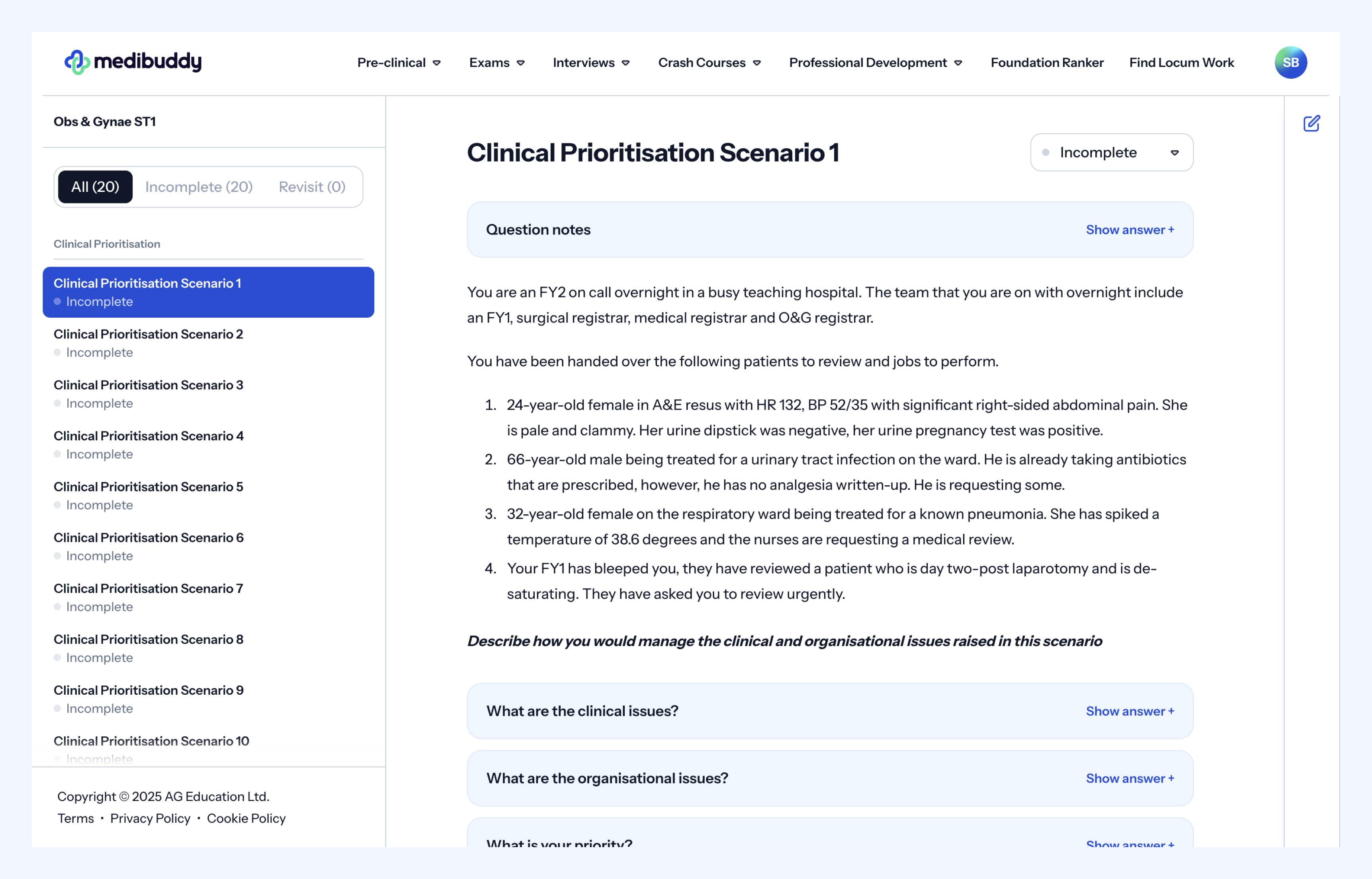 After you've worked through the clinical scenarios a few times you may be lulled into a false sense of security, "Well I know how to treat a blood transfusion reaction." It is important to stress that this station is not only assessing your knowledge but your ability to communicate it under pressure. Always practise these questions out loud, and practice documenting the patient information within a time limit.
Hints and Tips for the Structured Interview StationThe structured interview station lasts approximately 9 minutes. There will be two interviewers who will ask you questions and one panel member who won't speak. This station involved a very quick-fire set of questions that you must be ready to answer. There is limited time to pause and think so having several weeks of practice behind you will allow you to keep the pace of the interview. Due to the short amount of time and the volume of questions the interviewers have to get through, it can feel like they are cutting you off or not reacting to what you are saying - don't let this rattle you. If the interviewers move on to the next question, they are likely happy with what you have said and want to hear your answer to the next question which may be assessing a different key attribute. The structured interview station includes core topics:
 When considering "commitment to speciality" utilise experiences you've had within the speciality to answer the questions. If you've done an FY2 rotation, been a clinical fellow for a year or had a taster week - explain why this made you want to be an O&G trainee. The answer to "Why obstetrics and gynaecology?" will be different for everyone; but you know the question is coming so make it brief, make it slick, and make it sound great as your first soundbite to kick off the interview.
If you can talk about a personalised experience you've had this can project a very genuine decision - "During my FY2 rotation, I was drawn to not only the complex surgeries but also the psychological support women needed during the investigation of chronic pelvic pain. Historically I know the problems women have had when presenting with undefined pain and I want to be part of a speciality that supports these patients."
Spend a significant amount of time on the RCOG website to ensure you have a detailed understanding of the O&G training pathway and curriculum. How many years long is training? When can you sub-specialise? What is an ASTM? What portfolio requirements will you have as an ST1? When do you have to sit MRCOG?
It is also important to have a realistic understanding of the speciality. It comes across as a more carefully thought-out and motivated decision if you can reflect on the less fantastic parts of being an Obstetrics and Gynaecology trainee. Consider what you're least looking forward to about being a trainee and how you might get support for this. Consider the negatives of Obstetrics and Gynaecology as a speciality; high rates of litigation, high rates of trainee drop-outs, the emotional impact of maternal/ fetal deaths, several significant recent publications about poor care in women's health departments, steady increase in the complexity of births, national midwifery staff shortages, reduced theatre opportunities in gynaecology so harder to gain competency before CCT. Reflect on these problems and be honest that you might not know how to deal with them now, but you'll seek guidance and support from your seniors and supervisors.
When considering "commitment to speciality" utilise experiences you've had within the speciality to answer the questions. If you've done an FY2 rotation, been a clinical fellow for a year or had a taster week - explain why this made you want to be an O&G trainee. The answer to "Why obstetrics and gynaecology?" will be different for everyone; but you know the question is coming so make it brief, make it slick, and make it sound great as your first soundbite to kick off the interview.
If you can talk about a personalised experience you've had this can project a very genuine decision - "During my FY2 rotation, I was drawn to not only the complex surgeries but also the psychological support women needed during the investigation of chronic pelvic pain. Historically I know the problems women have had when presenting with undefined pain and I want to be part of a speciality that supports these patients."
Spend a significant amount of time on the RCOG website to ensure you have a detailed understanding of the O&G training pathway and curriculum. How many years long is training? When can you sub-specialise? What is an ASTM? What portfolio requirements will you have as an ST1? When do you have to sit MRCOG?
It is also important to have a realistic understanding of the speciality. It comes across as a more carefully thought-out and motivated decision if you can reflect on the less fantastic parts of being an Obstetrics and Gynaecology trainee. Consider what you're least looking forward to about being a trainee and how you might get support for this. Consider the negatives of Obstetrics and Gynaecology as a speciality; high rates of litigation, high rates of trainee drop-outs, the emotional impact of maternal/ fetal deaths, several significant recent publications about poor care in women's health departments, steady increase in the complexity of births, national midwifery staff shortages, reduced theatre opportunities in gynaecology so harder to gain competency before CCT. Reflect on these problems and be honest that you might not know how to deal with them now, but you'll seek guidance and support from your seniors and supervisors.
How long should I take to prepare?This fully depends on your learning style and which aspects of the interview you might struggle with. It is up to you how many weeks you designate for each stage below: Stage One: Start gathering information after you have sat the MSRA in January. Make sure you understand the format of the interview. Start purchasing question banks to help you practise. Save/ print important information from the RCOG website about training. Read the MBRRACE-UK report. Stage Two A: Start writing answers to each question you may be asked - remembering that you do not get a lot of time per question so no paragraph answers. Try to avoid attempting to memorise your answers, this can cause you to falter under pressure if you forget exactly what you wanted to say. Sticking to bullet points which you can comfortably expand upon will take the onus off of perfectly reciting an answer. Stage Two B: Remind yourself of all the common clinical scenarios you may be asked about and how these are managed. If you've not had a rotation in O&G take some time reading about ectopics, PMB, endometritis, major haemorrhage etc. and the initial emergency management of these conditions. Stage Three: Practice, practice, practice. Practise with family, practice with friends, practice on Teams. Find an ST1 or ST2 who can help you - they have most recently, successfully been through this and can give you the most up-to-date help. Avoid practising with your best friend or mum unless you're sure they will give you honest feedback. Record yourself practising (I know it's uncomfortable to watch but it will help!). We hope you have found this blog useful and wish you the best of luck with your application.Further InformationOG ST1 - Day in the life of a trainee O&G ST1 Interview Format 2026 OG ST1 Interview Question Bank MSRA Complete Guide 2026 Mind The Bleep - Applying to Obstetrics and Gynaecology O&G ST3 Interview |
||||||||||||||||||||||||||||||||||||||||||||||||||||||||||||||||||||||||||||||||||||||||||||||||||||||||||||||||||||||||||||||||||||||||||||||||||||||||||||||||||||||||||||||||||||||||||||||||||||||||
Post ID: 3745 - Obs and Gynae ST1 Interview Format 2026The Obstetrics and Gynaecology ST1 interview format has changed over the last few years. Historically, deaneries would interview their own candidates locally, modifying the stations to fit with their preferences. Now, there is a national selection system (which is standard for other competitive run-through specialties like ophthalmology and radiology). Once you have completed your MSRA and been shortlisted for interview you’ll need to start preparing, and understanding the interview structure is the first step. In this blog, we outline the online format for 2026, which includes a new addition: a Communications question in Station 1. The Obs and Gynae ST1 Interview StationsThis year there are TWO stations, lasting approximately 30 minutes in total. You will be assessed and scored at each station by at least two Consultants. There is likely to be a layperson present too; it is their job to ensure that the interview process is conducted fairly to all candidates.Station 1. Clinical Prioritisation Station
Station 1. Ethical and governance question
Station 2. Structured Interview Station
|
||||||||||||||||||||||||||||||||||||||||||||||||||||||||||||||||||||||||||||||||||||||||||||||||||||||||||||||||||||||||||||||||||||||||||||||||||||||||||||||||||||||||||||||||||||||||||||||||||||||||
| Section | Raw Marks from Examiner |
|---|---|
| Clinical Prioritisation | 20 |
| Structured Interview | 20 |
| Ethical & Governance | 10 |
| Total Score | 50 |
Feedback
All candidates who attended an interview will receive assessor feedback generated from the digital scoring interview. You will be able to see your rank, as well as your MSRA score.Further Information
Where are the interviews held?
Since the COVID-19 pandemic, interviews are held online.Do I need to provide a portfolio?
No. This is no longer required and was removed prior to the 2016/2017 recruitment. This means that candidates need to interview well. Practice is everything!Do I need to sit the Part 1 MRCOG during my foundation training?
No. Passing the Part 1 MRCOG exam is not required for specialty application and it does not give you any extra points. It could, however, be used to demonstrate commitment to specialty.Is there anything else I need to do?
The Multi-Specialty Recruitment Assessment (MSRA) was introduced in 2017 and is an essential component of the recruitment process. The MSRA is a written situational judgement test that is now used across a multitude of specialities. The exam counts for 33.33% of the overall interview score and by scoring well in your MSRA, you could bypass interview and head straight to the offer stage. Therefore, it's essential that you perform well in the exam. The MSRA is not a difficult exam, but it is advisable to practise as much as possible before taking it. In fact, most applicants will begin preparing months in advance! We've designed our adaptive MSRA question bank to make preparing for the exam straightforward and effective. [msra_sales_panel] You can find out more information about the MSRA for the O&G ST1 interview here. Time is always short in interviews. The key is to try and plan what you would ideally like to get across to the examiners during each station. Hopefully, you have found this post useful and remember, you can also use our O&G ST1 Interview Question Bank to prepare for each individual station! Good luck!Try our other articles:
Obs & Gynae ST1 Interview Tips OG ST1 - Day in the life of a trainee Obs & Gynae ST1 Interview Preparation and Essential Reading MSRA Guide MSRA Question Bank Obs & Gynae ST3 InterviewPost ID: 3445 - How to Prepare for the 2026 Core Surgical Training (CST) Interview
Doing well in the Core Surgical Training (CST) interview is very achievable, provided you put in sufficient preparation and practice. Starting your CST application early leaves plenty of time to prepare for your MSRA, organise evidence for the portfolio station, and practise management and clinical scenarios for the interview. The template below is a basic outline of targets to set yourself when approaching CST interviews. We’ve also developed our Core Surgical Training Interview Question Bank and CST Knowledge Course to help you prepare for the big day!
FY1 year/ year before
This is the year to really maximise your portfolio in preparation for CST applications. Start by reading the scoring criteria in our portfolio section, and set realistic goals for what to achieve in the 12 months. Remember, CST applications open early into FY2 therefore, most of the high-scoring opportunities will come in FY1 year.Realistic CST portfolio goals for FY1 (more details in the portfolio section):
- Design, lead and implement change through a QI project (ideally surgically themed). The earlier you start this the better, as it will provide more opportunity to present at a conference (and gain the maximum grade!)
- Organise a teaching programme – there will be plenty of opportunities for teaching medical students on the wards.
- One poster/ oral presentation – if you ask around, there is more than likely an opportunity to get involved in a project that will lead to a presentation.
- Surgical Logbook – nearly every FY1 post will have a surgical rotation. This is the time to get into theatre and assist as much as possible. Build up the logbook, and you may even get the opportunity to carry out your own minor procedures
- Publish a chapter in a medical book
- Attend a teaching course – A Teach the Teacher Course should give you a grade D. You can complete the Medibuddy Teach the Teacher Course either live or on-demand, both of which are CPD-accredited and should count towards points in this domain. If you prefer an interactive learning environment, our live course is available in 1-day or 2-day formats, offering practical teaching experience and real-time feedback.
6 months to CST interview
When starting FY2, it is a good idea to begin building up your portfolio for interviews. Collect evidence from teaching and clinical activities, which can be entered into a professional and practical folder. Try to get this completed a few months prior to interviews taking place, as you do not want to be panicking over missing documents of evidence at this time. [ttt_sales] With 6 months to go, it is also a good idea to begin planning your preparation strategy. Identify resources you are going to use, study partners, and time you will set aside. Some suggested resources are below:- ISC Medical – Medical Interviews: A relatively detailed book with extensive guidance on how to answer questions using a structured format. It also has model answers on portfolio questions, motivation questions and up-to-date topics. It is a great resource for learning how to structure answers, however many of the questions/ answers are not relevant to CST interviews or updated regularly, so keep this in mind if you only plan to use this resource.
- Online Question Banks: Essential for revision purposes in order to bolster the number of clinical/ management cases encountered. The Medibuddy CST Interview Question Bank has been produced by high-scoring trainees and is updated every year with new questions and in response to interview feedback. We have over 40 unique scenarios, with interview questions attached, for you to practise. We recommend you practise out loud and even video yourself so you can see if you need to work on your delivery.
-
3-4 months to CST interview
Now comes the main preparation phase. Set yourself 1-2 hours of preparation per day, building up nearer to the interview. Remember, you’ll also prepare for your MSRA at this stage, so organisation and efficiency are key. One way of structuring this preparation has been detailed below, but it is by no means the only way to successfully prepare: - First 2 months: Familiarise yourself with the online question bank. Develop a broad idea of how to structure answers to each of the common questions, including examples from your own experience where appropriate. Read up on ATLS approach to trauma, along with common post-op clinical scenarios. Most of the theory should already be provided in model answers from the question bank.
- Final 2 months: Practise answering unseen questions with friends/ colleagues. Build an outline of your 3-minute answer to the presentation question. Become familiar with your portfolio, and how to navigate through it with ease, familiarising yourself with your achievements so you don’t forget any! To score highly, you will need to practise answering the common questions over and over again.
MSRA Exam
The MSRA exam contributes to 10% of your final selection score, while the portfolio station, and management and clinical station make up 45% each. With the number of total CST applicants surpassing 5300, scoring well in the MSRA is more crucial than ever. The exam is separated into the following two papers:Professional Dilemmas Paper
This is a Situational Judgement Test (SJT) with 50 scenarios relating to challenging professional dilemmas. An example question taken from our adaptive MSRA question bank can be seen below:
Clinical Problem Solving Paper
This includes 86 questions designed to assess your ability to apply clinical knowledge and make clinical decisions in the context of everyday practice. An example question from our MSRA question bank is shown below: [caption id="attachment_25389" align="alignnone" width="2130"] Clinical Problem Solving Question[/caption]
Our MSRA question bank dashboard (below) shows a full list of the topics you'll be assessed on within the exam.
[caption id="attachment_25391" align="alignnone" width="3040"] Medibuddy MSRA Question Bank Dashboard[/caption]
You can check out our MSRA Complete Guide 2025 for more information about the exam and how to prepare, as it is vital you do well.
We also have a whole host of resources dedicated to the MSRA exam here, including our adaptive MSRA question bank with over 4000 practice questions; we have you covered!
[msra_sales_panel]
Core Surgical Training Interview day
Interviews will take place between Monday 2 March to Wednesday 11 March 2026 using the Qpercom video platform. Make sure you test your microphone and camera well before your interview, to ensure everything works smoothly. Your time will be provided via Oriel. You should register for Qpercom when told to do so. On the day of your interview, you should join the call 5 minutes before your interview time, where you will wait in a virtual lobby.2026 CST Interview
The following is an overview of the key dates relating to the 2026 CST interview:| Stage | Date |
|---|---|
| Applications open | 23 October 2025 |
| Applications close | 20 November 2025 |
| Invitations to MSRA no later than | 15 December 2025 |
| MSRA exam window | 6—19 January 2026 |
| Invites to interview | 13 February 2026 |
| Interview window | 2—11 March 2026 |
| Initial offers released | 24 March 2026 |
Management and Clinical Station
For 2026, the CST interview features a combined Management and Clinical station lasting 15 minutes. During this station, you will face three questions designed to assess your ability to think on your feet, including:- 1 management scenario question: This will test your decision-making, problem-solving, and ability to apply frameworks such as SPIES, CAMP, or STAR in real-time.
- 2 clinical scenario questions: These typically focus on emergency or post-operative situations and assess your clinical judgement and prioritisation skills.
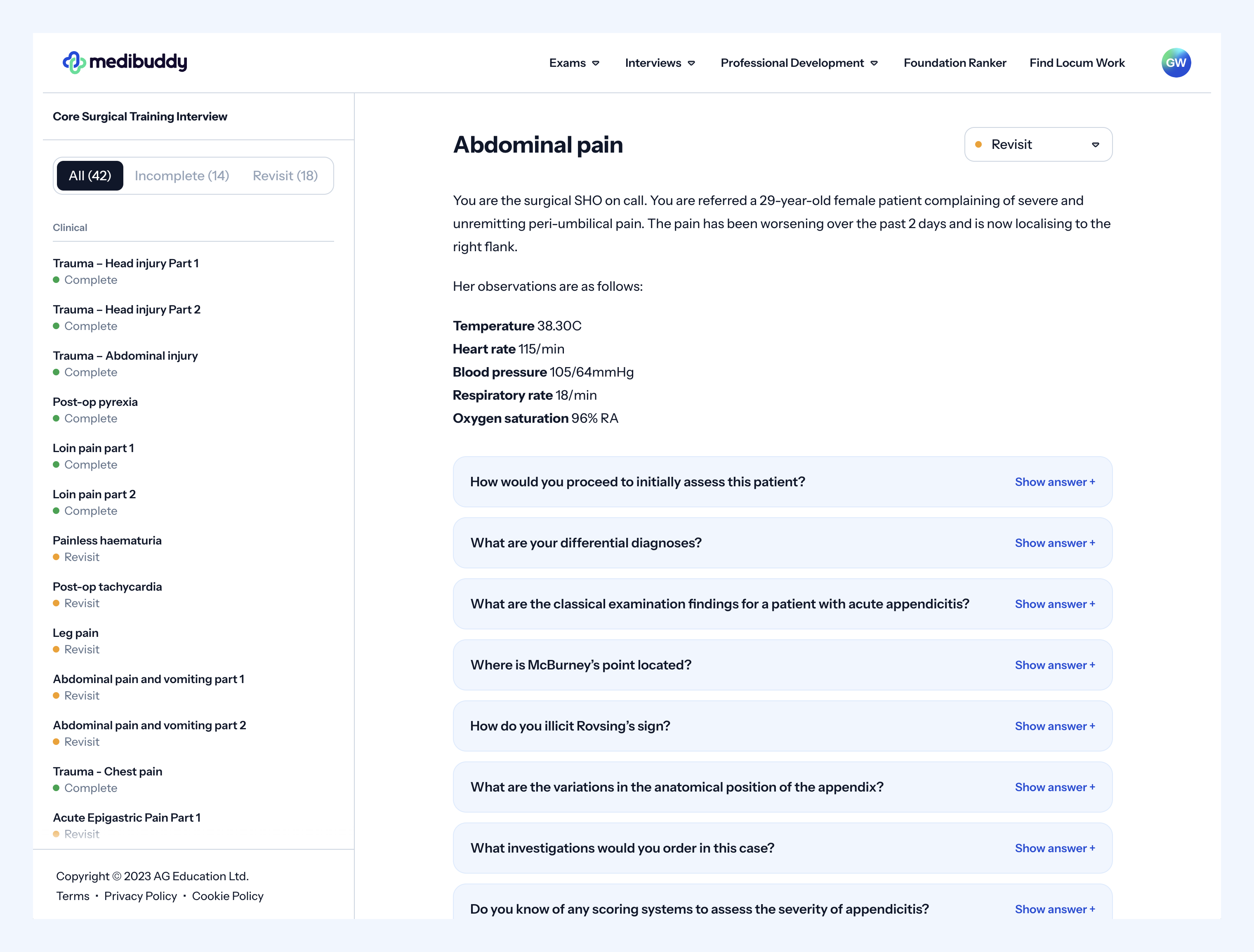
Portfolio Station
You’ll no longer need to complete a self-assessment on Oriel. Instead, if you’re invited to interview, you must upload an index page, indicating the category of evidence (A to E, with A being the highest) you believe applies to each domain. This serves as a guide for assessors, but the final score will be determined during the interview. The portfolio station is a 15-minute virtual interview. It begins with a 3-minute pre-prepared presentation, followed by 2 minutes of questioning on your presentation. You will then be asked two 5-minute questions based on portfolio domains selected by the assessors. Of course, you should ensure that all evidence is uploaded accurately and is a true reflection of your achievements. Our CST Knowledge Course is divided into 18 focused topics, offering nearly 10 hours of comprehensive material designed to enhance your surgical knowledge and interview preparation. You can even save £30 on the question bank when you purchase the knowledge course at the same time.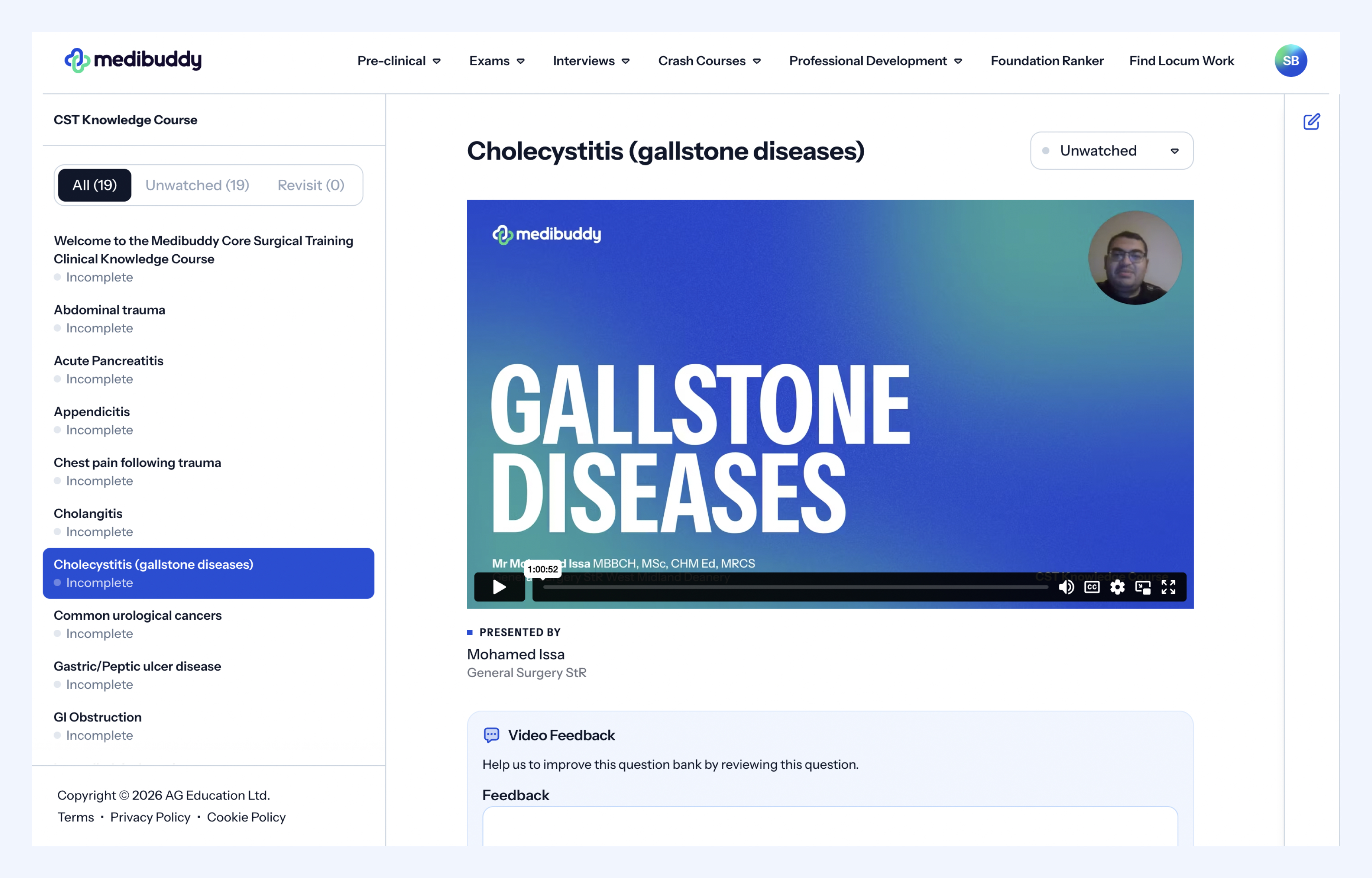 If you have any specific questions, please do get in touch. You can access our other interview resources in the Core Surgical Interview section of the website.
Good luck!
If you have any specific questions, please do get in touch. You can access our other interview resources in the Core Surgical Interview section of the website.
Good luck!
Further Reading
How to maximise points in the 2026 CST Interview Portfolio MSRA Complete Guide 2026 Mind The Bleep - Applying to Core Surgical Training Core Surgical Training Person Specification Teach the Teacher Course Live Teach the Teacher CoursePost ID: 3234 - UK Internal Medicine Training Interview Tips for 2026
Congratulations on applying for the UK Internal Medicine Training (IMT) Interview! You’ll soon start your interview preparation and we’ve written this post in combination with our IMT Interview Question Bank and IMT Knowledge Course to help you get the best score possible. Just making the decision to apply means you have started on the path to a career in clinical medicine. Take a moment and think about it. It’s scary but exciting. The rest of your career lies before you. With the application completed, your mind turns to the next hurdle, the interview, the most important point of the application process and the bit that needs practising. The interview is often the stage that applicants find most stressful. Understandably, there is pressure that comes from sitting in a room with three or four consultants asking you questions, but it shouldn’t be stressful. The most important thing to remember is that the people sitting on the other side from you want you to succeed. They are on your side. What they are asking isn’t difficult, but the stress of the situation can do funny things to your brain. Remind yourself of that when the bell goes and your time begins. Take two deep breaths and clear your mind. You’ve got this!
Key things to remember for the Internal Medicine Training Interview
Before we even think about the internal medicine interview and the different stages, remember a few simple rules. To sail through the interview, you need to do three things:- Be safe – the people interviewing you are consultants and the people you will be working for. They are looking for candidates they can trust to be on-call and look after their patients. They want to know that you can think under pressure and make decisions whilst not overreaching yourself. They want to see that you know your limits and understand when it’s the right time to call for help. The candidate who can answer all the questions but cannot recognise when they are out of their depth is not the doctor the consultant will want working for them!
- Be polite – in addition to being safe, the consultants want to find candidates that they would like to work with. Medicine is a team game and finding players that buy into that is important to your bosses. Being dressed appropriately, being courteous as you enter the room and thanking your interviewers as you leave are all important. Make sure you listen attentively and look the interviewer in the eye when answering. Looking at the floor or around the room certainly won't help you get the job!
- Be prepared – you know what is coming so don’t be surprised when you get there. Ensure you are ready on time so you don’t add extra stress to your day. Practising the sort of questions you will get will help you to feel comfortable with the style and layout of the interview and prepare you for that tricky question at the end. If you know what is coming, you can be calm and collected, and points one and two above will come naturally.
Key Dates for IMT
The deadline for your IMT application is at 4pm on Thursday 20 November 2025. If you are looking to apply for the next round, thinking about the interview, its layout and structure, are all important when putting together your application, as discussed in other posts, so start thinking about it from the beginning. Shortlisting for interviews is by Wednesday 17 December 2025, with invites to interview sent out by Thursday 18 December 2025. Remember to keep an eye on your email during this period, as once invites are sent out, it is down to each applicant to book their own slot. Interviews will be held from Monday 12 January to Friday 13 February 2026. The booking process is first-come-first-served, so doing this at the earliest opportunity will ensure you get a time and location that suits you, and remove another layer of unnecessary stress (particularly important if you already know that you are away for some of this period). Early booking will also mean you can warn your clinical team in advance of when you will be away. You should be able to take this leave as study leave if you are in a programme, and don’t forget to ask for a few days off before for interview preparation! Offers will then be sent on Tuesday 24 March 2026. The exact timeline for the 2026 application can be found here in our applying for IMT blog post.Preparing for your IMT Interview
As you're putting together your application, it's worth finding out who amongst your colleagues is also thinking about applying for IMT as they are going to be your best friends during your interview preparation. Practising together will let you rehearse your answers out loud. A good way to practice and help you understand where the interviewers are coming from is to examine someone else’s portfolio or application (now the portfolio is a virtual self assessment) and then ask them questions about it. A simple way to prepare for the interview is to record yourself speaking your answers out loud and watching them back. No one else is going to see, so don’t be embarrassed. It will definitely make you feel more comfortable on the day as your mind and body will know you’ve done it before. Spend time using interview question banks to identify areas of your knowledge that need a little more work. The Medibuddy IMT question bank includes scenarios written by previously high scoring IMT trainees covering all parts of the syllabus, and will help you prepare for the style of questions that will come up. Here is an example of a clinical scenario from our question bank.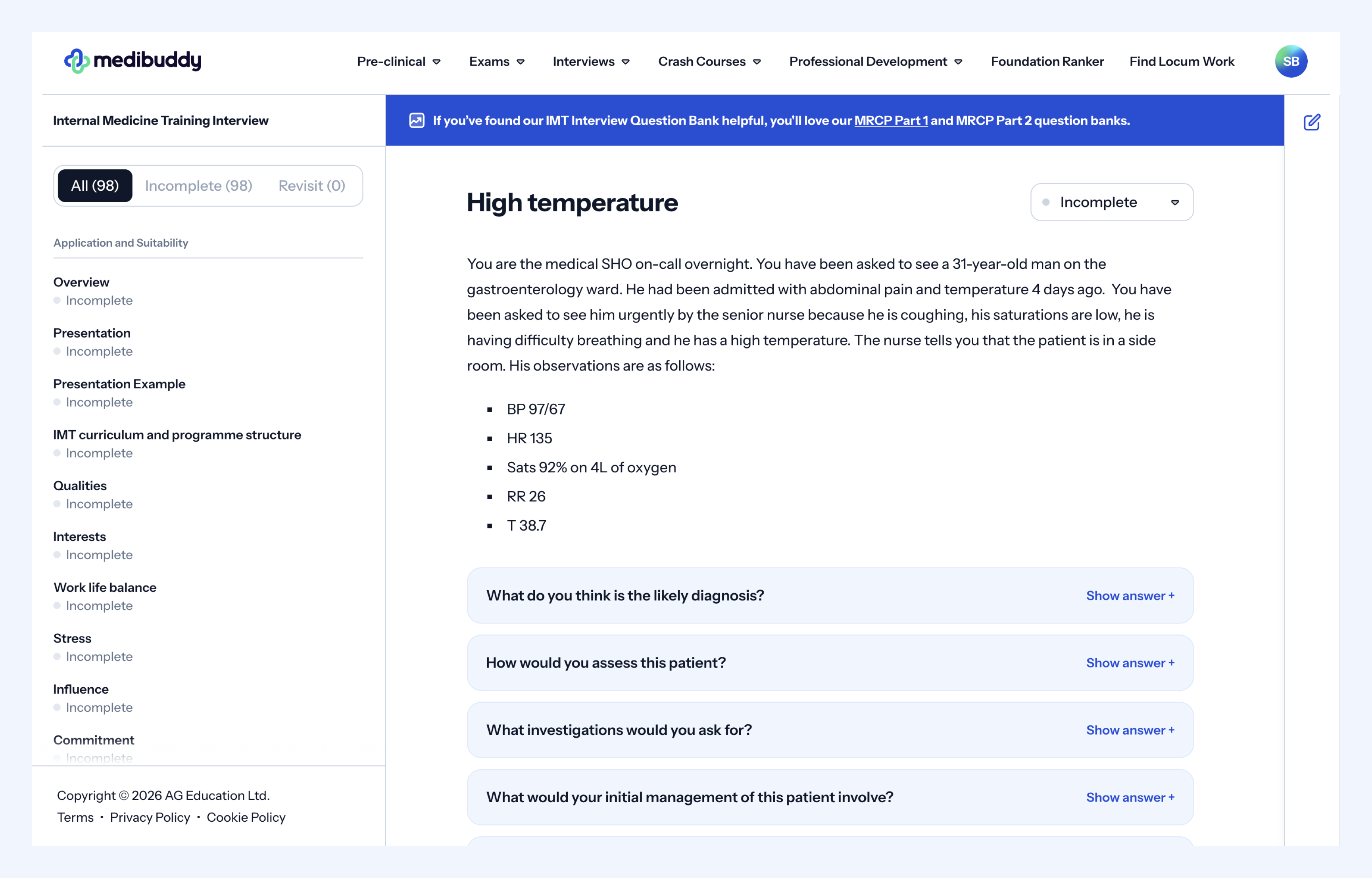 The 2026 interviews will be held online via Qpercom Recruit. Therefore, ensure you have a suitable place to undertake it from and have checked that your tech is up to the job. It is important for candidates to consider:
- Microphone and camera – make sure that you’ve checked that these are working in advance. This is certainly not something you want to be stressed about on the day. Consider the position of the camera – often it's better to use a webcam that can be positioned ahead of you, rather than a camera on your laptop, for example. Ultimately, find what works best for you so you can be seen and heard clearly.
- Internet connectivity – this goes without saying, you will need to make sure that you are somewhere with good internet connectivity.
- Background - be aware of your background and try to make sure your backdrop is clear. There are functions to blur your background, but it is definitely better to think about this in advance.
- Environment – you will need to be in a well-lit and quiet space. If there are others in the house, give them a heads up as to when your interview will be so there will be no interruptions!
The IMT Interview
The structure of the IMT interview has remained the same; however, as of the 2026 interview cycle, applicants will also be evaluated on their communication skills in Station 1. There will still be three main question areas, but these will be split across two stations, each lasting 11 minutes. The total interview time, including time between stations, will be around 30 minutes. You will be scored on the following 6 areas: Station 1:- Application and achievements
- Suitability for IMT
- Ethical, professionalism and governance scenario
- Communication mark
- Clinical scenario – Investigations/diagnosis/management
- Clinical scenario – Communication mark
- Clinical scenario – Handover
- Station 1, Question 1 – Application and suitability for IMT – 6 minutes: The first question is divided into two sections: presentation and questions.
- The presentation will last 2 minutes and you must discuss the following: "Give an overview of your achievements to date which are most relevant to your application to be a trainee in internal medicine".
- You only have 2 minutes, so use this time wisely. Prepare your presentation beforehand, breaking it down into headings and brief explanations of your achievements. Don't just list them, explain their relevance. Think about achievements that demonstrate transferrable skills useful for IMT.
- You will then be asked questions about your suitability for IMT. Review your application in case you are asked any questions about the information provided here.
- Station 1, Question 2 – Ethical, Professionalism and Governance Question – 5 minutes: You will be given this immediately following the clinical scenario (so no preparation time). It may be related to the previous scenario or may be completely separate. The interviewers will want to see you consider the moral, ethical or legal implications of the scenario given. Five minutes is not a long time, so this is not a deep dive into medical ethics. Be sure you know your stuff on issues an IMT trainee would be expected to deal with; for example, mental capacity, decisions relating to DNACPR, patient confidentiality, patient safety incidents and reporting (DATIX), conflicts/issues with colleagues and how to escalate appropriately, and familiarise yourself with the GMC's Good Medical Practice guide.
- Station 2, Question 1 – Clinical scenario and patient handover – 10 minutes + 1 minute: The scenario will be given to candidates after station 1, with an additional three minutes to review this, before up to 10 minutes for questions relating to it. The questions will focus on assessment, diagnosis and management, followed by communication and appropriate escalation questions. The scenario is likely to be short, with limited information. Candidates should use the time available to them to consider the salient points and, in most cases, start thinking about a list of differential diagnoses, as this will help shape the first part of the question. Candidates will then be given 1 minute to hand over the patient to a ‘colleague’ (played by one of the interviewers). Given that you know this will happen, it would be worth familiarising yourself with common handover techniques such as SBAR. With each clinical scenario you undertake on Medibuddy, finish with a timed 1-minute summary. You’ll soon have this part of the scenario well practised and have no problems come the interview. Two marks are available, one based on your investigations, diagnosis and management of the patient, and the second based on your ability to handover.
- Knowledgeable
- Team player
- Good communication
- Willingness
- Adaptable
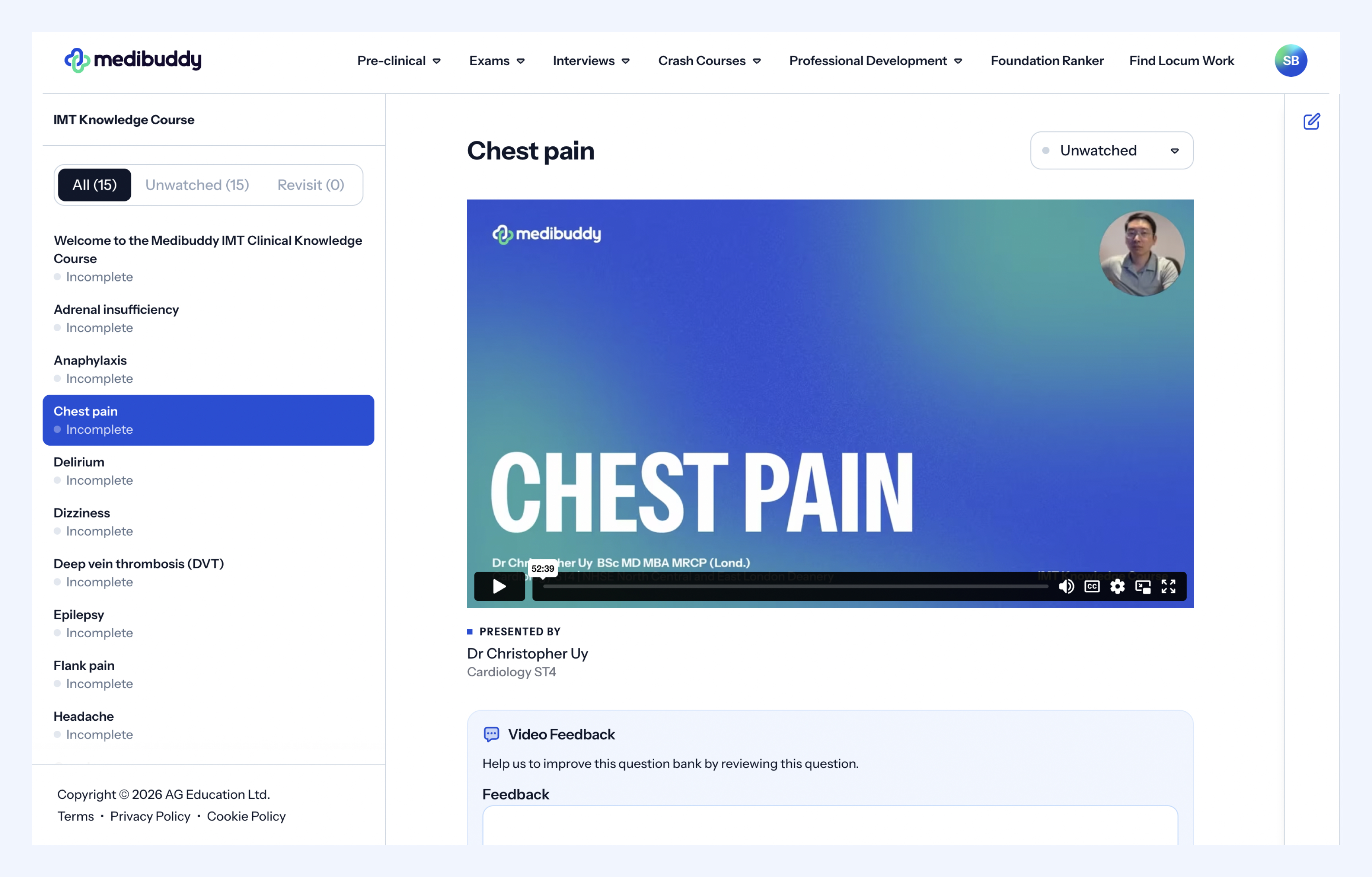
Timings
As you can see, there is not a lot of time to fit in a lot! The key, therefore, is not to panic. The interview is not a race. You likely have lots of things you would like to talk about, but the trick here is to talk up the most important elements that show why you’re a great fit to be an IMT trainee. Be selective! If you’re considering General Internal Medicine training in Ireland, the BST GIM interview lasts around 15 minutes and includes five questions. For the full breakdown, see our BST GIM Application and Interview Guide.Scoring for the IMT Interview
There are seven areas during the interview that are scored. You receive a score from each interviewer from 1-5, which means a maximum of 70 points are on offer. Once the scores are collated, a weighting is applied, which as you can see from the sections below, gives a greater emphasis on Station 1 – so it is worth keeping in mind that nailing these questions is just as important as the clinical scenario.| Interviewer 1 | Interviewer 2 | Weighting | Max Score | |
|---|---|---|---|---|
| Station 1, Question 1 | ||||
| Application and achievements | /5 | /5 | x1.6 | /16 |
| Suitability for IMT | /5 | /5 | x1.6 | /16 |
| Station 1, Question 2 | ||||
| Ethical, professionalism and governance | /5 | /5 | x1.2 | /12 |
| Station 1, Question 3 | ||||
| Communication mark | /5 | /5 | x1.6 | /16 |
| Station 2, Question 1 | ||||
| Clinical scenario – investigations / diagnosis / management | /5 | /5 | x1.2 | /12 |
| Clinical scenario – patient handover | /5 | /5 | x0.8 | /8 |
| Communication mark | /5 | /5 | x1.6 | /16 |
| Raw interview score | /70 | |||
| Interview score (w weighting) | /96 | |||
| Total Score | /96 | |||
Additional Tips for the IMT Interview
- Dress to impress. Your interview starts the moment you click on the link, so it's worth thinking about your appearance for this formal interview setting. Whilst you are not marked on what you are wearing, the interviewers will be looking for you to demonstrate professionalism, and this starts with what you are wearing.
- Be on time. The interviews run to strict times, enforced by the local administration team. This is due to the large number of applicants that need to be interviewed and the time that the interviewers are giving up. It is unlikely that if you are late and miss your slot they will be able to fit you in. Also, being late is likely to cause you considerable stress which will negate all the preparation you have done, so don’t chance it, give yourself plenty of time to be in place before the interview.
- Prepare all your additional documents the night before (if not days before). Don’t leave yourself with anything to do on the day of the interview itself. Unless requested otherwise, the only documentation you will need to bring is proof of your identity.
- Make sure you have considered your interview environment and the tech you will need to use. If in doubt, try practising this with a colleague and getting their feedback on it.
Post ID: 18413 - SJTs: A Complete Guide for the UKFPO
If you’re applying to the UK Foundation Programme (UKFPO) for 2026 entry, including the Specialised Foundation Programme (SFP) and Foundation Priority Programme (FFP), you’re no longer required to complete the Situational Judgement Test (SJT). This simple guide provides all the key information for applying, preparing and undertaking the SJT for 2023 UKFPO entry. For 2024 entry onwards, the UK Foundation Programme introduced a new Preference Informed Allocation (PIA), which removes the need to sit the SJT. You can find more information about the new PIA model which uses computer-generated ranking in our Foundation Job Ranking blog. This SJT blog is for reference only.
Do you need to take the MLA?
Our new MLA question bank, designed specifically to match the exam syllabus, can help!
The MLA syllabus differs from old-style medical finals or the PLAB.
Ensure that any question bank provider you use hasn’t just changed the name of their old question bank. Medicine is vast, and you may waste considerable time revising topics not in the MLA.
All providers should be able to give you a breakdown of exactly how their question bank matches the MLA content map. Find ours here.
UK Foundation Programme Application – SJT
The SJT is a vital element of your UKFPO application. To give you an idea of how it fits into your UKFPO application, the following is a brief overview of the process:- Complete your eligibility application form (if applicable)
- Register on Oriel
- Complete the national application form, including ranking your foundation school preferences (you can find more information in our Foundation Job Ranking Guide).
- Complete the SJT
- Rank the foundation jobs within your allocated foundation school in order of preference
FPAS calculator
EPM and SJT scores are combined to give every applicant a ranking. Your FPAS points – and subsequent ranking – determine how likely you are to be matched with your chosen foundation school and foundation job. Foundation schools and foundation jobs are allocated in rank order, with higher scoring FPAS applicants given priority. You can find out more about foundation school and foundation job allocation, as well as advice on how to rank your preferences, in our Foundation Job Ranking Guide. If you want to get an idea of the foundation schools and the types of UKFPO jobs that have been offered previously, visit our Foundation Job Ranker to view the 2023 options. There you’ll also find the 2024 jobs once they have been released by Oriel.Format of the SJT Test
The SJT consists of two exam sections, totalling 2 hours 20 minutes of exam time, with additional mandatory and optional sections to complete. The format of the SJT is as follows:| Section | Explanation | Time |
|---|---|---|
| A non-disclosure agreement (NDA) | Mandatory – you must complete the NDA before you can start the exam | Untimed |
| Tutorial | Optional – helps you to understand the basic functionality of the computer-based exam | 5 minutes |
| SJT section 1 | Typically 37 scenarios – 19 multiple choice and 18 rating scenarios – each with several related questions | 70 minutes |
| Comfort break | Optional | 10 minutes |
| SJT section 2 | Typically 38 ranking scenarios, each with several related questions | 70 minutes |
| Survey | Optional – allows you to give feedback if you wish | 10 minutes |
- Multiple choice – you’re required to select three answers from a possible eight, which when applied together, will address the situation given.
- Rating questions – you’ll be given five possible responses to the scenario, which you need to rank in order of importance or appropriateness.
- Ranking questions – you’ll be given between four and eight responses to the scenario, each of which you must individually rate (between 1–4) the importance or appropriateness of the response.
Registering for your SJT
For 2023 UKFPO entry, the SJT booking windows are as follows:| Applicant type | Dates |
|---|---|
| For applicants with approved reasonable adjustments | 3 – 7 October 2022 (12 midday BST) |
| For all applicants | 10 – 13 October 2022 (12 midday BST) |
When should I take my SJT?
Two-week testing windows for the SJT are offered twice per year (December and January). The UKFPO states that there is no advantage in taking the exam in either December or January; it is simply down to which testing window is more suitable for you. For 2023 UKFPO entry, the SJT testing windows are as follows:| Exam window | Dates |
|---|---|
| SJT window 1 | 7 – 20 December 2022 |
| SJT window 2 | 19 – 23 January 2023 |
What should I bring to my SJT?
The SJT is a computer-based test, delivered in Pearson VUE test centres or remotely (see below). For the exam, you’re required to take one form of original, valid government issued identification; you can find a list of accepted IDs here. You’re not permitted to take any form of notes into the exam, this includes having a notebook or paper, whether undertaking the exam in a test centre or remotely. You’ll be provided with a physical or online whiteboard for making notes, depending on where you complete the exam.How should I prepare for my SJT?
Although the scenarios are clinical based, the SJT is not designed to test your medical knowledge, rather it assesses the essential competencies outlined in the national Person Specification. The SJT focuses on the attributes needed to work as a doctor, including, among other things, the ability to:- Prioritise tasks
- Make decisions
- Work effectively with works
- Communication effectively with patients and colleagues
- Deal with pressure
SJT Practice
To get the most out of SJT practice questions, ensure that you pay close attention to the feedback / explanations, as these provide insight into the reasoning behind the answers given, and will help you to identify where you are potentially dropping marks. Likewise, you don’t want to miss marks for simply running out of time in the exam, so practice completing the number of questions in the allocated time. The UKFPO provides SJT practice questions here.Remote SJT
As mentioned previously, you have the option to take the SJT at a Pearson VUE test centre or remotely using OnVUE. If you choose to take the exam remotely, you’ll be monitored by an online invigilator throughout, and must meet strict guidelines. Therefore, it’s important that you read all guidance relating to OnVUE, to ensure that you can follow the guidelines. You can find out more here.How is the SJT scored?
As mentioned in the SJT format section above, the exam is made up of three different question types: multiple choice, rating questions and ranking questions. The following is an overview of the marks available for each:| Maximum marks available per response | Responses per scenario | Maximum marks available per scenario | |
|---|---|---|---|
| Multiple choice | 4 | Chose 3 of 8 | 12 |
| Rating questions | 4 | Rate between 4-8 | Up to 32 (depending on number of responses within each scenario) |
| Ranking questions | 4 | Rank 5 | 20 |
What is a good SJT score?
The UKFPO provides a breakdown of previous scores, including the average, maximum and minimum score per medical school, which you can access here (page 24). Currently, the data goes up to 2020, but you’ll find any updates on the UKFPO website here. You’ll see from the table that the maximum scores for all medical schools in 2020 was 44 or above. Of course, this will be combined with each applicant’s EPM score – which can range between 41 – 50 – and therefore could give a wider range of scores. However, a high score in the SJT will significantly help to boost your chances of ranking higher. As well as paying attention to the maximum scores and how this will potentially affect your ranking, it is worth noting that you can achieve what is classed as an ‘exceptionally low score’. If this happens, you’ll have an opportunity to attend a review. If you are successful at the review your application will be progressed, however, if you’re unsuccessful your application will be withdrawn from the process. The UKFPO provides more information about what happens if you get a low SJT score here, as well as figures from the exceptionally low scoring SJT reviews in 2020 here. The UK Foundation Programme Office (UKFPO) recently disclosed that there was an unintended early release of Situational Judgement Test (SJT) scores to applicants. This mistake occurred prior to the official release date. The UKFPO acknowledges that the SJT score carries a significant weight in an applicant's overall score for the Foundation Programme, and they would like to reassure all candidates that the early release of SJT scores will not impact their allocation to a Foundation School or programme. Eligible applicants can expect to receive information on their allocation to a Foundation School on March 9, 2023, as planned. The UKFPO guarantees that all eligible applicants receive a place on the UK Foundation Programme for the year 2023.How is my SJT score used?
As mentioned previously, your SJT and EPM scores are combined to give you a ranking. Foundation schools and foundation jobs are then allocated to applicants in rank order; meaning the higher you score the more likely you are to be given one of your top preferences for foundation school and foundation job. For more information and advice about foundation school and foundation job ranking, visit our Foundation Job Ranking Guide and our Foundation Job ranker, which does the hard work for you. Or, if it’s more information on the UKFPO you need, our UK Foundation Programme Office (UKFPO): Overview 2024 has you covered.Post ID: 18143 - Foundation Job Ranking: A Complete Guide
Ranking your foundation jobs can be a stressful and time consuming process. The choices that you make will determine where you spend the next two years and possibly even what area you specialise in. Add to that the huge task of actually ranking your choices in Oriel, and the whole experience can feel overwhelming, and frankly not what you need in your final year of medical school. This simple guide will break down everything you need to know about foundation job ranking and show you how to make the whole process easier and quicker with our FREE foundation job ranker. Please note: The UK Foundation Programme announced major changes to the Foundation Programme Allocation Process for 2024 onwards. This included the introduction of the new Preference Informed Allocation (PIA) model – which uses computer-generated ranking for applicants – and the removal of the Situational Judgement Test (SJT). This guide provides up-to-date information for the 2026 application process, including the PIA system.
Do you need to take the MLA?
Our new MLA question bank, designed specifically to match the exam syllabus, can help!
The MLA syllabus differs from old-style medical finals or the PLAB.
Ensure that any question bank provider you use hasn’t just changed the name of their old question bank. Medicine is vast, and you may waste considerable time revising topics not in the MLA.
All providers should be able to give you a breakdown of exactly how their question bank matches the MLA content map. Find ours here.
What is foundation year 1 (FY1)?
After completing your medical degree, you’ll undertake a two-year Foundation Training programme – foundation year 1 (FY1) and foundation year 2 (FY2) – your first paid role as a doctor. The foundation programme usually involves six different rotations – three in FY1 and three in FY2 – providing experience in different medical and surgical specialties. Following successful completion of FY1, you can apply for full registration with the GMC.How do I choose a foundation school?
Foundation schools are made up of a group of hospitals within a region. You can find a full list of the current foundation schools on the UK Foundation Programme website here. When completing your UK Foundation Programme application, you’ll first need to rank all of the foundation school geographical areas in order of preference. You’ll then be allocated a foundation school (see the section below for how this is done) from which to rank foundation jobs. To help you do this, you may want to consider the following:- The location – this may be the main / only deciding factor for you, particularly if you have commitments limiting your choice of locations or are quite set on the general location you’d like to be.
- The type of Hospital Trust – for example, will you experience inner-city or rural medicine?
- Competition – some areas are more popular than others, which may affect your decision.
- The number of posts – again, this may affect your decision as it can make some areas more competitive than others.
Which foundation school will I be allocated?
Once you have submitted your ranked preferences, you’ll be allocated a foundation school. Previously, this was based on your Foundation Programme Application System (FPAS) points – a combination of your Educational Performance Measure (EPM) and Situational Judgement Test (SJT) Score – which determined your ranking. Following the new Preference Informed Allocation (PIA) process introduced for 2024 entry, you will be given a computer-generated ranking, which is not informed by performance at medical school (as the EPM and SJT were). The Oriel system will then use an algorithm to work through all applicants in this computer-generated rank order. This will happen in two passes through the system:- As the algorithm works through in computer-generated rank order, it allocates as many applicants as possible to their first choice foundation school.
- Once this is done, any unplaced applicant will be worked through in rank order again, and assigned their highest preferenced foundation school with places available.
How do I rank my foundation jobs?
Once you’ve been allocated your foundation school, you’ll then need to rank the foundation jobs in order of preference. To help you do this, you may want to consider the following:- The location – your foundation school can cover a large area and multiple clinical settings. How important is the location to you? Are there areas you’d prefer or wish to avoid?
- The specialties – each job will usually provide details of 6 specialties that you’ll undertake. Are there specialties that are of particular interest to you? Or are there specialties which you’d prefer to avoid?
- The experience offered – the same specialty can offer a completely different experience from one setting to another. This is where GMC satisfaction scores can be a big help! Find out more in the section below.
- Your priorities – which of the above is most important: location, specialties or satisfaction scores?
How does the foundation job ranker work?
The Medibuddy FREE foundation job ranker automatically ranks all of the jobs within your given foundation school based on your preferences. You simply select the locations and specialties that you want / don’t want, and our foundation job ranker does all the hard work for you. If you opt for our premium ranker (for a small fee), you’ll also be provided with the GMC satisfaction ratings and the job competitiveness scores, so you can easily compare how highly rated and competitive each job is. You can find more information about the GMC satisfaction ratings and the competitiveness scores in their respective sections below. This option also allows you to export your ranked jobs as an excel document to make the process of ranking in Oriel even easier. The Medibuddy foundation job ranker makes the process quick and easy. In four simple steps you’ll have all of the jobs within your foundation school ordered to suit your preferences:- Simply drag each specialty into ‘like’, ‘indifferent’ or ‘dislike’
- Do the same with the locations – drag into ‘like’, ‘indifferent’ or ‘dislike’
- Choose what’s more important to you: specialty, location or no preference
- View your results – you can also make any small tweaks you’d like at this stage by manually reordering your list to suit you
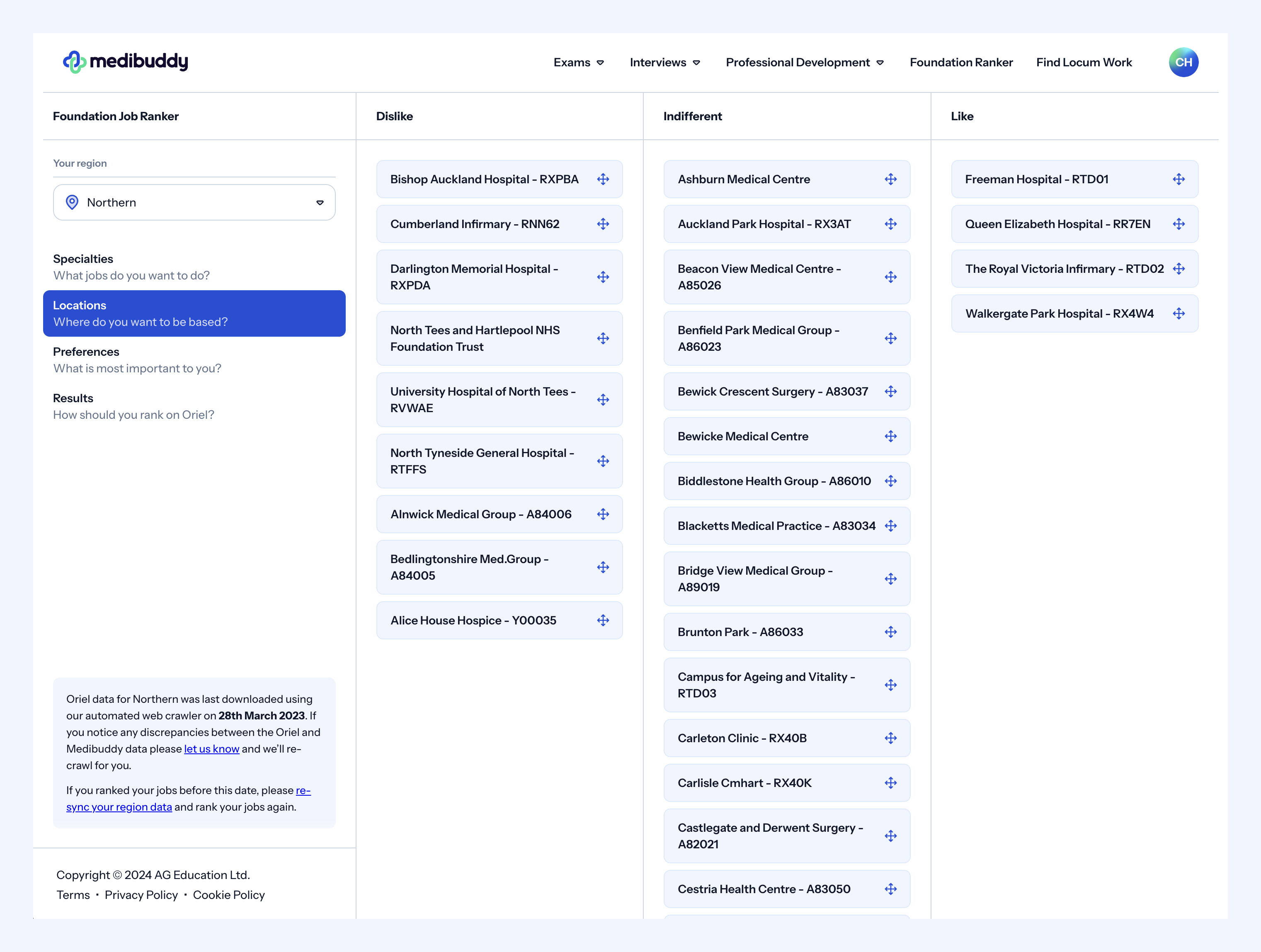 The foundation job ranker works by applying a score to each location and specialty based on your choices. Our system will then automatically cross-check each job with your selections and rank them based on an overall score. You can learn more about how the foundation job ranker works in our FAQs.
Where does the list of foundation jobs come from?
The list of foundation jobs comes directly from the Oriel website. We use a web crawler to download the information; this ensures that our job list is identical to Oriel and, in turn, makes it easier for you to take your ranked choices in our system and apply them straight into Oriel.How do you know how competitive each rotation was in 2025?
We understand that how competitive a job is will be an important factor in many people’s decision making, and therefore, we provide a competitiveness score based on our independent data. Each year our competitiveness score is calculated using data from the previous year’s ranking (making it as up-to-date as possible). We draw upon users’ selections to calculate a score for each job, consider how it compares to others within the same region, and weight each accordingly.What are the GMC satisfaction ratings and where do you get them from?
Each year, the GMC surveys all doctors in the country and asks them to rate their jobs, based on a number of factors, including teaching and workload. From this, they generate GMC satisfaction ratings for each job. This information is available on the GMC website.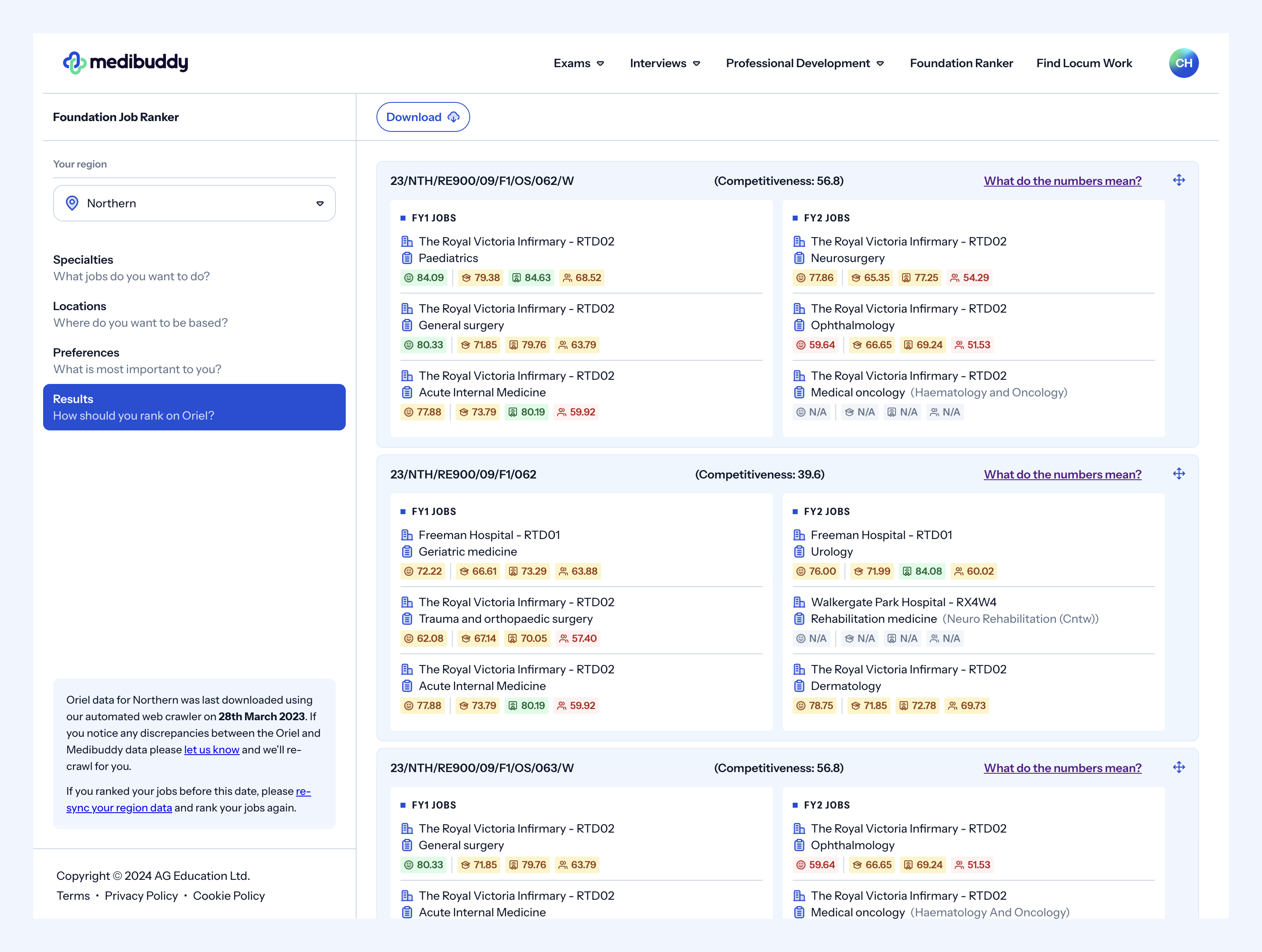
Do I need to rank all foundation jobs?
It is recommended that you rank all foundation jobs within your allocated foundation school. Although the new process aims to allocate as many applicants as possible their first choice job, if yours isn’t available, you’ll go back through the algorithm and be given your highest available preference, once all available first choices have been assigned. So, yes in an ideal world you will be allocated your first choice job, but really there is no guarantee that you’ll receive your first or even your tenth choice. This is why carefully ranking all of the jobs is beneficial. However, it can be difficult – not to mention time consuming – to carefully consider all the available jobs. With the Medibuddy foundation job ranker it doesn’t have to be!How do I rank programme preferences in Oriel?
Once the preferencing window is open, you can rank all available jobs in Oriel by visiting the ‘applications’ tab and opening your application form. You can also update them using the ‘preferences’ tab on Oriel. You will need to drag and drop each individual programme into the ‘preference’ column in order of preference. For more information about our foundation job ranker and how it can save you time and effort, whilst ensuring you effectively rank your preferred jobs, visit our Foundation Ranker FAQs. To learn more about the FP application process, including the UKFPO timeline and key dates, visit our UK Foundation Programme Office (UKFPO): Overview 2026.Post ID: 10263 - 4 Most Common Mistakes Made by MRCS Candidates
If you’re planning to undertake the Membership of the Royal College of Surgeons (MRCS) exam, and are concerned about the relatively low pass rate (for Part A in particular), the following will help you to avoid common mistakes made and ensure that your exam preparations are as effective as possible. You’ll also find guidance on planning your revision, prioritising key areas to enhance your performance and recommended textbooks to support your learning.
Exam structure
The MRCS assesses whether you have the relevant knowledge, skills, clinical competence and experience expected at the end of core surgical training and for entry onto specialty training (ST3). The exam consists of two parts:- MRCS Part A – a written paper
- MRCS Part B – an objective structured clinical examination (OSCE)
MRCS parts
The MRCS Part A – the written paper – is a five-hour multiple choice exam, comprising of two papers, completed on the same day (one AM and one PM). The two papers are as follows:- Paper 1 – applied basic sciences
- When: AM
- Duration: three hours – divided into two 90-minute sections with a 10-minute comfort break in between
- Number of questions: 180
- Paper 2 – principles of surgery in general
- When: PM
- Duration: two hours
- Number of questions: 120
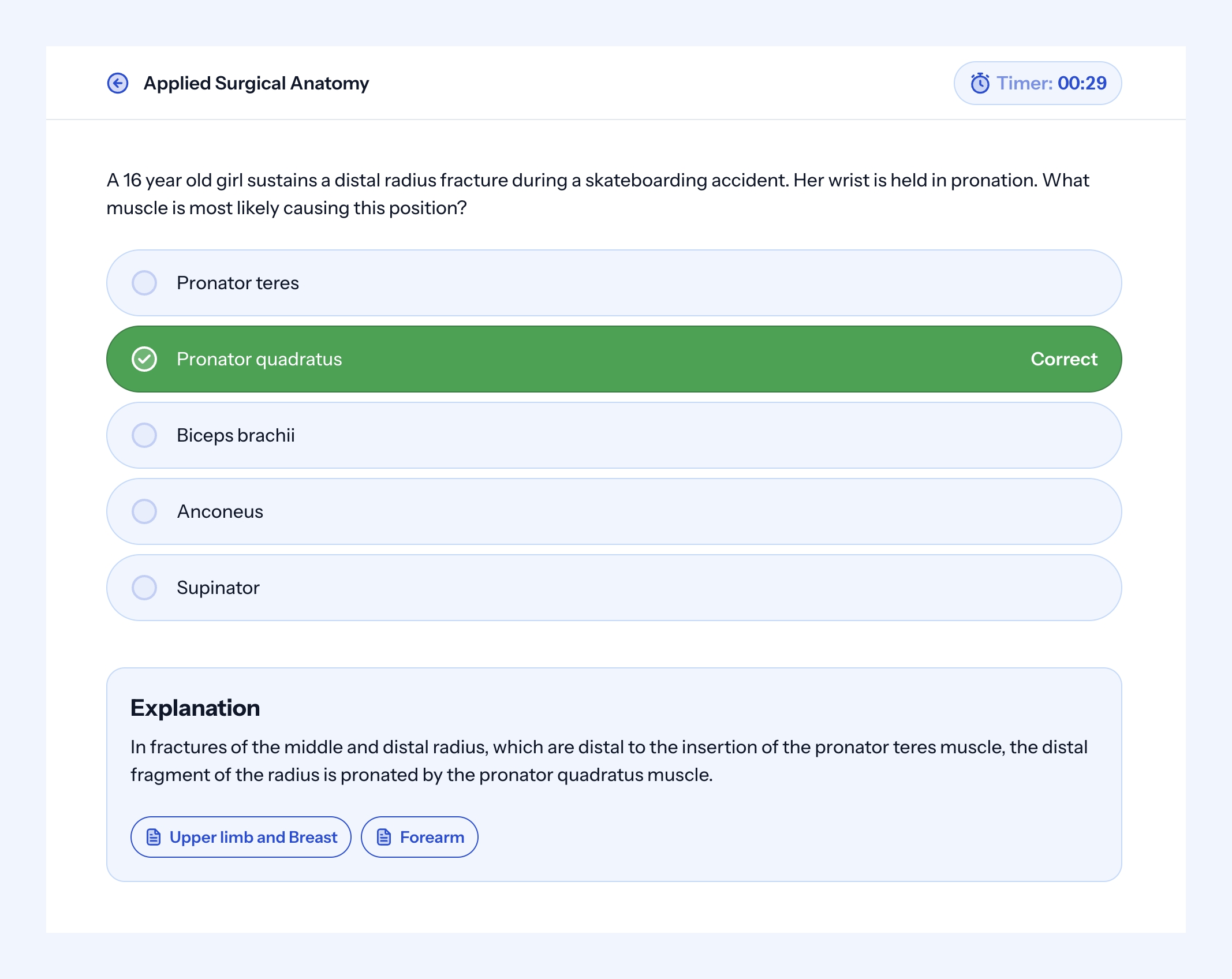 As well as thousands of professionally written MRCS Part A questions, you’ll also be given an answer explanation and further reading to support your revision, to help you prepare as effectively as possible.
The MRCS Part A assesses generic surgical sciences, applied knowledge and core knowledge required in all nine speciality areas; you can find more information about these and the syllabus for Part A in our MRCS Part A Complete Guide.
You must successfully complete the MRCS Part A before you can undertake Part B of the exam.
The MRCS Part B – the OSCE – consists of 17 examined stations, each lasting nine minutes.
The MRCS candidate guidance outlines that for each station, you’ll be given a ‘clearly defined task’, which may include ‘taking a focused history or clinical examination, interpreting an X-ray or performing a practical procedure in simulation’. Each station is marked out of a total of 20.
Part B assesses the following areas:
As well as thousands of professionally written MRCS Part A questions, you’ll also be given an answer explanation and further reading to support your revision, to help you prepare as effectively as possible.
The MRCS Part A assesses generic surgical sciences, applied knowledge and core knowledge required in all nine speciality areas; you can find more information about these and the syllabus for Part A in our MRCS Part A Complete Guide.
You must successfully complete the MRCS Part A before you can undertake Part B of the exam.
The MRCS Part B – the OSCE – consists of 17 examined stations, each lasting nine minutes.
The MRCS candidate guidance outlines that for each station, you’ll be given a ‘clearly defined task’, which may include ‘taking a focused history or clinical examination, interpreting an X-ray or performing a practical procedure in simulation’. Each station is marked out of a total of 20.
Part B assesses the following areas:
- Anatomy and surgical pathology
- Applied surgical science and critical care
- Clinical and procedural skills
- Communication skills
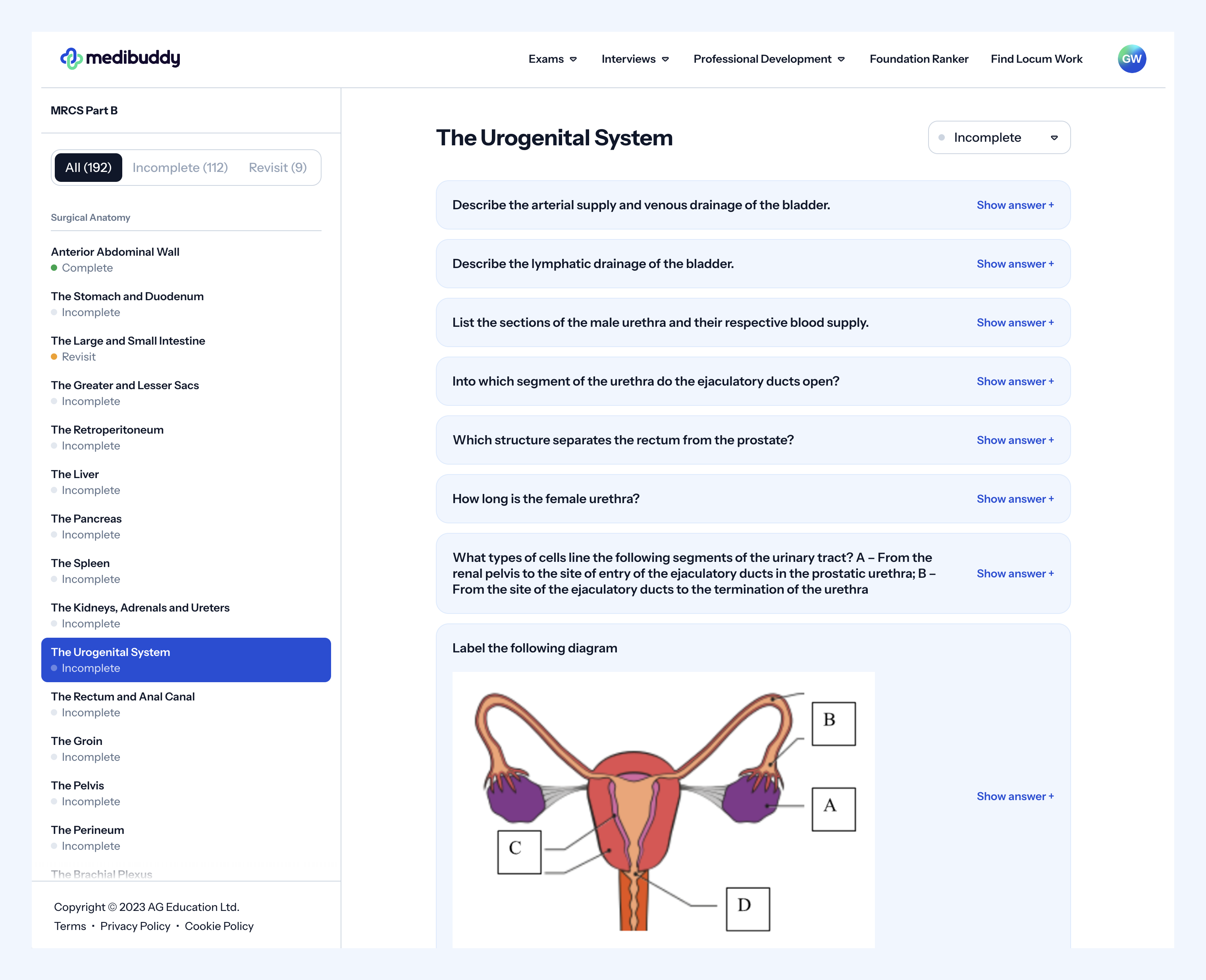 As with the MRCS Part A question bank, you’ll be given an answer explanation, and the option to read more about the topic and extend your learning further with the ‘Station Summary’. You’ll also see how many marks are awarded for each question.
A full breakdown of the topics covered and the number of questions for each can be found in the priorities section below. You can also find more information about the MRCS Part B, including exam dates, scoring and how to pass, in our MRCS Part B Complete Guide.
As with the MRCS Part A question bank, you’ll be given an answer explanation, and the option to read more about the topic and extend your learning further with the ‘Station Summary’. You’ll also see how many marks are awarded for each question.
A full breakdown of the topics covered and the number of questions for each can be found in the priorities section below. You can also find more information about the MRCS Part B, including exam dates, scoring and how to pass, in our MRCS Part B Complete Guide.
Top mistakes
It goes without saying that how you prepare for the MRCS will have a considerable impact on how you perform during the exam. Therefore, approaching your preparations in the most effective way is key. Here are a few simple mistakes which can be easily avoided when preparing for the exam:- An overreliance on one type of resource While all are valuable resources, focusing solely on either the recommended textbooks, syllabus content (see our MRCS Part A Complete Guide for more on this) or practice questions will leave you at a disadvantage. A mixture of all is essential. Textbooks and syllabus content will support you in developing your knowledge. MRCS Part A and MRCS Part B practice questions will then allow you to apply this knowledge to the types of questions you’ll be given in the exam, which in turn will help you to discover any gaps in your knowledge or areas for improvement, that can be developed further with the use of recommended texts. You can find a full list of the MRCS recommended texts in the ‘reading’ section below.
- Not using practice questions effectively for MRCS Part A As mentioned above, completing practice questions is essential during your MRCS Part A preparations, and the more time you can dedicate to these, the better. However, to make the most of them, you should aim not only to complete practice questions but to use them to develop your understanding further, by identifying areas which you need to improve and reading around the subject more if required. Quality practice questions will also provide you with feedback so you can learn from your mistakes. This is where our artificial intelligence powered, adaptive MRCS Part A question bank will help you. It uses state-of-the-art algorithms to identify your strengths and weaknesses, and tailors questions to this, to ensure that your revision is focused on the areas which you need to develop. This helps you to progress faster and make more effective use of your MRCS preparation time.
- Not managing time effectively during the MRCS Part A exam While this appears more about the exam itself, rather than your revision, how you prepare for the exam can support you with this. Practice mock tests are useful in your preparations, as they allow you to gain experience of the time pressure of the exam, as well as the stamina required to complete it (remember the MRCS Part A is made up of a 3-hour and 2-hour exam within the same day).
- Underestimating the communication skills in the MRCS Part B Communication skills make up a significant proportion of the assessment marks within the OSCE element of the exam (Part B). This offers an opportunity to pick up ‘easy’ marks if you can demonstrate these skills, so it’s worth ensuring that you don’t neglect these during your preparations. Simple actions such as practising with others, using your clinical time and reflecting on how you can improve your communication skills will enhance your preparations and help you to use communication skills to your advantage during the OSCE.
How to pass the MRCS
As mentioned previously, the pass rate for Part A of the MRCS is relatively low. The most recent figures published for exams in May 2025 showed only 55% of candidates passed. The proportion of candidates passing Part B of the MRCS is generally higher than the pass rate of Part A. The May 2025 exam saw 61% of candidates pass. You can find more information on how the standards are set and the pass marks agreed for the MRCS exams in the ‘results’ sections of our MRCS Part A and MRCS Part B complete guides. While the pass rate, particularly for Part A, may seem disheartening, remember that you can attempt the MRCS Part A six times and MRCS Part B four times. However, as each attempt comes at a price to you, financially and time-wise, the following sections will support you to prepare for the exam as effectively as possible to ensure your best chance at success. You can find further advice on preparing effectively in our MRCS Part A Preparation Blog. Through the following sections we’ll help you to consider the following:- Planning your revision
- How much revision time is needed for MRCS Part A and Part B
- When to book each exam
- Recommended reading
- Your revision priorities
Planning
Making a solid revision plan – and sticking to it – is invaluable for any exam preparation. However, considering the following will also help you to plan for and execute your MRCS preparations effectively:- Plan when you intend to take the exam – the ‘how much revision time’ and ‘when to book’ sections below will help you to plan when it may be the best time.
- Ensure that you have an understanding of the test format and what’s required of you first. You may find it useful to plan this into your revision time, preferably before commencing any reading or practice questions, so that you can tackle these more efficiently.
- Likewise, explore what content is covered and what resources will support your preparations; this will help you to plan your revision time. The reading list below will give you an idea of resources, and you can find more guidance in our MRCS Part A and MRCS Part B complete guides.
How much revision time
The length of time required to prepare for the MRCS will depend largely on how much time you can dedicate to your revision during this period. For the MRCS Part A, candidates generally find that at least three months is required to prepare thoroughly, and that includes a packed revision timetable. However, if you have less time to regularly revise, you’re more likely to need in the region of six to twelve months. For MRCS Part B, approximately three months should be sufficient time, but again, this will depend on how much time you can dedicate to it. Our MRCS Part A and MRCS Part B question banks offer different subscription options so you can choose the plan that is right for you and how much time you have to revise. [mrcs_combined_sales_panel] This is where the timing of your exam can make a huge difference; if this is planned for the best time in your schedule, it’ll allow you to dedicate more time to your revision, reduce the length of preparation time you need and have a positive effect on how well you can prepare overall. Consider which placement you will (hopefully) have the most time to revise and prepare for the MRCS during; booking your exam for just after this will ensure that you give yourself the best possible chance to prepare as efficiently as possible.When to book
The MRCS candidate guidance recommends that you undertake Part A in Specialty/Core Training Year 1 (ST/CT1) and Part B in Specialty/Core Training Year 2 (ST/CT2). However, provided you meet the eligibility criteria, you can take the MRCS earlier, but bear in mind this may put you at a disadvantage if you have not had any surgical rotations. Part A and Part B MRCS exams are held three times per year – for Part A, these are in January, May and September – with the deadline for applying always two to three months before the exam. Once you’ve decided when you’ll take the exam, booking it as soon as possible is recommended. Having a deadline to work towards may help you to get organised and increase your motivation to revise. It’ll also ensure that you don’t miss the deadline for applying and, therefore, the exam you wish to enter. If you live outside of the UK or Ireland, additional considerations, such as the need to travel or registration with the General Medical Council (GMC), may also be factors in when you decide to book your exam. Our MRCS for Overseas Doctors blog will provide you with all the information you need about the MRCS if you’re an international graduate.Reading
The MRCS candidate guidance provides the following list of recommended textbooks for preparing for the MRCS exam:Basic science textbooks
- Agur AMR, Dailey AF. Grant's Atlas of Anatomy, 12e. Lippincott, Williams & Wilkins, 2008.
- Netter FH. Atlas of Human Anatomy, 5th edn. Saunders, 2010.
- Sinnatamby CS. Last’s Anatomy: Regional and Applied, 12th edn. Churchill Livingstone, 2011.
- Barrett KE, Barman SM, Boitano S, Brooks HL. Ganong's Review of Medical Physiology, 23rd edn. McGraw-Hill, 2009.
- Kumar V, Abbas AK, Fausto N, Mitchell R. Robbins Basic Pathology, 8th edn. Saunders, 2007.
Clinical textbooks
- Garden OJ, Bradbury AW, Forsythe JLR, Parks RW. Principles and Practice of Surgery, 5th edn. Elsevier, 2007.
- Williams NS, Bulstrode CJK, O’Connell PR, eds. Bailey and Love's Short Practice of Surgery, 25th edn. Hodder Arnold, 2008.
Priorities
By looking at the breakdown of the exam topics and the number of questions for each, it’s easy to identify areas where you can pick up a considerable amount of marks if you’re well prepared, and therefore, reveal what you should prioritise when revising – particularly if one of the key areas is weaker. The MRCS candidate guidance provides a full breakdown of the topics covered in each exam and the number of questions relating to each. The following provides a summary of this:MRCS Part A, Paper 1 – Applied Basic Sciences (180 Questions)
- Applied Surgical Anatomy – 75 questions
- The majority of these are regional anatomy (63 questions)
- Applied Surgical Physiology – 45 questions
- 15 of which are general physiological principles
- The rest are physiology of specific organ systems relevant to surgical practice – 5 questions per: cardiovascular, respiratory, gastrointestinal, urinary, endocrine and neurological
- Applied Surgical Pathology – 37 questions
- 20 questions relating to the pathology of specific organ systems relevant to surgical care (2 per system)
- Pharmacology as applied to surgical practice – 8 questions
- Microbiology as applied to surgical practice – 7 questions
- Imaging – 5 questions
- Data interpretation and audit – 3 questions
MRCS Part A, Paper 2 – Principles of Surgery in General (120 Questions)
- Common congenital and acquired surgical conditions – 45 questions
- Total of 12 conditions, with varying number of questions for each, including gastrointestinal disease and orthopaedic conditions
- Perioperative management – 35 questions
- Questions spread across 8 sections, including preoperative assessment and management, postoperative care and intraoperative care
- Assessment and management of patients with trauma – 30 questions
- Questions spread across 6 sections, including organ-specific trauma and fractures and dislocations
- Surgical care of children – 7 questions
- Medico-legal aspects of surgical practice – 3 questions
MRCS Part B (18 stations)
These stations are grouped into two broad categories – knowledge and skills – which are then broken down further as follows:- Knowledge – 8 stations
- Surgical anatomy – 3 stations
- Surgical pathology – 2 stations
- Applied surgical science and critical care stations – 1 generic critical care; 1 generic interpretation of written data; 1 generic interpretation of visual information
- Skills – 10 stations
- Communication skills – 4 stations:
- Generic history taking – 2 stations
- Generic giving information to a patient/relative – 1 station
- Generic giving information to another health professional – 1 station
- Clinical and procedural skills – 5 stations
- Communication skills – 4 stations:
Post ID: 9748 - MRCS for Overseas Doctors
If you gained your primary medical qualification outside of the UK and are considering completing the MRCS examination, our MRCS guide for overseas doctors will provide you with all the information you need, including guidance on the online application process, registration with the General Medical Council (GMC) following the exam and even comparison with PLAB and FRCS. GMC registration with a licence to practise medicine is essential for all doctors practising within the UK. Doctors who qualified outside of the UK must demonstrate that they have the relevant knowledge and skills to practise medicine within the UK, as part of the GMC’s registration process. Successful completion of the MRCS (Part A and Part B) is one method of providing this evidence and is open to all international medical graduates, provided that you meet the eligibility criteria (given below).
MRCS guidance
The MRCS consists of two separate exams: a written paper (Part A) and an objective structured clinical examination (OSCE) (Part B). You must pass Part A before you can apply to sit Part B. Both elements must be successfully completed before the postgraduate diploma and membership to one of the four Royal Colleges of Surgeons of Great Britain and Ireland can be granted.MRCS Part A – written paper
The MRCS Part A is a five-hour multiple-choice exam consisting of the following two papers:- Paper 1 – applied basic sciences
- When: AM
- Duration: three hours – divided into two 90-minute sections with a 10-minute comfort break in between
- Number of questions: 180
- Paper 2 – principles of surgery in general
- When: PM
- Duration: two hours
- Number of questions: 120
MRCS Part B – OSCE
The MRCS Part B is an objective structured clinical exam (OSCE) consisting of 17 examined stations, each lasting nine minutes. It assesses the following areas:- Anatomy and surgical pathology
- Applied surgical science and critical care
- Clinical and procedural skills
- Communication skills
MRCS online application
To be eligible for the MRCS exam, if you qualified outside of the UK or Ireland, you must hold a primary medical qualification which is accepted by the Councils of the colleges. The Intercollegiate MRCS Exam website provides further guidance on this and how to check if your medical qualification is acceptable. Your application for the MRCS must be made via the relevant individual Royal College of Surgeons’ website – either the Royal College of Physicians and Surgeons of Glasgow; the Royal College of Surgeons of Edinburgh; the Royal College of Surgeons of England; or the Royal College of Surgeons of Ireland – through which you want to take the exam. The MRCS is an intercollegiate exam, so you’ll take the same exam regardless of which college you choose to book with. The deadlines for applying for the upcoming MRCS Part A exams are listed in the section below, as well as information relating to the MRCS Part B exams.MRCS Part A dates and locations
The MRCS Part A exam is held three times per year, in January, April and September. The upcoming 2026 exam dates, application deadlines and fees for the MRCS Part A can be found in the table below:| MRCS Part A exam date | Application closing date | Exam fee |
|---|---|---|
| 21 January 2026 | 30 October 2025 | £625 |
| 22 April 2026 | 12 March 2026 | £625 |
| 9 September 2026 | 1 July 2026 | £625 |
MRCS Part B dates and locations
Examination dates and locations vary for MRCS Part B, depending on the Royal College you choose; you can find more information and book your exam on their individual websites (remember you can only do this after you have successfully passed Part A). The closing date for applying for the exam is usually approximately three months prior, as with Part A of the exam. The upcoming 2026 exam dates can be found in the table below:| Location | MRCS Part B exam window | Application deadline | Exam fee |
|---|---|---|---|
| Sheffield | 8 — 12 May 2026 | 19 March 2026 | £1,177 |
| London | 14 — 24 May 2026 | 19 March 2026 | £1,177 |
PLAB vs MRCS
As with the MRCS, passing the Professional and Linguistic Assessments Board (PLAB) exam can be used as evidence that you have the required knowledge and skills to practise medicine within the UK, and is an alternative route for applying for GMC registration. Whether you choose to undertake the PLAB or MRCS will not affect your GMC registration, but there are a number of factors that you may wish to consider when deciding.Both the PLAB and MRCS are sufficient for securing a job within the NHS (following successful registration with the GMC). However, MRCS is required for most surgical specialties and is a more appropriate route if you’re looking to undertake a specialist training post in surgery while working in the UK or more senior roles. You can find more information on surgical training in the relevant section below.The difference in cost may also be a consideration. At face value, the total cost of the PLAB exams is cheaper than MRCS; however, as PLAB 2 must be completed at the clinical assessment centre in Manchester (UK), and the MRCS Part B is limited in its examination locations, you may incur additional travel costs on top of the exam fees.Additionally, how much experience you have may be a deciding factor in which exam you opt for. You can take both the PLAB and MRCS immediately after graduating from medical school, provided you meet the eligibility criteria; however, the MRCS candidate guidance recommends that you undertake MRCS Part A in Specialty/Core Training Year 1 (ST/CT1), which is two years after graduation, and Part B in Specialty/Core Training Year 2 (ST/CT2). Therefore, more experience is preferable if considering the MRCS to ensure that you’re not at a disadvantage.Your aspirations for the role/route you’ll take whilst working in the NHS will possibly be the biggest consideration. However, factors such as cost and how much experience you have may also help you decide which is more suitable, PLAB or MRCS.To find out more about the PLAB, visit our PLAB Guide 2024 and PLAB Pathway / Route blogs, or the PLAB section of our website.FRCS vs MRCS
As with the PLAB or MRCS consideration, the choice whether to complete the Fellowship of the Royal College of Surgeons (FRCS) will depend on your role aspirations; however, your experience will also be a significant factor, as further training and experience is required to be eligible for the FRCS.Successful completion of the MRCS – in addition to meeting other requirements – is essential for entry onto specialty training (ST3 and beyond). Specialty training is the final stage of surgical training before obtaining your Certificate of Completion of Training (CCT), granting you entry to the Specialist Register and allowing you to practise as a substantive consultant surgeon in the NHS. Successful completion of the FRCS exam, however, is an essential requirement for the award of CCT. Surgeons are eligible to take the FRCS exam at the end of their surgical training. The Royal College of Surgeons of England confirms that, if you trained outside of the UK, it’s not necessary to complete the FRCS to work as a consultant within the NHS. However, you are required to gain entry to the specialist register, which can be achieved via the Certificate of Eligibility for Specialist Registration (CESR) route, and the FRCS may help you with this process.The following section has more information on the standard surgical training route.UK surgical training scheme
The following is the standard training route for surgery within the UK:- Medical school – 5-6 years
- Foundation training – 2 years
- Core surgical training (CT / ST) – 2 years
- Specialty training (ST3+) – approximately 6 years
- This is the point at which completion of the MRCS examination is required, in addition to other entry criteria.
- Following completion, you’ll be eligible to undertake the FRCS exam.
- Senior medical appointment
- At this point, you’re required to have attained CCT or CESR, before being added to the GMC’s specialist register and being eligible to apply for a consultant post or a fellowship for further, more specialised training.
Salary after MRCS in UK
After successfully completing the MRCS, your expected salary will depend on the role you secure. Passing the MRCS will provide you with a postgraduate diploma and allows you to apply for specialty training (ST3+), provided you also have the relevant experience; however, this is not guaranteed, particularly if you have no previous experience working for the NHS, and a more junior and/or non-training role may be more likely in the first instance.The BMA provides full details of the basic pay scales for junior doctors in training in England and is useful for comparing salary expectations for different grades within the NHS.GMC registration after MRCS
Once you have passed both parts of the MRCS, you can apply for GMC registration with a licence to practise medicine in the UK. Once the GMC has approved this, you can work as a doctor within the UK.For more information about the MRCS, including preparing for the exam, tips for revising and resources to use, visit our ‘MRCS Part A Complete Guide’, 'MRCS Part B Complete Guide' and '4 Most Common Mistakes Made by MRCS Candidates' blogs.Post ID: 20029 - MRCS Part A Preparation
If you’re preparing for the MRCS Part A exam, this guide offers essential information on the structure and syllabus, practical preparation tips, advice on choosing the right MRCS Part A question bank, and strategies to help you succeed in this critical surgical assessment. For information on applying, preparing and undertaking the MRCS Part B, visit our complete guide. You may have heard that Part A of the exam has a low pass rate. The most recent figures published for the exam in May 2025 showed only 55% of candidates passed. However, if you prepare well, you can realistically expect to pass the first time! And given the expense of the exam and the time it takes to prepare, this will undoubtedly be the goal.
Structure of MRCS Part A
The MRCS Part A is a five-hour multiple-choice exam. It consists of the following two papers which must be completed on the same day:| Paper 1 – applied basic sciences | Paper 2 – principles of surgery in general | |
|---|---|---|
| When | AM | PM |
| Duration | 3 hours (Two 90-minute sections with a 10-minute comfort break in between) | 2 hours |
| Number of questions | 180 | 120 |
How is the MRCS Part A syllabus broken down?
The MRCS Part A assesses your knowledge of applied basic science (paper 1) and principles of surgery in general (paper 2) to a level that would be expected of you, as a surgical trainee, two to three years after you’ve qualified. The MRCS Part A syllabus is separated into the following ten modules:- Basic science knowledge relevant to surgical practice
- Common surgical conditions
- Basic surgical skills
- The assessment and management of the surgical patient
- Perioperative care of the surgical patient
- Assessment and early treatment of the patient with trauma
- Surgical care of the paediatric patient
- Management of the dying patient
- Organ and tissue transplantation
- Professional behaviour and leadership skills
Paper 1 – Applied Basic Science
| Topic | Subtopic |
|---|---|
| Applied Surgical Anatomy (75 questions in total) | Regional Anatomy
63 questions, including:
|
Surgically related embryology and development
8 questions, including at least 1 of each of the following:
|
|
| Surface and imaging anatomy 4 questions, including at least 1 of head & neck. | |
| Applied Surgical Physiology (45 questions in total) | General physiological principles 15 questions |
The physiology of specific organ systems relevant to surgical practice
30 questions, including:
|
|
| Applied Surgical Pathology (37 questions in total) | General pathological principles 9 questions (from across the 7 subcategories) |
| Surgical immunology 2 questions | |
| Surgical haematology 2 questions | |
| Surgical clinical chemistry 2 questions | |
| Principles of neoplasia & oncology 2 questions | |
The pathology of specific organ systems relevant to surgical care, including congenital anomalies
20 questions, including:
|
|
| Pharmacology as applied to surgical practice (8 questions in total) | From any combination of subcategories as will produce 8 items |
| Microbiology as applied to surgical practice (7 questions in total) | From across the subcategories |
| Imaging (5 questions in total) | From across the subcategories |
| Data interpretation and audit (3 questions in total) | From across the subcategories |
Paper 2 – Principles of Surgery in General
| Topic | Subtopic | Number of questions |
|---|---|---|
| Common congenital and acquired surgical conditions (45 questions in total) | Gastrointestinal disease | 7 |
| Breast disease | 3 | |
| Vascular disease | 4 | |
| Cardiovascular & pulmonary disease | 4 | |
| Genitourinary disease | 4 | |
| Orthopaedic conditions | 7 | |
| Diseases of the skin, head & neck | 4 | |
| Neurology and neurosurgery | 2 | |
| Endocrine disease | 4 | |
| The lymphoreticular system | 2 | |
| Principles of cancer therapy and palliative care | 2 | |
| Acute emergencies | 2 | |
| Perioperative management (35 questions in total) | Preoperative assessment & management | 7 |
| Intraoperative care | 5 | |
| Perioperative care | 2 | |
| Postoperative care | 8 | |
| Nutritional management | 2 | |
| Haemostasis & blood products | 3 | |
| Coagulation, deep vein thrombosis & embolism | 3 | |
| Metabolic & endocrine disorders | 5 | |
| Assessment and management of patients with trauma (including the multiple injured patient) (30 questions in total) | General | 4 |
| Shock | 2 | |
| Wounds & soft tissue injuries | 4 | |
| Burns | 2 | |
| Fractures & dislocations | 8 | |
| Organ-specific trauma | 10 | |
| Surgical care of children | From across the subcategories | 7 |
| Medico-legal aspects of surgical practice | From across the subcategories | 3 |
How to prepare for MRCS Part A
As you’ll see from the syllabus breakdown above, an extensive list of topics is squeezed into the five-hour exam. To help you prepare for these, there are a range of resources that you can use, including:- The MRCS syllabus
- Recommended textbooks
- Practice questions
- Mock exams
MRCS question banks
An MRCS question bank will be one of the most valuable investments you can make for your exam preparation. A high quality question bank will give you access to well written practice questions, so you can become familiar with the types of questions you’ll be asked, practice applying your knowledge and receive feedback on your performance. It should also provide answer explanations that further your understanding of the topics so you can continue to learn and develop during your exam preparations. However, it can be difficult to know which question bank to choose. You may want to consider the following to help you find the best MRCS Part A question bank for you:- The cost of the question bank and if it’s good value – i.e. how many questions are included and how long is the subscription. Access to a wider range of practice questions will give you more opportunities to expand your knowledge and prepare more thoroughly for the MRCS Part A. Our adaptive MRCS Part A question bank has the following subscription options:
- The quality of the resource – are the questions and explanations providing opportunities to further your learning? For each question in the Medibuddy MRCS Part A question bank, you’ll be given a detailed explanation to help you understand what the correct answer is and why, as well as suggested further reading to enhance your understanding of the topic.
- The ability to track your progress – is feedback provided on how you’re performing, is it easy to see where you’re making progress and to identify areas that you need to improve? Our dashboard provides a clear breakdown of how you’re performing in each topic of the exam, so you can see which areas you’ve “mastered” and which you need to dedicate more revision time to, based on how much you’ve shown the algorithm that you know.
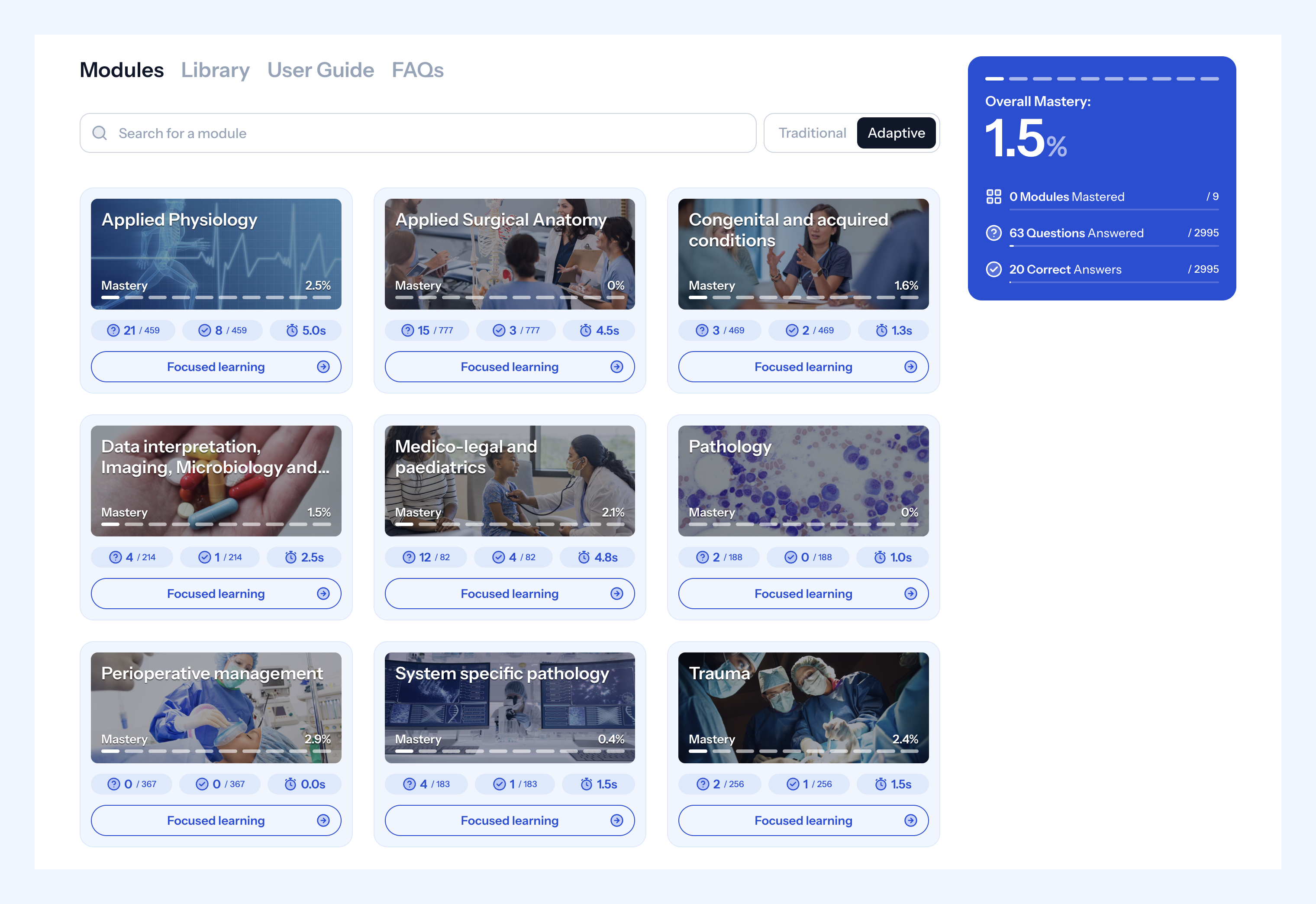
- Will the practice questions be personalised to your learning needs? Personalised learning is revolutionising medical education. Unlike traditional question banks, which treat everyone the same regardless of their abilities, a personalised question bank adapts to individual strengths and weaknesses. A question bank which includes this learning method will automatically identify the topics which you need to improve for the MRCS Part A and direct your learning to meet these needs, making your revision more purposeful and effective.
- Continually calculates your mastery level so you can always clearly see how you’re performing in each area and how you’re progressing through the question bank.
- Monitors your progress and identifies your strengths and your areas for development.
- Automatically adapts to your individual learning needs and ensures that you focus on the MRCS Part A topics that will impact your exam score the most.
- Gives you the right questions at the right time (rather than the same questions for everyone!), so your revision is targeted, and your time is used effectively.
MRCS Part A practice questions
Practice questions will undoubtedly be essential to your MRCS Part A preparation. But how do you know you’re getting the most out of your practice questions? To make the most productive use of your revision time, you might find it helpful to incorporate the following when completing practice questions:- Identify topics which you need to improve
- Complete background reading to develop your understanding of these topics
- Repeat questions that you’ve previously answered incorrectly and assess if you’ve now mastered these topics or if you still need to complete further reading
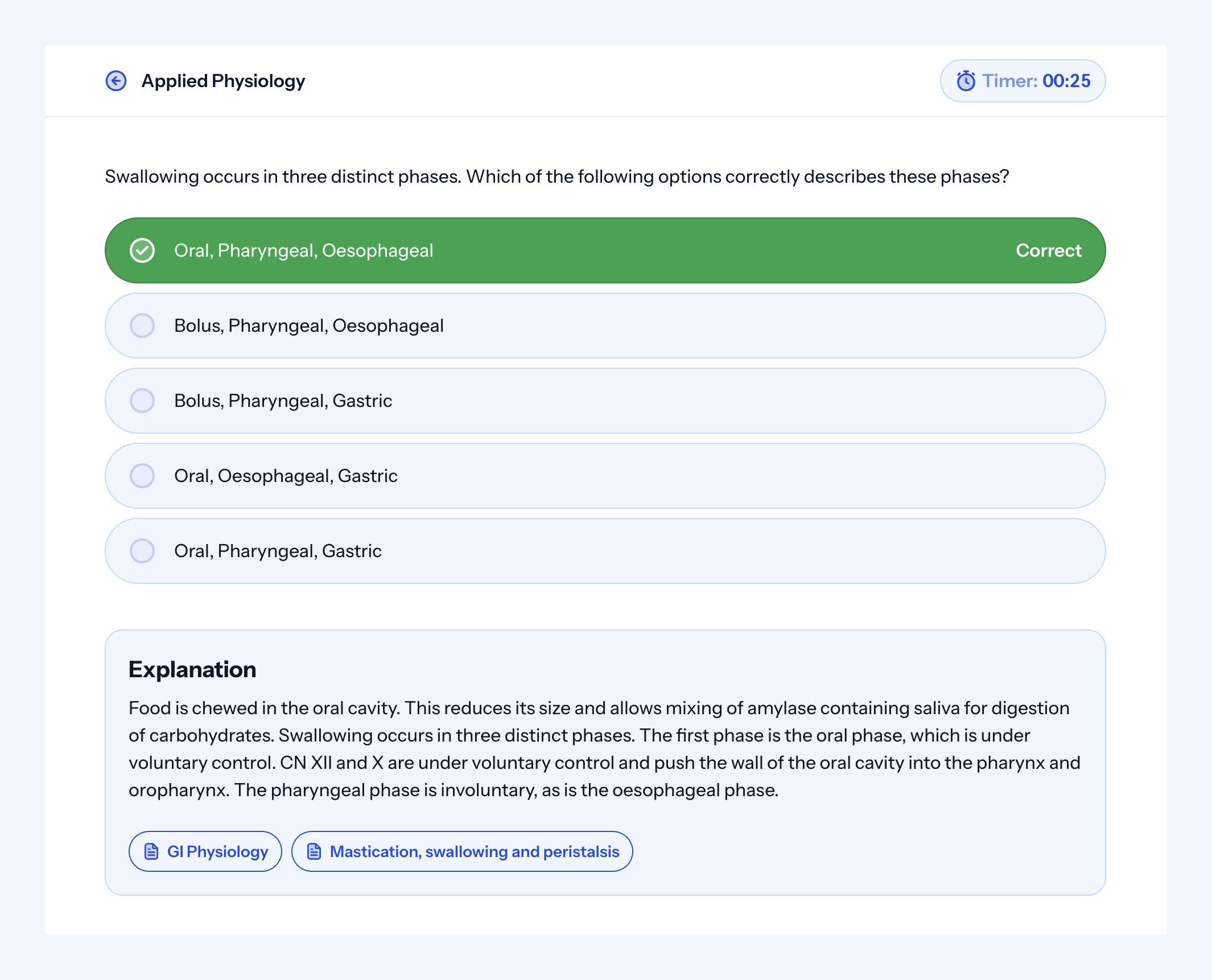 Question from the Medibuddy MRCS Part A question bank with answer explanation and further reading.[/caption]
[caption id="attachment_25382" align="alignnone" width="3040"]
Question from the Medibuddy MRCS Part A question bank with answer explanation and further reading.[/caption]
[caption id="attachment_25382" align="alignnone" width="3040"]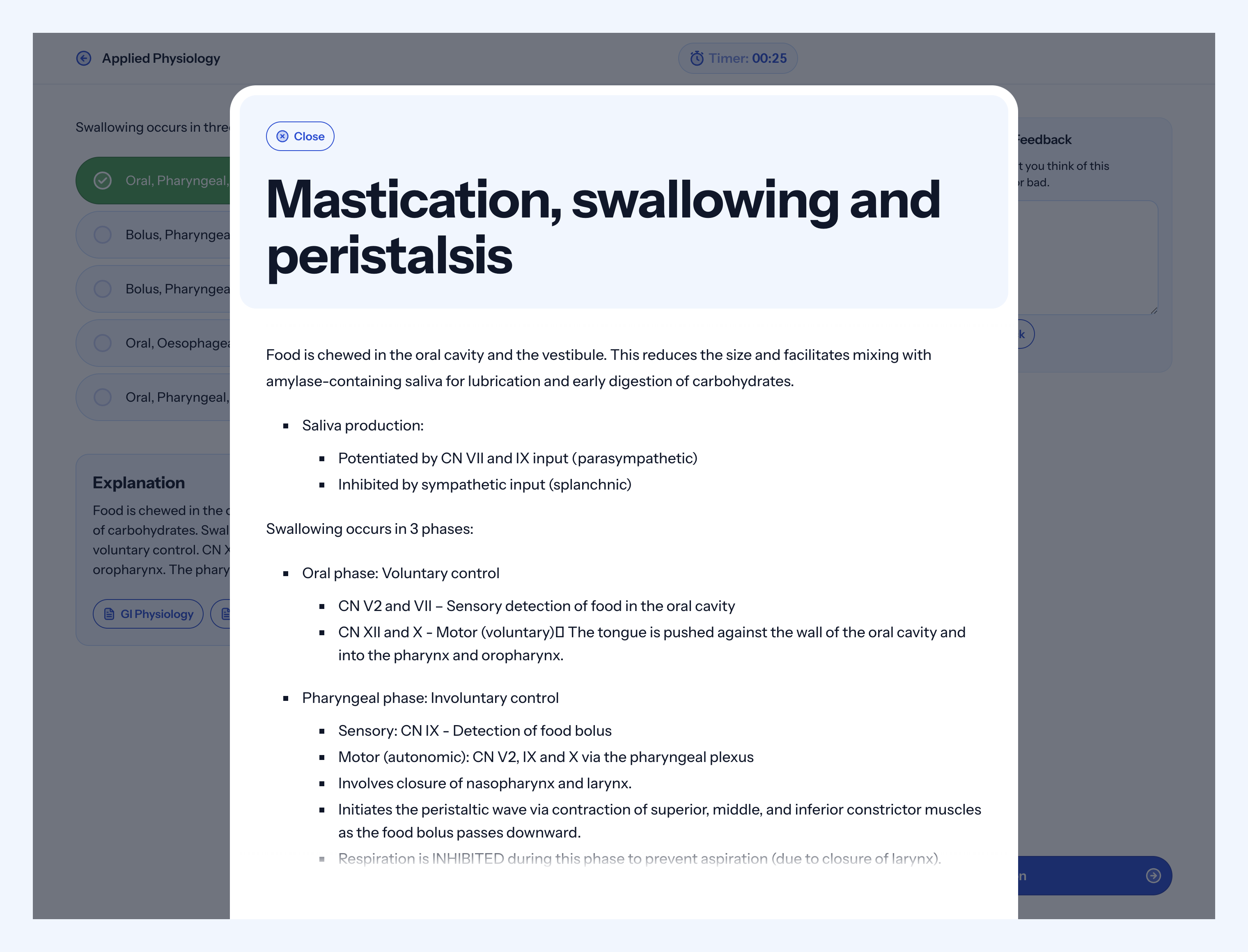 Example of further reading from the Medibuddy MRCS Part A question bank.[/caption]
For questions you’ve answered incorrectly, you’ll automatically revisit them later to ensure that they’ve been mastered, meaning you don’t need to think about manually going back through and repeating them. The dashboard also means it’s easy for you to track your progress and identify areas which you need to dedicate more revision time to.
Example of further reading from the Medibuddy MRCS Part A question bank.[/caption]
For questions you’ve answered incorrectly, you’ll automatically revisit them later to ensure that they’ve been mastered, meaning you don’t need to think about manually going back through and repeating them. The dashboard also means it’s easy for you to track your progress and identify areas which you need to dedicate more revision time to.
How to pass MRCS Part A
As mentioned previously, the MRCS Part A does have a low pass rate, which understandably concerns many candidates preparing for the exam. Focus your efforts on preparing well, using the MRCS syllabus, recommended reading list and high quality practice questions.How many questions should I answer to prepare for the MRCS Part A?
Unfortunately, there’s no set number of questions that will ensure you pass the MRCS Part A. Your knowledge and experience will differ from other candidates taking the exam, so there really is no benefit in comparing how many questions you answer. Rather, you should focus on the quality of your MRCS Part A preparation. Aim to incorporate a wide range of questions, so you have experience of different questions and topics, and don’t skim over answer explanations and further reading, which can be valuable learning opportunities. Factors such as when you take the exam will also play a key part in how well you perform in the MRCS Part A. For guidance on when is the best time to take the exam, and more tips to help you to revise effectively, visit our MRCS Part A Complete Guide. You’ll also find advice on how to avoid the most common mistakes made by MRCS candidates on our website, along with our adaptive MRCS Part A question bank to help you make the most of your preparation time. Good luck with your exam!Post ID: 14003 - MRCS Part B Complete Guide
The MRCS Part B exam is the second and final examination required to gain membership of the Royal College of Surgeons (MRCS). It assesses whether a surgical trainee has the correct knowledge, skills and attributes to progress beyond basic training to higher levels of specialist surgical training. The MRCS exam is made up of two parts. Part A is a written paper, while Part B is an Objective Structured Clinical Exam (OSCE). This complete guide will support you to prepare for the MRCS Part B. For more information and support preparing for Part A, there’s our MRCS Part A complete guide. Those who complete both parts of the MRCS exam are awarded the postgraduate diploma, which grants membership to one of the four Royal Colleges of Surgeons of Great Britain and Ireland. The awarding bodies of the MRCS are:
- The Royal College of Physicians and Surgeons of Glasgow
- The Royal College of Surgeons of Edinburgh
- The Royal College of Surgeons of England
- The Royal College of Surgeons of Ireland
| Cardiothoracic Surgery ST3 | Plastic Surgery ST3 |
| Emergency Medicine ST3 | Trauma & Orthopaedic Surgery ST3 |
| General Surgery ST3 | Thoracic Surgery ST4 |
| Oral & Maxillofacial ST3 | Urology ST3 |
| Otolaryngology ST3* | Vascular Surgery ST3 |
| Paediatric Surgery ST3 | |
Guidelines
MRCS Part B consists of 17 examined stations, each lasting 9 minutes. In total, the exam takes approximately 3.5 hours. An examiner overlooks every station, with some stations requiring two examiners, while others only need one. For stations with two examiners, each examiner will assess different aspects of your performance. The various stations will examine your knowledge and skills of the following topic areas:- Applied knowledge: anatomy, surgical pathology, applied surgical science and critical care.
- Applied skills: communication skills in giving and receiving information, history taking and clinical and procedural skills.
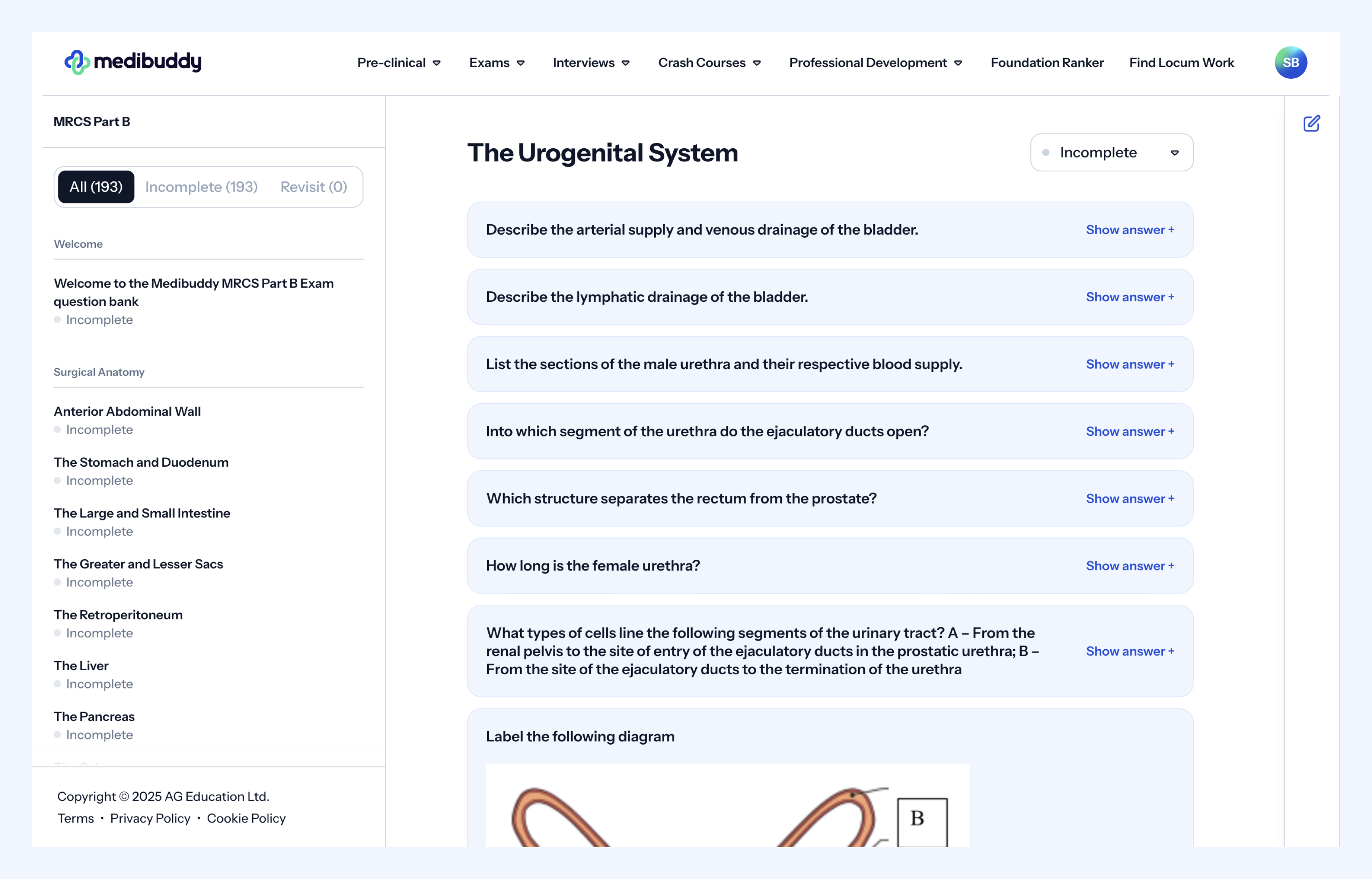 For each question, you’ll be given an answer explanation and the number of marks awarded. The ‘Station Summary’ provides the option to extend your learning further with more information about the topic.
Requirements for MRCS Part B
You must demonstrate an understanding of the four key content areas of anatomy, surgical pathology, applied surgical science and critical care. In addition to this, you will be required to show a range of applied skills across various topics. To successfully pass MRCS Part B, you must complete both the knowledge and skill components of the exam. You will have a maximum of four attempts to pass Part B of the MRCS exam. However, given the expense of the exam, you want to avoid resits where possible. Dedicating time to effective preparation can help you pass the MRCS Part B first time. [mrcs_part_b_sales_panel]MRCS Part B eligibility criteria
You must pass Part A of the MRCS before you can take Part B. To be eligible for the MRCS exam, you must have a medical degree that is deemed acceptable by either the UK General Medical Council (GMC) or the Medical Council in Ireland, so you can be fully, provisionally or temporarily registered. First time applicants not registered with the GMC or the Medical Council in Ireland must submit their original medical degree certificate or an authenticated copy to the councils of colleges. Our blog on MRCS for Overseas Doctors provides further information for those not in the UK. For further support in helping you find out whether you are an eligible candidate, you can check the intercollegiate MRCS exam website for more information.MRCS application
Applications for Part B of the MRCS can be submitted through each of the Royal College of Surgeons websites. In total, there are four colleges where you can complete an application. These are the Royal College of Physicians and Surgeons of Glasgow; the Royal College of Surgeons of Edinburgh; the Royal College of Surgeons of England; and the Royal College of Surgeons of Ireland.MRCS Part B Exam dates
MRCS Part B exam dates are held at different stages and locations throughout the year. The 2026 exam dates can be found in the table below:| Location | MRCS Part B exam window | Application deadline | Exam fee |
|---|---|---|---|
| Sheffield | 8 — 12 May 2026 | 19 March 2026 | £1,177 |
| London | 14 — 24 May 2026 | 19 March 2026 | £1,177 |
MRCS Part B results
Each individual station within the MRCS Part B is assessed in two ways:- Firstly, a structured mark sheet determines the award for each domain, while generic descriptors are used to identify and guide examiners in allocating the marks. There is a standardised distribution of marks across the broad content areas.
- In addition, an overall judgement is made on the candidate’s performance at the station as a whole, concluding in either a pass, borderline or fail.
MRCS Part B questions
The MRCS syllabus provides insight into the necessary knowledge and skills that are needed to pass the exam. For MRCS Part B, the individual stations are grouped into two separate content areas. Knowledge (8 stations)- 3 surgical anatomy stations
- 2 surgical pathology stations
- 3 applied surgical science and critical care stations
- 1 generic critical care
- 1 generic interpretation of written data
- 1 generic interpretation of visual information
- 4 communication skills stations
- 2 generic history taking
- 1 generic giving information to a patient/relative
- 1 generic giving information to another health professional
- 5 clinical and procedural skills stations
- 3 physical examination
- 2 generic skills
- The duties of a doctor registered with the GMC
- Knowledge, skills and performance
- Safety and quality
- Maintaining trust
How to Pass MRCS Part B
MRCS Part B revolves around the knowledge and skills of each candidate. Therefore, it’s vital that you know how to effectively demonstrate your skill set in front of the examiners. You can also pick up a significant amount of marks within the exam by displaying good communication skills. These skills can be improved by working with others and reflecting on how you can benefit by communicating effectively. There are many resources that can help you to prepare for MRCS Part B. These generally include the MRCS syllabus, textbooks, practice questions and mock exams. Using a mixture of these tools will mean you are likely to be well prepared, giving you a higher chance of passing MRCS Part B. The Medibuddy MRCS Part B question bank can help you to prepare effectively and maximise your performance to help you pass the exam first time! With questions and scenarios covering all aspects of the exam syllabus, mark schemes and ‘station summaries’ to aid your revision, you’ll find everything you need to prepare for the MRCS Part B.Resources
The MRCS syllabus is a useful resource for preparing to take both parts of the exam. Within the syllabus, there are several sections that provide helpful information, including a background and overview of the MRCS exams, as well as the recommended textbooks for revision. The syllabus also indicates the topics and skills that might be examined in the MRCS exams. The final section of the syllabus is dedicated to MRCS Part B sample questions. Going through a range of practice questions allows you to determine a response to each of the scenarios that you are likely to come across. The sample questions in the MRCS syllabus provide a great starting point for this, but you’re likely to need more practice questions to help you prepare fully, which is where a question bank, such as the Medibuddy MRCS Part B question bank, can help.MRCS Part B books
The Royal College of Surgeons website provides an extensive list of books that can help you prepare for the MRCS exams:- Grant’s Atlas of Anatomy (13th ed.)
- Ganong's review of medical physiology (25th ed.)
- Last’s Anatomy: Regional and Applied (12th ed.)
- Essential revision notes for Intercollegiate MRCS: book 1 (2006)
- Access to surgery: 500 single best answers in general & systemic physiology (2007)
- Surgical critical care for the MRCS OSCE (2015)
- Physical examination for surgeons: an aid to the MRCS OSCE (2015)
- SBA MCQs for the MRCS Part A (2013)
- MRCS Part A: 500 SBAs and EMQs (2013)
- Intercollegiate MRCS part A: SBAs and EMQs: mock papers with comprehensive answers (2013)
- Principles and Practice of Surgery (7th ed.)
- Robbins Basic Pathology (10th ed.)
- Gray's Basic Anatomy, (2nd ed.)
- Gray’s Atlas of Anatomy (2nd ed.)
- Gray’s Anatomy (2016)
- Netter’s Atlas of Human Anatomy (7th ed.)
- Last's Anatomy, (12th ed.)
- Guyton and Hall Textbook of Medical Physiology, (13th ed.)
- Netter’s Clinical Anatomy (4th ed.)
Is the MRCS Part B Exam Difficult?
The highest pass rate for MRCS Part B is 75%, which was recorded during the autumn 2020 exams. More candidates tend to pass Part B of the exam than Part A. However, you only get four attempts to complete Part B, whereas with Part A you get six opportunities. How difficult you find MRCS Part B will largely depend on how well you prepare. While knowledge is an integral component of MRCS Part B, using the right exam technique is crucial. Therefore, it’s important that you learn how to extract and present your knowledge in response to each exam question. Our blog covering common mistakes made by MRCS candidates – both in Part A and Part B – will help you to avoid errors and prepare as effectively as possible. And our professionally written MRCS Part B question bank will help you to get the most out of our exam preparation. For more preparation support and exam advice, check out the MRCS Part A and MRCS Part B sections of our website.Post ID: 9729 - MRCS Part A Complete Guide
The MRCS Part A is a written paper and forms the first part of the exam for the Membership Examination of the Royal Colleges of Surgeons (MRCS), which assesses whether surgical trainees have the knowledge, skills, clinical competence and experience expected at the end of their core surgical training. The second part is an Objective Structured Clinical Examination (OSCE) (Part B). This comprehensive guide provides everything you need to know about applying, preparing for and undertaking MRCS Part A. As well as allowing you to progress to higher levels of specialist surgical training, passing the MRCS (both Part A and Part B) and being awarded this postgraduate diploma grants membership to one of the four Royal Colleges of Surgeons of Great Britain and Ireland. These four Royal Colleges of Surgeons, and therefore awarding bodies of the MRCS, are:
- The Royal College of Physicians and Surgeons of Glasgow
- The Royal College of Surgeons of Edinburgh
- The Royal College of Surgeons of England
- The Royal College of Surgeons of Ireland
| Cardiothoracic Surgery ST3 | Plastic Surgery ST3 |
| Emergency Medicine ST3 | Trauma & Orthopaedic Surgery ST3 |
| General Surgery ST3 | Thoracic Surgery ST4 |
| Oral & Maxillofacial ST3 | Urology ST3 |
| Otolaryngology ST3* | Vascular Surgery ST3 |
| Paediatric Surgery ST3 | |
Guideline - MRCS Part A
Part A of the MRCS is a five-hour multiple choice exam, consisting of two papers, which must be completed on the same day (one AM and one PM). It assesses generic surgical sciences, applied knowledge and core knowledge required in all nine speciality areas (which can be found in the MRCS Part A questions section below).
This is an example of an MCQ from our MRCS Part A question bank. When you submit your answer, you will see if you have got it correct or incorrect, with an explanation and an option to learn more.
The two papers are as follows:
- Paper 1 – Applied Basic Sciences
- When: AM
- Duration: three hours – divided into two 90-minute sections with a 10-minute comfort break in between
- Number of questions: 180
- Paper 2 – Principles of Surgery in General
- When: PM
- Duration: two hours
- Number of questions: 120
Requirements for MRCS Part A
Candidates undertaking the MRCS Part A will be required to demonstrate ‘knowledge of both applied basic science and principles of surgery in general to a level that a surgical trainee should have achieved two to three years after qualification’. The focus, therefore, of the MRCS Part A is on assessing your knowledge and skills across a wide range of surgical conditions – not only the area of surgery in which you hope to train – to ensure that you have the core basic knowledge and skills which are essential for successful higher training. Note: MRCS only tests knowledge ‘at the level expected of all trainees completing core training irrespective of their chosen specialty’. More information about the MRCS syllabus and modules can be found in the MRCS Part A questions section below.MRCS eligibility criteria
To be eligible for the MRCS exam, you must hold a primary medical qualification which is accepted by the UK General Medical Council (GMC) for full or provisional registration or by the Medical Council in Ireland for full or temporary registration. Candidates who qualified outside of the UK or Ireland must hold a primary medical qualification which is accepted by the Councils of the colleges. International graduates can find further guidance on the MRCS in our ‘MRCS for Overseas Doctors’ blog. The Intercollegiate MRCS Exam website also provides further information on the eligibility requirements and how to check if your medical qualification is acceptable.MRCS application
Applications for the MRCS Part A exam should be made through the relevant individual Royal College of Surgeons’ website – either the Royal College of Physicians and Surgeons of Glasgow; the Royal College of Surgeons of Edinburgh; the Royal College of Surgeons of England; or the Royal College of Surgeons of Ireland. The deadlines for applying for the upcoming MRCS Part A exams are listed in the section below.MRCS Part A dates
The MRCS Part A exam is held three times per year, in January, April and September, simultaneously by each of the Royal Colleges of Surgeons. The 2026 exam dates, application deadlines and fees can be found in the table below:| MRCS Part A exam date | Application closing date | Exam fee |
|---|---|---|
| 21 January 2026 | 30 October 2025 | £625 |
| 22 April 2026 | 12 March 2026 | £625 |
| 9 September 2026 | 1 July 2026 | £625 |
MRCS Part A test locations
During the COVID-19 pandemic, the MRCS Part A was temporarily delivered online. Since May 2022, the exam has been offered at Pearson Vue test centres at various locations within the UK, Ireland and internationally.MRCS Part A results
The standard for the MRCS Part A exam is set using the ‘Angoff procedure’; you can find more information about what this entails on the Intercollegiate MRCS Exam website. This same process is used to set the standard for all MRCS Part A exams and ensures that the standard required to pass the exam is consistent for all. However, as each MRCS Part A exam is different, the pass mark for individual exams will vary each time. When you complete the MRCS Part A exam, your marks for both papers (Paper 1: applied basic science and Paper 2: principles of surgery in general) will be combined to give you a total mark for Part A of the assessment. Following the exam, you’ll receive a breakdown of your marks, but no further feedback is provided. The date you can access your MRCS Part A results will be specified on your MRCS exam documentation or provided when you complete the exam. Results will then be published on the individual Royal College of Surgeons’ website, through which you sat the exam, on the date given. Following this, you’ll also receive written confirmation of your results.MRCS Part A questions
To gain an understanding of the knowledge and skills assessed as part of the MRCS exam, you should familiarise yourself with the MRCS syllabus. The ‘competence based’ curriculum identifies the applied and theoretical knowledge and practical skills, and professional behaviours, you’ll be required to demonstrate within the MRCS exam. The syllabus is divided into the following ten modules, which you’ll be assessed on during the MRCS exam:- Module 1: basic science knowledge relevant to surgical practice
- Module 2: common surgical conditions
- Module 3: basic surgical skills
- Module 4: the assessment and management of the surgical patient
- Module 5: perioperative care of the surgical patient
- Module 6: assessment and early treatment of the patient with trauma
- Module 7: surgical care of the paediatric patient
- Module 8: management of the dying patient
- Module 9: organ and tissue transplantation
- Module 10: professional behaviour and leadership skills
MRCS Resources
Aside from the MRCS syllabus and the recommended reading list (see below), practice questions and mock exams will be one of the most valuable resources for preparing for the MRCS exam. Using a mixture of practice questions and mock exams will ensure that you’re familiar with the types of questions you’ll be asked, have the opportunity to develop your responses and grow accustomed to dealing with the time pressure and demands of a full MRCS exam. When it comes to choosing the most suitable resources for your revision, it’s important to consider the cost involved, the number of questions included and the quality of these questions, as well as the platform being used. We’ve included a comparison table below to show how different MRCS Part A resources compare. [mrcs_part_a_comparison] To help you prepare for the MRCS Part A questions, the MRCS candidate guidance provides detailed information on the MRCS syllabus, including the objectives and knowledge relating to each of the modules above. And to take your MRCS preparations to the next level, there’s our adaptive MRCS Part A Question Bank. Using artificial intelligence, our state-of-the-art algorithms tailor questions to you and focus on your areas for development, to help you progress faster and make more effective use of your MRCS preparation time.MRCS books
The MRCS candidate guidance provides the following list of recommended textbooks for preparing for the MRCS exam: Basic science textbooks- Agur AMR, Dailey AF. Grant's Atlas of Anatomy, 12e. Lippincott, Williams & Wilkins, 2008.
- Netter FH. Atlas of Human Anatomy, 5th edn. Saunders, 2010.
- Sinnatamby CS. Last’s Anatomy: Regional and Applied, 12th edn. Churchill Livingstone, 2011.
- Barrett KE, Barman SM, Boitano S, Brooks HL. Ganong's Review of Medical Physiology, 23rd edn. McGraw-Hill, 2009.
- Kumar V, Abbas AK, Fausto N, Mitchell R. Robbins Basic Pathology, 8th edn. Saunders, 2007.
- Garden OJ, Bradbury AW, Forsythe JLR, Parks RW. Principles and Practice of Surgery, 5th edn. Elsevier, 2007.
- Williams NS, Bulstrode CJK, O’Connell PR, eds. Bailey and Love's Short Practice of Surgery, 25th edn. Hodder Arnold, 2008.
5 Tips to help you revise
As with all exams, effective revision will ensure that you are prepared for the MRCS and provide you with the best possible chance of performing well on the day. The following tips will help you to get the most out of your revision time:- Consider when may be the best time to undertake the exam Before you even book your test and begin revising, consider your current knowledge, skills and experience, and how prepared you are for the MRCS. Although you can take the MRCS earlier, provided you meet the eligibility criteria, the candidate guidance recommends that you undertake Part A in Specialty/Core Training Year 1 (ST/CT1) and Part B in Specialty/Core Training Year 2 (ST/CT2). Many people do pass Part A in their foundation years; however, it’s important to ensure that you have time to fully prepare, as you may risk wasting your limited attempts at passing the exams.
- Familiarise yourself with the syllabus As mentioned above, the MRCS syllabus outlines the knowledge, skills and behaviours assessed within the exam. Therefore, you can gain an understanding of what to expect within the exam, providing a useful starting point for identifying key areas for revision.
- Dedicate time to the recommended reading The MRCS candidate guidance advises that the recommended texts provide the level of knowledge required to successfully pass the exam. Mastery of the syllabus subjects, to the depth covered in the texts, and the ability to apply this knowledge in the context of surgical practice, is essential. In addition to this, you are expected to read beyond the recommended reading list in your preparations for the MRCS. However, many candidates find it difficult to revise from textbooks while working full-time. This is where using a high-quality question bank can help. Our adaptive MRCS Part A question bank contains all the resources you need to pass the exam, and using AI technology, it creates a personalised learning journey based on your individual strengths and weaknesses.
- Utilise practice questions While being familiar with the syllabus and recommended texts is valuable, dedicating time to completing practice questions will allow you to apply your knowledge and gain exam experience. Quality practice questions will also provide feedback, which will support you to develop your knowledge and skills, and help your revision progress.
- Don’t skip practising full mock exams In addition to helping you become familiar with the exam format, completing full practice tests will support you to prepare for the demands of a five-hour exam, which offers additional challenges. It’ll also provide you with a more realistic exam experience and expectation of what you can achieve in the given time frame and over the space of a five-hour exam.
Post ID: 14539 - A Complete Guide to the MRCP Part 1 Exam for 2026
The full MRCP(UK) diploma contains three parts, MRCP(UK) Part 1, MRCP (UK) Part 2 Written, and MRCP(UK) Part 2 Clinical (PACES). [vimeo_video id="1096932405"] If you're planning to take the MRCP Part 1 exam in 2026, our Complete Guide will provide you with the relevant information to help you prepare.
Which specialties require MRCP?
If you intend to apply for any Physician Higher Specialty Training (PHST) programmes, it is necessary to have completed the entire MRCP(UK), or an acknowledged equivalent, before the specified deadline. This is often by the offer date, however, please ensure you check your relevant specialty deadline here. The following specialties require MRCP:| Acute Internal Medicine (AIM) ST4 | Geriatric Medicine ST4 |
| Allergy ST3 | Haematology ST3 |
| Audiovestibular Medicine (AVM) ST3 | Immunology ST3 |
| Aviation and Space Medicine ST3 | Intensive Care Medicine ST3 |
| Cardiology ST4 | Medical Oncology ST3 |
| Clinical Genetics ST3 | Medical Ophthalmology ST3 |
| Clinical Neurophysiology ST3 | Neurology ST4 |
| Clinical Oncology ST3 | Nuclear Medicine ST3 |
| Clinical Pharmacology & Therapeutics (CPT) ST4 | Paediatric Cardiology ST4* |
| Combined Infection Training (CIT) ST3/ST4 | Palliative Medicine ST4 |
| Dermatology ST3 | Rehabilitation Medicine ST3 |
| Endocrinology & Diabetes Mellitus ST4 | Renal Medicine ST4 |
| Gastroenterology ST4 | Respiratory Medicine ST4 |
| General Internal Medicine ST4 | Rheumatology ST4 |
| Genitourinary Medicine (GUM) ST4 | Sports & Exercise Medicine ST3 |
What is the MRCP Part 1 Exam?
This exam is for doctors who have already spent a year active in some form of medical employment, and before you can enter specialist training, you must prove that you have a satisfactory level of medical knowledge. That’s where the MRCP Part 1 exam comes in. With this exam, you will be expected to understand a wide variety of topics. Although it requires candidates to make use of their previous knowledge, your understanding of medical science must have developed since your graduation. The Medibuddy MRCP Part 1 Exam Question Bank covers the wide range of topics you'll encounter in the exam.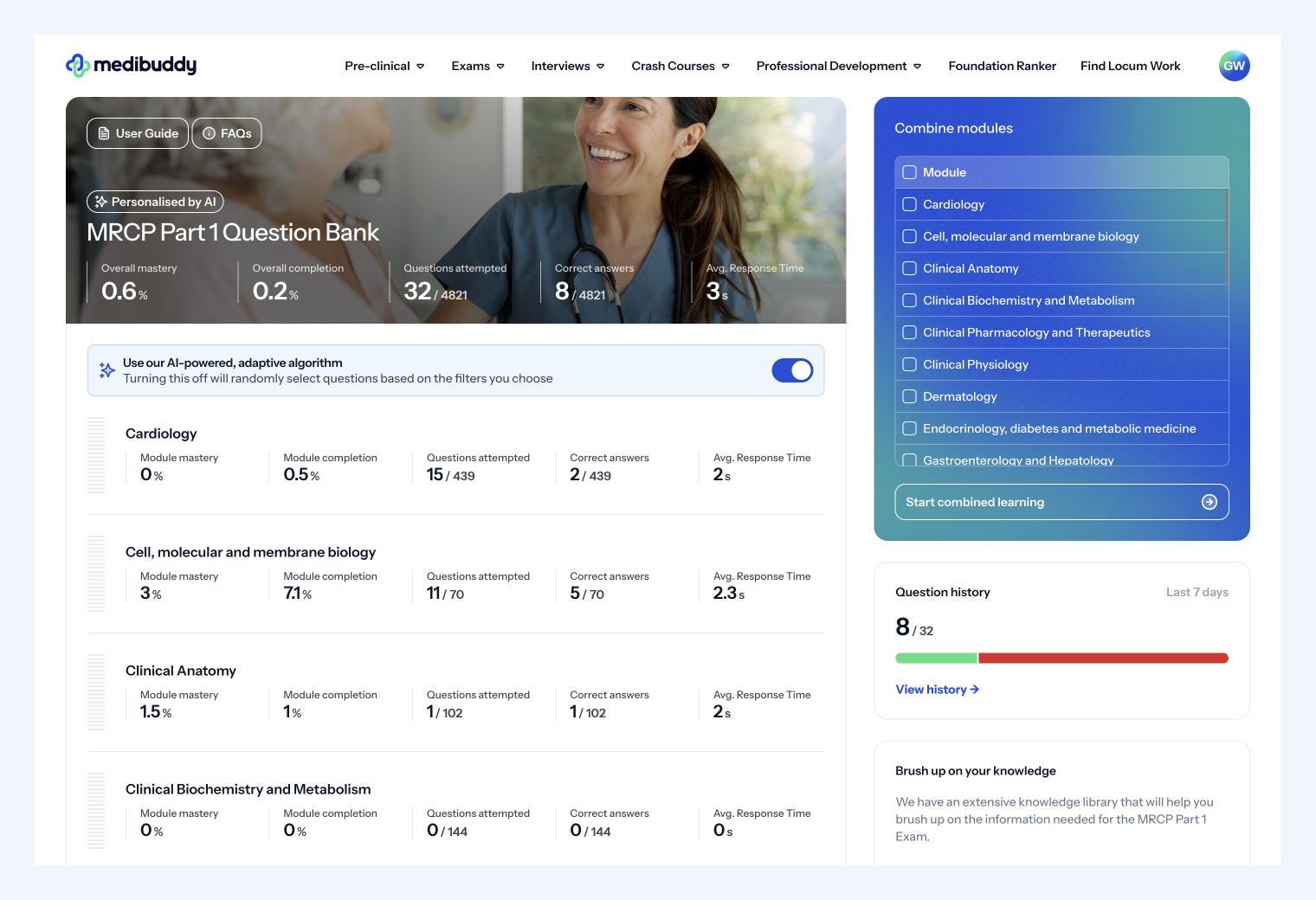
What is the difference between MRCP Part 1 & 2?
MRCP Part 1 builds on the knowledge of basic medical science which is acquired from undergraduate education. The exam covers a range of subjects in a multiple-choice format, to determine if you have the necessary knowledge as a doctor. Because of this, MRCP Part 1 aims to test your understanding of common disorders, clinical sciences and national guidelines of the UK. Also formed from multiple-choice questions, MRCP Part 2 assesses the candidates practical knowledge of Part 1. However, the questions in Part 2 of the exam will likely include images to emphasise the outcome of investigations. Throughout the exam, each candidate is observed on their medical skills, knowledge and behaviour when dealing with specific medical scenarios.Requirements for MRCP Part 1
To be eligible for MRCP Part 1, a minimum of one year must have passed since your medical graduation and you must have spent this time in some kind of medical employment.MRCP Part 1 Dates
When you're ready to start preparing for your MRCP, you need to first book an exam date. So far, the MRCP exam Part 1 exam has been scheduled to take place three times in 2026. You can find the exam dates below. The current fee is £502 for UK students and £672 for international students. To apply for MRCP Part 1, you can register an account and apply through the MRCP UK website. The 2026 MRCP Part 1 exam dates are as follows:| Exam date | Application period | Results by |
|---|---|---|
| 28 January 2026 | 4 – 11 November 2025 | 13 March 2026 |
| 21 May 2026 | 10 – 17 March 2026 | 3 July 2026 |
| 23 September 2026 | 14 – 21 July 2026 | 6 November 2026 |
MRCP Part 1 Exam Questions
For the MRCP Part 1 exam, you will take two papers. You will have 3 hours to complete 100 multiple choice questions in each paper. Using what's known as a ‘best of five’ format, your job is to choose one correct answer from five options. The other four options will be similar to the correct answer, but are not the preferred choice. As a candidate, you will have to decide which one you think is the best answer from a selection of five possibilities. As there is no negative marking in this exam, you are given one mark for every right answer. Below is the type of practice question you can expect to find in our MRCP Part 1 Exam Question Bank.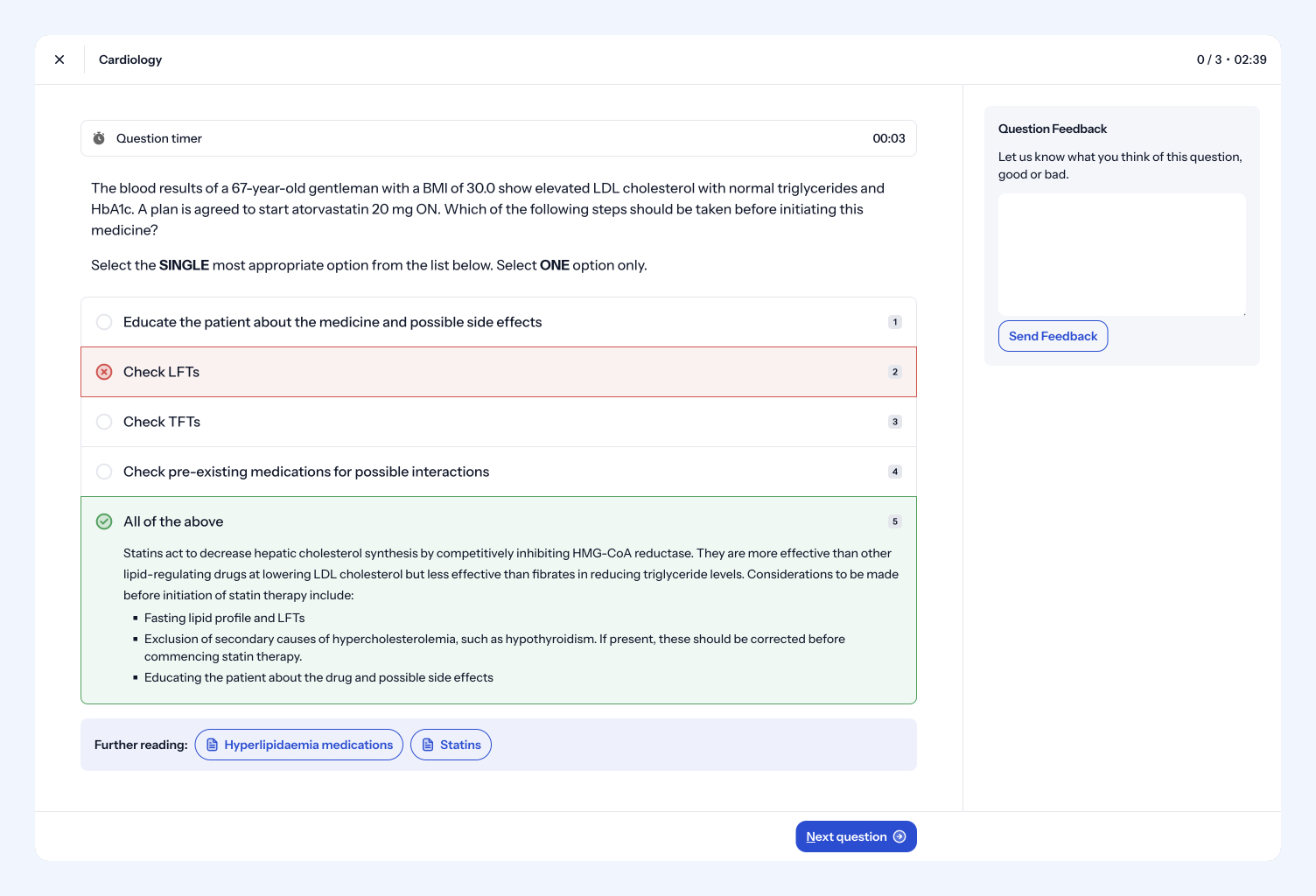
MRCP Part 1 Results
Your exam result will be worked out by a process called equating. This process ensures that candidates are awarded similar overall results for corresponding rates of performance in separate parts of the MRCP exams. Candidates no longer receive hard copies of examination results in the post. Instead, MRCP exam results are published on the MRCP UK website, with each candidate able to view their specific results by logging into their account.MRCP Part 1 Pass Mark
To pass Part 1 of the MRCP exam, you will have to get a mark higher than 540. After tallying the number of correct answers in the two papers, most scores will range anywhere from 200 to 800. With the use of equating, the difficulty of each question and the overall exam will have been considered as well. You can review the latest diet performance reports here.Resources
To make sure that you are fully prepared to take MRCP Part 1, you need to build your knowledge in line with the UK core medical training curriculum, internal medicine training and UK national guidelines. Alongside these guidelines, you should study the relevant clinical textbooks and medical journals. Completing example questions for the MRCP Part 1 will help you to become familiar with the types of questions you’ll experience in the exam. It’ll also help you to gain practical experience of answering questions within the given time so you feel more prepared on exam day. Our MRCP Part 1 Exam Question Bank offers expert practice questions designed to mirror the types you'll encounter in the exam, helping you refine your timing, improve accuracy, and feel confident on test day.How to prepare for MRCP Part 1
To start with, all candidates should prepare for the MRCP Part 1 exam by gaining practical experience in caring for medical emergency patients. A key part of ensuring that you are ready for any exam is practising sample exam questions. By doing this, you will be able to understand the format of the exam and recognise patterns in the questions. As there are hundreds of questions in the MRCP exams, it’s wise to complete mock exams under timed conditions. Instead of simply memorising concepts, you should also aim to understand the reasoning behind why questions are right or wrong. Finally, if you know any doctors that have completed the MRCP qualification, you can ask them for advice. By approaching the exam in a similar way, you will be giving yourself a higher chance of success. Each question in the Medibuddy MRCP Part 1 Question Bank has a thorough explanation, breaking down the concepts so you can build a deeper understanding and retain key information.
Is MRCP Part 1 Difficult?
There is no doubt that MRCP Part 1 is a challenging exam. However, if you prepare correctly, you can pass this exam without too much trouble. To do this, you will need advanced knowledge of applied basic sciences and medical principles. Candidates who first take the exam shortly after their graduation are most likely to pass. After this point, the pass rate goes down the longer the candidates decide to wait. This doesn’t mean that you should take the exam before you are ready, as your level of preparation will be the deciding factor in whether you pass the first time.Post ID: 11315 - MSRA Exam Revision
If you’re applying for a Specialty Training (ST) post in 2026, you may need to undertake the Multi-Specialty Recruitment Assessment (MSRA) as part of the recruitment process. Our MSRA exam revision guide will provide you with advice and tips on preparing effectively, as well as information about the ‘exam difficulty’ and ‘what is a good score?’. For some specialties, if you score highly on the MSRA, you can bypass the interview stage of recruitment, meaning there are huge advantages of preparing effectively and performing well in the MSRA. Furthermore, General Practice ST1 and Core Psychiatry CT1 assess and rank applicants based solely on their MSRA performance; therefore, if you’re applying for these, it’s more important than ever to ensure that you’re as prepared as possible for the exam. For more details relating to the specialties which currently require completion of the MSRA, exam dates and how the MSRA is scored, visit our MSRA: Complete Guide 2026.
Is the MSRA exam difficult?
The MSRA is designed to assess essential competencies expected at foundation level. The Professional Dilemmas paper assesses your professional behaviours and judgements in relation to clinical scenarios; relating directly to the General Medical Council’s (GMC’s) generic professional capabilities framework, it thereby assesses the capabilities expected of all doctors. The Clinical Problem Solving paper assesses your ability to make appropriate clinical decisions drawing on your clinical knowledge and problem solving skills; based on the Foundation Programme, it assesses competencies expected at this stage of your experience. Therefore, the MSRA is an accessible and fair examination for entry to ST. That being said, the MSRA is competitive, and as discussed previously, outperforming your peers can have significant advantages for your ST recruitment; therefore, the importance of preparing well for the MSRA should not be underestimated. Effective preparation will develop your understanding of the types of questions you’ll be asked and the exam expectations, allowing you to build experience and confidence when answering the questions. The 'how to revise' section below will provide guidance and tips on preparing successfully for the MSRA.What is a good score on the MSRA?
Your MSRA score will be used for the purpose of shortlisting for interview, and in most cases – with the exception of Community Sexual – it will be combined with your interview score for ‘ranking and offering’. Therefore, achieving a ‘good’ score will impact not only your chance of receiving an interview but also your ranking following this. You can find more information about shortlisting, interviews, offers and ranking for each specialty here. Additionally, specialties such as Obstetrics and Gynaecology ST1 allow you to bypass the interview stage if you achieve a top score in the MSRA. Therefore, achieving a high MSRA score can be extremely beneficial. However, there is no one ‘good’ score for the MSRA, as how your MSRA score is used and the expectations on your performance will depend on the specialty to which you’re applying to. Often specialties scale MSRA scores, rather than use raw marks, but again this varies between specialties. It’s always best to check the specific national recruitment website for guidance on your specialty of choice.Can I resit the MSRA?
Your MSRA score is valid for the duration of the recruitment year in which you take the exam. However, if you wish to resit the exam due to an unsuccessful attempt or to improve your score, check the guidance for your chosen specialty for rules and restrictions relating to resits, as these do vary between specialties.How do I revise for the MSRA?
Familiarising yourself with the exam content is a useful starting point for your MSRA preparations. This will ensure that you're aware of the demands of the exam and allow you to identify any subject areas which you may need to revisit as part of your MSRA revision. For a breakdown of the MSRA exam structure and different test papers, visit our MSRA complete guide and practice questions blogs. You may also find it helpful to revisit the following documents, given their influence on the MSRA exam, as mentioned previously: As well as exploring the exam topics, incorporating practice questions is essential for your MSRA preparations. This allows you to become familiar with the different types of questions and scenarios you’ll encounter during the exam, and provides opportunities to practise applying your knowledge and problem solving skills, which are important elements that will be assessed within the MSRA exam. Our adaptive MSRA question bank not only provides you with thousands of practice questions! Powered by artificial intelligence, it also automatically identifies your strengths and areas for development, ensuring that you’re given the right questions at the right time. By personalising learning to your individual needs, it enables you to focus on the topics which will have the biggest impact on your MSRA score, making the most effective use of your valuable revision time. The dashboard (below) also provides a clear snapshot of how you're performing across all topics so you target the areas that you need to improve.
Visit our MSRA question bank to start preparing for the MSRA exam more efficiently and take your exam revision to the next level.
[msra_subscriptions]
MSRA revision tips
Preparing well for the MSRA will ensure that you give yourself the best possible chance of achieving a high MSRA score and positively impacting your ST application. The following are some final tips to support you in preparing effectively for the MSRA exam:- Ensure you dedicate enough time To ensure that you’re confident in all aspects of the exam and can perform well, give yourself adequate time to prepare for both test papers – Professional Dilemmas and Clinical Problem Solving – and make sure you cover all topics in the Clinical Problem Solving paper. To learn more about the topics covered in the MSRA exam, visit our MSRA complete guide or practice questions blogs.
- Make the most of your time Preparing for an exam while working a full-time job is no easy feat, so anything you can do to make your revision time more productive will be beneficial, and no doubt have a positive impact on your MSRA score. Rather than aimlessly completing question after question, use our adaptive MSRA question bank to make the most effective use of practice questions. Also available as an app, you can answer questions and review your feedback on the go, allowing you to squeeze in some MSRA revision whenever you have the opportunity.
- Get familiar with the exam functions Making yourself aware of the exam functions doesn’t sound like the most crucial exam preparation, but knowing what to expect will help you feel more confident and avoid pointlessly wasting time during the exam. Pearson VUE, who delivers the exam, provides a generic tutorial so you can view the controls and screen layout before the test day.
- Maximise your chance of picking up points Although not strictly related to revision, it’s always worth remembering that neither paper in the MSRA exam is negatively marked, so it’s worth attempting to answer all questions as it may just get you an extra few marks on the exam.
Post ID: 11888 - MSRA Question Bank
If you’re required to undertake the 2026 Multi-Specialty Recruitment Assessment (MSRA) as part of your Specialty Training (ST) application, no doubt you’ll be considering MSRA question banks and how they can support your exam preparations. This guide will provide advice on what to look for to ensure you’re accessing the best MSRA question bank, how many questions you should answer to prepare thoroughly, and how to pass the MSRA. The MSRA is used by a wide range of specialties as part of the ST recruitment process and plays an important role in the ranking of applicants; therefore, it’s essential that you prepare well to ensure you give yourself the best possible chance of achieving highly. Our MSRA complete guide provides details on the specialties that currently require completion of the MSRA; you’ll also find information relating to the 2026 exam dates, how the MSRA is scored, and further tips on how to do well.
What is the best question bank for the MSRA?
Choosing an MSRA question bank can be a bit of a minefield; with a huge variety available, knowing which one to select can be difficult. You may want to take into account the following considerations to help you choose the best MSRA question bank for you:- The cost of the question bank but also what you actually get for your money. You may want to explore what’s on offer and if it’s good value. We offer three price points for our MSRA question bank subscription, so you can choose the most relevant subscription for you.
- Linked to this, it’s particularly important to consider the volume of practice questions you’ll be able to access. You should aim for one which offers a wide range of practice questions to expand your understanding of the MSRA and support your preparations. Our question bank has over 4,000 clinical problem solving questions and 200 professional dilemma questions.
- An MSRA question bank which provides quality explanations following the questions will be more beneficial and further your learning. Every time you answer a question in our MSRA question bank, you will be provided with a detailed explanation that will help you to understand why it’s correct and provide an opportunity to develop your knowledge further.
- Does the question bank include feedback on how you’re doing? A question bank which provides an insight into how well you’re doing – particularly if this is broken down into performance against each topic area and each of the test papers – allows you to track your progress and identify areas where you need to dedicate more revision time. Our dashboard shows you how well you have “mastered” each of the topics required for the exam, based on how much you have shown the algorithm that you know.
- Personalised learning is a learning method which is revolutionising medical education. A personalised question bank will identify areas that you need to improve and direct your learning to meet those needs, making your revision more purposeful and effective. You should decide whether your learning style is better suited to textbooks and traditional question banks, which treat everyone the same despite differing abilities, or personalised question banks, which will adapt your learning experience based on your strengths and weaknesses.
How do I pass the MSRA?
For specialties which require the MSRA, passing the exam is essential to be shortlisted for an interview. However, simply passing the exam may not be your goal when you consider the advantage that achieving a high score can give you. For the majority of specialties, with the exception of Community Sexual and Reproductive Medicine, your MSRA score is combined with your interview score for ‘ranking and offering’ and, therefore, has an impact on this. Furthermore, some specialties, such as Obstetrics and Gynecology ST1, allow you to bypass the interview stage altogether if you achieve a top score in the MSRA. Additionally, for the 2026 recruitment window, General Practice ST1 and Psychiatry CT1 will rank you based solely on your MSRA performance. Therefore, it can be hugely beneficial to score highly in the MSRA, regardless of your chosen specialty. Preparing well for the MSRA will give you the best possible chance of not only passing the exam but also of performing well. Effective MSRA preparation should ensure that you build your knowledge of the types of questions you’ll be asked and your experience in answering these questions. Put simply, you need to:- Ensure that you’re aware of what the exam entails (i.e. the content and what’s being assessed) Without this, you won’t know what to expect from the exam or what to include in your revision. Our MSRA complete guide and practice questions blogs are useful starting points for understanding the different test papers within the MSRA, the exam structure and assessment areas.
- Revise / revisit your weaker subject areas From examining the test structure and assessment areas, you may immediately identify areas which you need to revise or revisit before the exam. You can do this by going over old notes and re-reading textbook chapters, or if using our MSRA question bank, this will happen automatically. Ensure you dedicate time to developing your knowledge and skills within these weaker areas to improve your MSRA score.
- Dedicate time to MSRA practice questions Not only will practising questions help you become familiar with the types of questions and scenarios you’ll encounter, but they’ll also allow you to practise applying your knowledge and problem solving skills, which will be tested during the exam.
- The GMC’s generic professional capabilities framework The Professional Dilemmas paper relates directly to the GMC’s generic professional capabilities framework, as it aims to assess your professional behaviours and judgements in relation to clinical scenarios.
- The Foundation Programme curriculum The Clinical Problem Solving paper is based on the Foundation Programme and assesses your ability to apply clinical knowledge and problem solving skills to make appropriate clinical decisions.
How many questions should I answer to prepare for the MSRA?
Although it’s tempting to want a set number of questions to aim for, everyone has different levels of experience, so there’s no set number of questions a candidate should answer to guarantee a pass. Instead of focusing on how many questions you’ve done, especially in comparison to others, aim to focus on the quality of your MSRA preparation and ensure that you use your time wisely. That’s not to say that you shouldn’t plan to complete a wide range of practice questions, as more exposure will provide more experience of the types of questions you’ll have to answer. However, it’s important to ensure you absorb the valuable learning experiences you will get from each question and explanation. When completing practice questions, you may find it more productive to incorporate the following to ensure you’re getting the most out of your practice questions:- Identify areas / topics that you need to improve
- Do some background reading to develop your understanding of these topics
- Repeat questions that you’ve got incorrect and assess if you have now mastered these topics or if there is any further reading you need to do.
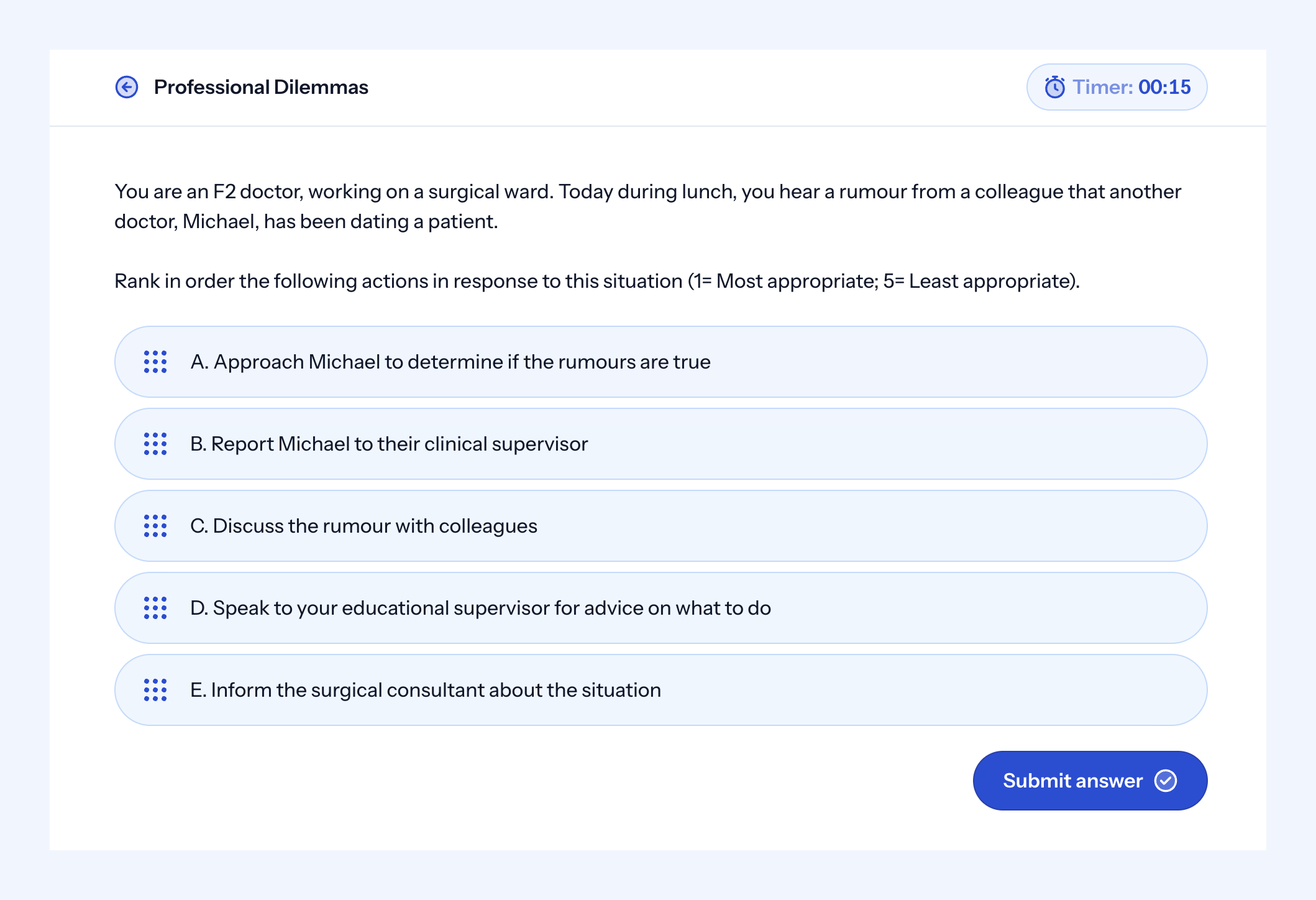 Professional Dilemmas Question[/caption]
[caption id="attachment_25389" align="alignnone" width="2130"] Clinical Problem Solving Question[/caption]
For a comprehensive overview of what’s expected in each section of the MSRA, visit our MSRA complete guide 2026. Aim to dedicate time to adequately prepare for all areas, enabling you to perform well and score highly.
Good luck!
Professional Dilemmas Question[/caption]
[caption id="attachment_25389" align="alignnone" width="2130"] Clinical Problem Solving Question[/caption]
For a comprehensive overview of what’s expected in each section of the MSRA, visit our MSRA complete guide 2026. Aim to dedicate time to adequately prepare for all areas, enabling you to perform well and score highly.
Good luck!
Resources:
MSRA AI-powered adaptive question bank MSRA Complete Guide 2026 MSRA Practice Questions MSRA Exam RevisionPost ID: 11552 - MSRA Practice Questions
The Multi-Specialty Recruitment Assessment (MSRA) is used as part of the Specialty Training (ST) recruitment process by a wide range of specialities. To support your MSRA preparation, this guide provides information on the structure of the exam and how to prepare, as well as example MSRA practice questions. For more details relating to the specialties which currently require completion of the MSRA, as well as information about exam dates, how the MSRA is scored and tips on how to do well, visit our MSRA: Complete Guide 2026.
Structure of MSRA
Based on the Foundation Programme curriculum, the MSRA is designed to assess essential competencies and your ability to apply your knowledge to clinical decisions. The MSRA is separated into the following two parts:Professional Dilemmas Paper
- Duration: 95 minutes
- Number of questions: 50 scenarios
- Format of questions: There are two different parts of the paper, each making up roughly half of the questions:
- Part 1: Ranking – For these scenarios, you need to judge the appropriateness of actions in response to the situation and rank them in order, from most to least appropriate.
- Part 2: Multiple Choice – For each scenario you will be given eight plausible actions and be required to select the three most appropriate, when used in unison, to fully resolve the situation.
- Assessment area: This is a Situational Judgement Test (SJT). The paper assesses your professional attributes, behaviours and judgements in relation to clinical scenarios. It focuses on the following core areas: professional integrity, coping with pressure, and empathy and sensitivity.
Clinical Problem Solving Paper
- Duration: 75 minutes
- Number of questions: 86 questions
- Format of questions: Again, there are two different types of questions, which make up roughly half of the questions each:
- Extended Matching Questions – You’ll be given a set of responses and need to identify the most appropriate option in relation to multiple, independent scenarios.
- Single Best Answers – You’ll be given a set of responses and need to identify the most appropriate option for a single scenario.
- Assessment area: The paper assesses your ability to apply your clinical knowledge, judgement and problem solving skills to make appropriate clinical decisions. It focuses on the following core competencies: investigation, diagnosis, emergency care, prescribing and management (non-prescribing).
How to prepare for the MSRA
It’s essential that you identify what’s required for both the Professional Dilemmas and Clinical Problem Solving papers and allocate enough time to adequately prepare for them. As mentioned previously, our MSRA guide provides a comprehensive overview of what’s expected in each section of the MSRA, and is a useful reference point for all your MSRA queries. As the Professional Dilemmas paper focuses on assessing your professional attributes and behaviours, revisiting the General Medical Council’s (GMC’s) good medical practice guidance and generic professional capabilities framework may be helpful in your MSRA preparations. Likewise, the Clinical Problem Solving paper assesses your ability to apply your clinical knowledge and problem solving skills to clinical scenarios, and therefore some direct revision of clinical theory may be required. However, for each the focus is on applying this knowledge and skills, and making sound judgements in relation to clinical scenarios; as such, dedicating time to practice questions and mock exams will be invaluable, as these provide the opportunity to explore the types of scenarios and questions you’ll encounter during the MSRA exam. While many may advise dedicating as much time as possible to your preparations to do well in an exam, in fact, making the most effective use of your revision time will have a more significant impact than simply allocating more time to it. With the added challenge of preparing for the MSRA while working a full-time job, it’s essential that you focus on the effective use of practice questions, rather than aimlessly completing as many questions as you can in the time you have available. Our adaptive MSRA question bank uses state-of-the-art algorithms to automatically identify your strengths and weaknesses, personalising your learning to ensure you focus on the topics which will have the biggest impact on your MSRA preparations, and ultimately your exam score. By ensuring that you’re asked the right questions at the right time, and spending more time mastering the topics that you need to focus on, you’ll make the most effective use of your valuable revision time. To access thousands of professionally written MSRA questions and take your exam preparations to the next level, visit our MSRA question bank and start preparing for the MSRA more efficiently.
This is an image of the question bank dashboard, so you know what to expect when you purchase. You will be able to clearly see what areas of the syllabus you have "mastered" and which areas require further study.
Practice questions
This section provides examples of the type of questions you’ll experience in each section of the MSRA. You can also find more information about MSRA preparation and practice questions in our ‘MSRA Question Bank’ and ‘MSRA Exam Revision’ blogs.Professional Dilemmas Practice Questions
As highlighted in the structure section, the Professional Dilemmas paper contains two types of questions: ranking and multiple choice.Ranking questions
With ranking questions, you’ll be presented with a scenario and possible actions, from which you need to judge the appropriateness of these responses. You’ll be required to rank each action in order from the most appropriate (1) to the least appropriate (5) in relation to the scenario given.Multiple choice questions
For the multiple choice questions, you’ll be presented with a scenario and eight plausible actions, from which you need to judge the most appropriate responses to the situation given. You’ll be required to select three options that, when combined, give the most appropriate response to the scenario. 👉 MSRA Professional Dilemmas Example Questions from the Medibuddy MSRA question bankClinical Problem Solving Practice Questions
As mentioned previously, the Clinical Problem Solving paper contains two types of questions: extended matching questions and single best answer questions. For both, you’ll be presented with a set of responses and asked to judge which is the most appropriate in relation to a given scenario. The difference being, for the extended matching questions, these same responses must be judged against multiple, independent scenarios; whereas, for the single best answer questions, the given responses are only judged against a single scenario. Scenarios in the Clinical Problem Solving paper cover the following topics:- Cardiovascular
- Dermatology / ENT / Eyes
- Endocrinology / Metabolic
- Gastroenterology / Nutrition
- Infectious Disease / Haematology / Immunology / Allergies / Genetics
- Musculoskeletal
- Paediatrics
- Pharmacology and Therapeutics
- Psychiatry / Neurology
- Renal / Urology
- Reproductive
- Respiratory
Further reading
MSRA Complete Guide 2026 MSRA Exam Revision MSRA Question BankPost ID: 2939 - The General Surgery ST3 Application Process
When you apply for the ST3 General Surgery interview, you may find it difficult to find a clear summary of the application process. Many candidates have requested we produce a summary of the timeline and the type of evidence they needed to submit, so that they can start their preparations early. Therefore, we have provided a clear summary of the application process below. Pay particular attention to the ‘Supporting Information’ required on the Oriel application form.
Application timeline 2026
For posts commencing in August 2026, the job advert will be released on Wednesday 19 November 2025, and you’ll be able to apply for General Surgery through the Oriel website between Thursday 20 November 2025 and Thursday 11 December 2025. No applications will be accepted outside of this period so it’s crucial that you’re prepared and ready to submit your application during this time. You’ll also be asked to provide three references, one of whom must be your current supervisor, but the employing Trust will only use these after offers are made. A full breakdown of the General Surgery ST3 recruitment dates for posts commencing in August 2026 are provided on the NHS Health Education England (HEE) website and in the table below:| Stage | Key dates |
|---|---|
| Vacancies published | 19 November 2025 by 5pm |
| Applications open | 20 November 2025 at 10am |
| Applications close | 11 December 2025 at 4pm |
| Evidence verification upload | 16 December 2025 – 12 January 2026 |
| Shortlisting scoring date | 26 – 27 January 2026 |
| Shortlisting release date | 12 February 2026 |
| Appeal window | 12 – 16 February 2026 |
| Invites to interview | 10 March 2026 |
| Interview window | 26 – 27 March 2026 |
| Preferences window | 19 March – 2 April 2026 |
| Initial offers out | 14 April 2026 by 5pm |
| Hold deadline | 22 April 2026 at 1pm |
| Upgrade deadline | 23 April 2026 at 1pm |
Longlisting for General Surgery ST3
In order to meet the entry criteria to be considered for specialty training, the application form requires you to confirm the following achievements in line with the 2026 person specification:- MBBS or equivalent.
- Full MRCS or equivalent – MRCS Part A and Part B – by offer date
- Complete employment history.
- Evidence of achievement of CT1 competencies in surgery by time of application and CT2 competencies in surgery by time of appointment.
Shortlisting
You will calculate a self-assessment score from your personal achievements and be required to submit evidence. The self-assessment questions in 2026 are as follows:Question 1 – Time spent in General Surgery
This question relates to how many months you will have spent in total in General Surgery in any post-foundation programme in any country by the end of July 2026 or by the completion of Core Training if this is later. There are a maximum of 8 points available:| Responses | Score |
|---|---|
| 0 to 3 months | 0 |
| 4 to 7 months | 1 |
| 8 to 12 months | 6 |
| 13 to 36 months | 8 |
| 37 to 60 months | 4 |
| 61 months or more | 1 |
Question 2 – Time spent in other specialties
By the end of July 2026, or the completion of Core Training, will you have spent at least 4 months in T&O, Plastic Surgery, Neurosurgery, ENT Surgery, Cardiac/Thoracic surgery, A&E, ITU, Paediatric Surgery, Urology, Vascular or OMFS posts since completing your Foundation Programme? A maximum of 4 points are available as follows:| Responses | Score |
|---|---|
| I will not have spent 4 months in any of these specialities. | 0 |
| I will have spent at least 4 months in a post in 1 of these specialities. | 2 |
| I will have spent at least 4 months each in posts in 2 or more of these specialities. | 4 |
Question 3 – Appendicectomies completed
This question asks how many appendicectomies (laparoscopic and/or open) you have completed which have been done either STS or STU or P or T? Note: This refers to those done at the time of application, and they must be recorded in a validated logbook and each sheet signed by a consultant. You can score a maximum of 10 points for:| Responses | Score |
|---|---|
| 0 to 9 | 0 |
| 10 to 20 | 2 |
| 21 to 35 | 7 |
| 36 to 70 | 10 |
| 71 to 85 | 5 |
| 86 or more | 1 |
Question 4 – Publications
Here, you're required to submit your 2 best publications, published in any PubMed indexed journal. To be eligible, these must have a PubMed ID and be published by the time of application. 5 points are available per publication, giving a maximum of 10 points for this section.Question 5 – Presentations
You need to submit your 2 best presentations (these can include poster presentations) to be eligible for this section. Again, the presentations must have occurred by the time of application. Points will be awarded for candidate contribution, being the presenter of the work, quality of study and scope of meeting (regional, national, or international). A maximum of 5 points is available per presentation and 10 points in total.Question 6 – Audits and QIPs
You should submit a single best closed loop audit. You can only include an audit that you have presented as you need to provide evidence of presentation. Points are awarded for candidate involvement, reference standard, study design, importance of clinical question and impact of work. You can achieve up to 8 points for a closed loop audit.Question 7 – UK higher degree
You can score points here if, at the time of application, you have completed and been awarded a stand-alone UK higher degree or equivalent examined by thesis/dissertation. This section has been broadened to include PG Certs, Diplomas and taught Masters degrees. You can score a maximum of 5 points for the following:| Responses | Score |
|---|---|
| PG Certificate | 1 |
| Diploma/Masters degree without thesis or dissertation | 2 |
| Masters with thesis or dissertation (e.g. MSc, MMedEd, MS, ChM) | 3 |
| MD | 4 |
| PhD | 5 |
After shortlisting
If shortlisted, you will need to book an interview via Oriel. Invites to interview will be sent on 10 March 2026. Slots are offered on a first-come, first-served basis. The 2026 interview window is 26 — 27 March 2026. The General Surgery ST3 interview for 2026 will be an online interview. This will last 40 minutes and involve 3 stations:- Clinical Station – You will be given 5 minutes before the interview to read a clinical scenario about a patient. This will be followed by 10 minutes of questions about the clinical scenario and other related questions.
- Management Station – Again, you will have 5 minutes to read through a management scenario based in the clinical environment. This will once again be followed by 10 minutes of questions about the management scenario and other related questions.
- Professional Development Station – You will have 10 minutes to answer questions about aspects of your career to date.
In the interview, you’ll given 5 minutes reading time before the clinical scenario and management scenario. This isn’t a lot of time in which to read the scenario and begin preparing for the related questions. However, the recommended answer structures provided in the question bank will guide you through all considerations, so you can provide a clear step-by-step management plan within your answer.
After the interview, you will be asked to list your preferred jobs in order. Offers will be made based on your ranking at interview and your verified self-assessment scores. You’ll then have to accept, reject or hold (i.e. if considering jobs in other specialties) one offer with the option of ‘upgrading’ if a more preferred post becomes available. All dates, including when the initial offers are released and ‘hold’ and ‘upgrade’ deadlines, can be found in the table above.
For more interview guidance, check out our blogs discussing the interview format and interview preparation and essential reading, and to support your interview preparations, there’s our interview questions.
Further reading
General Surgery ST3 Interview Questions General Surgery ST3 Interview Format ST3 General Surgery Interview Preparation and Essential Reading General Surgery ST3 Person Specification 2026Post ID: 3212 - Plastic Surgery ST3 Interview Preparation and Essential Reading 2026
Preparation is key to doing well in the Plastic Surgery ST3 Interview. You will have spent months/years developing your portfolio, however, it only represents a small proportion of your overall mark. Whether you get a Plastics training number or not will depend on how well you answer the questions in your interview. In this post, we will give you some general advice on how to prepare, and we have also developed our Plastic Surgery ST3 Question Bank to help with your revision. High-scoring plastics trainees update our interview question bank every year with new questions based on feedback from the interviews.
Important dates for Plastic Surgery ST3 Recruitment 2026
Important dates to note for 2026 recruitment are as follows:| Stage | Date |
|---|---|
| Advert appears | 19 November 2025 by 5pm |
| Applications open | 20 November 2025 at 10am |
| Applications close | 11 December 2025 at 4pm |
| Evidence upload portal opens | 18 December 2025 |
| Evidence upload portal closes | 5 January 2026 |
| Self-assessment verification window | 13 January to 14 January 2026 |
| Appeal window for candidates | 15 January to 19 January 2026 |
| Preferences open date | 12 March 2026 |
| Invites to interview | 2 February 2026 |
| Preferences close date | 12 March 2026 |
| Interview dates | 10 February to 11 February 2026 |
| Initial offers | 14 April 2026 by 5pm |
| Hold deadline | 22 April 2026 at 1pm |
| Upgrade deadline | 23 April 2026 at 4pm |
| Interview scoresheet release date | TBC |
Plastic Surgery ST3 Application
As you see from the 2026 recruitment dates above, the Plastic Surgery ST3 application process involves the following stages:-
- Completing your application via the ORIEL system, which includes your self-assessment score (more detail is given about this in the following section).
- Once the evidence portal opens, you'll need to upload your evidence to justify your self-assessment.
- This will then be reviewed by a team of Plastic Surgery consultants to verify your self-assessment score. This gives your verified evidence score.
- Following this, the highest-scoring applicants will be invited to attend an online interview.
- Your verified evidence score and scores at interview will then be combined to determine your final score and ranking.
Starting Plastic Surgery ST3 soon?
No one wants to be the new Plastics Registrar that all the bosses avoid being on call with. Everyone has to start somewhere, but preparing for the transition can give you the best possible chance of excelling in your new role. Sign up to the Medibuddy Plastic Surgery ST3 Crash Course and take the first step towards becoming a confident and competent Plastics SpR.

Self-Assessment
This part of the Plastic Surgery ST3 application form asks candidates to make a declaration of achievement in various criteria relating to the 2026 person specification. These measurable indicators of achievement are then used to score applicants relative to their level of experience. The self-assessment section of the application changes slightly every year. Below is the self-assessment guide from the current 2026 application round, which can be used as a guide to help with portfolio preparation:Competence assessment
You will need to submit evidence of completion or prospective completion of all requisite core surgical competences by post start date as per the 2026 person specification. You can find more information about the 3 possible candidate groups for the competence assessment in the self-assessment and verification guidance.MBBS (or equivalent)
Pretty straight-forward, but you must list your primary medical qualification in the Entry Qualifications section.MRCS
You must achieve full MRCS – Part A and Part B – by offer date. You should indicate on your application form whether you have full MRCS or if you intend to successfully complete the exam by offer date.Years in Practice
A maximum of 3 points will be awarded for this section of the self-assessment:| Years in Practice | Score |
|---|---|
| <5 | 3 |
| 5.1 - 7 | 2 |
| 7.1 - 10 | 1 |
| >10 | 0 |
Clinical Knowledge and Experience
There are 12 points across the following three domains:| Domain | Maximum score (points) |
|---|---|
| Surgical Competence – Hand Trauma | 4 |
| Surgical Competence – Burns | 4 |
| Surgical Competence – Skin Cancer | 4 |
Academic/Management/Teaching Achievements
There are a maximum of 20 points across the following domains:| Domain | Maximum score (points) |
|---|---|
| Higher qualifications directly related to Medicine | 4 |
| Audit | 3 (An extra point can be awarded by the verification panel if they feel the audit presented has significantly improved patient care or has significant merit.) |
| Publications | 5 |
| Presentations/Posters | 4 |
| Collaborative research | 1 |
| Principle Investigator | 1 |
| Presentation of portfolio | 2 |
Plastic Surgery ST3 Interview
You should prepare for your interview as you would for an exam. Give yourself plenty of time to cover all the core topics; we recommend 2-3 months, depending on how intensive your preparation is likely to be. Most of your time will be spent learning the content required for the clinical station. However, it is important that you don’t neglect the OSCE and structured interview. We’ve broken down the stations below with tips on how to prepare for each one. The 2026 interview will take place online using a system called Qpercom Recruit. The interview will be 30 minutes, with 4/5 panel members. There may also be a lay representative who monitors the interviews to ensure they are all conducted fairly. Check your microphone, camera and connectivity in advance, and ensure your background is clear and that you are in the right environment for an important interview. If you live with friends, tell them when your interview is, so they know not to disturb you. The types of interview questions asked are expected to be similar to previous years, with the exception of the presentation station, which is no longer part of the interview.Interview Structure
OSCE and Communications
The OSCE is divided into 2 sections and you should prepare for each one separately:Consent
This station will last 5 minutes. There are only a limited number of core procedures that you are likely to be asked to consent for. Consider all the procedures you have seen registrars perform and prepare your consent for them. We have also produced several scenarios in our interview question bank with example answers to help guide you through your preparation. Here is a picture of our consent dashboard, so you know what to expect when you purchase. Keeping to time can be difficult in this station, particularly with some more complicated procedures like breast reduction. You should practise consenting on your own and with others until your delivery is slick and concise. We would recommend timing yourself right from the beginning of your revision, as fitting everything in is key to doing well here.
Communication
This part will also be 5 minutes. This station looks at your communication skills when calling consultants to discuss scenarios. There are only a limited number of plastic surgery emergencies, so it’s possible to prepare for them, and we have included these in our interview question bank. It is a good idea to record yourself when working through these practice scenarios, as you can then listen back and see where you need to improve your delivery. Here is an example of a chemical burn scenario from our interview question bank.
Clinical Scenario
This station lasts 10 minutes, and you will be made aware of 2 clinical scenarios for discussion. The same key topics tend to come up each year in this station and you should make sure you have a good understanding of all of them. You aren’t expected to have FRCS knowledge at this stage, but you should have a good understanding of the diagnosis and management of common plastic surgery conditions. They will often start with simpler questions such as asking you to describe a clinical image, followed by questions on what you’d ask during the history, what you’d look for on examination and what investigations you would order. They will form an impression of you based on how you answer these first few questions, so you should repeatedly practise answering them for the core topics. Aim to convey the key points to the simple questions in a clear and concise way. Your goal is to get through them quickly so you can move on to the more challenging questions where you can demonstrate your knowledge. You should aim to have your clinical knowledge up to scratch early in your interview preparation period and then focus on how you deliver your answers. As you get more confident, you can ask your registrars and consultants to grill you, although be wary of seniors with a poor understanding of the interview process! Many will ask you questions that are too high a level for the interview, which can be quite demoralising, particularly if the interview is not far off! Here is an example of a clinical interview question from our question bank, so you can get an idea of the level required.
Structured Interview
If you’ve been through core training, you will have had some experience answering similar questions to the ones you will get in the structured interview part. This section lasts 10 minutes, during which you’ll have to answer 2 to 3 questions about a range of potential topics, including audits, ethics, leadership, research and teaching. We have updated and enhanced our structured interview questions this year to give you the best support for your interview possible!Essential Reading
These are some of the resources that we used to prepare for interview. Most of the books can be picked up in hospital libraries. If you have an Open Athens account, the app Clinical Keys can also give you access to many of them.- Plastic Surgery ST3 Person Specification
- E-LPRAS - This is the e-Learning project for Plastic, Reconstructive and Aesthetic Surgery and can be accessed for free on the e-learning for healthcare website
- Key Notes on Plastic Surgery - You don’t need to know this cover to cover; focus on the key topics and use them to get a broad understanding of the specialty. The first chapter on core principles is particularly helpful for getting to grips with the fundamentals of plastic surgery. If you are a BMA member, you can access a free pdf from the BMA library.
- Essentials of Plastic Surgery - The breast and facial reconstruction chapters explain the principles well and will help you shape your answers in the clinical station.
- Green’s Operative Hand Surgery - This is a good book for learning the principles of the key hand surgery procedures required for interview. You should be able to talk through and explain all the procedures you state you can do in your self-assessment.
Post ID: 24817 - Trauma and Orthopaedic Surgery ST3: Interview Guide 2026
If you’re considering applying for Trauma and Orthopaedic Surgery ST3 (T&O ST3), you’ll no doubt be aware that it can be a competitive specialty. With this in mind, we have created this T&O ST3 interview guide to help you prepare well for the interview and application process. Here you’ll find everything you need to know about applying for T&O ST3, including the application timeline, format of the interview and the competition ratios, to give you the best chance of a stress-free application process.
Trauma and Orthopaedic Surgery ST3 Interview Timeline
The following is the T&O ST3 recruitment timeline for 2026:| Activity | Date |
|---|---|
| Applications open | 20 November 2025 |
| Application deadline | 11 December 2025 |
| Self-Assessment Verification | 27 – 28 January 2026 |
| Interviews | 24 – 27 March 2026 |
| Initial offers released on | 14 April 2026 |
| Holding deadline | 22 April 2026 |
| Upgrade Deadline | 23 April 2026 |
T&O ST3 Applications
Applications for T&O ST3 2026 will open between 20 November – 11 December 2025, giving you a limited amount of time to submit your application. You can only apply through the Oriel recruitment system, and all sections of the application need to be completed. The ST3 T&O application form has several self-assessment multiple-choice questions. This part of the application form requires you to select responses to the questions while providing evidence to support your answers. The T&O self-assessment questions cover:- Specialty Experience
- T&O Specialty Experience
- Related Specialty Experience
- Operative Experience
- Publications (a)
- Publications (b)
- Presentations
- Audits
- Higher Degrees
- Leadership
- Teaching
- Gained a minimum of 8 months’ experience in two related specialties – for example, Plastic Surgery, Neurosurgery, Vascular Surgery, ENT Surgery, Cardiac/Thoracic Surgery, A&E, ITU, Urology, OMFS and General Surgery.
T&O ST3 Interview Format
If your evidence is verified by the assessors and your application is considered successful, you will be invited to an interview. The T&O ST3 interview is a multi-station, 60-minute interview. This will be split into the following four 10-minute stations:Commitment to Specialty (previously Portfolio)
During this station, you will be interviewed about various aspects of your career. The two interviewers will be looking to gain insight into your experience to date. The categories on the mark scheme include:- Career Motivation, Learning and Development
- Leadership and Team Involvement
- Organisation and Planning
- Communication – Information Giving
- Academic
Clinical
The clinical station consists of two halves and two scenarios lasting 5 minutes each. Candidates are presented with XRs or scenarios either from a trauma or elective setting and then asked related questions. The assessors will score you based on the following:- Technical Knowledge
- Problem Solving and Decision Making
- Situational Awareness
- Communication – Information Gathering
- Communication – Information Giving
Prioritisation
This station – sometimes considered the trickiest – consists of a prioritisation exercise. It tends not to test any new knowledge that hasn’t been covered in the Clinical and Commitment to Specialty stations, but requires a certain technique to excel. The candidate is presented with several cases which they must prioritise in order of urgency. Usually, the setting is that of the on-call registrar organising the next day’s trauma list and also deciding which patients to see first in the emergency department. To give you an idea of the types of prioritisation questions you might face, the following is an example from our T&O ST3 interview question bank: For each prioritisation question in our T&O ST3 interview question bank, you’ll be given a possible answer (prioritisation list) and a discussion of each case to understand how this decision has been reached.
The two interviewers, who score you independently, will test elements of your skill set. This includes:
For each prioritisation question in our T&O ST3 interview question bank, you’ll be given a possible answer (prioritisation list) and a discussion of each case to understand how this decision has been reached.
The two interviewers, who score you independently, will test elements of your skill set. This includes:
- Organisation and Planning
- Communication – Information Gathering
- Communication – Information Giving
- Judgement Under Pressure
- Situational Awareness
Communication
Previously, communication was assessed across the other three stations (as is still the case). However, for the 2024 interview, it was introduced as a separate station, and this has been continued for the T&O ST3 2026 interview. The communication station is based on a scenario involving communication with a patient. You will be assessed – and scored individually by the two assessors – against the following domains:- Technical Knowledge
- Situational Awareness
- Judgement Under Pressure
- Communication – Information Gathering
- Communication – Information Giving
T&O ST3 Competition Ratios
In 2025, T&O ST3 had 684 applications. With only 150 posts, there was a competition ratio of 4.56. This means more than three people were applying for every post. With a high number of applicants battling it out, you need to ensure that your T&O ST3 application is the best it can be. When preparing your application, we recommend ensuring you are familiar with the self-assessment scoring guidance and the application handbook. We’ve also designed the Medibuddy Trauma and Orthopaedic Surgery ST3 Interview Question Bank with a broad range of questions covering all elements of the interview and detailed explanations to help you succeed. You can find out more about our new T&O ST3 interview question bank here.Post ID: 23654 - Paediatrics ST3 Interview Guide 2026
For the majority of trainees, Paediatrics training is a run-through from ST1. Entering as a Paediatrics ST3 is not the norm, and this is usually done by doctors with other paediatric experience, as you will need to evidence ST1/ST2 capabilities to apply for ST3. Applicants will also need to evidence at least 6 months each of general paediatric and neonatology, as well as having two of the three written MRCPCH exams. Despite this, competition is still very high for ST3. This guide will provide you with everything you need to know, including in-depth information about the Paediatrics ST3 interview timeline, the structure, and the scoring process, allowing you to concentrate on performing to the best of your ability.
Paediatrics ST3 Interview Timeline
The next recruitment round for ST3 Paediatrics is National Round 2, with posts starting in August 2026. The application window is open from 20 November – 11 December 2025, and interviews will take place between 18 – 19 March 2026, so there’s not much time to submit your application and prepare for the interview. Below is a full list of the key dates that you need to be aware of:| Stage | Date |
|---|---|
| Advert appears | 19 November 2025, by 17:00 |
| Applications open | 20 November 2025, at 10:00 |
| Applications close | 11 December 2025, at 16:00 |
| Shortlisting window opens | 30 January 2026 |
| Shortlisting window closes | 24 February 2026 |
| Invite to Interview & Applicant Declaration sent | 4 March 2026 |
| Deadline for Interview Booking & Applicant Declaration return | 6 March 2026 |
| Interview window opens | 18 March 2026 |
| Interview window closes | 19 March 2026 |
| Offers released | 14 April 2026, by 17:00 |
| Hold deadline | 22 April 2026, at 13:00 |
| Upgrade deadline | 23 April 2026, at 13:00 |
| Paperwork must be submitted by | 6 May 2026 |
Paediatrics ST3 Applications
The application form for Paediatrics ST3 will consist of a set of white-space questions covering past achievements, teaching, management and clinical experience. These questions will be used for the purpose of shortlisting for interview if the number of eligible applicants exceeds the interview capacity (in recent years, this has been well exceeded – see the Paediatrics ST3 competition ratios below for more details). The Royal College of Paediatrics and Child Health (RCPCH) recommends that you read the descriptors for each section carefully and focus on providing high-quality, relevant answers and examples. Remember, depth is better than breadth - one good high-quality example or response is better than three smaller ones. The following is a full breakdown of the areas of assessment and the available score for each:| Area of assessment | Points available |
|---|---|
| Clinical capabilities | 8 |
| Quality Improvement Project (QIP) / Audit | 6 |
| Leadership / Management | 5 |
| Research / Academic achievements | 4+1 |
| Teaching | 5+1 |
| Total | 30 |
Paediatrics ST3 Interview Format
The 2026 Paediatrics ST3 interview will take place online via Qpercom. The exam will be formatted as follows:- Two station multi scenario format
- Each station will be 17 minutes long
- The overall interview will last 55 minutes
Communication
(20 marks available per Assessor, 10 minutes) This scenario-based station will assess your ability to communicate with patients, parents and carers. You will be given a scenario 5 minutes before the start of your interview, explaining a clinical condition or reasons for intervention or transfer. After your short preparation time, you’ll be expected to act out the scenario with the role player. The following is an example from our Paediatrics ST3 interview question bank with guidance on how to approach the communication scenario:
Reflective practice
(15 marks available per Assessor, 7 minutes) This station assesses your understanding of reflection and your ability to use your experiences for career progression. You’ll be asked to reflect on a significant event from your career – this can either be a positive or negative experience – and demonstrate how you will use your experiences to help you in the future. You can expect the assessors to ask the following:- Please could you briefly describe a significant clinical event you were involved in or observed and discuss your learning from it?
- How do you use similar reflective practice in your daily role?
Clinical thinking
(20 marks available per Assessor, 10 minutes) This station will assess your situational judgement and clinical problem-solving skills. Before this part of the interview begins, an assessor will give you a scenario verbally. You will then have to describe how you would manage the situation, before answering a variety of follow-up questions. An example of a clinical scenario taken from our Paediatrics ST3 interview question bank can be seen below:
Governance & leadership
(15 marks available per Assessor, 7 minutes) This part of the interview will assess your awareness and understanding of the role of governance in the workplace, along with your ability to lead and manage situations to the level expected of an ST3 doctor. You’ll be given a scenario verbally by the assessors. This may not be directly clinical but could revolve around areas such as staffing, patient management and complaint handling.Paediatrics ST3 Interview Scoring
For the 2026 application cycle, the interview scoring has been confirmed to remain the same as in 2025. The details are outlined below: In 2026, applicants will be interviewed by two clinicians for each station, with each clinician scoring independently. This means a total of 140 marks will be available for the interview. The final appointability threshold will remain at 55%, requiring a minimum overall score of 77 out of 140. However, given the competitive nature of the process, applicants will likely need to score significantly higher than the appointability threshold to secure a post, even if they meet the minimum score. [custom_sales_panel title="Paediatrics ST3" link="https://medibuddy.co.uk/st3-paediatrics/interview-question-bank"]Paediatrics ST3 Competition Ratios
In 2025, there were 507 applications for Paediatrics ST3, with only 49 posts available. This means the competition ratio was 10.35, or in other words, there were over 10 applicants for every post. There’s no doubt that the ST3 paediatrics pathway is a competitive one. Ensure you invest time into making your application the best it can be, and prepare effectively for your interview, to give yourself the best chance of securing a ST3 Paediatrics role. We designed our Paediatrics ST3 interview question bank to help you prepare as effectively as possible, with high-quality questions and explanations covering every element of the interview, and additional general preparation advice. You can find out more about the Medibuddy Paediatrics ST3 interview question bank here.Further Reading
Post ID: 24834 - Anaesthetics ST4 Interview Guide 2026
If you’re considering applying for Anaesthetics ST4, this guide covers everything you need to know about the application process and interview. This includes the key Anaesthetics ST4 recruitment dates, the format of the interview and how it's scored by the assessors. Competition for Anaesthetics is affected by multiple factors including the number of applicants and the number of posts available. You will find historical data on competition ratios on the Specialty Application website. However, bear in mind that the previous competition ratio does not mean your application cycle will be just as competitive, and factors change every year, so do not let that stop you from putting in your best application! We have created this Anaesthetics ST4 interview guide to help you stand out with your application.
Anaesthetics ST4 Application
The first stage in the Anaesthetics ST4 recruitment process is to submit an application via Oriel. Recruitment for Anaesthetics ST4 happens twice a year for February and August commencement. The next recruitment is for August 2026 entry, with the application window running from 20 November – 11 December 2025. As with other Oriel job applications, late applications will not be accepted. You can find a full breakdown of the Anaesthetics ST4 recruitment dates in the section below. As of the time of writing, the Anaesthetics ST4 application will go through a longlisting and a shortlisting process. During longlisting, all applications are assessed based on essential criteria found on the ST4 Anaesthetics Person Specification. Only applicants who meet the essential criteria will be longlisted. They then go on to undergo the shortlisting process. The shortlisting process consists of self-assessment scoring and an interview. These will be discussed below.Anaesthetics ST4 Self-Assessment 2026
There are several self-assessment questions throughout the Anaesthetics ST4 application. The self-assessment questions are used to determine your strengths within the field of Anaesthetics. So, you must answer all the questions honestly. The Self-Assessment score is made up of a number of categories. These categories may differ slightly between different application cycles. The Self-Assessment categories for the August 2026 and February 2027 commencement are:- Additional degrees and qualifications
- Additional achievements, prizes, and awards relative to medicine
- Postgraduate clinical experience in other specialties (excluding those done during Foundation Programmes, Anaesthesia, research and teaching)
- Quality improvement
- Research
- Teaching
- Academic publications
- Presentations and poster presentations
- Continuing professional development in stage 1 training or equivalent (CT1-CT3)
- Activities demonstrating leadership and/or management inside or outside of work
Boost your Anaesthetics ST4 application score by Training in Teaching
Gaining Teaching qualifications will contribute to your Anaesthetics ST4 application score. However, this can be time-consuming and might not even be possible before your interview. An easy alternative is to attend a course like our Teach the Teacher course, which should give you 1 point towards your Anaesthetics application score. If you prefer learning in an interactive environment, we also offer 1-day and 2-day live Teach the Teacher courses.| Option | Score |
|---|---|
| I have been awarded a master's in medical/clinical education | 6 |
| I have made a major contribution to a regional or national teaching programme, including developing a programme during my anaesthetic training, or I have obtained a postgraduate diploma in teaching | 5 |
| I have made a major contribution to a regional or national teaching programme, including developing a programme as a postgraduate | 4 |
| I have a postgraduate certificate in teaching | 3 |
| I have made a major contribution to a local teaching programme, including developing/organising a programme or instructing on an ALS /ATLS course | 2 |
| I have experience in formal teaching for health professionals, experience of formal teaching health-related topics to a non-medical audience, or attended a Teach the Teachers course, generic instructors course or similar | 1 |
| I haven’t done any formal training | 0 |
- ST4 Self-Assessment Criteria – this document contains the scoring grid with the criteria for each score
- ST4 Self-Assessment Guidance – this document goes into detail on how you can/should score yourself and provides examples on what can be considered evidence
- The evidence is unlabelled and difficult to find
- There are more than the recommended 4 documents
- The documents are poor quality and difficult to read
Anaesthetics ST4 Key Dates
The Anaesthetics ST4 recruitment process takes place twice a year. Round 2 covers start dates in August, while round 3 covers February start dates. For 2026 entry, the key recruitment dates for round 2 (August 2026 start dates) are as follows:| Stage | Date |
|---|---|
| Advert appears | 19 November 2025 |
| Applications open | 20 November 2025 (10am) |
| Applications close | 11 December 2025 (4pm) |
| Self-assessment document upload window | 5 – 11 January 2026 |
| Self-assessment verification scores released | 2 February 2026 |
| Self-assessment verification review window | 3 – 5 February 2026 |
| Invitations to interview & applicant declaration | 2 February 2026 |
| Deadline for interview & applicant declaration | 5 February 2026 |
| Interview window | 16 March – 10 April 2026 |
| Offers from | 14 April 2026 |
| Hold deadline | 22 April 2026 |
| Upgrade deadline | 23 April 2026 |
Anaesthetics ST4 Interview Format
The Anaesthetics ST4 interview is split into two stations. You will be interviewed by 2 interviewers for each station. Each station lasts 15 minutes, although you can expect the whole interview process to take up to 50 minutes. For 2026 recruitment, the interview will continue to take place online. Hence, it is important for you to have a reliable internet connection and a laptop with a camera and microphone. Before your online interview, you will receive information about how to log in to the QPERCOMf system. This will also include a video guide on how to use the QPERCOM system. You will also be encouraged to perform a compatibility test with the device you intend to use for your interview prior to your interview day. The interview is made up of the following two stations:Clinical Judgement Station
At the start of the station, you will have 5 minutes to read the scenario. You will be able to make notes on a blank piece of paper. Once the 5 minutes is up, you then have 15 minutes for this interview station. You will be asked questions related to the clinical scenario. The interviewer may add key information as you progress through the clinical scenario. An example from the Medibuddy Anaesthetics ST4 interview question bank can be seen below: The interviewers will assess your clinical judgement and decision-making, reflective practice and ability to work under pressure. There will be 15 marks on offer from each interviewer, making 30 marks for this station in total. This does not include the Global Rating discussed below .
General interview
In this station, you will be asked questions about your training so far and your experience within the speciality. Some questions will require you to reflect on specific experiences, while others may include discussion on wide topics related to the NHS and Anaesthesia. This part of the interview will be assessing the following domains:- Professional behaviour and communication skills
- Teamwork
- Demonstration of either Safety and QI or Research and Data or Education and Training or Health Promotion
 [custom_sales_panel title="Anaesthetics ST4" link="https://medibuddy.co.uk/st4-anaesthetics/interview-question-bank"]
Anaesthetics ST4 Interview Scoring
With two independent interviewers assessing your performance, there are a possible 60 marks available across both sections of the interview. The scores are then reviewed by the panel, recruitment lead and clinical lead. Once satisfied with the process, each assessor will give you a Global Rating, with up to 40 marks available here, contributing to a possible total of 100 marks. To be deemed appointable for the Anaesthetics ST4 post, you need to score a minimum of 60 out of 100 in the interview. We’ve created our Anaesthetics ST4 interview question bank to support you to prepare effectively and succeed in securing a post. You can find out more about what our Anaesthetics ST4 interview question bank offers here. Visit the Anaesthetics National Recruitment Office (ANRO) website for the most up-to-date information regarding the Anaesthetics ST4 application. Good luck!Post ID: 32567 - Vascular Surgery ST3: Interview 2026
Are you interested in applying for Vascular Surgery ST3 in the 2026 recruitment window? To help you make a lasting impression with your application, we’ve created this Vascular Surgery ST3 interview guide. The guide covers the key recruitment dates, the interview format and how your application will be scored. Vascular surgery used to be linked to general surgery. However, the application process for the two specialties has been separate for a few years now, and 2026 is no different. Therefore, if you’re applying for both specialties, you’ll need to fill out separate application forms. Securing a vascular surgery post isn’t easy, as demonstrated by last year’s competition ratios. In round 2 of 2025, there were 225 applications for 35 posts. This resulted in a competition ratio of 6.43, meaning over five people applied for each post. [custom_sales_panel title="Vascular Surgery ST3" link="https://medibuddy.co.uk/st3-vascular-surgery/interview-question-bank/"]
Vascular Surgery ST3 Application
The Vascular Surgery ST3 application window is open from 20 November to 11 December 2025. To be eligible for the specialty, you must have achieved the core surgical competencies via one of the following methods:- Currently employed in a UK core surgical training programme which leads to successful completion of the programme by the advertised post-start date.
- Successful completion of a UK core surgical training programme, evidenced by a satisfactory ARCP outcome
- Achievement of core surgical competencies at the time of application via a completed Certificate of Readiness to Enter Higher Surgical Training.
- Qualifications
- Clinical skills
- Academic skills
- Personal skills
- Professional integrity
- Commitment to specialty
Vascular Surgery ST3 Recruitment Timeline
You can find the key 2026 recruitment dates for Vascular Surgery ST3 below:| Activity | Date(s) |
|---|---|
| Applications open | 20 November 2025 |
| Applications close | 11 December 2025 |
| Evidence Verification Upload | 12 – 19 December 2025 |
| Interview dates | 9 February 2026 |
| Initial offers released all regions | 14 April 2026 |
| Hold deadline | 22 April 2026 |
| Upgrading deadline | 23 April 2026 |
| Hierarchical deadline | 23 April 2026 |
| Training start date | August 2026 (TBC by employing trust) |
Vascular Surgery ST3 Application Scoring
As part of your Vascular Surgery ST3 application, you’ll have a number of self-assessment questions to answer. Each question will be accompanied by a list of possible responses, where you should choose the most relevant option. Each option you select will give you a score reflecting your level of experience in that domain. Later in the process, your self-assessment scores will be used to determine the success of your application, and whether you’ll be shortlisted for interview. You’ll be required to submit evidence to verify your claims. And, if the interviewers are unable to verify that your evidence matches your answers, you won’t be awarded any points for that domain.Vascular Surgery ST3 Interview Format
Vascular Surgery ST3 interviews will take place on 9 February 2026. Every interview will take place remotely, with the panel consisting of four consultants. There may also be a Lay Representative in attendance, who is there to assess the quality of the interview process. You can expect the interview to take 50 minutes in total. The interview will assess different areas of your skills, knowledge and expertise, through the following scenarios:Station 1 Question 1 - Clinical Scenario
For the first part of the interview, you’ll be given a clinical scenario involving a patient. You’ll have five minutes to review the scenario before answering questions for ten minutes. Here’s an example of a clinical scenario from our Vascular Surgery ST3 Question Bank:
Station 1 Question 2 - Communication Scenario
This part of the interview will challenge you to answer questions about a communication scenario for ten minutes.Station 2 Question 1 - Management Scenario
Before this question, you’ll be given a management scenario based on a clinical environment. You’ll have five minutes to review the situation and then ten minutes to answer questions on the management scenario.Station 2 Question 2 - Virtual Skills
For the final part of the interview, you’ll face ten minutes of questioning about a virtual operative skills scenario. Good luck with your application!Post ID: 49733 - Clinical Oncology ST3: Interview Guide 2026
Clinical Oncology ST3 remains an accessible and rewarding specialty for trainees, offering a balance of academic challenge and practical patient care. While many specialty applications can be highly competitive, Clinical Oncology ST3 is comparatively less so, making it an attractive choice if you have a strong interest in the field. To provide context, the 2025 competition ratio was 2.63, with 276 applications for 105 posts—just under three applicants per post. Our guide covers every aspect of the application process, including the recruitment timeline, interview format, and how offers are made, ensuring you’re fully prepared to secure your first-choice post.
Clinical Oncology ST3 Application
To be eligible for Clinical Oncology ST3, you must demonstrate achievement of core medical capabilities by the application round, through one of the following approved routes:- UK Internal Medicine Stage 1 Training (IMT1)
- UK ACCS (Internal Medicine)
- UK Broad Based Training (medicine route)
- Joint Royal Colleges of Physicians Training Board (JRCPTB) internationally level 3 accredited equivalent IMT1 programme
- UK Core Medical Training (CMT) or ACCS (Acute Medicine)
Clinical Oncology ST3 Application Scoring
Part of your Clinical Oncology ST3 application requires you to answer self-assessment questions, with 51 points available across the following domains:| Assessment area | Maximum score available |
|---|---|
| Postgraduate degrees and qualifications | 4 |
| Presentations/posters | 8 |
| Publications | 10 |
| Teaching experience | 7 |
| Training in teaching | 6 |
| QI project (QIP) | 8 |
| Leadership | 8 |
Boost your Clinical Oncology ST3 application score by Training in Teaching
Teaching qualifications will contribute to your Clinical Oncology ST3 application score. A 3-year master's level teaching qualification will score you 6 points, while a higher qualification in teaching, such as a PG Cert or PG Diploma, will score you 5. However, if you don’t already have one of these qualifications, there are still options that allow you to pick up some points for this domain. An easy alternative is to attend a teaching course that lasts no more than two days, which will give you 1 point towards your application score. You can choose between our On-Demand Teach the Teacher course for maximum flexibility or our Live Teach the Teacher courses, if you’d prefer taking part in an interactive teaching session. [ttt_sales]Clinical Oncology ST3 Recruitment Timeline
The 2026 recruitment dates for round 1 of Clinical Oncology ST3 are below:| Stage | Date |
|---|---|
| Applications open | 20 November 2025 at 10am |
| Applications close | 11 December 2025 at 4pm |
| Evidence verification upload | 12 December 2025 – 2 January 2026 |
| Interviews | 23 – 24 March 2026 |
| Initial offers released | 14 April 2026 by 5pm |
| Hold deadline | 22 April 2026 at 1pm |
| Upgrading deadline | 23 April 2026 at 4pm |
Clinical Oncology ST3 Interview Format
The 2026 Clinical Oncology ST3 interview will be conducted online via the Qpercom platform. You must ensure that you have a computer equipped with a camera and microphone for the interview, which will last approximately 30 minutes. It’s recommended to allocate an additional 30 minutes in case of unforeseen delays. The interview will comprise three distinct stations, each designed to assess various aspects of your skills and experience:Clinical station
This will include two clinical scenarios, each lasting five minutes. With a relatively short timeframe to cover each scenario, it’s essential that you’ve prepared for the structure of the interview and the scenarios you’re likely to encounter to ensure you can score highly in the time available. You can see an example below of a clinical scenario taken from our Clinical Oncology ST3 question bank:
Ethics and communication station
As with the clinical stations, this will be split into two questions focusing on ethical issues, each lasting five minutes. You will also be scored on your communication skills throughout this station.Portfolio station
For this station, you’ll be asked two questions relating to your portfolio and experience. You’ll have a total of ten minutes, so again, consider the time constraints when preparing your answers and ensure you’ve practised getting across your key points within the limit. Each interview panel will include two assessors, with the possibility of a third panel member or Trainee Quality Assurer observing. Additionally, a lay representative may be present to oversee the quality assurance process, though they will not contribute to scoring.Clinical Oncology ST3 Offers
After the interview, you will receive a unique ranking and be informed of the outcome of your application – either successful or unsuccessful – via Oriel. The preferencing window will open before offers are made, with the exact dates for this being confirmed closer to the time. For guidance on submitting preferences, you should refer to the Oriel Applicant User Guide. Offers are made based on ranking and preferences. Initial offers will be released on 14 April 2026. You will then have 48 hours (excluding weekends) to accept, reject, or hold your offer via Oriel. After the hold deadline, only the accept or reject options will remain. References are requested only once an offer is accepted, and scoresheets will be released on a specified date without the need for a request. Best of luck with your application and interview!Post ID: 28655 - Intensive Care Medicine ST3: Interview 2026
Are you interested in applying for Intensive Care Medicine ST3? To help you with the application process, we’ve created an Intensive Care Medicine ST3 interview guide. The guide includes the key recruitment dates for the specialty, the self-assessment scoring process and how offers are made. With Intensive Care Medicine ST3 being a popular course pathway, it’s important to know the type of competition you’re facing. In round 2 of 2025, there were 537 applications for 181 posts. This resulted in a competition ratio of 2.97, meaning nearly three people applied for each post.
Intensive Care Medicine ST3 Application
The Intensive Care Medicine ST3 application process takes place once each year. For 2026 start dates, the application window opened on 20 November and runs until 11 December 2025. The eligibility criteria varies depending on whether you have an anaesthetics, medicine or emergency medicine training background. For example, applicants from a medicine training background, via internal medicine training or ACCS internal medicine or equivalent are required to complete MRCP(UK) – MRCP Part 1 at the time of application and MRCP Part 2 by offer day – in order to be eligible. The application process is your chance to show how suitable you are for the specialty. Once submitted, your application will be assessed using modern methodologies, guaranteeing a fair and fit-for-purpose assessment process. You’ll also be required to answer self-assessment questions, which will be covered later in the blog. You can find more information about the eligibility criteria and the competencies that you’re assessed against in the 2026 Intensive Care Medicine ST3 person specification.Intensive Care Medicine ST3 Key Dates
You can find the key 2026 recruitment dates for Intensive Care Medicine ST3 below:| Stage | Date |
|---|---|
| Application window | 20 November – 11 December 2025 |
| Self Assessment document upload window | 14 – 21 January 2026 |
| Self Assessment verification scores released | 10 February 2026 |
| Self Assessment verification review window | 10 – 13 February 2026 |
| Invite to Interview & Applicant Declaration sent | 2 March 2026 |
| Deadline for Interview Booking & Applicant Declaration return | 4 March 2026 |
| Interview Window | 11, 12, 23, 24 March 2026 |
| Offers Released | 14 April 2026 |
| Hold Deadline | 22 April 2026 |
| Upgrade Deadline | 23 April 2026 |
Intensive Care Medicine ST3 Self Assessment Scoring
Part of the application form will consist of self–assessment questions. It’s important that you answer each question accurately and honestly. To progress, you need a score of at least 12. However, this isn’t guaranteed, if applicant numbers exceed capacity. If you meet the criteria to be longlisted, you’ll be required to upload evidence to the self-assessment portal. For the 2026 recruitment round, you’ll be able to do this between 14 – 21 January 2026. From this, a clinician will verify your self-assessment score before your interview. Here’s a look at the self-assessment scoring matrix you can find on the official website:| Domain | Descriptors | Scores |
|---|---|---|
| 1. Additional degrees and qualifications | I don’t have any additional degrees or qualifications | 0 |
| I have partially completed a postgraduate qualification that hasn’t been used for application eligibility | 1 | |
| I have finished a postgraduate qualification that hasn’t been used for applicant eligibility | 2 | |
| I have a Masters level degree | 3 | |
| I have a PhD or postgraduate Masters degree | 4 | |
| 2. Additional achievements and prizes that are relevant to medicine | I don’t have any additional prizes or distinctions | 0 |
| I have one or poster prizes or other undergraduate prizes | 1 | |
| I have achieved a distinction in my original degree | 2 | |
| I have received a postgraduate award by a regional medical organisation | 3 | |
| I have receive a postgraduate award by a national or international medical organisation | 4 | |
| 3. Publications | I don’t have publications or abstracts | 0 |
| I have been co-author on a publication that isn’t PubMed-cited | 1 | |
| I have been first author on a publication that isn’t PubMed-cited | 2 | |
| I have been co-author on a commissioned chapter in a published medical book or I have been co-author on a PubMed-cited publication | 3 | |
| I have been first author on a commissioned chapter in a published medical book or I have been first author on a PubMed-cited publication | 4 | |
| 4. Presentations | I haven’t given any presentations or shown any posters | 0 |
| I was first or second author on a poster that was presented at a local or regional medical meeting | 1 | |
| I was first or second author on a poster that was displayed at a national or international medical meeting | 2 | |
| I was first or second author on a poster that was verbally delivered at a national or international medical meeting | 3 | |
| I have delivered a presentation in the main auditorium at a national or international medical meeting | 4 | |
| 5. Clinical audit and quality improvement projects | I haven’t participated in any audit or quality improvement projects | 0 |
| I haven’t taken part in a completed audit or quality improvement project | 1 | |
| I have designed or led a completed audit or quality improvement project | 2 | |
| I have led an audit or quality improvement project which has resulted in a demonstrable improvement or I have led a regional collaborative multi-centre project | 3 | |
| I have taken the lead on a national or international collaborative multicentre project | 4 | |
| 6. Teaching skills | I haven’t got any teaching experience or received training on teaching methods | 0 |
| I have taught healthcare professionals or medical students, receiving formal, positive feedback or I have been on a basic teaching methodology course (check out our On-Demand Teach the Teacher and Live Teach the Teacher courses) | 1 | |
| I have provided regular teaching as part of a course for healthcare professionals or medical students, with evidence of positive feedback to show for it or I have been certified as an instructor for a postgraduate medical course | 2 | |
| I have led a regional teaching programme made up of multiple sessions with evidence of positive feedback or I have completed over half of a teaching qualification | 3 | |
| I have taken the lead on a national or international teaching programme that consists of multiple sessions with evidence of positive feedback or I have completed a formal higher teaching qualification | 4 | |
| 7. Progress through training and excellence | I don’t have any educational supervisor reports reflecting a level of high performance | 0 |
| I have an educational supervisor report that demonstrates I can perform to a high level | 2 | |
| Within every year of my training, my educational supervisor reports contains a reference to performance that is excellent or above the expected level | 4 | |
| 8. Achievements specific to Intensive Care Medicine (ICM) training | I don’t have any additional achievements specific to ICM training | 0 |
| I have evidence of CPD of benefit to working in ICM | 1 | |
| I have finished two or more ICM related courses or I have completed a qualification in Point of Care Ultrasound | 2 | |
| I have completed more than one qualification in Point of Care Ultrasound or I have completed an ICM specific postgraduate qualification | 3 | |
| I have an ICM Masters level degree or above or I have completed accreditation with The British Society of Echocardiography or equivalent | 4 | |
| 9. Leadership and management | I don’t have any leadership or management experience | 0 |
| I have held a local or regional leadership role for 6 months or more and I can demonstrate I made a positive impact | 2 | |
| I have held a national or international leadership or management role for 6 months or more and I can show I made a positive impact | 4 |
Intensive Care Medicine ST3 Interview Format
The Intensive Care Medicine ST3 interview is split across three stations. Each station will last for ten minutes and provide a potential 48 marks. So, when you consider the time between the stations, you can expect the interview to last 45 minutes overall. All interviews will take place online through Qpercom. Before your interview, you’ll receive information about how to log in to Qpercom. Make sure you complete a compatibility test before the date of your interview, to ensure everything works well. The Intensive Care Medicine ST3 interview consists of the following three stations:Clinical Interview Station
You’ll have 5 minutes to review a clinical scenario before starting this station. In the 10 minutes that follow, you’ll be assessed on problem-solving, diagnosis, decision-making, situational awareness and judgement and organisation and planning of ideas.Commitment to Specialty
The Commitment to Specialty station also lasts 10 minutes and focuses on your understanding of intensive care medicine and what it takes to train in the field. You’ll need to reflect on your strengths and weaknesses and show that you’re genuinely interested in a career in intensive care. Expect questions about your training journey and how well you know the ins and outs of the NHS and its impact on intensive care. This is your chance to highlight your achievements and demonstrate your commitment.Task Prioritisation Exercise
Before this station, you’ll receive a list of tasks to prioritise during your prep time. You’ll then have 10 minutes to impress the assessors with how you handle complex work situations typical in intensive care medicine. Below is an example of our Intensive Care Medicine ST3 Interview Question Bank, so you know what to expect:
Intensive Care Medicine ST3 Offers
After your interview performance has been assessed, you’ll be ranked in a national list alongside other applicants. Offers are then allocated based on the rank of each applicant. If two applicants receive the same overall score, the following marking order will be used to determine the ranks:- Overall Score (Self-Assessment and Interview Score Combined)
- Total Interview Score
- Clinical Scenario
- Task Prioritisation Exercise
- Commitment to specialty
- Self-Assessment
Post ID: 54011 - Emergency Medicine ST4 Interview Guide 2026
If you’re preparing for the Emergency Medicine ST4 interview, it’s essential to understand what to expect from the process. In this blog, we’ll cover how competitive ST4 entry is, the application process, key dates, and the interview format so you know exactly what to prepare for.
Emergency Medicine ST4 Application
Emergency Medicine ST4 is a direct entry point into higher specialty training for those who have already completed core training, such as ACCS Emergency Medicine or DRE-EM, and therefore, it has different eligibility requirements to Emergency Medicine ST3. To secure an Emergency Medicine ST4 post, you'll need to show that you've built up plenty of relevant experience across the ACCS specialties. Specifically, you must have at least 36 months of training at ST/CT1-3 level in these areas, and within that time, you’ll need to meet some minimum requirements:- 12 months in Emergency Medicine
- 3 consecutive months in Acute Medicine
- 6 consecutive months in Anaesthesia
- 6 consecutive months in Intensive Care Medicine
- 3 consecutive months in Paediatric Emergency Medicine
Emergency Medicine ST4 Self-Assessment
As part of your Emergency Medicine ST4 application, you’ll be required to complete a self-assessment, a crucial element of the selection process. This section allows you to score yourself based on your portfolio, covering 10 key domains. These domains include your prior experience in ACCS training posts, presentations and publications you’ve been involved in, teaching experience, and contributions to quality improvement projects. Each domain is scored on a scale from 0 to 3, with a total maximum score of 30 points. Your self-assessment score plays a significant role in your overall application, so it's essential to be both accurate and thorough. Providing clear and well-documented evidence is key—overestimating your achievements won’t help, and under-scoring yourself could put you at a disadvantage. Once submitted, assessors will review your evidence to verify your scores, so double-check everything carefully before submission. Taking the time to ensure your self-assessment is detailed and well-supported can make a real difference in your Emergency Medicine ST4 application.Boost your Emergency Medicine ST4 Application by Training in Teaching
You can earn up to 3 points in the teaching domain of your Emergency Medicine ST4 application. To achieve the highest score, you'll need a master's degree in medical education. However, you can gain an extra point for your Emergency Medicine ST4 application through 'training in teaching.' Attending a recognised course, such as the Medibuddy Teach the Teacher course, can help you secure this additional point. If you'd prefer an interactive environment with peers and tutors, we also offer the course in 1-day and 2-day live formats.| Option | Score |
|---|---|
| Master's degree in medical education | 3 |
| Postgraduate diploma/certificate in medical education | 2 |
| University-accredited educational supervision course | 1 |
| ‘Train the Trainers’ education supervision course | 1 |
| No formal teaching qualifications | 0 |
Emergency Medicine ST4 Recruitment Timeline
You can find the 2026 Emergency Medicine ST4 recruitment dates below:| Stage | Date |
|---|---|
| Applications open | 20 November 2025 at 10am |
| Application deadline | 11 December 2025 at 4pm |
| Self-Assessment Validation | 12 — 19 December 2025 |
| Interviews | 4 — 5 March 2026 |
| Initial offers released on | 14 April 2026 by 5pm |
| Holding deadline | 22 April 2026 at 1pm |
| Upgrade Deadline | 23 April 2026 at 1pm |
Emergency Medicine ST4 Interview Format
The Emergency Medicine ST4 interview follows the same structured format as the ST3 interview—a 30-minute panel interview designed to assess key skills such as clinical decision-making, ethical reasoning, communication, and prioritisation. However, as this is an ST4-level interview, the scenarios are more challenging than those at ST3, reflecting the additional experience expected at this stage. The interview consists of the following three 10-minute stations:Clinical/Ethical Scenario Station
Here, you’ll face a realistic clinical or ethical dilemma that tests how well you handle complex situations under pressure. Scenarios may involve managing a critically unwell patient, handling a high-risk discharge, or dealing with consent and confidentiality issues. You’ll need to demonstrate sound clinical reasoning, awareness of guidelines, and ethical judgment while justifying your decisions clearly.Prioritisation Station
In Emergency Medicine, decision-making under pressure is vital. This station will assess your ability to triage and allocate resources effectively in a high-stakes environment. You might be asked to manage multiple critically ill patients, distribute limited staff resources, or decide which investigations to prioritise first. A structured, logical approach is key here. Below is the type of Prioritisation Scenario you can expect to find in our Emergency Medicine ST4 Interview Question Bank:
Communication Station
Strong communication skills are fundamental in Emergency Medicine, whether interacting with patients, relatives, or colleagues. This station will test your ability to navigate challenging conversations, such as breaking bad news, de-escalating a conflict, or explaining a complex diagnosis in a patient-friendly way. Clear, empathetic communication is essential to scoring well.How is the Emergency Medicine ST4 Interview Scored?
Each station is individually assessed using a structured scoring system, with your total interview score determining your final ranking. Your performance across all stations contributes to your final ranking, so consistency is key. NHSE may also impose minimum score thresholds for each domain—failing to meet this standard in any one station could result in an automatic ranking of 0, meaning you won’t progress further in the process. Thorough preparation across all three stations is essential to maximising your score. Understanding the interview structure, practising with mock scenarios, and refining your decision-making and communication skills will significantly improve your chances of success. Good luck!Post ID: 53990 - Emergency Medicine ST3 Interview Guide 2026
If you’re preparing for the Emergency Medicine ST3 interview, it’s essential to understand the application process, key recruitment dates, and what to expect on the day. With a competitive selection process, knowing how applications are assessed and how the interview is structured can help you prepare effectively.
Emergency Medicine ST3 Application
When applying for Emergency Medicine training, it’s crucial to determine which pathway best matches your experience and qualifications. If you’ve completed the three-year ACCS Emergency Medicine program, then Emergency Medicine ST3 is the standard route. In 2025, there were just 11 applicants for 9 posts, making it one of the least competitive specialties. If you haven’t done the full ACCS program but have relevant experience, you might be eligible for Emergency Medicine (DRE-EM) ST3 instead. This route includes an extra year to make sure you meet all the core training requirements. In 2025, there were 283 applicants for 25 posts, giving it a competition ratio of 11.32. If you’re on, or have completed, an approved UK Core Surgical Training programme (CCT route) or an equivalent programme (CESR CP route), there are a few key requirements you need to meet before applying for Emergency Medicine ST3. Most importantly, you must have completed MRCS Part A and MRCS Part B by the time offers are made. If you're applying via the CESR CP route, having FRCS or MFAEM will also be accepted. Both Emergency Medicine ST3 and DRE-EM ST3 share the same person specification, so it’s worth checking the criteria carefully to see which one suits you best. If you don’t qualify for one, you might still be eligible for the other.Emergency Medicine ST3 Self-Assessment
As part of your Emergency Medicine ST3 application, you’ll need to complete a self-assessment, which forms a key part of the selection process. This is your chance to score yourself based on your portfolio. There are 12 domains covering areas like your previous experience in ACCS training posts, postgraduate exams, teaching, and quality improvement work. Each domain is scored from 0 to 3, meaning the maximum possible score is 36 points. The self-assessment stage is an important part of the process, so score yourself accurately and back it up with solid evidence. Overestimating your achievements won’t get you anywhere, and under-scoring yourself could put you at a disadvantage. Remember, after submission, the assessors will analyse your evidence and verify your scores. So, take your time, be thorough, and double-check everything before submitting!Boost your Emergency Medicine ST3 Application by Training in Teaching
You can score up to 3 points by being involved in teaching. To score maximum points in this domain, you must have a master's degree in medical education. However, you can also score an additional Emergency Medicine ST3 Application point by ‘training in teaching’. All you have to do is attend a course like the Medibuddy Teach the Teacher course. If you prefer learning in an interactive environment, where you can engage with peers and tutors, we also offer the course in 1-day and 2-day live formats.| Option | Score |
|---|---|
| Master's degree in medical education | 3 |
| Postgraduate diploma in medical education | 2 |
| Postgraduate certificate in medical education | 1 |
| University-accredited educational supervision course | 1 |
| ‘Train the Trainers’ education supervision course | 1 |
| No formal teaching qualifications | 0 |
Emergency Medicine ST3 Recruitment Timeline
The 2026 recruitment dates for Emergency Medicine ST3 are below:| Stage | Date |
|---|---|
| Applications open | 20 November 2025 at 10am |
| Application deadline | 11 December 2025 at 4pm |
| Self-Assessment Validation | 12 — 19 December 2025 |
| Interviews | 4 — 5 March 2026 |
| Initial offers released on | 14 April 2026 by 5pm |
| Holding deadline | 22 April 2026 at 1pm |
| Upgrade Deadline | 23 April 2026 at 1pm |
Emergency Medicine ST3 Interview Format
The Emergency Medicine ST3 Interview is a 30-minute multi-station panel interview designed to evaluate not only your clinical knowledge but also your decision-making, communication skills, and professionalism—all essential attributes for a future Emergency Medicine registrar. The interview is split into three 10-minute stations.Clinical/Ethical Scenario Station
In this station, you can expect to be presented with a scenario that tests your ability to manage clinical and ethical challenges. These scenarios often reflect real-life situations you could face in the emergency department, such as dealing with a deteriorating patient, managing risk, or navigating dilemmas involving patient confidentiality or consent. Below is an example of a clinical & ethical scenario that you can expect to find in our Emergency Medicine ST3 Question Bank:
Prioritisation Station
Emergency Medicine demands quick thinking and the ability to triage effectively. This station will assess your ability to prioritise tasks in a high-pressure scenario, such as deciding the order of patient care, allocating limited resources, or managing multiple simultaneous emergencies.Communication Station
This station tests your ability to communicate effectively, whether with patients, their families, or colleagues. The scenario might involve breaking bad news, explaining a diagnosis, handling a difficult conversation with a patient, or resolving a conflict with a colleague.How is the Emergency Medicine ST3 Interview Scored?
Your Emergency Medicine ST3 interview performance will be evaluated using a structured scoring system. Each station will be scored individually, and the combined scores will produce your overall interview score. Your overall score and performance in each station will determine your final ranking. It’s worth noting that NHSE may set a minimum required score for individual domains, so it’s crucial to perform consistently across all stations. If you fail to meet the minimum score for any domain, your ranking will default to 0, and you will not progress further in the process. Prepare thoroughly for each station to maximise your scores and ensure your best possible ranking. Good luck!Post ID: 3862 - Haematology ST3 Interview Guide 2026
If you’re considering applying for ST3 Haematology, this guide will provide all the information you need to submit a successful application. We cover everything from the application and interview process, to the key dates and competition ratio, to make the process as easy as possible.
Haematology ST3 Competition ratios
In 2025, there were 236 applications for 103 available posts, giving a competition ratio of 2.29. This means there were over 2 people applying for each post. Although Haematology ST3 isn’t as competitive as some other specialties, dedicating time to your application and preparing well for the interview is still essential. [coming_soon qb="haematology_st3"]Haematology ST3 Application
To be eligible to apply for Haematology ST3, you must have completed the first two years of the internal medicine training (IMT) stage 1 programme or equivalent. There's also the MRCP to consider. You must have either successfully completed the MRCP(UK) Part 1 at the time of application and MRCP(UK) Part 2 by the offer date or completed the Irish Basic Specialty Training in Medicine and the MRCPI full diploma by the offer date to be eligible to apply. Being eligible for the specialist register in general internal medicine by the time of application is another alternative which will allow you to apply for Haematology ST3. You can find more information and a full list of the eligibility criteria in the Haematology ST3 person specification 2026. If you meet the eligibility criteria, submitting your application is the first step in the recruitment process. The 2026 recruitment dates are included below so you don’t miss the application deadline!Haematology ST3 Application Scoring
Your application will be scored on the following two sections of the application form:- Self-assessment – You’ll be awarded scores based on the options you choose in relation to your achievements and qualifications.
- Evidence – You’ll explain your selections by detailing your achievements and contributions.
Haematology ST3 Self Assessment
For the Haematology ST3 Self Assessment, there are 38 points available across the different domains, with a further 2 marks for evidence documents that are organised to a satisfactory standard. Note: if your evidence presentation is sufficiently poor, your application may not be shortlisted, regardless of your other scoring. The Haematology ST3 Self Assessment covers the following areas:| Assessment area | Maximum score available |
|---|---|
| Postgraduate degrees and qualifications | 4 |
| MRCP(UK) | 8 |
| Presentations | 6 |
| Publications | 8 |
| Teaching Experience | 5 |
| Training in Teaching | 3 |
| Quality improvement | 4 |
Boost your Haematology ST3 application score by Training in Teaching
Completing a postgraduate teaching qualification such as a PG Cert or PG Diploma can contribute up to 3 points to your Haematology ST3 application. However, these courses can take several months to finish and may not be achievable before interviews. A quicker alternative is to attend a Live Teach the Teacher Course, which offers at least six hours of live, interactive teaching and awards 1 point toward your application. You can choose between our 1-day and 2-day course formats, depending on what best fits your schedule.Haematology ST3 Key Dates
The following is an overview of the Haematology ST3 2026 recruitment dates:| Stage | Date |
|---|---|
| Advert appears | 19 November 2025 by 5pm |
| Applications open | 20 November 2025 at 10am |
| Applications deadline | 11 December 2025 at 4pm |
| Evidence uploads | 17 December 2025 – 2 January 2026 |
| Interviews | 10 – 12 March 2026 |
| Initial offers released on | 14 April 2026 |
| Holding deadline | 22 April 2026 |
| Upgrade Deadline | 23 April 2026 |
| Interview feedback release date | 24 April 2026 |
| Posts commencing from date | 5 August 2026 |
Haematology ST3 Interview Format
The Haematology ST3 interview is split into two stations, each with two questions, giving you a total of four questions to answer. Each station will last 15 minutes, and there will be a short amount of time between them, so you can expect the interview to take around 40 minutes in total. The following is an overview of the interview format and stations:Station 1 Question 1 – Clinical Scenario
You will be given a clinical scenario to review, describing a hypothetical clinical situation in which you’re involved. You’ll then be required to answer questions relating to the scenario. The question will last approximately seven and a half minutes. When reviewing the scenario and preparing for the questions, you should consider the following:- The steps you would take
- The potential treatment options
- What further information you would gather
- How you would communicate with patients, family members, colleagues, etc., involved in the scenario
Station 1 Question 2 – Ethical, Professionalism & Governance
You will be given a short question to prompt a discussion on professionalism and governance. The interviewers will provide this verbally at the beginning of the question (not in advance). Again, the question will last approximately seven and a half minutes. This is designed to assess your demonstration and understanding of moral, ethical and legal issues in a given situation. The principles of the GMC Good Medical Practice underpin the assessment of professionalism and governance; therefore, you should familiarise yourself with this to prepare.Station 2 Question 1 – Suitability & Commitment
This section will focus on your commitment to training in the specialty. You’ll have the opportunity to expand on the information provided in your application form. The question will last approximately seven and a half minutes.Station 2 Question 2 – Presentation
This question requires you to give a 4-minute presentation, which you should prepare in advance. Your presentation must be on one of the following topics:'An interesting case I have been involved in'
OR
'An interesting recent development / research finding in haematology'
When preparing your presentation, you should consider the following:
- Clarity & relevance – The topic should be relevant to haematology and, where possible, your application and you should present it with clarity.
- The four-minute time limit – You are limited to four minutes and the interviewers will stop you if you exceed this deadline.
- No resources allowed – You cannot share your screen or use PowerPoint or any other visual representation. Cue cards are permitted, but these must only be used as prompts for yourself.
Haematology ST3 Interview Scoring
For each question, there will be two interviewers assessing you. Each interviewer will score you independently, giving you two scores for each question and eight scores overall. The interviews will score you against the following framework:| Mark | Rating | Assessment |
|---|---|---|
| 1 | Poor | Not considered appointable |
| 2 | Area for concern | Performed below the level expected from a core level trainee applying to the specialty Possibly unappointable, subject to discussion and performance in other areas |
| 3 | Satisfactory | Performed at the level expected of a core level trainee applying to the specialty The candidate is suitable for a higher specialty training post |
| 4 | Good | Above average ability The candidate is suitable for a higher specialty training post |
| 5 | Excellent | Highly performing trainee The candidate is suitable for a higher specialty training post |
- None of your eight interview scores can be 1/5
- No more than two of your eight interview scores can be 2/5
- Your RIS must be 24 or above
Post ID: 24809 - ENT ST3 Interview Guide 2026
If you’re considering applying for ENT ST3 (Otolaryngology), this guide will provide information to help you submit a successful application. We cover everything from the key ENT ST3 dates to the format of the interview, and how it's scored.
ENT ST3 Competition ratios
In 2025, there were 243 applicants for 41 posts. With a competition ratio of 5.93, just under six people were applying for each post. Therefore, it’s essential that you dedicate time to your application and prepare well for your interview to beat the competition.ENT ST3 Application
The first step in the ENT ST3 recruitment process is submitting your application. The main part of the ENT ST3 application revolves around the self-assessment questions. Here, you will have to select the most appropriate responses and then submit evidence to support your answers. The Recruitment Office can't help you with any of your responses, and it's important to choose the options that you can back up with evidence. When preparing your application, consider any ENT experience you had during medical school, foundation years, and core surgical training. Think about where your interest in Otolaryngology has come from. When you submit your application, the only sections you can change are your personal details and your referee details. So, make sure to complete all sections of the application to the best of your ability.ENT ST3 Portfolio Scoring
How you respond to the self-assessment part of the application will be reviewed by a panel of clinicians, who will verify your responses against the evidence you upload to the self-assessment portal, and use this to score you. You will be provided with a scoresheet that confirms these results. Those with the highest self-assessment scores will be shortlisted and invited to an interview. However, those who aren't shortlisted won't have their future applications influenced by this.ENT ST3 Self Assessment
The self-assessment form requires you to complete a range of multiple-choice questions for each section. The ENT ST3 Self Assessment form covers a variety of key experience areas, including:- ENT Experience
- Postgraduate degrees and qualifications
- Publications
- Collaborative research
- Audits
- Presentations since medical school
- Surgical logbook
- Postgraduate Medical Teaching Experience/Qualifications
ENT ST3 Key dates 2026
The following is an overview of the ENT ST3 2026 recruitment dates:| Activity | Date |
|---|---|
| Applications open | 20 November 2025 |
| Application deadline | 11 December 2025 |
| Self-Assessment Uploads | 6 – 13 January 2026 |
| Interviews | 11 – 12 March 2026 |
| Initial offers released on | 14 April 2026 |
| Holding deadline | 23 April 2026 |
| Upgrade Deadline | 24 April 2026 |
ENT ST3 Interview Format
If your ENT ST3 application is shortlisted, you will be invited to attend an interview. Make sure to book an interview on Oriel for a time that suits you; interview slots are offered on a first come, first served basis, so we recommend doing this as soon as possible. The interviews for the 2026 recruitment window will be held online. This means you need a reliable internet connection and a device with a camera and microphone suitable for a video interview. It is worth testing your setup before your interview, ensuring your lighting is appropriate; having a big window behind you can affect your appearance, so it is best to shut blinds or curtains if this is the case. At the start of the interview, you must prove your identity with either your passport or driving licence. You will be notified of this requirement, and any others, within your invitation on Oriel. The ENT ST3 interview consists of three separate stations. Each station lasts 10 minutes, plus two minutes of reading time and 3 minutes of break/scoring time, and will assess you against the 2026 person specification selection criteria.The ENT ST3 interview stations are:
Professional
This station might require you to read a paper or prepare a presentation. You can expect to find out more information about your specific requirements within seven days of the interview, once you have chosen a time slot. The Medibuddy ENT ST3 interview question bank provides support for preparing for a potential presentation or other areas relating to professionalism that you might face at this station, and we have provided an example below.
Communication
Communication skills are important in the role of an ENT specialist. And this station is all about demonstrating these skills. To assess your skill set, this station will require you to role-play a medical scenario with an actor. Below is an example from our ENT ST3 interview question bank with explanations of how to approach this role-play scenario.
Clinical
This part of the interview assesses your clinical problem-solving skills. Before the station, you will receive a clinical scenario. Here, you will have to describe how you would manage and lead the scenario. The following is an example clinical question from our ENT ST3 interview question bank: We’ve broken our ENT ST3 Interview question bank down into the three interview stations, and included some general tips, preparation and structure information, to help you maximise your interview preparation time!
ENT ST3 Interview Scoring
Your ENT ST3 interview will be scored by two independent assessors using a structured scoring system. Your scores for each station will be combined, resulting in a total score. A Lay Representative may be present during your interview; however, they won’t be assessing you. They are there to make sure the process is fair and consistent. The ranking you receive will depend on each of your station scores, as well as your overall self-assessment score. Health Education England might set a minimum requirement for a specific area of the assessment; if your score were to fall below this requirement, you would be ranked 0. [custom_sales_panel title="ENT ST3" link="https://medibuddy.co.uk/st3-ent/interview-question-bank"] If you are still thinking about your ST3 applications and perhaps aren’t sure if ENT is for you, or maybe you are applying to several specialties (which is often the case due to the competitive nature of specialty training!), take a look at our other ST3/ST4 resources where we provide further information on general surgery, plastic surgery, and urology.Post ID: 29367 - Rheumatology ST4: Interview 2026
Do you need help with the Rheumatology ST4 application process? To support you through the recruitment process and the interview, we’ve created this Rheumatology ST4 interview guide. The guide covers all the key dates you need to be aware of, as well as the different interview stations and how your performance will be scored. To give you an insight into how competitive Rheumatology ST4 can be, we’ve put together the latest competition ratio. In round 2 of 2025, there were 240 applications for 51 posts, giving a competition ratio of 4.71 This means just under five people applied for each post!
Rheumatology ST4 Application
The Rheumatology ST4 application window is open from 20 November – 11 December 2025. The registration and application process is estimated to take around ten hours, so you should give yourself plenty of time to complete all the sections in the application form well before the deadline. To be eligible for Rheumatology ST4, you must have completed the internal medicine training (IMT) stage 1 programme or equivalent, as well as MRCP(UK). To be eligible, applicants must have completed MRCP Part 1 at the time of application and MRCP Part 2 by the offer date. As part of the application form, you will be required to answer a series of self assessment questions about your career so far, with a particular focus on your experience and achievements. You must be honest about the information you provide, as you’ll be required to upload evidence to support your claims later in the process. The Rheumatology ST4 self assessment scoring section below covers the process in more detail. You can find more information about the eligibility criteria In the 2026 Rheumatology ST4 Person Specification.Rheumatology ST4 Key Dates
The Rheumatology ST4 recruitment process takes place twice a year. The application window for round 1 of 2026 is now open, with posts starting in August 2026. The key 2026 Rheumatology ST4 recruitment dates are as follows:| Stage | Date |
|---|---|
| Applications | 20 November – 11 December 2025 |
| Interviews | 23 – 24 March 2026 |
| First offers deadline | 14 April 2026 |
| Offer holding deadline | 22 April 2026 |
| Offer upgrade deadline | 23 April 2026 |
| Interview feedback release date | 24 April 2026 |
| Posts commencing from date | 5 August 2026 |
Rheumatology ST4 Self-Assessment Scoring
Part of the 2026 Rheumatology ST4 application form requires you to self assess your experiences and qualifications. For each domain, you’ll be trusted to choose the most relevant option from a list of statements. This will give you a score for each section, reflecting your level of experience. There are a total of 38 points up for grabs across the following domains:| Assessment area | Maximum score available |
|---|---|
| Postgraduate degrees and qualifications | 4 |
| MRCP(UK) | 8 |
| Presentations | 6 |
| Publications | 8 |
| Teaching Experience | 5 |
| Training in Teaching | 3 |
| Quality improvement | 4 |
Boost your Rheumatology ST4 application score by Training in Teaching
Completing a teaching qualification, like a PG Cert or PG Diploma, can boost your Rheumatology ST4 application by up to 3 points. However, these qualifications often take several months to complete and may not be feasible ahead of the interview period. A quicker way to gain points is by joining a Live Teach the Teacher Course, which provides at least six hours of live, synchronous teaching and awards 1 point toward your application. You can choose between our 1-day or 2-day format, depending on what suits your timetable best.Rheumatology ST4 Interview Format
The Rheumatology ST4 interview is split across three stations, with four questions in total. Each question lasts for 5-10 minutes, and when you consider the time between the stations, you can expect the interview to take somewhere between 40-45 minutes.Station 1 Question 1 – Clinical Scenario
This question requires you to review and then answer questions on a clinical scenario. The scenario will only be a couple of sentences long, describing a hypothetical situation that you’ve become involved in. To ensure you’re prepared for the discussion, you should think about the following points when reviewing the scenario:- Your next steps
- The potential treatments
- Any further information you would collect
- How you would communicate with patients, family members and colleagues in the scenario
- Any other factors you deem appropriate based on your experience
Station 2 Question 1 – Medical registrar suitability
This question will explore the non-clinical aspects of being a medical registrar, with a focus on two of the Capabilities in Practice (CiPs) from the Internal Medicine Stage 1 Curriculum. These are:- Managing an acute unselected team
- Managing a multi-disciplinary team including effective discharge planning
Station 3 Question 1 – Ethical Scenario
For this question, you’ll have to review an ethical scenario. As with the clinical scenario, the ethical scenario will be a couple of sentences in length, and you’ll have a small amount of time to review it before a 5-minute discussion relating to the scenario. Again, this will be a hypothetical situation; however, this scenario focuses more on the moral, ethical and legal side of a situation, rather than the clinical aspect. During the five-minute discussion, the interviewers will take note of your responses to the ethical scenario and the different considerations you put forward.Station 3 Question 2 – Suitability & Commitment
This part of the interview focuses on your suitability and commitment to Rheumatology. With only five minutes allocated to this question, this is your opportunity to build on the information you provided in the application form.Rheumatology ST4 Interview Scoring
You’ll be scored by two separate assessors throughout each stage of the interview. A score of 3/5 means you performed at the expected level, while a 4 or 5 puts you above average. However, receiving a mark of 1 or 2 means the assessors have concerns about your performance for that part of the interview. On top of the four questions, each interviewer will mark you on your communication skills. This includes how you interact with them at each station, as well as how you communicate with the other people in the clinical scenario. With this, you’ll receive 10 scores, resulting in a raw interview score (RIS) of between 10 to 50.Rheumatology ST4 Offers
Before you can move on and receive offers, your results must meet the following criteria:- None of your ten interview scores can be 1/5
- A maximum of two of your ten scores can be 2/5
- Your RIS must be 30 or higher
Post ID: 26877 - Endocrinology and Diabetes Mellitus ST4 Interview Guide 2026
If you’re hoping to secure an Endocrinology and Diabetes Mellitus ST4 interview during the 2026 recruitment window, this guide will provide everything you need to know about the application process, recruitment timeline, interview format and scoring, to help you succeed. With continuous developments in the field, there are increasing opportunities available, making Endocrinology and Diabetes Mellitus ST4 an attractive proposition for doctors, and the competition ratios reflect this. For the 2025 recruitment window, there were 362 applications for 73 posts, resulting in a competition ratio of 4.96. This meant over three people were applying for each position. We have put together this Endocrinology and Diabetes Mellitus ST4 Interview guide to help with your application submission and interview preparation, so you can focus on beating the competition.
Endocrinology and Diabetes Mellitus ST4 Application
The Endocrinology and Diabetes Mellitus ST4 application window runs from 20 November – 11 December 2025. You must demonstrate in your application that you meet the essential entry criteria to be considered for interview. This includes holding an MRCP qualification – MRCP Part 1 must be successfully completed at the time of application and MRCP Part 2 by offer date – or equivalent. You must also have completed the internal medicine training (IMT) stage 1 programme or equivalent. The 2026 person specification provides a full breakdown of the essential entry requirements for Endocrinology and Diabetes Mellitus ST4.Endocrinology and Diabetes Mellitus ST4 Application Scoring
The following two sections will determine your application score:- Self-assessment – Scores are awarded based on the options you choose in relation to your achievements and qualifications.
- Evidence – This will support your self-assessment selections and includes providing evidence documents.
Endocrinology and Diabetes Mellitus ST4 Recruitment Timeline
You can find the 2026 recruitment timeline for Endocrinology and Diabetes Mellitus ST4 below:| Stage | Date |
|---|---|
| Specialty advertisements published | 19 November 2025 by 5pm |
| Applications open | 20 November 2025 at 10am |
| Applications close | 11 December 2025 at 4pm |
| Evidence upload window | 17 December 2025 – 2 January 2026 |
| Interview window | 5 – 9 March 2026 |
| First offers deadline | 14 April 2026 |
| Offer holding deadline | 22 April 2026 |
| Offer upgrade deadline | 23 April 2026 |
| Interview feedback release date | 24 April 2026 |
| Posts commencing from | 6 August 2025 |
Endocrinology and Diabetes Mellitus ST4 Self Assessment
For the Endocrinology and Diabetes Mellitus ST4 self assessment, there will be 38 marks available across the following domains:- Postgraduate degrees and qualifications
- MRCP(UK)
- Presentations
- Publications
- Teaching Experience
- Training in Teaching
- Quality improvement
Boost your Endocrinology and Diabetes Mellitus ST4 application score by Training in Teaching
Completing a postgraduate teaching qualification such as a PG Cert or PG Diploma can earn you up to 3 points on your Endocrinology and Diabetes Mellitus ST4 application. However, these qualifications can take months to finish and may not be achievable before interviews. A more practical alternative is attending a Live Teach the Teacher Course, which includes at least six hours of interactive, real-time teaching and awards 1 point toward your application. Our 1-day and 2-day course options make it easy to choose a format that fits your schedule.Endocrinology and Diabetes Mellitus ST4 Interview Format
The Endocrinology and Diabetes Mellitus ST4 interview is split across two stations, consisting of two questions each. Two interviewers will score you on each of the four questions. You will also be judged on your communication skills; therefore, you’ll be scored across five areas in total. Each question takes around 10 minutes. So, when you include the time between stations, you can expect the interview to last approximately 45-50 minutes. You can find more details about each station and its questions below:Station 1 - Question 1 - Clinical Scenario - Endocrinology
Before this question, you will be given a clinical scenario on Endocrinology, which will be two to three sentences long. You will have a small amount of time to review the scenario, before answering questions about it. The clinical scenario will describe a hypothetical situation in which you’re involved. During your preparation time, you should think about the following:- The next steps you would take
- Possible treatments
- How you would communicate with others involved in the scenario
- Any other factors you deem appropriate due to your experience
Station 1 - Question 2 - Medical Registrar Suitability
The second question will test your judgement on the non-clinical aspects of being a medical registrar. It focuses on two of the Capabilities in Practice (CiPs) from the Internal Medicine Stage 1 Curriculum. These are:- Managing an acute unselected take
- Managing a multi-disciplinary team including effective discharge planning
Station 2 - Question 1 - Clinical Scenario - Diabetes
Before this question, you’ll be given a clinical scenario that relates to diabetes and a hypothetical situation that you’re involved in. Like the Endocrinology scenario, you’ll have to answer questions related to the scenario. Again, the scenario you’ll be given will only be a couple of sentences, so you’ll have the rest of the time to prepare for the questions. During this time, you should think about the following factors:- The steps you would take within the scenario
- The potential treatments
- Any further information you would gather
- How you would communicate with patients, colleagues and family members within the scenario
Station 2 - Question 2 - Suitability & Commitment
This part of the assessment requires you to give a three-minute presentation. The content of your presentation should focus on the topic below: 'What makes me suitable for higher specialist training in endocrinology & diabetes?' Your presentation is an opportunity to convince the assessors that you’re suitable for the training post. Therefore, you should think about your career so far and the experience you’ve gained, as well as your portfolio, exam results and achievements. You can’t use any form of visual representation, such as PowerPoint, but you can use cue cards to help you with your presentation. Your presentation will be followed by a discussion about your training and experience. This seven-minute window will be another chance to show the interviewers how suitable you are for the specialty.Station 2 - Question 3 - Communication Mark
This part of the interview isn’t strictly a question. However, you’ll be judged on how you communicate throughout the different interview stations and scored accordingly. This will include the way you interact with patients, colleagues and family members during the scenarios, as well as how you communicate with the interviewers.Endocrinology and Diabetes Mellitus ST4 Interview Scoring
The interviewers will score you for each section based on your performance against the expected level. The framework for awarding scores is as follows:| Mark | Rating | Assessment |
|---|---|---|
| 1 | Poor | You are not considered appointable. |
| 2 | Area for concern | You performed below the level expected from a core level trainee applying to the specialty. You are possibly unappointable, subject to discussion and performance in other areas. |
| 3 | Satisfactory | You performed at the level expected of a core level trainee applying to the specialty. You are considered suitable for a higher specialty training post. |
| 4 | Good | You demonstrated an above average ability. You are considered suitable for a higher specialty training post. |
| 5 | Excellent | You are a high performing trainee. You are considered suitable for a higher specialty training post. |
- None of your ten interview scores can be 1/5
- A maximum of two of your ten interview scores can be 2/5
- Your RIS must be 30 or higher
Post ID: 3794 - Obs and Gynae ST1 Interview Tips
Congratulations on applying to be a 2026 Obstetrics and Gynaecology Trainee! We’ve written this post in combination with our ST1 Interview Question Bank to help you start preparing for interview.
Obstetrics and Gynaecology ST1 Interview Top Tips
You have already done the hard step, making a decision about your specialty. You've taken the MSRA, and now is the time to focus on your interview. As you are aware, some of you may not need to have an interview if you score highly in your MSRA exam (see O&G MSRA Exam for more details). If successful with your interview, you have an exciting career ahead of you with so many possibilities. One of the amazing aspects about O&G, and there are many, is the mixture of medicine and surgery. Perhaps it is a cliché but it is very true! The interview is often the stage that applicants find most stressful! However, it shouldn’t be. The examiners are there because they want you to succeed. They will try and help you to interview as the best person you can be! You have a right to be there. You need to show them what you are made of…ready? The 2026 interviews will be conducted online. This, however, shouldn’t really change your preparation process too much!What are the interview basics?
- Dress the part: appearance is important. You want to look professional; this is, after all, a professional interview. Ensure you are smart; bare below the elbows– the basics!
- Be polite: how you act during the interview process is important. Remember in seven years time the person sitting in front of you may be your Consultant colleague. O&G is a specialty built on teamwork and communication as well as technical skill. Show that you are a team player and communicate well by being polite, listening actively and thanking the interviewers before you finish.
- Be prepared: by reading this blog you are already preparing. Speak to people you know who have done the interview. Our other blogs O&G Interview Preparation and Essential Reading, O&G Interview Format and O&G: The Day in the Life of a Trainee will also provide some useful information, and our Interview Question Bank will guide you through potential interview questions. A simple way that you can prepare for the interview is to record yourself speaking your answers out loud, this will help consolidate your thoughts. If you are brave, get a family member or friend to ask you questions. The more you speak outline the easier it will be on the day. We also recommend practicing speaking in front of a camera too, so you are fully confident doing this.
- Check your technology: there are likely to be stipulations to the online interview (such as which web browser to use, login times, no mobile phones etc.) so make sure you read any pre-interview information clearly and check everything works beforehand. You will need to make sure that your web browser has permission to use your microphone and web camera, for example.
Post ID: 12607 - O&G ST1 Multi-Specialty Recruitment Assessment (MSRA Exam) and Essential Reading
All applicants to Obstetrics and Gynaecology ST1 are required to sit the Multi-Specialty Recruitment Assessment (MSRA). The 75 highest-scoring candidates will be bypassed to the offer stage and won't have to do an interview. The key to doing well in your MSRA is practice! In this blog, we give guidance on how to start preparing for this exam, including useful links for further information. Information about other aspects of the application process such as the interview can be found on our O&G ST1 Interview Format page and we have also developed an O&G ST1 Interview Question Bank to help you prepare in more detail. Here is some general information about the MSRA exam that is important to note at the beginning of your revision and preparation:
How do Obstetrics and Gynaecology use the MSRA exam during the ST1 application process?
- The MSRA is used for shortlisting candidates for offers, or interviews.
- The highest scoring applicants in the MSRA (75 applicants) will bypass the interview and get an automatic offer.
- The pass mark for bypassing is not readily available and can vary each year.
- The lowest scoring applications in the MSRA will not proceed further in the selection process.
- Those of you that pass the MSRA but do not reach the bypass score, will be invited to an online interview. The scores from the MSRA and interview are combined to decide who is offered a place on the specialty training programme.
- The MSRA counts for 33.33% of your overall interview score.
- Where there are tied MSRA scores for bypass applicants, they are then split using the following order of priority: i) Clinical Problem Solving and ii) Professional Dilemmas paper
Where is the exam held?
Pearson VUE test centres.Do you have to pay for the exam?
There is no charge for the exam, however you may incur travel and/or accommodation costs which will not be reimbursed.Which specialties have to sit the exam?
- Obstetrics and Gynaecology ST1
- General Practice ST1
- Core Psychiatry Training CT1
- Ophthalmology ST1
- Clinical Radiology ST1
- Community and Sexual Reproductive Health ST1
- Anaesthetics CT1
- ACCS Emergency Medicine CT/ST1
- Neurosurgery ST1/ST2/ST3
- Nuclear Medicine ST3
- Core Surgery Training CT1
What is the structure of the exam?
There are two parts to the exam that are based on the Foundation Programme curriculum. The most up-to-date information on the curriculum can be found on the UK Foundation Programme website. The two parts of the exam are below, along with the details:| MSRA Paper | Number of Questions | Test Time |
|---|---|---|
| Professional Dilemmas (PD) | 50 scenarios | 95 minutes |
| Clinical Problem Solving (CPS) | 86 questions | 75 minutes |
Is there anything more I should know about the Professional Dilemmas Paper?
The Professional Dilemmas paper is split into two parts. Part 1 is ranking, where you are asked to rank actions to a scenario in order from most to least appropriate. Part 2 is multiple choice, where you are asked to choose the three most appropriate actions from a choice of eight. Below is an example of a question from the Professional Dilemmas section of our MSRA question bank to give you an idea of what to expect in this part.
Is there anything more I should know about the Clinical Problem Solving Paper?
- Of the 86 questions, there are usually around 43 extended matching questions and 43 single best answers. The questions will cover the whole of medicine and surgery and focuses on core competencies.
- The core competencies are:
- Diagnosis
- Investigation
- Emergency
- Prescribing
- Management (non-prescribing)
How should I prepare for the MSRA?
We recommend allocating as much time as possible to prepare. Our MSRA guide provides further information about the MSRA. with tips and advice on structuring your preparation. There are several MSRA question banks on the market, and you should consider the following when deciding which MSRA question bank to use:- The cost of the question bank and value for money, including the number and quality of questions. The Medibuddy adaptive question bank has over 4,000 questions covering Clinical Problem Solving and Professional Dilemmas, making it the largest on the market. We have three price points, depending when you are taking your exam, so you only pay for what you need.
- Does the question bank provide explanations to questions? Most question banks should provide explanations for questions and answers, which is particularly useful if you are unsure about a question and wish to learn more. These explanations will help enhance your knowledge and understanding of each part of the syllabus.
- How you learn. Everyone has a different learning style, so it is important to choose an MSRA resource that fits your learning style the best. Some people may prefer to read textbooks and use sticky notes to flag areas that they need to work on, others may spend time answering questions in a question bank and writing notes of the areas they should come back to. Our adaptive question bank provides a personalised learning experience, meaning no two users are treated the same. Sophisticated algorithms will carefully select questions for you based on your strengths and weaknesses, so you no longer spend time flicking through questions you already know and can spend more time getting to grips with the topics you don't. The image below shows the dashboard for the Clinical Problem Solving section of our MSRA question bank. You can see that it has been broken down into sections and the "mastery" shows you what % of the syllabus you know based on the questions you have answered, making it easy to see which topics to dedicate your time to.
How is the MSRA exam scored?
- There is no negative marking.
- There is one mark for each correct response.
Useful Resources
O&G ST1 Interview Tips OG ST1 - Day in the life of a trainee O&G ST1 Interview Format MSRA Information O&G ST3 Interview Try our Obs and Gynae ST1 Interview Question Bank, providing worked examples to help you ace the interview.Post ID: 3802 - Obs and Gynae ST1: A day in the Life of a Trainee
Hello, I'm a current Obstetrics and Gynaecology ST1 and I want to tell you about my training year, my average week and what I do day-to-day. As an ST1, we cover the junior rota alongside GPST2s and FY2s. Typically, in most hospitals, the ST1s will be given opportunities to cover more useful areas (the fun stuff) to develop our training. So I can cover; gynaecology emergency admissions, gynaecology theatre, maternity assessment unit, labour ward, elective C/sections, and 'the day ward' (observed TOP / MVA). I am less often asked to cover routine antenatal/postnatal wards compared to other doctors on the junior rota (you'll still never fully avoid discharge letters!). I feel like every day is different and every day is interesting - there are hundreds of skills to conquer in O&G and each day I get to learn something new and work on developing independence in these skills.
A year as an Obstetrics and Gynaecology ST1
An amazing benefit of being an ST1 in a run-through programme is that your seniors are interested in helping you develop skills and will often find you when something exciting is happening to let you do it or to let you watch if it's something you've not seen before. In a run-through programme such as O&G, all the doctors you work with will be your colleagues for the rest of your career, there's no atmosphere of competition and everyone works to make sure you're meeting your portfolio requirements. In stark contrast to being an FY, you get offered so many opportunities to send portfolio forms (several times per day) that I have a backlog of Mini-CEXs, OSATs and CBDs to send out to seniors for sign-off. The RCOG oversees your training and you complete your portfolio through their trainee online portal. Currently, as an ST1, the bare minimum of technical skills to progress to ST2 is the ability to do cervical smears. Obviously, in a year you will want to do a lot more than that! I'm hoping to be signed off as 'Entrusted to act under direct supervision' in elective C/sections, non-rotational forceps, non-rotational kiwi and repair of 1st/2nd degree perineal tears by the end of the year. You are assigned an educational supervisor and will have a local college tutor to support your learning and development. Again, another amazing thing about being a trainee is that you are in one place for a year and have the same supervisor for a year. Your supervisor meets with you monthly (although you'll probably see them more often than that on shift) to see how you're doing, see what skills you've been working on, see what you still need help achieving and what clinics they can help you get into to support your learning. Your regional lead will email you frequently with learning opportunities, courses and teaching days to support your learning and portfolio. You get so many study days that we were told no one has managed to use them all in a year (I'm trying my best).A typical week as an O&G ST1
Below is what I did this week - I'll talk through some of the interesting things I did each day.Monday: Maternity Assessment Unit 8:30 am-4:30pm
The maternity assessment unit at my hospital is a six-bed unit, alongside a 6-bed daycare unit (midwifery-led) and attached to the early pregnancy assessment unit (EPAS). Within the MAU I work very closely with midwives to look after any pregnant person unless they'd be better looked after by EPAS. So I most commonly see pathological presentations (i.e. things that aren't supposed to happen in pregnancy) and the midwives manage presentations like; hyperemesis, at-term rupture of membranes, labour and first episode of reduced fetal movements. Some of the interesting things I saw on Monday:- A patient referred from ED with?PE in pregnancy (safe to go home on blood thinners and come back for a V/Q scan)
- Post-natal C/S wound infection (Needed to be admitted for IV antibiotics and a scan for ? collection)
- Bleeding in 2nd trimester (speculum didn't indicate a cause, there were no signs of miscarriage, organised an ultrasound scan for assessment of placenta)
- At-term anti-partum haemorrhage (APH) that was stabilised and transferred to the labour ward for expedited delivery
- A non-specific presentation of lethargy post-natally that was a presentation of 'baby blues' (I spent lots of time with this patient to assess safety for them and the baby and get support in place for community follow-up)
Tuesday: Gynaecology Junior On-call 8:30am-8:30pm
On gynaecology on-call days, we begin in the labour ward by 'huddling' and finding out who is covering each role within the maternity hospital that day. I can swap bleep numbers with the obstetric junior and find out who the obstetric registrar is in case we need to cross-cover if we get busy. We then break off and get a gynaecology handover from the nightshift team to see what patients are on the ward, what beds we have available, who is waiting in ED to be assessed and which patients are waiting for a slot in the emergency theatre today. We went to the ward and completed the consultant-led ward round (9:00-11:00 am) then I began seeing emergency patients in our dedicated 'gynaecology emergency unit'. These patients can come from the ED, be referred from the clinic, or come in from GPs. Tuesday was a (quiet) day so I had lots of observed consultations and procedures for my portfolio:- Saw a patient in very early pregnancy with lots of pain and reported bleeding. The speculum examination didn't show anything concerning and I couldn't see any bleeding. I'm not able to scan yet (TVUSS scanning courses are very overbooked just now and spaces often go to ST2/3/4s) so I asked my registrar to scan the patient. This showed a viable intra-uterine pregnancy (IUP) so all was well! Urine dip showed a significant UTI and the patient went home with their scan pictures and some antibiotics.
- Saw a patient from the post-menopausal bleed (PMB) clinic with low haemoglobin and heavy bleeding. They had known fibroids which had worsened and needed TXA and a blood transfusion. They were admitted for monitoring and planning for myomectomy as an in-patient.
- My last patient for the day was a woman admitted by the GP with abdominal distention, high Ca125 and pelvic mass on a scan who was not managing at home and needed admission for pain management, IV rehydration and further investigation.
Wednesday: Postnatal Ward Cover 8:30am-4:30pm
Wednesday was an easier day - covering the postnatal wards. The midwives write a list of patients who need to be medically reviewed (most patients are midwifery-led discharges on the ward for uncomplicated births). I saw a few patients with larger than accepted blood losses - I assessed them for symptoms of anaemia and talked to them about iron replacement. I then saw a few patients who had been readmitted after discharge - one for endometritis, the other for a C/S wound cellulitis. I then completed any discharge letters for patients discharged on medications out of the midwifery formulary. In the afternoon, I floated down to the labour suite to see if I could do anything interesting and caught up on my portfolio.Thursday: Elective Caesarean section list 8:30am-4:30pm
On Thursday, I was working with a great consultant who let me do lots of different bits of the elective C-Sections. I'm getting more and more confident as time goes on with different parts of the C-sections. I consented to the 5 women on the list and got to meet them and their birthing partners. We spoke about what was going to happen / what they were going to feel and what they wanted us to do when the baby was born. If the parents didn't know the sex of the baby I offered the birthing partner a chance to stand up and see the baby. Three of the patients on the list were first-time mums so I completed the majority of their operations with the consultant watching and delivered my first breech baby by c-section. The two other patients on the list had more complex abdomens or a high risk of PPH so the consultant led those operations. We finished the last 30 minutes early so I sat with the consultant and they supported me in writing the operation notes.Friday/Saturday/Sunday: Obstetric Junior Nightshift 8:30pm-8:30am
On the weekend I'm on the obstetric junior nightshift, which starts at 8:30pm and I leave the hospital at about 9am the next day. These are waking night shifts and I don't get to nap at all! With the senior registrar, I cover the labour ward and the antenatal and postnatal wards. To start with, we hand over, go through the labour ward board and talk about high-risk births we might be getting involved in later. We then complete the evening ward round, introducing ourselves to the labouring patient, countersigning the CTGs and sometimes completing vaginal examinations to see how the patient is progressing in labour. After that, we go to see any high-risk patients on the antenatal ward who might come down to the labour ward through the night. From there - I run around answering bleeps for help with IV access, blood test result interpretation, high blood pressure and pain relief. At any time, my emergency pager can go off for me to return to the labour ward for emergency C-Sections. On my most recent set of obstetric night shifts; we did two emergency c-sections each night, I assisted with a forceps birth in theatre and we had a massive obstetric haemorrhage at 8 am on my last shift - this was the first time I'd seen a massive obstetric haemorrhage and the steps of emergency management we complete in theatre. Everything ran so smoothly during the emergency and the anaesthetist, registrar and charge midwife had such amazing communication that everyone in the room was aware of what we had tried and what was coming next.The Training Pathway:
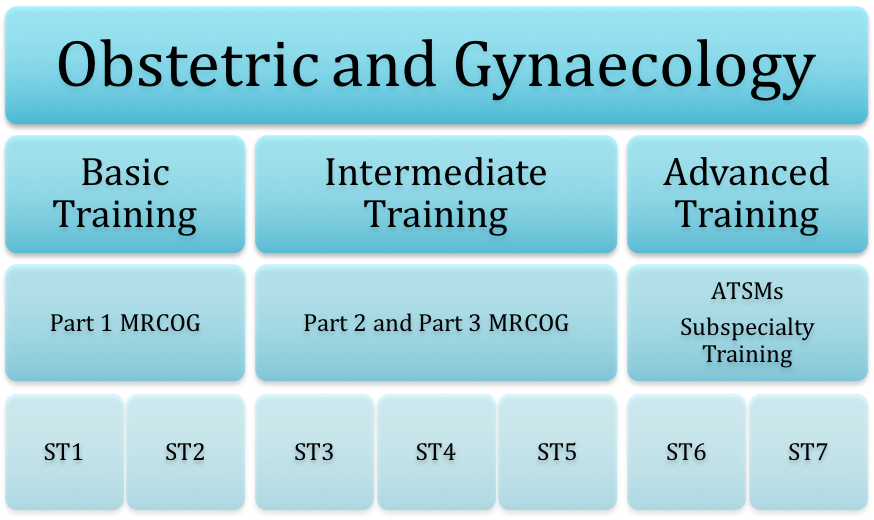 So coming next for me is to sit and pass MRCOG Part 1 and move into ST2. As an ST2, I will spend the first few months supernumerary, shadowing the registrar in both obstetrics and gynaecology and beginning to make senior decisions under direct supervision. Across the year, as I become more competent and confident I will meet with my supervisor to decide if they believe I can 'step up' into the senior rota and start working at a registrar level. The ARCP at the end of ST2 is when these decisions are formalised and personalised plans are put in place to support you as an ST3.
This blog was written by Suzie, an ST1 in NHS Glasgow and Greater Clyde.
So coming next for me is to sit and pass MRCOG Part 1 and move into ST2. As an ST2, I will spend the first few months supernumerary, shadowing the registrar in both obstetrics and gynaecology and beginning to make senior decisions under direct supervision. Across the year, as I become more competent and confident I will meet with my supervisor to decide if they believe I can 'step up' into the senior rota and start working at a registrar level. The ARCP at the end of ST2 is when these decisions are formalised and personalised plans are put in place to support you as an ST3.
This blog was written by Suzie, an ST1 in NHS Glasgow and Greater Clyde.
Further Reading
Obs & Gynae ST1 Interview Preparation and Essential Reading Obs & Gynae ST1 Interview Format 2026 Obs & Gynae ST1 MSRA and Essential ReadingPost ID: 28606 - Respiratory Medicine ST4 Interview 2026
Are you applying for Respiratory Medicine ST4 in the 2026 recruitment round? To support you with your application, we’ve put together a Respiratory Medicine ST4 interview guide. The guide covers everything you need to know about the application process. This includes the key recruitment dates, the interview format and how you’ll be assessed. To stand out with your application, you need to make a good impression, but before you do this, it’s helpful to have an idea of what you’re up against. In round 2 of 2025, there were 413 applications to Respiratory Medicine ST4. With 104 posts, the competition ratio was 3.97, meaning more than three people applied for each post. [custom_sales_panel title="Respiratory Medicine ST4" link="https://medibuddy.co.uk/st4-respiratory-medicine/interview-question-bank/"]
Respiratory Medicine ST4 Application
To be eligible to apply for Respiratory Medicine ST4, you must have completed internal medicine training (IMT) stage 1 programme or equivalent. You must also have one of the following:- MRCP Part 1 at the time of your application and MRCP full – Part 1 and Part 2 – by offer date
- Eligibility for the specialist register in general internal medicine by the time of your application submission (this must be approved by the GMC)
- Completion of Irish Basic Specialty Training in medicine and the MRCPI full diploma by offer date
Respiratory Medicine ST4 Application Scoring
Your Respiratory Medicine ST4 application will be scored based on your self assessment and supporting evidence. For your self assessment, you’ll answer questions relating to your achievements and qualifications, and be awarded scores based on the options you select. Your evidence documents are then used by assessors to verify these scores. For the Respiratory Medicine ST4 self assessment, 38 points are available across the domains, with an additional 2 points for evidence documents which are organised to a satisfactory standard. The Respiratory Medicine ST4 self assessment scoring domains are as follows:| Assessment area | Maximum score available |
|---|---|
| Postgraduate degrees and qualifications | 4 |
| MRCP(UK) | 8 |
| Presentations | 6 |
| Publications | 8 |
| Teaching Experience | 5 |
| Teaching Qualifications | 3 |
| Quality improvement | 4 |
Boost your Respiratory Medicine ST4 Application Score through Teaching
Gaining formal training in teaching can strengthen your Respiratory Medicine ST4 application. While postgraduate qualifications such as a PG Cert or PG Diploma can earn up to 3 points, they often take several months to complete and may not be practical before interview season. If you’re looking for a quicker option, attending a Live Teach the Teacher Course that includes at least six hours of live, synchronous teaching will award you 1 point on your application. Our course is available in both 1-day and 2-day formats, allowing you to choose the approach that best fits your timetable.Respiratory Medicine ST4 Recruitment Timeline
The Respiratory Medicine ST4 application process takes place twice a year, with interviews for round 1 of the 2026 recruitment process scheduled for March. You can find the key 2026 Respiratory Medicine ST4 recruitment dates in the table below:| Stage | Date |
|---|---|
| Advert appears | 19 November 2025 |
| Applications open | 20 November 2025 |
| Applications close | 11 December 2025 at 4pm |
| Evidence upload window | 17 December 2025 – 2 January 2026 |
| Interviews held | 2 – 4 March 2026 |
| First offers deadline | 14 April 2026 |
| Offer holding deadline | 22 April 2026 |
| Offer upgrade deadline | 23 April 2026 |
| Interview feedback release date | 24 April 2026 |
| Posts commencing from date | 5 August 2026 |
Respiratory Medicine ST4 Interview Format
The Respiratory Medicine ST4 interview is split across two stations. There are four questions in total, lasting 6-10 minutes each. Each station will be approximately 16 minutes in total, so including the time between the stations, you can expect the interview to last 40 minutes. Below, you’ll find what each question entails, along with how you’ll be assessed:Station 1 – Question 1 – Clinical Scenario
For the first question of the interview, you’ll be given a clinical scenario. The scenario will be a few sentences long, describing a hypothetical situation that you’re involved in. You can use the time before the discussion to either make notes or undertake some mental preparation. When reviewing the scenario, you should think about the following:- Your next steps
- The potential treatments
- How you would communicate with other people in the scenario
- Any further information you would gather
- Any other factors you deem appropriate
Station 1 – Question 2 – Application & Training
The second question focuses on your application form and training to date. The interviewers will ask you questions based on your career and achievements, while also exploring how you’ve engaged with training and learning so far. This question will last approximately 6 minutes. Remember, you’ve already been scored on your achievements in your application, so scores in this station are not purely for your achievements. Rather, the interviewers will award scores based on a combination of factors, including your responses to the questions, the breadth and quality of your achievements and your career progression.Station 1 – Question 3 – Communication mark
This is not a separate question, but a score for your communication across the station. You will be assessed and scored specifically on the communication skills you demonstrated with patients, colleagues, etc. in the scenario and with the interviewers throughout questions 1 and 2.Station 2 – Question 1 – Medical Registrar Suitability
Station 2 starts by exploring the non-clinical aspects of being a medical registrar, with a primary focus on two of the Capabilities in Practice (CiPs) from the Internal Medicine Stage 1 Curriculum. These are:- Managing an acute unselected take
- Managing a multi-disciplinary team including effective discharge planning
- What roles you’ve had and for how long
- How much responsibility you had, and how closely you were supervised
- What kind of team you were leading (e.g. number of people, mix of roles)
- Roughly how many patients you were looking after—both directly and indirectly
- Any non-clinical responsibilities you picked up during that time
Station 2 – Question 2 – Suitability & Commitment
The last question will cover your suitability and commitment to Respiratory Medicine training. This 6-minute question is a window of opportunity to build on the information you provided in your application form.Station 2 – Question 3 – Communication mark
Again, this is not a separate question, but you will be assessed on your communication throughout the station. This is an opportunity to score specific points by demonstrating strong communication skills in questions 1 and 2.Respiratory Medicine ST4 Interview Scoring
Each of the assessors will mark your interview performance separately, providing you with two scores for each section. As mentioned above, in addition to the four questions, the interviewers will also judge your communication skills for both stations. And after determining how well you perform in relation to the expected level, the assessors will give you a score between 1-5 for each question. A 3/5 means your performance was satisfactory, while a 4 or 5 means you’re above the expected level for a trainee. However, scoring a 1 or 2 means you have scored below the expected level, potentially leading to you being considered ‘unappointable’. The total of these scores gives you your Raw Interview Score (RIS). And with 6 assessment areas in your interview, you can expect to receive an RIS somewhere between 12 to 60. Before you can be considered an ‘appointable’ candidate, you must meet several points. Failure to do so will result in your application progressing no further. So, for your application to progress, you must meet the following criteria:- None of your 12 interview scores can be 1/5
- A maximum of two of your twelve interview scores can be 2/5
- A RIS of 36 or higher
Post ID: 23645 - Renal Medicine ST4 Interview: Complete Guide 2026
If you’re currently completing IMT3 and looking to apply for Renal Medicine ST4 (nephrology), we’ve created this guide to help you plan for your application and interview. We will provide everything you need to know about the interview timeline, format, and scoring to give you the best chance of success. For round 1 in 2025 there were 206 applications for 58 posts, giving a competition ratio of 3:55. This means there were more than three applicants for every renal medicine post. Bear in mind, however, that many applicants apply to more than one specialty. You can find out application numbers and competition ratios here (on the “data” tab).
Renal Medicine ST4 Interview Timeline
The key dates for renal medicine ST4 2026 recruitment are as follows:| Stage | Date |
|---|---|
| Advert appears | 19 November 2025 by 5pm |
| Applications open | 20 November 2025 at 10am |
| Applications close | 11 December 2025 at 4pm |
| Evidence upload window | 14 – 26 January 2026 |
| Interview window | 24 – 26 March 2026 |
| Offers released | 14 April 2026 by 5pm |
| Hold deadline | 22 April 2026 at 1pm |
| Upgrade deadline | 23 April 2026 at 1pm |
| Interview feedback release date | 24 April 2026 |
| Posts commencing from date | 5 August 2026 |
Renal Medicine ST4 Applications
Renal Medicine is a Group 1 specialty and you will dual specialise with general internal medicine. Candidates are therefore required to have completed the internal medicine training (IMT) stage 1 programme or equivalent. The only exception is for current intensive care medicine trainees who are applying with the intention to dual train in this specialty. For more information, please see the “Planning your application” tab here and take a look at the Renal Medicine ST4 eligibility criteria. As part of the shortlisting process, you will be assessed on your achievements to date. You can score points based on your commitment to specialty, postgraduate degrees, additional achievements (e.g. undergraduate prizes), MRCP Part 2 qualifications (note, no score is given for MRCP Part 1 as this is an essential eligibility requirement), oral presentations, publications, teaching achievements, quality improvement projects, and leadership and management. Therefore, gaining a full MRCP membership puts you on the right track to ensuring eligibility for Renal Medicine ST4 and boosting application points. Take a look well in advance at the scoring framework in order to identify any areas where you can maximise your points. You can find more information about the application form on the Physician Higher Specialty Training Recruitment website.Boost your Renal Medicine ST4 Application Score through Teaching
Gaining formal training in teaching can strengthen your Renal Medicine ST4 application. While postgraduate qualifications such as a PG Cert or PG Diploma can earn up to 3 points, they often take several months to complete and may not be practical before interview season. If you’re looking for a quicker option, attending a Live Teach the Teacher Course that includes at least six hours of live, synchronous teaching will award you 1 point on your application. Our course is available in both 1-day and 2-day formats, allowing you to choose the approach that best fits your timetable.What is the Renal Medicine ST4 Interview Format?
The Renal Medicine ST4 Interview can be daunting, but it needn’t be. Preparation is key. Take the time to familiarise yourself with the format of the interview, as well as the scoring framework. Some stations are more heavily weighted than others, so it may be worth focusing your attention on these. Practise your answers in front of the mirror and with colleagues. Perhaps even arrange an informal mock interview with a consultant so you have had a go under pressure. [custom_sales_panel title="Renal ST4" link="https://medibuddy.co.uk/st4-renal-medicine/interview-question-bank/"] Currently, the interview is split across two stations, each with two questions to answer. In station 1 you will also be assessed on your communication skills. This gives a total of 5 domains in which you are scored (clinical, ethical, communication, medical registrar suitability, and suitability and commitment to specialty). Each station will last 15 minutes. So, including the time between stations, you can expect the interview to take approximately 40 minutes.Station 1, Question 1 – Clinical Scenario
In this station of the Renal Medicine ST4 interview, the question will be based on a clinical case. You will be presented with a brief vignette and you will have several minutes to collect your thoughts before the questioning begins. During this time, you should consider the following:- The steps you might take
- Any possible treatment options
- Any further information you might try to gather
- How you’re going to communicate with those involved in the scenario, for example, patients, family members, colleagues, etc.
- Any other factors you consider appropriate, using your experience and professional judgement
 Remember, many applicants will have limited renal experience. You are not expected to answer the questions as a nephrologist, but rather you should demonstrate that you are a safe, logical and confident doctor. Escalate early and always discuss with your consultant if there are any concerns.
Common scenarios that typically come up in this station include (but are not limited to):
Remember, many applicants will have limited renal experience. You are not expected to answer the questions as a nephrologist, but rather you should demonstrate that you are a safe, logical and confident doctor. Escalate early and always discuss with your consultant if there are any concerns.
Common scenarios that typically come up in this station include (but are not limited to):
- Acute kidney injury
- The overloaded heart failure patient
- Line infection
- Thrombosed fistula
- PD peritonitis
Station 1, Question 2 – Ethical Scenario
Again, you will be given a brief vignette based on a clinical case. However, unlike the clinical scenario, the ethical scenario will not be given to you in advance so there is no preparation time. The focus will be on the moral, ethical and legal implications of the situation. You may be asked one or two follow-up questions related to the same case. You will be assessed on your responses to the ethical scenario and your knowledge of the different ethical and legal considerations required. Familiarise yourself with GMC Good Medical Practice, the four pillars of medical ethics, and key ethical principles, such as duty of care, clinical negligence, duty of candour, confidentiality, consent, capacity (and the Mental Capacity Act), advanced care planning, withdrawing treatment, ceilings of care and end of life decisions. Often this station will be based on a renal case, for example:- A patient with dementia who does not wish to continue haemodialysis. You may have to deal with capacity assessment and family discussions.
- A frail patient on haemodialysis who would like to have a second renal transplant. Discussion may surround capacity, fitness for transplantation, or alternatives to haemodialysis.
Station 1 – Communication Mark
The communication mark is not a separate question. However, you will receive a separate mark specifically for the communication skills which you demonstrate across the station, during the clinical and ethical scenarios. This will include not only an assessment of how you communicate during the scenario, for example with patients and colleagues, but also how well you communicate with the interviewers throughout the two scenarios. Here are some tips on how to maximise your communication mark in the Renal Medicine ST4 interview:- Structure your answer. After you have read the vignette, summarise your main concerns and what you will need to address. This will make it easier for the interviewer to follow your thought process and also demonstrate that you are a logical thinker.
- Remember, this is an interview for a registrar post. Do not waste time enumerating your ABCDE approach as you might for an IMT interview. Instead, treat the station as though you are having a clinical discussion with your examiner. Explain your thought processes, weigh up the pros and cons out loud, and demonstrate your thinking.
- Empathise with the patient/relative/colleague in question. Check the patient’s understanding, detailing how you would explain something. Demonstrate that you care.
- Speak slowly and clearly. Take your time and don’t rush.
- Practise how you might explain common conditions or procedures to a patient (e.g. haemodialysis, peritoneal dialysis, tunnelled line insertion etc.)
- And finally, body language is very important. Smile and try to enjoy yourself!
Station 2, Question 1 – Medical Registrar Suitability
This question will focus on the non-clinical aspects of being a medical registrar and will revolve around two of the Capabilities in Practice (CiPs) from the Internal Medicine Stage 1 Curriculum:- Managing an acute unselected take
- Managing a multi-disciplinary team, including effective discharge planning
 Often the line of questioning will ask you to give personal examples. Again, preparation is key. Make sure you have some examples in your armoury.
This question will last approximately 10 minutes.
Often the line of questioning will ask you to give personal examples. Again, preparation is key. Make sure you have some examples in your armoury.
This question will last approximately 10 minutes.
Station 2, Question 2 – Suitability & Commitment
This question examines your suitability and commitment to training in this specialty. It also gives you an opportunity to expand on the information you provided in your application form. Typically, you might be asked an open-ended question such as “Tell us about your commitment to ST4 training in nephrology, using examples from your portfolio”. Know your portfolio and prepare a structured answer in advance. Practise your response so that you are able to succinctly sum up your main achievements in about 2 minutes. Be able to talk about your strengths and relative weaknesses. You might also be asked where you see yourself in 5-10 years’ time, where you see the specialty evolving, and what challenges you anticipate. Most importantly, be enthusiastic. Consultants are looking for a trainee who is interested in their specialty and who they will enjoy working with and teaching. This question will last approximately 5 minutes.Renal Medicine ST4 Interview Scoring
For each station, a different pair of interviewers will assess you separately against the two questions/scenarios. They will mark you based on a framework, reflecting how you are expected to perform, giving you a score of 1-5 for each station.| Mark | Rating | Assessment |
|---|---|---|
| 1 | Poor | Not considered appointable |
| 2 | Area for concern | Performed below the level expected from a core level trainee applying to the specialty Possibly unappointable, subject to discussion and performance in other areas |
| 3 | Satisfactory | Performed at the level expected of a core level trainee applying to the specialty The candidate is suitable for a higher specialty training post |
| 4 | Good | Above average ability The candidate is suitable for a higher specialty training post |
| 5 | Excellent | Highly performing trainee The candidate is suitable for a higher specialty training post |
- None of your ten interview scores can be 1/5
- No more than two of your ten interview scores can be 2/5
- Your RIS must be 30 or above
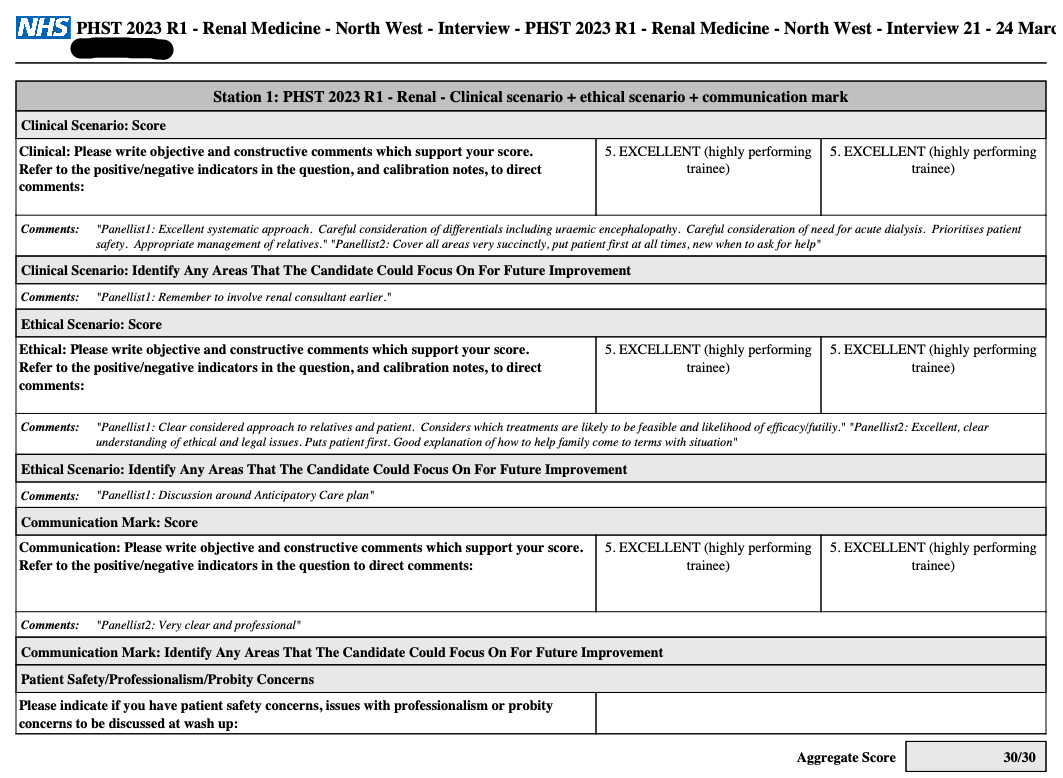
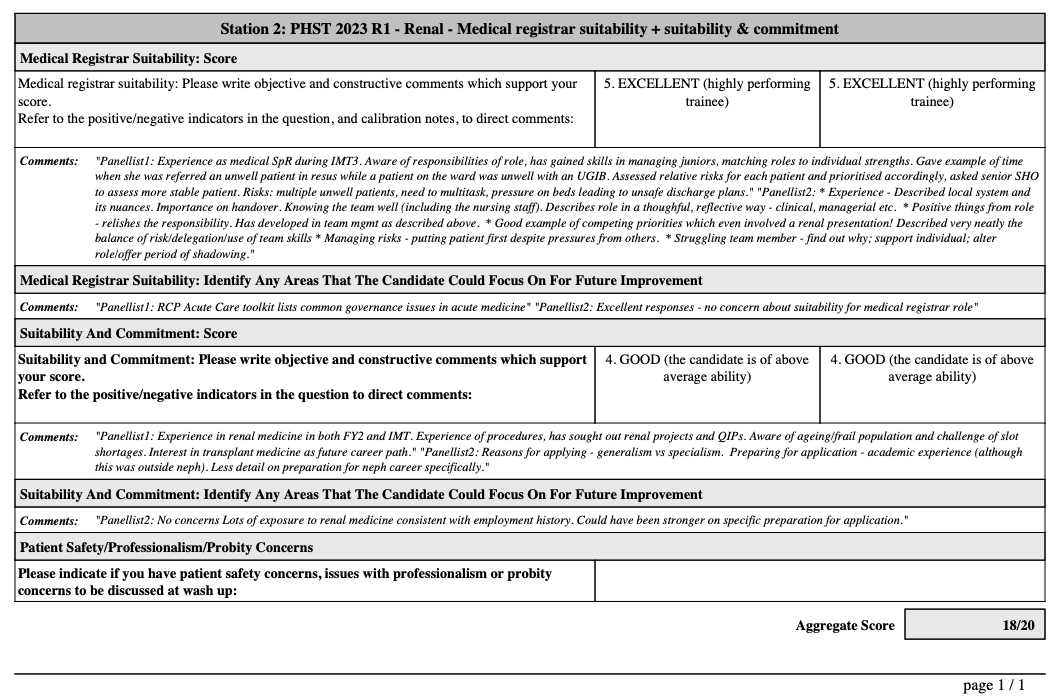
Total Score
After the interview, a weighting is applied to the scores in each area as well as to your application score, giving a total score. Your total score will determine your ranking and influence how subsequent offers are made. As you can see, the interview accounts for the bulk of your total score (80/100) and your application form only carries a small number of your total score (20/100). Note also that some stations carry more weight (e.g. clinical scenario and suitability and commitment). It may be worth focusing your attention on these stations during your preparation| Interviewer 1 | Interviewer 2 | Weighting | Max score | |
|---|---|---|---|---|
| Clinical scenario | /5 | /5 | 2.0 | 20 |
| Ethical scenario | /5 | /5 | 1.5 | 15 |
| Communication mark | /5 | /5 | 1.0 | 10 |
| Medical registrar suitability | /5 | /5 | 1.5 | 15 |
| Suitability and commitment | /5 | /5 | 2.0 | 20 |
| Raw interview score | /50 | |||
| Interview score (with weighting) | 80 | |||
| Application score | /50 | 0.4 | 20 | |
| Total score | 100 | |||
Further Reading
Post ID: 3819 - Neurology ST4 Interview Preparation and Essential Reading
Effective Neurology ST4 interview preparation requires an early and strategic approach to ensure you are ready to perform at your best. Success in the interview often hinges on demonstrating a strong understanding of neurology and showcasing your clinical knowledge and problem-solving skills. Familiarising yourself with Neurology ST4 interview resources is a key step in this process, as they provide valuable insights into the specialty and can significantly improve your confidence. Below, we’ve outlined suggestions to guide your preparation. Additionally, our Neurology ST4 Interview Question Bank is an excellent resource for practising the types of questions you’ll encounter, helping you to refine your responses and stand out during the interview.
Visit the ABN Website. Join the society.
The Association of British Neurologists (ABN) offers different membership tiers for junior doctors interested in neurology. Membership benefits include newsletters updating you on the hot topics in neurology (know about these!) as well as giving you the opportunity to attend their annual meetings (good opportunity to showcase your research).Read Practical Neurology
Making the most of Neurology ST4 essential reading materials is key to building a strong foundation in the knowledge and skills required for the interview. Practical Neurology is one of the most important resources for your future neurology training. It’s a free journal for members of the ABN and covers many topics important to the neurological curriculum. Knowing the topics covered here will certainly stand you in good stead if the topic arises in a clinical case. Once more, watch out for hot topics arising here. Up To Date also provides information about the current hot topics for 2025-26.Practice interview questions
Answering Neurology ST4 interview practice questions is a crucial part of your preparation, as it allows you to familiarise yourself with the types of scenarios and topics that are likely to appear during the actual interview. Our question bank has been written by previously high-scoring trainees and is updated every year to ensure the information provided is accurate, helping you maximise your chances of scoring highly in your interview.Talk to neurologists and neurology registrars
This is particularly important when it comes to the presentation station. Present this a few times to different people and have them ask you questions. Get them to really grill you. In reality, you will be well supported at the interview, but you may want to practice under pressure to make sure you really know your stuff.Practice making the question about you
There’s nothing more irritating than hearing the 25th candidate tell you the definition of a QIP. If you’re asked about something generic (such as audit, QIP, or governance), talk about your experience with it and showcase the evidence in your portfolio. You will be employed based on your experience and attitudes, not your ability to regurgitate audit cycle definitions and descriptions.On the day
You’ve applied and been invited to interview; well done! The interview process is challenging for many, but knowing what will happen on the day will help relieve your nerves. The current Neurology ST4 interview format consists of 4 question areas, and you will be invited via Oriel to choose an interview slot. The 2026 interviews will be online. Therefore, ensure you have a suitable place to undertake it from and have checked that your tech is up to the job. It is important for candidates to consider:- Microphone and camera – ensure you’ve checked that these work in advance. It's not something you want to be stressing about on the day. Consider the position of the camera – often, it's better to use a webcam that can be positioned ahead of you rather than a camera on your laptop, for example. Ultimately, find what works best for you to be seen and heard clearly.
- Internet connectivity – it goes without saying you will need to ensure you are somewhere with good internet connectivity.
- Background – be aware of your background and ensure your backdrop is clear. There are functions to blur your background, but it is definitely better to think about this in advance.
- Environment – you will need to be in a well-lit and quiet space. If there are others in the house, give them a heads up as to when your interview will be so there will be no interruptions!
Further Reading
Neurology ST4 Interview Format 2026 Check out all our Neurology ST4 Interview resources.Post ID: 59608 - Academic Clinical Fellowship (ACF) Interview Guide 2026
If you’re considering an Academic Clinical Fellowship (ACF), it’s worth knowing that these posts are among the most competitive in UK medical training. Each year, interest in combining clinical training with academic research continues to grow, and competition ratios can vary significantly depending on the specialty and deanery, in some cases reaching as high as 13 applicants per post. In this guide, we’ll walk you through how ACF recruitment works, key dates for the 2026 cycle, and what to expect at interview, so you can prepare effectively and give yourself the best possible chance of success.
What is ACF?
An Academic Clinical Fellowship (ACF) is a specialty training post that combines clinical practice with protected academic time. Typically, this means spending around 75% of your time in clinical work and 25% in academic research. ACFs are usually three years long (or four years for GP trainees) and are designed to give you the experience, skills, and track record needed to compete for a doctoral fellowship (PhD or MD) and eventually pursue a clinical academic career.ACF Key dates
ACF recruitment runs on a national timetable each year, coordinated through Oriel. Posts are advertised by local deaneries/IAT partnerships from October, with a main recruitment round followed by a re-advert window for any unfilled posts. Timelines can vary slightly between specialties and regions, so always check both the NIHR ACF recruitment guidance and your local deanery website for the most up-to-date information. Below are the key dates for the 2026 ACF recruitment cycle:| Stage | Date |
|---|---|
| Applications Open | 2 October 2025 |
| Applications Close | 30 October 2025 |
| Interview Window | 10 November 2025 — 16th January 2026 |
| Initial Offers | 20 January 2026 |
| Hold Deadline | 27 January 2026 |
| Return recruitment status updates to NIHR | From 3 February 2026 |
ACF Eligibility & Entry Requirements
Academic Clinical Fellowships (ACFs) are available across most GMC-recognised specialties and at a range of training levels, most commonly ST1/CT1, ST3, and ST4. To be eligible, applicants must meet both the clinical person specification for the chosen specialty and the academic person specification set for the ACF. If you do not already hold a National Training Number (NTN) or Designated Registration Number (DRN) for the specialty and level you are applying to, you will be appointed to the ACF and clinically benchmarked through the standard clinical recruitment process to ensure you meet the required clinical standards.The ACF Application Process
Your first step is to find available posts on Oriel. Search for “Academic Clinical Fellowship” and filter by specialty or deanery. You’ll find some ACF posts are designated as competition posts, aligned with NIHR research themes, and may span up to three different specialties. Next, you’ll need to submit your ACF application through Oriel. This form typically includes CV-style questions and requests evidence of your academic achievements, research experience, and relevant skills. Make sure all documentation is clear, concise, and accurately reflects your contributions. If you do not already hold a National Training Number (NTN) or Designated Registration Number (DRN) for the specialty and level you are applying to, you’ll also need to submit a clinical application to the standard recruitment round for benchmarking. Offers for ACF posts may be conditional on successfully passing this clinical benchmark, so it’s important to complete this step carefully.Shortlisting & interview
Once applications are submitted, candidates are first longlisted against essential criteria. Those who meet the minimum standards are then shortlisted and invited to interview if the competition is strong. ACF interviews are typically around 30 minutes and follow the NIHR evaluation framework, although the exact format may vary slightly between deaneries. You can expect the interview to assess both academic and clinical elements, reflecting the dual nature of the ACF post. Panels also have discretion over the exact wording of questions and may include a brief clinical scenario relevant to your specialty.Common academic stations
Interviews usually cover several academic areas. Candidates can expect to face questions such as:- Critical appraisal – explaining a paper or dataset, and then summarising it for a lay audience.
- Academic achievements – summarising your research contributions and personal role in projects or publications.
- Research interests – discussing how your interests align with the ACF post or NIHR research themes.
- Practical research experience – outlining hands-on experience in study design, methodology, or analysis.
- Challenges of combining clinical and academic roles – reflecting on how you would manage dual responsibilities effectively.
How ACF interviews are scored
While each deanery may use a slightly different scoring criteria, panels generally assess candidates on:- Scientific reasoning and data interpretation, including the ability to communicate complex findings clearly to both clinical and lay audiences.
- Academic track record and potential, appropriate for your career stage.
- Research knowledge and fit with the unit or NIHR theme.
- Practical research experience and methodological understanding.
- Professional skills, including communication, teamwork, leadership, and a realistic understanding of the ACF role.
Post ID: 3825 - Neurology ST4 Application Process 2026
The Neurology ST4 application process is designed to ensure you meet the essential criteria required to progress to the next stage of recruitment. This involves demonstrating key competencies, qualifications, and experience in your application form. To be eligible for the interview, you must hold an MRCP qualification or equivalent. While MRCP Part 1 must be successfully completed at the time of application, MRCP Part 2 must be passed by the offer date. The Neurology ST4 person specification provides a detailed breakdown of all essential requirements, so it’s vital to review this document thoroughly before submitting your application. Ensure your application is accurate and highlights your suitability for the specialty to maximise your chance of being invited to interview.
Neurology ST4 Self-Assessment
As part of the Neurology ST4 application process, you’re required to complete self-assessment questions that showcase your experiences and qualifications. These questions are designed to evaluate you across a series of key domains. A total of 38 points can be awarded for these domains, with an additional 2 marks available if your evidence is well-organised and submitted to a satisfactory standard. Attention to detail and thorough preparation are essential to maximise your score in this part of the process. You can find the breakdown of the self-assessment domains and their corresponding marks below:| Assessment area | Maximum score available |
|---|---|
| Postgraduate degrees and qualifications | 4 |
| MRCP(UK) | 8 |
| Presentations / posters | 6 |
| Publications | 8 |
| Teaching experience | 5 |
| Training in teaching | 3 |
| Quality improvement | 4 |
Boost your Neurology ST4 Self-Assessment Score by Training in Teaching
Completing a teaching qualification such as a PG Cert or PG Diploma can earn you up to 3 points on your Neurology ST4 application, but these courses often require significant time and may not be feasible before your interview. A faster alternative is our Live Teach the Teacher Course, which provides at least six hours of interactive, real-time teaching and gives 1 point toward your application. You can choose between a 1-day and a 2-day live course format to fit your schedule.Neurology ST4 Interview Dates
- The Neurology ST4 Interview consists of the following four questions: Application & Training / Suitability & Commitment
- Presentation
- Medical Registrar Suitability
- Ethical, Professionalism & Governance
| Stage | Date |
|---|---|
| Application window | 20 November – 11 December 2025 |
| Evidence upload window | 8 – 15 January 2026 |
| Interview window | 17 – 18 March 2026 |
| First offers deadline | 14 April 2026 |
| Offer holding deadline | 22 April 2026 |
| Offer upgrade deadline | 23 April 2026 |
| Advertised post start date | 5 August 2026 |
Neurology ST4 Offers Timeline
After your interview, you will receive a comprehensive breakdown of your performance, including your interview score and overall ranking. The Neurology ST4 offer timeline is structured to release offers in stages. This system ensures you are allocated your highest-preferred available post. If a higher-ranked preference becomes available in subsequent rounds, your offer may be upgraded accordingly. Good luck with your application!Useful Resources
Neurology ST4 person specification 2026 Meddibuddy Neurology ST4 Interview Question BankPost ID: 3828 - Neurology ST4 Interview Format 2026
Preparing for the Neurology ST4 interview requires you to meet specific requirements outlined for the 2026 intake. These include completing the IMT Stage 1 programme or an equivalent qualification, as neurology is a Group 1 specialty. All Group 1 specialties, including neurology, will dual accredit with General Internal Medicine. Further details about eligibility can be found in the Neurology ST4 person specification, which provides a comprehensive guide to the qualifications and experience required for this competitive training pathway. There’s also the MRCP to consider. You must have either successfully completed the MRCP(UK) Part 1 at the time of application and MRCP(UK) Part 2 by the offer date or completed the Irish Basic Specialty Training in Medicine and the MRCPI full diploma by the offer date to be eligible to apply. Being eligible for the specialist register in general internal medicine by the time of application is another alternative which will allow you to apply for Neurology ST4.
What is the Neurology ST4 Interview Format?
There are two ST4 Neurology Interview stations that each contain two questions. 15 minutes are allocated to each station, and the entire interview will last approximately 35-40 minutes. We have produced our Neurology ST4 Interview Question bank to help you prepare for your interview, including questions and themes that have come up in previous interviews. You'll see some examples from our question bank throughout this blog, which will give you an idea of what the question bank entails. Neurology ST4 interviews for 2026 are 17 – 18 March 2026.Station 1 - Question 1 - Application & Training / Suitability & Commitment (7.5 mins)
In previous years, this station was broken into two; Application and Training, and Suitability and Commitment, however, these stations have now been merged together. For this station, you will be asked one question that covers application and training, and suitability and commitment, and you will be scored on each of these areas. For the application and training part of this question, ensure you are familiar with the application that you submitted, as here you will be asked further questions about this as well as any training you have undertaken so far. To demonstrate your suitability and commitment, expand on the information provided in your application form, think about why you would be a good neurologist, what experience of neurology you have etc. Think about what inspired you to study neurology in the first place. Below is an example question from our interview question bank, where we provide example questions and answers to aid you in your Neurology ST4 interview preparation.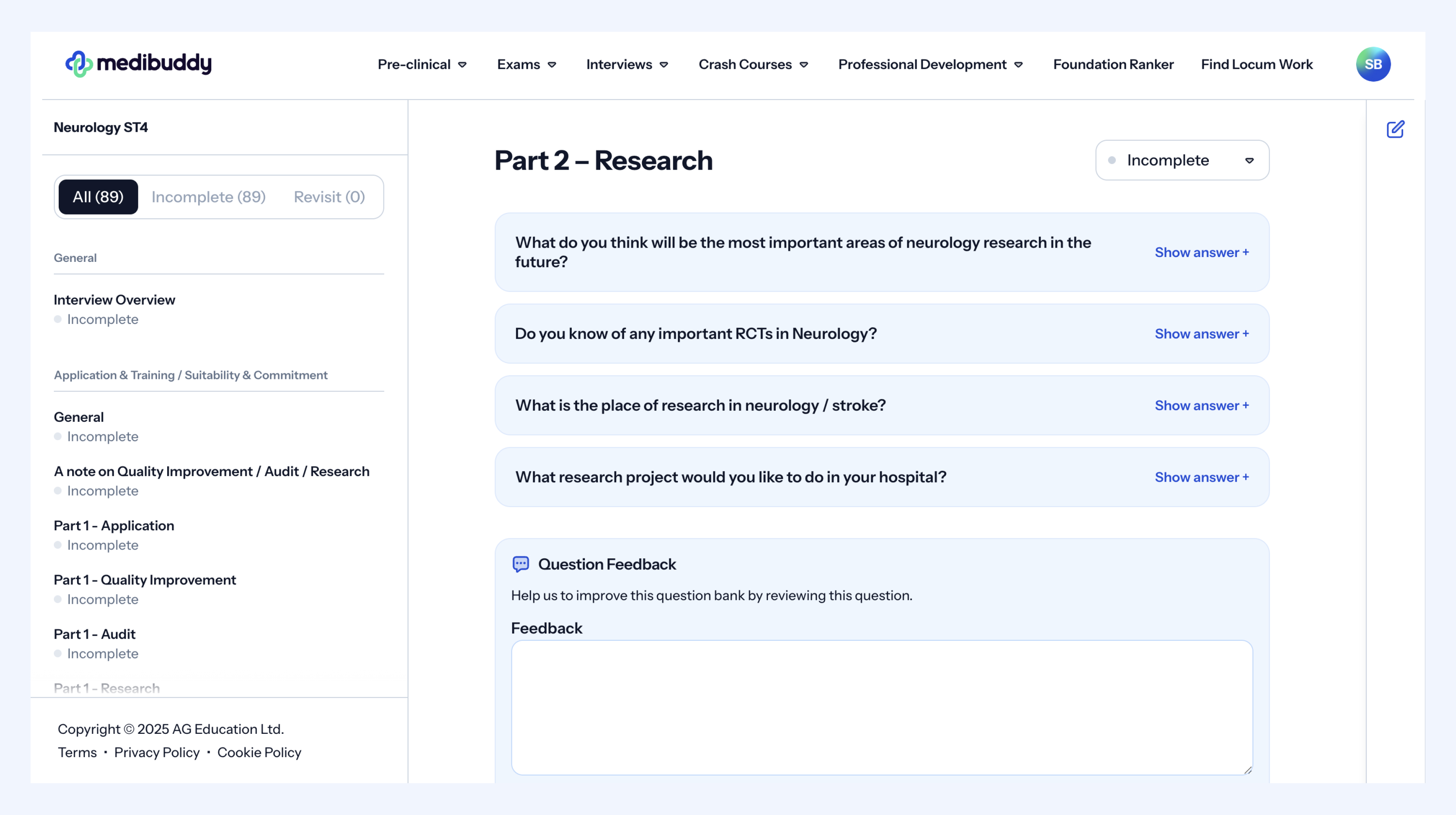
Station 1 - Question 2 - Presentation (approx. 4.5 minutes)
The topic for this question is ‘An interesting case I have been involved in/a case that has changed my practice’. You will be expected to present an interesting (neurological!) case you’ve been involved with. This doesn’t have to be ground-breaking stuff; any case that you found interesting personally will do. Choose wisely, the more interested you are in the case, the better you will present it. The interviewers will expect you to present the case over 3 minutes, followed by some discussion. This will be without multimedia backup: imagine presenting a patient over a cup of coffee. A few minutes of questioning will then ensue, so make sure you get across the salient points. If you know the diagnosis, be prepared to discuss differentials and treatments. Your knowledge of the in-depth particulars is not being assessed; rather the interviewers are looking for a clear communication style and that you recognise the learning points of the case being presented. To make sure you’re ready to present, practice in front of a mirror and film yourself. You can then watch the recordings back, take note of your body language, and ensure you’re speaking clearly. Our Neurology ST4 Interview question bank provides examples of presentations to give you an idea of how to approach this question area.Station 2 - Question 1 - Medical Registrar Suitability (7.5 mins)
The question looks at the non-clinical aspects of being a medical registrar, specifically focusing on two Capabilities in Practice (CiPs) outlined in the Internal Medicine Stage 1 Curriculum. These CiPs are vital for a medical registrar's role and include: Managing an acute unselected take: This refers to the ability to effectively handle the influx of patients during a busy period, where the patient mix may be varied and diverse. It requires prioritisation, efficient triage, and allocation of appropriate resources to ensure optimal patient care. Managing a multi-disciplinary team, including effective discharge planning: This involves the coordination and leadership of a diverse team of healthcare professionals to provide comprehensive care for patients. Additionally, it emphasises the importance of efficient discharge planning to ensure smooth transitions of patients from hospital to community care. You’ll also be required to give a one-minute presentation summarising your experience managing the acute unselected medical take as a medical registrar. Focus on outlining your key roles and responsibilities, how long you’ve held them, the level of supervision involved, and the size and structure of the team you managed. You can also briefly mention how many patients you were responsible for and any relevant non-clinical duties. Keep your presentation concise and well-structured; you’ll be stopped after one minute. After your presentation, interviewers may ask follow-up questions before moving on to discuss how you’ve managed different situations when leading a team caring for acute medical admissions. In our Neurology ST4 interview question bank, we provide example scenarios and questions to help you familiarise yourself and prepare for this station. We also encourage users to provide feedback whilst using the question bank and after the interview, so we can constantly update and improve on the question bank.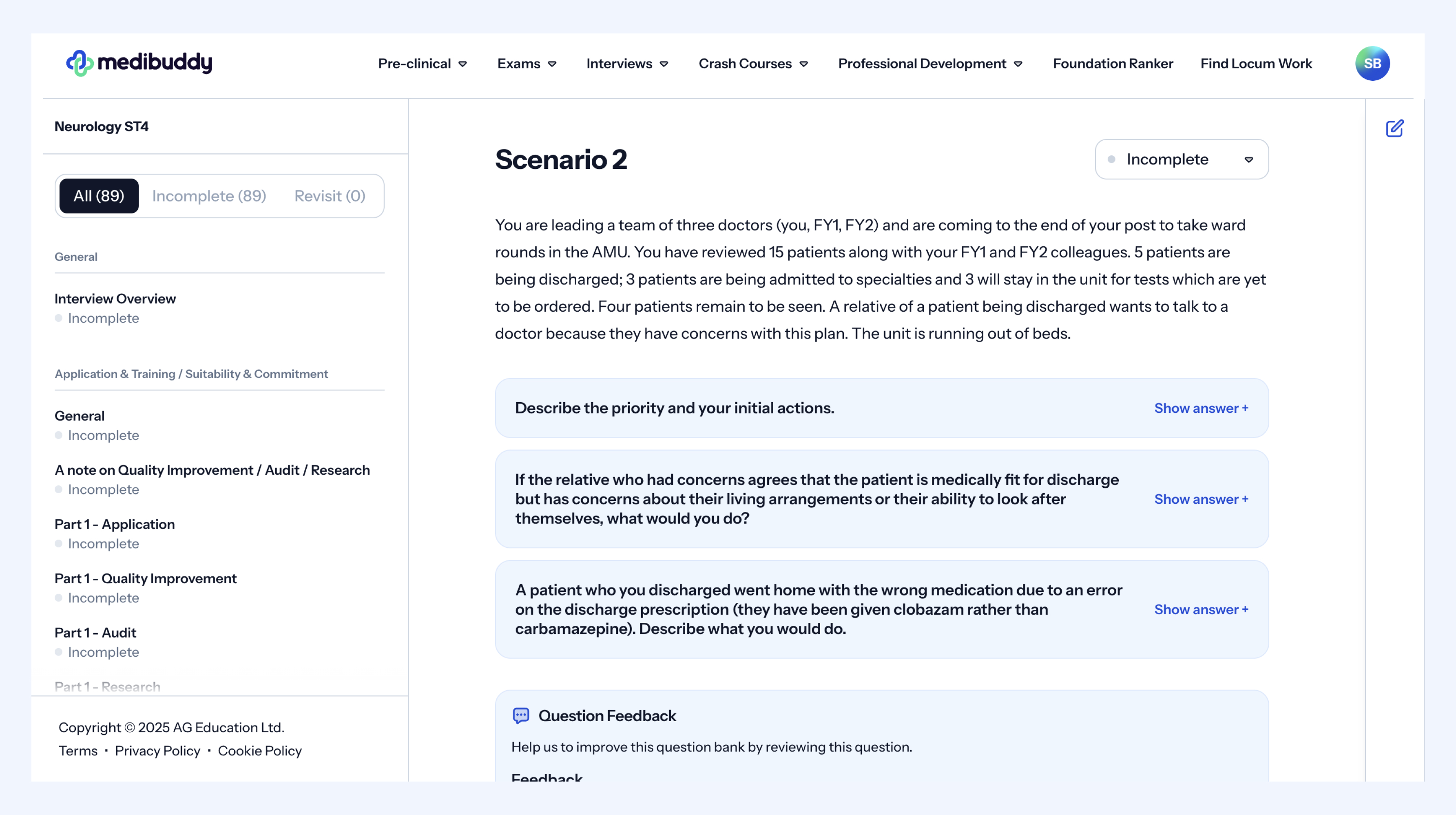
Station 2 - Question 2 – Ethical, Professionalism & Governance (7.5 mins)
For this question, the discussion will begin with interviewers posing a hypothetical situation that relates to ethical, professionalism, and governance issues. This hypothetical situation will not be provided beforehand but will be presented verbally after the previous question. You will have approximately 7.5 minutes to respond and answer questions addressing the moral, ethical, and legal aspects of the scenario. If there’s time, you may also be asked a couple of questions about GMC Good Medical Practice principles. Practising Neurology ST4 interview questions, like the example below from our question bank, can help you build confidence and familiarity with the types of scenarios you’ll encounter during the real interview. Successful candidates will reflect on their own experience in their answers; e.g. if asked about improving or identifying a problem within a service, you may wish to talk about the QIP you led the year previously and what the next steps are.
Familiarising yourself with the principles of Good Medical Practice will help you prepare, and if you can, it would be useful to chat with current registrars / senior doctors to be quizzed on topics.
Successful candidates will reflect on their own experience in their answers; e.g. if asked about improving or identifying a problem within a service, you may wish to talk about the QIP you led the year previously and what the next steps are.
Familiarising yourself with the principles of Good Medical Practice will help you prepare, and if you can, it would be useful to chat with current registrars / senior doctors to be quizzed on topics.
Neurology ST4 Interview Scoring
There are 5 scored areas in the interview, scored by two markers, based on how well you perform. This means there is a total of 50 points on offer. As a guide, marks are awarded according to the following quality markers: 0/1 – Very poor answer; does not grasp concept. 2 – Area for concern; falls below standard required for commencement of ST4. 3 – Average Answer; Standard expected of an average candidate applying to the specialty. 4 – Good Answer; Above average ability. 5 – Excellent Answer; a high performing trainee. Your raw interview score (RIS) is the sum of all 10 scores you receive, which will be between 10 and 50. Final points from the interview will be processed through a predefined formulae to combine the interview score with your shortlist score. The final mark will be published /100. The process of this and the formulae are available on the ST4 recruitment website. To note, candidates scoring ≤1 points will automatically be ranked as unappointable to an ST4 post and you cannot have more than two of your 10 scores as 2/5. Remember, you can prepare for each of the stations with our Neurology ST4 Interview Question Bank, written by previously high-scoring trainees to help you rank highly at interview. Good luck!Further Reading
Neurology ST4 Interview Preparation and Essential Reading Internal Medicine Training ApplicationsPost ID: 24909 - Gastroenterology ST4 Interview Guide 2026
This guide will tell you everything you need to know about the Gastroenterology ST4 application and interview. We cover the key application dates, the different interview questions and the scoring process, allowing you to prepare well and perform to the best of your ability. Gastroenterology is a popular pathway, so you can expect to face a lot of competition. In round 1 of 2024, there were 312 applications for 98 posts, resulting in a competition ratio of 3.18. This means more than three people applied for each post. Entry for 2025 was even more competitive, with 383 applicants for 104 posts, giving a competition ratio of 3.68.
Gastroenterology ST4 Application
Before you can be selected for an interview, you must submit your application form. The application form covers a variety of key areas, including your:- Qualifications
- Eligibility
- Language skills
- Health
- Career progression
- Fitness to practise
- Qualifications*
- Career progression
- Clinical experience
- Clinical skills
- Academic skills
- Personal skills
- Professional integrity
- Commitment to specialty
Boost your Gastroenterology ST4 application score by Training in Teaching
Completing a formal teaching qualification, such as a PG Cert or PG Diploma, can earn you up to 3 points on your Gastroenterology ST4 application. However, these courses can take months to finish and may not be achievable before interviews. A more accessible alternative is attending a Live Teach the Teacher Course that includes at least six hours of live, interactive teaching, which will give you 1 point on your application. We offer 1-day and 2-day live course options so you can choose the format that works best for you.Gastroenterology ST4 Key Dates
The following is an overview of the Gastroenterology ST4 2026 recruitment dates:| Stage | Date |
|---|---|
| Advert appears | 19 November 2025 by 5pm |
| Applications open | 20 November 2025 at 10am |
| Applications deadline | 11 December 2025 at 4pm |
| Evidence upload window | 19 December 2025 – 2 January 2026 |
| Interviews | 23 – 27 March 2026 |
| Initial offers released on | 14 April 2026 by 5pm |
| Hold deadline | 22 April 2026 at 1pm |
| Upgrade Deadline | 23 April 2026 at 1pm |
| Interview feedback release date | 24 April 2026 |
| Posts commencing from date | 5 August 2026 |
Gastroenterology ST4 Interview Format
The Gastroenterology ST4 interview is split across two separate stations. Each station consists of two questions, meaning you will have to answer four in total. You will have between 5 to 10 minutes to answer each question, and when combined with the time between the stations, you can expect the interview to take around 40 minutes. You’ll also be assessed on your communication throughout each station. This includes how clearly and confidently you express yourself, how you engage with the interviewers, and how effectively you would communicate with patients and colleagues in a real clinical setting. Below, we cover each question and what you can expect to be assessed on. We’ve also included some examples from our Gastroenterology ST4 interview question bank. [custom_sales_panel title="Gastroenterology ST4" link="https://medibuddy.co.uk/st4-gastroenterology/interview-question-bank/"]Station 1 Question 1 - Clinical Scenario
Before this question, you will be given a clinical scenario and a short amount of time to review it. The information regarding the scenario will be limited, only lasting for a couple of sentences, and will cover a hypothetical situation in which you’re involved. The following is an example from our Gastroenterology ST4 interview question bank: After reading the scenario, go over the information and prepare to answer several questions. You should use your experience to consider:
- The steps you would take
- The potential treatments
- What further information you would gather
- How you would communicate with patients, family members and colleagues
Station 1 Question 2 - Presentation
This question requires you to give a four-minute presentation on one of two topics. You can either prepare a presentation on:'An interesting case I have been involved in'.
OR
'An interesting recent development in gastroenterology'.
When preparing the presentation, you should consider the following points:- Clarity and relevance – The topic you choose should revolve around Gastroenterology. So, you must present with clarity, communicating the contents of the presentation effectively.
- The four-minute time limit – Your presentation can’t last longer than four minutes. If you go over this deadline, you will be stopped to allow time for the discussion. Therefore, you need to get your main points across in good time.
- No resources allowed – You can’t share your screen or use any visual representations like PowerPoint. However, you can use cue cards as prompts.
Station 2 Question 1 – Suitability & Commitment
This part of the interview examines your suitability and commitment to Gastroenterology and will last approximately seven minutes. The question allows you to expand on the information you provided in your application form. Below you’ll find an example of the type of question you may be asked in this section of the interview and how to approach it. This is taken from our Gastroenterology ST4 interview question bank.
Station 2 Question 2 – Medical Registrar Suitability
The final question of the Gastroenterology ST4 interview focuses on the non-clinical aspects of being a medical registrar. This covers two of the Capabilities in Practice (CiPs) from the Internal Medicine Stage 1 Curriculum:- Managing an acute unselected take
- Managing a multi-disciplinary team, including effective discharge planning
How is the Gastroenterology ST4 Interview scored?
Each of the four questions uniquely assesses you, allowing you to earn marks in the different areas of the interview. Both interviewers will score you independently, basing your marks on a specific framework. A score of 3/5 is considered satisfactory, reflecting the score of a trainee ready to progress to the next stage of their specialty. If your performance exceeds this level, interviewers can give you a score of 4/5 or 5/5. But, if your performance isn’t at the expected level, you can receive a score of 1/5 or 2/5. These scores are then combined to determine the success of your interview performance. Our Gastroenterology ST4 interview question bank provides high-quality questions and explanations covering all elements of the interview to help you perform as well as possible. You can learn more about our Gastroenterology ST4 interview question bank here. Good luck!Post ID: 32744 - Acute Internal Medicine ST4 Interview 2026
If you’re applying for Acute Internal Medicine ST4 in 2026, you’ll find everything you need to know here. Our Acute Internal Medicine ST4 interview guide includes the key recruitment dates, the interview format and how your performance will be scored. Because of its varied and dynamic nature, Acute Internal Medicine ST4 is a competitive pathway. Last year’s competition ratios demonstrate this, as there were 443 applications for the 100 posts on offer. This gave a competition ratio of 4.43, meaning that more than four people applied for each position.
Acute Internal Medicine ST4 Application
The Acute Internal Medicine ST4 application window is open from 20 November — 11 December 2025. The registration and application process takes around ten hours. The application form requires you to fill out information based on your career, experience and personal achievements. Later in the process, you’ll have to provide evidence for the claims you make. To be eligible for Acute Internal Medicine ST4, you must have evidence of having achieved Internal Medicine Stage 1 capabilities by one of the following methods:- UK Internal Medicine Stage 1 Training
- UK ACCS (internal medicine)
- UK Broad-Based Training (medicine route)
- a standalone UK IMY3 programme (following completion of UK core medical training/ACCS (acute medicine)
Acute Internal Medicine ST4 Application Score
For the 2026 Acute Internal Medicine application, there are 38 points available across 7 domains. Each domain will have various options, reflecting different levels of achievement. You will have to choose the response that best reflects your experience level for each of the following domains:- Postgraduate Degrees and Qualification
- MRCP(UK)
- Presentations
- Publications
- Teaching Experience
- Training in Teaching
- Quality Improvement
Boost your Acute Internal Medicine ST4 application score by Training in Teaching
Achieving a teaching qualification like a PG Cert or PG Diploma can add up to 3 points to your Acute Internal Medicine ST4 application. However, these qualifications often take considerable time to complete and may not be practical before interview season. An easier and quicker way to strengthen your teaching score is by attending a Live Teach the Teacher Course that provides at least six hours of interactive, real-time teaching. This will award you 1 point on your application. We offer both 1-day and 2-day live course options, allowing you to pick whichever format best suits your schedule.Acute Internal Medicine ST4 Key Dates
The Acute Internal Medicine ST4 recruitment process takes place twice a year, with the interviews for round 1 of 2026 taking place in February. You can find more key dates for the upcoming recruitment round in the table below:| Stage | Date |
|---|---|
| Applications open | 20 November 2025 |
| Applications close | 11 December 2025 |
| Evidence Verification Upload | 15 December 2025 — 5 January 2026 |
| Interview dates | 23 — 27 February 2026 |
| Initial offers released all regions | 14 April 2026 |
| Hold deadline | 22 April 2026 |
| Upgrading deadline | 23 April 2026 |
| Training start date | 5 August 2026 |
Acute Internal Medicine ST4 Interview Format
The Acute Internal Medicine ST4 interview is split across two stations. There are four questions in total, each lasting seven to eight minutes. So, when you consider the time between stations, you can expect the interview to last around 40 minutes.Station 1 - Question 1 - Clinical Scenario
You’ll be given a clinical scenario for the first question, describing a hypothetical situation that you’re involved in. The brief will only be a few sentences long, and you’ll have a short amount of preparation time to get ready to answer questions on the scenario. During this time, you should consider the following points:- Your next steps
- The potential treatments
- Any further information you would gather
- How you would communicate with patients, family members and colleagues in the scenario
- Any factors you deem appropriate based on your past experiences
Station 1 - Question 2 - Medical Registrar Suitability
This part of the interview will go over the non-clinical aspects of being a medical registrar, with a focus on two of the Capabilities in Practice (CiPs) from the Internal Medicine Stage 1 Curriculum. These are:- Managing an acute unselected take Managing a multi-disciplinary team, including effective discharge planning
- The questioning within this part of the interview will require you to think about your experience managing a team caring for acute medical admissions. To provide further weight to your answers, it’s important to provide specific examples that highlight this experience.
Station 1 - Question 3 - Communication Mark
This part of the interview isn’t strictly a question. But, the interviewers will judge you based on the communication skills you display throughout the station. This includes how you would communicate with the other people in the clinical scenario, as well as how you interact with the interviewers.Station 2 - Question 1 - Suitability and Commitment
The second part of the interview starts by focusing on your suitability and commitment to the Acute Internal Medicine specialty. This is your opportunity to build on the information you provided in your application form.Station 2 - Question 2 - Ethical, Professionalism and Governance
The final stage of the interview assesses your understanding of ethics, professionalism and governance in a given situation. You won’t receive the question ahead of time here. Instead, the interviewers will start the discussion by asking a question verbally.Acute Internal Medicine ST4 Interview Scoring
Each assessor will score you based on how you perform against the expected level, giving you a score between 1-5 for each section of the assessment. You can find the in-depth scoring framework below:| Mark | Rating | Assessment |
|---|---|---|
| 1 | Poor | Not considered appointable |
| 2 | Area for concern | Performed below the expected level of a trainee applying to the specialty. Progression to a higher level training post will depend on performance in other areas |
| 3 | Satisfactory | Performed to the expected level of a trainee applying to the specialty and suitable for a higher level training post |
| 4 | Good | Performed above the average level and suitable for a higher level training post |
| 5 | Excellent | High-performing trainee and suitable for a higher level training post |
- None of your interview scores can be a 1/5
- A maximum of two of your interview scores can be a 2/5
- A RIS higher than 30
Total Score
After the interview, a weighting is applied to each of the scores, giving you a total score. Your application score is included in this, although it only accounts for 20 marks. The bulk of your total score will come from your interview, where there are 80 marks up for grabs. When you break the interview down even further, you’ll find the clinical scenario and suitability and commitment sections are worth more than the others. Because of this, it’s worth spending more time preparing for these sections.| Interviewer 1 | Interviewer 2 | Weighting | Max Score | |
|---|---|---|---|---|
| Clinical scenario | / 5 | / 5 | 2.0 | 20 |
| Medical registrar suitability | / 5 | / 5 | 1.5 | 15 |
| Communication Mark | / 5 | / 5 | 1.0 | 10 |
| Suitability & Commitment | / 5 | / 5 | 2.0 | 20 |
| Professionalism and governance | / 5 | / 5 | 1.5 | 15 |
| Raw interview Score | / 50 | |||
| Interview score (w weighting) | / 80 | |||
| Application Score | / 50 | 0.4 | / 20 | |
| Total Score | / 100 | |||
Post ID: 29466 - Medical Oncology ST3: Interview Guide 2026
Are you looking for a 2026 Medical Oncology ST3 interview guide to help you with your application? Our guide covers everything relating to the application process, including the recruitment timeline, the interview format and how it’s scored. Last year’s competition ratio will give you an idea of what you’ll be up against in the upcoming recruitment round. In 2025, there were 319 applications for 101 posts. This resulted in a competition ratio of 3.16, meaning over three people applied for each post. We created this Medical Oncology ST3 interview guide to help you beat the competition. [custom_sales_panel title="Medical Oncology ST3" link="https://medibuddy.co.uk/st3-medical-oncology/interview-question-bank/"]
Medical Oncology ST3 Application
The Medical Oncology ST3 recruitment process occurs twice a year. For August 2026 start dates, the application window opens on 20 November 2025 and runs until 11 December 2025. The Medical Oncology ST3 eligibility criteria varies depending on your training background. For example, if you have a medical background, you must have completed the internal medicine training (IMT) stage 1 programme or equivalent and MRCP(UK) to be eligible. This includes finishing MRCP Part 1 by the time of application and MRCP Part 2 by the offer day. More information on the eligibility criteria can be found in the 2026 Medical Oncology ST3 person specification.Medical Oncology ST3 Application Scoring
Part of the Medical Oncology ST3 application form requires you to answer self-assessment questions. A total of 38 points are available across the following domains:| Assessment area | Maximum score available |
|---|---|
| Postgraduate degrees and qualifications | 4 |
| MRCP(UK) | 8 |
| Presentations / posters | 6 |
| Publications | 8 |
| Teaching experience | 5 |
| Training in teaching | 3 |
| Quality improvement | 4 |
Boost your Medical Oncology ST3 application score by Training in Teaching
Completing a higher teaching qualification, such as a PG Cert or PG Diploma, can add up to 3 points to your Medical Oncology ST3 application. However, these courses can be lengthy and often difficult to complete before the interview stage. An easier way to gain teaching points is by attending a Live Teach the Teacher Course with at least six hours of interactive, real-time teaching. This will give you 1 point towards your Medical Oncology ST3 score. Our 1-day and 2-day course options make it easy to fit into your schedule, whether you prefer an intensive or more in-depth experience.Medical Oncology ST3 Recruitment Timeline
The 2026 recruitment dates for round 1 of Medical Oncology ST3 are as follows:| Stage | Date |
|---|---|
| Application window | 20 November 2025 (10am) – 11 December 2025 (4pm) |
| Evidence upload date | TBC |
| Interviews | 19 – 20 March 2026 |
| First offers deadline | By 5pm 14 April 2026 |
| Offer holding deadline | At 1pm on 22 April 2026 |
| Offer upgrade deadline | At 4pm on 23 April 2026 |
| Interview Feedback release date | By 5pm on 24 April 2026 |
| Posts commencing from date | 5 August 2026 |
Medical Oncology ST3 Interview Format
The Medical Oncology ST3 interview is split across two stations. Each station consists of two questions, which take 5-6 minutes to complete. With each station taking 11 minutes, when you include the time between the stations, you can expect the interview to take around 30 minutes. You can find more information on the interview stations below, allowing you to see what each question entails:Station 1 Question 1 – Clinical Scenario
You’ll receive a clinical scenario at the start of the interview, which will only be a few sentences long. You’ll have a short time to review the scenario before facing approximately 6 minutes of interview questions. The clinical scenario will describe a hypothetical situation in which you’ve become involved. To prepare for the discussion, you should think about the following points:- Your next steps
- The potential treatments
- How you would communicate with other people involved in the scenario
- Any further information you would collect
- Any other factors you consider to be significant based on your experience
Station 1 Question 2 – Ethical, Professionalism and Governance
This part of the interview assesses your understanding of ethical, professionalism and governance issues in a specific situation and will last approximately 5 minutes. Unlike the previous part of the interview, you won’t receive a brief before the question, but rather verbally, once you’ve finished the clinical scenario. The assessment will be underpinned by the principles of the GMC’s Good Medical Practice, so it’s recommended that you refresh your knowledge of this.Station 2 Question 1 – Suitability and commitment
The part of the interview focuses on your suitability and commitment to Medical Oncology ST3 training. This question will last approximately 6 minutes and is an opportunity to build on the information you provided in the application form.Station 2 Question 2 – Academic/research
Station 2 ends with a general discussion about research and academic medicine. You don’t receive any specific information in advance for this question. But, it’s worth getting to grips with how medical research takes place, so you have an idea of the costs, challenges and benefits of conducting research. You can also look into areas of research that interest you. This question will last approximately 5 minutes.Medical Oncology ST3 Interview Scoring
Two separate assessors will score each question in your Medical Oncology ST3 interview. The scoring framework used to determine the scores you’ll be awarded is in the table below:| Mark | Rating | Assessment |
|---|---|---|
| 1 | Poor | Not appointable |
| 2 | Area for concern | Performed below the expected level - the ability to progress depends on performance in other areas |
| 3 | Satisfactory | Performed at the expected level - the candidate is suitable for the next level of specialty training |
| 4 | Good | Performed above the expected level - the candidate is suitable for the next level of specialty training |
| 5 | Excellent | High-performing candidate - the candidate is suitable for the next level of specialty training |
- None of your eight interview scores can be 1/5
- No more than two of your scores can be 2/5
- Your RIS must be 24 or higher
Post ID: 24916 - Dermatology ST3 Interview Guide 2026
We have created this guide to help you with the Dermatology ST3 application and interview process. Here, we cover the key application dates, what you can expect from each part of the interview and how your performance is assessed. Dermatology is a varied specialty, covering skin diseases, surgery and cancer in adults and children. Because of this, it’s a competitive pathway, which demands high standards from applicants. To provide an insight into how competitive Dermatology ST3 can be, we have compiled the competition ratios from 2025. There were 261 applications for 57 posts, leading to a competition ratio of 4.58. This means nearly 5 people applied for each post.
Dermatology ST3 Application
The process begins with completing your application form. Within this, you can expect to find sections asking for your:- Qualifications
- Eligibility
- Fitness to practise
- Language skills
- Health
- Career progression
Boost your Dermatology ST3 application score by Training in Teaching
Gaining higher teaching qualifications, such as a PG Cert or PG Diploma, can boost your Dermatology ST3 application score by 3 points. However, completing a higher qualification can be time-consuming and isn’t always realistic before interviews. A simpler option is to attend a Live Teach the Teacher Course that includes at least six hours of live, synchronous teaching, which will earn you 1 point on your Dermatology application. We offer both 1-day and 2-day live Teach the Teacher courses, so you can choose the format that best fits your schedule.Dermatology ST3 Recruitment Dates
If your Dermatology ST3 application is successful, you will be invited to an interview. For 2026, the key recruitment dates for Dermatology ST3 are as follows:| Stage | Date |
|---|---|
| Advert appears | 19 November 2025 by 5pm |
| Applications open | 20 November 2025 at 10am |
| Applications deadline | 11 December 2025 at 4pm |
| Evidence upload window | 6 —13 January 2026 |
| Interviews | 30 March — 1 April 2026 |
| Initial offers released on | 14 April 2026 by 5pm |
| Hold deadline | 22 April 2026 at 1pm |
| Upgrade Deadline | 23 April 2026 at 1pm |
| Interview feedback release date | 24 April 2026 by 5pm |
| Posts commencing from date | 5 August 2026 |
Dermatology ST3 Interview Format
The Dermatology ST3 interview is divided into three stations, and we have formatted our Derm ST3 Interview Question Bank like this to ensure you are closely matching the interview structure when practising. There will be multiple questions within every station, each lasting approximately seven minutes. That means you can expect the interview to take around 30-35 minutes when you include the time spent between stations. You will also be marked on your communication skills, giving you a total of four assessment areas. Below, you can find the details of each station:Station 1 - Research & Academic Medicine
This stage of the interview focuses on academic medicine. You’ll be given a clinical scenario to review briefly before the question begins. From there, you’ll be asked to discuss research methodology and how you would approach or answer the question presented.
You’ll be assessed on your understanding of the academic issue, so focus on identifying the key findings and demonstrating a critical approach to analysis.
An example of this from the Medibuddy Dermatology ST3 interview question bank can be seen below:
Station 2 - Clinical Scenario
For this station, you will have a clinical situation to consider, this will be dermatology related. The scenario will describe a hypothetical situation that you’re involved in. Here, the interviewers will give you a brief vignette about a patient before asking for your initial response. The interviewers will then ask a series of follow-up questions to determine how you would investigate and manage the case. To prepare for the discussion, you should consider the following points:- The steps you would take
- Potential treatments
- The additional information you would gather
- How you would go about communicating with the people involved in the scenario
- Any other factors you’re aware of due to your experience
 You will be assessed on your responses to the clinical scenario, as well as the communication skills you display throughout the station.
Station 3 - Suitability & Commitment
This station will very much focus on YOU – to assess your suitability and commitment to Dermatology. It will allow you to build on the information you provided in your application form. Again, example questions and guidance on how to answer “suitability and commitment” questions can be found in our Dermatology ST3 interview question bank. An example of this is shown below:
How is the Dermatology ST3 Interview Scored?
Each interviewer will assess your performance independently, so you will receive two scores for each part of the interview. The interviewers will use a specific scoring framework and provide you with a score for each area of assessment. The interviewers will award you a 4/5 or 5/5 if they deem your performance to be above the expected level. A 3/5 is a satisfactory score, reflecting the performance level of a trainee who’s ready to progress. However, a score of 1/5 or 2/5 means that the interviewers are concerned about an element of your performance. The scores from each area of the interview are then combined to give you a raw interview score (RIS) between 8 and 40. To be classed as ‘appointable’, you must meet the following criteria for your interview scoring:- None of your 8 interview scores can be 1/5
- A maximum of 2 of your interview scores can be 2/5
- Your RIS must be 24 or more
Post ID: 4683 - MSRA: Complete Guide 2026
Over half of all resident doctors applying for Specialty Training posts each year will need to undertake the Multi-Specialty Recruitment Assessment (MSRA); our complete guide will provide you with information for the MSRA 2026.
Multi-Specialty Recruitment Assessment / MSRA Exam
The MSRA is a computer-based exam designed to assess essential competencies and is used as part of the application and/or shortlisting process in several postgraduate medical specialties. Depending on the specialty, your MSRA score may either contribute a percentage to your overall selection score or be used as a minimum threshold that you must meet to progress to the next stage. You can find a few examples of specialites that use the MSRA in their recruitment process below:- ACCS Emergency Medicine CT1/ST1
- Anaesthetics CT1/ACCS
- Clinical Radiology ST1
- Community Sexual and Reproductive Health ST1
- Core Psychiatry Training CT1
- Core Surgical Training CT1
- General Practice ST1
- Nuclear Medicine ST3
- Neurosurgery ST1/ST2/ST3
- Obstetrics and Gynaecology ST1
- Ophthalmology ST1
Test Centre Locations
The MSRA is delivered in Pearson VUE test centres across several consecutive days within the MSRA window. The exam is offered throughout the UK and internationally; you can find your closest test centre here. It’s worth noting that there may not be availability at your nearest or preferred Pearson VUE test centre, due to the demand within the short assessment window, so you may be required to travel further to sit your exam. Please note: currently, all MSRA invitations will be for MSRAs delivered within a Pearson VUE test centre; however, once you receive your invitation, you can apply for a remote test ‘by exception’ if you meet the criteria set to do so. Requests for remote examinations are assessed and approved on a case-by-case basis. You can find out more remote testing for the MSRA here.MSRA Exam Dates 2026
Once the application window has closed for your chosen specialty and successful candidates have been longlisted, you’ll be invited to register with Pearson VUE and book your MSRA, if you meet the eligibility criteria outlined during the application process. Although the application deadline date and the MSRA assessment window are the same across the specialties, the MSRA registration invites will be sent out at different times, depending on the longlisting timeframe, which may affect the test centre availability when you come to register. Please note that if you fail to register and complete the MSRA, your application will be withdrawn. The 2026 MSRA exam dates are 6 — 19 January 2026 and 12 — 25 February 2026. The February 2026 MSRA exam dates are solely for applicants who apply to Core Psychiatry and/or General Practice. You can find more information about the MSRA sittings and allocation process here. So you can pick the most suitable option for you and your test date, the Medibuddy adaptive, personalised MSRA question bank offers three subscription options that vary in price depending on the length of the subscription you need. [msra_subscriptions]MSRA Exam Cost
There is no charge for the assessment; however, you may incur travel and accommodation costs, which will not be reimbursed, so it’s advised that you book your assessment as soon as possible to avoid missing out on your closest test centre.Structure of MSRA
The MSRA is separated into two sections, and you can see an example of a question from each section in our question bank below.Professional Dilemmas Paper
Clinical Problem Solving Paper
Both elements of the exam are based on the Foundation Programme curriculum and are designed to assess how you apply your clinical knowledge to support you to make clinical decisions.
How Many Questions in the MSRA?
| MSRA Paper | Number of Questions | Test Time |
|---|---|---|
| Professional Dilemmas (PD) | 50 scenarios | 95 minutes |
| Clinical Problem Solving (CPS) | 86 questions | 75 minutes |
Professional Dilemmas Paper
The Professional Dilemmas Paper is a Situational Judgement Test (SJT) designed to assess your response to situations involving challenging professional dilemmas. Although a general understanding of typical primary/secondary care work is required, the Professional Dilemmas Paper does not assess specific knowledge within speciality training or your problem solving skills. Rather, it focuses on professional attributes and behaviours when interacting with patients and colleagues, and requires you to demonstrate your judgement regarding the most appropriate behaviours within given scenarios. The paper centres around the following core areas:- Professional Integrity
- Coping with Pressure
- Empathy and Sensitivity
Format of the Professional Dilemmas Paper
The Professional Dilemmas Paper is separated into the following two parts, with around half of the 50 scenarios for each question type:| Part 1 - Ranking | Part 2 - Multiple Choice |
|---|---|
| You will be given scenarios and asked to judge the appropriateness of four or five independent actions in response to the situation presented. You will be required to rank the actions in order from the most to the least appropriate response to the situation. | You will be given eight plausible actions for each scenario and asked to select the three most appropriate actions. You will be required to consider the appropriateness of each individual action and select three responses that will fully resolve the situation when used in combination. |
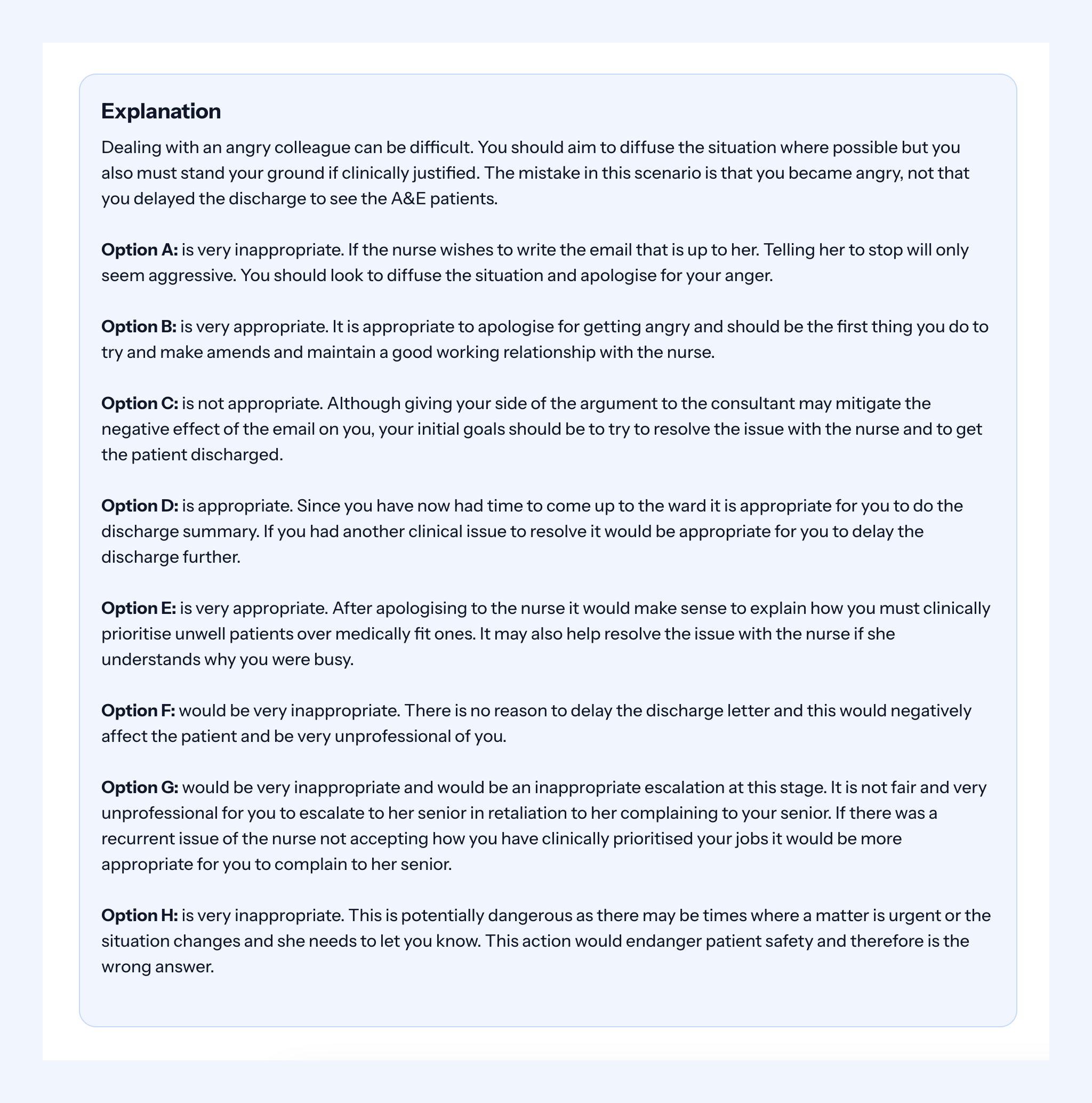
Clinical Problem Solving Paper
The Clinical Problem Solving Paper is designed to assess your ability to apply your clinical knowledge and make clinical decisions within the context of everyday practice. Although the scenarios are relevant to foundation level clinical practice (FY2), it does not aim to simply assess your recall of knowledge, but focuses on your ability to synthesise and apply your medical knowledge appropriately.Format of the Clinical Problem Solving Paper
You will be presented with clinical scenarios and required to utilise your judgement and problem solving skills to determine the appropriate diagnosis and treatment of patients. Within the 86 questions, there are two types of questions, making up roughly half of the questions each. The question types are:| Extended Matching Questions | Single Best Answers |
|---|---|
| You will be given a set of responses (usually between 7 - 10) and asked to select the most appropriate option for multiple, individual scenarios. Each of the responses may be used once, more than once or not at all when selecting a suitable option for each scenario. | You will be given a set of responses (usually between 5 - 8 in this instance) and asked to select the most appropriate option for a single scenario. |
- Cardiovascular
- Dermatology / ENT / Eyes
- Endocrinology / Metabolic
- Gastroenterology / Nutrition
- Infectious Disease / Haematology / Immunology / Allergies / Genetics
- Musculoskeletal
- Paediatrics
- Pharmacology and Therapeutics
- Psychiatry / Neurology
- Renal / Urology
- Reproductive
- Respiratory
- Investigation - Focusing on specific investigations to support a more conclusive diagnosis or to rule out possible causes of illness / injury.
- Diagnosis - Evaluating the symptoms presented by a patient to identify a possible condition, disease or injury.
- Emergency - Recognising patient risk and a potential serious illness requiring immediate action.
- Prescribing - Advising, authorising or reviewing a patient’s clinical management plan - specifically the use of medicine / drugs.
- Management (non-Prescribing) - Advising, authorising or reviewing a patient’s clinical management plan - specifically the use of non drug-related treatment.
When working through your questions, the AI-powered algorithm will carefully select questions for you. You won’t just answer questions in a random order; instead, each question will be carefully selected based on your strengths and weaknesses within the syllabus.
MSRA Results
Shortly after the MSRA testing window has closed, your MSRA result will be available within your Oriel account against your application shortlist scores.How is the MSRA scored?
For the Clinical Problem Solving paper, one mark is awarded for each correct response. The Professional Dilemmas paper is scored against pre-determined keys to make the test standardised and fair for all candidates. This involves comparing your responses to the pre-determined key – i.e. the model answer combination – and awarding you marks based on how closely matched these are. The closer your responses are to the pre-determined key, the more marks you’ll be awarded; however, you can still pick up points even if your answer doesn’t completely match this. As there is also no negative marking, it’s worth attempting to answer all the questions. Remember, you can still pick up some marks on answers which aren’t entirely correct, but you won’t receive any marks for missed questions. Each specialty uses the MSRA score differently, so check the specific national recruitment websites for further guidance on your chosen speciality. For the majority of specialties, your score will be used to shortlist for interview, and contribute to your overall ranking, along with your interview score. Details of how the GP application process incorporates the MSRA score are given below as an example:GP entrance exam / MSRA GP
For GP applicants, your offer and location of your offer will depend solely on your MSRA score, as opposed to an interview being included like in previous years. Some locations are much more popular than others, so will require a higher MSRA score to be in line with the competition. The score for each paper is normalised; this is usually around a mean score of 250, but as normalisation is dependent on each year’s average scores, there could be a variation of up to 40 marks either side of the mean score. The scores for each paper are also banded (1 – 4), with a band one indicating that the minimum threshold has not been met. If you achieve a band one in either of the papers, you will not be able to progress with your application. However, if you are unsuccessful in achieving the acceptable standard, it is possible to resit the MSRA within a different assessment window, as long as it’s within the same recruitment year. If you achieve a passable score (bands 2-4), you will not be able to resit the MSRA within the same recruitment year.How to prepare for the MSRA / MSRA Exam Preparation
While your previous studies and work as a junior doctor will have prepared you for some of the questions and scenarios within the MSRA, it’s advisable to allow adequate revision time for the MSRA, as you would with any other exam. The following tips will help you with your MSRA preparations: 1. Allocate as much time as you can to preparing for the MSRA
The more practice questions you do, the more chance you have of scoring a higher score; it’s that simple.
2. Familiarise yourself with the topics that will be covered within the Clinical Problem Solving Paper
Dedicate enough time to covering each specialty to ensure that you are confident in all areas that will be included within the paper. Focusing on one specialty at a time will also allow you to identify common themes and consolidate your learning within each topic. Your mastery level for each topic in the Medibuddy MSRA question bank will help you decide which areas you should focus on.
3. Include timed papers within your MSRA preparations
Exposure to timed practice papers will give you a realistic view of how much you’ll get through within the time frame/how long you'll have to check back through your answers. Practice completing the two papers back to back so you’re used to the demands of the full MSRA - almost three hours completing an exam is no easy task.
1. Allocate as much time as you can to preparing for the MSRA
The more practice questions you do, the more chance you have of scoring a higher score; it’s that simple.
2. Familiarise yourself with the topics that will be covered within the Clinical Problem Solving Paper
Dedicate enough time to covering each specialty to ensure that you are confident in all areas that will be included within the paper. Focusing on one specialty at a time will also allow you to identify common themes and consolidate your learning within each topic. Your mastery level for each topic in the Medibuddy MSRA question bank will help you decide which areas you should focus on.
3. Include timed papers within your MSRA preparations
Exposure to timed practice papers will give you a realistic view of how much you’ll get through within the time frame/how long you'll have to check back through your answers. Practice completing the two papers back to back so you’re used to the demands of the full MSRA - almost three hours completing an exam is no easy task.
MSRA Exam Practice
As mentioned for Obstetrics and Gynaecology ST1, in some cases, a high score can allow you to skip the interview section of the application and be ranked above fellow applicants, therefore increasing your chances of receiving a training offer in your preferred programme/location. While General Practice ST1 and Core Psychiatry Training CT1 don’t include an interview; instead, they assess and rank applicants solely on their MSRA score. So it’s worth investing the time preparing for the MSRA exam. To effectively revise for the questions/scenarios that may appear on the MSRA, invest your time in completing practice questions and full timed mock exams.MSRA Practice Questions / MSRA Question Bank
To really show off your skills and achieve a high score on the MSRA, it’s worth putting in the effort to revise for the assessment. Completing a combination of practice questions and full practice exams during your revision for the MSRA will help you to fully prepare for the exam. 1. Practice Question Banks You can work through the MSRA practice questions in your own time, allowing you to familiarise yourself with the different question formats and types of scenarios you will encounter in the exam. 2. Timed Practice Test By mimicking the exam conditions, you can develop your speed to ensure that you can complete all the questions within the timeframe, and your stamina to complete the two papers. When choosing your MSRA preparation resources, it is important to think about the costs involved, the quality of the questions and the number of questions, and the platform being used. Naturally, we are big fans of our adaptive MSRA question bank, and we have included a comparison table below to show how different resources compare. [msra_comparison]How artificial intelligence technology can improve your MSRA score
The Medibuddy team is a group of doctors with a special interest in using the latest educational technology to improve medical education. Personalised learning, where educational content is tailored to someone’s individual strengths and weaknesses (think 1-on-1 tutoring or small group learning) has been shown time and time again to beat non-personalised learning (lectures, textbooks, non-adaptive question banks, etc.) when it comes to exam scores. Until now, the only way to access personalised learning for exams like the MSRA was to pay for expensive courses. These don’t represent value for money for most candidates who instead use question banks to prepare for their exam. Question banks are a great way of breaking down information into bitesize chunks, but they are an inherently inefficient way to prepare for an exam. You answer questions in a random or pre-set order that bears no relation to the gaps in your knowledge or the topics that would give you the biggest boost in your exam score. This is fine if you’re the kind of person who completes multiple question banks, multiple times before an exam. It doesn’t matter if the questions you answer aren’t targeted because by doing thousands and thousands of questions, you’ll eventually cover your knowledge gaps anyway. However, the majority of us aren’t able to do this much preparation before a postgraduate exam (which is why failure rates are so high!). When you’re working nights, weekends or normal days which overrun, it’s hard to find the time! This is why we’ve released the Medibuddy MSRA Adaptive Question Bank. Our question bank is the only one on the market that uses machine learning algorithms to identify your strengths and weaknesses, ensuring that every minute of your revision is focused on maximising your exam score. It’s also the largest on the market, offering over 4000 questions written specifically for the MSRA. Our super smart question bank adapts to YOU, providing all the benefits of personalised learning at a fraction of the cost of a course. We're really excited about it (I'm sure you can tell!) and probably a bit biased, but we think it's the best way to prepare for the MSRA in 2026!MSRA Tips
Hopefully this has provided you with basic information about the MSRA to help you to begin your preparation for the exam. Below are a few final nuggets of information to support you with your MSRA preparations:- Pearson VUE provides a generic tutorial which gives you the opportunity to familiarise yourself with the controls and screen layout of the exam - useful so you know what to expect when it comes to the exam, so no time is wasted trying to figure these out.
- During the exam, there is a glossary of frequently used terms and a list of abbreviations - great to use if you’re less familiar with the UK medical system or if you just have a moment of panic and go blank.
- It’s so basic, but remember to read the question carefully – it’s easy to miss things when you’re rushing, and the information provided will help you give the best possible answer to the question.
- We mentioned it already, but remember the papers are not negatively marked, so answering a question will always be better than leaving it blank.
- Medibuddy - A Guide to GP Recruitment 2025
- Multi-Specialty Recruitment Assessment (MSRA) - Information
- NHS GP Recruitment - MSRA Guidance for Applicants
- NHS GP Recruitment - Recruitment Timelines and Vacancies (ST1 & TGPT)
Post ID: 25508 - Community and Sexual Reproductive Health (CSRH) ST1 Interview Guide 2026
Community and Sexual Reproductive Health (CSRH) ST1 marks the beginning of a six-year specialty training programme. Getting on the programme isn’t easy, as the CSRH pathway is one of the most competitive specialties in medicine. In 2025, there were 1,379 applications to the ST1 Community and Sexual Reproductive Health (CSRH) speciality, with only 14 posts available. The competition ratio was 98.50, meaning nearly 100 people applied for each post! With a high level of competition for places, you need to make sure that you prepare well and submit the best application possible. To help, we have created a Community and Sexual Reproductive Health (CSRH) ST1 interview guide. This guide includes everything you need to know about the application process including the timeline and format of the interview. [custom_sales_panel title="CSRH ST1" link="https://medibuddy.co.uk/st1-csrh/interview-question-bank"]
Community and Sexual Reproductive Health (CSRH) Application
Health Education England coordinates the national process for recruiting trainees into Community Sexual and Reproductive Health (CSRH) ST1 level posts. You can only submit your application through the online application system, Oriel. You will need to complete all parts of the Application Form. No application form will be accepted after the deadline, no matter the reason. To ensure a fair process, there are no exceptions to this. Because of this, candidates are advised to submit their application form well before the deadline. Also, everyone applying for Community Sexual and Reproductive Health (CSRH) ST1 will be required to take a Multi-Specialty Recruitment Assessment (MSRA). The test is a mandatory computer-based assessment, made up of two papers, the Professional Dilemmas Paper and the Clinical Problem Solving Paper. A full breakdown of the topics you'll be assessed on can be seen in our MSRA question bank dashboard (below). [caption id="attachment_25391" align="alignnone" width="3040"] Medibuddy MSRA Question Bank Dashboard[/caption]
The results of the MSRA will help to determine the ranking of each candidate. This, along with the places available at the time, will influence who’s invited to an interview. You can prepare for this using our adaptive, AI-powered MSRA question bank.
[msra_sales_panel]
The MSRA score isn't used for ranking beyond this, and there is no option to bypass the interview due to a high MSRA score, as with some other specialties. Those who fail to attend the test will be removed from the selection process.
Community and Sexual Reproductive Health (CSRH) Interview Timeline 2026
The interview timeline for 2026 is below:| Activity | Date |
|---|---|
| Applications open | 23 October 2025 at 10am |
| Applications close | 20 November 2025 at 4pm |
| NROs to instruct their applicants to register with Pearson VUE | 25 November 2025 |
| Invitation to book Multi-Specialty Recruitment Assessment | 15 December 2025 |
| Multi-Selection Recruitment Assessment (MSRA) Window | 6 — 19 January 2026 |
| Applicants advised of MSRA results | TBC |
| Preferences | TBC |
| Interview dates | 17 — 18 March 2026 |
| Initial offers released | 24 March 2026 by 5pm |
| Holding deadline | 2 April 2026 until 1pm |
| Upgrade deadline | 8 April 2026 until 4pm |
Community and Sexual Reproductive Health (CSRH) Interview Format
With a limited number of posts available, only a small proportion of applicants will progress to the interview. The interview will last for around 30 minutes. There will be two assessors on the panel. Each assessor will score you out of 60, meaning there's a total of 120 marks available. The Community and Sexual Reproductive Health (CSRH) interview will cover the following four key areas:- Communication (Presentation) Information about the presentation will be provided before the interview, giving you some time to prepare. This section is not designed to assess your clinical knowledge, but some understanding of ethical and legal considerations will help you here.
- Specialty Interest
This section will focus on what you know about the CSRH training programme and what you think makes you a suitable candidate. Below you can see an example question from our Community and Sexual Reproductive Health ST1 interview question bank and how to approach answering it:
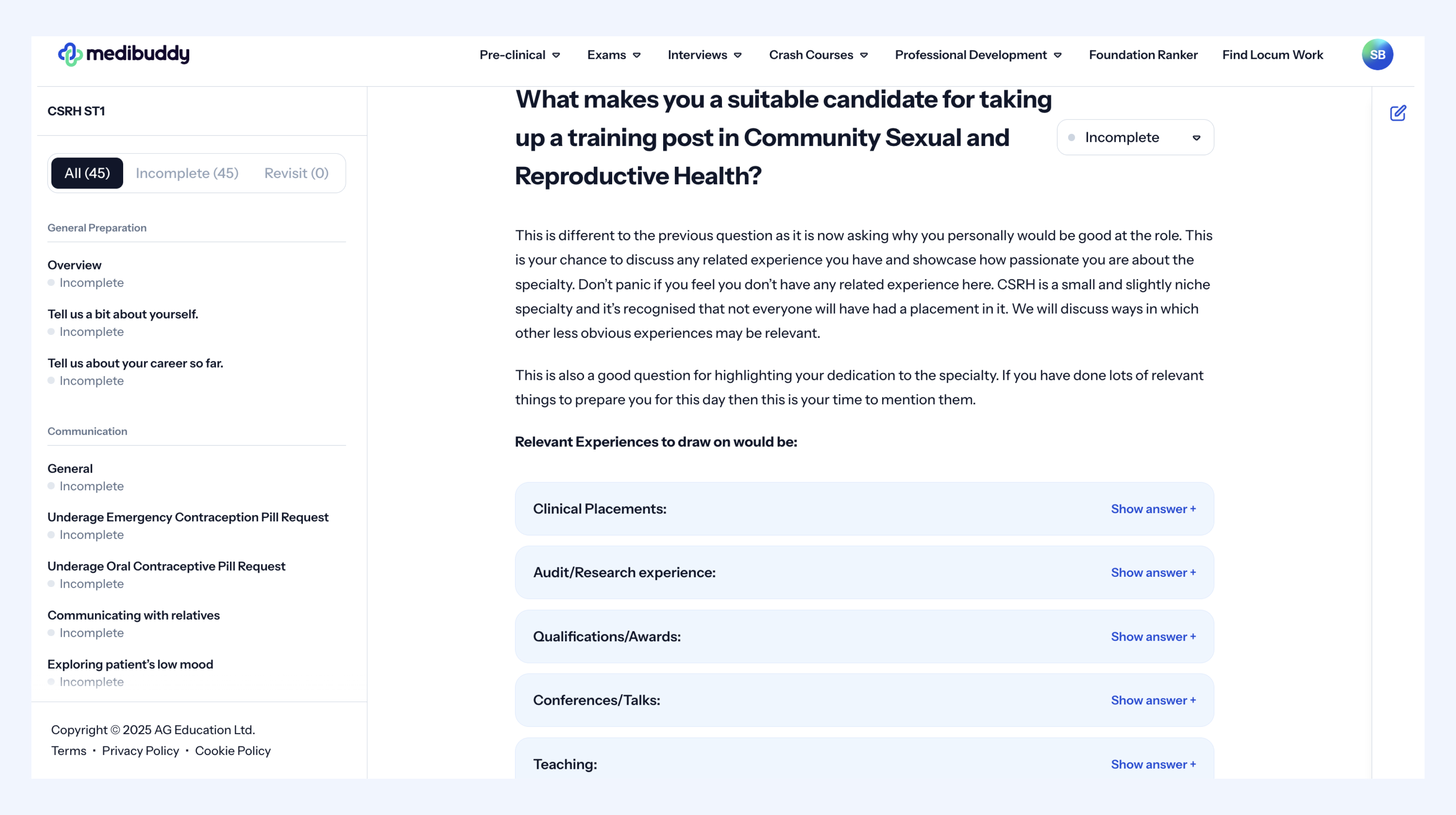
- Data Handling In previous recruitment rounds, candidates have been provided with an article to read prior to their interview. This is usually sent about a week before and will vary in content, anything from a published research paper to a patient opinion piece. Our CSRH ST1 interview question bank shows you how to systematically approach the article so you’re prepared to discuss it with the assessors.
- Teamwork
This station focuses on your ability to work effectively in a team. You may be asked about your experiences and tasked with explaining how you collaborate and communicate with those around you. An example from our CSRH ST1 interview question bank is shown below:
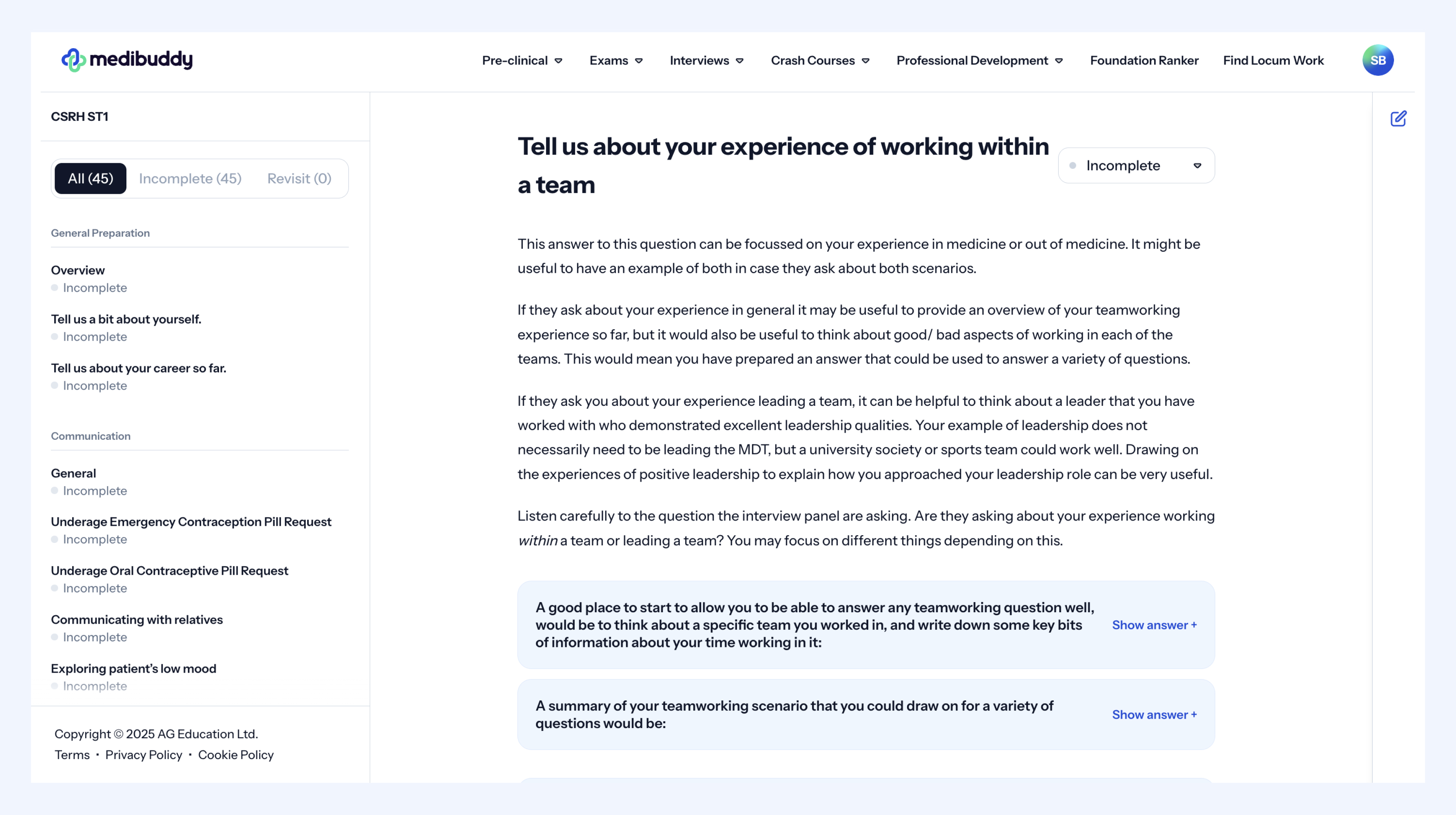
Further Reading
MSRA Complete Guide Person Specification 2026Post ID: 26884 - Histopathology ST1 2026 Interview Guide
If you’re applying for Histopathology ST1 in the 2026 recruitment window, this guide has you covered with everything from the key dates to the interview structure and how offers are made. For 2025 recruitment, there were 985 applications for 104 Histopathology ST1 posts, resulting in a competition ratio of 9.47. That means nearly 10 people applied for each post, an increase on the previous year. To help you beat the competition, we’ve put together our Histopathology ST1 interview guide. [custom_sales_panel title="Histopathology ST1" link="https://medibuddy.co.uk/st1-histopathology/interview-question-bank/"]
Histopathology ST1 Application
For the 2026 recruitment window, the Histopathology ST1 application deadline is 20 November 2025. It’s important to submit your application well ahead of time, as those submitted after the deadline won’t be considered. When looking at your application form, assessors will be making their judgements based on a few key areas, including:- Qualifications
- Clinical skills
- Academic skills
- Personal skills
- Professional integrity
- Commitment to specialty
Histopathology ST1 Self Assessment
Part of the application requires you to complete a self-assessment and score yourself based on your achievements in a variety of domains. These include:- Additional undergraduate degrees and qualifications
- Postgraduate degrees and qualifications
- Presentation / posters
- Publications
- Teaching experience
- Training in teaching
- Quality improvement (QI)
- Leadership and management
- Commitment to Histopathology as a specialty
- Histopathology related activities
Boost your Histopathology ST1 application by Training in Teaching
Training in teaching can earn you up to 5 Histopathology ST1 application points. For maximum points, you must have been awarded a master’s qualification in teaching. However, you might find this difficult to achieve before you submit your application. So, an easy alternative is to receive brief training in teaching methods. Our flexible, 2-day Teach the Teacher course should grant you 1 extra point towards your Histopathology ST1 application. If you prefer an interactive learning environment where you can actively engage with tutors and peers, we also offer 1-day and 2-day Live Teach the Teacher Courses.| Options | Score |
|---|---|
| I have been awarded a master’s level teaching qualification | 5 |
| I have a higher qualification in teaching e.g. PG Cert or PG Diploma | 3 |
| I have had substantial training in teaching methods lasting more than two days; this could include a completed module which forms part of a postgraduate teaching qualification | 2 |
| I have had brief training in teaching methods lasting no more than two days | 1 |
| I have had no training in teaching methods | 0 |
Histopathology ST1 Key Dates
The 2026 recruitment timeline for Histopathology ST1 is as follows:| Stage | Date |
|---|---|
| Vacancies published | 22 October 2025 by 5pm |
| Applications open | 23 October 2025 at 10am |
| Applications close | 20 November 2025 at 4pm |
| Evidence upload window opens | 24 November 2025 |
| Evidence upload window closes | 1 December 2025 |
| Appeal window (72 hours excluding weekends) | 9 — 12 January 2026 |
| Interview window | 2 — 5 February 2026 |
| Initial offers released by | 24 March 2026 by 5pm |
| Hold deadline | 2 April 2026 at 1pm |
| Upgrade deadline | 8 April 2026 at 4pm |
| Hierarchal deadline | 9 April 2026 at 4pm |
Histopathology ST1 Interview Format
If you’re shortlisted for interview, you will be invited to book this through your Oriel account. Interview slots are offered on a first-come, first-served basis and must be booked before the deadline. For the 2026 recruitment window, interviews will take place online through the Qpercom video platform. So, make sure you have a working laptop microphone and camera. The specialty recruitment website provides guidance about the online process and how to use Qpercom. The Histopathology ST1 interview consists of six questions across two stations. Each station lasts 15 minutes and is designed to test different aspects of your suitability for the specialty. You can find the different interview topics below, and how long you can expect each question to last:Station 1
This station is 15 minutes long and consists of the following three questions:- Question 1 revolves around interpreting an image. For this question, you’ll be shown an image and asked questions relating to it. This will last a total of 4 minutes.
- Question 2 centres around Histopathology as a career. This question will make up 5 minutes of the station.
- Question 3 is a case study, making up the final 6 minutes of the station.
Station 2
As with station 1, this station will last 15 minutes. It’s formatted into the following three question areas:- Question 4 will focus on your experience of teamwork. This question will last 5 minutes.
- Question 5 involves clinical knowledge scenarios and will make up 4 minutes of the total time.
- Question 6 will focus on questions relating to clinical error and audit. This will be 6 minutes long.
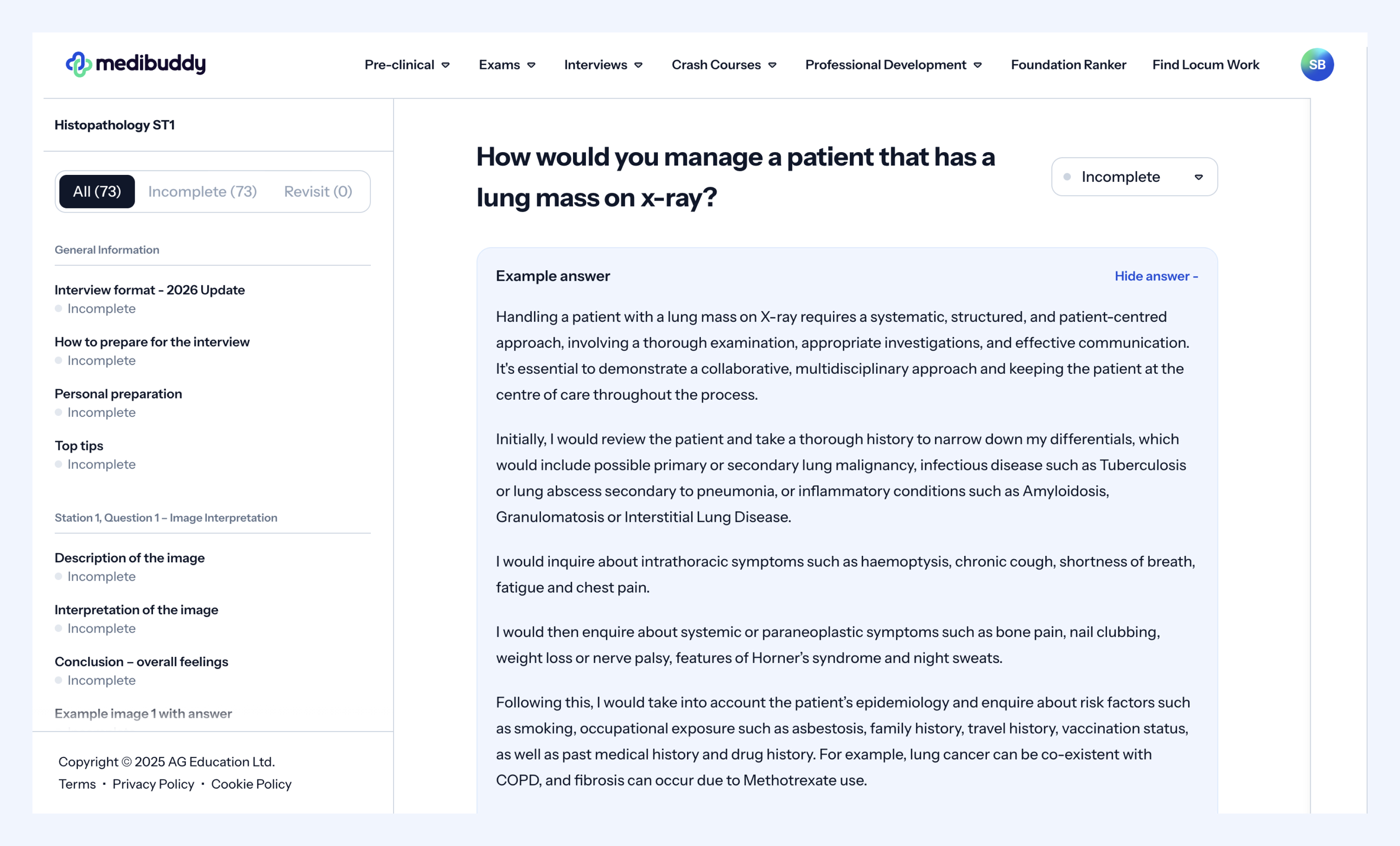 The remote panel responsible for assessing your interview will consist of two consultants. There may also be a lay representative present, whose role will be to check for fairness and consistency.
Histopathology ST1 Offers
Before offers are made, preferencing will take place. This is your opportunity to state which posts you want the most, and those you want the least. You’ll be deemed successful or unsuccessful depending on your interview performance and subsequent interview score. If successful, the score you achieved at interview will determine your final score and ranking. Offers will be made in rank order. For 2026 recruitment, initial offers will be sent by 24 March 2026 to successful candidates who have declared their preference for a post. Once the offer has been made, you’ll have 48 hours to decide if you want to accept, reject or hold. After accepting a Histopathology ST1 offer, you’ll be directed to the relevant region, who will contact you to complete the application process. Good luck with your application and interview!Post ID: 18349 - ST3 Obstetrics and Gynaecology Interview Guide 2026
With a limited number of posts available, competition for ST3 Obstetrics and Gynaecology is fierce! Therefore, knowing what to expect from the interview, and preparing well, is vital. To make things easier, this guide provides you with the key information you’ll need, including the interview timeline, interview format and interview panel and scoring.
ST3 Obstetrics and Gynaecology Interview Timeline
The following is an overview of the ST3 Obstetrics and Gynaecology recruitment process timeline: Before applying:- Ensure that you meet the relevant eligibility criteria
- Register on Oriel
- Familiarise yourself with the information provided about the process and the programme
- Complete and submit your ST3 O&G application on Oriel before the deadline, including the self-scoring self-assessment domain questions, which are used for shortlisting (see below).
- Your application will be checked to ensure that you’re eligible to apply (longlisted).
- If you pass the longlisting, you’ll be required to upload evidence to support your self-assessment questions (completed as part of your application). This will be used to verify your self-scores. Your verified score will then be used for the purpose of shortlisting.
- You’ll be required to complete your preferencing – i.e. preference all programmes in which you will be willing to accept a post.
Boost your ST3 Obstetrics and Gynaecology application by Training in Teaching
Gaining a master's degree in teaching can earn you up to 4 points towards your Obstetrics and Gynaecology ST3 application. This might be difficult to achieve before you submit your application. However, you should score an easy 2 points by providing formal evidence of attending a teaching course like the Medibuddy Teach the Teachers course. If you prefer an interactive learning environment where you can actively engage with tutors and peers, we also offer Live Teach the Teacher Courses. [ttt_sales] Interviews and offers:- If you’re shortlisted, you’ll be invited to attend an interview which takes place online in April 2026.
- You’ll be ranked based on a combination of your verified self-assessment score and interview performance. Offers are made in rank order until all posts are filled.
| Stage | Key dates |
|---|---|
| Vacancies published | 19 November 2025 |
| Application window opens | 20 November 2025 at 10am |
| Application window closes | 11 December 2025 at 4pm |
| Longlisting | 2 January 2026 by 4pm |
| Self-assessment evidence upload window opens | 6 January 2026 at 10am |
| Self-assessment evidence upload window closes | 20 January 2026 |
| Self-assessment evidence verification | 17 February 2026 by 12pm (midday) |
| Self-assessment appeal window opens | 17 February 2026 at 2pm |
| Self-assessment appeal window closes | 19 February 2026 at 2pm |
| Shortlisting | 13 March 2026 by 4pm |
| Invitations to interview | 16 March 2026 by 4pm |
| Preferences open on Oriel | 23 March 2026 at 2pm |
| Interview dates | 8, 9 and 10 April 2026 |
| Preferences close on Oriel | 10 April 2026 at 10am |
| Initial offers released | 14 April 2026 by 5pm |
| Hold deadline | 22 April 2026 at 1pm |
| Upgrade deadline | 23 April 2026 at 4pm |
ST3 Obstetrics and Gynaecology Interview Format
For the purpose of shortlisting applicants for interview, self-assessment questions are included in the application. Verified self-assessment scores are used to rank applicants, and interviews are offered in rank order up to the available interview capacity. You can find further details of the self-assessment domains and guidance for completing them on the Health Education England website. If shortlisted, you’ll be invited to attend a 40-minute online interview, which consists of the following two elements:- Clinical prioritisation
- Structured interview
| Area | Timing |
|---|---|
| Applicant waiting room | Log in at your interview time (given on Oriel). The Panel Administrator will perform an ID check and camera room sweep. They will also process you through each stage to your respective interview station rooms. |
| Clinical Prioritisation reading time | 5 minutes |
| Introduction | 30 seconds |
| Interview station 1: Clinical Prioritisation | 15 minutes |
| Waiting time | 5 minutes |
| Introduction | 30 seconds |
| Interview station 2: Structured Interview Questions | 15 minutes |
Clinical Prioritisation
The Clinical Prioritisation section of the Obs and Gynae ST3 interview requires you to prioritise and explain a management plan for four patients. In our Obs and Gynae ST3 Interview Question Bank, we have broken down the Clinical Prioritisation questions into Obstetrics, and Gynaecology, and included detailed explanations. The best way to prepare for this is simply to practise. Use different scenarios, different topics across O&G and pay attention to feedback or explanations which can provide insight into areas you can improve. You can see an example of a gynaecology clinical prioritisation question from our question bank below: You’ll have five minutes to read through the prioritisation scenario and prepare. The time will go fast! Make sure you use the preparation time effectively so you can provide well structured, thought-out management plans and a justification for your prioritisation.
Structured Interview
The Structured Interview section of the ST3 O&G interview consists of questions which cover the following four areas:Targets and Management
Think questions relating to leadership and appraisal, as well as topics such as the Maternity Dashboard and Clinical Negligence Scheme for Trusts (CNST).Communication
Prepare for topics such as breaking bad news, communicating with women in labour and antenatal counselling.Challenges and overcoming challenges
Having an understanding of the challenges facing O&G is essential. For example, the challenges of O&G training, the workforce and the pressures of out of programme vacancies.QIP, research and teaching
Be prepared to discuss Quality Improvement Projects (QIP), the difference between audit and research, and the role of teaching and why it’s important. The following is an example from our question bank of a ‘challenges’ questions from the structured interview section: As with the Clinical Prioritisation section, completing practice questions and learning from the feedback / explanations provided is the best way to prepare effectively for the ST3 Structured Interview. Check out our ST3 O&G question bank for a wide range of questions to ensure that you’re as prepared as possible for all aspects of the interview.
ST3 Obs and Gynae Interview Panel
The interview panel will consist of four assessors; two per interview station. The applicants’ guide highlights that you can expect the interviewers to ‘probe and challenge’ your answers if they require more information. Don’t let this put you off, it’s designed to ensure you have a fair opportunity to answer the questions fully, so see it as an opportunity to score some extra points that you’ve missed.ST3 Obs and Gynae Interview Scoring
Each assessor on the interview panel will score you independently. The applicants’ guide states that all panel members are trained and briefed on the interview process and the importance of maintaining consistent scoring parameters. Additionally, all scoring is reviewed by the interview panel, a lay chair and the recruitment lead, to address any significant discrepancies between the interviewers’ scores. Your ST3 Obs and Gynae interview score will be combined with your weighted verified self-assessment score to determine your ranking. Offers are then made in rank order until all posts are filled. With O&G ST3, the number of posts is limited and significantly lower than the number of applicants they receive. This makes the interview highly competitive. However, it is not impossible, if you’re determined to secure a position, dedicate time to preparing effectively with plenty of practice questions. We recommend you use a question bank which offers a broad range of topics and high quality explanations to help you to improve. This was our aim when creating our question bank, to ensure that applicants had high quality resources, to enable them to succeed. You can find out more about our Obs and Gynae ST3 question bank and what it offers here.Post ID: 18505 - ST1 Paediatrics: Complete Guide 2026
Specialty training in paediatrics is usually entered by most doctors at the ST1 level. If you’re considering applying for ST1 paediatrics, this simple guide will provide you with all the necessary information you need, from the ST1 application process and recruitment timeline to the paediatrics interview structure. To support you with your paediatrics ST1 interview preparation, we’ve designed a comprehensive Paediatrics ST1 Interview Question bank. Preparing for interviews whilst working can be really daunting, and with the MSRA exam no longer used for Paediatrics recruitment, more focus is placed on your interview, so it is important that you make time to prepare like you would an exam!
Paediatrics ST1 application
If you’re applying for a 2026 post, you must have no more than 2 years experience in paediatric posts (excluding Foundation posts) at the time of making your application to be eligible. Alternatively, if you have more than 2 years experience, you should aim to apply for Paediatrics ST3. For ST1 paediatrics training, you’ll submit one application via Oriel for all participating regions, meaning you’ll be considered for programmes across the UK and offered ST1 paediatrics roles based on your performance and rank. It’s recommended that you start your application as soon as possible to allow plenty of time to complete it fully and to the best of your ability. You’ll find the paediatrics ST1 application window in the recruitment timeline section below. As part of your paediatrics ST1 application, you’ll be required to complete a set of white-space questions. For 2026 entry, these focus on assessing the following areas:- Transferable clinical capabilities
- Personal achievements and reflection
- Quality Improvement Project (QIP) / Audit relevant to application level and experience of applicant
- Academic achievements relevant to application level and experience of applicant
- Teaching relevant to application level and experience of applicant
How is my ST1 paediatrics application scored?
For 2026 the ST1 paediatrics application will be scored as follows: For the purpose of longlisting: Applicants are assessed against the essential criteria outlined in the ST1 paediatrics person specification. In order to demonstrate that you are eligible to apply, and therefore progress to the next stage, you must meet all of the essential criteria. For the purpose of shortlisting: If you are successfully longlisted, your white-space answers will be scored by two clinical assessors. The maximum score available is 30 per assessor (60 in total), scored as follows:| White-space question / assessment area | Points available |
|---|---|
| Transferable clinical capabilities | 8 |
| Personal achievements and reflection | 8 |
| QIP / Audit | 5 |
| Academic achievements | 3+1 |
| Teaching | 5 |
| Total | 30 |
- To score well in the Transferable Clinical Capabilities domain, choose different, specific examples that show skills like teamwork, handover, leadership and organisation, not just generic “I take histories” statements. You can include up to two practical procedures, but avoid using multiple examples that all demonstrate the same capability, as that won’t gain extra points.
- QIP / audit, academic achievements and teaching all specify that this is relevant to your application level and experience. However, you will score more marks for:
- QIP / audit – if you’ve designed, led and presented your data (rather than just collected data) and you’ve provided evidence of regularly participating in QIP / audits throughout your training so far.
- Academic achievements – as well as providing a good description of research that you’ve undertaken or preferably led, you’ll score more points for presenting your research at a regional, national or international presentation, and being published as a co-author, first or last author.
- Teaching – designing, leading and evaluating teaching will score you the highest possible marks.
- If the number of eligible applicants (i.e. those who have been longlisted) exceeds the interview capacity, these scores will be used to differentiate between applicants and determine who is invited to interview.
- Following your interview, it’ll be combined with your interview score to give an overall recruitment score. It’s worth noting that your application score (white-space questions) does not have the same weighting as your interview score. So, while it is important for ensuring that you’re invited to interview, it’s your interview score, and therefore interview preparations, that will have the greatest impact on how highly you're ranked for an STI paediatrics role.
ST1 paediatrics recruitment timeline
As mentioned above, the ST1 paediatrics recruitment process comprises of your application form (with white-space questions) and your ST1 paediatrics interview. The following are the key ST1 paediatrics recruitment dates for 2026 entry:| Stage | Date |
|---|---|
| Vacancies published | 22 October 2025 (by 5pm) |
| Applications open | 23 October 2025 (at 10am) |
| Applications close | 20 November 2025 (at 4pm) |
| Shortlisting window opens | 17 December 2025 |
| Shortlisting window closes | 12 January 2026 |
| Interview invites* | 21 January 2026 |
| Interview booking closes* | 23 January 2026 (by 4pm) |
| Interview window | 3 February to 13 March 2026 |
| Initial offers out | 24 March 2026 (by 5pm) |
| Hold deadline | 2 April 2026 (at 1pm) |
| Upgrade deadline | 8 April 2026 (at 4pm) |
Paediatrics ST1 interview structure
The interview for 2026 entry will be a two-station multi-scenario format performed online via Qpercom. The whole interview will be around 45 minutes in length. The interview aims to assess the following in relation to your clinical experience to date and your understanding of issues relevant to working in the NHS:- Communication This involves a role play scenario in which you are required to explain a clinical condition or reasons for an intervention or transfer. You’ll be given 5 minutes before the interview to read the scenario. Communication is undoubtedly a core part of paediatric practice, and therefore, this scenario aims to assess your ability to interact with patients and parents/carers.
- Career motivation Although a physical portfolio is not required, you are advised to prepare the content you wish to discuss in this section of the interview, to demonstrate your enthusiasm, suitability and motivation for a career in paediatrics. It’s vital that you can demonstrate that you have undertaken research and, therefore, know what is involved in a career in paediatrics, are committed to the specialty and have the required personal attributes and transferable skills.
- Reflective Practice This section of the interview asks you to reflect on a significant event in your career so far, which either went well or not, and demonstrate how you would use this experience in the future. Assessment here focuses not only on your ability to reflect on your experiences, but also to demonstrate how you have learnt from this and what impact it has had on your future career.
- Paediatric Clinical Reasoning Question This section involves a case-based scenario which requires you to describe the relevant issues and how you would manage the situation. Although paediatric based, this question doesn't require complex paediatric clinical knowledge, rather it aims to assess your ability to demonstrate a clear and methodical approach to a clinical problem.
In our Paediatrics ST1 Interview Question bank, we have broken down each of the four themes included in the interview. You can navigate through these via our dashboard. For ease of use, you can mark each scenario as either “completed”, “incomplete” or “go back”, so you know which scenarios you are confident with, and which ones require you to dedicate some more time to.
We have broken down each scenario into the questions you could be asked, with tips and suggestions on how best to approach your answer. Below is an example of a "Paediatric Clinical Reasoning Question" from our question bank so you know what to expect.
Paediatrics ST1 competition ratios
For 2024, there were 1,583 applications for 479 posts, resulting in a competition ratio of 3.30. This means over three people applied for each role. For 2025, 2,780 applications were made for a total of 476 available posts, meaning over five people applied for each ST1 Paediatrics role. This has increased yearly since 2020, when the competition ratio was 1.4, meaning that there were a little under 1.5 applicants for every available ST1 paediatrics post. With the specialty becoming more and more competitive each year, it is so important to plan and prepare for your interview. Good luck!Resources:
Paediatrics ST1 Interview Question Bank Royal College of Paediatrics and Child Health Day in the life of a Paediatrics ST1 2026 Paediatrics ST1 Applicant Guidance Paediatrics ST3 InterviewPost ID: 3726 - How to Maximise Points in the 2026 Core Surgical Training (CST) Interview Portfolio
For 2026, Core Surgical Training (CST) interviews are being held in March 2026. There is a fairly quick turnaround from MSRA results and interview invites to the interview window, so we recommend being fully prepared where you can! Whether you are a foundation year doctor, medical student or taking a year out of training, if you are serious about applying for surgical training, it is important to understand how the portfolio section has changed to put yourself in the strongest position. We will break down the Oriel Portfolio Scoring for 2026. You can also check out our Core Surgical Training Interview Question Bank, which has been put together by previously high-scoring trainees to help you prepare for that all important interview.
2026 Core Surgical Training Interview
The 2026 MSRA exam is scheduled between Tuesday 6 January to Monday 19 January 2026, and the Core Surgery interviews will run between Monday 2 March to Wednesday 11 March 2026, with invites sent on Friday 13 February 2026. This year, interviews will continue to take place online on a video platform called Qpercom. You will receive instructions on how to use this prior to your interview. CST interviews will consist of one 30-minute interview divided into 2 x 15-minute stations, comprising a management and a clinical station, and a portfolio station. These stations will be back to back and conducted by the same interview panel. The domains for 2026 are as follows:- Commitment to surgery
- Quality Improvement / Clinical Audit
- Presentations and Publications
- Teaching experience
The Core Surgery Training (CST) Portfolio
We have broken down each portfolio section to help guide you when putting your portfolio together. Scoring for all domains has shifted from a numerical system to letter grades (A to E), with each grade requiring a specific level of supporting evidence.Commitment to surgery
This is a broad section of the portfolio with points in various categories. Please note, this section no longer includes the MRCS Part A.Operative Experience
Having at least 40 surgical cases assisting or supervisor trainer scrubbed is needed for the highest grade. This has continued to increase over the years, reflecting the competitive nature of CST. Keeping an eLogbook of surgical cases should begin at medical school and is useful for monitoring your progress through training. The summary sheet is required to be signed by a consultant.| Option | Indicator | Notes |
|---|---|---|
| Operative experience: choose one of the following options | ||
| Involvement in 40 or more cases | A | Verified logbook evidence must be provided |
| Involvement in 30-39 cases | B | |
| Involvement in 20–29 cases | C | |
| Involvement in 11-19 cases | D | |
Surgical Experience
Doing a surgical placement (with redeployment included) OR a surgical elective will get full points here. If you are a student, it is recommended you complete a surgical elective, and then ensure you reflect on it for evidence. Although usually undertaken at medical school, you can also do short electives in your FY3 if applying then. Some bursaries are available from surgical societies if undertaken later, with potentially more opportunities for hands-on surgical experience. If you have not had the opportunity to do a surgical placement, a 5 day taster week will get you the highest grade. Use this as an opportunity to try out a subspecialty of interest to help you with preferencing your surgical jobs in CST. You can also use it to increase your operating logbook, network with surgeons and sign up to research or audits.| Option | Indicator | Notes |
|---|---|---|
| Surgical experience: choose one of the following options | ||
| I have attended a surgical taster week (minimum 5 days, can be non-consecutive days) | A | Proof of completion required |
| I have undertaken an elective in a surgical specialty (minimum 4 weeks), OR I have undertaken a surgical placement (see additional notes below) during my foundation training or equivalent (minimum 12 weeks) | A | |
| I have not attended a surgical taster/ elective | B | |
Quality Improvement (Clinical Audit)
This section focuses on demonstrating the complete process of a quality improvement project. You need to show your role in designing the project, collecting data, presenting findings, identifying areas for improvement, implementing change, and reassessing the outcomes. Full marks in this section requires you to have “lead in ALL aspects of a surgically themed clinical audit or QI project that has demonstrated change” (i.e. second cycle/ closed audit loop). This should be achievable if you choose a project early (ideally FY1 year).| Option | Indicator | Notes |
|---|---|---|
| I was involved as Lead in ALL aspects of a surgically themed clinical audit or QI project that has demonstrated change (i.e., second cycle/closed audit loop). | A | You participated in all stages of the audit/QI project (planning, data collection, data analysis, implementing change and involvement in at least two cycles). The project must be surgically themed. |
| I was involved as Lead in ALL aspects of a clinical audit or QI project that has demonstrated change (i.e., second cycle/ closed audit loop). | B | You participated in all stages of the audit (planning, data collection, data analysis, implementing change and involvement in at least two cycles). |
| I was involved as a contributor in a clinical audit or QI project that has demonstrated change (i.e., second cycle/ closed audit loop). | C | You participated actively through multiple cycles but did not take a leading role in the project. |
| I was involved in a clinical audit or QI project. | D | For example, you assisted with data collection for the project in at least one cycle. You did not take a leading role. |
| None/other | E |
| Option | Indicator | Notes |
|---|---|---|
| Applicant presented both cycles of data or presented the intervention and change aspects of a project at a meeting | A | The applicant personally presented the project evidenced by first author in the presentation slides and letter of acceptance of presentation for meeting. |
| Applicant presented one cycle of the project at a meeting | B | The applicant personally presented the project evidenced by first author in the presentation slides and letter of acceptance of presentation for meeting. |
| Applicant did not present any aspect of the project | C | The applicant personally presented the project evidenced by first author in the presentation slides. |
Presentations and Publications
Planning ahead is essential when aiming to publish work or present at conferences, as these processes often take time. Original research can be challenging, but case reports or review articles may offer a more accessible path. Engaging with academic consultants can open doors to opportunities for publications and presentations. Publications must be PubMed-cited, and chapters in medical books require an ISBN. Pay-to-present conferences do not count as peer-reviewed presentations. You may not gain a grade for the same audit as you gained a grade for in the Audit/ QI section. Instead, ensure you claim grades only for projects not used elsewhere in your portfolio, and select the option that awards you the most.| Option | Indicator | Notes |
|---|---|---|
| I have won a prize for delivering an oral presentation at a national or international medical meeting convened by an accredited institution after being invited/selected to do so | A | Personal delivery of presentation required. This does not include “oral poster presentations” |
| I am first author (please see appendix for definition) of a PubMed-cited publication (or in press) not including a case report or editorial letter | A | Evidence of PubMed ID number. |
| I have delivered an oral presentation at a national or international medical meeting convened by an accredited institution after being invited/selected to do so | B | Personal delivery of presentation required. This does not include “oral poster presentations” |
| I am first author a prize-winning poster or oral poster presentations presented at an international or national medical meeting convened by an accredited institution after being invited/selected to do so | B | Personal delivery of presentation required. |
| I am first author of a PubMed-cited publication of a case report or editorial letter (or in press) OR I have written a book chapter related to medicine which has been published (not self-published) | B | Evidence of PubMed ID number. |
| I am a named co-author (please see appendix for definition) of one PubMed-cited publication (or in press) | C | |
| I am first author for a poster or oral poster presentations presented at an international or national medical meeting convened by an accredited institution after being invited/selected to do so | D | |
| I have given an oral presentation at a regional medical meeting after being invited/selected to do so | D | |
| I am a Cited Collaborative author as part of a research collaborative publication | D | Does not require named authorship alongside publication title |
| None/other | E |
Teaching Experience
Teaching experience offers a valuable way to enhance your Core Surgical Training application, even if medical education isn't your primary career goal. Teaching opportunities could involve peers, medical students, or other healthcare professionals. To score the highest grade, candidates must organise and deliver at least four teaching sessions, which can be done individually or in collaboration with others. Evidence is required, including letters from consultants confirming your involvement in designing and delivering the programme, along with formal feedback from participants or a senior observer, which must be verified but doesn't need to be submitted directly. If in-person teaching is limited, virtual teaching sessions are a flexible alternative, and collaborating with your hospital’s education department can further boost your application. You can also improve your teaching experience and boost your application by completing a course like the Medibuddy Teach the Teacher Course. You can complete the course either live or on-demand, both of which are CPD-accredited and should count towards points in this domain. How to set up a teaching programme- Start as early as possible, e.g. in induction week
- Briefly plan a program, e.g. session titles, audience, setting, teaching style, teachers, e.g. others colleagues/ junior doctors.
- Discuss the plan with your education supervisor during the first meeting as they may be able to assist.
- Discuss with the medical education department and arrange meetings with the head of medical education to discuss your proposal.
- If approved, you will need to plan the program in more detail
- Following this, the medical education department will usually email junior doctors asking for volunteers to prepare and deliver teaching based on your topics, offering certificates and formal feedback.
- Since COVID-19, there has been a proliferation of virtual teaching and webinar series in surgery which offer an opportunity for teaching programmes. This may be the most straightforward way to set up a program which is accessible at a regional and even national level.
| Option | Indicator | Notes |
|---|---|---|
| I have won a prize for delivering an oral presentation at a national or international medical meeting convened by an accredited institution after being invited/selected to do so | A | Personal delivery of presentation required. This does not include “oral poster presentations” |
| I am first author (please see appendix for definition) of a PubMed-cited publication (or in press) not including a case report or editorial letter | A | Evidence of PubMed ID number. |
| I have delivered an oral presentation at a national or international medical meeting convened by an accredited institution after being invited/selected to do so | B | Personal delivery of presentation required. This does not include “oral poster presentations” |
| I am first author a prize-winning poster or oral poster presentations presented at an international or national medical meeting convened by an accredited institution after being invited/selected to do so | B | Personal delivery of presentation required. |
| I am first author of a PubMed-cited publication of a case report or editorial letter (or in press) OR I have written a book chapter related to medicine which has been published (not self-published) | B | Evidence of PubMed ID number. |
| I am a named co-author (please see appendix for definition) of one PubMed-cited publication (or in press) | C | |
| I am first author for a poster or oral poster presentations presented at an international or national medical meeting convened by an accredited institution after being invited/selected to do so | D | |
| I have given an oral presentation at a regional medical meeting after being invited/selected to do so | D | |
| I am a Cited Collaborative author as part of a research collaborative publication | D | Does not require named authorship alongside publication title |
| None/other | E |
Evidence
For each domain, ensure you look at what evidence is required (e.g. letters, audit presentation, etc.) early enough in the process to give yourself time to gather it. More information can be found here. You must have your portfolio completed and submitted by Thursday 26 February 2026 at the very latest, so ensure you have all of the evidence you need well before then.Further Reading
CST Interview Preparation and Essential reading MSRA Complete Guide MSRA Question Bank Core Surgery Interview Question BankPersonal background
I am a registrar who previously worked in a top ranked rotation in London, which includes plastic surgery (my chosen specialty). I was not top ranked at medical school; in fact I was in the 8th decile academically on my foundation application. I was definitely daunted when I first reviewed the points required for CST and did not think I would be able to achieve enough points to obtain a job which included my chosen specialty, let alone in my chosen region. Please do not be put off by the points sheet and note that medical school academic performance is worth a minority of points on the interview application. The majority coming from other work in areas such as audits, teaching, clinical performance and projects work (presentations and publications). I would suggest you read carefully the previous interview points specifications and set your own objectives on how you can achieve them. I would also recommend that you work with others, find mentors, form groups and share the workload involved in teaching, doing audits and research projects. There is a lot of work (and unfortunately expense) involved in scoring highly on the application and collaborating with peers makes this much more manageable. Please feel free to get in touch if you have any specific questions regarding the portfolio. Mr Peter Macneal MBChB BSc PGDip (Clin Ed) MRCS (Eng)Post ID: 53297 - How to Prepare for the 2026 Core Surgical Training (CST) Interview Portfolio Station
The 2026 Core Surgical Training (CST) interview will include a 15-minute Portfolio Station, which has remained largely consistent with the 2025 format. We’ve updated our question bank to include preparation guidance and example answers to help you perform confidently in this station. Here’s a summary of what to expect and how to prepare effectively.
Portfolio Station: Key updates for 2026
For 2026, the CST Portfolio Station is largely the same as in 2025. If you’re invited to interview, you’ll need to upload an index page on the portal, showing which category (A to E) your evidence fits for each domain. This helps assessors quickly navigate your submission. During the interview, your portfolio will first be reviewed for 10 minutes without you present, followed by a 15-minute virtual interview. You’ll be asked two questions (5 minutes each) based on two domains chosen by the assessors. Your overall portfolio score combines the strength of your evidence with how clearly and concisely you answer these questions. Key portfolio updates for 2026:- ITU placements no longer count as surgical experience.
- Foundation placements no longer earn points for surgical experience — only electives or taster weeks do.
- QI/Audit projects need to show actual impact, for example presenting the first cycle locally if auditing departmental compliance.
Portfolio domains you may be asked questions about your achievements on
- Surgical Experience/ Commitment to Surgery
- QI/ Audit
- Publications/ Presentations
- Teaching Experience
Preparing for the CST Portfolio Station
Evidence preparation
- Take time to prepare accurate and concise evidence relating to your highest category of evidence for each domain.
- There is limited time for interviewers to review this evidence, so you want to make it as straightforward for them to review as possible to ensure you are scored accurately.
Prepare answers to questions
- Be able to summarise your experience in each domain concisely with awareness of the scoring when creating ‘model answers’.
- As a bare minimum, this is summarising your achievements in each of the portfolio points sections.
- The structure and delivery of your answers to questions should be prepared, practised and refined.
- When considering structuring your answers well:
- Start with a strong opening line summarising your top achievements (with reference to portfolio points criteria). This gives the interviewers the key information they need straight away.
- Signposting and structure of answer, for example, explaining your experience using the ‘CAMP’ mnemonic, e.g. “I have shown surgical commitments: clinically, academically, through management and on a personal basis.. clinically this includes…”
- Finish your answer with an action, outcome or how this achievement will make you a better surgical trainee.
- The content of any follow-up questions is not fully understood as this is the first time portfolio answers have been directly scored.
- HEE suggested they will refer to your ‘achievements’; however follow-up questions could be more general in which you should include some personal experience.
- Our question bank now includes potential questions and example answers based on previous CST portfolio questions and surgical ST3 portfolio questions.
- We will update the question bank further following experiences within the 2026 interview.
General technique
Please consider interview technique as per the Medibuddy interview tips page (3). It is important to remain calm and composed even when discussing areas of contention in scoring. Try to make sure your enthusiasm and passion for surgery comes across.References/ links
- https://medical.hee.nhs.uk/medical-training-recruitment/medical-specialty-training/surgery/core-surgery/core-surgical-training-self-assessment-scoring-guidance-for-candidates
- https://medical.hee.nhs.uk/medical-training-recruitment/medical-specialty-training/surgery/core-surgery/overview-of-core-surgery-training/interviews
- https://medibuddy.co.uk/core-surgical/core-surgical-interview-tips
Post ID: 3383 - Ophthalmology ST1 Interview Evidence Folder Preparation: 2026 Guide
The ST1 Ophthalmology Evidence Folder is a key component of the selection process. This guide will provide everything you need to know about the domains included and what evidence to provide for each to ensure you score the maximum points available to you. There are strict criteria and a stringent mark scheme for your evidence folder, and with up to 50 points available, out of a total of 100 for all elements of the application process, it is worth spending time preparing it. To help you do well in the rest of the interview, we’ve designed our Ophthalmology ST1 Interview Question Bank, which includes example interview questions and tips on how to answer them from previously high-scoring Ophthalmology trainees. New for 2026: As part of your application, you’ll also complete a self-assessment, where you’ll score yourself across eight domains using the official scoring framework. Your completed self-assessment proforma should be uploaded as the first document in your evidence folder. To learn more about the 2026 application, the self-assessment and selection process for Ophthalmology ST1, including the key dates, MSRA requirements and the interview format, visit our complete guide. When organising your evidence folder, structure it according to the guidelines published on the Severn website. Remember, interviewers will be going through hundreds of anonymous evidence folders, so it is vital your folder is well organised. The following is a breakdown of the various domains included in the evidence folder and what you can score points for.
List of previous posts
This section will not be scored, but it’s essential that you provide a full list of your previous posts.Qualifications with certificates or letter of proof (cumulative scoring – maximum 5 points)
Points are available for the following:- 1 point – per qualification – MSc, BSc, PG Cert
- 3 points – for an MD or MPhil degree taken as a separate course
- 4 points – for a completed PhD or DPhil, including full-time research usually lasting 3 years' duration.
Prizes/Awards with proof (cumulative scoring – maximum 5 points)
As an undergraduate, ranking within the top 20% will give you 1 point and coming in the top 10% will give you 2 points. Bear in mind that obtaining an Honours Medical degree or 1st in your undergraduate degree counts as an award. Foundation schools offer awards to Foundation doctors for ‘teaching’ or ‘best audit of the year’, and these are just as valuable as prizes at international meetings or conferences. Other examples of merit can include bursaries or funding for research, grants or electives. A full list of the points available for prizes/awards is as follows:- 3 points – for Crombie Medal (stood 1st in FRCOphth part 1 exam)
- 2 points – 1st in final undergraduate degree point
- 1 point – Lead applicant on a successful research grant resulting in published peer-reviewed research.
- 1 point – First author on a presentation or poster that won Best Presentation/Poster at a national or international meeting.
Ophthalmology specialty links and commitment to date as a career (cumulative scoring – maximum 12 points)
The following points are available for Ophthalmology links and commitment to the specialty:- 1 point – Refraction Certificate
- 3 points – FRCOphth Part 1, or 1 point for attempting Part 1 FRCOphth on at least one occasion.
- 2 points (max) – Non-peer reviewed publications (0.5 points each) & case reports (1 point each) or other research publications in ophthalmology. These must not be included in other sections.
- 2 points max – Ophthalmic elective and/or separate undergraduate project. 1 point is available per achievement.
- 1 point max – Taster week
- 1 point max – Attending ophthalmology clinics and theatre sessions. This must be outside of a formal taster week and include a minimum of 10 sessions with dates & supervisor-signed evidence.
- 1 point max – EyeSi assessments (minimum 4 hours).
- 1 point max – Evidence of other ophthalmology simulation training
- 3 points max – Meetings attended, including:
- 3 points max for National / International Ophthalmology educational meetings attended (1 point per meeting)
- 1 point max for Regional Ophthalmology meetings attended (0.5 points per meeting)
- There is also a discretionary 2 point max available for evidence not included in the list above (not including taking Duke-Elder or WBAs).
- Microsurgical skills course, Royal College of Ophthalmologists
- FOCUS (Foundation Course in Ophthalmology), Edinburgh
- Ophthalmology Summer School, UCL Institute of Ophthalmology
- Tropical Ophthalmology, London School of Hygiene and Tropical Medicine
Multi-Source Feedback (MSF) (maximum 2 points)
The following points are available for MSF:- 0 points – for significant negative comments
- 2 points – satisfactory scores with appropriate good comments
Publications (maximum 6 points)
Points are awarded for publications in any speciality and do not have to be Ophthalmology-specific. According to the most recent guidance, your evidence should be a list of peer-reviewed original research publications with a photocopy of the first page of each paper. Marks for publications are awarded based on your authorship status. The points will be awarded:- 3 points – for each publication where you are first author or joint first author
- 1 point – for any other publications up to fourth author
Quality improvement / Audit projects (maximum 5 points)
You are asked only to include your best audit/QIP project in your evidence folder, therefore, there is no gain in spending time and effort doing extra audits/QIPs which you may not need. “Best” usually implies having to close the loop of an audit cycle (re-auditing the clinical practice after implementation of change) and effecting a significant improvement in clinical practice. Thus, it is wise to focus on simple audits and QIPs where data can be easily collected and analysed. You will be awarded points for the following:- 0 points – if there is no evidence of QI/audit work.
- 1 point – for participation but no specific roles documented or specific format followed.
- 2 points – for initiation and design of the QIP / audit and some evidence of specific format
- 3 points – for initiation, design and writing up the QIP / audit and specific format followed.
- 4 points – as above and was personally involved in implementing the QI strategy / completing the audit loop and implementing change
- 5 points – for published audit or QI guidelines implemented supra-regionally.
Presentations (maximum 6 points)
Try to submit your work to international conferences as these score more points than local conferences. These do not have to be Ophthalmology specific. Do apply for bursaries to fund your conference attendance, as these count as “Prizes” in your evidence folder. Start early at medical school if you can, as universities are generally much more generous with funding and bursaries than the local hospital or Health Education England. Remember to keep a copy of the programme booklet with your work highlighted, as this can be used as evidence. You can gain points for the following:- 1 Point – Regional presentations
- 2 Points – National presentations
- 3 Points – International meetings
Education and Teaching (maximum 5 points)
There are points for writing a chapter in a textbook, designing an educational course or e-learning tool, completing a course like the Teach the Teacher course, having a formal role in examining undergraduates and for a higher teaching qualification, such as a Diploma, Certificate or Masters in medical education. You can complete the Medibuddy Teach the Teacher Course either live or on-demand, both of which are CPD-accredited and should count towards points in this domain. [ttt_sales] On top of ad-hoc bedside teaching and occasional small group teaching in the NHS setting, try and organise your own regional teaching course on any subject. You would need participants from more than one University / Hospital to qualify your teaching course as regional. For any form of teaching, do get feedback forms from the attendees. It is best to summarise all the feedback gathered and present this neatly in your evidence folder. You could write short reflective pieces on your teaching to demonstrate your professional development. To be formally involved with examining undergraduates, most universities welcome junior doctors to assist in examining undergraduate OCSE examinations. If you know of academics or clinicians who are in touch with publishers, always ask if you could contribute a chapter for a textbook or course book. A full breakdown of the points available for education and teaching are as follows:- 0.5 point each – for helping with an educational course, designing an educational course or e-learning tool, writing an e-book, completing a “teaching the teachers” course, formal role in examining undergraduates
- 1 point - contributing to at least 3 teaching sessions over at least 3 months with formal feedback
- 2 points – for writing a chapter in a textbook (not an e-book)
- 2 points – for a Higher teaching qualification, e.g. a Diploma, Certificate or Masters in Medical Education
- 3 points – for writing a book (not an e-book)
Overall portfolio layout & quality (maximum 3 points)
Three points are available for the layout, organisation and quality of how your evidence folder is presented. So, in addition to making it easier for the assessors to award you points for all sections, ensuring your evidence folder is well-organised and to a high standard will also gain you extra points!Last words
Preparing a good quality evidence folder will be useful in any specialty you apply for. The best tip is to start early and get organised (months in advance!), as filing and gathering evidence will always take longer than you think. Then when it comes to your interview, remember to check out our Ophthalmology ST1 Interview Question Bank, which features patient consultation scenarios and advice on how to answer them.Further Reading
Teach the Teacher Course Live Teach the Teacher Course MSRA Complete Guide Ophthalmology Interview Ophthalmology ST1 Interview Question BankPost ID: 3223 - Ophthalmology ST1 Interview: 2026 Guide
If you’re considering applying for Ophthalmology ST1, this guide will provide everything you need to know about the application process, key recruitment dates and the interview format. Ophthalmology ST1 is a competitive pathway. In 2025, there were 2,197 applications for just 102 posts, giving a competition ratio of 21.54. This means there were almost 22 applications for every post available. This is a big increase from 2024, when there were nearly 15 applicants for each post. With the competition only increasing, it’s essential that you prepare well for the interview and perform to the best of your ability.
Ophthalmology ST1 Key Dates
The 2026 recruitment dates for Ophthalmology ST1 are as follows:| Stage | Date |
|---|---|
| Applications open | 23 October 2025 |
| Applications close | 20 November 2025 |
| Invitation to book MSRA expected no later than | 15 December 2025 |
| Multi-Specialty Recruitment Assessment (MSRA) | 6 — 19 January 2026 |
| Documentation upload window | 16 January — 2 February 2026 |
| Candidates invited to book an interview slot | 6 March 2026 |
| Interview date | 16 & 17 March 2026 |
| Feedback released | 19 March 2026 |
| Offers released by no later than | 24 March 2026 |
Ophthalmology ST1 Application
For 2026, the selection process consists of the following three components, which we will cover in more detail in the sections below: Only the highest ranking 260 applicants will be invited to interview, so you must also ensure you meet the essential eligibility criteria outlined in the Ophthalmology ST1 person specification. Following the interview, your performance in the evidence folder and online interview will be combined to give you an overall score, which is used to rank you against other candidates. The maximum score for each component is as follows:- Evidence Folder – Maximum 50 points
- Online interview – Maximum 50 points
Ophthalmology ST1 Evidence Folder
As mentioned above, you must submit an evidence folder as part of the selection process. This involves uploading documents to a specifically designed online portal to demonstrate your achievements within the set domains; for example, qualifications, prizes/awards and commitment to ophthalmology (e.g. electives/taster weeks). Your evidence folder will be scored against a set criteria for each domain. For more information and a full breakdown of the evidence folder domains and scoring, please see our 2026 guide to the Ophthalmology ST1 Interview Evidence Folder. Crucially, your evidence folder should be clearly laid out, following the mark scheme to the letter, as you have no opportunity to explain or present your contents. Therefore, it is vital that it is organised and everything that is worth points is easily navigable and scored for your benefit. Include only what directly earns points and remove unnecessary extras that could distract assessors. There are a few ways to gain some last-minute marks if you haven’t already got them. For example:- You can “design an educational course” via an e-learning tool, which you can put together in your local hospital.
- Alternatively, you can gain 0.5 points for simply completing a course like the Medibuddy Teach the Teacher course. If you prefer an interactive learning environment where you can actively engage with tutors and peers, we also offer Live Teach the Teacher Courses.
- In “commitment to ophthalmology”, if you haven’t already, you can ask your friendly local ophthalmologist to spend time with them in eye casualty (with a letter as evidence for points).
- There are also marks for the use of the EyeSi programme, which is a microsurgical simulator that junior trainees use, for example, in training for independent cataract surgery. Only a few units, such as Moorfields Eye Hospital, Western Eye Hospital and the Royal College of Ophthalmologists, have this simulator, and the best way to access these is to ask an ophthalmology trainee.
Ophthalmology ST1 Self-Assesssment
New for the 2026 recruitment round, candidates must complete a self-assessment as part of their application. This involves awarding yourself scores for your achievements across eight domains, using the official scoring framework published in the recruitment resources. You’ll need to:- Score yourself accurately against the criteria for each domain (maximum total: 47 points).
- Submit both components by the upload deadline on 2 February 2026:
- A completed proforma including your self-scores and brief notes describing the supporting evidence. This should be uploaded as the first document in your evidence folder.
- An online form submission, where you’ll enter only the scores.
Multi-specialty Recruitment Assessment (MSRA) Exam
The MSRA is a multiple-choice exam that is also taken by GP, radiology, emergency medicine and other specialty applicants. It consists of an SJT-type component and a general medical questions component. The best advice for this is to do as much practice as possible. It is not a difficult exam, but you need to do reasonably well to simply get an interview. The cut-off score for interview will vary from year to year. The 2026 exam will take place at Pearson Vue test centres, with the exact dates still to be confirmed Most applicants will spend months preparing for this exam, so we recommend you do the same to increase your chances of scoring well. The Medibuddy adaptive MSRA question bank has been built with you in mind. Preparing for interviews and exams, working full-time and trying to maintain a work-life balance can be incredibly tough. We know, we have been through it ourselves! [msra_sales_panel] Our question bank has been designed using sophisticated AI-powered algorithms which help you prepare quickly and efficiently. Unlike regular question banks, our algorithms tailor learning specifically to you, as opposed to just giving you access to a huge database of questions. We won't randomly give you questions; we will provide questions that will actually increase your exam score. Practice is especially important in the clinical component and can also be useful in your interview. It is usually based on generic, GP-tailored medical knowledge, which is a useful refresher for some basic interview questions. Here is an example of a clinical question from our MSRA question bank.
You can find out more about our question bank here.
Ophthalmology ST1 Interview Format
For 2026, the interview will have the following two components.- Component 1: Assessment in the form of clinical knowledge
- Component 2: Assessment will be in the form of a medical consultation focusing on a difficult communication or ethical scenario
- Patient with decreased vision, with diabetic retinopathy/maculopathy. You explain to them what the disease is, how it affects vision, treatment options, lifestyle advice and diabetic control.
- Patient with glaucoma, with progressing visual field loss and inadequate eye pressure control. You need to advise them about treatment compliance and disease progression, and always remember to check a social history, e.g. driving – do they meet the driving standards? What do they do for a living?
- Angry patient: common scenarios involve previous misdiagnoses (or poorly explained diagnoses), cancelled/delayed appointments and treatments not working.
- Refractive surprise: patient after cataract surgery noticing much worse vision – how would you approach this and what investigations would you instigate?
- Breaking bad news: for example, incidental finding of ocular metastasis. How would you begin a difficult consult like this? What does the patient know? What are your suggested next steps?
 Although there are no specific QIPP/Audit stations this year, these are overlapping and very relevant themes in ophthalmology in general. Therefore, we have left these scenarios in our question bank for reference, and we recommend you read through these scenarios to familiarise yourself with cases like this and beyond. It is always easier if you have encountered real-life situations like this in a clinical setting, so do try to gain some prior ophthalmology clinical experience if you can. Use your taster week wisely!
Final tips
- Get started as early as you can! Get your evidence folder in order, as it takes a lot longer than you expect.
- Put time aside to practise for the MRSA exam and do lots of questions.
- Prepare for the online interview as you would with real-life OSCE stations. Practise with a partner online on Microsoft Teams for familiarity.
- Remember, you are scored stringently with a mark scheme, and almost half your battle is done when you submit your evidence folder.
- Coming across as well-mannered and thoughtful is always important at any interview and especially on a video call.
Post ID: 26742 - Neurosurgery ST1 Interview Guide 2026
If the Neurosurgery ST1 pathway interests you, then it’s important to know what you’re up against. In round 1 of 2025, there were 561 applications for 21 posts, giving a competition ratio of 26.71. This means there were nearly 27 people applying for each post on offer! In fact, it was in the top 5 most competitive of all the entry pathways in 2025 (CT1/ST1 – ST4). With a limited number of posts available, you’ll have to make sure your application stands out. And to help you with this, we’ve put together this Neurosurgery ST1 interview guide for 2026 recruitment. The guide goes through everything you need to know about the Neurosurgery ST1 application process, giving you the best chance of success. Note: For the 2026 recruitment window, Neurosurgery will be recruiting to ST1 and ST2 level only, and won't be recruiting to ST3 level. For ST2, the recruitment process and timeline for 2026 are the same as ST1 (provided in the following sections). However, the eligibility criteria varies, notably the ST2 person specification includes providing evidence of achievement of ST1 Neurosurgery competencies as described in the Neurosurgery specialty curriculum as essential criteria. For more information about the ST2 entry requirements, see the 2026 person specification here.
Neurosurgery ST1 Application
Before you can submit a Neurosurgery ST1 application, you must first create an account on the Oriel Online Recruitment system. Here, you can create an account and complete a short applicant registration form. The application window for Neurosurgery ST1 opened on 23 October 2025. Within the application form, you’ll find the following sections:- Personal Details
- Eligibility
- Fitness to Practise
- References
- Evidence of Competences and Experience
- Employment History
- Evidence of Selection Criteria
- Supporting Information
- Equality & Diversity
- Monitoring Form
- Declarations
Neurosurgery ST1 Recruitment timeline
The key recruitment dates for Neurosurgery ST1 will follow the timeline below:| Stage | Dates |
|---|---|
| Applications Open | 23 October 2025 at 10am |
| Application Deadline | 20 November 2025 at 4pm |
| Shortlisting | 20 January 2026 |
| MSRA Window | 6 — 19 January 2026 |
| Interviews | 16 — 17 March 2026 |
| Nationally R1 Initial Offers Released by | 24 March 2026 by 5pm |
| Holding Deadline | 2 April 2026 at 1pm |
| Upgrade Deadline | 8 April 2026 at 4pm |
| Hierarchal Deadline | 9 April 2026 at 4pm |
Multi-Specialty Recruitment Assessment (MSRA)
All Neurosurgery ST1 applicants are required to sit the Multi-Specialty Recruitment Assessment (MSRA). Based around clinical scenarios, the MSRA is a computer-based assessment designed to test the essential competencies listed in the ST1 Person Specifications. The exam is separated into the following two papers:| Paper | Time | Question numbers |
|---|---|---|
| Professional Dilemmas | 95 minutes | 50 scenarios |
| Clinical Problem Solving | 75 minutes | 86 questions |
Professional Dilemmas Paper
[caption id="attachment_25388" align="alignnone" width="2130"] Professional Dilemmas Question[/caption]
Clinical Problem Solving Paper
[caption id="attachment_25389" align="alignnone" width="2130"] Clinical Problem Solving Question[/caption]
A full list of the topics covered in the MSRA are shown in our MSRA question bank dashboard below:
The MSRA provides an opportunity to demonstrate the skills and knowledge you gained from medical school. It also tests key components of Neurosurgery, including your professional capabilities and decision making abilities.
Most importantly though, the MSRA accounts for 40% of the total shortlisting score! Therefore, with competition for posts so fierce, it’s essential that you perform well to secure an interview. Most applicants will spend months preparing for the exam; we recommend you do the same and focus on practising as much as possible. Our adaptive MSRA question bank has you covered with over 4000 practice questions. Using sophisticated AI-powered algorithms, questions are tailored specifically to your learning needs, making your MSRA preparation more effective.
[msra_sales_panel]
To learn more about the exam, visit our MSRA Complete Guide for 2026.
Neurosurgery ST1 Interview format
Before you receive a place on the Neurosurgery pathway, you will have to complete an interview. The online interview dates for 2026 are between 16 and 17 March 2026. Each area of the interview provides a unique way to assess your suitability for the specialty. The Neurosurgery ST1 interview consists of the following four stations that each last 15 minutes:- Clinical Scenario
- Management & Problem Solving
- Motivation and Understanding of the Specialty
- Telephone referrals

Neurosurgery ST1 Application Scoring
The Neurosurgery ST1 scoring process provides three stages of feedback. Firstly, when you submit your application form. If you’re longlisted, you’ll be invited to book an interview. However, if you don’t pass this stage, you will be notified of the reasons for this. Also, once offers are released, you’ll be able to view your interview score and rank through your Oriel account. And finally, you’ll receive scoresheets and panel comments, providing you with a summary of your performance. Good luck!Post ID: 8959 - Radiology ST1 Self-Assessment Marking Scheme 2026
The Radiology ST1 self-assessment is a key part of the application process, with candidates required to score their portfolios. This self-assessment score is then combined with the Radiology interview score to rank all candidates. For 2026, the Radiology ST1 application process has been updated. You’ll still complete your self-assessment and upload evidence online via the ORIEL platform, but parts of your portfolio will now also be assessed during the interview. In Station 1, two of the five domains will be explored in more detail through structured questions, giving you the opportunity to expand on your experiences in person. As before, your uploaded evidence will be reviewed by consultant radiologists to ensure the self-assessment is accurate. Scores can be moderated and altered if the reviewers feel the evidence doesn’t support your claims. You’ll then have the opportunity to appeal if you feel a moderation was unfair. To avoid problems, don’t try to overscore yourself, instead, provide robust, official evidence for each domain. While no physical portfolio is required, we recommend keeping a folder (physical or online) with all your achievements and experiences organised, so you can easily refer to them when preparing for your interview.
Radiology ST1 self-assessment criteria
As part of your application for Clinical Radiology ST1, you’ll need to complete a portfolio review and submit supporting evidence to justify the category you select. Each category has descriptors of typical levels of experience, and it’s up to you to use your discretion to decide which best reflects your achievements. Make sure you also upload documentation to support your decision. For 2026, there has been a change in the self-assessment. The number of domains has been reduced from seven to five. This has been done by merging:- Teaching and training with teaching qualifications
- Academic achievements with awards and prizes
- Commitment to radiology Maximum points for multiple significant exposures to working in a radiology department.
- Leadership and management Maximum points for holding a leadership/management role within a national capacity, relevant to radiology. Few points for local or regional roles, or non radiology specific roles.
- Teaching and training You can score maximum points for holding a formal master’s level teaching qualification or above. A Grade B is awarded for making a major contribution to a national or international teaching programme lasting at least three months. For a Grade C, you’ll need formal evidence of completing at least two days of training in teaching methods. A straightforward way to achieve this is by attending a course like the Medibuddy Teach the Teacher Course. If you prefer a real, interactive learning environment where you can actively engage with tutors and peers, we also offer a 2-day Live Teach the Teacher Course.
- Audit and quality improvement Maximum points for leading two or more completed radiology relevant audits that have resulted in a change in practice.
- Academic achievements Maximum points for a postgraduate research degree, or at least one peer-reviewed publication related to radiology as a first author. Fewer points for oral or poster presentation presented at any level.
Radiology ST1 Self-assessment hints and tips
- Focus on quality over quantity Achievements are scored within each domain, and there’s a cap for how many points you can earn per category. Rather than only going for small, minor achievements, ensure you have strong, demonstrable evidence for each of the five domains.
- Prioritise high-yield activities Some achievements are quicker to complete but provide significant points. For instance, a second taster week in radiology may give a substantial increase in points with minimal time commitment, compared to long-term projects like a PhD or a national teaching programme.
- Align evidence carefully with domain descriptors At application, you’ll submit supporting evidence for each domain and justify the category you select. Choose the strongest, most relevant piece of evidence for each domain so it clearly demonstrates that you meet the descriptors, and ensure all documentation comes from official sources.
- Be prepared to discuss your portfolio at interview Two of the five domains will be explored in Station 1 of the interview. Make sure you know your achievements well and can link them to the specific questions being asked. It’s not enough to list them, you need to explain your role, impact, and learning.
- Keep a clear, organised record While no physical portfolio is required, having all your achievements and supporting documentation in a single folder (digital or physical) will help you prepare for interview questions and make it easy to reference your evidence if needed.
Useful resources:
Radiology ST1 Self Assessment Guidance 2025 Radiology ST1 Interview Question Bank - Updated for 2025 MSRA Question Bank Teach the Teacher Course Live Teach the Teacher CoursePost ID: 3852 - A guide to the 2026 Internal Medicine Training (IMT) Applications
Internal Medicine Training (IMT) applications are fast approaching! As we’re sure you already know, IMT is a competitive specialty. In 2025, 8841 people applied for the 1678 vacancies; making a competition ratio of 5.27. This is yet another increase on the previous years, with the number of applicants and competition ratio continuing to grow year-on-year. So, you don't want to waste any time, start thinking about what job you want and where you want it. IMT applications are run through Oriel, and it is worth setting up an account before it opens so you receive updates and don’t miss the date. The application period lasts for around a month, but it's best to start your application early as it can take some time to complete the whole thing. We recommend familiarising yourself with the timetable for internal medicine training recruitment:
| Timeline for 2026 IMT recruitment round 1 | |
|---|---|
| Vacancies published | By 5pm Wednesday 22 October 2025 |
| Applications open | At 10am Thursday 23 October 2025 |
| Applications close | At 4pm Thursday 20 November 2025 |
| Initial shortlisting confirmed | By Wednesday 26 November |
| Longlisting confirmed | By Tuesday 16 December 2025 |
| Shortlisting confirmed | By Wednesday 17 December 2025 |
| Invitation to interview by | Thursday 18 December 2025 |
| Interview booking deadline | Monday 22 December 2025 (first invites) Monday 29 December 2025 (second invites) |
| Interviews held | Monday 12 January to Friday 13 February 2026 |
| Rankings released | Tuesday 24 February 2026 |
| Programme preferences | Tuesday 24 February to Monday 16 March 2026 |
| Offers made | By Tuesday 24 March 2026 |
| Hold deadline | At 1pm on Thursday 2 April 2026 |
| Upgrade deadline | At 4pm on Wednesday 8 April 2026 |
| Scoresheet feedback released | Thursday 2 April 2026 |
| Advertised post start date | Wednesday 5 August 2026 |
What is the eligibility section of your IMT application?
This is essentially your right to work in a training program in the UK. If you are applying from overseas, you will need evidence of your visa status. In this section, you will have to show that you have completed FY2 or are currently training as an FY2. Again, if you are applying from overseas, you will need to show your equivalent training completion. You will need details of your Degree and your GMC registration – these should then be stored in your IMT eligibility folder. Finally, you will need to provide a list of each place you have worked and the level of each rotation. This is the time laborious bit! Once this is all entered, you will then need to provide three referees. These referees are simply to confirm that you are a doctor who has no training concerns. One must be your current educational supervisor or equivalent, and the other two you can choose. All of this information can take time to put together, so get it sorted now and you’ll breeze through the application process, giving you more time to prepare for the actual interview. We’ve designed the Internal Medicine Training Interview Question Bank to help you with that.How important is the evidence section of your IMT application?
This is the bit of your IMT application that counts, and where the score for your shortlisting comes from. You should have evidence for everything that you include in your IMT application. That’s easy when it comes to a paper you have written or a poster you have presented, but it can get harder when you are asked to show evidence for teaching that you have done or a leadership course you have attended. Certificates are obviously a good source of evidence, so make sure you collect them after each course and keep them safe. Letters, written and signed by a consultant, are also a good form of evidence, particularly for those harder to prove things – for example, setting up a ward-based teaching program or leadership experience. The main thing is that you think about these things early and get them in place.How is my IMT application score decided?
- Postgraduate: You either score here or you don’t (don’t worry if you don’t – it’s definitely not essential and you’ll claw back the marks later on). MRCP(UK) does not count in this section. Make sure you have your degree certificate in your portfolio!
- Presentations/Posters: Talk to your supervisor and find out what projects they have on the horizon; can you help with an abstract submission for an upcoming conference, for example? You can score points here if you’re the first or second author on a poster, even if you’re not the one to present it! Remember, there’s a separate section for Quality Improvement, so you can’t include posters you have presented for QI projects here.
- Publications: You’ll score the most points in this section if you’re the first author on one or more PubMed cited papers. However, you can pick up points for any publication you’ve been involved in, so it’s always worth including them. If you're lacking in this area, ask your consultant about writing a case report or see if you can write a piece for a journal, as even conference reviews will score you some points! Remember, you must be prepared to talk about any publications you include during your interview.
- Teaching Experience: The points here are gained for showing that you can develop and deliver your own teaching program; this can be as simple as starting a ward-based teaching program for the whole MDT. Start the sessions, collect your feedback (put it in the appendix of your portfolio) and ensure you get a letter from your supervisor or consultant saying what you’ve done to score well. Teaching medical students is good, but be the one to create the program, and you’ll score the best!
- Training in Teaching: A higher qualification in teaching, such as a PG Cert or PG Diploma, will score you the maximum points available. However, you can still boost your application by completing at least six hours (e.g. a one-day course) of synchronous (live) teaching, which should earn you an additional 1 point towards your application score and may also be discussed at interview. Medibuddy’s Live Teach the Teacher course is designed with this in mind, offering both 1-day and 2-day options that provide the required synchronous teaching hours while equipping you with practical teaching skills you can use throughout your career.
- Quality Improvement: This section used to be called ‘Audits’, but now it’s QI, and getting full marks should be straightforward. You can design a QI project tomorrow – follow the PDSA Methodology and capture two cycles, present it and you’re done. No excuse for not hitting the 10 points on offer! (Remember: Unfortunately, you cannot claim a presentation of your quality improvement project in the presentation section of the application form; presentations relating to audits or quality improvement projects must be detailed here as the scoring system is set up to include this.)
Commitment to Specialty
Applicants who only apply to the joint IMT/ACCS-Internal Medicine (ACCS-IM) process will be awarded 5 points in shortlisting. These points are designed to recognise applicants’ commitment to internal medicine in response to increasing competition for training places. There is also a section at the end of the IMT application form where applicants are encouraged to write a few words discussing their commitment to medicine. This comprises of two questions: the first asks you to describe why you have applied; the second focuses on what you’ve done to prepare. Each question has a limited word count of only 150. In previous years, this was only rarely reviewed, and generally discussed as a question in the portfolio stage of the interview. However, since the cancellation of the portfolio station, more emphasis has been placed on this. If you’re invited to interview, you can expect a significant focus on commitment to specialty, and your answers in this section will likely be discussed. Therefore, TAKE IT SERIOUSLY! Take time to think and write about why you want to apply for internal medicine, what you enjoy, what you want to get out of it, and most importantly, what you can offer to your consultant colleagues that would make them want to choose you (this is ultimately what it's all about!). Good luck with your Internal Medicine Training application! Further reading: Internal Medicine Training (IMT) Interview Question Bank How to maximise points in the Internal Medicine Training (IMT) Application Internal Medicine Training (IMT) Portfolio Guide Internal Medicine Training (IMT) Interview Tips Check out all our Internal Medicine Training (IMT) Interview Resources. Live Teach the Teacher coursePost ID: 8763 - The Internal Medicine Training (IMT) Portfolio: 2026 guide
The days of needing to prepare a physical copy of the ‘dreaded’ internal medicine training portfolio have long gone. However, preparing your portfolio is still good practice when considering applying for internal medicine training. We recommend continuing to keep a portfolio, either physically or online. Not only will it help to focus your mind on the interview, but it will also help you when preparing your IMT self assessment, as there is a large crossover in what is required, and often the self assessment is still referred to as the portfolio. It is also likely that the portfolio you build for this interview will stay with you and form the basis of your portfolio for many years to come, so the sooner you start, the better. For 2026, your Internal Medicine Training Application has 30 points available. Your score determines whether you are short-listed for interview and is based on your application self assessment covering 6 sections. It’s also worth noting that applicants who apply solely to Internal Medicine Training (and not through the joint IMT/ACCS-Internal Medicine route) will be awarded an extra 5 points at shortlisting. These points are intended to recognise commitment to internal medicine, particularly in response to the increasing competition for training places. We would therefore recommend thinking about your portfolio in terms of these headings:
- Postgraduate Degrees and Qualifications
- Presentations/Posters
- Publications
- Teaching Experience
- Training in Teaching
- Quality Improvement
Preparing your IMT Self Assessment
The portfolio station used to contribute to 33% of the overall IMT interview score, however, this is no longer the case. Your portfolio/self assessment will be taken into consideration if application numbers exceed interview capacity, which is highly likely considering how competitive IMT can be! Therefore, your self assessment will be used when shortlisting candidates for interview. As mentioned, it is also really useful in helping you prepare for interview, so make sure you familiarise yourself with the information you have provided, as you may have the opportunity to discuss your achievements at interview. Your interview points will come from the management and clinical stations in your interview, for which performance also relies on good preparation, but all points are determined on the day – please see our IMT Interview question bank for help preparing in these areas.Keeping an IMT portfolio
Although the physical portfolio is no longer required, we still think the information below remains very useful when preparing and keeping a portfolio, so we have kept this in for reference. Preparing your portfolio can be a daunting task. Lots of people won’t have ever made a portfolio before, and that’s normal; what is important is not to throw it together at the last minute. You should start thinking about your achievements now, as you are thinking about your application, and slowly pull together all the information that’s going to make you look great. If you keep a physical copy, we recommend using a standard lever arch folder with a contents page at the beginning and dividers for each section. We also advise uploading a virtual copy of each piece of evidence onto your computer as a backup. You can name the sections as you want, and we recommend basing it around the titles given to you for each of the scoring sections: Postgraduate, Additional Achievements, Presentations, etc. This way, everything is easy to find. Ultimately, the ‘portfolio’ is a way for you to keep track of all of your achievements. Think about the parts of your portfolio that you are most proud of and the parts that will make you a good fit for your chosen career. Remember to detail any extracurricular activities and commitment to specialty. There is a life beyond medicine, and we recommend keeping track of your “out of work” achievements too. Anything could go in this section, maybe you sing in a choir, love mountain climbing, or just really good at baking. Whatever it is, find a way of including it as it is important. Key points for a portfolio:- Make sure it’s neat and easy to use. Include a clear contents page.
- Do not overfill your portfolio! You may think that you have to put in everything you have ever done in medicine. Do NOT do this. Be selective with what you include – choose only the best bits and things YOU would want to talk about. Always think about what you learned and gained from your experiences.
- Prepare it early. Putting your portfolio together last minute could mean it is disorganised, and more importantly, you may miss key things, so start collecting your information now so you have time to check and review it.
- Nurture your portfolio. The IMT portfolio you start putting together now will likely last with you throughout your training career, and the same things that score you points now will likely score you points in the future. Don’t think of your portfolio as something you need for interviews but rather as a reflection of your career to date.
Further reading:
Internal Medicine Training (IMT) Interview Question Bank Internal Medicine Training (IMT) Points Internal Medicine Training (IMT) Interview Tips Applying for Internal Medicine Training (IMT) Check out all our Internal Medicine Training (IMT) Interview Resources. Live Teach the Teacher CoursePost ID: 3845 - How to maximise points in the 2026 Internal Medicine Training (IMT) Application
For 2026, there are a total of 30 points available across the different self-assessment domains. Applicants who apply solely to Internal Medicine Training (rather than dual applying with ACCS-IM) will be awarded an extra 5 points at shortlisting. These points are intended to recognise commitment to the specialty, particularly in response to the growing number of applicants applying for IMT. [vimeo_video id="1096932291"] With only a few points between candidates, an extra point can make a big difference to the outcome of your interview. As you sit down and start thinking about your application, it’s worth knowing what's going to get you points (which will get you that interview) and how to maximise your points in each area. There will be six sections in total, and we will go through each section here.
How can I maximise my points in my Internal Medicine Training (IMT) application?
Section 1: Postgraduate Degrees and Qualifications
The scoring is straightforward and relates to your final mark. Make sure you have your degree certificates in your portfolio!Postgraduate degrees and qualifications scoring:
| Option | Score available | Notes |
|---|---|---|
| PhD or MD by research (can include non-medical related qualifications) | 4 | You undertook research involving original work, usually of at least two to three years' duration, and ideally resulting in one or more peer-reviewed publication. A majority of the time during the period should have been dedicated to research rather than clinical training. To score yourself for an MD it should meet the UK definition of an MD: "A supervised research degree for students already registered with the General Medical Council, is studied full time over 2 years or 4 years part time awarded a doctorate if your thesis is judged to represent an original contribution to knowledge in your chosen area." |
| Masters level degree eg MSc, MA, MRes, etc. (can include non-medical qualifications). Typically lasts 8 months or longer, full-time equivalent. | 3 | This must be a specific course that usually lasts for three university terms (or equivalent) and is eight months' or more duration (full time equivalent); it must not be claimed for upgrading a bachelor’s degree without further study as is offered in some universities. You cannot claim this option for qualifications which are gained as part of a programme where a substantial amount of time was spent in clinical training, with significant overlap in capability attainment with Internal Medicine Stage 1. |
| Other relevant postgraduate diploma or postgraduate certificate typically lasting between one and ten months (whole-time equivalent). You cannot claim for any membership examinations, or parts thereof, from within or outside the UK; this includes the MRCP(UK). Qualifications unrelated to medicine cannot be claimed for in this option. | 1 | This option is for relevant postgraduate courses / modules - eg diploma of tropical medicine and hygiene. It is not permissible to claim points for partially completed qualifications - eg 1 year of a three-year degree. You can claim this option for an MD or masters degree (by teaching, usually including a dissertation), where a substantial amount of time was spent in clinical training and being taught; the dissertation is a smaller part of the programme, not usually involving new research. In addition to not being able to claim for the MRCP(UK) in this section, you also may not claim for other specialties' membership examinations (eg MRCGP) or any similar qualifications from outside the UK (eg MRCP Ireland, FCPS Pakistan). For a qualification to count, the eligibility criteria must specify that only graduate entrants can apply. |
| None/other: please specify | 0 | This space is for you to mention anything which you think is of relevance, but which cannot be categorised above. Please note that entries under this option do not gain marks at the application stage, but may be one of the factors taken into account by interviewers when deciding upon their interview scoring. |
Section 2: Presentations/Posters
This section is separate to Quality Improvement, so don’t include posters you have presented for QI projects (unless you have two). If you’re struggling here, now is the time to go and talk to your supervisor about what projects they have coming up and whether you can help with an abstract submission for any conferences on the near horizon. You don’t have to present, but get your name on the poster and you get the points. Many applicants are unaware of the low rejection rates for posters in small conferences, particularly regional and national. It can be much easier to get accepted than you think. Have a look through the list of medical specialities on the RCP website. Each specialty will have a society or organisation responsible for setting up and running conferences, and you will likely find a range of upcoming opportunities to present your work!| Option | Score available | Notes |
|---|---|---|
| An oral presentation in which I was a first or second author was given at a national or international medical meeting | 6 | International/national meetings should involve a document listing the abstracts of the presentations and posters included at that meeting. National meetings must be open to anyone in the country and international meetings must be open to anyone from a range of countries. For the purposes of scoring in this section, the home UK nations will be treated as separate nations. For example, a presentation at a Scotland-wide medical meeting will be considered as a national presentation. |
| A poster in which I was a first or second author was shown at a national or international medical meeting | 4 | As above |
| An oral presentation in which I was a first or second author was given at a regional medical meeting | 3 | Regional means that participation is confined to, for example, a county, medical training region, health authority, or beyond a recognised cluster of hospitals; for example, in the UK a multi-site trust or health board would count as local rather than regional. |
| An oral presentation in which I was a first or second author was given at a local medical meeting | 2 | Local usually means participation is confined to a single local hospital, trust, health board or university. |
| A poster in which I was a first or second author was shown at a regional or local medical meeting | 2 | See the options above for notes about what regional/local entails. |
| None/other: please specify | 0 | This option can be used for anything else you think is relevant that cannot be categorised above, including presentations not yet delivered. Please note that entries under this option do not gain marks at the application stage, but may be one of the factors taken into account by interviewers when deciding upon their interview scoring. |
Section 3: Publications
You score the most IMT points for being first author on one or more PubMed cited papers, but points can be picked up for any publications you have been involved with, so hang on to them and get them in your portfolio. If you don’t have any, then talk to your consultant about writing a case report, as these pick up points too. You could even write a piece for a journal, such as a conference review, as this still scores! Be prepared to talk about any publications that you include. If you’ve presented work at conferences in the past, have a look to see if the abstract was published. You should have been informed of this at the time, but you may have missed it, and it scores you 1 point!| Option | Score available | Notes |
|---|---|---|
| I am first author, joint-first author or corresponding author, of one or more PubMed-cited original research publications (or in press) | 8 | |
| I am co-author of one or more PubMed-cited original research publications (or in press) | 6 | |
| I am first author, joint-first author, corresponding author or co-author of more than one PubMed-cited other publications (or in press) such as editorials, reviews, case reports, letters, etc | 5 | |
| I have written on or more chapters of a book related to medicine in its broadest sense (this does not include self-published books) | 5 | This refers to medicine in its broadest sense and not just hospital medicine. Books must be published by an independent publishing house, i.e. not self-published |
| I am first author, joint-first author, corresponding author or co-author of one PubMed-cited other publication (or in press) such as an editorials, reviews, case reports, letters, etc | 3 | |
| I have published one or more abstracts, non peer-reviewed articles or published articles that are not PubMed-cited | 1 | |
| None/other: please specify | 0 | This option can be used for anything else you think is relevant that cannot be categorised above, including things not yet accepted for publication. Please note that entries under this option do not gain marks at the application stage, but may be one of the factors taken into account by interviewers when deciding upon their interview scoring. |
Section 4: Teaching Experience
Teaching is split into two sections: ‘Teaching experience’ and ‘Training in teaching’. The points in the first section are gained for showing that you can develop and deliver your own teaching program and are split as follows: 1 point – Teaching medical students or other healthcare professionals occasionally. All internal medicine training applicants should have this, and it can be done by volunteering to do a departmental teaching session or a teaching session for medical students. Many hospitals also offer twilight teaching sessions for students, which you can get involved with. Don’t forget to get your certificate! 3 points – Teaching medical students or other healthcare professionals regularly > 3 months. As above, this is a very achievable goal and easy to evidence with certificates and student feedback! 5 points – Worked with local tutors to organise a teaching programme (a series of sessions) to enhance locally organised teaching & provided teaching for 3 months. You need to demonstrate that you have liaised with other tutors to implement new changes into a teaching programme (you don’t have to design the program yourself). Contact the education leads for medical students in your hospital or the education leads for the different nursing or AHP departments; they will be happy for the help, and you will score easy points. Examples of teaching programmes include:- Structured bedside teaching
- Clinical skills in early years
- OSCE preparation +/- examination
- Communication skills workshops
How can I set up a program?
- Start as early as possible, e.g. in induction week.
- Briefly plan a program, e.g. session titles, audience, setting, teaching style, teachers, e.g. other colleagues/ junior doctors.
- Discuss the plan with your education supervisor during the first meeting, as they may be able to assist.
- Discuss with the medical education department and arrange meetings with the head of medical education to discuss your proposal.
- If approved, you will need to plan the program in more detail.
- Following this, the medical education department will usually email resident doctors asking for volunteers to prepare and deliver teaching based on your topics, offering certificates and formal feedback.
| Teaching experience | ||
|---|---|---|
| Option | Score available | Notes |
| I have worked with local tutors to organise a teaching programme (a series of sessions) for healthcare professionals or medical students on which I regularly taught over a period of approximately three months or longer. I have evidence of formal feedback. | 5 | You have worked with local tutors to organise a teaching programme and arrange teachers; it is not necessary for you to have personally designed the teaching programme. You have a certificate or letter of recognition of your contribution. You have evidence of formal feedback from these sessions, or a ‘Developing the Clinical Teacher’/’Teaching Observation’ form. |
| I have provided regular teaching for healthcare professionals or medical students, as part of a defined programme/course, over a period of approximately three months or longer. I have evidence of formal feedback. | 3 | For example, regular bedside or classroom teaching, acting as a mentor to a student or acting as a tutor in a virtual learning environment. You have a certificate or letter of recognition of your contribution. You have evidence of formal feedback from these sessions, or a ‘Developing the Clinical Teacher’ / ’Teaching Observation ’ form. |
| I have taught medical students or other healthcare professionals occasionally. I have evidence of formal feedback | 1 | Occasionally means less than the approximate three months for higher scoring options but should be at least three sessions. You have evidence of formal feedback from these sessions, or a 'Developing the Clinical Teacher' form. |
| None/other: please specify | 0 | This option can be used for anything else you think is relevant that cannot be categorised above. Please note that entries under this option do not gain marks at the application stage, but may be one of the factors taken into account by interviewers when deciding upon their interview scoring. |
Section 5: Training in Teaching
Whilst achieving higher qualifications in teaching before the IMT interviews (maximum points) may not be feasible, scoring 1 point for brief training in teaching (online modules or in person) is definitely achievable. To meet the requirements, your course must include at least six hours of synchronous (live) teaching. Medibuddy’s Teach the Teacher Course is designed with this in mind, offering both 1-day (8 hours) and 2-day (16 hours) live options that fulfil the criteria. You might find it useful to look at our complete guide for more information.| Option | Score available | Notes |
|---|---|---|
| I have a higher qualification in teaching e.g. PG Cert or PG Diploma. | 3 | For a qualification to count, it must be a university accredited programme, the eligibility criteria must specify that only graduate entrants can apply, and be worth an equivalent of least 60 credit points or equivalent; the Quality Assurance Agency for Higher Education and the EC European Education Area have guidance about credit points |
| I have had training in teaching methods which is below the level of a PG Cert or PG Diploma. | 1 | This should be additional to any training received as part of your primary medical qualification. Training should be delivered with a duration of at least six hours (i.e. a one-day course) of synchronous (live) teaching time. |
| I have had no training in teaching methods. | 0 |
Section 6: Quality Improvement
Getting full marks here should be straightforward. Remember, for higher specialty training, the scoring system is the same. Any QI project you start now, keep it going and you’ll score maximum marks at your next application too. You can design a QI project tomorrow – follow the PDSA Methodology and complete three cycles, analyse the data and demonstrate this, and you’re done. It will look better when it comes to interview if you have presented it at a regional or national meeting/conference, but ultimately this does not affect the points on offer, which are simply for demonstrating how you participated/led the project and how you interpreted the data. Be clear about what changes you have implemented. Presentation of the project, however, is no longer essential, given that not all QI works need to be presented, but it does make you look good! The main point is how you evidence your involvement. This can be in the form of the poster or abstract you wrote after the project, or by a letter from your consultant outlining your role in the project!| Option | Score available | Notes |
|---|---|---|
| Involvement in all stages of two cycles of a quality improvement project | 4 | For example you participated in all stages of a PDSA cycle (or similar) as well as a further cycle consisting, as a minimum, of data collection and analysis. Involvement in a project where a change/act/action step has not been carried out but only suggestions for change created/presented does not constitute involvement in all stages. Presentation of a project is not an essential stage as not all QI work requires presentation. It is likely that this involved working as part of a team but you must evidence your own role within the QI activity for all stages. |
| Involvement in some stages of two cycles of a quality improvement project OR involved in all stages of a single cycle of a quality improvement project. | 3 | For example you were involved in data collection/analysis for two cycles of a QI project but not the change and/or planning stages. You participated in all stages of a PDSA cycle or were involved in planning, data collection, data analysis and change. Involvement in a project where a change/act/action step has not been carried out but only suggestions for change created/presented does not constitute involvement in all stages. Presentation of a project is not an essential stage as not all QI work requires presentation. |
| Involvement in some stages of a single cycle of a quality improvement project | 1 | For example you were involved in data collection and analysis or a project that didn’t implement any change. |
| none/other: please specify | 0 | This option can be used for anything else you think is relevant that cannot be categorised above. Please note that entries under this option do not gain marks at the application stage, but may be one of the factors taken into account by interviewers when deciding upon their interview score. |
Post ID: 3764 - GP Stage 3 Selection Centre Tips For Success
Please note: This information is for reference only. The GP selection centre is no longer included in the selection process. Your ranking is now based solely on your MSRA score. [msra_sales_panel] If you’re already considering how you can excel at the GP Stage 3 Selection Centre then you are well ahead of the curve in your preparations for the GP application process! For some it may not be necessary to undertake a face-to-face assessment having achieved the magical score of 575 in the MSRA, however, don’t feel deflated if you don’t fall into this group. The Selection Centre, unlike those dreaded MCQs, is a great opportunity to demonstrate the attributes that will make you a brilliant GP. To help you prepare for the Selection Centre, we’ve produced our GPST Selection Centre Online Course. The sheer variety of candidates applying for GP training means that each is approaching the application process with a different set of skills and experiences. Whether you are a Foundation Doctor or Registrar transferring from a different speciality, the message is still the same – preparation is key! Interviewers have no access to your CV and scoring is based purely on your performance on the day. Some candidates may fall into the trap of thinking that the Selection Centre will merely be an extension of their everyday practice, however, a key focus within this process is the difference between how hospital doctors and GPs consult; a fact that can only be understood through adequate preparation. With competition ratios as high as 4:1 in some areas, it is important to know exactly what you will encounter on the day and how to target your preparation to showcase your suitability for the role.
Timing
Using the 2018 August Round 1 application as a guide, invitations to interview were offered no later than the 26th January with Selection Centres taking place between the 5-16th of February. This means that you may only have ten days to prepare for the Selection Centre so it is essential to use this time effectively. Furthermore, it is extremely important to check your emails regularly around this time in order to book a centre before it is full. Otherwise you may have a long journey to a different centre.On the day
Give yourself plenty of time to get to the venue. Remember to take all the documents requested (a list is usually provided by the individual deanery on confirmation of your Selection Centre location). This usually includes but is not restricted to:- A passport or driving license
- Your original medical qualification certificate
- A photocopy of both of these documents
Format
On arrival at the Selection Centre, you will be shown into a waiting room with approximately 40 other candidates and called up individually to register and check your paperwork. This is followed by a short briefing. The group is then split in two, with 50% completing the Written Prioritisation Task and 50% undertaking the Simulated Clinical Scenarios before swapping over. More information regarding these two components of the Selection Centre can be found in subsequent blog posts.National Personal Specification
Each candidate is assessed against the National Personal Specification. Knowing this document inside out is vital to understand what is expected of you. In brief, the following components are assessed during the interview:- Clinical skills
- Clinical knowledge and expertise
- Personal skills
- Communication skills
- Conceptual thinking and problem solving
- Empathy and sensitivity
- Managing others and the team environment
- Organisation and planning
- Coping with pressure
- Values
- Probity
- Professional integrity
- Commitment to speciality
- Learning and personal development
Good Medical Practice
The Good Medical Practice framework produced by the GMC describes the professional knowledge, behaviours and skills expected of all medical professionals and is essential reading prior to any medical interview. There are many common themes between this document and the National Personal Specification. Sound knowledge of both documents will provide a framework for performing well in both components of the Selection Centre.General Advice
Practice, practice, practice! People struggle at this stage if they have no idea what to expect and haven’t done the necessary preparation – you’re already at a significant advantage having read this article! There are often slim margins between candidates and even one extra point can make all the difference. Be yourself and don’t try and follow a script otherwise you will not be able to adapt to the scenario/situation or respond to individual concerns. Listen carefully to all instructions and only start the task when you are happy to do so. Lastly, remain calm. Each exercise is assessed separately, if something doesn’t go to plan try and put it out of your mind and move on to the next task. Good Luck!Useful Links
Recruitment Documents Example GPST Stage 3 exercises provided by the GP NROPost ID: 3789 - GP Stage 3 Interview Simulated Clinical Scenario Preparation
Please note: This is historical information about the GP selection centre interview and is for reference only. Applicants are no longer required to attend an interview. Instead, your ranking is based solely on your MSRA score. [msra_sales_panel] The Simulated Clinical Scenario section of the GP Stage 3 interview comprises of three, ten-minute stations examined in isolation, with a short rest break between each. It can be the most daunting aspect of the GP recruitment process! Present in each station is one trained actor who is taking on the role of either the patient, relative or carer, or non-medical colleague. There are also one or two trained examiners who are either doctors, educational psychologists or allied health professionals such as GP practice managers. You do not receive any information prior to entering the room. Instead the scenario is available on a piece of paper in the station and reading time is included within the ten minutes, therefore, it’s important to read the scenario as quickly and accurately as possible so as not to lose too much consulting time. To help prepare you for this station we’ve developed the GP Stage 3 Interview Question Bank. Often the chairs have been arranged within the room so that your back is facing the examiner. This is done deliberately and it is best to start by repositioning the chair so that your face is visible to both the patient and the examiner. It is hard for the examiner to assess empathy and non-verbal communication skills if they are unable to see you. It is important to introduce yourself to the patient according to your role that is stated in the scenario. The examiner’s focus is not on your practical clinical skills or knowledge but on your ability to listen, ask questions and address the concerns of the person you are talking to. This highlights a key difference between hospital and general practice medicine. Your responses should be tailored to the situation and person in front of you rather than sticking to a formulaic history. Many people fail to prepare for this section of the interview and drop marks, however the simulated scenarios are a key part of your GP application.
Consultation Skills
The actors are given instructions detailing what to say and how to behave, including their body language, emotional state and appearance. They may only reveal information if a question is asked in a certain way or if a good rapport is established with the candidate. It is therefore important to listen to what they say carefully and pick up on any verbal or non-verbal cues. The actor may also provide feedback on aspects of your performance to the examiner such as how you made them feel.Active Listening
Often during consultations candidates are so busy thinking about what question they should ask next they do not truly listen to what the patient is saying. In fact, if the patient is allowed to talk they will often tell you all the information that you need to know, they just require a little steering along the way. Listening is essential to picking up verbal queues and hints that will unlock a new level of detail within the patient’s story and score you high marks. For example; ‘Usually I would have come to the doctor before now but I’ve had a lot of things on my mind.’ It is important to ask what these things are as this will make the patient feel that you are listening and genuinely concerned about their problem whilst facilitating a holistic approach.Empathy
A key way of showing empathy is through non-verbal means. This may include nodding of the head, an open posture, appropriate facial expressions relating to what the patient is communicating i.e. a smile or a frown, and where appropriate the use of silence. Try to avoid the use of stock phrases and instead respond to the patient’s specific concern and reflect their thoughts and feelings.Open Questions
As taught in medical school open questions are the most effective way of gathering information. Often it can take a minimum of 2-3 open questions to get a good understanding of the patient’s problem. An opening statement as simple as, ‘How can I help today?’ can be enough to gain a good basis for the consultation. This can then be followed by a further general question such as, ‘Can you tell me a bit more about that?’. The use of reflection can also be helpful at this stage and reassure the patient that you are listening to their story. Simply saying, ‘You mentioned before that…’ is an effective way of achieving this.ICE – Ideas, Concerns, Expectations
Often in stressful situations it is useful to have a structure to fall back on in moments of panic and ICE provides this. Used most affectively towards the latter half of a consultation it can help to further reveal a patient’s or colleague’s motivation. Examples of how this can be used are provided below:- You have had this pain for some time now, I wondered have you had any thoughts as to what might be causing it? ( I )
- You mentioned before that you had read about your symptoms online, is there anything else that has caused you to worry? ( C )
- Do you have any particular hopes of what you wanted to happen following our consultation today? ( E )
Post ID: 4284 - How to prepare for the 2025 GP Applications
The first round of General Practice (GP) applications for 2025 have opened and it’s important to remember that succeeding in your application for UK GP training requires preparation and practice. The GP selection process requires applicants to take the Multi-Speciality Recruitment Assessment (MSRA). Successful applicants will be considered based solely on their performance in the MSRA. Our adaptive MSRA question bank will help you prepare more efficiently.
GP Training Application Stage 1 – Longlisting
Longlisting takes place after you have submitted your application via Oriel. This stage is fairly straightforward, but just make sure you have submitted your application by the deadline, which this year is 21 November 2024. If you meet the eligibility criteria you will then be shortlisted to take the MSRA exam.GP Training Application Stage 2 – Multi Specialty Recruitment Assessment (MSRA)
This stage assesses your clinical knowledge and problem-solving ability within the professional dilemma section. It is a computer-based exam comprising clinical and professional dilemma multiple choice questions. Your total score will be used to shortlist you for offers. The format of the MSRA is as follows:| Paper | Time | Question numbers |
|---|---|---|
| Professional Dilemmas | 95 minutes | 50 scenarios |
| Clinical Problem Solving | 75 minutes | 86 questions |
Professional Dilemmas Paper
[caption id="attachment_25388" align="alignnone" width="2130"] Professional Dilemmas Question[/caption]
Clinical Problem Solving
[caption id="attachment_25389" align="alignnone" width="2130"] Clinical Problem Solving Question[/caption]
You can find more information on the MSRA here.
Following your MSRA, a selection centre interview previously formed the third stage of the selection process. However, like in 2021 and subsequent years, in 2025, interviews will not take place, and instead, your ranking will be based entirely on your MSRA score, placing more emphasis on this stage of the selection process. To help you prepare effectively for the MSRA, we have an adaptive MSRA question bank, which will provide you with over four thousand practice questions. Our system automatically tailors the questions to your learning needs by assessing your areas for development and providing you with questions that will further support your learning and help you to achieve a higher MSRA score.
[msra_sales_panel]
GP Training Application Stage 3 - Selection Centre Interview
[covid_callout] Please note that the following information outlines the usual interview stage of the selection process; however, applicants for 2025 will not undertake this element. Instead, your ranking will be based entirely on your MSRA score. Congratulations! You have been invited to the selection centre for your interview, you have reached the last stage of the GP application. All your hard work is about to pay off, and you will soon be an RCGP trainee. In addition to the information below, our UK GP training material will provide you with both the content and the structure to ensure you get maximum points at interview. [/covid_callout]What to expect on the day
This is the face to face ‘interview.’ Don’t be fooled though, this is not a standard interview where you are asked to explain why you have chosen to pursue a career in General Practice or present a portfolio. Instead, there are 3x simulated consultation stations with actors and one written prioritisation question.- 1x essay style written prioritisation question (30 minutes)
- 3x simulated consultation scenarios (10 minutes each). 1x patient, 1x relative/carer and 1x colleague (non-doctor) scenario.
- Empathy & Sensitivity - Capacity and motivation to take in others’ perspectives and to treat others with understanding.
- Communication Skills - Capacity to adjust behaviour and language as appropriate to needs of differing situations.
- Conceptual Thinking & Problem Solving - Capacity to think beyond the obvious, with an analytical and flexible mind.
- Professional Integrity - Capacity and motivation to take responsibility for your own actions and demonstrate respect for all.
How to prepare for the GP Stage 3 selection centre
Practice, practice, practice! You will only be able to score highly in this interview if you prepare. The simulated consultation scenarios are meant to reflect your everyday practice, but you must hit all areas of the mark scheme to score highly, this skill takes practice. Our Medibuddy General Practice Selection Centre Interview (Stage 3) material has 50 written prioritisation questions with high scoring model answers and 18 simulated consultation scenario questions with excellent and average performing consultation videos, helping you get the marks you deserve and rank as ‘excellent’ in your interview.Tips for scoring highly at the GP interview
Remember, unlike the Multi-Speciality Recruitment Assessment (MSRA/ Stage 2), the Selection Centre Interview (Stage 3) focuses on your communication skills, not your clinical knowledge. This is where many candidates can get into difficulty, focusing their attention on clinical management, rather than exploring the underlying issues. You can get more tips on preparing for the selection centre here.Useful Resources:
Post ID: 4337 - A Guide to GP Recruitment 2025
GP recruitment in the UK is a competitive process. The UK GP Specialty Training scheme is one of the best in the world; because of this, it can be difficult to get a job in your preferred location! The GP recruitment process ranks all applicants in one cohort, and your ranking determines your region offer and often your likelihood of getting your job rotation preferences during GP training. We’ve written this guide in combination with our other GP Recruitment material to help you achieve your offer and set you up for your future career in General Practice.
GP Recruitment Timeline
Applications for the next round of General Practice ST1 training posts, starting in August 2025, will be invited from 24 October – 21 November 2024. See below for the full national recruitment timetable.| National Recruitment Timetable – August 2025 start date | |
|---|---|
| Advert Appears | 23 October 2024 |
| Apply from | 24 October 2024 (10:00am UK Time) |
| Application Closing Date | 21 November 2024 (4:00pm UK Time) |
| Invitations to Multi-Specialty Recruitment Assessment (MSRA) Expected by | 12 December 2024 |
| MSRA Window | 2 — 13 January 2025 |
| MSRA Results Expected by | TBC |
| First Offers from | 25 March 2025 (5:00pm UK Time) |
| Hold Deadline | 3 April 2025 (1:00pm UK Time) |
| Upgrade Deadline | 8 April 2025 (4:00pm UK Time) |
| National Recruitment Timetable – February 2025 start date | |
|---|---|
| Advert Appears | 22 July 2024 |
| Apply from | 23 July 2024 |
| Application Closing Date | 13 August 2024 |
| Invitations to Multi-Specialty Recruitment Assessment (MSRA) Expected by | 27 August 2024 |
| MSRA Window | 5 to 12 September 2024 |
| MSRA Results Expected by | 3 October 2024 |
| First Offers from | 21 October 2024 |
| Hold Deadline | 24 October 2024 |
| Upgrade Deadline | 25 October 2024 |
The GP Application Process
1: Oriel GP Application
Applications for GP training are made electronically via the Oriel recruitment portal website. This is the first stage of the application process and you will only be asked to provide factual information about you and your employment history. This is a fairly easy stage of the application, but it can take a bit of time to put in all the information. You can make sure this stage runs smoothly by asking your referees for permission for references early on. They will be contacted by the recruitment team separately, so they don’t need to actually send you a reference, just give you permission to put their details on the application form. There is only a few weeks window to apply via Oriel, so make sure you don’t miss it and remember to actually press SUBMIT! The dates and deadlines relating to 2025/26 recruitment activity are available on the GPNRO website. You will hear if you have been invited to attend the MSRA via direct messaging through Oriel. Technically, you should also receive an email to your allocated email address which you put on the initial application, but sometimes these can go awry, so don’t rely on this working! Make sure to check your Oriel account regularly for messages throughout the recruitment process. Another tip is to use an email account which you definitely have access to at any time and add gpnro@hee.nhs.uk and noreply@oriel.nhs.uk to your email whitelist, to prevent them being filtered to junk. If you meet the essential criteria outlined in the national GP ST1 Person Specification you will be longlisted for the next stage. Hooray! For more information on applying for GP training click here.2: Preferencing regions for national GP training recruitment
When you apply, you will be asked to indicate your region preferences in a rank order. You should only rank areas you would actually be willing to work in, as there is a chance you could be placed there even if it was your lowest preference. Programmes should be ranked in the order you wish them to be considered e.g. ‘1’ is your most wanted, ‘2’ your next most wanted, and so on. If you do not wish to be considered for a programme, you should move it to the ‘not wanted’ column. You will never be offered a post in the ‘not wanted’ column, even if it is the last post remaining when your rank is reached. This ranking does take careful consideration, it is not a time to make a last-minute decision. GP specialty training is 3 years and the region can make a massive difference to your overall enjoyment and happiness. You can get some useful information about the different regions via their profile pages and access individual region websites - a quick google search should find these easily. Things to consider when choosing your regions are the types of programmes, the geography of the area, transport links to home and so on. Your preferences are ‘locked’ once your application is submitted, but don’t panic if you have a sudden change of heart about a region, as there is a further window to edit your preferences; this window will span from the date of invitation to the MSRA until 48 hours before the first offers date; these dates are published on the GPNRO website.The ‘Golden Hello’/ Targeted Enhancement Recruitment Scheme (TERS)
This incentive scheme offers a one-off payment of £20,000 (pre-tax) for accepting a GP training post in an area which has been hard to recruit to for the past three years. Generally, these areas are more geographically rural and remote. But don’t let this put you off. They generally have had good feedback and often trainees end up staying in the area after training as they have enjoyed it so much. You can select TERS areas via your Oriel application, by prioritising a ‘hard to recruit to’ region. The locations for posts commencing between August 2024 and February 2025 are shown in the table below. The number of posts is not always the same for each intake. More information can be found at the Targeted Enhanced Recruitment Scheme (TERS) and GPNRO website.| HEE Region / Office | Training Programme | Number of TERS Posts |
|---|---|---|
| East of England | Basildon | 15 |
| Colchester | 22 | |
| Great Yarmouth | 18 | |
| Ipswich | 24 | |
| Kings Lynn | 18 | |
| Peterborough | 18 | |
| London | Barking, Dagenham & Havering | 26 |
| Bexley | 18 | |
| Ilford | 21 | |
| Midlands – East Midlands | Boston | 25 |
| Lincoln | 20 | |
| Sherwood Forest | 36 | |
| Midlands – West Midlands | Hereford | 18 |
| North Staffordshire | 30 | |
| Shropshire | 30 | |
| Worcester (Rural and Remote) | 5 | |
| North East & Yorkshire | Durham and Tees Valley | 60 |
| Dewsbury, Pontefract & Wakefield | 47 | |
| Doncaster | 30 | |
| North Cumbria | 20 | |
| North and East Yorkshire and Northern Lincolnshire | 10 | |
| North West | Blackpool | 22 |
| East Lancashire | 30 | |
| Lancaster | 11 | |
| South Cumbria | 7 | |
| South East – Kent, Surrey and Sussex | Chatham | 3 |
| Dartford Centre | 1 | |
| Gravesend Centre | 1 | |
| Gillingham (Medway) | 4 | |
| Halisham (East Sussex) | 12 | |
| Hastings | 7 | |
| East Ken (including Ashford, Canterbury and Margate) | 6 | |
| Swale (Medway) | 4 | |
| South West | Bristol, North Somerset & South Gloucestershire | 3 |
| Cheltenham | 4 | |
| Cornwall | 6 | |
| Exeter | 0 | |
| North Devon | 14 | |
| Plymouth | 27 | |
| Somerset | 12 | |
| Swindon | 12 | |
| Torbay | 3 | |
| Wessex | Dorchester (Rural) | 10 |
| Isle of Wight | 7 | |
| Mid Dorset | 5 | |
| Portsmouth | 20 |
- The £20,000 is pre-tax.
- If it ends up that the training places are oversubscribed, standard recruitment and selection processes for training places will be applied.
- If you defer entry, the TERS payment will be removed, unless the deferment is for statutory reasons, e.g. maternity leave.
3: The Multi-Specialty Recruitment Assessment (MSRA)
This is a computer-based test which assesses both your clinical knowledge and your ability to problem solve. There are two papers, the professional dilemma paper (which is similar to the situational judgement test (SJT)) and the clinical problem-solving paper.| Paper | Time | Question numbers |
|---|---|---|
| Professional Dilemmas | 95 minutes | 50 scenarios |
| Clinical Problem Solving | 75 minutes | 86 questions |
Professional Dilemmas Paper
Clinical Problem Solving Paper
You can find more information about the Professional Dilemmas and Clinical Problem Solving Paper in our MSRA Complete Guide.
Previously your score from the MSRA made up 60% of your overall score and the selection centre interview (see below) made up the remaining 40%. The top 10% of the cohort (usually a score of >575 points for the MSRA) would be given a direct offer without the need to complete the selection centre interview. However, as the interview stage has been removed from the selection process and will not be used for 2025-26 entry, your ranking will be based solely on your MSRA score. Therefore, it is vital that you prepare well for the exam, to give yourself the best possible chance of receiving your region and rotation preference.
Our adaptive MSRA question bank is here to help. Using AI-powered algorithm, each question you’re given is carefully selected based on your strengths and weaknesses, to help your learning progress quicker. What’s more, you’ll be able to see clearly on your dashboard which areas of the syllabus you’ve “mastered” and which you need to spend more time on.
The Clinical Problem Solving paper assesses the following 12 clinical topic areas:
- Cardiovascular
- Dermatology/ENT/Eyes
- Endocrinology/Metabolic
- Gastroenterology/Nutrition
- Infectious diseases/Haematology/Immunology/Allergies/Genetics
- Musculoskeletal
- Paediatrics
- Pharmacology & Therapeutics
- Psychiatry/Neurology
- Renal/Urology
- Reproductive
- Respiratory
Selection Centre Interview/Stage 3
We have included historic information about the GP selection centre interview. Please note that the following information outlines the interview stage of the selection process which took place prior to the Covid-19 pandemic; however, applicants will no longer undertake this element, and instead your ranking will be based entirely on your MSRA score. This is the face to face ‘interview.’ Don’t be fooled though, this is not a standard interview where you are asked to explain why you have chosen to pursue a career in General Practice or present a portfolio. Each selection centre is equivocal. They are usually in hotels or sports stadiums and spread across the country. The rooms are non-clinical and you will not need to examine a patient. Instead, there are 3x simulated consultation stations with actors and one written prioritisation question. The focus is on communication skills, not clinical knowledge, which can throw some candidates.- 1x essay style written prioritisation question (30 minutes)
- 3x simulated consultation scenarios (10 minutes each). 1x patient, 1x relative/carer and 1x colleague (non-doctor) scenario.
| Competencies for the Selection Centre Interview | |
|---|---|
| Empathy & Sensitivity | Capacity and motivation to take in others' perspectives and to treat others with understanding. |
| Communication Skills | Capacity to adjust behaviour and language as appropriate to needs of differing situations. |
| Conceptual Thinking & Problem Solving | Capacity to think beyond the obvious, with analytical and flexible mind. |
| Professional Integrity | Capacity and motivation to take responsibility for own actions and demonstrate respect for all. |
4: Successful Offer for a GP Training Post
Congratulations, you have been offered a training post in the UK General practice scheme! You will receive the offer via Oriel. Remember, you have just 48 hours (exclusive of weekends) to respond to the offer. You have the option to accept, decline or hold. Don’t forget to accept the offer if you do want it. There are horror stories of applicants forgetting to actually accept their offer via Oriel and their place then being allocated to someone else. Don’t let this be you. Press accept and then open a bottle of bubbles to celebrate. Well done, you have succeeded in gaining a place on the UK GP training scheme!Personal Experience of the Recruitment Process
I am currently in GP training. The UK GP training scheme is great, you meet wonderful people and feel like you are genuinely making a positive difference to patients. The recruitment process is fairly straightforward and takes only a few months from start to finish. Another positive is that, unlike other specialties, there isn’t the dreaded portfolio to prepare. However, this does mean that your marks and consequent ranking are based solely on your performance at the MSRA exam, which can seem a little daunting - what if I am having an off day?! Making sure that you dedicate time to your exam preparation is even more important now, as you won’t have an interview, and therefore your ranking will be based entirely on the score you achieve within the MSRA. To help you to prepare effectively for the MSRA, we have produced an adaptive, MSRA question bank, which will provide you with over four thousand practice questions. Our system automatically tailors the questions to your learning needs, by assessing your areas for development and providing you with questions that will further support your learning, and help you to achieve a higher MSRA score. Working as a junior doctor will have prepared you for some of the questions and scenarios in the MSRA. However, putting in some extra effort beforehand will ensure that you show off all the skills they are looking for and score highly. I would say that the GP recruitment process is a fair assessment of the skills which make a good GP, but the process is not 100% reflective of actual GP life and can be a bit unnatural, so don’t think you can just ‘wing it’ on exam day. That being said, don’t panic, most people do well if they are prepared. Good luck!Useful links
- Oriel Applicant User Guide (for general guidance on how to navigate Oriel and technical help with the on-line application form)
- MSRA Complete Guide 2024
- GPNRO website (for dates and deadlines for the 2024/2025 applications).
- Applicant Guidance
- GP Application Process
- Medibuddy MSRA question bank
Post ID: 19814 - Day in the life of an Emergency Medicine ST1
What is being an Emergency Medicine ST1 really like? If you’re considering specialising in Emergency Medicine, or have started preparing your application, hopefully, this blog will give you an insight into what the training is actually like! Most emergency medicine (EM) trainees will start by completing the ACCS programme (CT/ST1-3) before moving on to higher specialty training (ST4-6). Alternatively, the DRE-EM (Defined Route of Entry into Emergency Medicine) pathway provides ST3 entry for those who have completed approved training in surgery, acute medicine, anaesthetics or intensive care. The ACCS programme for Emergency Medicine is three years long and can either be run-through or standalone, giving you the choice to guarantee staying in the same deanery for your higher specialty training or have the option to apply elsewhere. During the first two years, trainees rotate between emergency medicine, acute medicine, anaesthetics and intensive care, typically with six months in each. The third year is spent in an emergency department with a large proportion of the time focused on paediatric emergency medicine (PEM).
ST1 Emergency Medicine Rotation
Shifts in emergency departments are variable and will include a range of days, nights and weekends. If starting at a key handover time, I start the shift alongside the whole team as we talk through the list of patients in the department, clarifying plans and which clinician is going to take these forward. We also identify anyone that was particularly unwell or any special circumstances we needed to be aware of such as patients awaiting transfer to a different hospital. This board round is led by a consultant; we’re one of the few specialties where there’s often a consultant present 24/7 (although this varies depending on the hospital), and the whole team of doctors, advanced clinical practitioners and physician associates attend. After clarifying where the consultants would like me to start (minors, majors, resus or ‘RAP’, the ambulance receiving area), I head to the area, introduce myself to the team and review the list of patients waiting to be seen. If in resus, I’ll receive a handover of all of the patients in there and find out about any imminent arrivals that the ambulance service has phoned through in advance. Sometimes called a ‘pre-alert’ or ‘ASHICE’, this is a way of generating a specific response before the patient arrives, such as gathering a trauma team. Then, I’ll put my name against the next patient to be seen, normally in time order, but by acuity where required, read the triage and ambulance notes, review any relevant previous attendances or other health records if possible, then go and meet the patient. One of the beautiful things about emergency medicine is its unpredictability. You will see the full spectrum of life, from newborns to centenarians, with all manner of presentations. Some will present with flares of chronic disease, some with traumatic injuries, and others still with acute medical problems. The required knowledge level is broad and deep, but the approach is always similar. You will take a history (from the patient, from relatives, from emergency services present), perform an examination (generally ABCDE to start for anyone in RAP/majors/resus, or a focused exam for minors), arrange and interpret investigations (x-rays, ultrasound, CT scans, bloods, blood gases, urine dips, peak flows etc) and work to establish a diagnosis or exclude significant pathology if a definitive diagnosis is not possible, before starting treatment. You will have the opportunity to work in and be supported to lead teams working together to resuscitate unstable patients. You will learn and perform procedures including joint and fracture manipulations, cardioversion, nerve blocks and more. In addition, you’ll communicate with different specialties and refer patients where appropriate. All the while, you’ll be supported by a senior team and will be constantly learning.ST1 Acute Medicine Rotation
The acute medicine rotation is very different to your emergency medicine one. Your focus will narrow, but the length of time you have with each patient and depth of investigation and treatment will increase. Acute medical units tend to be high-throughput areas, trying to turn patients around and discharge them within 48 hours, or admit them to a ward if that’s not possible. You’ll see a range of acute and chronic medical presentations from across the internal medicine spectrum, from rheumatological to respiratory, and endocrine to neurological. If you can’t remember the difference between ANCA and ANA, or really want to develop your understanding of hyponatraemia, this is the placement in which you’ll achieve that! Ward days typically start with a senior-led ward round, and as an ST1 you’ll generally prepare the notes, recap the story so far, and then scribe during the round. Ward rounds are often followed by board rounds with the multidisciplinary team to ensure shared awareness of medical, nursing, therapy and discharge plans. The rest of the day will involve implementing the medical plans; prescribing what needs to be prescribed, arranging and interpreting appropriate investigations, liaising with specialties and families, and progressing discharge plans. These days are typically 09:00-17:00 or similar. On-call days are generally split into either clerking or ward cover. These tend to be longer, up to 12.5 hours, during which the clerking doctors will review patients referred for a medical admission from A&E, clinics, or primary care, and prepare them for the consultant post-take ward round. Like in A&E, but with a bit more time and access to more medical investigations, you’ll review the patient, take a history and perform an examination, and try to progress their clinical care. You’ll present the patient to a consultant during the (normally twice-daily) post-take ward rounds and receive feedback on your diagnostic and management skills. On-call ward cover shifts involve looking after the wards whilst the normal ‘day teams’ aren’t around, completing the tasks handed over either by the ward team, as well as reviewing any sick patients and escalating or palliating where appropriate. These are often very busy shifts so it’s worth wearing your pedometer! You’ll also be part of the resuscitation team, attending medical emergency calls and cardiac arrests. Best practice is for these teams to meet, introduce and allocate roles at the beginning of each shift. As an emergency medicine trainee, you’ll often bring excellent skills to these calls.Training when completing Emergency Medicine ST1
There’s a mandatory requirement to complete a Kaizen ePortfolio (which will only cost you £322 for 2023-24, as part of your required subscription to the Royal College of Emergency Medicine). You’ll need to demonstrate growth and development via CBDs, DOPS, MiniCEXs and MSFs. There’s a list of procedures that you’ll need to be signed off for during ACCS, from chest drains to external pacing to central lines, with clearly stated ‘entrustment’ levels required for each skill. You will have access to generous amounts of study leave and study budget with the ability to attend required (ALS, EPALS, ATLS etc), optional (MIMMS, PHEC, EMTA conference etc) and aspirational (DipIMC, cardiac arrest symposium, international conferences) courses, examinations and CPD opportunities. You’ll have an ACCS Lead for your trust as well as appointed Educational and Clinical Supervisors, who are all there to support your development. Alongside this, you’ll have regional ACCS training days on a monthly basis that cover the curriculum, as well as local teaching on each placement. There’s also the ability to complete the ACCS programme whilst working less than full time, and to take time out when required. The faculty are supportive and understanding, and they want you to succeed. The combination of service delivery, on-the-job mentoring and structured courses will hopefully see you flourish as you work towards becoming an emergency medicine maestro. At some point, you’ll even be able to tell your friends that work has appointed you as ‘EPIC’ –whether you tell them that it means ‘emergency physician in charge’ is entirely up to you! If you have already applied for Emergency Medicine training and you are currently preparing for your MSRA or interview, check out our MSRA Complete Guide 2025, guide to the ACCS Emergency Medicine Interview and our ACCS Emergency Medicine Interview Question bank, providing a comprehensive set of questions and answers to help you prepare for that all important interview. This blog was written by Luke Tester, an emergency medicine trainee in South East England, and we hope it has given you an insight into what to expect!Post ID: 19803 - Life as a Cardiology ST4
Cardiology is one of the most competitive medical specialties, and like all higher specialty training, is often demanding. Deciding where you complete your Higher Specialty Training means first deciding whether you value having a Cardiology ST4 National Training Number (NTN) somewhere you want to live and work, or if you just want a National Training Number. NTNs in more competitive areas – generally London and the big cities – are harder to secure. You will often be up against non-training grade fellows with several years of Cardiology experience. When it comes to preparing for your interview, don’t forget to check out our Cardiology ST4 Interview Question Bank, with example interview questions and comprehensive answers, our questions cover all aspects of the interview syllabus. We have put together this blog, to give you an idea of what life is like for a Cardiology ST4, and if you have any questions, just get in touch!
Cardiology ST4: The Day-to-day job
Once you have your NTN, the day-to-day job will differ based on whether you are:- In a tertiary centre (London and major cities) vs a non-tertiary centre (DGHs and other hospitals).
- In a centre that performs primary PCI 24/7/365 vs a DGH that has no out of hours Cardiology cover.
- In a centre where you undertake Medical Registrar on-calls to achieve your GIM competencies (now that all trainees have to dual accredit in GIM as well as Cardiology!) so you will split your time over the year between Medicine and Cardiology.
- In some combination of the above, where you might do Cardiology out of hours on-calls and not Medical Registrar on-calls.
A typical week when not helping run the Coronary Care Unit might look like this:
| Monday | AM | Ward Round |
| PM | Clinic | |
| Tuesday | AM | Cath Lab session |
| PM | Referrals | |
| Wednesday | AM | Ward round |
| PM | Echo session | |
| Thursday | AM | Ward round |
| PM | Clinic | |
| Friday | AM | Referrals |
| PM | Ward cover |
What is it like being a Cardiology ST4 in the Coronary Care Unit (CCU)?
These are typically the busiest – but often most instructive – days you’ll have. In hospitals where there is a Registrar on CCU, while there will always be a Consultant who does the ward rounds (some CCUs get two ward rounds a day), you are responsible for the care of the CCU patients in between these rounds, generally with an SHO to support you. A typical day might look like this:| 08:00 | Multi-disciplinary meetings (MDT) – potentially 3-4 a week including Imaging, Electrophysiology, Joint Cardiothoracics and Cardiology meetings. |
| 08:30 | Consultant ward round – in-person reviews of every CCU inpatient to make a plan for the day or week ahead, trying to take into account space in the Cath Lab if patients need a procedure or device and organising inpatient investigations. |
| 10:00-12:30 | Support your SHO in completing ward round jobs, including specialty discussions, while answering your bleep, advice queries from GPs via switchboard, reviewing ECGs that other teams in the hospital are concerned about. This can be anything from AF with rapid ventricular response to acute coronary syndrome. |
| 12:30 | Lunchtime teaching – depending on where you work this may be Consultant delivered or delivered by you to the junior doctors, or delivered by them with you to support teaching and learning points. On other days, there might be a lunchtime MDT e.g. discussing infective endocarditis in and out-patients at a weekly MDT with Microbiology and Cardiothoracic surgery. |
| 12:30-13:00 | Lunch (hopefully!) |
| 13:00-17:30 | Continue answering bleep and other queries, with a Consultant ward round around 15:00/16:00 (focussed more on addressing concerns and decision making than in-person reviews, unless patients are acutely unwell). |
| 17:30 | Home (hopefully!) |
What other responsibilities are involved for a Cardiology ST4?
In between the ward rounds and answering your bleep, you might be doing anything on the list below:- Reviewing ECGs sent through on the primary PCI line to decide whether to activate the Cath Lab – your local hospital will have a protocol for whether you can activate the team yourself in or out of hours or if you need Consultant confirmation.
- Reviewing new Echocardiogram results to decide whether further investigations are needed, such as angiography, cardiac MRI or CT scanning – or just up-titration of or adding medications.
- Reviewing unwell patients, for example, hypotensive patients post-pPCI or unwell after a new cardiac implantable electronic device.
- Reviewing chest x-rays performed after device implantation to confirm patients can go home, and there is no pneumothorax.
- Consenting patients for coronary angiography +/- angioplasty or other procedures.
- Reviewing all of the overnight telemetry records for patients both on CCU – for example, has a recent pPCI patient had a run of VT overnight – and off CCU – for example, has a patient on the Acute Medical Unit admitted with syncope had a prolonged pause or tachy-arrhythmia on telemetry that would explain their presentation – making sure you’ve documented what you’ve seen and let the ward team know!
Conclusion
Whatever you do as a new Cardiology ST4 in this fast-paced and rapidly developing medical specialty, remember that wherever you are working you are surrounded by not just your senior doctor colleagues, but advanced nurse practitioners, specialist nurses and experienced ward nurses who will often have spent more time working in Cardiology than you have, and in particular in your hospital, so don’t be afraid to ask for help! Now you have decided to apply to Cardiology, check out our blog post on Interview Preparation and What to Expect. You can also check out our Cardiology ST4 Interview Question Bank, updated for 2025, it has been produced by previously high-scoring trainees who are currently in Cardiology training jobs. This blog is written by Robert Hurwitz Bremner, a current Cardiology ST4 registrar in the Wessex Deanery, and hopefully helps to give you an insight into what to expect as a Cardiology trainee!Post ID: 19622 - Day in the Life of a Paediatrics ST1
Are you thinking of applying to specialty training in Paediatrics? Have you started preparing for your Paediatrics ST1 application? Are you wondering what life in paediatrics is really like? I have written this blog to help give you an idea of what to expect as a Paediatrics ST1! There are several places where you can work as a paediatrics ST1, all of which have very different “normal” days and involve different jobs.
The ward
Working on the paediatric ward is very similar to working on an adult ward in terms of structure to the day, but the patients and presentations are very different (and I think more fun)! 8.30am: Handover: In paediatrics, unlike in adult wards, there are three handovers a day, which involve a brief rundown of every patient on the ward and any patients in A&E who may be admitted, as well as any jobs that need doing. 9.00am: Teaching: We have half an hour of teaching in the morning, often given by a consultant. 9.30 am: Ward Round: As in most wards, the ST1 tends to go around with the consultant or registrar to review patients and identify jobs. The main differences in jobs created that I have found in comparison to adult wards are that the turnover is very high, so there are often lots of discharge summaries to be done, and the phlebotomists don't come to the paediatric ward, so you have to bleed any children who need bloods. Lunch 2.00pm: Jobs: The afternoon is generally about working through the jobs list. The jobs tend to include discharge summaries, bloods, phoning your nearest tertiary centre for advice and reviewing any unwell children. 4.30pm: Handover: This is a similar handover to the morning to ensure everyone on call knows all the patients, as they may not have been on the ward during the day. The crash bleep gets handed from the A&E SHO to the on call SHO. 5.00pm: HomeA&E
Again, there are many similarities between adult and paediatric A&E - your job is to rule out any serious pathology, decide if the patient needs to be admitted and devise a plan. It is common to discuss most patients in A&E with your registrar and get them to review if you are concerned or unsure about how to proceed. There is not much of a structure to the day in A&E as it depends on who walks through the door and if there are any emergencies, as the A&E SHO holds the crash bleep during the day. Common Presentations to A&E:- Fever
- Jaundice
- Bronchitis
- Viral-induced wheeze/Asthma
- Difficulty in Breathing/Low saturations
- Sepsis
- Head injury/trauma call
Neonates
The neonatal SHO holds the delivery bleep. You will get called to attend:- Meconium-stained liquor
- Emergency C-sections
- Preterm babies
- Any concern about baby (e.g. Concerning CTG)
Post nates
Another job on the neonatal side is to review any babies on the postnatal ward whom midwives have any concerns or queries about. These are babies that are not unwell and can be kept with mum. Common jobs on post nates are:- Reviewing babies on antibiotics to ensure they remain well
- Heel-prick bilirubin for jaundiced babies
- Reviewing babies on KP observations who may be able to go home
- Perform NIPEs on babies with abnormal findings in pregnancy
- Review babies with abnormal findings on NIPE
Further reading
ST1 Paediatrics: Complete Guide ST1 Paediatrics Interview Question BankPost ID: 18622 - Medical Leadership Course
If you’re considering signing up for a Medical Leadership Course, this quick guide will provide you with a comprehensive overview of everything you need to know, to ensure you can find the right course for you.
What is a Medical Leadership Course?
A Medical Leadership Course – or Medical Leadership and Management Course as it’s more commonly referred to – will explore the theory of leadership and management in the context of medicine. It should be relevant to practical medicine and demonstrate how the theory you learn can be directly applied to your role as a doctor. The course can be an excellent opportunity to develop your leadership skills, which can be beneficial as you progress through your career. It can also be a useful talking point during interviews and potentially even score you valuable CPD points (see below).What's covered in a Medical Leadership and Management Course?
Generally, Medical Leadership and Management Courses will cover all relevant aspects of leadership and management, to support the development of these skills within your daily practice. The format and delivery will vary depending on the course, but topics covered may include:- The qualities of a good leader / manager
- Leader and management theory
- Management within the NHS
- Leading and managing within your role in the NHS
- Implementing change
How long is a Medical Leadership and Management Course?
Medical Leadership and Management Courses also vary considerably in length. Some courses are as short as a few hours, while others are spread across 2 or 3 days. However, it’s worthwhile looking at the course format and subject matter, if available, as longer does not always mean more content is included. For example, the course may be longer because it’s face-to-face, and therefore, there are meet and greets, breaks included, etc., which you may prefer over a shorter, more compact session. Whatever your preference, it’s worth bearing in mind when choosing a suitable course, to ensure you’re getting the most out of the time you’re putting into it.Can I complete my Medical Leadership & Management Course Online?
Yes, there are online Medical Leadership and Management Courses available. If you prefer face-to-face learning, this is possible with some courses, but it might be worth considering if there will be any added benefit of attending in person, particularly if you don’t live close to where the course is being held (usually London). Often, an online course will be the more convenient and cheaper choice, with the option to complete the course at a time that suits you, either all at once or in bite-sized chunks when you can. Additionally, a good online course will offer the same learning opportunities as a face-to-face course with interactive learning tools.Are Leadership and Management Courses only for doctors?
Not at all! Medical Leadership and Management Courses are suitable for doctors, nurses and other healthcare professionals, so if you’re working in a different healthcare role, the course is available to you too. However, make sure that the course is a Medical Leadership and Management Course, as there are others available that are not healthcare specific.When should I do my course?
Medical Leadership and Management Courses are usually suitable for doctors and healthcare professionals at all levels; therefore, it’s possible to take the course at any stage of your career. However, it’s always worth double-checking before signing up for a course that it is suitable for you and the current stage of your career. If you’re hoping to gain points towards your application scoring, the Medical Leadership and Management Course does count towards this for some specialties, such as ST1 Radiology, but it’s essential that you check the relevant scoring framework to ensure that it will.Are Leadership and Management Courses accredited for doctors?
If you’re planning to complete a Medical Leadership and Management Course to improve your application score or as a developmental requirement, you must ensure that the course you choose is accredited for doctors. The easiest way to do this is to check if they are CPD registered, who they’re registered with and how many CPD points you will receive for completing the course. If you’re looking for other ways to boost your application score and/or support your professional development, check out our guide to Teach the Teacher Courses, for a breakdown of everything you need to know about the courses.Post ID: 9230 - PLAB After Brexit
The Professional and Linguistic Assessments Board (PLAB) test assesses the knowledge and skills of doctors who qualified outside of the UK, as part of the General Medical Council’s (GMC’s) registration process. All doctors practising medicine in the UK must be registered with the GMC. Following the end of the Brexit transition period, you may be wondering what changes have been introduced for doctors who qualified outside of the UK, how it will affect you personally and if you’ll now be required to complete a PLAB test as part of the registration process. Whether you’re already working in the NHS or looking to in the future, the following will provide guidance on the implications of Brexit on your medical registration and the requirements for PLAB after Brexit. Additionally, our ‘PLAB Guide 2023’ and ‘PLAB Pathway / Route’ blogs will provide you with key information about the PLAB exam, including key dates, what to expect and how to prepare effectively.
GMC news for doctors
Following the end of the Brexit transition period, the GMC has published ‘Brexit – Guide to registration for doctors’, which outlines the changes to the registration process if you hold a non-UK qualification. This includes:- Information for EU / EEA nationals already working in the NHS. EEA – the European Economic Area – includes all countries in the EU, Iceland, Liechtenstein and Norway.
- Guidance for registration applicants, either those with EEA or Swiss medical qualifications, or those with medical qualifications from outside of the UK, EEA and Switzerland.
- Information for UK qualified doctors who wish to work in the EEA after Brexit.
EU nationals working in the NHS
The GMC has confirmed that if you’re an EU or EEA national working in the NHS, with provisional or full registration, then your registration status will not be affected by Brexit. In addition to this, if you currently hold a provisional registration and wish to apply for full, then you are able to do so, under the rules which were in place when your provisional registration was granted. Anyone with temporary or occasional registration will be contacted by the GMC to confirm the options available.
What will happen to EU doctors after Brexit?
For EEA nationals applying for GMC registration there are some changes as a result of Brexit, including professional qualifications no longer benefiting from automatic recognition. Your medical qualification, rather than your nationality, will determine the type of application and evidence that you need to provide for your GMC application. If you hold a ‘relevant European qualification’ this will be accepted as evidence of your knowledge and skills, meaning you won’t be required to complete the PLAB test. You can check the list of ‘relevant European qualifications’ provided by the GMC here; if yours isn’t included, it’s likely that you will be required to complete the PLAB assessment as part of your registration. The GMC also outlines the following requirements for EEA nationals applying for registration:- Your medical qualification must be independently verified by the Educational Commission for Foreign Medical Graduates (more information in the ECFMG verification for PLAB section below)
- You must provide evidence of your knowledge of English
- You must ensure that your insurance and indemnity provides ‘adequate cover to practise in the UK’
How will doctors be affected after Brexit?
The following is information provided by the GMC in relation to those who don’t fall into the category above:Those with a medical qualification from outside of the UK, EEA and Switzerland
As mentioned previously, it is your medical qualification, rather than your nationality, that will determine the evidence you need to provide for your GMC registration. If you have a medical qualification from outside of the UK, EEA and Switzerland, or if you don’t hold a ‘relevant European qualification’, the main difference from those that do is that your qualification can’t be used as your evidence of medical knowledge and skills. Rather, you’ll need to demonstrate this as part of the application process, usually by undertaking the PLAB test. There are some exceptions to this, acceptable postgraduate qualifications or sponsorship by an approved UK sponsor, which you can find on the GMC’s website here. You must also meet the other requirements of registration, listed above, which are as follows:- Your medical qualification must be independently verified by the Educational Commission for Foreign Medical Graduates (more information in the ECFMG verification for PLAB section below)
- You must provide evidence of your knowledge of English
- You must ensure that your insurance and indemnity provides ‘adequate cover to practise in the UK’
Rules in relation to Switzerland
The GMC has confirmed that following the end of the Brexit transition period, there will be no change for ‘Swiss nationals, UK nationals with Swiss qualifications or UK nationals who are established in Switzerland, and family members of Swiss nationals’. Due to the Citizens’ Rights agreement between the UK and Switzerland, registration for ‘qualifying Swiss applicants’ will be unchanged for the next four years at least. However, the application process for ‘qualifying Swiss applicants’ will be different to other doctors; you can find more information in the GMC’s Qualifying Swiss Applicants guide.UK qualified doctors who want to work in the EEA
Similar to EEA nationals wishing to work in the UK following Brexit, doctors with UK medical qualifications will no longer benefit from automatic recognition of their qualifications in ‘most EEA countries’. The registration process to work in the EEA varies depending on the country, so the GMC advises applicants to contact the regulator in the country in which you wish to apply, and provide contact details here.ECFMG verification for PLAB
If you hold a non-UK medical qualification, before registration with the GMC can be granted, you’ll need to have at least your primary medical qualification verified by the Education Commission for Foreign Medical Graduates (ECFMG). As mentioned in the previous two sections, this includes both ‘relevant European qualifications’ and qualifications from outside of the EEA or Switzerland. Depending on the type of registration you’re applying for, you may also need to have further qualification verified, in addition to your primary medical qualification. Through their online system – the Electronic Portfolio of International Credentials – the ECFMG will verify with your awarding institution that your qualification is genuine. You can find out more information about the verification process, including why it’s required, the cost involved and which qualifications you will need to have verified, on the GMC’s website.Deal Reassurance
As well as changes to registration for doctors, the end of the Brexit transition period indisputably brings changes for medical practise more broadly, with the implications for the NHS and its staff a key concern during the Brexit negotiations. The UK government has provided some reassurances in relation to the health and social care sectors, including areas such as medical supplies, reciprocal healthcare and for workers.Brexit Medicine shortage
The UK government released guidance in August and November 2020, requesting that suppliers have a ‘target level of 6 weeks’ total stock on UK soil’, to ensure the continuity of medical supplies following the end of the Brexit transition period. Despite initial concerns, there have currently been no major shortage of supplies as a result of Brexit; however, this is a developing situation, so there is the possibility that this could change under the new agreement.Professional qualifications
The information provided by the government also confirms an agreement which allows professionals regulators, i.e. the GMC, to cooperate with EU equivalents to form ‘Mutual Recognition Agreements (MRA)’ in relation to professional qualifications. ‘This allows regulators, once our 2-year standstill period comes to an end, the flexibility to negotiate MRAs or use existing third country recognition routes to recognise EU qualifications’.EEA workers
Finally, the government has offered some reassurance for EEA nationals who choose to work as a doctor in the UK following Brexit. While ‘all workers arriving from the EEA and non-EEA countries will be subject to the same immigration rules’, from 1 January 2021, the majority of healthcare workers are exempt from the new points-based immigration system and can apply for a Health and Care Worker visa. For EEA nationals who began working in the UK before 1 January 2021, application to the EU Settlement Scheme will ensure that you can continue to work and live in the UK after June 2021.Post ID: 3858 - Thinking about Core Medical Jobs
It’s time to start thinking about jobs! Right now everyone is just about settling into their new job. However, rotations go so quickly that even though you’re only one month in, it’s time to start thinking about the next one! This is the first year that candidates who were previously applying for core medical training are now applying for INTERNAL MEDICINE STAGE 1 (or IM stage 1 for short). The IM stage 1 programme will comprise the first three years post-foundation training, during which there will be increasing responsibility for the acute medical take and the MRCP(UK) Diploma will be achieved. It will include mandatory training in geriatric medicine, critical care, outpatients and ambulatory care. More information can be found on the JRCPTB website. Luckily, the interview format is still the same! Although applications are now managed nationally rather than choosing to apply for specific deaneries, and candidates receive their score and rank before having to decide which one to apply to. There will now be a national cut off for interview short listing, which means getting your portfolio prepared and scoring as many points as possible is as important as ever! More information on this process can be found here on the CT1 recruitment page. It still early, but the interviews come around quickly and getting everything in order now will give you the best chance of sailing through stress free. Preparing for the questions you’ll get in the interview is equally important and that’s where Medibuddy comes in! In addition to offering advice and preparation tips for the upcoming interviews, you’ll find our large bank of interview questions will get you ready and firing!
Further reading:
Applying for Core Medical Training Core Medical Training Interview Portfolio Preparation Core Medical Training Interview Tips Check out all our Core Medical Training Interview Resources.Post ID: 3665 - ST3 job offers - what went wrong?
What a mess! Many of you will be aware of the trauma and anguish many medics recently went through after applying for their ST3 jobs. For those that don’t here is a brief run down: By the 26th of April the Royal College of Physicians (RCP) and Oriel had sent out jobs offers to all ST3 candidates successful in their job application. Offers were accepted; congratulations were in order, family plans made. Unfortunately for those involved, there was a problem. After individual mark sheets were sent out to applicants an attentive few identified a problem between the scores on the sheet and the scores on Oriel. This led to a general check and ultimately the recall of hundreds of job offers. After several stressful weeks, the process was restarted and job offers were re-sent. It is likely that there will be new jubilation for some, but hurt for others. Now, obviously, there was a mistake and those that were not marked properly in the original round deserved to get their true score and job. The process should be fair and ultimately those that did best in the interview deserve their job. What rankles is the fact that it ever happened in the first place! A system such as this deserves proper stress testing so that this situation never happens! One can only hope that, for that small minority affected adversely by all this, there is proper compensation delivered where it is required. Ultimately though it should highlight the necessity to question something that does not seem right! If it had not been for the diligence of a small few, the RCP would likely never have noticed its mistake and many would have been left not getting what they deserved. Preparing for these interviews is key to knowing whether the score you’ve been given matches what you would expect. Being prepared for these interviews is essential and those that prepare do best. Whilst ST3 applications may seem far away for many of you, what you may not know is that the format is almost identical to the CMT interviews and the same principals apply! 3 stations – 1) Portfolio 2) Clinical Scenario 3) Ethical scenario – albeit with a few tweaks between specialties. The obvious one that can be prepared early is your Portfolio and if you're thinking of applying this autumn and have not yet found a course provider, you can start putting together now! Over the next few weeks I will be writing several blog posts on preparing your portfolio so check back in for more updates! I hope everyone is enjoying the last few months of their current rotation. See you soon!